“Coast Guard could see more funding in new Senate legislation to help face Arctic challenges from Russia and China” –Stars and Stripes

USCG Cutter Bear transits out of Torngat National Park, Canada, on Aug. 9, 2022. The Bear was partaking in the Tuugaalik phase of Operation Nanook, an annual exercise that allows the United States and multiple other partner nations to ensure security and enhance interoperability in Arctic waters. (Matthew Abban/U.S. Coast Guard)

This isn’t through the budgeting process, but it is more indication of the Congress’ bipartisan support for the Coast Guard. Seems likely much of this will be incorporated in the final budget.

Stars and Stripes reports on action by the Senate Committee on Commerce, Science and Transportation, that would provide money for the third Polar Security Cutter, establish an Arctic Security Cutter program, and provide “more options for child care, better access to affordable housing and expanded medical care and education opportunities…”

The bill would authorize $14.94 billion for the service for fiscal 2023, which begins Oct. 1. It would amount to a 21.5% budget increase from fiscal 2021.

The bill would support greater Arctic presence, combat IUU fishing, and improve polution response.

“U.S. Coast Guard conducts high seas boarding for first time in the South Pacific Regional Fisheries Management Organization Convention Area” –District 11

A U.S. Coast Guard member raises the South Pacific Regional Fisheries Management Organization (SPRFMO) flag on the Coast Guard Cutter James (WSML 754) in the Eastern Pacific, July 29, 2022. The Coast Guard completed a counter-illegal, unreported and unregulated (IUU) fishing operation for the first time under the SPRFMO. (U.S. Coast Guard photo)

Below is a news release from District 11 (HQ Alameda, CA). This looks like it may be the leading edge of new major commitment.

SPRFMO covers a huge area, “about a fourth of the Earth’s high seas areas.” See page 6 and the chart on page 50: Convention on the Conservation and Management of High Seas Fishery Resources in the South Pacific Ocean

There are currently sixteen members of the South Pacific Regional Fisheries Management Organisation:

– Australia                                                – Republic of Chile
– People’s Republic of China                   – Cook Islands
– Republic of Cuba                                  – Republic of Ecuador
– European Union                                    – Kingdom of Denmark  in
respect of  the Faroe Islands
– Republic of Korea                                 – New Zealand
– Republic of Panama                             – Republic of Peru
– Russian Federation                              – Chinese Taipei
– The United States of America              – Republic of Vanuatu

Since the EU is a member, the number of states represented is actually much higher.

News Release

U.S. Coast Guard 11th District Pacific Southwest

U.S. Coast Guard conducts high seas boarding for first time in the South Pacific Regional Fisheries Management Organization Convention Area

Editor’s Note: Click on images above to download full-resolution version.

ALAMEDA, Calif. — The Coast Guard recently completed an operation to counter illegal, unreported, and unregulated (IUU) fishing, within the South Pacific Regional Fisheries Management Organization (SPRFMO) Convention area.

The SPRFMO Convention area covers nearly a fourth of the Earth’s high seas. The SPRFMO Commission consists of 16 members from Asia, Europe, the Americas, and Oceania as well as three cooperating non-contracting parties. In 2015, the members adopted a high seas boarding and inspection measure, which allowed the United States and all SPRFMO Members to board and inspect other SPRFMO Members fishing vessels, and record any suspected violations of SPRFMO conservation measures. The results of any such boarding by the U.S. Coast Guard, including any suspected infractions, are submitted to the SPRFMO Secretariat and the flag state of the boarded vessel for further investigation and action, as appropriate.

The Coast Guard has carried out counter-IUU fishing operations in other regional fisheries management organization areas for years. IUU Fishing has replaced piracy as the leading global maritime security threat. The recent operation against IUU fishing in the Eastern Pacific Ocean marked the first time in which the Coast Guard conducted high seas boardings and inspections under SPRFMO.

This effort also demonstrated the successful use by the United States of the high seas boarding and inspection procedures outlined in the 1995 United Nations Fish Stocks Agreement – which SPRFMO adopted in 2015 – to ensure the long-term conservation and sustainable use of straddling fish stocks.

“U.S. Coast Guard presence south of the Galapagos Islands beyond Ecuador’s EEZ provided an effective presence in a difficult to reach region,” said Capt. Jim O’Mara, chief of enforcement, Coast Guard Eleventh District. “The planning and execution of the mission represented a whole-of-government approach to countering IUU fishing. Moving forward, we will build on the success of this operation and continue expanding cooperation with all our partners.”  

The areas beyond any country’s exclusive economic zone are areas often exploited by fishermen engaged in IUU fishing, as they fish beyond the reach of most law enforcement entities. The Coast Guard’s operation directly supported Central and South American partnerships and their desires to monitor and enforce sustainable fishing activity near their exclusive economic zones, and expanded maritime domain awareness and information sharing throughout the newly expanded Eastern Tropical Pacific Marine Corridor.

The Coast Guard’s actions ensured law enforcement presence among a substantial fleet of more than 400 fishing and transshipment vessels. Much of the fishing in the Eastern Pacific is accomplished by distant water fishing vessels, in many cases supported by transshipment vessels. These large-scale operations traverse the world’s oceans, and can involve forced labor, human trafficking, and other human rights abuses, as well as maritime pollution. With their vast numbers operating in close proximity to one another, these distant water-fishing fleets may also have a significant impact on such environmentally sensitive waters as those of the Galapagos Islands, home to a vulnerable ecosystem.

Enforcing the rules of regional fisheries management organizations is about sharing the responsibility for protecting vulnerable fish stocks, the economic stability of coastal nations, the livelihoods of small-scale and artisanal fishermen, and protecting our ocean resources that feed global populations and fuel economies.

“Deploying our most capable national security cutters to the Eastern Pacific to detect and deter IUU fishing in the SPRFMO Convention Area for the second time this year is a clear signal of the U.S. commitment to support what is truly a global mission,” said Rear Adm. Andrew Sugimoto, commander, Coast Guard Eleventh District. We will continue to build on these partnerships, and leverage our unique authorities and capabilities to advance stability, security, and order in the maritime domain.”

How Much Do Those Drones Cost?

The Coast Guard is equipping its National Security Cutters with Scan Eagle Unmanned Air Systems (UAS), but has yet to buy the systems. The deployed systems are contractor owned and operated. Should the Coast Guard decide to buy these systems we have a rough indication of the going rate. The RQ-21, referred to in the contract reported below, are similar in concept to the Scan Eagle, but a bit larger (135 pounds max takeoff weight vs 58 pounds).

This from the U.S. Department of Defense Daily Digest Bulletin, Contracts for Sept. 14, 2022.

Insitu Inc., Bingen, Washington, is awarded a $191,835,973 firm-fixed-price modification (P00002) to a previously awarded indefinite-delivery/indefinite-quantity contract (N0001922D0038). This modification adds scope to procure 13 RQ-21A Blackjack air vehicles, 25 ScanEagle air vehicles, 48 RQ-21A and ScanEagle payloads and turrets, support equipment, spares and sustainment spares and tools in support of RQ-21A Blackjack and ScanEagle unmanned aircraft platforms for the Navy, Marine Corps, and Foreign Military Sales customers.  Work will be performed in Bingen, Washington (88%); and various locations outside the continental U.S. (12%), and is expected to be completed in June 2026. No funds will be obligated at the time of award; funds will be obligated on individual orders as they are issued.  The Naval Air System Command, Patuxent River, Maryland, is the contracting activity.

It would not be unusual for the Coast Guard to piggy back on a DOD contract to procure these systems.

I can understand the Coast Guard’s decision to contract out rather than buy, because the technology has been moving incredibly fast. At some point in the not too distant future, we should have useful UAS operating from all our patrol vessels down to the Webber Class.

Scan Eagle approaching a ship for its first autonomous recovery, using the Skyhook system. This shows how even very small ships can operate these systems.

“HITRON received recognition at 2021 U.S. Interdiction Coordinator Awards” –MyCG

My CG reports on national recognition for a particularly difficult interdiction of two go-fast boats. Good story.

HITRON received recognition at 2021 U.S. Interdiction Coordinator Awards

By Annie Sheehan, MyCG Staff Writer  

The Coast Guard Helicopter Interdiction Tactical Squadron (HITRON) — the world’s premier counter-drug Airborne Use of Force (AUF) Unit — received recognition from White House Office of National Drug Control Policy (ONDCP) Director Dr. Rahul Gupta at a United States Interdiction Committee (USIC) Awards Ceremony in the Maritime Award category as a result of a major interdiction last August.

“It was probably the most challenging interdiction out of the 15 total that I have been involved with,” said Cmdr. Matthew Van Ginkel, who has served with HITRON Jacksonville, Florida, for about a decade.

Just before dawn on Aug. 30, a MH-65D helicopter — also known as “Endgame-59”— launched from the Coast Guard Cutter Tampa to locate a reported vessel of interest underway in the Caribbean Sea. After a difficult nighttime search, Van Ginkel and his crew detected two suspicious vessels traveling in tandem as he piloted the helicopter.

As the aircraft intercepted both vessels in complete darkness, the two suspected smuggling vessels split off in different directions.

The first vessel sprinted toward the Dominican Republic territorial seas, and a suspect aboard began to throw contraband into the water before attempting to evade interception.

For 20 minutes, Van Ginkel and his aircrew pushed the MH-65 helicopter to its limits as they tried to match the vessel’s rapid maneuvering in complete darkness. On two occasions, the aircrew recognized the early onset of aerodynamic factors that severely affected control of the helicopter and recovered at less than 50 feet above the water.

“This crew of three had 22 total combined deployments,” said Cmdr. Charlie Wilson, HITRON’s executive officer. “This was undoubtedly one of our most experienced aircrews out there conducting this interdiction, and it was even at their limits.”

During a brief moment where the helicopter aligned with the evasive vessel, Petty Officer 2nd Class James Peragine prepared for disabling fire. However, he disengaged when he noticed the suspect move into his view.

After quick deliberation, the aircrew determined the only way to force the vessel to stop before reaching territorial seas was to deliver disabling fire to a very small portion of the vessel’s outboard engines.

As Van Ginkel stabilized the helicopter, Peragine effected disabling fire, which caused the vessel to stop. The aircrew did the same to stop the second vessel.

The crew recovered the jettisoned bales of contraband, netting over 1,500 kilograms of cocaine, and detaining seven suspected narco-traffickers between the two vessels.

“The challenging nature of this interdiction is a testament to how well HITRON and the Coast Guard have advanced this mission set to interdict non-complaint vessels in the most difficult environmental conditions,” said Wilson.

This crew was one of more than 100 that the White House Office of National Drug Control Policy panel received from across the counterdrug law enforcement community. The Coast Guard was the only military branch who received recognition at the 2021 USIC Award ceremony for Maritime Interdiction.

“It was a true honor to be recognized for that award,” said Van Ginkel. “And it was also an honor to be recognized on the White House grounds in the White House.”

Since 1999, HITRON has successfully conducted 825 interdictions and detained 2,687 suspected smugglers. The unit’s sole mission is to interdict vessels suspected of illicit smuggling throughout the transit zones across the Caribbean Sea and throughout the eastern Pacific Ocean. HITRON’s drug interdiction last summer is just one of many examples of their achievements to keep our waters safe and the nation secure.

“Russia’s new maritime doctrine: adrift from reality?” –IISS

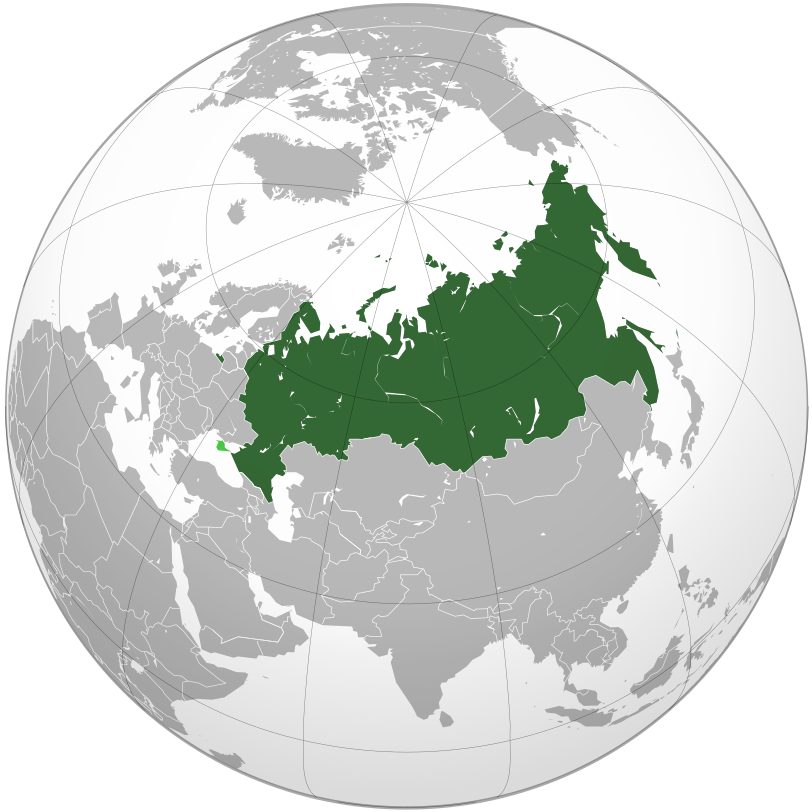
Russian Federation claimed territory. Disputed territory in light green.

The International Institute for Strategic Studies (IISS) has published a short look at Russia’s new maritime doctrine.

There are couple of things that caught my attention in the critique.

  • The Arctic, now comes first, replacing the Atlantic, and
  • No mention of China as a significant ally, while there is a reference to  partnerships and cooperation with India, Iran, Saudi Arabia and others.

The doctrine does not overtly acknowledge a diminished role for Russia on the world stage, but these actions may reflect that realization.

The Arctic: 

“In terms of the regional priorities of Russian naval activities, there is a reordering compared to 2015, with the Atlantic dropping from first to third on the list. The first priority is now the Arctic, with the promise of strengthened capabilities for the Northern and Pacific fleets in response to threats in the region.”

Emphasis on the Atlantic is inherently offensive, because they have to transit long distances through hostile waters to have an impact there. After all Russia has no Atlantic coast line. Access from either the Baltic or Black Sea looks increasing problematic.

Emphasis on the Arctic is primarily defensive. The Arctic is critical to Russia’s economy.  It is their front door. It is their longest border. Its Northern Sea Route is the strongest link between more populous industrialized European Russia and the sparsely populated Russian Far East, and with increasingly open water, the Arctic coast is increasingly exposed.

The Doctrine points out “…the ‘global naval ambitions’ of the United States, NATO activities close to Russia and at sea, an increase in foreign naval presence in the Arctic and efforts to weaken Russia’s control of the Northern Sea Route as the key challenges.” 

The US has made it clear it would like to conduct “Freedom of Navigation” exercises along the Northern Sea Route (which would require Coast Guard icebreakers). Russia has seen her control of the Northern Sea Route as a money maker and they are not eager to see it turned into open sea.

Notably China’s national interest is in opening the route to international traffic.

China: 

“…potential cooperation with China… is strikingly absent from the new doctrine.”

This and upgrades to Russia’s Pacific Fleet, along with improvements to the Northern Sea Route, may reflect a realization that perhaps China will not always be a friend, and ultimately China may turn on them.

A Second Analysis: 

There is a much more detailed analysis of the document here, done by Indian authors. This second analysis seems to confirm greater emphasis on the Arctic and discomfort with the isolation of the Russia’s eastern regions.

“In the 2015 doctrine, the Arctic was at second place after the Atlantic, which has been positioned at third place in the 2022 doctrine. Though the present sequencing may be in no specific order, it may also point to the priority of focus, as the Artic has found detailed mention as indicated earlier. It is evident that Russia recognises the Arctic not only as an area for global economic competition but as an area of military competition as well. The 21 focus areas enunciated for the Arctic region indicate a more positive and perhaps even aggressive approach as they:

—Posit Russia in the lead position in many areas of common regional interest.

—Espouse nuances of control, especially regarding foreign presence and shipping (particularly naval activities).

—Lay emphasis on protection of Russian sovereignty, especially resources.

—Indicate a growing focus on developing the requisite capacity and capability.”

When the Russian Empire fought the Russo-Japanese War (1904-1905), Russia was a great power and appeared to have many advantages, but its logistical links with its Asian holdings were weak. Apparently this is still the case.

Placement of the Pacific at second place is, perhaps, indicative of the Russian approach to the ‘Indo-Pacific’, enunciated in 2012 by the Russian president as the ‘pivot to Asia’, which was aimed at promoting modernisation of the economy. The term ‘pivot to Asia’ is, perhaps, reflective of the belief that “Russia, like China, still strongly opposes the idea of the Indo-Pacific”.
However, Russia will engage nations with which it has long standing strategic relations, like India. Hence, the 2022 doctrine retains the term ‘Asia-Pacific’, and focuses on “overcoming the economic and infrastructural isolation of the Far East from the industrialized regions of the Russian Federation, establishing sustainable sea (river), air and rail links with cities and towns in Siberia and the European part of the Russian Federation, including the development of the Northern Sea Route: This focus apparently seeks to strengthen the ‘pivot to Asia’ strategy, which was termed as a failure, especially due to “Russia’s lack of a comprehensive approach to overcoming the social and economic hardships faced by its least developed regions, namely Siberia and the country’s Far East”.

No Longer a Great Power: 

Despite its ambitions, Russia is not the Soviet Union and is no longer a Great Power. It is a middle weight power with a lot of nuclear weapons, many of which are aging. Potential military power is largely based on economic power, and Russia’s GDP is similar to that of Canada, Italy, Brazil, or South Korea. Even adjusted for “Purchase Power Parity (PPP),” Russia is only number six, behind China, the US, India, Japan, and Germany. In terms of PPP Russia’s GDP is only 14.5% that of China and 17.2% that of the US. Differences are even greater in terms of nominal GDP, 9.2% that of China and 7.2% that of the US.

As systems built during the Soviet era wear out and become increasingly obsolete, Russia’s military power is rapidly fading.

This is not to say that, during a war, Russia would not send at least some submarines into the Atlantic, but they cannot realistically deny the US and NATO control of the North Atlantic. Their SSNs will likely be more more concerned with protecting their SSBNs.

Russian and Soviet Naval thinking has long had an emphasis on coastal defense, that we saw in construction of a large fleet of torpedo and missile boats, corvettes, and light frigates. We still see that in the Karakut and Buyan-M class corvettes, and the retention of large numbers of Soviet era corvettes and light frigates, while they have not laid down a single carrier, cruiser, or destroyer since the fall of the Soviet Union. Even their frigates are smaller than their European counterparts.

Russia, it seems, is desparately trying to maintain its image as a great power, hoping no one, particularly China, will notice, but it simply does not have the means.

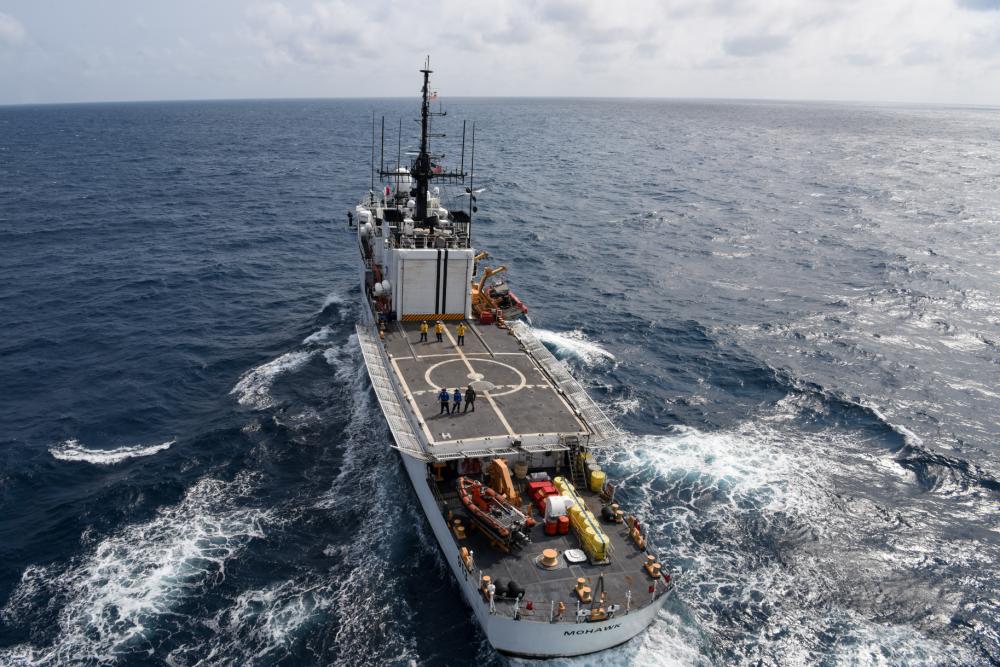
USCGC MOHAWK’s Trans-Atlantic, Europe and West Africa Deployment–Wrap Up

I love the T-shirt, great morale builder. U.S. Coast Guard Petty Officer 3rd Class Andrea Daring, an operations specialist temporarily assigned to the U.S. Coast Guard Cutter Mohawk, cleans the bulk heads during a fresh water wash down of the ship while underway in the Atlantic Ocean, Aug. 10, 2022.  (U.S. Coast Guard photo by Petty Officer 3rd Class Jessica Fontenette) 

Below is a media advisory concerning the expected return of USCGC Mohawk from a 92 day deployment that included escorting two PATFORSWA bound Webber class patrol craft accross the Atlantic and port visits and capacity building in Europe and West Africa.

Maybe we need a new slogan, “Join the Coast Guard and see the World.”

It was an unusually very well documented cruise, at least photographically, check it out.

USCGC Mohawk (WMEC-913), Clarence Sutphin Jr. (WPC-1147), and John Scheuerman (WPC-1146)

USCGC Mohawk sails alongside a Nigerian navy ship in the Atlantic Ocean, Aug. 22, 2022. (Jessica Fontenette/U.S. Coast Guard)

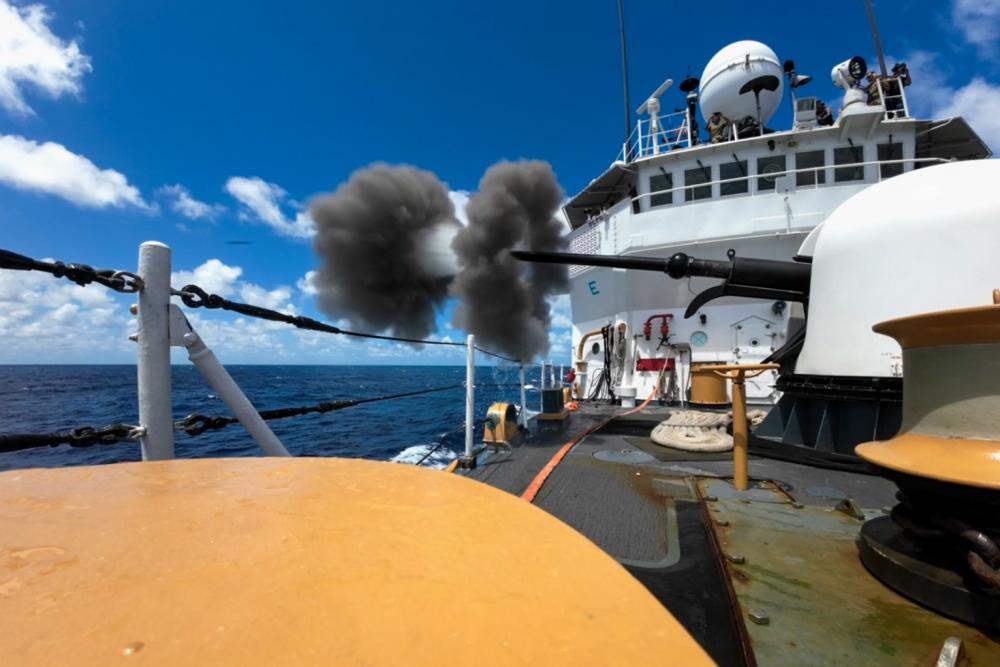
USCGC Mohawk (WMEC 913) conducts a MK-75 gun exercise while underway in the Atlantic Ocean, Sept. 2, 2022.  (U.S. Coast Guard photo by Petty Officer 3rd Class Jessica Fontenette)

Crew members onboard the USCGC Mohawk (WMEC 913) prepare for helicopter hoist training on the flight deck while underway in the Atlantic Ocean, Aug. 27, 2022. (U.S. Coast Guard photo by Petty Officer 3rd Class Jessica Fontenette)


Media Advisory

U.S. Coast Guard Atlantic Are

Coast Guard Cutter Mohawk to return from 92-Day AFRICOM deployment

KEY WEST, Fla. — USCGC Mohawk (WMEC 913) and crew are scheduled to return to their homeport Monday following a 92-day, United States Africa Command deployment.

WHO: Cmdr. Andrew Pate, Mohawk’s commanding officer, and Mohawk crew

WHAT: Mohawk crew returns to Key West homeport after 92-day, AFRICOM deployment

WHERE: Coast Guard Sector Key West, 201 Mustin St., Key West, Florida 33040, Delta 2 Pier

WHEN: 1 p.m. Monday, Sept. 12

Editor’s Note: Media are asked to RSVP by 4 p.m. Sunday to Atlantic Area Public Affairs at 757-452-8336. Media are requested to arrive no later than 12 p.m., Monday, with a driver’s license and proof of insurance in order to be processed through security.

Mohawk’s crew departed Key West, Florida in June and forward-deployed to the U.S. Naval Forces Europe –Africa area of operations, where they were employed by U.S. Sixth Fleet to defend U.S., allied and partner interests.

Mohawk began its deployment as surface action group commander, leading the transatlantic escort of two newly commissioned 154-foot fast response cutters, USCGC Clarence Sutphin Jr. (WPC 1147) and USCGC John Scheuerman (WPC 1146) from Key West, Florida to the U.S. Sixth Fleet area of operations. Clarence Sutphin Jr. and John Scheuerman continued on to their new homeport in Manama, Bahrain, where they will be employed by U.S. Fifth Fleet.

While on deployment, Mohawk made significant advances in combating piracy and illegal, unregulated, and unreported fishing conducting multinational law enforcement operations at sea in the Atlantic basin. Their efforts served to strengthen existing relationships with  African nations, and prioritized opportunities for new partnerships with allies who share common interests in the region. Mohawk’s crew worked closely with eight partner nation navies, sailing nearly 19,000 nautical miles in support of American interests abroad. Leading training exercises at-sea and in port, Mohawk also hosted diplomatic engagements and participated in community relations events during port visits to Côte d’Ivoire, Ghana, Nigeria, Portugal, Senegal, Sierra Leone and The Gambia. Mohawk was the first United States warship to moor in The Gambia since 1994.

Commissioned in March 1991, Mohawk is the 13th and last of the Famous-class Coast Guard cutters. It is named for the Algonquin tribe of Iroquoian Indians who lived in the Mohawk Valley of New York, and is the third cutter to bear the name. Mohawk is homeported in Key West, Florida.

 Photos from Mohawk’s deployment are available here.

“Making Space for Women Aboard Coast Guard Cutters Helps with Retention, Careers” –Seapower

BM3 Hailey LaRue of the U.S. Coast Guard Cutter Wire in Saugerties, New York, in 2021. LaRue was able to serve on the Wire after Senior Chief Petty Officer Ramona Mason worked with service officials to create extra rack space. U.S. COAST GUARD / Daniel Henry

The Navy League’s on-line Magazine, Seapower, reports on Coast Guard efforts to open additional afloat billets to enlisted women.

“Today more women are remaining in our service lon­ger,” Schultz said in his annual State of the Coast Guard speech in 2022. “Today we have 375 more women in the service at the critically important E6/E7 and O-4 mid-grade leadership ranks than we had five years ago in 2017… that’s a 28% increase of women at these mid-ca­reer pay grades, and a trend that outpaces their male counterparts.”

“Littoral Combat Ships Conduct Joint Oceania Maritime Support Initiative” –Seapower

“Independence-variant littoral combat ship USS Oakland (LCS 24) stations behind a fishing vessel while Tactical Law Enforcement Team Pacific Coast Guardsmen conduct an Oceania Maritime Support Initiative (OMSI) vessel compliance boarding, Aug. 19, 2022. Oakland is deployed in support of the Oceania Maritime Support Initiative, a secretary of defense program leveraging Department of Defense assets transiting the region to increase the Coast Guard’s maritime domain awareness, and law enforcement operations in Oceania. (U.S. Navy photo by Mass Communication Specialist 2nd Class Ian Zagrocki)”

The Navy League’s on-line magazine, Seapower reports,

Independence-variant littoral combat ships USS Jackson (LCS 6) and USS Oakland (LCS 24) deployed to the Oceania region with embarked U.S. Coast Guard Pacific Tactical Law Enforcement Team detachments to conduct maritime law enforcement operations in support of U.S. and Pacific Island nations fisheries laws, August 2022, Commander, Littoral Combat Ship Squadron One Public Affairs Office said Sept. 7.

Certainly not the first time Navy combatants have embarked TACLETs, but the LCS do appear to be more appropriate than DDGs and it appears that, at least USS Jackson, is not just doing this while transiting some where else, “Jackson will continue the OMSI mission through September 2022.”


“Coast Guard Polar Security Cutter (Polar Icebreaker) Program: Background and Issues for Congress” –CRS, Updated August 30, 2022

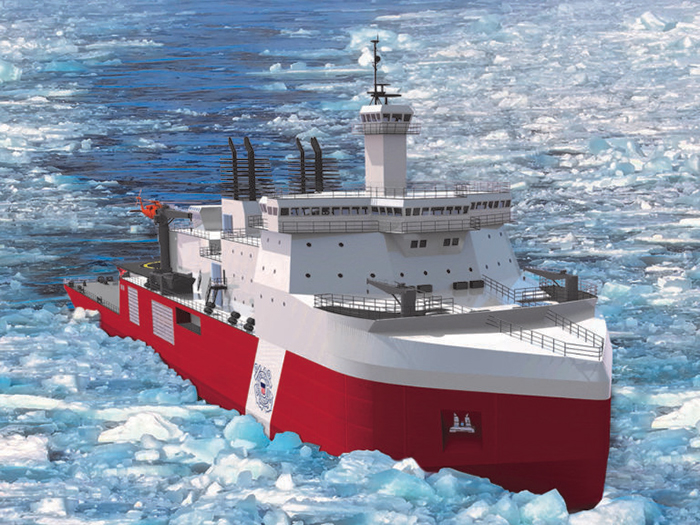
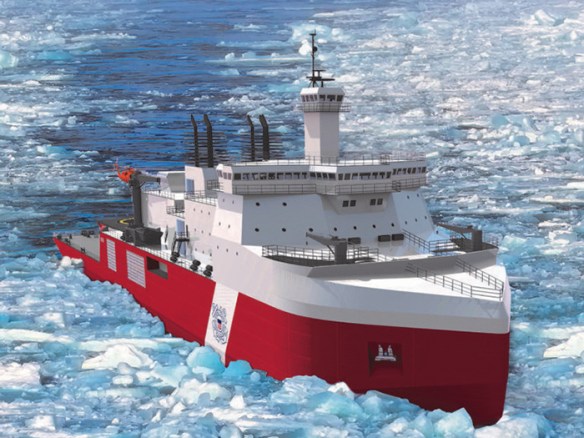
USCG Polar Security Cutter [Image courtesy Halter Marine / Technology Associates, Inc.]

The Congressional Research Service has once again updated their look at the Polar Security Cutter (heavy icebreaker) program. (See the latest version here.) My last look at this evolving document was in regard to the Dec. 7, 2021 revision.

The one-page summary is reproduced below, but first I will point out what appears to have changed since the Dec. 7, 2021 edition.

On December 29, 2021, the Coast Guard exercised a $552.7 million fixed price incentive option to its contract with Halter Marine Inc. for the second PSC. (Summary and p.9)

On February 24, 2022, the Coast Guard announced that the first PSC will be named Polar Sentinel, and that the Coast Guard has candidate names in mind for the second and third…PSCs. (p.5)

The new icebreaker was supposed to have been based on a proven “parent” design. The nominal parent for the chosen design was the Polarstern II, but in fact it was a design that had never been tested. There is a footnote (p.8) that explains that this design, on which the Polar Security Cutter was supposedly based, may be built after all. This may mean that the Polar Security Cutter will become the parent design for its own parent design.

On February 14, 2020, the Alfred Wegener Institute (AWI), Helmholtz Centre for Polar and Marine Research, announced that “the [German] Federal Ministry of Education and Research (BMBF) today cancelled the Europe-wide call for tenders for the procurement of a new polar research vessel, Polarstern II, for legal reasons.” (Alfred Wegener Institute, Helmholtz Centre for Polar and Marine Research, “Call for Fender Procedure for the Construction of a Successor to the Icebreaker Polarstern Has Been Cancelled.,” February 14, 2020.) On June 3, 2022, however, AWI stated that “Now that the federal budget for 2022 was approved by the German Bundestag on 3 June 2022, the construction procurement procedure for Polarstern II can begin. The AWI plans to promptly launch the Europe-wide procurement procedure so that the competitive bidding can start promptly as the first step. The handover of the completed ship is slated for 2027.” (Alfred Wegener Institute, Helmholtz Centre for Polar and Marine Research, “Polarstern II: German Bundestag Greenlights the Construction of New Icebreaker,” June 3, 2022. See also Eurasia Review, “Polarstern II: German Bundestag Green-  Lights Construction Of New Icebreaker,” Eurasia Review, June 4, 2022.; Michael Wenger, “Germany’s ‘Pola[r]stern II’ Becomes Reality,” Polar Journal, June 6, 2022.)

It was noted that the PSC will recieve the 30mm Mk38 Mod4. (p.9)
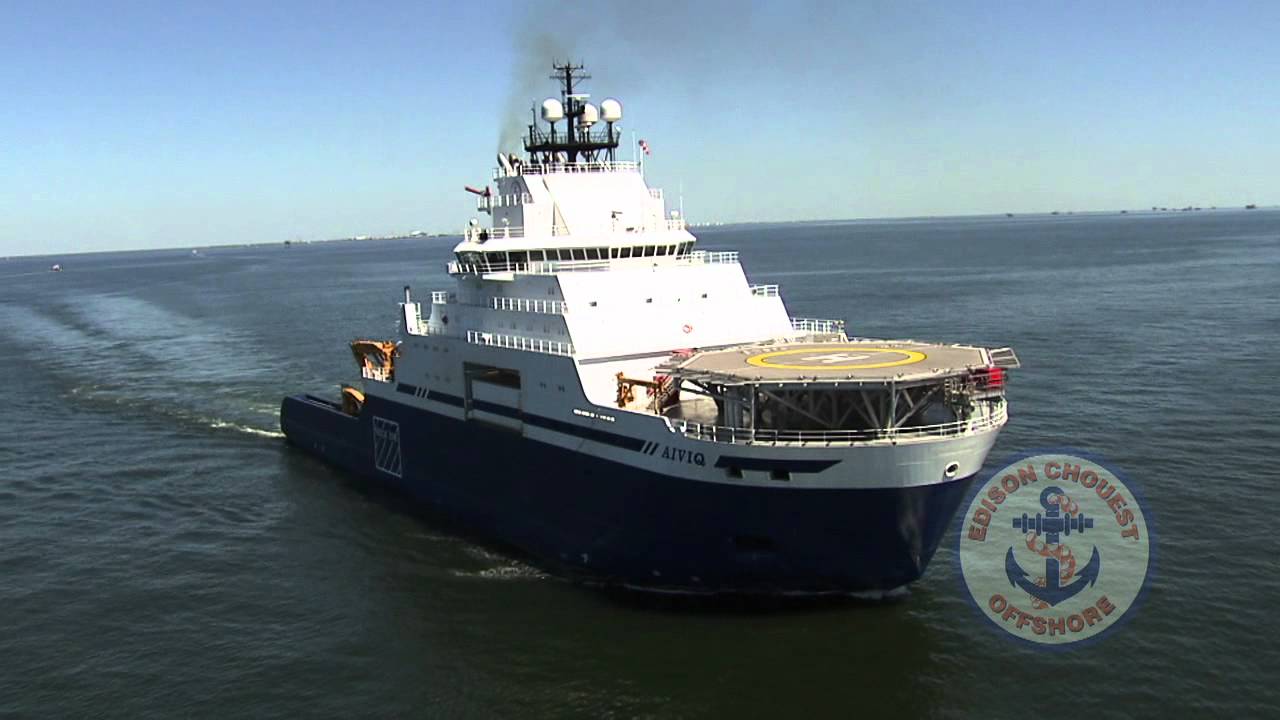
Icebreaking Anchor Handling Vessel Aiviq

Purchase of an existing Icebreaker

“On May 3, 2022, the Coast Guard released a Request for Information (RFI) regarding commercially available polar icebreakers, with responses due by June 10, 2022.” (p.13)

“An April 28, 2022, press report states that the commercial ship that would be “the most likely” candidate to be purchased under the Coast Guard’s proposal is the Aiviq…” (p.14)

“At a May 12, 2022, hearing on the Coast Guard’s proposed FY2023 budget, Coast Guard Commandant Karl Schultz testified that We can get a commercially available breaker fairly quick, bridge that [polar icebreaking] gap from a capacity standpoint. We had—the conversation [about how to bridge the gap] started as a lease conversation [i.e., a conversation about leasing an existing ship]. I—we—we shaped it [i.e., the conversation] to say, well, if we’re going to lease something, we could actually do this much cheaper, onboard it [i.e., purchase the ship rather than lease it], turning it into a Coast Guard ship. So, 125 [million dollars] to procure the vessel, hopefully, that’s what we’re thinking, [and] 25 million [addition dollars] for—for crewing. There’s probably a bill—125, 250 million [additional million dollars] to really outfit it over some outyear budget cycles [i.e., further modify and/or equip the ship over a period of some additional years]. That would be [i.e., doing that would produce] a medium icebreaker [that would be] in the Coast Guard inventory. There’s one domestically available ship that’s only 10 years old with very little use on it. We could—we could use that ship to shape our thinking about what the Arctic security requirements could look like.” (p.14/15)

Delayed Delivery (Original Expected Delivery was March 2024):

Another potential issue for Congress concerns the delay in the delivery date of the first PSC. The Coast Guard had earlier said the ship would be delivered in the first half of 2024. As noted earlier, the Coast Guard now expects it to be delivered in the spring of 2025.

Status of FY2023 Budget: 

This is the current state of the FY2023 budget according to the CRS report:

  • Polar Security Cutter (PSC)            Request $167.2M; HAC 257.2; SAC 257.2
  • Commercially Available Icebreaker Request $125.0M; HAC 125.0; SAC 125.0
  • Great Lakes Icebreaker                  Request 0;              HAC 0;        SAC 0

HAC=House Appropriations Committee/SAC=Senate Appropriations Committee

The “increase of $90,000,000 above the request for the remaining cost of long lead
time materials and the start of construction of a third PSC.” (Support from both HAC and SAC)

(Note, there was $350M included in the FY2022 budget for a Great Lakes Icebreaker.)

Regarding the procurement of a commercially available icebreaker, the House Appropriations committee wants the Coast Guard to also consider icebreakers that were not made in the US. (Note this has not yet made it into law.)

“The Committee notes that both 14 U.S.C. 1151 and 10 U.S.C. 8679 include waiver provisions for vessels not constructed in the United States. In order to conduct a full and open competition, the Coast Guard shall expand its source selection criteria to include commercially available polar icebreaking vessels that may require such a waiver. The Coast Guard is directed to brief the Committee not later than 30 days after the date of enactment of this Act on an updated procurement plan.


Summary

The Coast Guard Polar Security Cutter (PSC) program is a program to acquire three  new PSCs (i.e., heavy polar icebreakers), to be followed years from now by the acquisition of up to three new Arctic Security Cutters (ASCs) (i.e., medium polar icebreakers). The procurement of the first two PSCs is fully funded; the Coast Guard says the first PSC is to be delivered to the Coast Guard in the spring of 2025.

The Coast Guard’s proposed FY2023 budget requests $167.2 million in continued procurement funding for the PSC program, which would be used for, among other things, program management and production activities associated with the PSC program’s Detail Design and Construction (DD&C) contract, long leadtime materials (LLTM) for the third PSC, and government-furnished equipment (GFE), logistics, and cyber-security planning costs.

The Coast Guard’s proposed FY2023 budget also requests $125.0 million in procurement funding for the purchase of an existing commercially available polar icebreaker that would be used to augment the Coast Guard’s polar icebreaking capacity until the new PSCs enter service. Under the Coast Guard’s proposal, the Coast Guard would conduct a full and open competition for the purchase, the commercially available icebreaker that the Coast Guard selects for acquisition would be modified for Coast Guard operations following its acquisition, and the ship would enter service 18 to 24 months after being acquired.

The Navy and Coast Guard in 2020 estimated the total procurement costs of the three PSCs in then-year dollars as $1,038 million (i.e., about $1.0 billion) for the first ship, $794 million for the second ship, and $841 million for the third ship, for a combined estimated cost of $2,673 million (i.e., about $2.7 billion). Within those figures, the shipbuilder’s portion of the total procurement cost is $746 million for the first ship, $544 million for the second ship, and $535 million for the third ship, for a combined estimated shipbuilder’s cost of $1,825 million (i.e., about $1.8 billion).

On April 23, 2019, the Coast Guard-Navy Integrated Program Office for the PSC  program awarded a $745.9 million fixed-price, incentive-firm contract for the detail  design and construction (DD&C) of the first PSC to Halter Marine Inc. (formerly VT  Halter Marine) of Pascagoula, MS, a shipyard owned by Singapore Technologies (ST)  Engineering. Halter Marine was the leader of one of three industry teams that competed for the DD&C contract. On December 29, 2021, the Coast Guard exercised a $552.7 million fixed price incentive option to its contract with Halter Marine Inc. for the second PSC.

The DD&C contract includes options for building the second and third PSCs. If both of these options are exercised, the total value of the contract would increase to $1,942.8 million (i.e., about $1.9 billion). The figures of $745.9 million and $1,942.8 million cover only the shipbuilder’s portion of the PSCs’ total procurement cost; they do not include the cost of government-furnished equipment (or GFE, meaning equipment for the ships that the government purchases and then provides to the shipbuilder for incorporation into the ship), post-delivery costs, costs for Navy-specific equipment, or government program-management costs.

The operational U.S. polar icebreaking fleet currently consists of one heavy polar icebreaker, Polar Star, and one medium polar icebreaker, Healy. In addition to Polar Star, the Coast Guard has a second heavy polar icebreaker, Polar Sea. Polar Sea, however, suffered an engine casualty in June 2010 and has been nonoperational since then. Polar Star and Polar Sea entered service in 1976 and 1978, respectively, and are now well beyond their originally intended 30-year service lives. The Coast Guard plans to extend the service life of Polar Star until the delivery of at least the second PSC. The Coast Guard is using Polar Sea as a source of spare parts for keeping Polar Star operational.

“First Three SMDM Fixed-Wing UAS Delivered To The French Navy” –Naval News

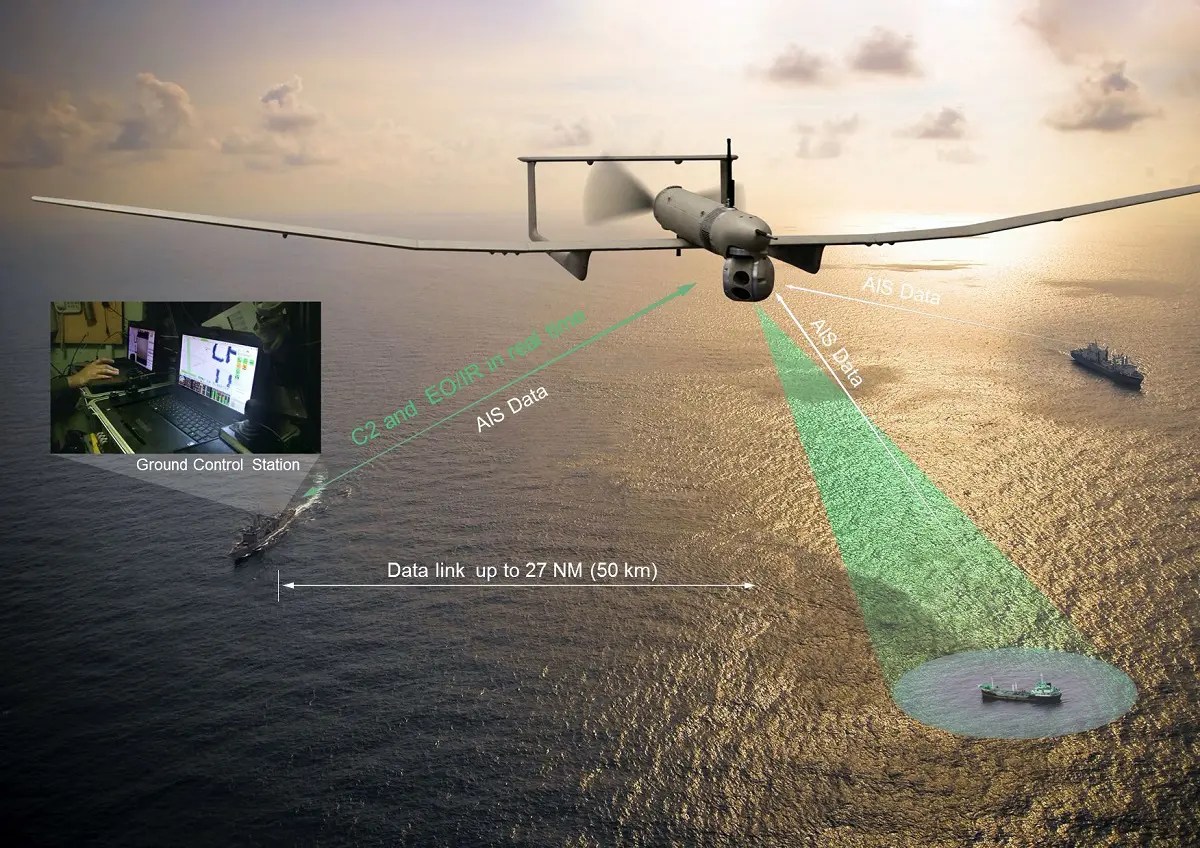
“The Aliaca maritime UAS is a high endurance versatile system allowing up to 3 hours missions over a 50 km (27 Nm) range, perfectly adapted to maritime missions with high gyro stabilized EO/IR payload performances and qualified to operate in severe environmental conditions. Airbus Defence and Space/ Survey COPTER image.”

Naval News reports first deliveries under the French Navy’s “Système de Mini Drones aériens embarqués pour la Marine” (On-board Mini Aerial Drone System for the Navy), or SMDM program intended to provide small, fixed wing, unmanned aircraft to support their Offshore Patrol Vessels. 

The DGA ordered 11 SMDMs at the end of 2020 to the SME Survey Copter, a subsidiary of Airbus Group, for an amount of 19.7 million euros, including procurement of systems and support services. Deliveries will be staggered until 2023…An SMDM is composed of two Aliaca UAVs from Survey Copter. The Aliaca is set to be deployed aboard the future offshore patrol vessels of the French Navy (both the POM and future Patrouilleur Oceanique) and surveillance frigates. Integration on the Mistral-class LHD is also considered.

These electric powered UAVs will fill essentially the same role as the Scan Eagles being used on the Bertholf class National Security Cutters (NSC). They are very nearly the same size. At first glance, at least, Scan Eagle appears more capable in every way.

Electric powered UAS are clean, quiet, and usually extremely reliable. The vessels that will be operating these UAS are all smaller than the 4,600 ton NSCs, the 1,300 ton POMs very much smaller.

It does sound like these will be Navy owned and operated, rather than operated by contractors, like the Coast Guard’s Scan Eagles.

Photos below were found in this French language report: “Marine nationale : une première capacité opérationnelle du SMDM espérée cet été”

Campagne d’essais en 2014 sur un PHM (© : MARINE NATIONALE)
© Mer et Marine https://www.meretmarine.com/fr/marine-nationale-une-premiere-capacite-operationnelle-du-smdm-esperee-cet-ete