The Coast Guard’s Air Policing Job Over DC and Armed Overwatch

Back in 2014, I published a post, Random Thoughts on CG Aircraft Missions,
that among other things, talked about the Coast Guard’s air policing/intercept duties over the National Capital, now being done by MH-65s, and use of fixed wing aircraft to provide air borne use of force support for Webber class cutters, which is a capability we currently do not have. 
We may have a unique opportunity to address the problems discussed, using excess USAF assets at little or no cost. In the case of the Air Policing operation it might even reduce operating costs.
To outline the problems, as I see them, I will simply repeat the arguments from the earlier post.
The DC intercept: The problems with the current use of H-65s for intercepting general aviation aircraft that violate the standing airspace restrictions over the capital is that: (1) Many general aviation aircraft have a higher maximum air speed than the helicopter. (2) Even if the target is slower, the relatively slow speed of the helicopter may make achieving an intercept problematic. (3) If the aircraft is in fact hostile, the helicopter has to hand over the task of destroying it to an interceptor aircraft or missile battery introducing the possibilities of delays and misdirection.
Airborne use of force for law enforcement: In the Webber class cutters, the Coast Guard has an asset that can perform many of the missions normally expected of a medium endurance cutter, including drug and migrant interdiction, but they do not enjoy the advantage of organic aviation assets. There is no helicopter to augment their search, to chase down high speed contacts, or to use force to compel them to stop. When boardings are performed, they have neither a second boat nor an armed helicopter to provide over-watch as their boarding team approaches a suspected trafficer.
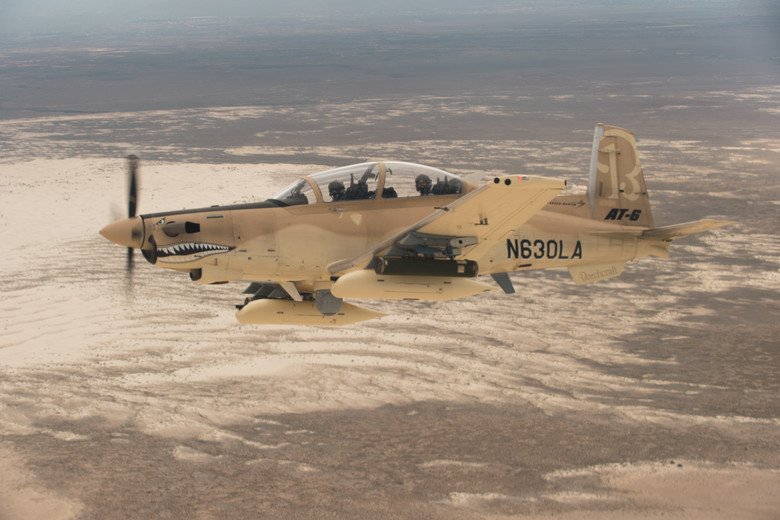
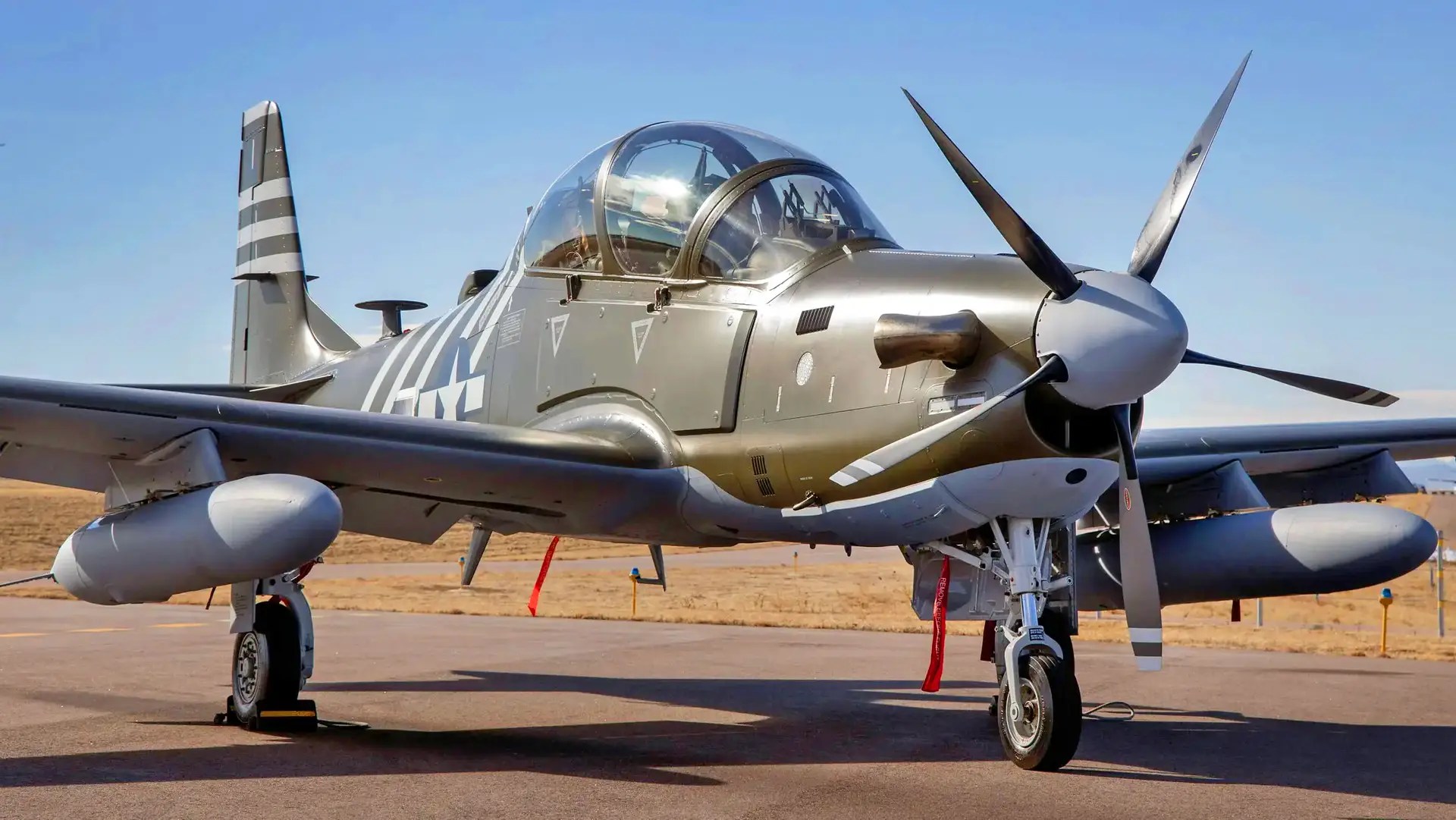
A couple of the aircraft I suggested might be appropriate for these roles were the A-29 Super Tucano and the AT-6 Wolverine.

The second A-29 Super Tucano for Air Force Special Operations Command, which received this one-off heritage scheme honoring the 1st Air Commando Group of World War II. Sierra Nevada Corporation

It just so happens, the Air Force has three A-29s and two AT-6s that are excess, now less than two years old, and they plan to dispose of them.
Compared to our helicopters, these aircraft have greater speed, range, and endurance and are, I believe, less expensive to operate. They are certainly less expensive to operate than our twin engine fixed wing aircraft.
In addition, these aircraft have excellent electro-optics and both air-to-air and air-to-surface capability, should it be necessary.
Replacing the H-65s providing air policing over DC, with the three A-29s, would not only provide a more capable interceptor, one still capable of operating at low air speeds, it would also reduce wear and tear on the H-65 fleet, whose maintenance has become problematic. As Air Force Special Operations Force aircraft, these planes may be better equipped to interface with the Capital Area Air Defenses, including F-16s and Army Surface to Air missile batteries than the MH-65s.

Basing the two AT-6s out of Puerto Rico would allow them to provide armed overwatch to Webber class WPCs in an area of intense activity. They could also be used as search assets given their excellent capabilities. The AT-6s are based on the T-6 Texan II trainer that is used to train all military aviators including Coast Guard. I understand there are now over 1000 T-6s and the two aircraft have 85% parts commonality.

If we chose to arm these, beyond their organic .50 cal. machine guns, we could probably make an arrangement with a nearby DOD air base to arm the aircraft.

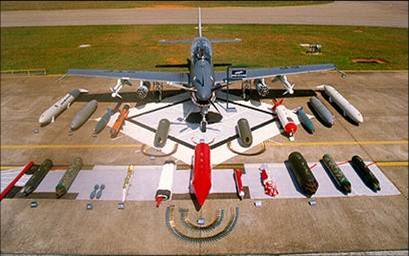
An A-29 Super Tucano with potential external stores. 

“U.S. Coast Guard presents USS Hershel “Woody” Williams crew with the Coast Guard Special Operations Service Ribbon” –LANTAREA/ESBs and the Coast Guard

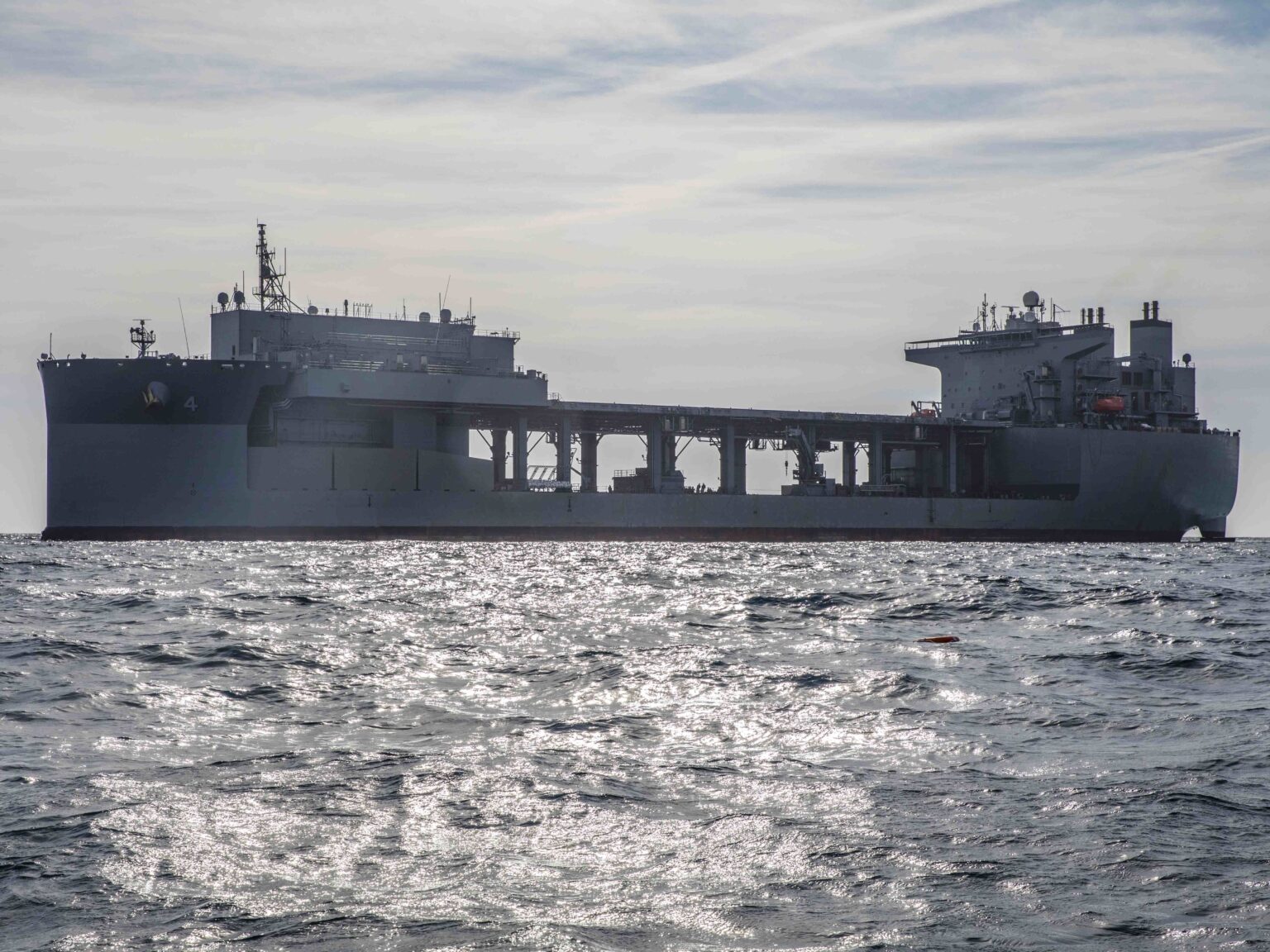
ADRIATIC SEA – (Feb. 19, 2022) The Expeditionary Sea Base USS Hershel “Woody” Williams (ESB 4) sails the Adriatic Sea, Feb. 19, 2022. Hershel “Woody” Williams is on a scheduled deployment in the U.S. Sixth Fleet area of operations in support of U.S. national interests and security in Europe and Africa. (U.S. Navy photo by Mass Communication Specialist 1st Class Fred Gray IV/Released)

Below is a news release from Atlantic Area. This is more evidence of the Coast Guard’s interest in helping the nations of West Aftrica, particularly those around the Gulf of Guinea. The unit used for the mission is a bit unusual. USS Hershel “Woody” Williams (ESB 4) is a Lewis B. Puller-class expeditionary sea base. 

These ships are unusual in that they have small hybrid civilian/regular Navy crews. They are commissioned Navy ships, not MSC. They might be thought of as large mobile warehouses. They have a lot of space and equipment for moving things around. They are doing a lot of work with unmanned systems and mine countermeasures. They are also expected to be useful in disaster response. They have a large flight deck and hangar. You could probably base four Coast Guard MH-60s on one of them. In wartime, they might provide air cover for convoys, much like the escort carriers of WWII (not that the Navy has floated this idea). How they ultimately get used, is still open to imaginative thinking.

US Navy Fleet Organization

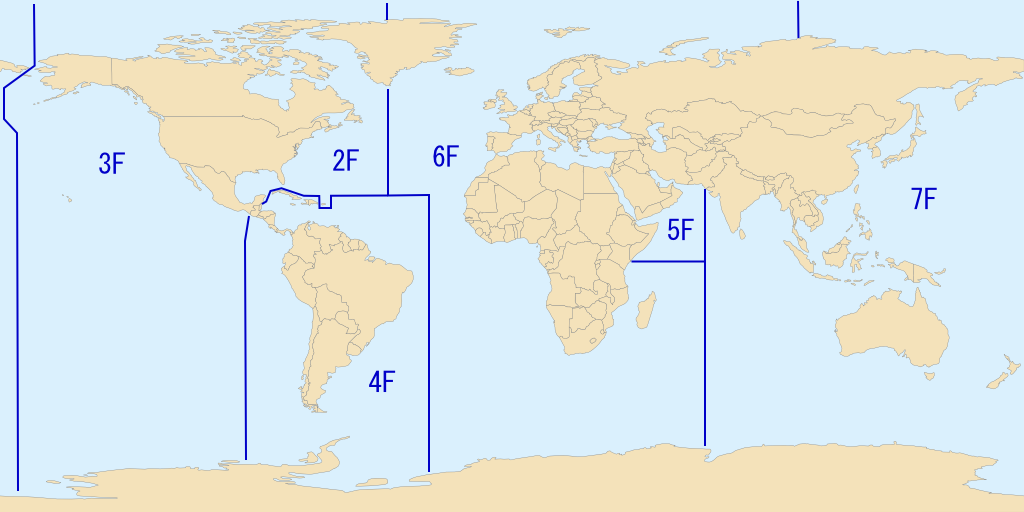
The observed pattern suggests, one ESB will be assigned to each of the six active numbered Fleet Commands with specific geographic responsibilties, with the probable exception of 2nd Fleet (Western North Atlantic Ocean). Currently five Expeditionary Sea Bases (ESB) are planned. Three have been delivered and two are on the way.

  • USS Lewis B. Puller (ESB-3) is assigned to 5th Fleet
  • USS Hershel “Woody” Williams (ESB 4) is assigned to 6th Fleet
  • USS Miguel Keith (ESB-5) is assigned to 7th Fleet

The Coast Guard’s Patrol Forces SW Asia (PATFORSWA) is almost certainly already working with USS Lewis B. Puller (ESB-3), based in Bahrain.

USS Miguel Keith (ESB-5) is based in Saipan, very near the three Webber class FRCs and buoy tender based in Guam. She may be helpful in Coast Guard efforts in the Western Pacific.

The two yet to be delivered ESBs may also be working with the Coast Guard. An ESB assigned to 4th Fleet could assist the Coast Guard’s drug interdiction efforts in the Eastern Pacific and a 3rd Fleet ESB could help IUU and other law enforcement and capacity building efforts in the South Central Pacific. They might serve as mother ships for patrol craft or as bases for UAVs.

News Release

U.S. Coast Guard Atlantic Area

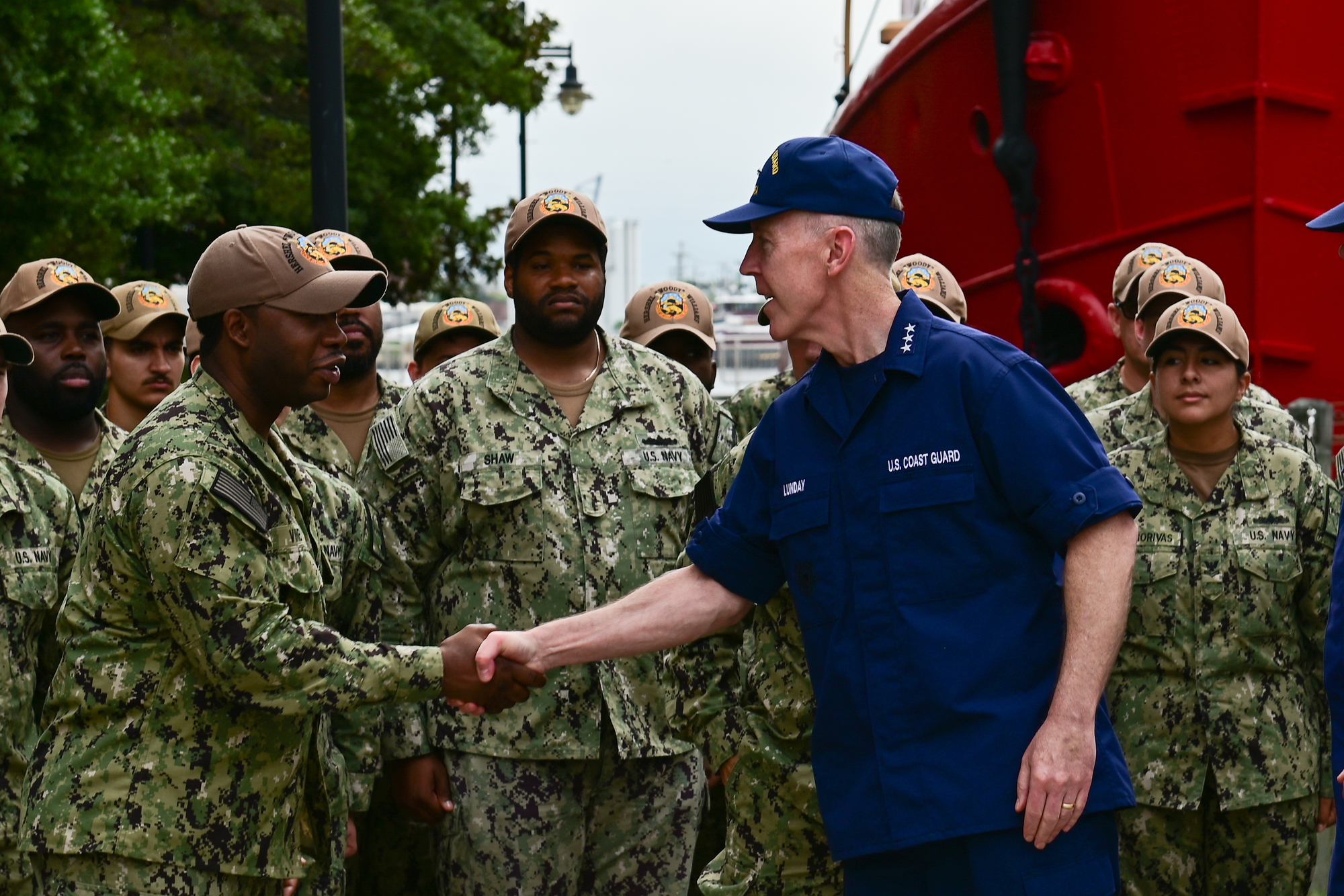
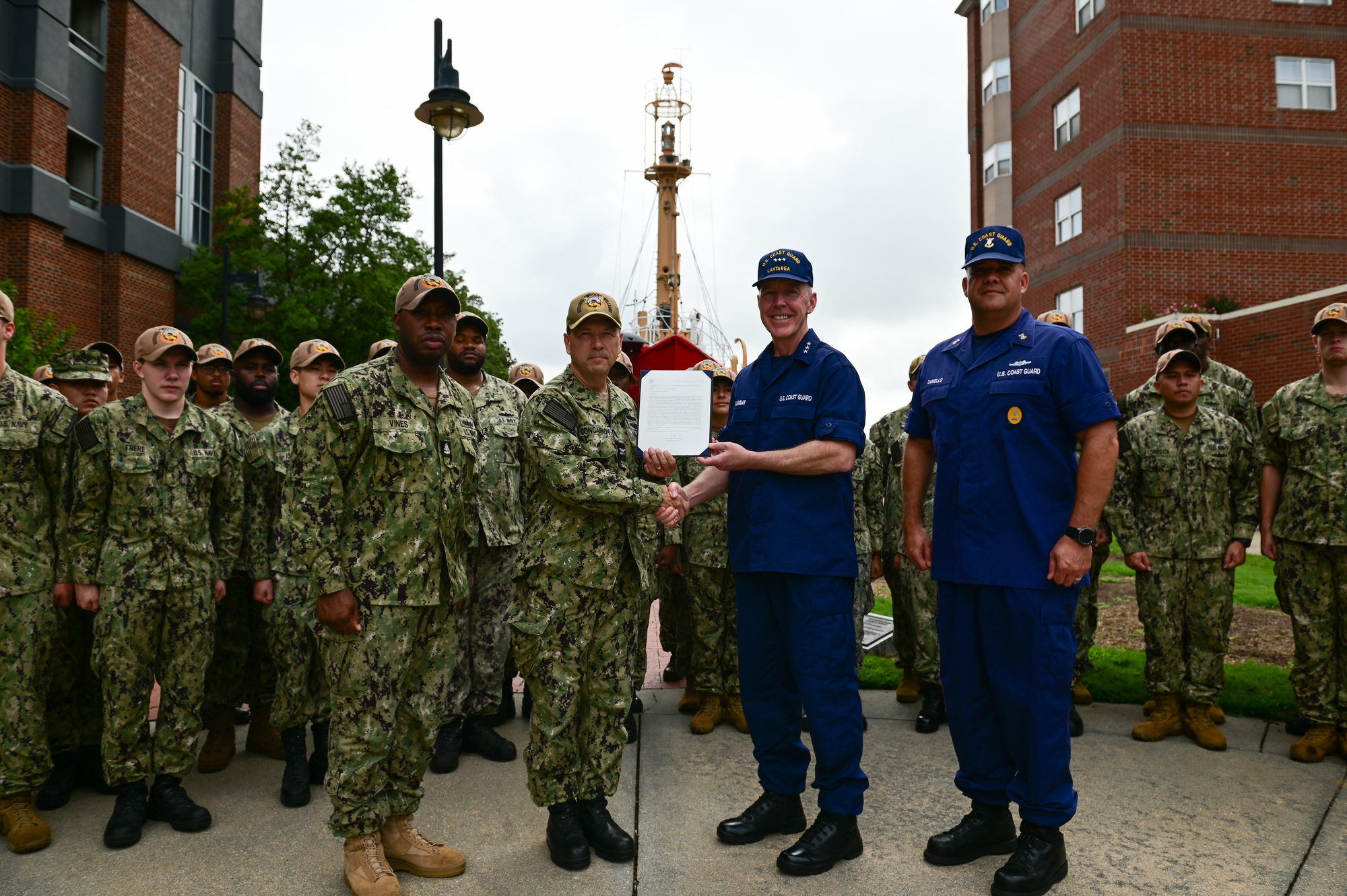
U.S. Coast Guard presents USS Hershel “Woody” Williams crew with the Coast Guard Special Operations Service Ribbon

Vice Adm. Kevin Lunday, commander, U.S. Coast Guard Atlantic Area, meets with the crew of USS Hershel Vice Adm. Kevin Lunday presents the Coast Guard Special Operations Service Ribbon to the crew of USS Hershel

Editors’ Note: To view more or download high-resolution imagery, click on the photos above.

PORTSMOUTH, Va. — Vice Adm. Kevin E. Lunday, commander of U.S. Coast Guard Atlantic Area, presented the Coast Guard Special Operations Service Ribbon to the crew of USS Hershel “Woody” Williams (ESB 4) during a ceremony at the Portsmouth Lightship, Monday, Aug. 22, 2022.

The Coast Guard Special Operations Service Ribbon is awarded to personnel of the U.S. Armed Forces who participated in Coast Guard operations of a special nature, not involving combat.

Capt. Michael Concannon, gold crew commanding officer of Hershel “Woody” Williams, accepted the award on behalf of the crew.

In April, Hershel “Woody” Williams completed a deployment in support of U.S. Naval Forces Africa, conducting a wide range of operations including counter-narcotics and combatting illegal, unreported, and unregulated fishing in the waters off of Africa’s Atlantic coast.

During the deployment, Hershel “Woody” Williams operated with an embarked Coast Guard law enforcement detachment as well as maritime forces from Cabo Verde and Sierra Leone. With the support of the embarked partner forces, U.S. personnel were able to assist with law enforcement operations within each partner’s respective territorial waters.

The joint and combined U.S.-African team conducted a counter-narcotics boarding of a fishing vessel, which resulted in the seizure of approximately 6,000 kilograms of suspected cocaine and transferred seven suspects to Cabo Verde officials.

Additionally, Hershel “Woody” Williams and the embarked Coast Guard law enforcement detachment supported the interdiction of a fishing vessel illegally operating within the exclusive economic zone of Sierra Leone. The vessel and its crew were escorted into port and transferred to Sierra Leonean authorities.

“I’m proud of the superior operations and mission outcomes by the crew of USS Hershel “Woody” Williams,” said Lunday. “This collaboration between the U.S. Coast Guard, U.S. Navy, and our African partners highlights the capabilities of America’s maritime services and our ability to aid partner nations as they seek to build their maritime security and economic prosperity.”

Coast Guard tactical law enforcement teams are made up of deployable law enforcement detachments, which provide specialized law enforcement and maritime security capabilities to enforce U.S. laws across the full spectrum of maritime response situations, as well as maritime security augmentation to designated elements of other U.S. government agencies in support of Coast Guard, national security, and law enforcement operations in the maritime environment.

The U.S. shares a common interest with African partner nations in ensuring security, safety, and freedom of navigation on the waters surrounding the continent, because these waters are critical for Africa’s prosperity and access to global markets.

Deployment of Hershel “Woody” Williams by U.S. Naval Forces Africa to Africa’s Atlantic coast demonstrates a commitment to helping our African partners improve security. The ship is an expeditionary sea base, which is capable of conducting counter-piracy, maritime security, and humanitarian and disaster relief operations, as well as supporting a variety of rotary wing aircraft. Acting as a mobile sea base, Hershel “Woody” Williams is a part of the critical access infrastructure that supports the deployment of forces and supplies to support global missions.

For over 80 years, U.S. Naval Forces Europe-U.S. Naval Forces Africa has forged strategic relationships with allies and partners, leveraging a foundation of shared values to preserve security and stability.

U.S. Coast Guard Atlantic Area, headquartered in Portsmouth, Virginia, oversees all Coast Guard operations east of the Rocky Mountains to the Arabian Gulf, spanning across five Coast Guard districts and 40 states.

For information on how to join the U.S. Coast Guard, visit www.GoCoastGuard.com to learn more about active duty and reserve officer and enlisted opportunities. Information on how to apply to the U.S. Coast Guard Academy can be found at www.uscga.edu.

“Coast Guard Cutter Procurement: Background and Issues for Congress, Updated August 30, 2022” –CRS

The Congressional Research Service has again updated their “Report to Congress on Coast Guard Cutter Procurement”. (This link will always take you to the most recent edition of the report.) My last post on this evolving document was in reference to a July 22, 2022 update. I have reproduced the one page summary in full below.

A decision on Eastern’s protest of the Stage 2 contract to Austal is still pending, with a decision due Oct. 24, 2022.

Since my last update, there have been two significant events. First, the Coast Guard has exercised an option for FRC#65, still leaving a considerable portion of the $130M voted for the FRC program in the FY2022 budget unobligated. Second, the Senate Appropriations Committee has reported.

Fast Response Cutter Program: 

On August 9, 2022, the Coast Guard exercised a contract option with Bollinger Shipyards for $55.5 million of the $130 million for production of one FRC plus associated deliverables; this FRC will be the 65th. (p.16)

FY2023 Budget Status: 

  • NSC: Requested,   60.0; HAC, 147.0;  SAC,   60.0
  • OPC: Requested, 650.0; HAC, 650.0;  SAC, 650.0
  • FRC: Requested,   16.0; HAC, 131.0;  SAC,   16.0

(HAC is House Appropriations Committee. SAC is Senate Appropriations Committee)

The Senate Appropriations Committee did have some notes for the Coast Guard, DHS, and the administration (from page 27):

Fleet Mix Analysis.—The Committee continues to be interested in the Fleet Mix Analysis required in the Joint Explanatory Statement accompanying Public Law 117–103, and appreciates the Coast Guard’s periodic status updates. The Committee reiterates its expectation, as stated in the requirement, that the analysis be truly comprehensive and include all classes of vessels, even those whose mission might not have a direct bearing on the workload of other vessel classes.

Full-Funding Policy.—The Committee again directs an exception to the current acquisition policy that requires the Coast Guard to attain the total acquisition cost for a vessel, including long lead time materials [LLTM], production costs, and post-production costs, before a production contract can be awarded. This policy has the potential to make shipbuilding less efficient, to force delayed obligation of production funds, and to require post-production funds far in advance of when they will be used. The Department should position itself to acquire vessels in the most efficient manner within the guidelines of strict governance measures.

Domestic Content.—To the maximum extent practicable, the Coast Guard shall utilize components that are manufactured in the United States when contracting for new vessels. Such components include: auxiliary equipment, such as pumps for shipboard services; propulsion equipment, including engines, reduction gears, and propellers; shipboard cranes; and spreaders for shipboard cranes….

Funded Projects.—The Committee expects that when it funds specific projects, those projects shall be executed expeditiously and responsibly. Given project cost increases across Coast Guard’s portfolio, the Committee is concerned about recent efforts by the Coast Guard to cancel funded projects in order to finance cost increases elsewhere. The Coast Guard shall be transparent with respect to cost increases, executability concerns, and any other issues that may increase the risk profile of a project, and shall provide the Committee sufficient time to consider the issue and respond in an appropriate manner….

Offshore Patrol Cutter [OPC].—The Committee provides the requested amount of $650,000,000 for the construction of the fourth OPC and LLTM for the fifth OPC. While the Committee supports OPC procurements, the Committee remains concerned about costs for the program and continues the requirement for the Coast Guard to brief the Committee within one week prior to taking any procurement actions impacting estimated costs for the OPC program. (Pages 75-76)

Bottom Line: 

As the FY2023 Budget currently stands, it includes only one additional OPC, #5 plus long lead time items for OPC#6, but no additonal Bertholf class NSCs or Webber class FRCs.


Summary

The Coast Guard’s program of record (POR), which dates to 2004, calls for procuring 8 National Security Cutters (NSCs), 25 Offshore Patrol Cutters (OPCs), and 64 Fast Response Cutters (FRCs) as replacements for 90 aging Coast Guard high-endurance cutters, medium-endurance cutters, and patrol craft. The total of 64 FRCs includes 58 for domestic use and 6 for use by the Coast Guard in the Persian Gulf.

NSCs are the Coast Guard’s largest and most capable general-purpose cutters; they are replacing the Coast Guard’s 12 Hamilton-class high-endurance cutters. NSCs have an estimated average procurement cost of about $670 million per ship. Congress has fully funded the procurement of 11 NSCs—three more than the 8 in the Coast Guard’s POR—including the 10th and 11th in FY2018, which (like the 9th NSC) were not requested by the Coast Guard. In FY2020, Congress provided $100.5 million for procurement of long lead time materials (LLTM) for a 12th NSC, so as to preserve the option of procuring a 12th NSC while the Coast Guard evaluates its future needs. The Coast Guard’s proposed FY2023 budget requests $60.0 million in procurement funding for the NSC program. This request does not include further funding for a 12th NSC; it
does include funding for closing out NSC procurement activities and transitioning to sustainment of in-service NSCs. Nine NSCs have entered service; the ninth was commissioned into service on March 19, 2021. The 10th is scheduled for delivery in 2023.

OPCs are to be less expensive and in some respects less capable than NSCs; they are intended to replace the Coast Guard’s 29 aged medium-endurance cutters. Coast Guard officials describe the OPC program and the Polar Security Cutter (PSC) program as the service’s highest acquisition priorities. (The PSC program is covered in another CRS report.) The Coast Guard’s FY2020 budget submission estimated the total acquisition cost of the 25 ships at $10.270 billion, or an average of about $411 million per ship. The first OPC was funded in FY2018. The first four OPCs are being built by Eastern Shipbuilding Group (ESG) of Panama City, FL. The Coast Guard held a full and open competition for a new contract to build the next 11 OPCs (numbers 5 through 15). On June 30, 2022, the Coast Guard announced that it had awarded a fixed-price incentive (firm target) contract to Austal USA of Mobile, AL, to produce up to 11 offshore patrol cutters (OPCs). The initial award is valued at $208.3 million and supports detail design and procurement of LLTM for the fifth OPC, with options for production of up to 11 OPCs in total. The contract has a potential value of up to $3.33 billion if all options are exercised. The Coast Guard’s proposed FY2023 budget requests $650.0 million in procurement funding for the 5th OPC, LLTM for the 6th, and other program costs.

FRCs are considerably smaller and less expensive than OPCs; they are intended to replace the Coast Guard’s 49 aging Island-class patrol boats. The Coast Guard’s FY2020 budget submission estimated the total acquisition cost of the 58 cutters intended for domestic use at $3.748.1 billion, or an average of about $65 million per cutter. A total of 64 FRCs were funded through FY2021. The Coast Guard’s proposed FY2022 budget did not request funding for the procurement of additional FRCs. In acting on the Coast Guard’s proposed FY2022 budget, Congress added $130 million in FRC procurement funding for the construction of up to two additional FRCs and associated class-wide activities. On August 9, 2022, the Coast Guard exercised a contract option with the FRC builder (Bollinger Shipyards of Lockport, LA) for $55.5 million of the $130 million for production of one FRC plus associated deliverables; this FRC will be the 65th . As of July 22, 2022, 48 FRCs have been commissioned into service. The Coast Guard’s proposed FY2023 budget requests $16.0 million in procurement funding for the FRC program; this request does not include funding for any additional FRCs.

“U.S. Maritime Forces Arrive for UNITAS LXIII hosted by Brazil” –Seapower

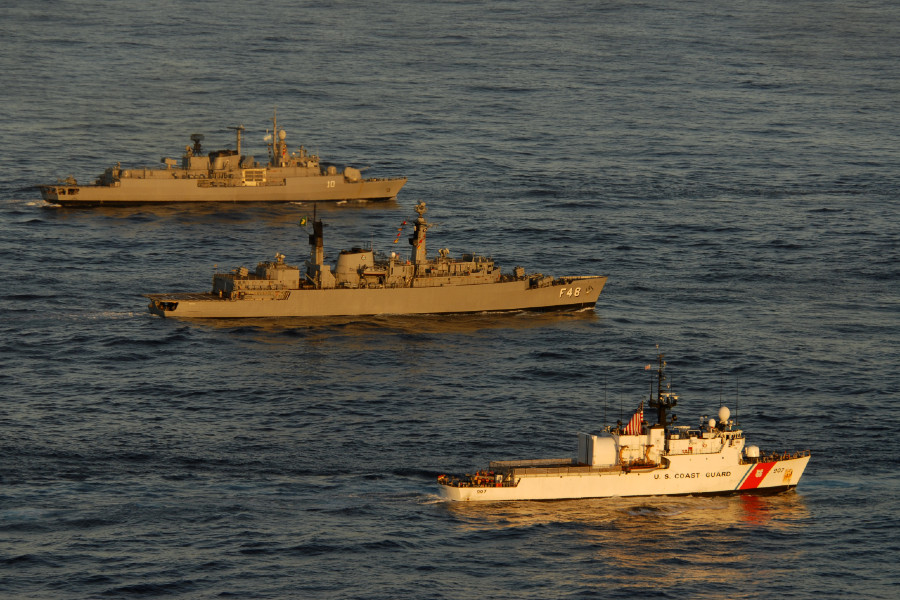
LOOKING BACK: The US Coast Guard cutter USCGC Escanaba (WMEC 907), Brazlian Navy ship BNS Bosisio (F 48) and Argentinian navy ship ARA Almirante Brown (D-10) move into formation for a photo exercise during the Atlantic phase of UNITAS 52 on May 4, 2011. The formation included a total of ten ships from the US, Brazil, Mexico and Argentina. (Photo: US Navy/Mass Communication Specialist 1st Class Steve Smith)

The Navy League’s on line magazine, Seapower, reports on the upcoming 63rd UNITAS exercise,

RIO DE JANEIRO, Brazil — Navy and Marine forces are set to arrive in Rio de Janeiro in support of UNITAS LXIII, the world’s longest-running multinational maritime exercise scheduled to take place Sept. 8-22, the U.S. Naval Forces Southern Command / U.S. 4th Fleet said in a Sept. 1 release.

This year’s exercise is hosted by the Brazilian navy and will included 20 participating nations, 19 ships, one submarine, 21 aircraft, accounting for approximately 5,500 total military personnel that will conduct operations principally off the coast of Rio de Janeiro.

USCG Pacific Area Tactical Law Enforcement Team (PAC AREA TACLET) will be there, but apparently no other Coast Guard units.

Notably, Argentina is not participating.

The Very First US Naval Helicopters and Their Coast Guard Pilot

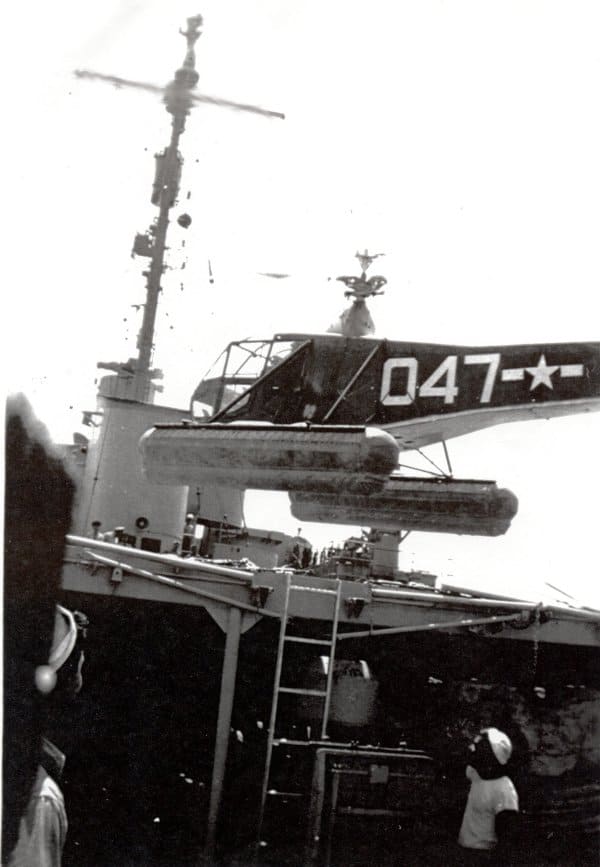
CDR Frank Erickson, USCG, the first US Naval Aviation helicopter pilot.

I am sharing a post written by Coast Guard Aviator, Capt. Sean M. Cross, that appeared on his Facebook Page. Captain Cross’s Facebook page provides daily stories about Coast Guard aviation history. I have a bit of a personal connection, because his dad, former Vice Commandant, VAdm. Terry M. Cross, USCG (ret.), served with me, on my first active duty station, USCGC McCulloch. Even then, it was clear he was a standout.


TODAY IN COAST GUARD AVIATION HISTORY – 03 SEPTEMBER 1943: On 3 September, the U.S. Navy Chief of the Bureau of Aeronautics requested that Coast Guard CDR Frank Erickson, who was assigned to the Sikorsky Factory in Bridgeport, CT, prepare a weekly report for the Bureau outlining the progress made on various model helicopters, estimates of completion, trial and delivery dates; and in addition, such other technical information determined from time to time which had or may have a bearing on present or future operations of this type aircraft.
[Some excerpts from “1943: Coast Guard Assigned the Sea-going Development of the Helicopter” on the Coast Guard Aviation History website] This arrangement came about because U.S. Navy CDR Charles Booth, the naval aviator in the initial helicopter training class at Sikorsky, was involved in moving the Navy’s flight test facility from NAS Anacostia to the Naval Test Center at Patuxent River, Maryland and as a result had not followed through on his qualification. Erickson thus remained the only naval aviator qualified in the helicopter. Hence, in the summer of 1943 Erickson had taken charge of the Navy’s helicopter development program.
Erickson submitted his first report on 18 September. It noted that the YR-4s for the joint evaluation program were on schedule. The two British helicopters had been completed but had not yet been delivered because of rotor problems. He further stated the problems were being addressed. On 25 September a YR-4A was released to the British. On October 16, 1943 – the U.S. Navy accepted its first helicopter, a Sikorsky YR-4B, Navy designation XHNS-1, BuNo 46445, at Bridgeport, Connecticut. However, and this is rich, Coast Guard LCDR Frank Erickson, CGA ’31 flew the one-hour acceptance test flight because the Navy had no helicopter pilots. I will admit – they were pretty busy fighting WWII and winning.
Regardless, the Navy celebrates 16 October as the Birthday of Navy Helicopter Aviation^^^. CDR Charles T. Booth, USN, went to Bridgeport to qualify as a helicopter pilot and to fly the XHNS-1 to the Naval Air Test Center (NATC), NAS Patuxent River, MD. CDR Booth was the first U.S. Navy Officer to become qualified to fly helicopters.
With the acceptance of two additional helicopters at the end of October 1943, the Sikorsky facilities became very crowded. Erickson sought to transfer all operation to Coast Guard Air Station Brooklyn at Floyd Bennett Field. The Chief of Naval Operations approved and designated the Coast Guard Air Station Brooklyn as the Helicopter Training and Development Base. On 20 November, LCDR John Miller, USN and LTJG Stewart Graham, USCG completed flight training. Graham received Coast Guard Helicopter Pilot Designation Number Two.
[NOTE: the Coast Guard celebrates this anniversary on 15 June 1943 when LCDR Erickson was designated Coast Guard Helicopter Pilot #1 at the Sikorsky Aircraft plant]

“Homeland Security Task Force Southeast partners increase illegal migration enforcement patrols in Florida Straits, Caribbean” –D7

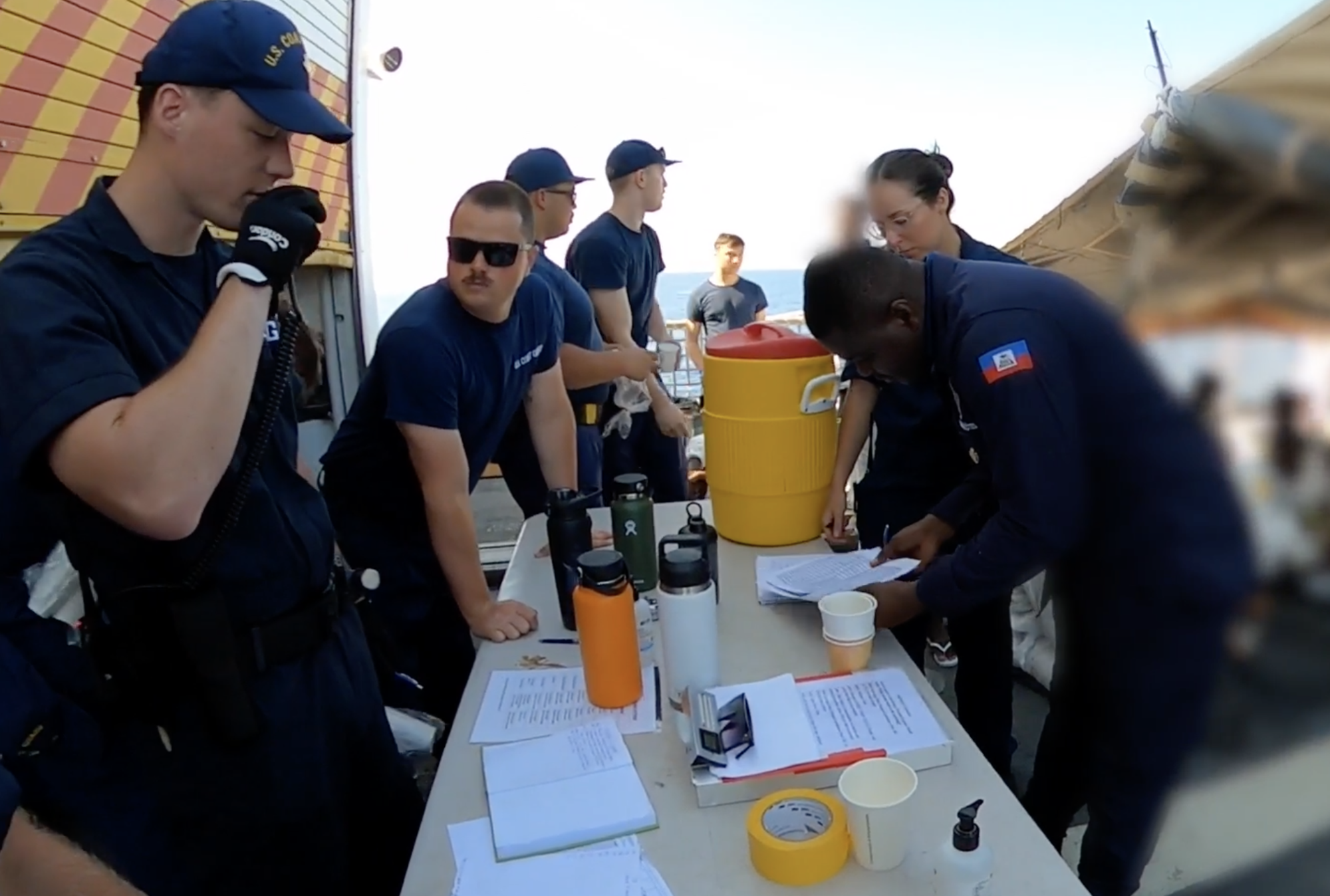
An overloaded migrant vessel sails next to the U.S. Coast Guard Cutter Confidence off the northwest coast of Haiti on Thursday, May 20, 2022. The Coast Guard said the boat collided with the bow of the cutter. U.S. Coast Guard

Below is a District Seven (HQ Miami) news release.

There has been a significant increase in illegal maritime immigration attempts. Figures below were culled from previous press releases:

Since Oct, 1, 2021, Coast Guard crews have interdicted 7,173 Haitian migrants compared to:

  • 1,527 Haitian Migrants in Fiscal Year 2021
  • 418 Haitian Migrants in Fiscal Year 2020
  • 932 Haitian Migrants in Fiscal Year 2019
  • 609 Haitian Migrants in Fiscal Year 2018
  • 419 Haitian Migrants in Fiscal Year 2017

Since Oct. 1, 2021, Coast Guard crews interdicted 5,006 Cubans compared to: 

  • 838 Cuban Migrants in Fiscal Year 2021
  • 49 Cuban Migrants in Fiscal Year 2020
  • 313 Cuban Migrants in Fiscal Year 2019
  • 259 Cuban Migrants in Fiscal Year 2018
  • 1,468 Cuban Migrants in Fiscal Year 2017
  • 5,396 Cuban Migrants in Fiscal Year 2016

Since Oct. 1, 2021 through June 30, 2022, the Coast Guard has carried out 72 illegal voyage interdictions in the Mona Passage and waters near Puerto Rico.  Interdicted during this period, are 1,919 non-U.S. citizens including 1,414 Dominicans, 404 Haitians, 01 Cuban, 1 Ecuadorian, 52 Venezuelan, 12 Uzbek, and 35 of unknown nationalities.

News Release

U.S. Coast Guard 7th District Southeast

Homeland Security Task Force Southeast partners increase illegal migration enforcement patrols in Florida Straits, Caribbean

Coast Guard Cutter Campbell stops unsafe, overloaded Haitian sailing vessels Coast Guard shows safety of life at sea interdiction process

Editor’s Note: Click on still images above to view high-resolution versions of migrant interdiction videos.

MIAMI — Homeland Security Task Force – Southeast enhanced its operational posture and readiness to address a recent increase in irregular maritime migration originating from the Bahamas and Cuba through the Florida Straits, from Haiti through the Windward Pass, and from the Dominican Republic to Puerto Rico through the Mona Pass.

Task Force partners are increasing patrols and enforcement by land, air and sea, day and night.

HSTF-SE is a Department of Homeland Security-led, standing interagency task force responsible for deterring, preventing, and responding to illegal maritime migration under Operation Vigilant Sentry. The primary objectives of the Task Force are to prevent loss of life at sea and to deter and dissuade maritime migration using DHS forces, reinforced by other federal, state, and local assets and capabilities.

“Illegal maritime voyages in the Caribbean are always dangerous and very often deadly,” said Rear Adm. Brendan C. McPherson, Commander, Seventh Coast Guard District and Director, HSTF-SE. “Smugglers routinely exploit vulnerable migrants for profit while putting their lives at risk aboard overloaded and unseaworthy vessels. These dangerous voyages must not be attempted. Safe, legal, and orderly migration saves lives.”

OVS is HSTF-SE’s comprehensive, integrated, national operational plan for a rapid, effective, and unified response of federal, state, and local capabilities in response to maritime migration in the Caribbean. OVS describes the basic organization and structure by which the Task Force will deploy resources and coordinate multi-agency operations to address illegal maritime migration patterns in the Southeast region of North America. The plan allows for the task force to adjust resources and posture as necessary based upon illegal maritime migration trends.

“The U.S. Border Patrol Miami Sector is committed to working alongside our federal, state, and local law enforcement partners in a whole-of-government effort to prepare for and address any potential increases in irregular maritime migration or border security threats in Florida,” said Walter N. Slosar, Chief Patrol Agent for Border Patrol Miami Sector and deputy director, HSTF-SE.

The Coast Guard and federal partners maintain a continual presence with land, air and sea assets in the Florida Straits and in the Caribbean Sea, as part of a multi-layered approach to interdict migrants attempting to enter the U.S. Those without a legal basis in the United States will be removed.

In 2003, the DHS established HSTF-SE for the purpose of responding to maritime migration events in the Caribbean. The Task Force provides the organizational framework to detect maritime migration indicators, monitor maritime migration trends, and conduct joint training, exercises, and planning. Members of the Task Force include the U.S. Coast Guard, the departments of Defense, State, Justice, Health and Human Services, Homeland Security, the Federal Emergency Management Agency, the Transportation Security Administration, U.S. Citizenship and Immigration Services, U.S. Secret Service, and state and local agencies including representatives from FDEM, FDLE, Palm Beach, Broward, Miami-Dade and Monroe counties.

HSTF-SE represents an all-of-government approach. CBP-AMO officers embarked on aircraft and boats work alongside Coast Guard units to detect and interdict illegal maritime migrant ventures. CBP-OFO officers and USBP agents coordinate efforts with maritime branches to detect and interdict migrants who land on Florida beaches and U.S. islands and territories in the Caribbean. HSI special agents specifically target individuals who are involved in human smuggling events and investigate the transnational criminal organizations that profit from these illegal activities. U.S. Public Health Service officers from the ICE Health Service Corps Special Operations Unit work with the Coast Guard and provide medical care to migrants on board Coast Guard vessels and treat any immediate needs.

The Coast Guard is simultaneously a federal law enforcement agency and a branch of the military. Among its 11 statutory missions, the Coast Guard is charged with the enforcement of U.S. immigration law and U.S. government policy to secure our maritime borders and prevent illegal migration attempts by sea. People trying to enter the country illegally by sea will be interdicted and repatriated to their country of origin or the country they departed from, consistent with U.S. law, policies, and international treaty obligations.

Follow Homeland Security Task Force – Southeast on Twitter @HSTF_Southeast.

For more breaking news follow us on Twitter and Facebook.

“Polar Star arrives at homeport after completion of dock work and sea trials during second phase of service life extension project” –CG-9

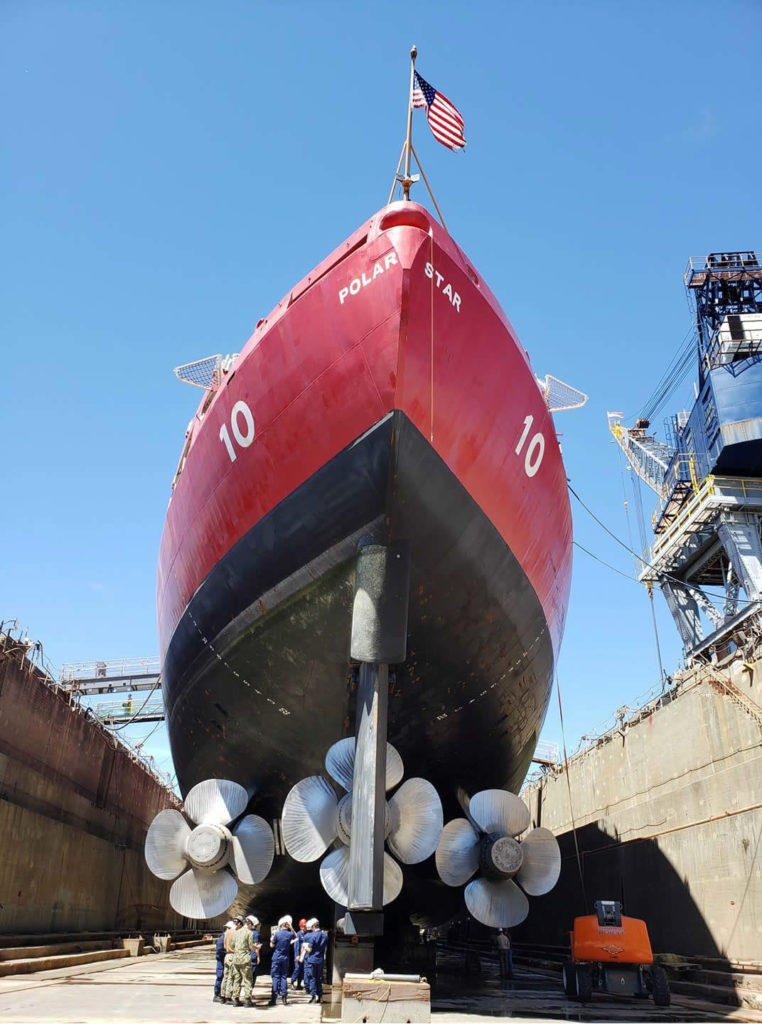
Photo: Official USCG Polar Star Facebook

The Acquisitons Directorate (CG-9) reports that USCGC Polar Star has returned to Seattle, after at least 146 days away from homeport (April 8 to Sept. 1) following the second phase of a five phase Service Life Extension program at Mare Island Dry Dock, Vallejo, California.

Now that is a long time. I know steps have been taken to mitigate the hardship this time away from homeport has caused, but knowing the ship will be spending months every year in Vallejo, wouldn’t it be worthwhile to change the ships homeport? It might also have allowed the ship to make an Arctic Summer cruise.

After all that is going into remaking this ship, I wonder if perhaps we will keep it around, even after the second Polar Security Cutter is delivered?


Polar Star arrives at homeport after completion of dock work and sea trials during second phase of service life extension project

Sept. 1, 2022 —

Polar Star

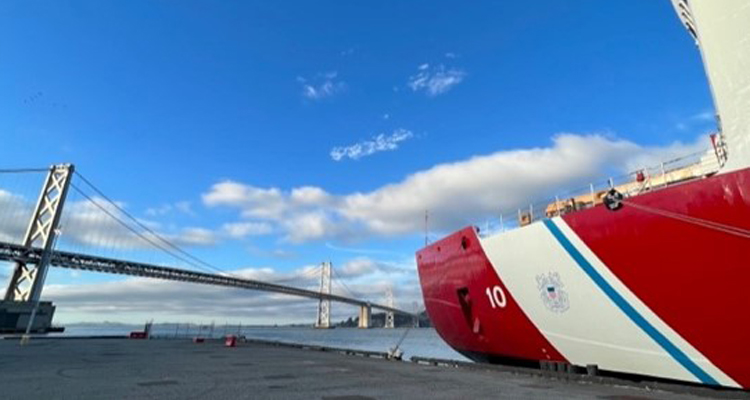
Coast Guard Cutter Polar Star sits moored in San Francisco following completion of dock trials on Aug. 12, 2022, for the second phase of its service life extension project completed by Mare Island Dry Dock. U.S Coast Guard photo.


Coast Guard Cutter Polar Star has completed sea trials for the second phase of its service life extension project (SLEP), as part of the In-Service Vessel Sustainment Program, and returned to its homeport of Seattle. The remaining contracted production work will be completed by Sept. 30 at the homeport, as well as final testing of the newly installed machinery control systems.

Polar Star commenced the second phase of SLEP work items and recurring maintenance on April 8. Service life extension program work is taking place over a five-year, annually phased production schedule that runs through 2025, and each phase is coordinated to support operational commitments, such as the annual Operation Deep Freeze deployment to Antarctica, and to take advantage of planned maintenance availabilities. During the second phase, all of the galley equipment was recapitalized, reflecting the modern upgrades of commissary equipment available on extended voyage seagoing ships.

In addition, Naval Surface Warfare Center Philadelphia Division and Coast Guard Yard installed two machinery control systems. The Coast Guard Machinery Control System (CGMCS) recapitalizes the Main Propulsion Control and Monitoring System that was installed during Polar Star’s reactivation in 2013. The CGMCS increases system reliability and operator familiarity, as this newly installed propulsion control system is standard across much of the service’s surface fleet. The new Propulsion Power Distribution System replaced the analog diesel electric propulsion suite that was installed when Polar Star entered service in 1976. The new system features improved reliability as compared to the legacy system and reduces maintenance requirements that previously took approximately 45 days and 1,600 maintenance-hours to complete.

The Polar Star crew will conduct integrated operational testing of both new systems prior to departing for Operation Deep Freeze in 2023. The cutter regularly completes Operation Deep Freeze deployments to resupply McMurdo Station in Antarctica.

Polar Star is the Coast Guard’s only active heavy icebreaker. The 399-foot cutter supports nine of the 11 Coast Guard statutory missions. The Coast Guard is investing in a new fleet of polar security cutters (PSC) that will sustain the service’s capabilities to meet mission needs in both the Arctic and Antarctic regions. The first PSC is on contract for delivery in 2025.

For more information: In-Service Vessel Sustainment Program page and Polar Security Cutter Program page

Keyword

“Coast Guard releases a request for proposal for long range interceptor III cutter boats” –CG-9

Long Range Interceptor, Length: 35 feet
Maximum Speed: 40 knots
Range: 240 nautical miles
MEDITERRANEAN SEA (April 23, 2021) Crew prepare to depart from the U.S. Coast Guard Legend-class national security cutter Hamilton (WMSL 753)… (U.S. Coast Guard courtesy photo)

The Acquistions Directorate (CG-9) has issued a Request for Proposal (RFP) for a new, third generation of Long Range Interceptors. This is an 11 meter (35 foot) boat, unique to the National Security Cutters. For convinence, I have reproduced the CG-9 announcement below.

If you want to look more closely at the specs, go here and select Attachment 1. A couple of interesting items you will find among the specs are references to removable ballistic protection panels (p.66) and “OVER-THE-HORIZON SATELLITE BLUE FORCE TRACKING (SBFT) SYSTEM” (p.97).


Coast Guard releases a request for proposal for long range interceptor III cutter boats

The Coast Guard released a request for proposal (RFP) today to acquire the third generation of long range interceptor boats (LRI III). The Coast Guard plans to acquire up to 17 LRI IIIs. The RFP is available here.

The acquisition is being conducted as a total small business set-aside under Federal Acquisition Regulation Subpart 19.5.

Proposals are due by Nov. 1.

The LRI cutter boat platform is designed to augment Coast Guard national security cutter mission effectiveness by providing over-the-horizon capability in search and rescue, drug and migrant interdiction, living marine resources, defense readiness, and ports, waterway and coastal security missions.

For more information: Boat Acquisition Program page.

“U.S. Coast Guard Cutter James’ commanding officer temporarily relieved” –LANTAREA

Hate to see this sort of thing. Just passing it along. No comment.

News Release

U.S. Coast Guard Atlantic Area

U.S. Coast Guard Cutter James’ commanding officer temporarily relieved

PORTSMOUTH, Va. — The commanding officer of USCGC James (WMSL 754), Capt. Marc Brandt, was temporarily relieved of duties Friday, Aug. 26, 2022.

Vice Adm. Kevin Lunday, commander of Coast Guard Atlantic Area, effected the relief due to a loss of confidence in Brandt’s ability to command the cutter. The circumstances leading to a loss of confidence involved a mishap aboard the cutter. No personnel were injured.

Lunday appointed Capt. John Driscoll to assume temporary command of the cutter pending the results of an investigation into the mishap. 

Brandt has been temporarily assigned to Coast Guard Atlantic Area.

James is a Legend-class national security cutter (NSC) homeported in Charleston, South Carolina, with a crew of 148 officers and enlisted personnel. NSCs are the Coast Guard’s most technologically-advanced cutters in the fleet.

“U.S. Coast Guard arrives for planned port visit in Cairns, Australia” –Adventures in Paradise with the Webber Class

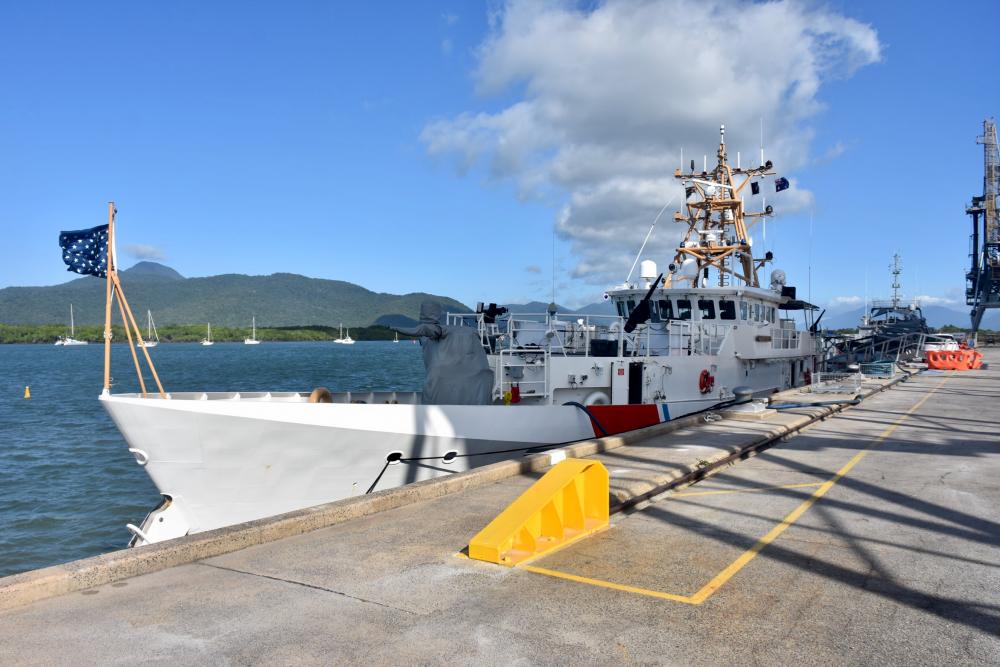
The Sentinel-class fast response cutter USCGC Oliver Henry (WPC 1140) arrive in Cairns for engagements with Australian Defence and Home Affairs partners and local representatives, Aug. 31, 2022. The U.S. Coast Guard is conducting a routine deployment in Oceania as part of Operation Blue Pacific, working alongside Allies, building maritime domain awareness, and sharing best practices with partner nation navies and coast guards. Op Blue Pacific is an overarching multi-mission U.S. Coast Guard endeavor promoting security, safety, sovereignty, and economic prosperity in Oceania while strengthening relationships with our regional partners. (U.S. Coast Guard photo courtesy USCGC Oliver Henry)

The six Hawaii and Guam based Webber class Fast Response Cutters do seem to get around. USCGC Oliver Henry made it to North Eastern Australia, mooring at Her Majesty’s Australian Station Cairns, which is home to some Australian Navy patrol, hydrographic, and survey vessels. Cairns looks like a delightful little city (population in June 2019 was 153,951). Not bad after no one tossed out the welcome mat in the Solomon Islands. The crew is going to have a lot of sea stories.

Cairns is a bit over 1800 nautical miles South of Oliver Henry’s homeport in Guam.

News Release

U.S. Coast Guard Forces Micronesia / Sector Guam

U.S. Coast Guard arrives for planned port visit in Cairns, Australia

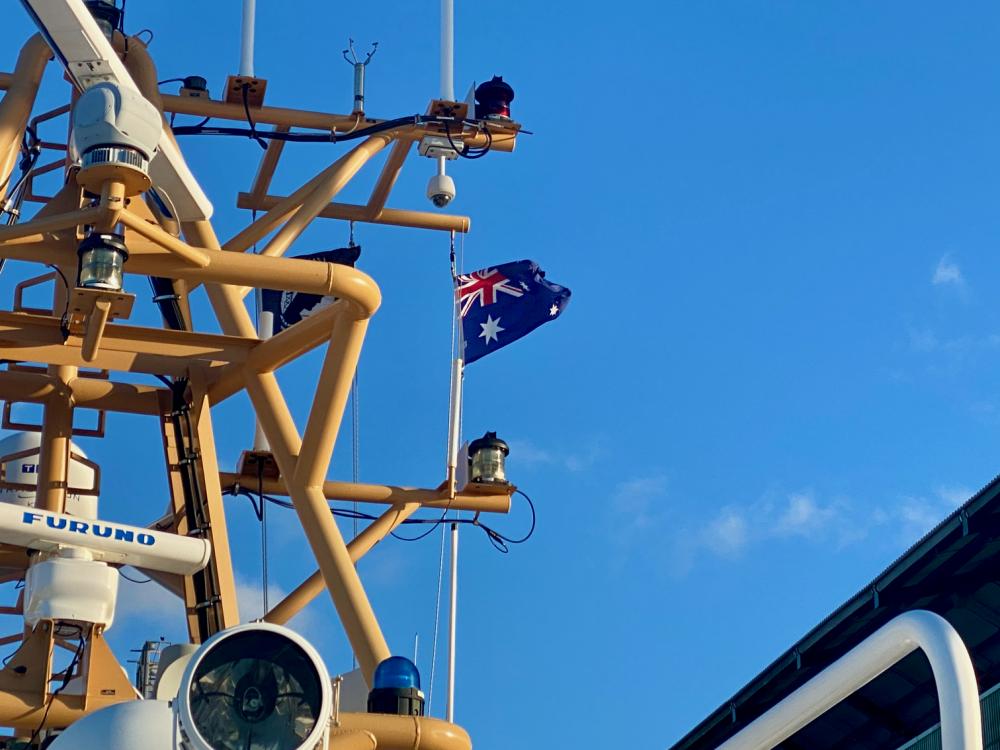
The Oliver Henry is the first U.S. Coast Guard fast response cutter ever to fly the Australian ensign.  The Sentinel-class fast response cutter USCGC Oliver Henry (WPC 1140) command stand for a photo with Cmdr. Alfonso Santos, commander of HMAS Cairns, and Capt. Toby Reid, U.S. Coast Guard representative to the defense attache office of the U.S. Embassy in Australia,
USCGC Oliver Henry meets with Cairns regional Council and mayor The Sentinel-class fast response cutter USCGC Oliver Henry (WPC 1140) arrive in Cairns for engagements with Australian Defence and Home Affairs partners and local representatives, Aug. 31, 2022

Editor’s Note: Click on the images above to view or download more.

CAIRNS, Australia — The Sentinel-class fast response cutter USCGC Oliver Henry (WPC 1140) crew arrived in Cairns for engagements with Australian Defence and Home Affairs partners and local representatives, Aug. 31.

“A cutter arrival to Australia is another first, not only for U.S. Coast Guard Forces Micronesia but also our fast response cutter fleet and is a reminder of our Service’s commitment to our partners and our enduring presence in the region,” said Capt. Nick Simmons, commander U.S. Coast Guard Forces Micronesia/Sector Guam. “The ship driver in me was envious when Lt. Hofschneider reported ‘OH transiting southbound along Inner Great Barrier Reef Passage enroute to Cairns. No issues or concerns.’ Not the kind of thing many Coast Guard members have ever written or said.”

Before arrival in port, Oliver Henry’s crew operated at sea with aerial support from the Australian Border Forces in the Torres Strait. While in port, the two nations will continue to build on the relationship forged at sea. Upon arrival, the crew was greeted by representatives from the Royal Australian Navy HMAS Cairns and the U.S. embassy. They were also guests of the Cairns Regional Council.

“It is an honor for Oliver Henry and her crew to visit and host our Australian friends,” said Lt. Freddy Hofschneider, the Oliver Henry commanding officer. “The U.S. and Australia have been standing side-by-side for more than 100 years. This is more than a partnership, it is mateship. The U.S. Coast Guard looks forward to more opportunities where we can work with the Australian Border Force, Royal Australian Navy, and other Australian partners to advance the rule of law at sea.”

During their stop in Cairns, members of Oliver Henry anticipate engagements with local officials and the community while also experiencing local culture.

The U.S. Coast Guard is conducting a routine deployment in Oceania as part of Operation Blue Pacific, working alongside Allies, building maritime domain awareness, and sharing best practices with partner nation navies and coast guards. Op Blue Pacific is an overarching multi-mission U.S. Coast Guard endeavor promoting security, safety, sovereignty, and economic prosperity in Oceania while strengthening relationships with our regional partners.

The Oliver Henry is the 40th Sentinel-class fast response cutter. The ship was commissioned along with its sister ships, Myrtle Hazard and Frederick Hatch, in Guam in July 2021. In the time since, the crew has participated in several search and rescue cases, completed a counternarcotics patrol off Guam with the Japan Coast Guard, and conducted sovereignty and fisheries patrols in the Forces Micronesia/Sector Guam area of responsibility.

For more U.S. Coast Guard Forces Micronesia/Sector Guam news, visit us on DVIDS or subscribe! You can also visit us on Facebook at @USCGForcesMicronesia.

For more U.S. Coast Guard Forces Micronesia/Sector Guam news, visit us on DVIDS or subscribe! You can also visit us on Facebook at @USCGSectorGuam.