“Coast Guard Cutter Midgett arrives in the Western Pacific” –PacArea

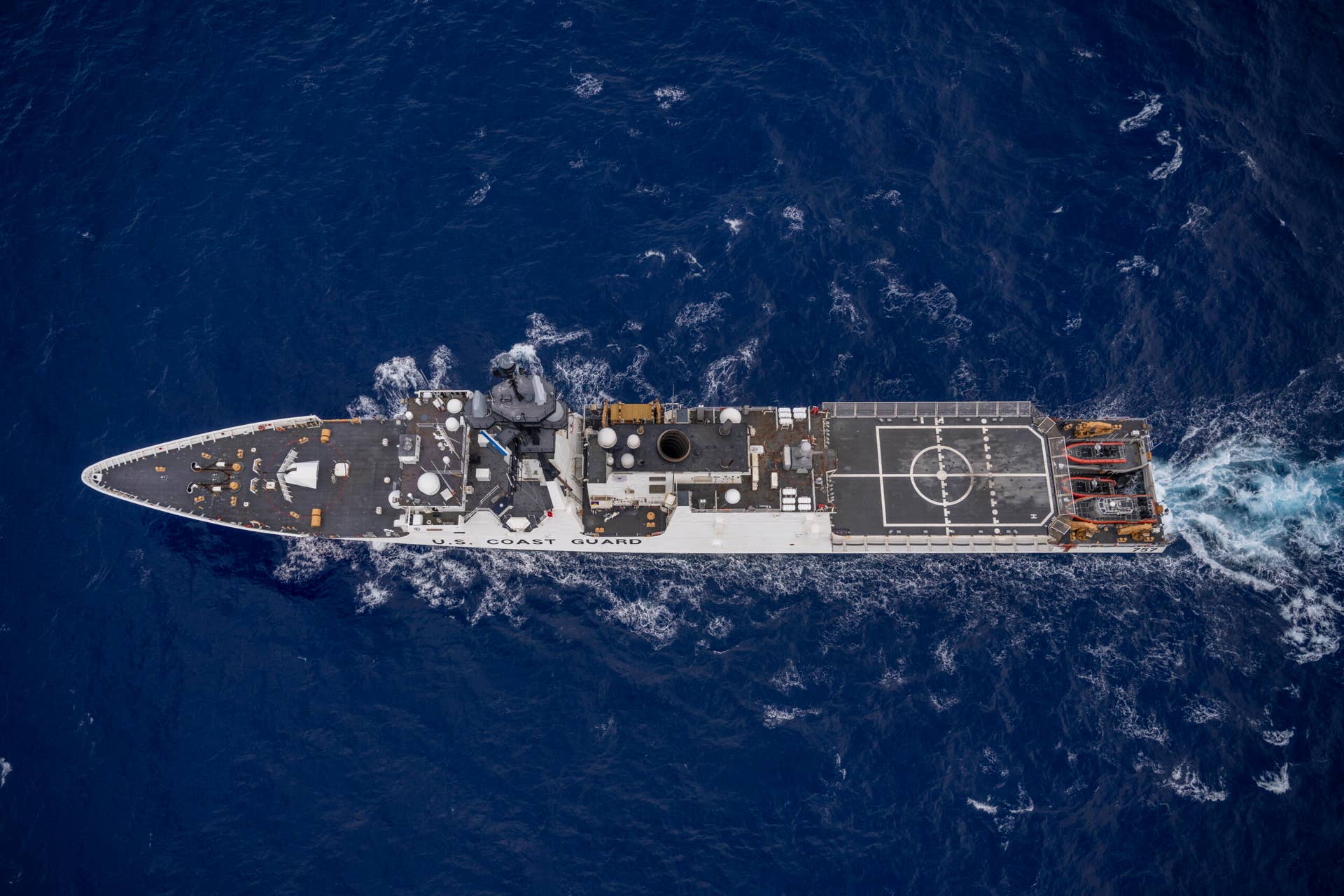
PACIFIC OCEAN (July 30, 2022) U.S. Coast Guard Legend-class cutter USCGC Midgett (WMSL 757) transits the Pacific Ocean during Rim of the Pacific (RIMPAC) 2022. Twenty-six nations, 38 ships, three submarines, more than 170 aircraft and 25,000 personnel are participating in RIMPAC from June 29 to Aug. 4 in and around the Hawaiian Islands and Southern California. The world’s largest international maritime exercise, RIMPAC provides a unique training opportunity while fostering and sustaining cooperative relationships among participants critical to ensuring the safety of sea lanes and security on the world’s oceans. RIMPAC 2022 is the 28th exercise in the series that began in 1971.(U.S. Coast Guard photo by Petty Officer 3rd Class Taylor Bacon)

Only weeks after having completed participation in RIMPAC2022, Honolulu based USCGC Midgett begins a “months-long” deployment in the Western Pacific.

News Release

August 31, 2022
U.S. Coast Guard Pacific Area

Coast Guard Cutter Midgett arrives in the Western Pacific
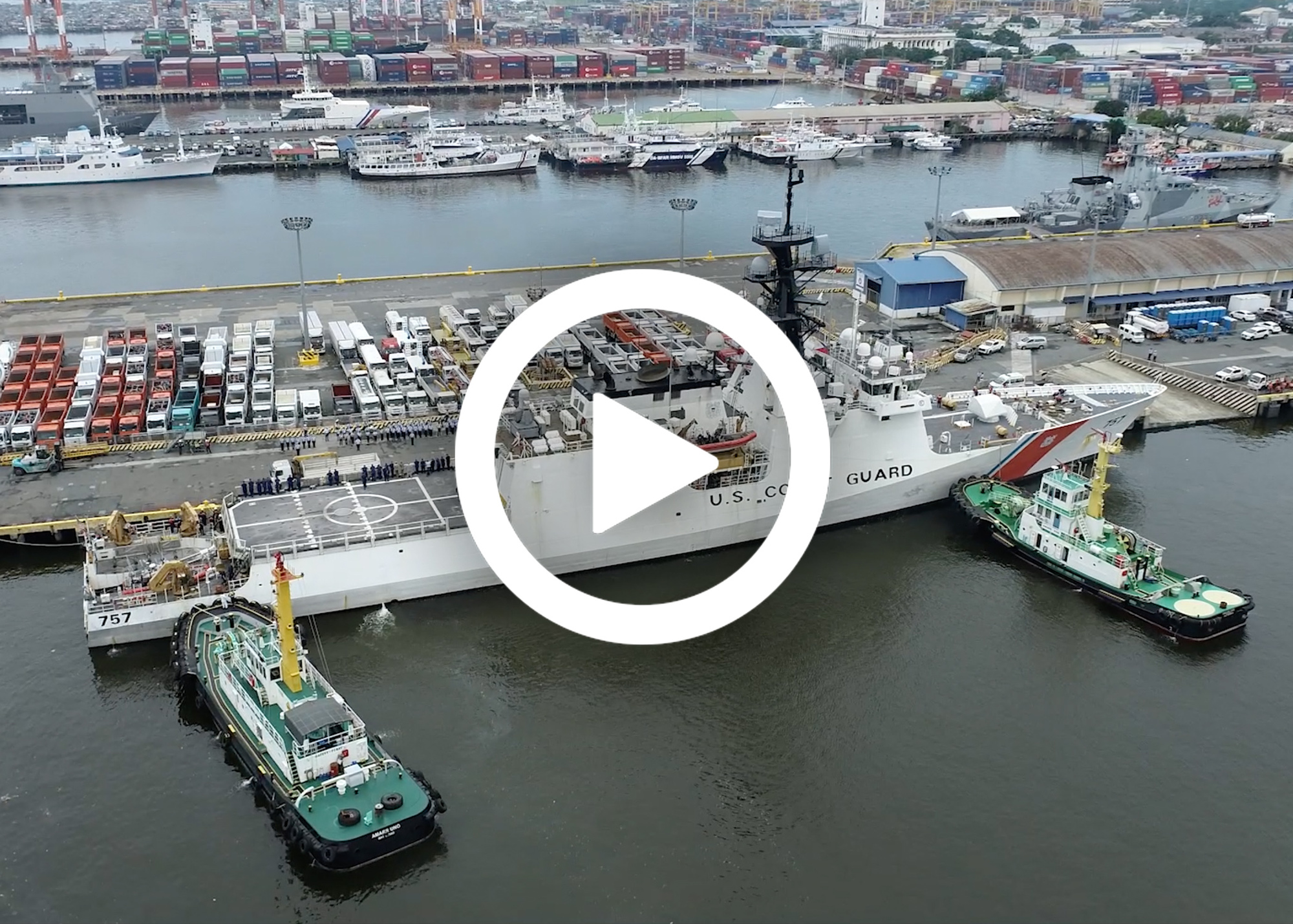
VIDEO: Coast Guard Cutter Midgett arrives in the Western Pacific
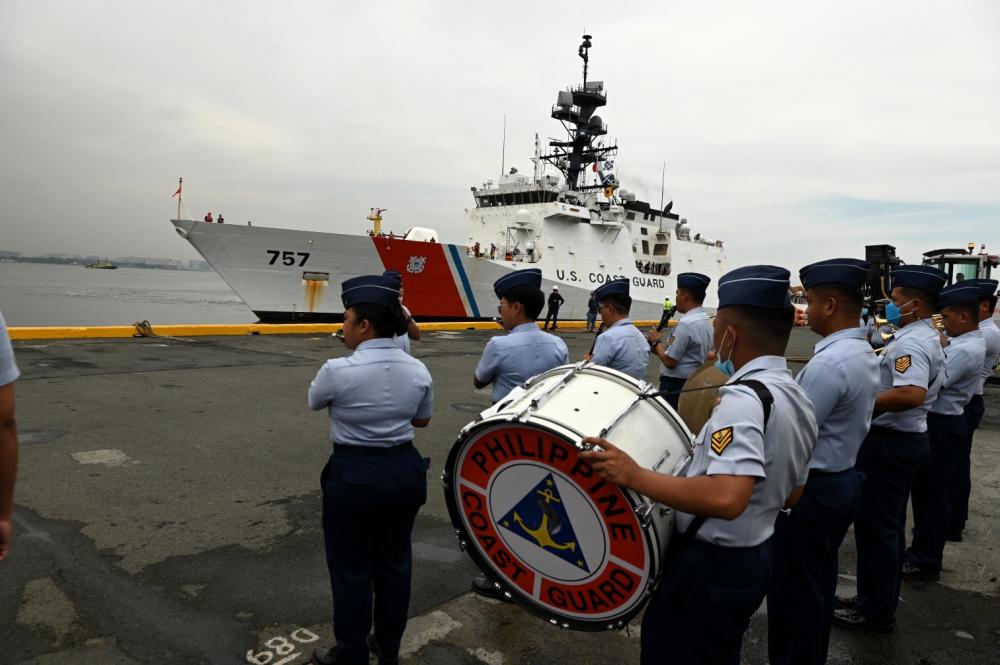
Coast Guard Cutter Midgett arrives in Manila, Philippines Coast Guard Cutter Midgett arrives in Manila, Philippines Coast Guard Cutter Midgett arrives in Manila, Philippines

Editors’ Note: Click on images to download high resolution version.

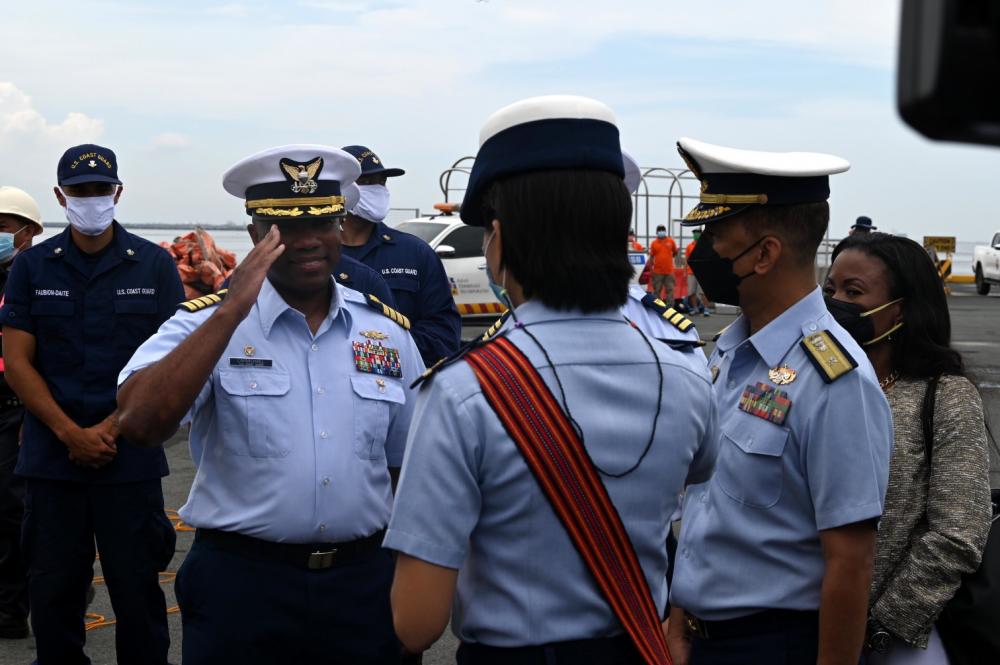
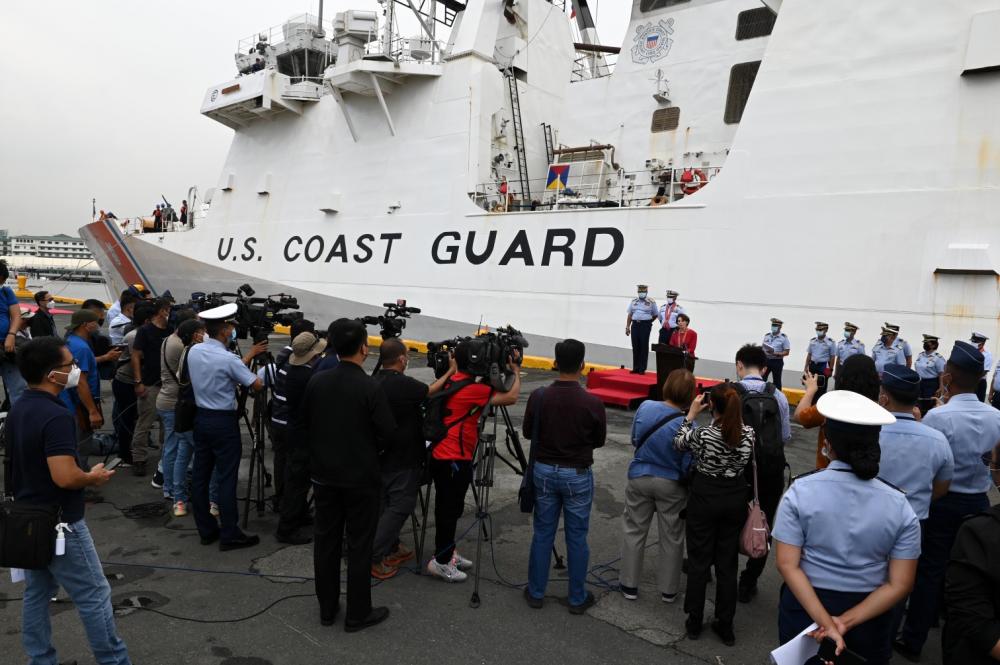
MANILA, Philippines – The U.S. Coast Guard Cutter Midgett (WMSL 757) arrived in Manila Tuesday for its first international port call during the crew’s months-long Western Pacific deployment to the region.

Midgett’s crew will conduct professional exchanges and operate with the Philippine Coast Guard as part of an at-sea search-and-rescue exercise while in Manila, building upon the strong partnership between the two nations.

Midgett is operating in support of United States Indo-Pacific Command, which oversees military operations in the region.

Operating under the tactical control of Commander, U.S. 7th Fleet, the cutter’s crew plans to engage in professional and subject matter expert exchanges with regional partners and allies and will patrol and operate as directed during their Western Pacific deployment.

The Coast Guard provides expertise within the mission sets of search and rescue; illegal, unreported and unregulated fishing; maritime environmental response; maritime security; maritime domain awareness; aviation operations; interoperability; and humanitarian assistance and disaster relief.

As both a federal law enforcement agency and a branch of the armed forces, the Coast Guard is uniquely positioned to conduct non-escalatory defense operations and security cooperation in support of combatant commanders on all seven continents. The service routinely provides forces in joint military operations worldwide, including the deployment of cutters, boats, aircraft and deployable specialized forces.

“Engaging with our Philippine Coast Guard partners is truly an honor,” said U.S. Coast Guard Capt. Willie Carmichael, commanding officer of the Midgett. “Together we will continue to build strong relationships and learn from each other. Our deep-rooted partnership will combine the best of both our Coast Guards and the planned search-and-rescue exercise and professional exchanges are a great opportunity for us keep the Indo-Pacific region open and free.”

The U.S. Coast Guard has a 150-year enduring role in the Indo-Pacific. The service’s ongoing deployment of resources to the region directly supports U.S. foreign policy and national security objectives in the Indo-Pacific Strategy and the National Security Strategy.

Since 2019, the Coast Guard Cutter Bertholf (WMSL 750), Stratton (WMSL 751), Waesche (WMSL 751) and Munro (WMSL 755) have deployed to the Western Pacific.

Commissioned in 2019, Midgett is one of two Coast Guard legend-class national security cutters homeported in Honolulu. National security cutters are 418-feet long, 54-feet wide, and have a 4,600 long-ton displacement. They have a top speed in excess of 28 knots, a range of 12,000 nautical miles, endurance of up to 90 days and can hold a crew of up to 170.

Midgett is the second cutter named after Rear Admiral John Midgett, whose family has a long legacy in the Coast Guard and our services precursor – the U.S. Life Saving Service.

National security cutters feature advanced command and control capabilities, aviation support facilities, stern cutter boat launch and increased endurance for long-range patrols to disrupt threats to national security further offshore.

“Iranian ship intercepted while trying to detain American drone” –Breaking Defense

USS Thunderbolt, seen here in both Coast Guard and Navy markings during its period of service in the USCG. U.S. Coast Guard photo by David Schuffholz

Breaking Defense reports,

The US Navy’s 5th Fleet today announced it thwarted an attempt by an Iranian ship to seize an American unmanned surface vessel operating in the Arabian Gulf.

(See the video below.)

The unit that stopped this Iranian vessel from making off with the Saildrone was USS Thunderbolt (PC-12), supported by a helicopter of Helicopter Sea Combat Squadron 26, presumably an MH-60S. Vessels of this class are in the process of being decommissioned from the US Navy. Most of their functions will be performed USCG Webber class WPCs of Patrol Forces SW Asia.

This incident does seem to highlight a, not unexpected, aspect of Unmanned Surface Vessel (USV) deployment. Rogue nations and even non-state actors may try to steal them. As we see here, there may be little or no consequences if they are caught in the act, so there is little to deter a repeated attempt.

Next time it happens, it is likely that a Coast Guard cutter will be sent to retrieve it.

Wikipedia provides this information on the Saildrone Explorer.

“The Saildrone Explorer is a 23-foot-long (7.0 m) USV that can sail at an average speed of 3 knots (5.6 km/h; 3.5 mph) (depending on the wind) and stay at sea for up to 365 days. The Explorer is designed for fisheries missions, metocean data collection, ecosystem monitoring, and satellite calibration and validation missions.”

Bigger, more expensive and more capable Saildrones are on the way.

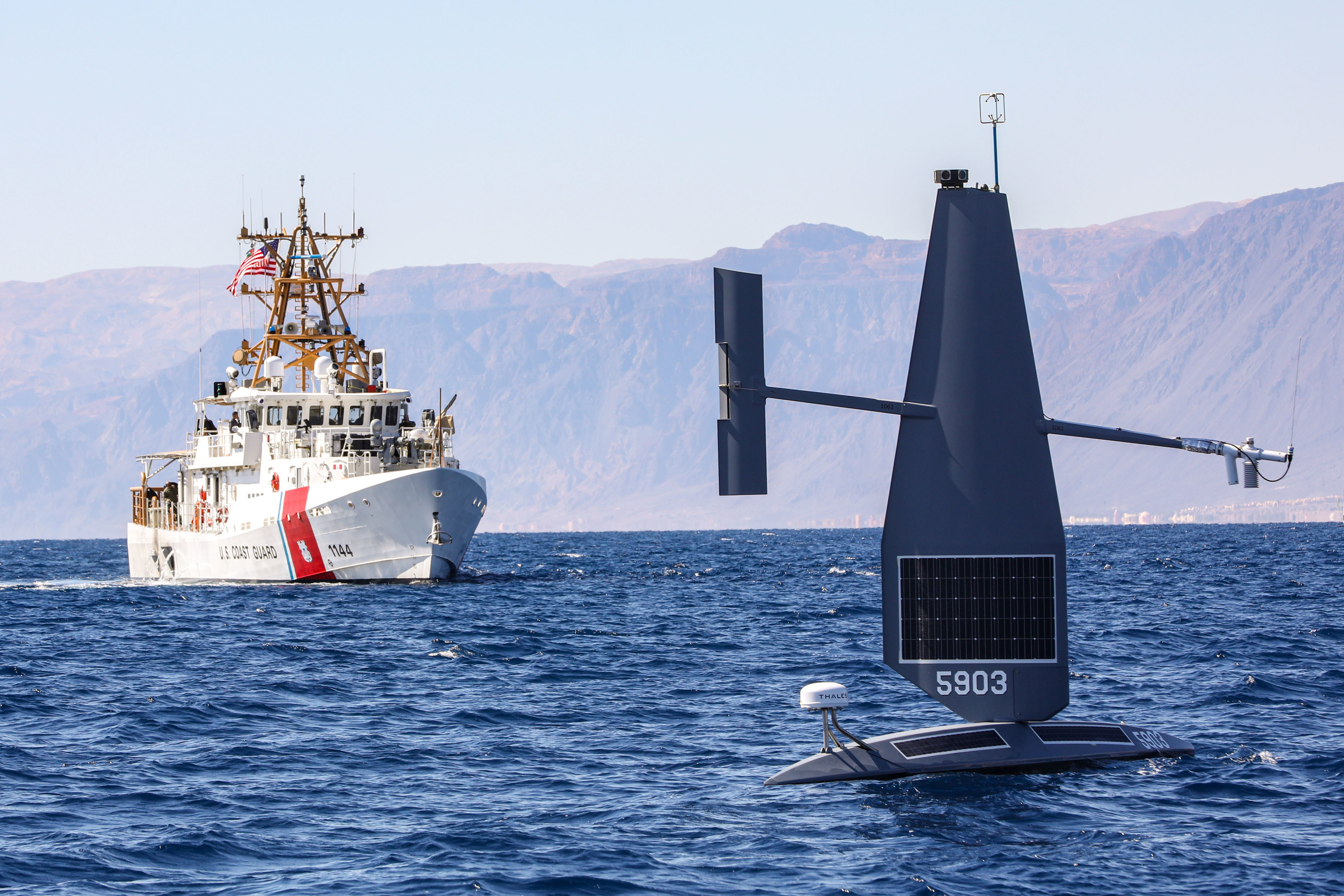
The US Coast Guard has been experimenting with Seadrones of this class, and has supported 5th Fleets experiments with them.

GULF OF AQABA (Feb. 13, 2022) The U.S. Coast Guard Sentinel-class cutter USCGC Glen Harris (WPC 1144) sails near a U.S sail drone explorer during the International Maritime Exercise/Cutlass Express (IMX) 2022, Feb. 13, 2022. IMX/CE 2022 is the largest multinational training event in the Middle East, involving more than 60 nations and international organizations committed to enhancing partnerships and interoperability to strengthen maritime security and stability. (U.S. Army photo by Cpl. DeAndre Dawkins)

Thanks to Walter for bringing this to my attention.

“South Korea Unveils High-Speed Interceptor Craft – HSIC” –Naval News

Naval News reports,

South Korea’s Defense Acquisition Program Administration (DAPA) developed a “high speed interceptor craft” (HSIC) dubbed “Phantom” capable of reaching a top speed of 60 knots.

Specifications include:

  • Displacement: 20 tons
  • Length: 20 meters (65.6′)
  • Beam: 4 meters (13.1′)
  • Range: 300 nautical miles
  • Crew of up to 12 plus 2 ton payload

Apparently, the  high performance is made possible by carbon fiber composite construction. The US Coast Guard really doesn’t have anything of comparable length  that I can compare it to, but we have had much smaller 35 foot “Long Range Interceptor” alluminum hull cutter boats that displaced 12 tons and 45 foot “Response Boat, Medium” boats that displaced 18.4 tons (light). (I don’t have current specs. This information from my nine year old Combat Fleets of the World.)

Bet the Vampire APKWS guided rocket system would fit on the cabin roof in place of the remote weapon station with 12.7 to 30mm gun.

“‘Vampire’ to transform Ukraine pickups into deadly missile launchers” –Defense News

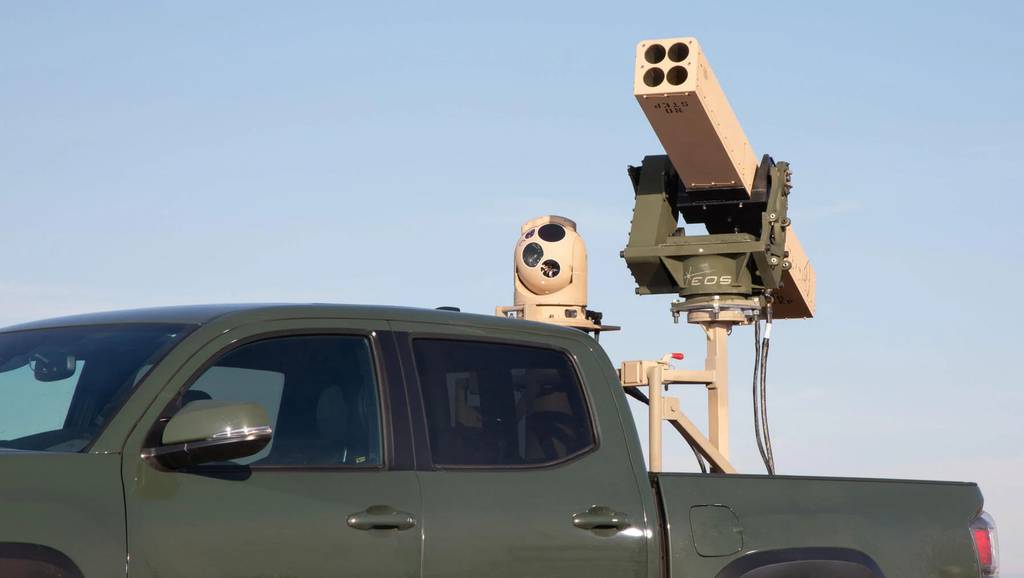
The VAMPIRE system can fit in almost any pickup or vehicle with a cargo bed. (Courtesy of L3Harris)

Defense News reports,

The U.S. is sending Ukraine “Vampire” kits that transform pickup trucks and other non-tactical vehicles into highly portable missile launchers...The L3Harris-made weapon ― a small, four-barreled rocket launcher and sensor ball ― can be mounted in two hours and operated by a single person, the company said. It can be equipped with missiles to hit ground or air targets including unmanned aircraft systems.

Gee, that sounds like something the Coast Guard could use, first and foremost on the Webber class FRCs of PATFORSWA, but really on virtually all cutters. It could be almost a ubiquous as the .50 caliber machine gun. Good for use against drones and swarming small craft, even small ships, and a bigger single round punch than any weapon in the current Coast Guard inventory.

The weapons expected to be used by the VAMPIRE (Vehicle-Agnostic Modular Palletized ISR Rocket Equipment) system are the AGR-20 APKWS II (Advanced Precision Kill Weapon System), 70mm (2.75″) rockets with a semi-active laser homing guidance kit added.

This is not an expensive, exotic, limited production weapon. It is used in the thousands by the Army, Air Force, Navy, and Marines. It is combat proven. As we noted earlier, in “More on Surface Launch Application of APKWS,

“… the U.S. military has a lot of 70mm rockets and buys thousands more every year. The Army alone plans to buy 60,000 unguided rockets in fiscal 2023 alone. BAE Systems, which builds the APKWS II seeker kit, is tooled to build 25,000 of them per year and is expanding production, according to its website. It has already delivered 37,000 units in six years of production.”

As I have contended,

This is a weapon the Coast Guard could add, relatively painlessly, that could deal with a range of threats including:

  • Drones/Unmanned Air Systems
  • Small, fast, highly maneuverable surface threats
  • Small ships

With the right choice of ammunition type, it might provide a degree of effectiveness against larger ships, all while doing so with great precision and minimal chance of collateral  damage.

It is an easy fix, at least for the lower end of target set. If we can’t mount APKWS launchers on the 25mm Mk38, on the Webber class, we could mount it on the deck immediately above and behind the gun.

That the VAMPIRE system includes a laser designator also means that it can be used to identify targets for supporting units, particularly attack aircraft, something else I think we need.

“Singapore’s Police Coast Guard deploys multilayered tactics to defend coastline” –Indo-Pacific Defense Forum

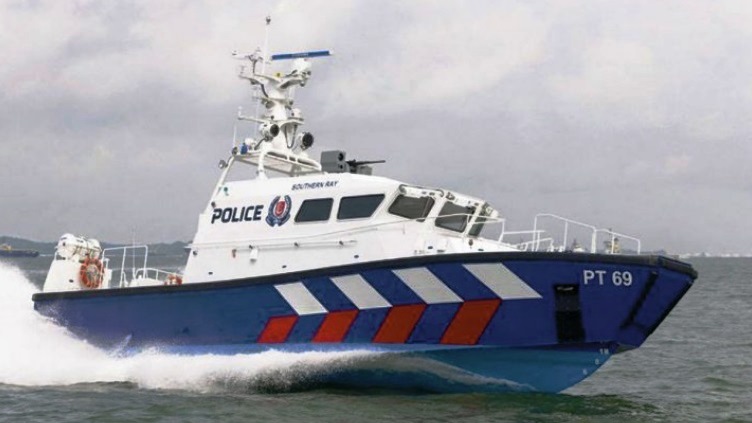
Indo-Pacific Defense Forum takes a look at Singapore’s Police Coast Guard, apparently prompted by a July 2022 report commissioned by the Korea Institute for Maritime Strategy and titled “Second Amongst Equals? The Police Coast Guard within Singapore’s Maritime Security Architecture.” Wikipedia has a more detail.

(They have a very different sort of “racing stripe” to identify their vessels, apparently replacing a more conventional white/red/white stripe on blue hull about a decade ago.)

Singapore has a very small EEZ, 1,067 sq.km. That of the US is 10,638 times larger, but those waters are extremely important, highly congested, and have had a long history of piracy. IUU, terrorism, and particularly illegal imigration are continuing concerns.

The largest Singapore Police Coast Guard vessels are similar in size to the 110 foot WPBs. Most of their vessels are relatively fast (35 to 55 knots) and for a “police” organization, well armed. The Singapore Navy handles some missions that we would consider Coast Guard missions, including operation of Offshore Patrol Vessels.

“Solomon Islands doesn’t answer US Coast Guard’s request for port visit, US says” –CNN/Reuters

The USCGC Oliver Henry (WPC 1140) crew arrives in Manus, Papua New Guinea, on Aug. 14, 2022, from Guam as part of a patrol headed south to assist partner nations in upholding and asserting their sovereignty while protecting U.S. national interests. The U.S. Coast Guard is participating with partners to support the Pacific Islands Forum Fisheries Agency-led Operation Island Chief and the larger Operation Blue Pacific through patrols in the Western Pacific in August and September 2022. (U.S. Coast Guard photo by USCGC Oliver Henry)

CNN reports,

A United States Coast Guard vessel was unable to enter Solomon Islands for a routine port call because the Solomon Islands government did not respond to a request for it to refuel and provision, a US official said.

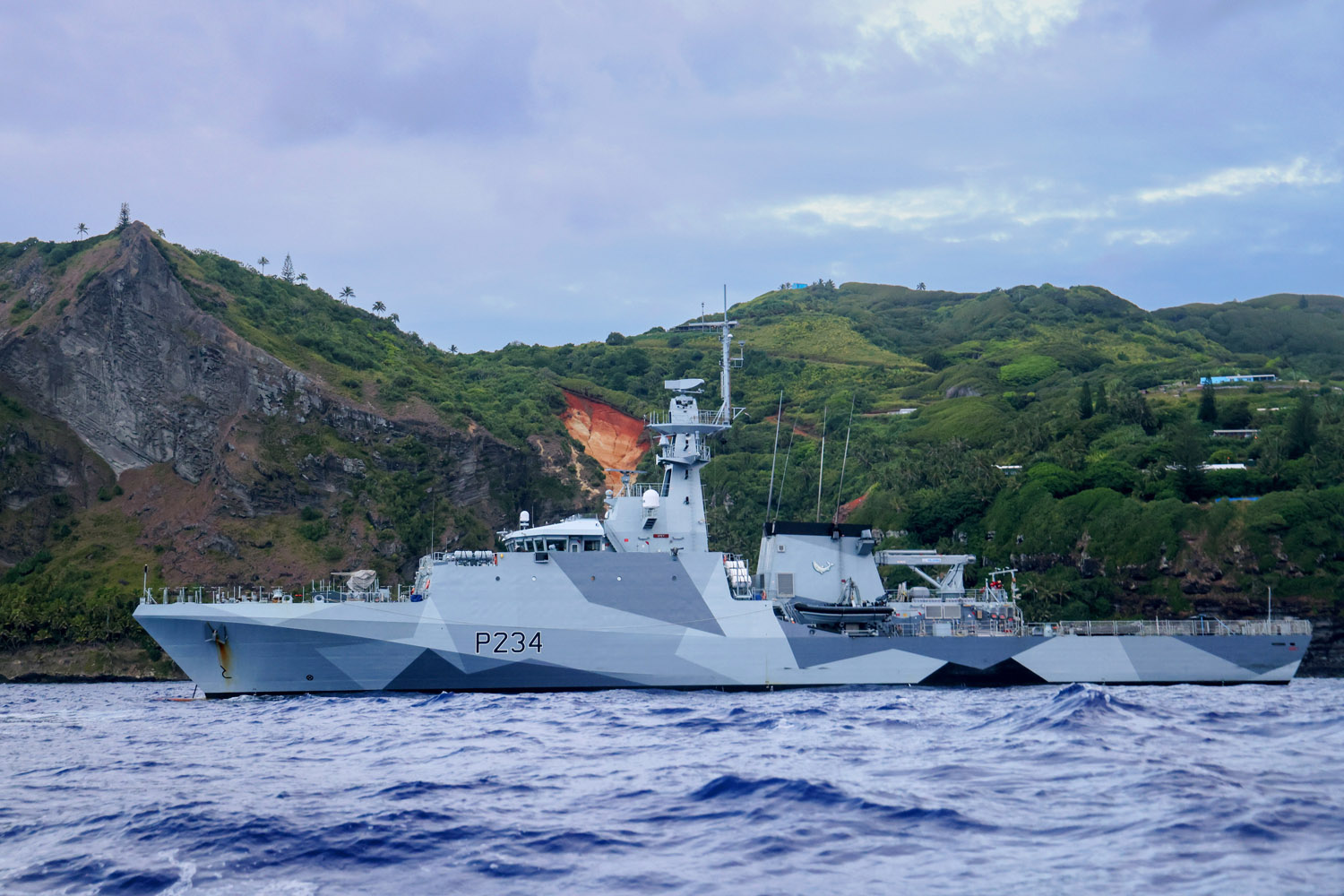
The vessel was USCGC Oliver Henry, hardly a symbol of American hegemony. HMS Spey, a larger offshore patrol vessel, was also reported to have had difficulty arranging a replenishment stop. Both were operating in support of the fisheries agency for the Pacific Islands Forum.

HMS Spey, River class Batch2 OPV

The difficulties may have been resolved,

“The U.S. Department of State is in contact with the Government of the Solomon Islands and expect all future clearances will be provided to U.S. ships”

Still it appears to be a symptom of growing Chinese influence in the Western Pacific.


“SOLICITATION FOR SUBJECT MATTER EXPERTS (SME) TO ASSESS THE OFFSHORE PATROL CUTTER” –ALCOAST

Some of you might be interested in responding to this. It also seems to suggest the future USCGC Argus is pretty far along.

Maybe something similar was done earlier, but it seems late in the game to do this sort of design review. Even so, seems like a good idea. Maybe not too late to incorporate ideas in the “B class” OPCs.

As you all probably know by now, I don’t think any current or planned cutter meets the implicit requirement of being able to forcibly stop any ship, regardless of size, and my belief this is entirely possible for cutters as small as patrol boats (WPBs).

R 241556Z AUG 22 MID200080150110U
FM COMDT COGARD WASHINGTON DC
TO ALCOAST
BT
UNCLAS
ALCOAST 307/22
SSIC 5102
SUBJ:  SOLICITATION FOR SUBJECT MATTER EXPERTS (SME) TO ASSESS
THE OFFSHORE PATROL CUTTER
1. This ALCOAST solicits volunteers to participate in a six-day
Offshore Patrol Cutter (OPC) Operational Assessment (OA) in Panama
City, FL from 31 October to 05 November 2022. The OA is a review
and analysis of cutter design data to determine the operational
capability and effectiveness expected to be delivered by an OPC.
2. Background: The OPC will constitute a significant percentage of
the USCG’s major cutter fleet, and is designed to have new
capabilities for maritime homeland security, law enforcement and
national defense missions. OPCs, designated as the Maritime
Security Cutter, Medium (WMSM), will replace existing Medium
Endurance Cutters (WMECs) and fill a critical operational gap
between the USCG’s Fast Response Cutter (FRC) and the National
Security Cutter (NSC). The first OPC will be delivered in FY 2023.
3. The OA, facilitated by the Operational Test and Evaluation Force
(OPTEVFOR), is primarily a tabletop documentation review by
experienced active duty members who are currently serving, or have
recently served on WMECs, WHECs, WSMLs, or have experience with
planned OPC systems and major cutter support. The OA will also
provide SMEs an opportunity to walk an OPC currently in production
to supplement their assessment of capabilities. SME input will
assist OPTEVFOR in assessing suitability of systems on an OPC and
will culminate in an OA report submitted to the Vice Commandant and
DHS’ Office of Test and Evaluation to assess OPC capabilities.
4. Following are the OPC assessment groups and the corresponding SME
experience needed for the OA:
a. DECK – Current or recent major cutter First Lieutenant (BOSN).
Boatswain’s Mate with current or recent major cutter experience as
Deck Leading Chief Petty Officer. Enlisted ratings with current or
recent major cutter experience as coxswain, boarding officer, boat
deck operator/supervisor/safety, flight deck crew, and underway
replenishment crew/supervisor/safety.
b. ENGINEERING – Current or recent major cutter Engineer Officer,
Main Propulsion Assistant, and Damage Control Assistant. Senior
enlisted with current or recent experience as Engineering Leading
Chief Petty Officer. Machinery Technicians, Electrician’s Mates,
Electronics Technicians, and Damage Controlmen with current or
recent major cutter experience.
c. OPERATIONS – Current or recent major cutter Commanding
Officer, Executive Officer, Operations Officer, and Electronic
Materials Officer. Boatswain’s Mates with current or recent major
cutter experience with navigation duties and visual signaling.
Operations Specialists with current or recent major cutter
experience with Sea Commander and electronic warfare systems.
Electronics Technicians with current or recent major cutter
experience with electronics systems maintenance. Information
Systems Technician with current or recent major cutter experience.
Intelligence Specialist with recent major cutter intelligence
support experience.
d. SUPPORT – Current or recent major cutter Support Officer.
Storekeeper, Yeoman, Culinary Specialist, and Health Services
Technician with current or recent major cutter experience. Port
Engineer, Asset Manager, Availability Project Manager, and Logistics
Specialist with current or recent experience in supporting major
cutters.
e. WEAPONS – Current or recent major cutter Weapons Officer, and
Tactical Action Officer or Combat Systems Officer. Electronics
Technicians with current or recent major cutter experience as Mk 48
GWS operators/maintainers. Gunner’s Mates with current or recent
major cutter experience maintaining and operating Mk 110, Mk 38, and
small arms maintenance.
f. AVIATION – Current or recent major cutter Helicopter Control
Officer and Landing Signals Officer. Helicopter pilots with current
or recent shipboard deployments as Senior Aviator or HITRON pilot.
Enlisted aviation ratings with current or recent experience in major
cutter deployments with responsibilities for aircraft maintenance.
5. Volunteers must be available for the entire six-day event and be
free of normal duties to allow focus on this Operational Assessment.
Participants can anticipate travel on 30 October and 06 November.
SMEs will be provided read-ahead documents in preparation for their
role to ensure the OA is completed within the allotted time. A
detailed schedule of events will be provided via email after
participants have been identified.
6. Interested participants should contact the OPC Sponsor’s
Representative, LT Sam Williams, by 19 September 2022 via email,
noting relevant experience and desired mission area from paragraph
7. Members must include a copy of their employee summary sheet from
CGBI in-board view as an attachment. Email must be forwarded from
your unit CO or XO to demonstrate command approval for
participation. COMDT (CG-9322) will issue travel orders to members
selected to participate.
8. Point of contact: LT Sam Williams, COMDT (CG-751), 202-372-2324,
Samuel.N.Williams@uscg.mil.
9. RADM Todd C Wiemers, Assistant Commandant for Capability (CG-7),
sends.
10. Internet release is authorized.

PATFORSWA Now Has Six Webber Class

220822-A-KS490-1182 STRAIT OF HORMUZ (Aug. 22, 2022) From the left, U.S. Coast Guard fast response cutters USCGC Glen Harris (WPC 1144), USCGC John Scheuerman (WPC 1146), USCGC Emlen Tunnell (WPC 1145) and USCGC Clarence Sutphin Jr. (WPC 1147) transit the Strait of Hormuz, Aug. 22. The cutters are forward-deployed to U.S. 5th Fleet to help ensure maritime security and stability across the Middle East. (U.S. Army photo by Spc. Noah Martin)

The planned six Webber Class contingent for PATFORSWA is now complete. See the press release below.


08.23.2022

Story by NAVCENT Public Affairs   

U.S. Naval Forces Central Command / U.S. 5th Fleet

MANAMA, Bahrain – Two U.S. Coast Guard fast response cutters arrived in Bahrain, Aug. 23, marking the arrival to their ultimate destination after departing Key West, Florida in June.

USCGC John Scheuerman (WPC 1146) and USCGC Clarence Sutphin Jr. (WPC 1147) are two of the Coast Guard’s six newest Sentinel-class fast response cutters (FRC) now stationed in Bahrain where U.S. 5th Fleet is headquartered.

“This arrival represents the culmination of years of tireless effort and exceptional teamwork,” said Capt. Eric Helgen, commander of Patrol Forces Southwest Asia (PATFORSWA). “These newest FRCs bring us to our full complement of six ships and mark the beginning of a new era of extraordinary maritime capability supporting U.S. 5th Fleet.”

The Sentinel-class cutters in Bahrain are overseen by PATFORSWA, the Coast Guard’s largest unit outside of the United States. The ships are forward-deployed to U.S. 5th Fleet to help ensure maritime security and stability across the Middle East.

“We are extremely excited to be here and look forward continuing to work with international partners in the region,” said Lt. David Anderson, commanding officer of Clarence Sutphin Jr. “Completing this more than 10,000-nautical-mile transit to Bahrain has been a once-in-a-lifetime opportunity.”

John Scheuerman and Clarence Sutphin Jr. were commissioned in February and April 2022 respectively. The 154-foot long vessels feature advanced communications systems and improved surveillance and reconnaissance equipment.

“Ecuador combats Chinese fleet’s illegal fishing with Canadian satellite technology” –Indo-Pacific Defense Forum

Indo-Pacific Defense Forum reports,

The Ecuadorian government is using Canadian technology to monitor the Chinese fleet’s illegal, unreported and unregulated (IUU) fishing around the Galápagos Islands.  In early June 2022, the government detected 180 Chinese vessels near the islands’ exclusive economic zone (EEZ), fishing for large Humboldt squid and threatening the region’s biodiversity and economy.

The Ecuadorian Navy patrols to prevent illicit fishing in the protected zone. “As long as these vessels are far from the insular EEZ, more than 100 miles [more than 160 kilometers] away, we monitor them by satellite,” Ecuadorian Navy Rear Adm. John Merlo León, commander of naval operations, told Ecuadorian television network Teleamazonas.

Reportedly, Ecuador uses both space technology company MDA, based in Brampton, Ontario, to provice satellite tracking, remote sensing and the ability to synthesize large amounts of data and Global Fishing Watch, a Google-backed website that tracks commercial fishing and interprets vessel movements, including fishing in prohibited areas.