The Indo-Pacific Partnership for Maritime Domain Awareness

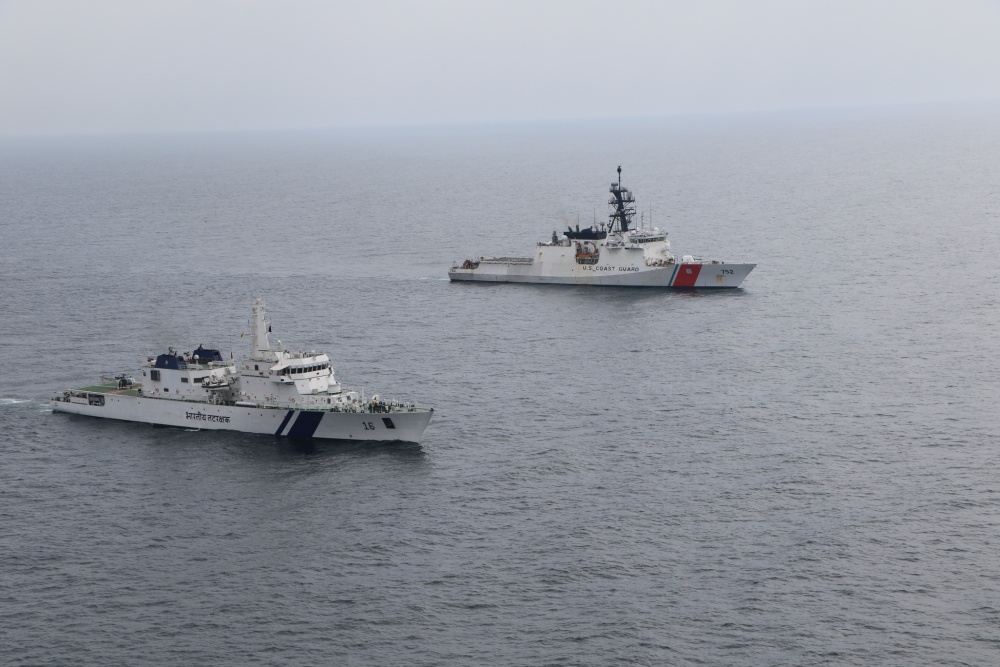
Coast Guard Cutter Stratton (WMSL 752) sales alongside the Indian coast guard ships Abheed and Shaurya (16) Aug. 23, 2019, while transiting in the Bay of Bengal off the coast of Chennai, India. The Stratton is participating in a professional exchange with the Indian coast guard that includes operational exercises at sea and on shore. (U.S. Coast Guard photo by Petty Officer 3rd Class Stephen Esterly)

Time to learn a new acronym, IPMDA, Indo-Pacific Partnership for Maritime Domain Awareness.

The Maritime Executive reports,

The Quadrilateral Security Alliance (Quad), a loose defense cooperation group composed of the U.S., India, Australia and Japan, plans to introduce a joint satellite-based tracking system aimed squarely at Chinese illegal fishing.

Real Clear Defense has another view, ““Black Ships,” the Quad and Space.

A Whitehouse “FACT SHEET: Quad Leaders’ Tokyo Summit 2022” leads of with discussion of the IPMDA. Quoting,

The Indo-Pacific Partnership for Maritime Domain Awareness  

At the Tokyo Summit, the Quad leaders will welcome a major maritime initiative: the Indo-Pacific  Partnership for Maritime Domain Awareness (IPMDA). In close consultations with regional partners, IPMDA will offer a near-real-time, integrated, and cost-effective maritime domain awareness picture. This initiative will transform the ability of partners in the Pacific Islands, Southeast Asia, and the Indian Ocean region to fully monitor the waters on their shores and, in turn, to uphold a free and open Indo-Pacific. Quad countries are committed to contributing to the region’s maritime domain awareness—a fundamental requirement for peace, stability, and prosperity—through an investment in IPMDA over five years. The partnership will innovate upon existing maritime domain awareness efforts, rapidly bringing emerging technologies to bear for the greater good of the Indo-Pacific community.

IPMDA will build a faster, wider, and more accurate maritime picture of near-real-time activities in partners’ waters. This common operating picture will integrate three critical regions—the Pacific IslandsSoutheast Asia, and the Indian Ocean region—in the Indo-Pacific. The benefits of this picture are vast: it will allow tracking of “dark shipping” and other tactical-level activities, such as rendezvous at sea, as well as improve partners’ ability to respond to climate and humanitarian events and to protect their fisheries, which are vital to many Indo-Pacific economies. IPMDA will do so by:

  • Harnessing commercially-available data using existing technologies. Through a combination of Automatic Identification System and radio-frequency technologies, Quad partners can provide an unprecedented “common thread” of activities. Because of its commercial origin, this data will be unclassified, allowing the Quad to provide it to a wide range of partners who wish to benefit.                 
  • Extending support for information-sharing across existing regional fusion centers, such as the Information Fusion Center-Indian Ocean Region, based in India; the Information Fusion Center, based in Singapore; the Pacific Islands Forum Fisheries Agency, based in the Solomon Islands, and the Pacific Fusion Center, based in Vanuatu, both of which receive support from Australia.

Quad partners will begin immediate consultations on this opportunity with partners in the region. As the initiative proceeds, the Quad will identify future technologies of promise, allowing IPMDA to remain a cutting-edge partnership that promotes peace and stability throughout the region. 

More on the Quad here.

If this works, similar systems should be extended over the Atlantic and Eastern Pacific as well. In addition to countering Illegal, Unreported, Unregulated (IUU) fishing, such systems have potential for SAR, MEP, interdiction of smuggling activities, counter piracy, disaster response, and sanctions enforcement.

In wartime such systems would have significant implications for Naval Control of Shipping and might alert us to sinkings. Access to this information would, of course, also be useful to our enemies seeking to target ships. Presumably there is planning for these eventualities.

Thanks to Paul for bringing this to my attention.

“New Drug Seizure By The French Navy In The Gulf Of Guinea” –Naval News

Naval News reports seizure of 1.7 tons of cocaine in an unusual place, the Gulf of Guinea, off the West coast of Africa. It was apparently incidental a normal French Navy deployment, not specifically a drug interdiction operation.

I found it a bit unusual that the cocaine did not appear to be well hidden. That might indicate how unlikely interception along this route may be.

Significantly this interception was conducted in cooperation with the Gulf of Guinea Interregional Network’s centers of the Yaoundé Process.

The “Landing Helicopter Dock” (LHD) Mistral, is certainly not the type vessel typically involved in drug interdiction.

The frigate involved, FS Courbet, is a Lafayette class frigate. This class always seemed similar in function to Coast Guard WHECs, because, as built, they had no ASW capability. Aside from the Anti-Ship Cruise Missiles they carried, in many respects their capabilities were similar, particularly after the WHECs were FRAMed. The French ships were built about aboout three decades after the Hamilton class. In some ways they apear to be as an intermediate design between the Hamilton class and the Bertholfs. FS Courbet is smaller (3600 tons full load), slower (25 knots), and has less range than the Bertholf class NSCs (7,000 nmi), but has been recently upgraded with a hull mounted sonar, improved point defense AAW systems, and later model Exocet ASCMs.

“Navy: Mine Countermeasures Mission Packages to Be Available for Vessels of Opportunity” –SeaPower/Coast Guard Connection?

USNS Hershel “Woody” Williams launches a Knightfish unmanned underwater vehicle (UUV) while at anchor in the Chesapeake Bay, Sept. 14, 2019. Photo: US Navy

The Navy League’s on line magazine, Seapower, reports,

“Capt. Mike Egan, branch head for mine warfare in the Office of the Chief of Naval Operations, speaking May 24 in Monterey, California, at the 2022 International Mine Warfare Technology Symposium of the Mine Warfare Association, said the MCM mission package is on track to achieve initial operational capability in the fall of 2022 and the Navy plans to procure a total of 24 packages.

“The Navy plans to equip 15 Independence-class littoral combat ships with the MCM mission package, which will leave an additional nine mission packages for use elsewhere.”

USN mine countermeasures ships are being decommissioned. Soon these mission packages will be the only US naval mine clearance assets. If a US port is mined, how will the mines be cleared?

Currently all Independence class LCS are based in San Diego. With the decision to shed all but six of the Freedom class LCS, none of which will be MCM capable, it is likely at least some Independence class will be based on the East Coast, presumably at Jacksonville. Aside from these 15 LCS mounted systems, it also appears the Navy will mount one on each of the five Lewis-B. Puller-class “Expeditionary Sea Bases” (ESB). That still leaves four MCM mission packages unclaimed.

LCSs based in San Diego and Jacksonville are still a long way from many US ports. In addition to transit time, the LCSs may be deployed or may not be available on short notice. The ESBs are all expected to be forward deployed, with one probably being assigned to each Geographic Combatant Commanders with the exception of Northern Command, e.g. Africa Command, Central Command, European Command, Indo-Pacific Command, and Southern Command, so they are unlikely to be available.

These four packages could provide mine clearance for US ports. One East Coast (perhaps Norfolk area), one West Coast (Seattle?), one Hawaii (Pearl?), and one in Alaska (Anchorage?) might be a logical distribution.

We know the disasterous effect of even short term port closures. Time is critical. The mission packages should be able to be deployed by air to the port(s) of interest. Some elements of the packages could certainly operate from shore. In many cases Coast Guard bases and air stations would be logical locations for temporary relocation of Navy assets. It is not unlikely Coast Guard fixed wing aircraft might be tasked with providing the air lift.

Some elements of the mission package, like the Unmanned Underwater Vehicles are still likely to require operation from floating units. Buoy Tenders would likely be able to fill this role. It might be worthwhile exercising this option, perhaps at RIMPAC.

“Indonesia stands up to PRC’s aggressive moves in South China Sea” –Indo-Pacific Defense Forum

A China Coast Guard ship is seen from an Indonesian naval vessel during a patrol north of Indonesia’s Natuna islands. (Antara Foto via Reuters)

Indo-Pacific Defense Forum reports,

“Indonesia has successfully defended its sovereignty off the northwest coast of the island of Borneo by standing up to aggressive incursions by the People’s Republic of China (PRC), which maintains that its widely dismissed territorial claim in the South China Sea gives it authority to enter the area unimpeded.”

Indonesia is demonstrating it is possible to resist China’s bullying without starting a war.

“Bad News” from the Navy, an Upnote for the Coast Guard

USS Zephyr (PC 8) and U.S. Coast Guard Law Enforcement Detachment Pacific personnel, conducting operations in support of JIATF-S Operation Martillo. U.S. Navy photo by MC3 Casey J. Hopkins

Texas Public Radio has a report, “A surge in Navy deserters could be a sign of a bigger problem for the military,” that also references recent suicides in the Navy. I would note that, based on their reporting, there has been no comparable surge in other armed services, and there is good news from the Coast Guard.

“But other branches of the military didn’t see a similar increase in the past three years.Desertions in the Army dropped by 47%, from 328 in 2019 to 174 in 2021, and the Marine Corps reported 59 in 2019 and 31 in 2021. The Coast Guard said it didn’t record a single deserter between 2019 and 2021.”

I would also point out, that 157 desertions out of over 340,000 active duty members is still a pretty smaller percentage (<0.046%, about one out of 2,178), only a little worse than the Army’s much improved 2021 figures, and actually much better than the Army’s 2019 figures.

The TPR report is really using this “surge” as basis for discussing the lack of early out options. While we don’t want to spend a lot of money training someone for a high paying civilian job and then release him or her as soon as they go to a job where their boss actually expects them to do their job, there are times when early separation is good for the service.

Early in my career, it was the Vietnam era. Many enlisted in the Coast Guard, not because they wanted to be there, but because it was a way to avoid the draft. The Ocean Station program was ending, so the Coast Guard decided to decommission many of its larger ships and to truncate the WHEC 378 program at 12 instead of the planned 36. The resulting downsizing meant there would be a large reduction in force. We took advantage of this by early, many times compulsary, separation of many trouble makers and poor performers. It always seemed 90% of our personnel problems were caused by fewer than 10% of our people. This purge had a wonderful effect.

Photos to Share, Report of Collision and Two Canadian AOPS in Key West

An overloaded migrant vessel sails next to the U.S. Coast Guard Cutter Confidence off the northwest coast of Haiti on Thursday, May 20, 2022. The Coast Guard said the boat collided with the bow of the cutter. U.S. Coast Guard

Couple of photographs of interest.

First is a photo of a ship I served on, USCGC Confidence (now based in Florida instead of Kodiak). The photo is from a Miami Herald report, “Coast Guard says migrant boat collided with cutter off the coast of Haiti.(apparently very minor) Confidence is about 56 years old and still doing the job. I see four RHIBs in the photo and Connie has only two. No indication where the other two came from.

The second is from Facebook. What are two Canadian Arctic and Offshore Patrol Ships (AOPS) doing in Key West? One has been doing drug interdiction with the US Coast Guard.

HMCS Harry Dewolf (AOPV 430) and HMCS Margaret Brooke (AOPV 431) alongside at NAS Key West, Florida in late May of 2022. HMCS Margaret Brooke is finishing warm weather trials on the ships cooling systems. HMCS Harry DeWolf is finishing a Op Caribbe with the USCG.

“Coast Guard modifies offshore patrol cutter contract to complete installation of the combat and radar systems” -CG-9

OPC “Placemat”

Below is a post from the  Acquisitions Directorate (CG-9). I had never heard of the “Athena combat weapons system” so “Googled” it. The most common thing that came up was an Army laser weapons program. I don’t really think that is what they talking about, but I could be wrong. The post does call it a “weapons system.” I think it may be the Leonardo ATHENA® (Architecture & Technologies Handling Electronic Naval Applications) Combat Management System (CMS). Leonardo’s web page on the system indicates it is the CMS used on the FREMM frigate which is the parent craft for new USN FFG. Maybe the Navy liked the CMS as much as they liked the ship.

The CMS on the Bertholf class cutters is an Aegis based system. I have not heard anything about its application to the offshore patrol cutter (OPC).

Late Addition: Got this, thanks to Timothy H,

AEGIS Athena Baseline 9G
May be an image of text
That is good news, since it means there will be commonality between the systems on the NSCs and the OPCs.

The Coast Guard modified its current contract with Eastern Shipbuilding Group (ESG) May 20 so installation of the Athena combat weapons system and multi-mode radar system will be completed during the production phase of the offshore patrol cutter (OPC). The Athena system, radar and armament of the OPC are provided to the Coast Guard as Navy type-Navy owned government furnished equipment.

Prior to this modification, installation of both systems was to occur after contract delivery while each cutter was in its homeport. The Navy has completed development, integration and testing of the Athena and radar systems, enabling the Coast Guard to shift to production-phase installation. Performing this work prior to delivery reduces the technical risks associated with post-delivery installation and delivers mission-ready OPCs to the fleet as soon as possible.

The first four OPCs are currently in production at ESG’’s shipyard in Panama City, Florida.

The OPC meets the service’s need for cutters capable of deploying independently or as part of a larger task force and is essential to stopping smugglers at sea, rescuing mariners, enforcing fisheries laws, responding to disasters, interdicting undocumented individuals and protecting the nation. The acquisition of 25 OPCs will complement the capabilities of the service’s national security cutters and fast response cutters as an essential element of the Department of Homeland Security’s layered maritime security strategy.

For more information: Offshore Patrol Cutter Program page

“US, Japan coast guards formally expand cooperation” –PAC AREA News Release / “Royal Navy and US Coast Guard to Forge Closer Bonds”

Ships from the U.S. Coast Guard and Japan Coast Guard conducted exercises near the Ogasawara Islands of Japan, Feb. 21, 2021. The U.S. Coast Guard Cutter Kimball and Japan Coast Guard Ship Akitsushima, two of the respective services’ newest and most capable vessels, operated alongside helicopters and unmanned aerial vehicles to practice interdicting foreign vessels operating illegally inside Japanese waters. (U.S. Coast Guard photo courtesy of the Coast Guard Cutter Kimball/Released)

The Coast Guard has been busy increasing its international visibility. Below is a news release concerning increased cooperation with the Japanese Coast Guard that came out yesterday. Today, I see a SeaWaves report, also dated yesterday that,

“The Royal Navy and US Coast Guard have vowed to work more closely to fight crime and protect the planet. The two services already combine to stop drugs traffickers in the Caribbean and Middle East, assist each other with operations in the polar regions, run exchange programs for sailors and frequently work and train side-by-side around the globe.”

The new relationship with the Royal Navy includes expanded personnel postings that began back in 2014.

There are also plans to build on already successful exchange programs, which allows USCG engineers to work with the Royal Navy but will soon also allow pilots and aircrew to do the same. (emphasis applied–Chuck)

Perhaps we are not too far from exercising something like my proposed “Combined Maritime Security Task Force Pacific” with a US Coast Guard Cutter, a Japanese Coast Guard Cutter, and a Royal Navy River Class OPV working with navies and coast guards of SE Asia to protect their EEZ. Perhaps the Indian Coast Guard will join as well.

News Release

May 19, 2022
U.S. Coast Guard Pacific Area

US, Japan coast guards formally expand cooperation

US, Japan coast guards formally expand cooperation US, Japan coast guards formally expand cooperation

Editors’ Note: Click on images to download high resolution version.

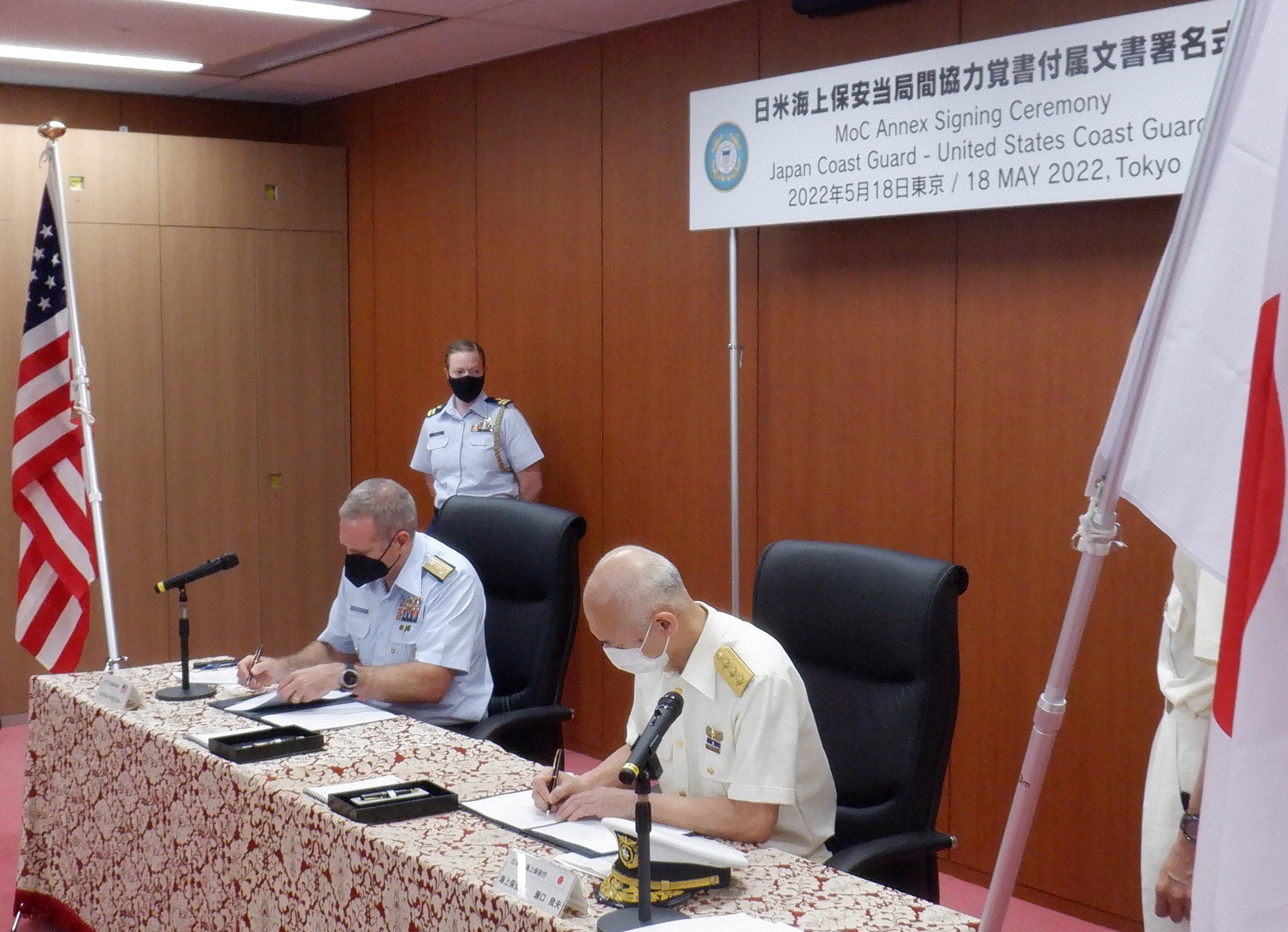
TOKYO — The United States and Japan coast guards formally expanded cooperative agreements and established a new perpetual operation during a ceremony Wednesday in Tokyo.

Vice Adm. Michael McAllister, commander of U.S. Coast Guard Pacific Area, and Vice Adm. Yoshio Seguchi, Japan Coast Guard vice commandant for operations, represented their respective services during the historic document signing ceremony and celebration at Japan Coast Guard Headquarters.

Although a memorandum of cooperation between the sea services has existed since 2010, strengthened relationships, increasing bilateral engagements and continued focus on maintaining a free and open Indo-Pacific necessitated expansion of the memorandum.

The new operation’s name, SAPPHIRE, is an acronym for Solid Alliance for Peace and Prosperity with Humanity and Integrity on the Rule of law based Engagement, and it honors the gem regarded as an emblem of integrity and affection found throughout the Indo-Pacific.

Operation Sapphire encompasses all the annual interactions between the Japan and U.S. coast guards, with the goal of increasing interactions over time.

To formalize the expanded cooperation, annexes were added to the existing memorandum of cooperation outlining Operation Sapphire to include standard operating procedures for combined operations, training and capacity building, and information sharing.

“We rely on our partners, allies, and like-minded nations to achieve our shared missions,” said McAllister. “As evidenced by this agreement, our relationship with the Japan Coast Guard is stronger than ever, and I am looking forward to many more decades of partnership and collaborative operations in the Indo-Pacific.”

“We will conduct smooth cooperation in the fields of joint operation, capacity building and information sharing by this agreement” said Seguchi. “Sapphire embodies the rule-of-law based engagement between the coast guards, and we will expand the principle of Free and Open Indo-Pacific to other nations.”


“LET THE NAVY RETIRE LCS AND BUILD A U.S. MARITIME CONSTABULARY INSTEAD” –CIMSEC

Indonesian Maritime Security Agency vessel KN Tanjung Datu, left, sails alongside U.S. Coast Guard Cutter Stratton during joint exercises in the Singapore Strait in August 2019. IMAGE CREDIT: PO1 LEVI READ/USCG

CIMSEC has an opinion piece written by Bryan Clark and Craig Hooper, both influential defense journalists, that advocates,

The Congress and DoD leadership should embrace the Navy’s focus on high-end warfare by shifting security and training missions to ships operated by other services, specifically the Coast Guard and Military Sealift Command. Congressional leaders have expressed interest in adding defense-related spending to the White House FY2023 budget proposal, which could build more of the existing ships the Coast Guard and MSC would use. And to operate them, the up to $2 billion in annual LCS sustainment, basing costs, and manpower funding could be moved to these new mission owners. If the Navy sheds the small boat mission, the costs should be taken out of the Navy’s budget.

We have seen that, to some extent, this has already taken place, but without the movement of money to the new providers.

The Navy hopes to save money by retiring LCS, so they can put money in other Navy programs, not so that they can hand it over to another agency (although, yes, MSC is really part of the Navy).

Navy seamanship training has had a lot problems recently, and I think a lot of that can be traced to the lack of smaller vessels with smaller wardrooms, where junior officers can get more experience in shiphandling. The Navy does not allow their surface warfare officers to specialize on their first tour. They are supposed to learn about complex engineering and weapons as well as seamanship and deck watch standing while serving on ships that may have many times the number of JOs that are on CG ships. The Navy is eight times the size of the Coast Guard, but the Coast Guard has almost as many wardrooms as the Navy. The Coast Guard has roughly 250 coastal and ocean-going cutters, patrol ships, buoy tenders, tugs, and icebreakers; as well as nearly 2,000 small boats and specialized craft. The US Navy has about 296 ships and a number of those are manned by civilian mariners of the MSC. On top of that, Navy ships are generally underway a smaller percentage of the time than Coast Guard ships, and Coast Guard vessels operate more frequently in high traffic coastal areas. It should not be surprising that Navy officers in general have less seamanship experience than their Coast Guard and merchant marine counterparts.  Unless the Navy develops a cadre of ship driving specialists, shedding their smaller ships will only exacerbate the problem.

“Coast Guard Academy graduates record number of officers” –CGA news release

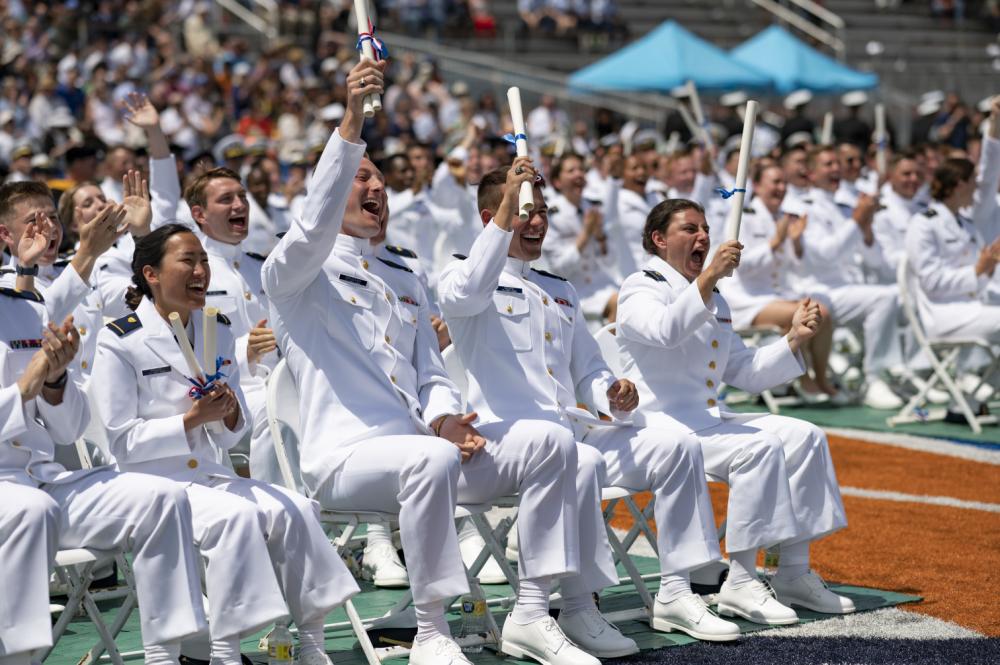
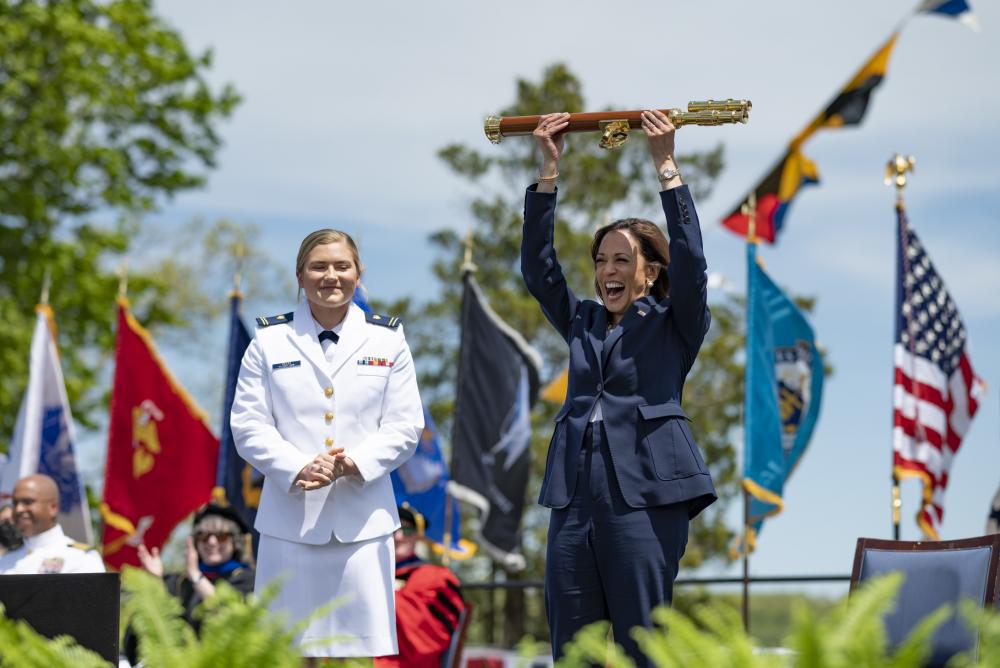
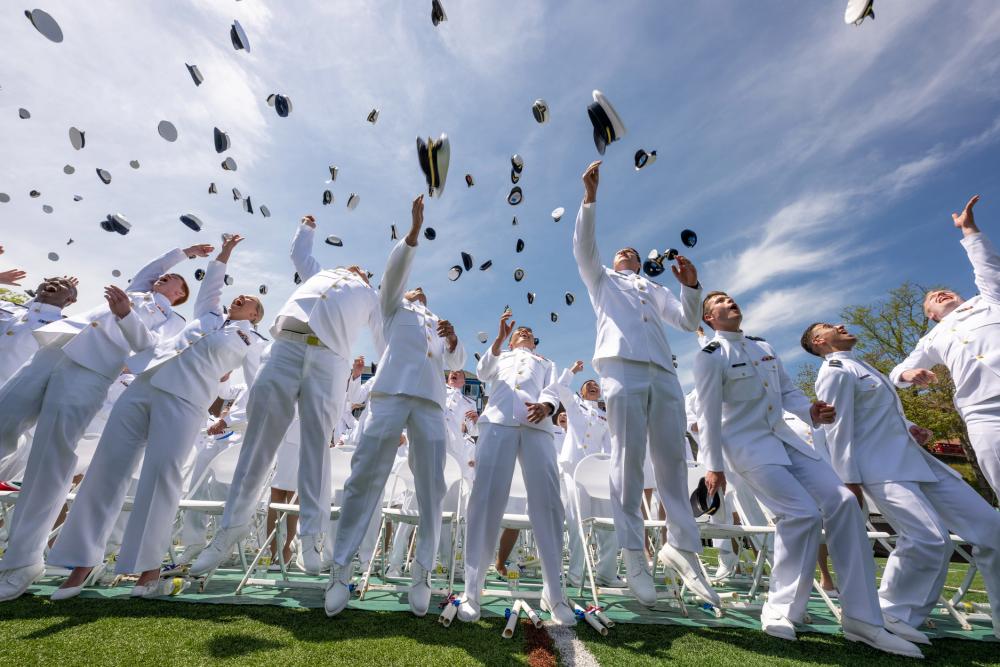
Coast Guard Academy 141st Commencement Exercises May 18, 2022. The Coast Guard Academy graduated 252 new officers along with nine international students. (U.S. Coast Guard photo courtesy of Mr. David Lau)

This is about twice as large as my graduating class, 53 years ago. Interesting class composition including international students and first cyber systems graduates. 

News Release

U.S. Coast Guard Academy

Coast Guard Academy graduates record number of officers

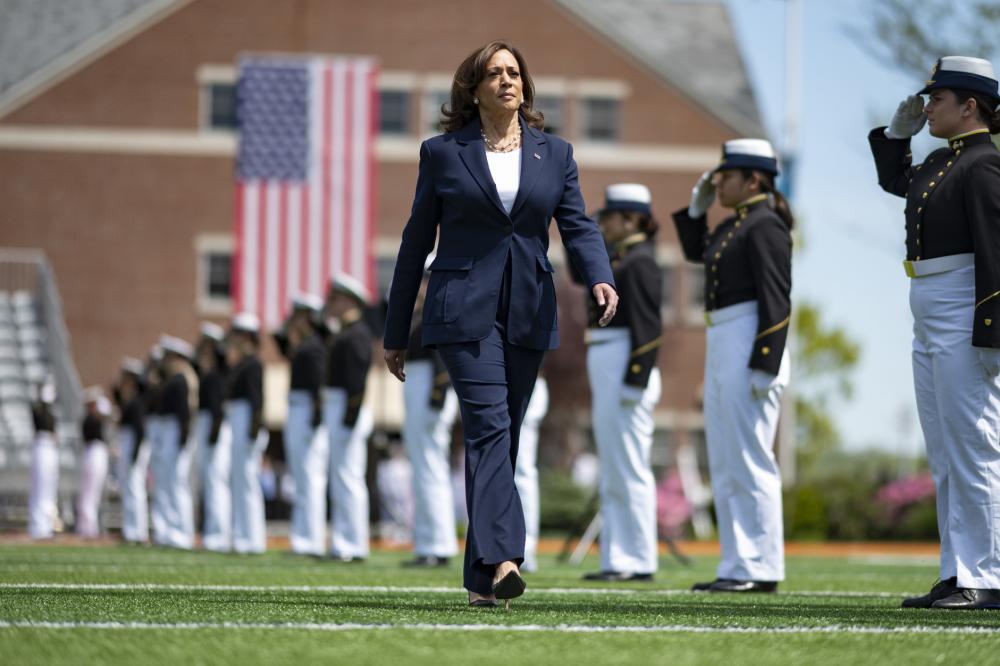
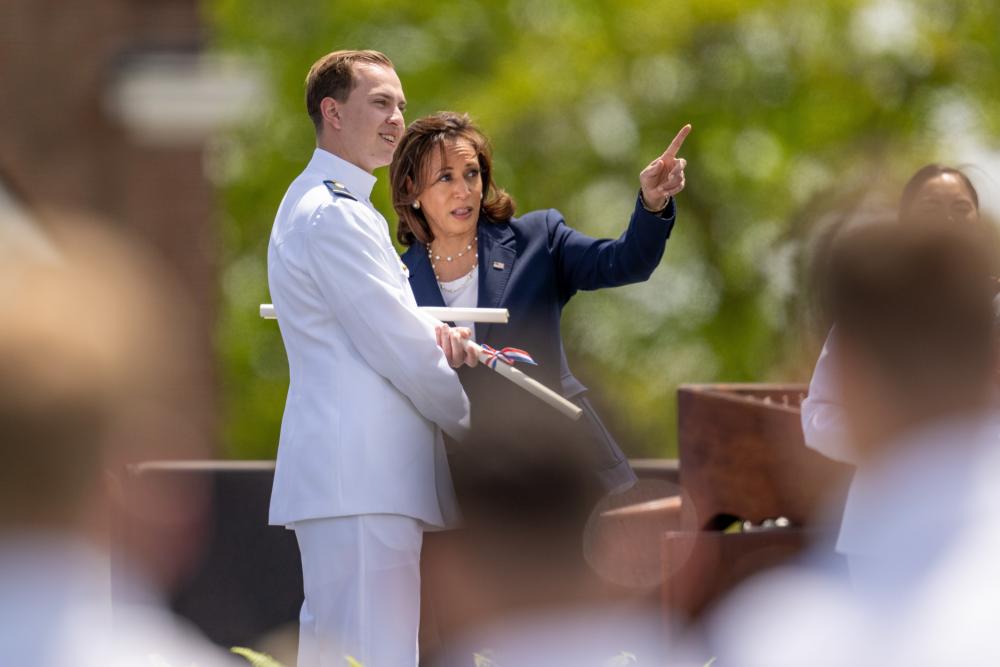
Vice President Kamala Harris delivered the keynote address at the Coast Guard Academy during the 141st Commencement Exercises May 18, 2022. The Coast Guard Academy graduated 252 new officers along with nine international students. (U.S. Coast Guard photo by Petty Officer 3rd Class Matthew Thieme) Vice President Kamala Harris delivered the keynote address at the Coast Guard Academy during the 141st Commencement Exercises May 18, 2022. The Coast Guard Academy graduated 252 new officers along with nine international students. (U.S. Coast Guard photo by Petty Officer 3rd Class Matthew Thieme) Vice President Kamala Harris delivered the keynote address at the Coast Guard Academy during the 141st Commencement Exercises May 18, 2022. The Coast Guard Academy graduated 252 new officers along with nine international students. (U.S. Coast Guard photo courtesy of Mr. David Lau)
Vice President Kamala Harris delivered the keynote address at the Coast Guard Academy during the 141st Commencement Exercises May 18, 2022. The Coast Guard Academy graduated 252 new officers along with nine international students. (U.S. Coast Guard photo courtesy of Mr. David Lau) Vice President Kamala Harris delivered the keynote address at the Coast Guard Academy during the 141st Commencement Exercises May 18, 2022. The Coast Guard Academy graduated 252 new officers along with nine international students. (U.S. Coast Guard photo by Petty Officer 3rd Class Matthew Thieme) Vice President Kamala Harris delivered the keynote address at the Coast Guard Academy during the 141st Commencement Exercises May 18, 2022. The Coast Guard Academy graduated 252 new officers along with nine international students. (U.S. Coast Guard photo courtesy of Mr. David Lau)

Editors’ Note: Click on images to download high resolution version.

NEW LONDON, Conn. — The U.S. Coast Guard Academy graduated 252 new officers along with nine international students with keynote speaker Vice President Kamala Harris in attendance during the 141st Commencement Exercises Wednesday, May 18.

The Class of 2022 consisted of 87 cadets from underrepresented minority groups including the largest number of Asian American and Pacific Islanders to graduate in Academy history.

This year also marked the second highest number of cadets to commission into the Coast Guard in addition to 21 Cyber Systems graduates, the first to graduate from the newly instituted major to meet the needs of the service’s cybersecurity strategy of defending cyber space, enabling operations, and protecting infrastructure.

The new officers will begin to serve as leaders in a variety of operational roles throughout the Coast Guard, mostly on cutters.

Nine graduating international cadets from the countries of Cambodia, Iceland, Jordan, Mexico, Madagascar, Palau, Panama, Rwanda and the Ukraine will serve in their respective countries of origin.

“We view our cadets as our eyes and ears and hands and hearts, wherever you serve,” said Vice President Kamala Harris. “You are doing the critical work — you will be doing the critical work to protect our country, to advance our interests, and to shape the trajectory of world affairs.”

Founded in 1876, the Coast Guard Academy is one of the five U.S. service academies and is ranked among the nation’s most prestigious and selective institutions of higher learning.