“USCG Provides Information on OPCs’ Speed and Machine Gun Armament” by Peter Ong

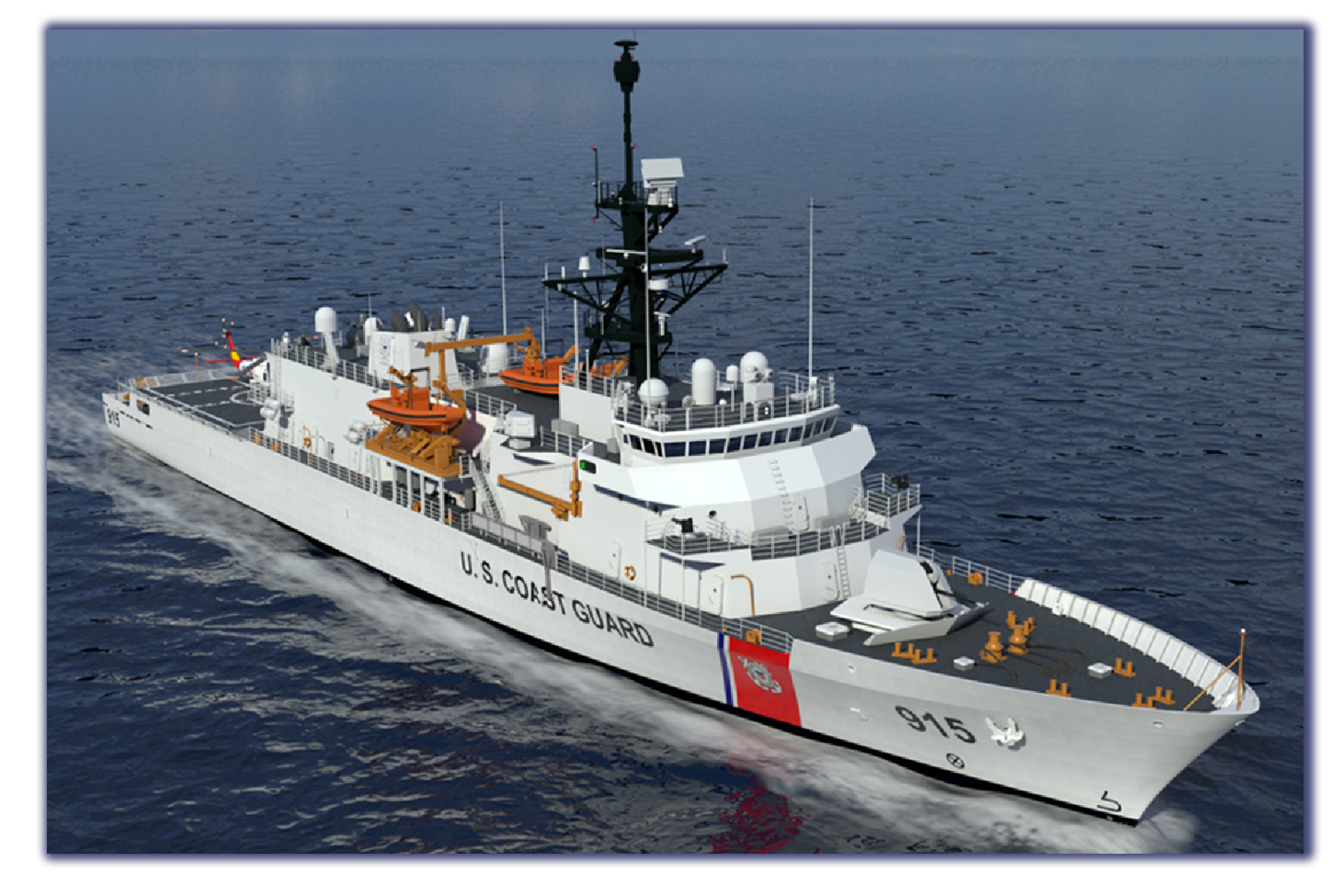
Comments on an earlier post here, “Updated: “U.S. Coast Guard Provides Information On The Offshore Patrol Cutter” –Naval News” prompted friend and journalist Peter Ong, author of the referenced Naval News story, to enquire further. Results below: 


The comments posted on Chuck Hill’s CG Blog in response to my story published 13 January 2022 on Naval News about the U.S. Coast Guard’s Offshore Patrol Cutter (OPC) had a running discussion as to the maximum speed of the OPCs and how many .50 caliber M2HB heavy machine gun mounts the OPCs will be outfitted with.

Some commentators believe that the OPCs can sail faster than 22.5 knots, which according to specifications is the sustained speed of the OPCs.  Furthermore, the number of .50 caliber (12.7mm) M2HB mounts is relatively unknown with some believing that the mounts will be a mixture of remote weapons stations and handheld crew-served pedestal mounts.  (The OPCs are armed with a Mark 110 57mm turret cannon at the bow and a Mark 38 MOD 3 with 7.62mm coaxial chaingun over the hangar).

I inquired to the U.S. Coast Guard’s Public Affairs Department seeking more information on the maximum OPC’s speed and the quantity of small caliber weapon mounts.  Brian Olexy, Communications Manager with the U.S. Coast Guard Acquisition Directorate, replied via email at the end of January 2022.

Question: Some believe that the OPC’s maximum sprint speed, or emergency Flank Speed, is more than 22.5 knots as rated by the specifications.  Can the USCG settle this dispute and provide the maximum “all engines at 100% or more” speed that the OPCs can safely sail at?

Brian: “The contract requires the [Offshore Patrol] cutter to be capable of maintaining a sustained speed through the water of 22 knots in full load condition at delivery.  Sustained speed is not “flank speed,” but rather the speed that the cutter can maintain in trial conditions. While the cutter design is required to meet the capability requirement of 22 knot sustained speed, the Coast Guard expects to obtain greater clarity on the actual speed range of the vessel during pre-acceptance sea trials.”

Question: How many 7.62mm M240 or 12.7mm M2HB mounts will the OPCs have in total?

Brian: “Final armament of the cutter will not be determined until the Coast Guard takes delivery, but the cutter has been designed with six different small caliber weapon mounts.”

Thanks to Peter for the follow-up.

“ARGENTINA DEPLOYS NEW PATROL VESSELS TO COMBAT IUU FISHING” –CIMSEC

The former French Ship L’Adroit, now the Argentinian OPV, ARA Bouchard (P-51)

CIMSEC brings us a report on Argentina’s efforts to combat Illegal, Unreported, and Unregulated (IUU) Fishing.

The former L’Adroit and her three new construction ice-strengthened half-sisters are central to the story. I have long thought these ships epitomized a very disciplined approach to the design of an Offshore Patrol Vessel. Defense capabilities aside, they have everything you need in an OPV and nothing you don’t. They are the best example of my Cutter X concept. They are fast enough at 21 knots. They have enough seaworthiness and endurance (7,000-8,000 nmi at 12 knots). They have a helicopter deck and hangar. They have the boats they need. They have a small crew (30) but can accommodate 60.

That is not to say adding additional capabilities for defense does not make sense, but in affect they constitute a baseline for an OPV. When you start adding capabilities you could say, what is the cost/benefit compared to this baseline?

The post also includes an interesting proposal,

“Regional cooperation is vital to solving this security challenge, which can be achieved by modernizing the Inter-American Treaty of Reciprocal Assistance (Tratado Interamericano de Asistencia Recíproca: TIAR) into a 21st-century agreement that is also tasked with combating IUU fishing.”

Thetis Escorts FRCs Transatlantic

USCGC Thetis (WMEC 910) is moored behind USCGC Glen Harris (WPC 1144) and USCGC Emlen Tunnell (WPC 1145) in Mindelo, Cabo Verde, on Dec. 29, 2021. Mindelo served as the cutters’ first stop after crossing the Atlantic Ocean before continuing the escort of the fast response cutters to the Mediterranean en route to their new homeport of Manama, Bahrain. (U.S. Coast Guard photo by Petty Officer 3rd Class John Hightower)

Below is a press release regarding USCGC Thetis’ escort of Fast Response Cutters Emlen Tunnell and Glen Harris across the Atlantic, enroute Bahrain, where they will become part of the PATFORSWA. Contrary to the title on the release, this was not a counter-narcotics deployment. Appropriately enough, they did have a SAR case enroute.

There are some notable differences between this transit and the previous one. The previous escort by Hamilton, apparently made a more northerly transit and Hamilton and the FRCs parted company in the Mediterranean. Hamilton made several port calls in the Mediterranean and Black Sea.

This transit, perhaps to avoid the North Atlantic in Winter, actually crossed the equator, replenishing in Fortaleza, Brazil Dec. 22/23. They apparently stayed only one day, and then sailed NE to Mindelo, Cape Verde arriving Dec. 29, 2021. They were, unfortunately, underway over Christmas. Fortaleza to Mindelo is only 1477 nautical miles, one of the shortest ways to cross the Atlantic. The FRCs should have been able to make the crossing with ample fuel reserves, without refueling from Thetis.

There is no mention of Thetis entering the Mediterranean or doing any “capacity building” anywhere other than Mindelo. Their SAR case was Jan. 4.

Thetis’ odyssey started in Key West Nov. 18 and ended Jan. 26, 2022.

I expect we will hear about the arrival of the two WPCs in Bahrain very soon.
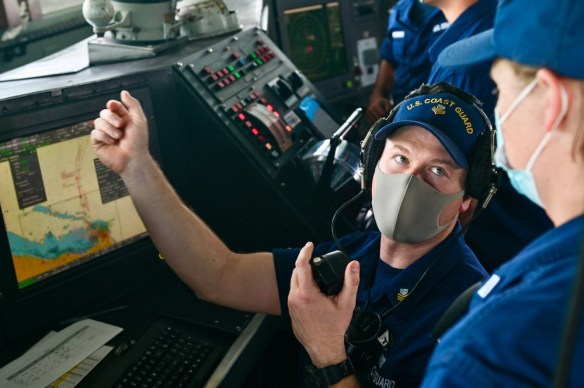
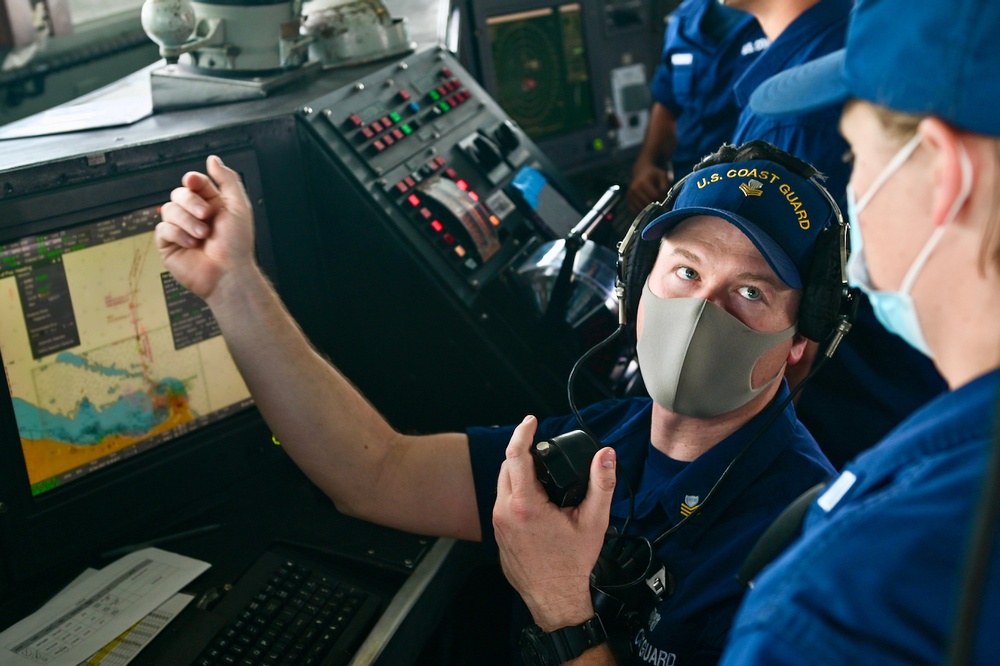
Petty Officer 1st Class Jared Phillips speaks with Lt. Mary Mills on the bridge of USCGC Thetis (WMEC 910) in the port of Fortaleza, Brazil, on Dec. 23, 2021. Phillips served as the navigation evaluator while leaving the port and communicated with the cutter’s combat information center through a sound-powered phone. (U.S. Coast Guard photo by Petty Officer 3rd Class John Hightower)

News Release

U.S. Coast Guard Atlantic Area

USCGC Thetis returns home from 68-day counter-narcotic deployment
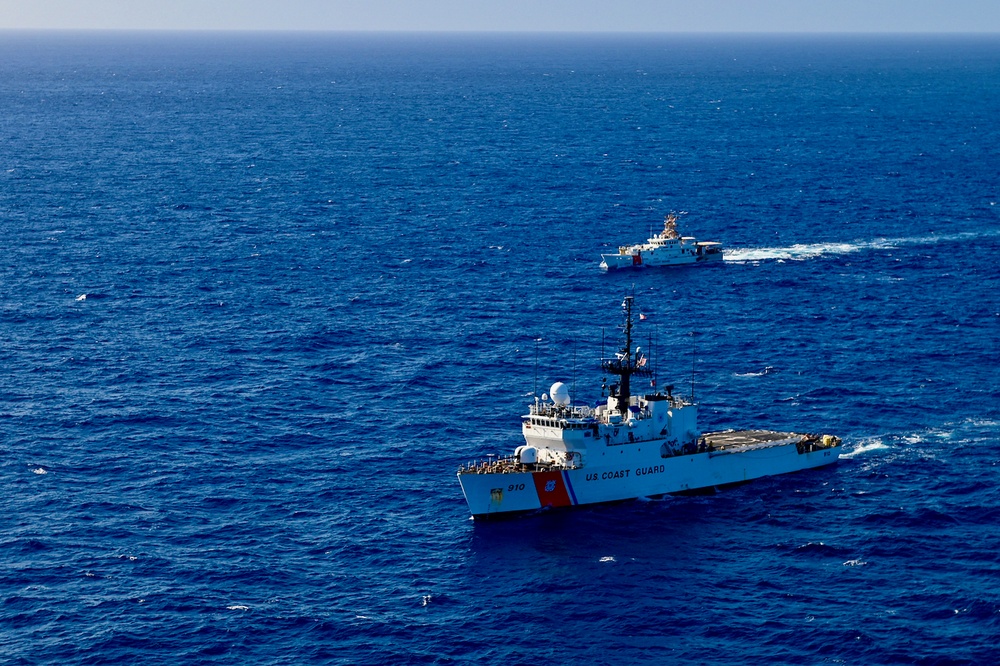
USCGC Thetis fast response cutter escortUSCGC Thetis returns home from 68-day counter-narcotic deploymentUSCGC Thetis returns home from 68-day counter-narcotic deployment
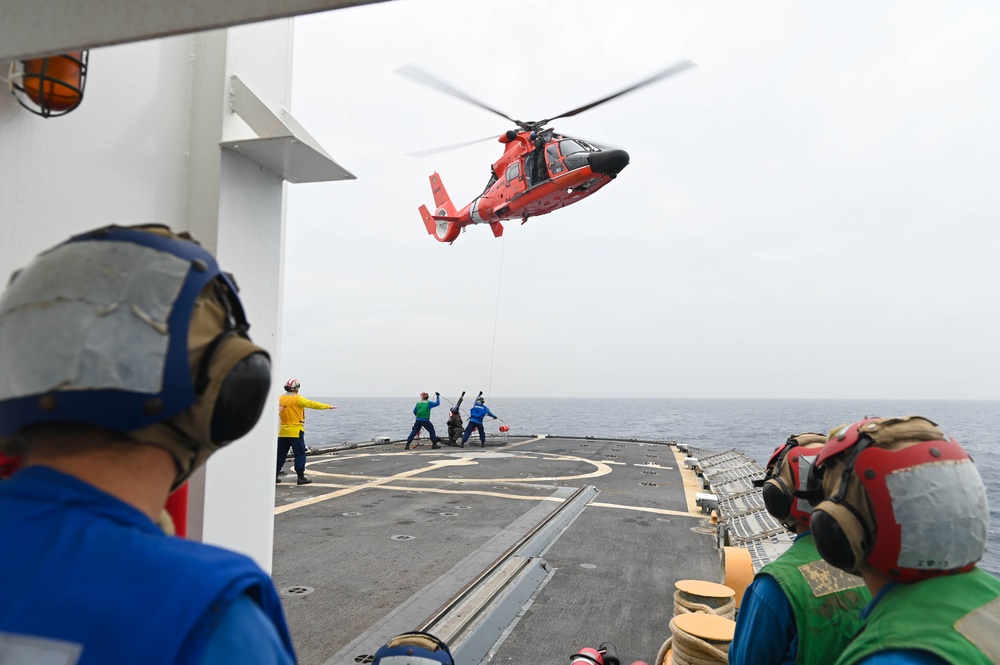
USCGC Thetis returns home from 68-day counter-narcotic deploymentUSCGC Thetis in BrazilU.S. Coast Guard, partners conduct joint rescue of migrants in Atlantic

Editors’ Note: To view more or download high-resolution imagery, click on the photos above.

KEY WEST, Fla. – The U.S. Coast Guard Cutter Thetis’s crew (WMEC 910) returned to homeport in Key West on Wednesday, after a 68-day transit escorting the Coast Guard Cutters Emlen Tunnell (WPC 1145) and Glen Harris (WPC 1144) across the North Atlantic en route to their new homeport in Manama, Bahrain.

Thetis’ crew worked alongside NATO Allies and interagency partners in the region while transiting in the U.S. Navy’s Sixth Fleet area of responsibility.

During the patrol, Thetis’s crew received a report from Spain’s Las Palmas Rescue Coordination Center of two overloaded migrant rafts taking on water. Thetis, Glen Harris and Emlen Tunnell crews worked together to rescue 103 migrants from overloaded and unseaworthy vessels and recovered two deceased migrants. The rescued individuals were provided food and medical care prior to being transferred to a Royal Moroccan Navy frigate.

“While escorting two new cutters across the Atlantic, we responded to a distress call and quickly transitioned to our service’s core mission of search and rescue,” said Cmdr. Justin Nadolny, the commanding officer of Thetis. “Working alongside a Moroccan ship, we were able to rapidly respond to those in distress. The case reinforced the importance of joint operations and reaffirmed the U.S. Coast Guard’s presence in the region to ensure the safety of life at sea. I am exceedingly proud of our professional and highly capable team. The crew of all three ships showed remarkable vigilance and adaptability. This case highlighted the Coast Guard’s ability to operate worldwide to protect and save those in distress on the ocean, along with our ability to work seamlessly with international partners to accomplish a shared mission.”

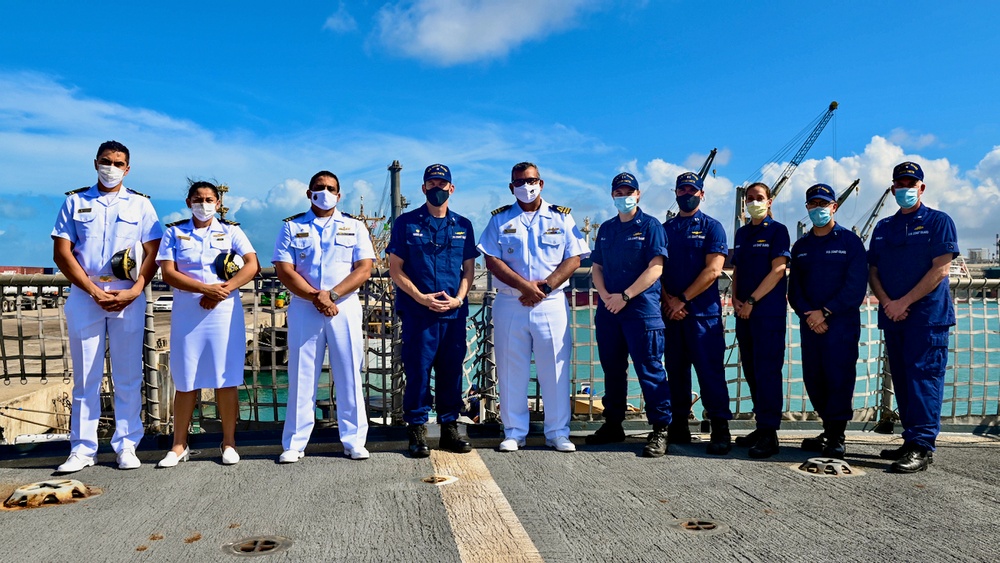
Thetis’ crew strengthened international partnerships in various ports, hosting military and Coast Guard leaders in Fortaleza, Brazil and Mindelo, Cape Verde. Thetis’s crew also embarked a Cape Verdean Coast Guard officer aboard for two weeks. The professional exchange was mutually beneficial, providing U.S. Coast Guard members with a deeper understanding of maritime activity in the region while passing on valuable lessons to our foreign allies.

Prior to departing Cape Verde, U.S. Ambassador Jeff Daigle visited Thetis. The ambassador’s visit showcased the importance of the maritime partnership between the U.S. and Cape Verde while demonstrating the commitment to the shared goal of global maritime security and stability on the African continent.

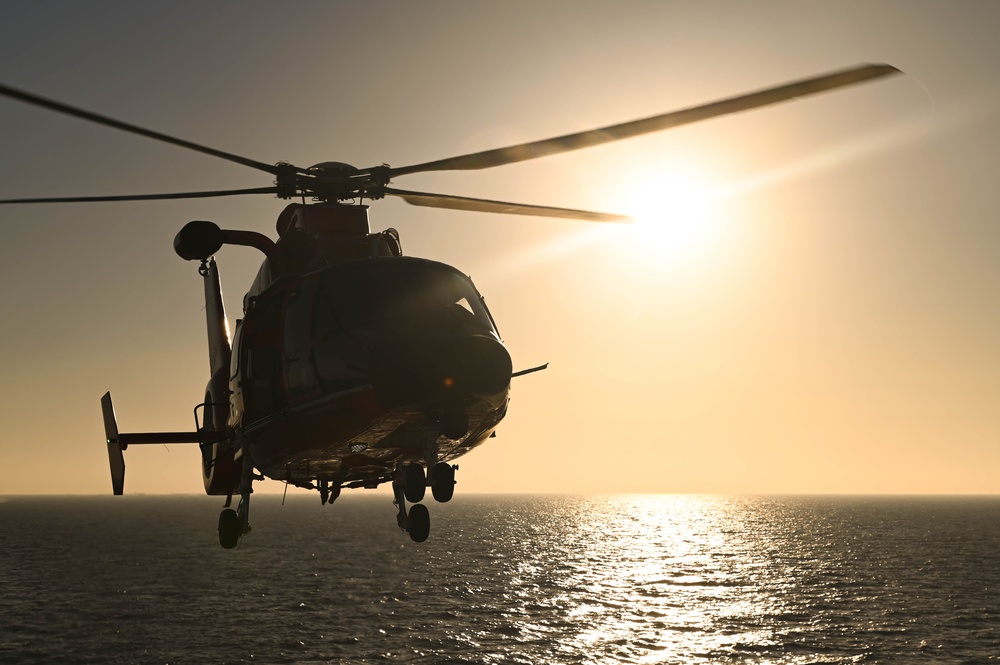
Thetis deployed with a MH-65 helicopter and aircrews from Air Station Miami and Houston to increase their capabilities. The aviation detachment and cutter crew worked together to conduct day and night flight operations and practice rescue hoists.

Thetis is the first 270-foot medium endurance cutter to escort fast response cutters across the Atlantic in support of the Coast Guard’s Patrol Forces Southwest Asia mission. These cutters are the third and fourth to be deployed to the region, with the final two scheduled to be delivered to Bahrain in the spring of 2022.

Thetis is a 270-foot Famous-class cutter homeported in Key West with a crew of 104. Its primary missions are counter-drug operations, migrant interdiction, enforcing federal fishery laws and search and rescue in support of U.S. Coast Guard operations throughout the Western Hemisphere.

65 Foot Tugs

The Coast Guard Cutter Bridle breaks ice on the Penobscot River in Maine March 17, 2015. Operation renewable energy for Northeast Winters. (U.S. Coast Guard photo by Chief Petty Officer Marc Moore)

Below is a news release about a routine operation that occurs every year. Keeping harbors open for delivery of heating oil and breaking up ice dams to prevent flooding is seasonal. It is routine, but it is also important.

What I wanted to point out is, that these useful little ships are getting very old and there is no replacement in sight. Replacement with something more capable would be easy and inexpensive.

The Coast Guard commissioned 15 of these 65 foot harbor tugs between 1961 and 1967, during the same period we were also building 378s, 210s, and 82s. Four have been decommissioned, but eleven continue to serve. All are based in the NE, from Baltimore North.

These little vessels are easy to overlook, but they still do important work. They are 54 to 61 years old. They have at most 500 HP. It is pass time to replace them with something better. Here is an example of a 56 foot, 750 HP potential replacement, and with only a little effort, we could probably do better that.

News Release

U.S. Coast Guard 1st District Northeast

 Coast Guard to break ice along Penobscot, Connecticut, and Hudson Rivers in support of Operation RENEW 

IMMEDIATE OPPORTUNITY AVAILABLE: The Coast Guard Cutters Bridle, Shackle, and Tackle, are scheduled to break ice along the Bangor, Maine, waterfront on the Penobscot River, Thursday, at 26 Front Street, Bangor, Maine. News media must RSVP with D1PublicAffairs@uscg.mil if interested in getting underway for icebreaking operations.

BOSTON — The Coast Guard ice breaking season is underway as winter’s cold temperatures are impacting ports, waterways, and harbors in the Northeast. 

Operation Reliable Energy for Northeast Winters (RENEW) is the Coast Guard’s region-wide effort to ensure Northeast communities have the security, supplies, energy, and emergency resources they need throughout the winter. 

Of the heating oil used in the country, more than 85 percent is consumed in the Northeast, and 90 percent of that is delivered on a Coast Guard maintained waterway by ship. 

The Coast Guard’s domestic icebreaking operations are intended to facilitate navigation within reasonable demands of commerce and minimize waterways closures during the winter, while enabling commercial vessels to transit through ice-covered critical channels. 

Coast Guard crews are also replacing aids to navigation with special ice buoys designed to ride underneath ice and remain on location.  

A coordinated effort with the maritime industry ensures the vital ports of the Northeast remain open year-round. 

COVID-19: The following safety protocols must be followed by all personnel who intend to come aboard any unit for icebreaking:

  • Masks must be worn throughout the event by all attendees
  • Visitors must provide a negative COVID-19 test that is less than 48 hours old (at home test/rapid test/PCR test)
  • Visitors must also provide proof of full vaccination status

“Eastern Shipbuilding Group Completes Major Infrastructure Improvement Project to Support Offshore Patrol Cutter Program” –News Release

Below is a news release from Eastern Shipbuilding Group:

PANAMA CITY, FL – On Thursday, January 20th, Eastern Shipbuilding Group, Inc. (ESG) announced the completion of a new, state-of-the-art aluminum superstructure fabrication and assembly hall at its Nelson Street Shipyard. This major infrastructure project further optimizes ESG’s Nelson Street Facility to support multi-hull production for the U.S. Coast Guard’s (USCG) Offshore Patrol Cutter (OPC) program for which ESG serves as the prime contractor. The $5 million facility was funded through the Triumph Gulf Coast economic development program.

“The construction of this new facility manifests our commitment to provide the country a long-term industrial capability that can build the most exceptional national security assets on schedule and on budget. Every day we employ the highest quality craftmanship to incorporate the finest materials and equipment in these vessels to ensure USCG mission success along our country’s many coastlines. Construction of fabrication capabilities like this new facility, enhance our capabilities while reducing cost and schedule risk. I thank Triumph board members across the panhandle and their staff, as well as area leaders for their investments in support of the USCG OPC program here in Panama City,” said Joey D’Isernia, President of Eastern Shipbuilding Group.

The aluminum fabrication facility, with significant crane capacity and hook height, along with a heavily reinforced high-strength concrete slab flooring system and large sliding entryway doors, was specifically designed to support full construction of the OPC aluminum superstructure from fabrication through assembly and outfitting in a covered and controlled environment. The facility is sized to enhance ESG’s ability to support the peak production rate of delivering two OPCs per year and is part of ESG’s commitment to upgrade and tailor their USCG-dedicated Nelson Street Shipyard to meet the needs of the USCG’s future medium endurance cutter fleet.

The facility was commissioned in a ceremony with leaders of the United States Coast Guard Project Resident Office and local, state and Triumph Gulf Coast officials in attendance.

“The City of Panama City is proud to collaborate with the State of Florida, Triumph Gulf Coast, our neighbors in Bay County and the school board in partnering with Eastern Shipbuilding Group to continue supporting the Offshore Patrol Cutter program for the long term. We believe our community is unmatched anywhere in the country to support the U.S. Coast Guard. We commend Eastern Shipbuilding Group for bringing jobs and opportunities to the region and for the transformative work it’s accomplished since the hurricane. It is the best shipyard to build the OPCs,” said Panama City Mayor Greg Brudnicki.

“Triumph Gulf Coast is pleased to have partnered with the City of Panama City and Eastern Shipbuilding to provide the new aluminum fabrication building that it is so important to the success of the USCG OPC contract. It is an honor to have a role in supporting our military and we hope to continue to support those that protect our nation through partnerships here in Bay County and across our entire region,” said Ben Lee, Triumph Board Member.

In addition to enhanced capabilities, the new hurricane hardened building is built to the latest stringent Florida building codes. The original building was destroyed by Hurricane Michael in 2018. Over the last three years, ESG has fully rebuilt its operational facilities with insurance proceeds and has also made infrastructure expansion investments from $50 million in state appropriations and economic development grants. The company has recently completed launch way upgrades, upland bulkhead upgrades, construction platen expansions, waterway deepening projects and has many more improvement projects underway as part of its commitment to provide a dedicated facility that is optimized for construction of the Offshore Patrol Cutter. At its Allanton Shipyard, ESG has constructed a state-of-the-art C5ISR Production Facility to accomplish testing and integration of operational combat systems, equipment, and simulators on premises prior to final installation on the vessel. ESG will continue to improve its facilities as part of its focused vision to support the USCG’s highest acquisition priority with shipbuilding excellence.

“THERE’S A RACE FOR ARCTIC-CAPABLE DRONES GOING ON, AND THE UNITED STATES IS LOSING” –Modern War Institute

Modern War Institute alerts us to the limitations of US drone technology in the Arctic.

“America’s drones struggle to compete against Russia in the Arctic. In 2019, Russia’s equivalent of the Defense Advanced Research Projects Agency announced a drone capable of remaining airborne for four consecutive days in the Arctic. Russian state sources report their drones can navigate in the Arctic without the use of jammable satellite-based navigation instead employing the alternative GIRSAM system. While the processes behind this system are unknown, supposedly it does not rely on GPS satellites or those of the Russian-developed GLONASS. Not until 2021—two years later—did an American MQ-9A Reaper drone complete a flight navigating with satellites past the seventy-eighth parallel north. Additionally, Russia plans to build an Arctic drone reconnaissance base four hundred and twenty miles off the Alaskan coastline. By 2025, the ability of Russian drones to monitor air, surface, and subsurface activity will far outpace the United States in the Arctic region.”

This is certainly an area the Coast Guard is interested in and one where the Coast Guard’s assets can be of assistance.

“Coast Guard cutters begin Operation Aiga in Oceania” –D14

The crew of the Coast Guard Cutter Juniper (WLB 201) return to Honolulu after completing a 45-day patrol in Oceania in support of Operation ‘Aiga, Oct. 1, 2021. The Juniper is a 225-foot Juniper-Class seagoing buoy tender home-ported in Honolulu, the crew is responsible for maintaining aids to navigation, performing maritime law enforcement, port, and coastal security, search and rescue and environmental protection. (U.S. Coast Guard photo courtesy of Coast Guard Cutter Juniper)

Below is a D14 news release. These long distance/long duration operations pairing a buoy tender (WLB) and a Webber class WPC are getting to be fairly routine.

Buoy tenders are proving to be good PC tenders as well. This is a good demonstration of the multi-mission nature of Coast Guard buoy tenders and support for the contention that the buoy tender function should not be passed off to some other agency or outsourced.

Wonder if they might be able to support more than one patrol craft at a time?

(The photo in the news release below is of a different Juniper class WLB, USCGC Elm)

News Release

U.S. Coast Guard 14th District Hawaii and the Pacific

Coast Guard cutters begin Operation Aiga in Oceania


Editors’ Note: Click on Coast Guard stock images to download a high-resolution version.

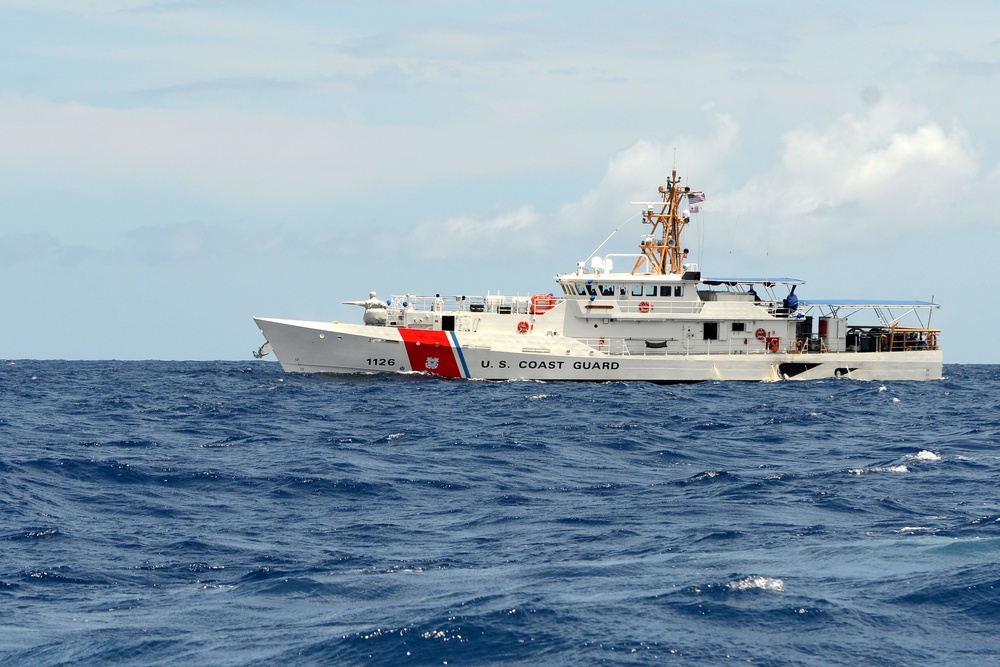
HONOLULU — The crews of the Coast Guard Cutter Juniper (WLB 201) and Joseph Gerczak (WPC 1126) will aim to extend the Coast Guard’s at-sea enforcement presence in the region through a 40-day patrol.

“Aiga,” the Samoan word for family, is designed to integrate Coast Guard capabilities and operations with Pacific Island Country (PIC) partners in order to protect shared national interests, combat illegal, unreported, and unregulated fishing, and strengthen maritime governance in Oceania.

“Responsible fisheries management is vital to the Pacific’s well-being, prosperity, and security,” said Lt. Cmdr. Jessica Conway, the 14th District’s current operations officer. “The Coast Guard is an adaptable, responsive military force of maritime professionals whose broad legal authorities, capable assets, and expansive partnerships provide a persistent presence throughout our exclusive economic zones (EEZ) and on the high seas.”

IUU fishing operates outside the rules adopted at the national and international level. It threatens the ocean’s ecosystem, food security, and economic growth around the world by undercutting law-abiding fishermen and communities that depend on fish and fish products.

“An essential protein source for more than 40% of the world’s population, fish stocks are critical to maritime sovereignty and resource security of many nations,” said Cmdr. Christopher Jasnoch, the Juniper’s commanding officer.

As part of Operation Blue Pacific 2022, the crews of the Juniper and Joseph Gerczak will conduct information sharing activities to advance the U.S.’s bilateral and cultural relationships with Melanesia and Polynesia.

The Coast Guard regularly exercises bilateral shiprider agreements with partner nations. These agreements help to host foreign law enforcement personnel to better exercise their authority; closing any global maritime law enforcement gaps, improve cooperation, coordination, and interoperability.

Operation Blue Pacific is an overarching multi-mission Coast Guard endeavor seeking to promote maritime security, safety, sovereignty, and economic prosperity in Oceania while also strengthening relationships with our partners in the region.

“To ensure a free and open Indo-Pacific, the U.S. remains committed to strengthening regional alliances and enhancing emerging partnerships,” said Lt. Joseph Blinsky, Joseph Gerczak’s commanding officer. “Leading global deterrence efforts, the Coast Guard likewise remains committed to combating IUU fishing and our crews look forward to collaborating with PICs to better address this growing national security concern.”

“New Zealand, Australian Navies Deploy for Tongan Disaster Relief” –USNI

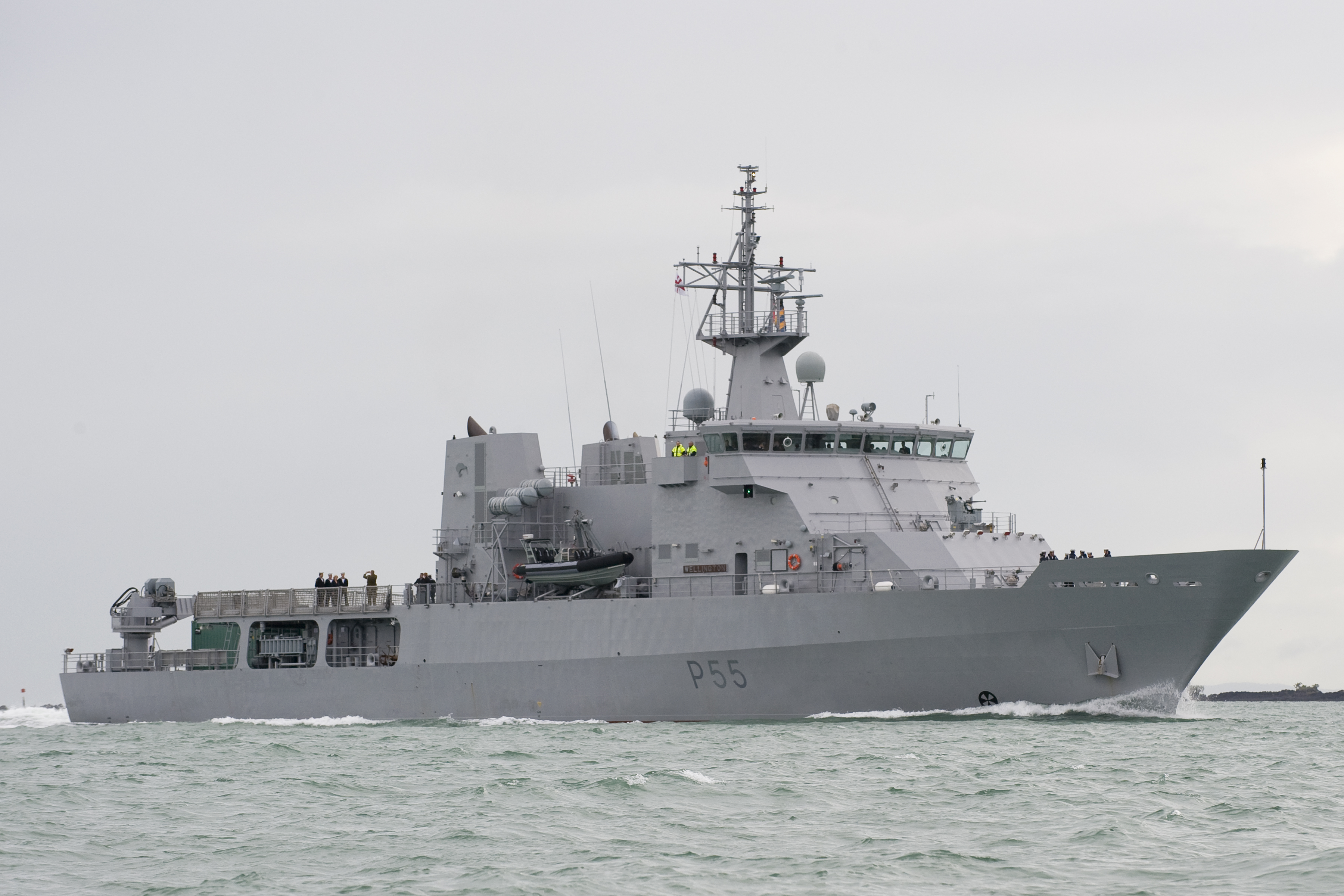
HMNZS Wellington. New Zealand Defence force photo

The US Naval Institute News service reports on the response by the Australian and New Zealand Navies to the tsunami that followed a recent underwater volcanic eruption near Tonga.

Both navies have sent Maritime Patrol Aircraft to survey the damage. New Zealand is taking the initiative to sortie ships even before they receive a request for assistance. Australia is preparing a ship to go.

New Zealand’s response it especially commendable in taking immediate action without waiting for a request for assistance.

Just as in the response to the 2021 earthquake in Haiti, it appears an Offshore Patrol Vessel will be the first ship on scene.

HMNZS Wellington (pictured above) was designed by VARD, same firm that did the design for the Offshore Patrol Cutter.  She is much smaller, but you can see a family resemblance. Photos of the other New Zealand ships mentioned in the below.

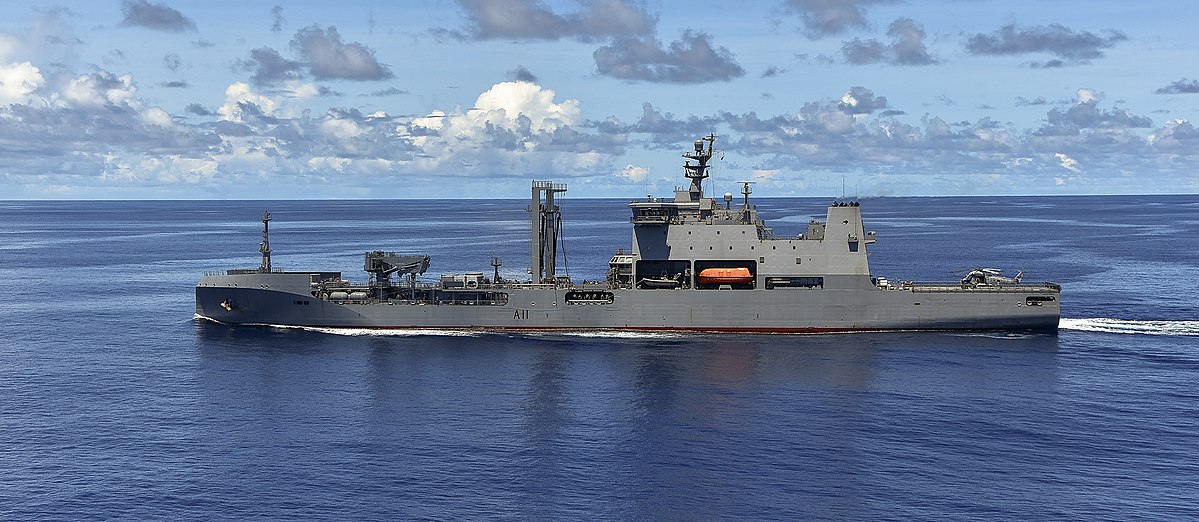
 HMNZS Aotearoa (A11) (Photo courtesy of Deck Cadet Natalie Dorsey) For an underway replenishment ship, this ship is unusual in that it is ice-strengthened. 

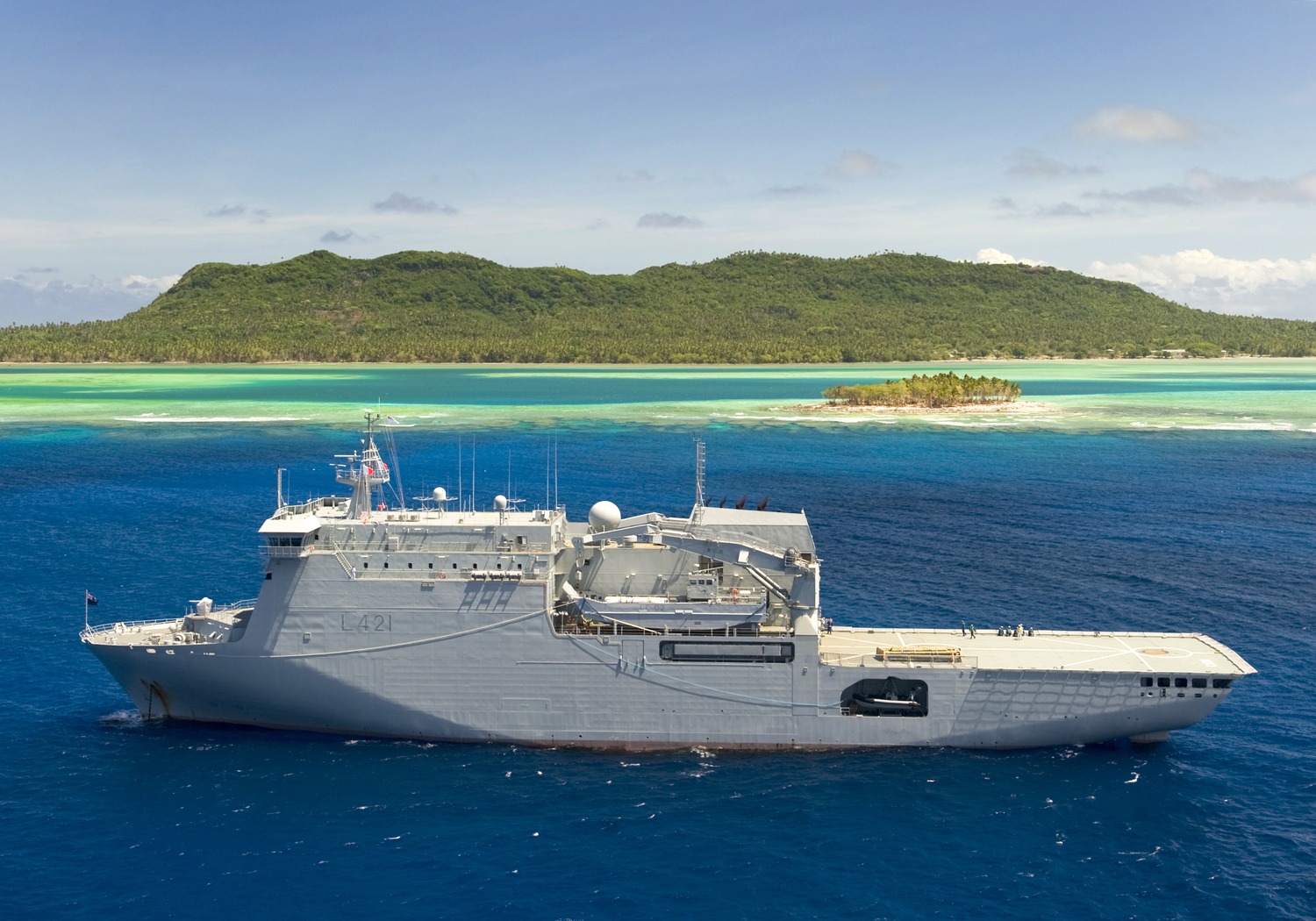
New Zealand Defence Force – The HMNZS CANTERBURY (L 421) off Samoa coastline


“MASTERING EXPEDITIONARY IUU FISHERIES ENFORCEMENT IN THE BAHAMAS” –CIMSEC

HMBS Nassau (P-61). Taken by Erick Perez on 5/26/2007. From Wikipedia commons.

SIMSEC brings us a suggestion from a pair of Coast Guard officers that,

“… in order to achieve the Commandant’s vision for becoming the partner of choice, the Coast Guard only need look 50 miles east of Florida to the Bahamas. The Bahamas is an archipelagic nation beleaguered by competing fisheries claims, including some coming from U.S. commercial and recreational fishermen. It presents a ready-made test bed for partner building and enforcing fisheries violations without the tyranny of distance. It has the further benefit of strengthening partnerships with the nation that enjoys the closest maritime boundary to the United States outside of Mexico and Canada, and where Chinese economic influence is finding a foothold. It is an environment where small U.S. Coast Guard cutters or “patrol boats” are uniquely suited to sustained law enforcement operations in shallow littorals.”

While I find the proposal interesting, there are some issues that need to be considered.

First, unlike the island nations of the Western Pacific that are bound to US by the Compact of Free Association, we have no treaty obligations to the Bahamas and currently no enforcement authority in their waters.

Second, as a member of the Commonwealth Caribbean, I am sure the Bahamian Defense Force already has an on-going relationship with the Royal Navy. We would want to complement rather than replace that.

Third, our objective should be to strengthen Bahamian capability not, replace it. The Bahamian EEZ is 5.6% the size of that of the US. The Royal Bahamian Defense Force (RBDF) is essentially their Coast Guard. They have no army or air force. The RBDF reportedly has 1,600 members so it is about 3.6% the size of the active duty USCG. It is the largest navy in the Commonwealth Caribbean. The have ten patrol vessels:

The oldest and largest, HMBS Bahamas (P-60) and HMBS Nassau (P-61) (pictured above) were delivered in 1999. they are American made, 60.4 m (198 ft) in length, and capable of 24 knots. They are also equipped with a 25mm gun, four .50 caliber machine guns and a pair of RHIBs.

HMBS Rolly Gray (P424) a Damen Stan Patrol 4207

They have four of the very widely used Damen Stan Patrol 4207 (pictured above), used by 13 different coast guards and navies including the Canadian Coast Guard, Mexican Navy, and the UK Border Force. These are little sisters to the Webber class FRCs which are derived from the Damen Stan Patrol 4708 design. The 4207s are 42.8 m (140.4 ft) in length and are typically capable of about 26 knots.

HMBS Lignum Vitae (P 301) a Damen Stan Patrol 3007

They also have four Stan Patrol 3007 patrol boats that were delivered beginning in 2015. They are 30.93 meters (101’5″) in length, have a speed of at least 24 knots, and have a stern ramp for an RHIB.

In addition to three manned aircraft of three different types, two twin engine and one single engine, the RBDF has a fleet of 55 short and medium range UAS provided by the American firm Swift Tactical Systems.

There is certainly a lot we can do for them in terms of information sharing, training and joint exercises. Looks like they have a good basis for an effective force and the Coast Guard could benefit from a strong relationship with them. I gather we already have a good relationship with RBDF.