Odd Ball ISR

A couple of posts from “The Drive” about aircraft that fit somewhere between High Altitude Drones and more common reconnaissance aircraft, sort of low budget U-2s. The first, “The U.S. Coast Guard May Be Flying a Unique Stealthy Spy Plane,” now almost five years old, suggest there might be Coast Guard interest in the second, “Unusual High-Altitude Spy Plane Appears at Special Operations Exercise.”

We know the Coast Guard has dabbled with these type aircraft for drug interdiction, and so far, the Coast Guard has not chosen an Unmanned system to fill this role.

Foward Looking Navigational Sonar

gCaptain brings us a short “sponsored” post about “Safely Navigating Polar Regions.” This is essentially an advertisement for the company, FarSounder, but that is not necessarily all bad. The products are reported to be able to identify navigational hazards in 3D out to 1000 meters at speeds up to 25 knots.

I am not endorsing this particular product. There are probably other vendors offering similar products, but a forward-looking navigational sonar sounds like a good idea for any vessel, such as Offshore Patrol Vessels, that may frequently be called upon to go close in shore for SAR, marine environmental protection, or for interdiction,

FarSounder has fourteen dealers in the US, so it can’t be that exotic.

For icebreakers there is a retractable version.

The Argos 1000 Transducer Module is housed in a retractable steal pod with integrated cover-plate. When retracted, the cover-plate sits flush with the hull and is reinforced for protection during ice-breaking.

Two of the ships reportedly using this system are pictured below. 

Polar cruise ship Le Commandant Charcot

RRS Sir David Attenborough. Proto from Rolls-Royce

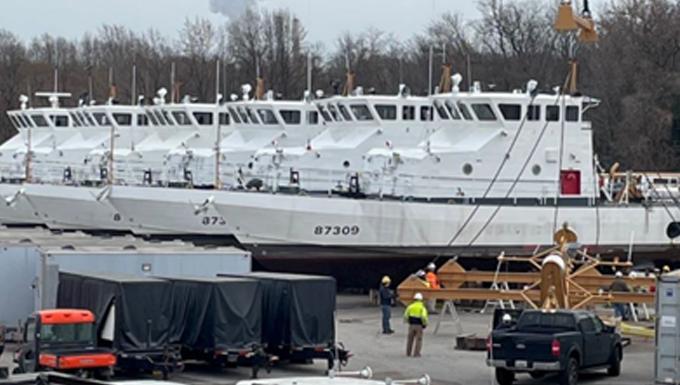
WPB87 transfers

Former Coast Guard Cutters Albacore, Cochito and Gannet are among six cutters currently at Coast Guard Yard awaiting upgrade and outfitting before transfer to Uruguay and Lebanon. U.S. Coast Guard photo.

Just wanted to pass along this photo and its caption which refers to transfers not only to Uruguay but also to Lebanon. The photo was found here.

There was also a report of additional interaction with Lebanese armed forces here.

Coast Guard Cutters Emlen Tunnell and Glen Harris are moored pierside in Beirut, Lebanon, Jan. 31, 2022. The two fast response cutters are deployed to the U.S. 5th Fleet area of operations to help ensure maritime security and stability in the Middle East region. U.S. Army photo by Cpl. DeAndre Dawkins.

“2022 State of the Coast Guard on Feb. 24” –MYCG

Vice Adm. Karl L. Schultz, commander, Coast Guard Atlantic Area, speaks at the Coast Guard Cutter Benjamin Dailey commissioning ceremony in Pascagoula, Miss. Coast Guard Photo

Below is an announcement from MyCG. I have reproduced it in full.


Feb. 7, 2022

You’re invited: 2022 State of the Coast Guard on Feb. 24

By MyCG Staff

Mark your calendars so that you don’t miss this year’s State of the Coast Guard Address. Livestream the event from your workstation or personal device, or join your unit’s watch party.

The Commandant looks forward to sharing stories from across the service, highlighting the tremendous accomplishments of our workforce.

 There are multiple ways to tune in Feb. 24, at 1pm EST  

During the address, you can join the conversation on social media. Visit the Vice Commandant’s Facebook page (@ViceCommandantUSCG) or Twitter account (@VComdtUSCG) using #CoastGuard2022.

Not available to watch the livestream? The full video will available online for you.

If your unit plans to host a watch party, register your event through the State of the Coast Guard Address CG Portal using the watch party community site. Watch party questions and coordination can be directed to Lt. James Carzoli.

Commands are encouraged to host discussions following the Commandant’s address. To help leaders facilitate these events, a conversation guide will be distributed through the Commandant’s FLASH Brief and posted on the State of the Coast Guard portal site.

Join the conversation: This year’s theme for State of the Coast Guard is “United in Service.” Coast Guard members can share what #UnitedInService means to them via Facebook or Twitter.

“SEA CONTROL 314 – A GLOBAL FORCE FOR THE GREATER GOOD WITH CAPT DAVE RAMASSINI”

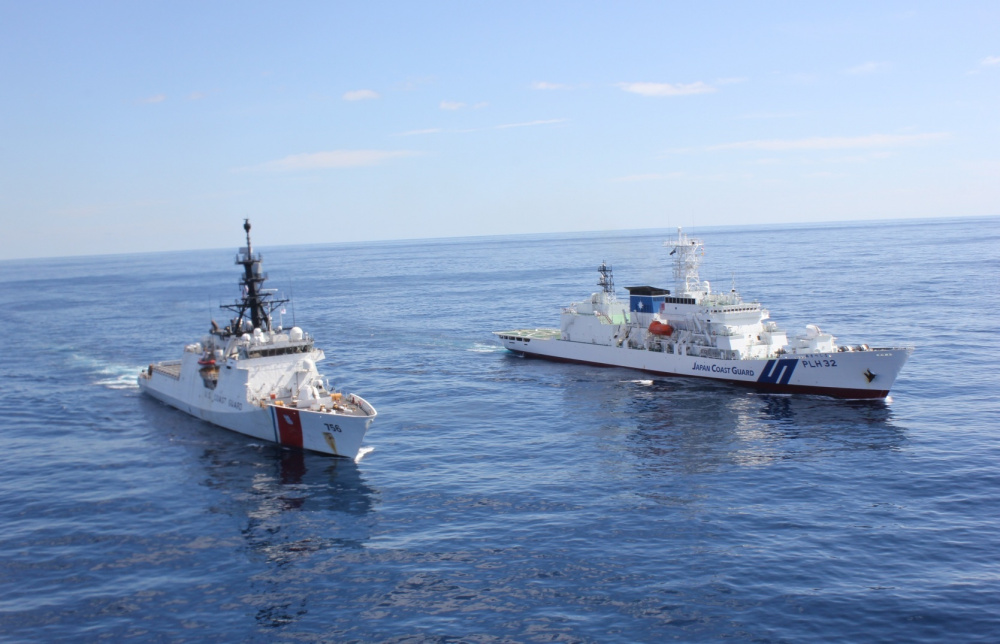
Ships from the U.S. Coast Guard and Japan Coast Guard conducted exercises near the Ogasawara Islands of Japan, Feb. 21, 2021. The U.S. Coast Guard Cutter Kimball and Japan Coast Guard Ship Akitsushima, two of the respective services’ newest and most capable vessels, operated alongside helicopters and unmanned aerial vehicles to practice interdicting foreign vessels operating illegally inside Japanese waters. (U.S. Coast Guard photo courtesy of the Coast Guard Cutter Kimball/Released)

CIMSEC brings us a podcast of particular interest to the Coast Guard.

I don’t really like podcasts myself. It seems a slow and inefficient way to pass information compared to reading. Inevitably, interviews are not as well organized as the written word. But then I don’t have a long commute anymore. That might have changed my opinion.

If you don’t have that long commute, I would recommend reading his Naval Institute Articles as a better use of time.

Of course, if you are not a US Naval Institute member, you may not have access to the full articles. We have discussed a couple of these earlier.

Don’t know how I missed writing about the most recent post which advocates a larger and more stable Coast Guard budget.

“Recognizing the various U.S. instruments of national power—diplomatic, information, military, economic, finance, intelligence, and law enforcement—arguably, no other government entity is as well-positioned, has the reputation for fiscal stewardship, nor has broader authorities and existing bilateral relationships to collectively exercise the full range of these instruments as effectively as the Coast Guard. It is time to properly include the Coast Guard in military rebuilding efforts to properly attend to business beyond U.S. borders that is booming with no remedy in sight. Coast Guard leaders need to get all GCC commanders on board to craft a 24-star letter expressing their need for a more robust and constant Coast Guard presence for the greater good of not only U.S. international partners, but also our own national interests.”


“Lack of Coast Guard Icebreakers Disrupts Shipping on Great Lakes, Says Task Force” –gCaptain

Launch of USCGC Mackinaw (WLBB-30) on April 2, 2005. Photo by Peter J. Markham.

gCaptain brings us a report on Coast Guard icebreaking on the Great Lakes, based on information provided by the Great Lakes Maritime Task Force, a Great Lakes shipping special interest group.

Should this be a Coast Guard function? There are really two elements here, one commercial and one safety.

The commercial aspect is facilitating commerce. Some might say that shippers and ports should pay for their icebreaking. On the other hand, the Federal Government facilitates commerce in a number of ways including, building roads, air traffic control, dredging ports and waterways, and maintaining navigation systems.

The safety aspect is preventing flooding. This is disaster response before the disaster and certainly something DHS should be interested in.

Great Lakes shipping interest are fixated on the idea of a second Great Lakes Icebreaker in the mold of USCGC Mackinaw.

If we accept that Great Lakes icebreaking is a Coast Guard function, but we don’t want to build a dedicated Great Lakes Icebreaker in spite of an apparent desire on the part of members of Congress to appropriate for that purpose, we have to either convince Congress that devoting additional assets would not be cost effective, that additional money is better spent elsewhere, or offer an alternate plan for Great Lakes icebreaking.

Alternatives might be to make the proposed medium icebreakers capable of operating in and out of the Great Lakes so that they could be used there when conditions warranted or perhaps a new fleet of small but more powerful icebreaking tugs to replace the 65 foot WYTLs would fill the bill.

Each of the alternatives offers a different mix of advantages and costs. This is another area where perhaps the Coast Guard needs to invest a bit more in analysis.

Thanks to Bruce for bringing this to my attention.

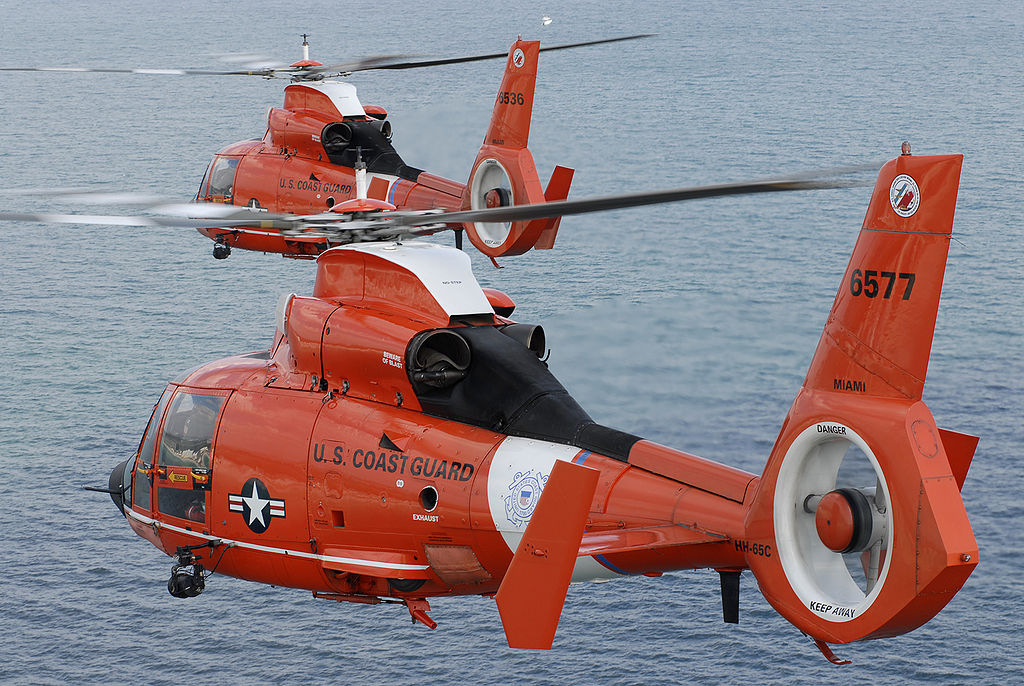
“The Coast Guard’s MH-65 Helicopter Fleet Is Headed For Trouble” –Forbes + Maybe MQ-8Bs

US Coast Guard photo, by PAC Dana Warr

Craig Hooper, writing for Forbes, brings us a warning about the status of the H-65 fleet.

We knew the Coast Guard was in the process of replacing H-65s with H-60s because they have become increasingly difficult to support.

The Coast Guard has on-going life extension programs for both H-60s and H-65s, but the author thinks progress is too slow.

There are two issues here.

  1. Replacing land-based H-65s
  2. Having helicopters that can operate off the WMECs.

I would like to think the Coast Guard has a workable plan to replace the land based H65s but waiting way too long to start replacement programs does seem to be part of the Coast Guard’s DNA.

As to the helicopters for WMECs, Cooper notes,

“At sea, the Coast Guard’s 27 aged mid-sized cutters cannot fully support the larger footprint of an MH-60 platform. Delays in getting the Coast Guard’s highly anticipated Offshore Patrol Cutter into service means the old cutters will remain in the fleet—and needing Dolphin helicopters—for years.”

As I recall, the 13 WMEC 270s were designed to operate H-60s and Alex Haley looks like her facilities may be large enough as well. Certainly, operating H-60s from the 14 WMEC 210s is a non-starter.

The number of H-65s required solely to support 210 operations is relatively small. Judicious use and cannibalization could probably keep a few operational until the last 210 goes out of service.  That should happen about 2032.

If that is not possible, there is another alternative, UAVs. They could certainly operate Scan Eagle. Another possibility is Fire Scout.

The Navy is phasing out their MQ-8B VTOL drone in favor of the larger MQ-8C. Perhaps the Coast Guard could take over some or all 30 ot the B models and operate them from 210s. They might also be operated alongside H-60s from Bertholf class NSCs and Argus class OPCs. Although they probably cannot do armed overwatch (or maybe they could), they might be a better search asset than the H-65, given their greater endurance. This would also prep the Coast Guard to also participate in the MQ-8C at some time in the future.

PACIFIC OCEAN (Sept. 18, 2019) Sailors push an MQ-8B Fire Scout assigned to the Wildcards of Helicopter Sea Combat Squadron (HSC) 23 on the flight deck of the Independence-variant littoral combat ship USS Gabrielle Giffords (LCS 10).  (U.S. Navy photo by Mass Communication Specialist 3rd Class Josiah J. Kunkle/Released)190918-N-YI115-1004

Interestingly, there is also a comment about the Coast Guard’s role in DOD’s Future Vertical Lift (FVL) Program,

“Replacement helicopters will be slow to arrive. The U.S. Coast Guard Commandant, Admiral Karl L. Schultz, says the Service is “looking fifteen or so years down the road at our rotary wing aviation program.” Unless the Coast Guard acts quickly to have their basic performance requirements folded into the Department of Defense’s Future Vertical Lift Initiative, a Coast Guard variant of whatever the Navy gets will likely take two decades—or more—to obtain and field.”

The FVL program is expected to produce at least two airframes, one to replace the H-60 and a smaller aircraft to replace the Army’s scout helicopters.

Thanks to Paul for bringing this to my attention. 

“USCG Provides Information on OPCs’ Speed and Machine Gun Armament” by Peter Ong

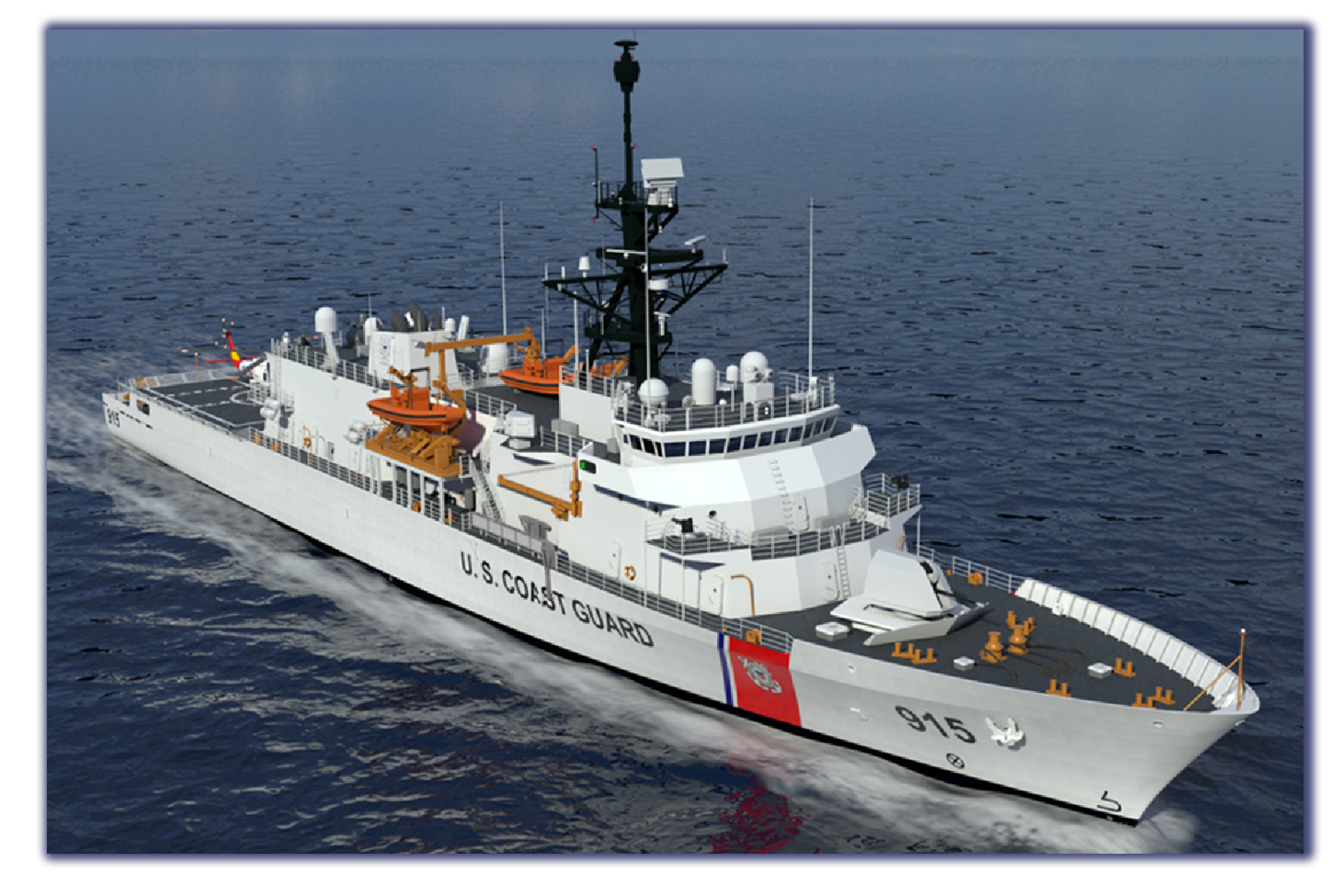
Comments on an earlier post here, “Updated: “U.S. Coast Guard Provides Information On The Offshore Patrol Cutter” –Naval News” prompted friend and journalist Peter Ong, author of the referenced Naval News story, to enquire further. Results below: 


The comments posted on Chuck Hill’s CG Blog in response to my story published 13 January 2022 on Naval News about the U.S. Coast Guard’s Offshore Patrol Cutter (OPC) had a running discussion as to the maximum speed of the OPCs and how many .50 caliber M2HB heavy machine gun mounts the OPCs will be outfitted with.

Some commentators believe that the OPCs can sail faster than 22.5 knots, which according to specifications is the sustained speed of the OPCs.  Furthermore, the number of .50 caliber (12.7mm) M2HB mounts is relatively unknown with some believing that the mounts will be a mixture of remote weapons stations and handheld crew-served pedestal mounts.  (The OPCs are armed with a Mark 110 57mm turret cannon at the bow and a Mark 38 MOD 3 with 7.62mm coaxial chaingun over the hangar).

I inquired to the U.S. Coast Guard’s Public Affairs Department seeking more information on the maximum OPC’s speed and the quantity of small caliber weapon mounts.  Brian Olexy, Communications Manager with the U.S. Coast Guard Acquisition Directorate, replied via email at the end of January 2022.

Question: Some believe that the OPC’s maximum sprint speed, or emergency Flank Speed, is more than 22.5 knots as rated by the specifications.  Can the USCG settle this dispute and provide the maximum “all engines at 100% or more” speed that the OPCs can safely sail at?

Brian: “The contract requires the [Offshore Patrol] cutter to be capable of maintaining a sustained speed through the water of 22 knots in full load condition at delivery.  Sustained speed is not “flank speed,” but rather the speed that the cutter can maintain in trial conditions. While the cutter design is required to meet the capability requirement of 22 knot sustained speed, the Coast Guard expects to obtain greater clarity on the actual speed range of the vessel during pre-acceptance sea trials.”

Question: How many 7.62mm M240 or 12.7mm M2HB mounts will the OPCs have in total?

Brian: “Final armament of the cutter will not be determined until the Coast Guard takes delivery, but the cutter has been designed with six different small caliber weapon mounts.”

Thanks to Peter for the follow-up.

“ARGENTINA DEPLOYS NEW PATROL VESSELS TO COMBAT IUU FISHING” –CIMSEC

The former French Ship L’Adroit, now the Argentinian OPV, ARA Bouchard (P-51)

CIMSEC brings us a report on Argentina’s efforts to combat Illegal, Unreported, and Unregulated (IUU) Fishing.

The former L’Adroit and her three new construction ice-strengthened half-sisters are central to the story. I have long thought these ships epitomized a very disciplined approach to the design of an Offshore Patrol Vessel. Defense capabilities aside, they have everything you need in an OPV and nothing you don’t. They are the best example of my Cutter X concept. They are fast enough at 21 knots. They have enough seaworthiness and endurance (7,000-8,000 nmi at 12 knots). They have a helicopter deck and hangar. They have the boats they need. They have a small crew (30) but can accommodate 60.

That is not to say adding additional capabilities for defense does not make sense, but in affect they constitute a baseline for an OPV. When you start adding capabilities you could say, what is the cost/benefit compared to this baseline?

The post also includes an interesting proposal,

“Regional cooperation is vital to solving this security challenge, which can be achieved by modernizing the Inter-American Treaty of Reciprocal Assistance (Tratado Interamericano de Asistencia Recíproca: TIAR) into a 21st-century agreement that is also tasked with combating IUU fishing.”