“Autonomous vessels can help the Coast Guard safeguard our waters” –Work Boat

S&T, USCG, Ocean Aero, CNSP, NRL, ARL, HSSEDI, and USM’s evaluation team monitors a Triton autonomous vessel during performance testing. DHS photo. Note here the mast is folded down. 

Work Boat has a short report from DHS’s Science and Technology Directorate about experiments with an unmanned system.

First, its good to see the Department supporting R&D efforts on behalf of the Coast Guard, because the Coast Guard R&D budget is miniscule.

Second, this unmanned surface system is a bit unique, in that it is submersible, unlike the SeaDrones that the Coast Guard had previously experimented with. It is not primarily expected to operate underwater, because it is powered by wind and solar, but it does have the capability to submerge.

There are already several autonomous vessels in the field utilized for both commercial and military applications. However, the Tritons are a unique technology. At 14 feet long, they are the size of a small rowboat—making them easy to deploy from any port or USCG vessel. They are environmentally friendly and rely solely on wind and solar power at sea. The Tritons’ solar arrays are positioned atop their hulls, along with retractable 8-foot wind sails—both designed to charge the Tritons’ batteries whenever they are on the surface of the ocean. The Tritons also perform surface and underwater surveillance activities; navigate while submerged; dive to about 100 feet; and accommodate state-of-the-art sensor packages that utilize electro-optical and infrared cameras, sonar, and other specialized sensors. All of these characteristics and abilities make them useful for long-term USCG maritime protection and law enforcement operations at sea.

The ability to submerge opens up some interesting options. This might be used to avoid collision. It might be used to sample the water column. It might be used to put acoustic sensors below the surface layer. Or it might be used to take a closer look at mine-like objects below the surface.

Thanks to Paul for bring this to my attention. 

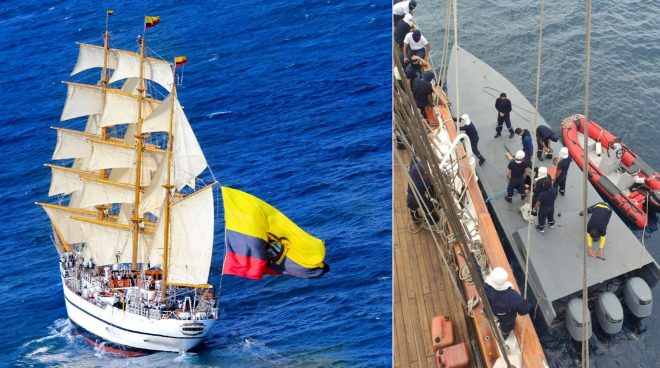
“Ecuadorian Navy Sailing Ship Interdicts Drug Smugglers in the Pacific” –USNI

Ecuadorian Navy Sailing Ship Interdicts Drug Smugglers in the Pacific

The US Naval Institute news service reports,

A three-masted training ship interdicted a drug-laden high-speed smuggling vessel off the coast of Colombia on Friday, the Ecuadorian Navy announced.

Sailing ship BAE Guayas caught the low-profile vessel within the 200-nautical miles of the Colombian exclusive economic zone, the service announced.

Maybe we should put Eagle to work.

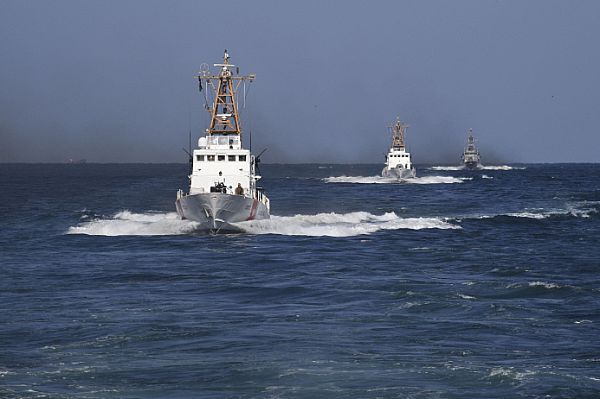
“Ukraine to receive 3 more Island-class patrol boats from the U.S.” –Naval Post

180201-N-TB177-0211
U.S. 5TH FLEET AREA OF OPERATIONS (Feb. 1, 2018) Island-class patrol boats USCGC Wrangell (WPB 1332), left, USCGC Aquidneck (WPB 1309), middle, and coastal patrol ship USS Firebolt (PC 10) patrol the open seas. Wrangell, Aquidneck and Firebolt are forward deployed to the U.S. 5th Fleet area of operations in support of maritime security operations to reassure allies and partners and preserve the freedom of navigation and the free flow of commerce in the region. (U.S. Navy photo by Mass Communication Specialist 2nd Class Kevin J. Steinberg/Released)

Naval Post reports,

According to Ukraine’s Washington Ambassador’s statements on Friday, the U.S. will hand over three Island-class patrol boats to Ukraine in November.

Thanks to Nicky for bringing this to my attention. 

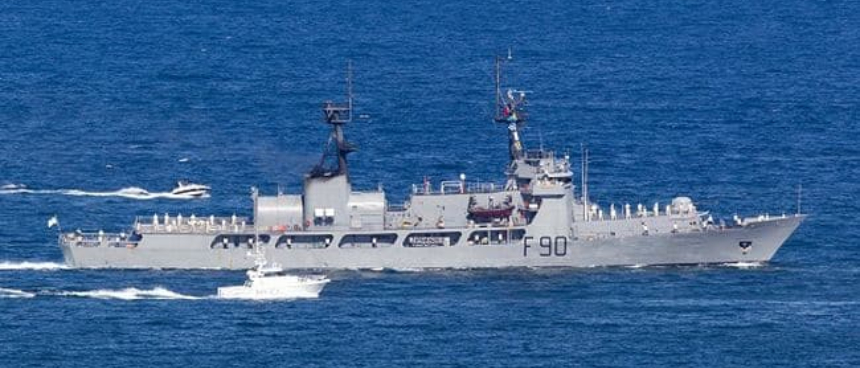
“NIGERIA RECORDS LOWEST LEVEL OF PIRACY SINCE 1994” –Baird Maritime

The Nigerian Navy frigate NNS Thunder, former USCGC Chase (Photo: International Chamber of Shipping)

Baird Maritime gives us some good news out of Nigeria,

The trend of reduction in piracy and armed robbery in Nigerian waters has continued, with the International Maritime Bureau (IMB) reporting in its third quarter 2021 account a 77 per cent decrease in the first nine months of the year, compared to the same period last year.

Nigeria reported four incidents in the first nine months of 2021, in comparison to 17 in 2020 and 41 in 2018. This represents a 77 per cent decrease in incidents between 2021 and 2020, and a 95 per cent reduction from 2018. The IMB also reported a 39 per cent reduction in piracy and armed robbery incidents in the Gulf of Guinea.

I think perhaps the US Coast Guard may have had something to do with this. They now have two former USCG WHECs, Chase and Gallatin, transferred in 2011 and 2014 respectively. USCGC Thetis was there in 2019 for Exercise Obangame Express. Coast Guard teams also operated from Navy vessels.

Cat 4 Hurricane, No Problem, Bollinger Delivers USCGC John Scheuerman Ahead of Schedule

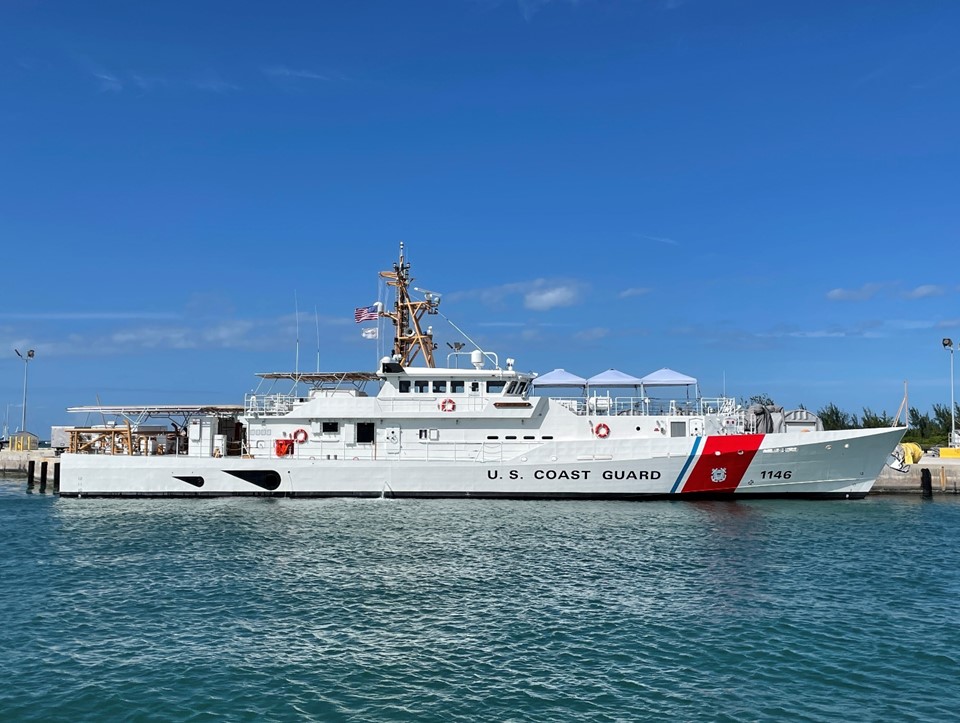
USCGC John Scheuerman in Key West, Florida.

Below is a lightly edited Bollinger news release. The battle in which John Scheuerman lost his life, was the Invasion of Solerno. If you read the link I provided, you can see that the Luftwaffe response was so intense, it caused the naval task force commander shift his flag to a less conspicuous ship, USS Biscayne, a ship that would later serve as USCGC Dexter.


BOLLINGER SHIPYARDS DELIVERS 46th FAST RESPONSE CUTTER AHEAD OF SCHEDULE DESPITE DIRECT HIT FROM HURRICANE IDA 

LOCKPORT, La., – (October 21, 2021) – Bollinger Shipyards LLC (“Bollinger”) has delivered the newest Sentinel-class Fast Response Cutter (“FRC”), the USCGC John Scheuerman, to the U.S. Coast Guard in Key West, Florida nearly one week ahead of schedule despite a three week shutdown due to the significant damage sustained to Bollinger’s facilities during Hurricane Ida. The storm made landfall in late August near Port Fourchon, Louisiana as a powerful Category 4 storm. Bollinger’s facilities in Port Fourchon, Lockport, Houma and Larose suffered significant damage as a result of Hurricane Ida, which tied with last year’s Hurricane Laura and the Last Island Hurricane of 1856 as the strongest on record in Louisiana.

“While every delivery is meaningful, being able to deliver this vessel nearly a week early despite everything our crew has faced over the past month is nothing short of remarkable,” said Bollinger President & CEO Ben Bordelon. “We had folks who lost everything in that storm. Our yard where we build the FRCs took a beating and was shuttered for three weeks while we rebuilt. This vessel and this delivery is a win our folks really needed and it reflects the resilience, commitment and tenacity of the 650 skilled men and women that built it.”

On September 24th, following an extensive multi‐week recovery and rebuilding effort, Bollinger welcomed employees back to all 11 of its facilities across Louisiana. Bollinger’s Lockport facility is home to the FRC program, which directly supports 650 jobs. The USCGC John Scheuerman departed Lockport on Monday, October 11th for Bollinger’s Fourchon facility where it performed a shakedown excercise prior to dry docking for final inspection in preparation of its delivery. The Cutter departed Fourchon for Key West, FL on Sunday, October 17th. The USCGC John Scheuerman is the 169th vessel Bollinger has delivered to the U.S. Coast Guard over a 35-year period and the 46th FRC delivered under the current program. The USCGC John Scheuerman is the fifth of six FRCs to be home-ported in Manama, Bahrain, which will replace the aging 110’ Island Class Patrol Boats, built by Bollinger Shipyards 30 years ago, supporting the Patrol Forces Southwest Asia (PATFORSWA), the U.S. Coast Guard’s largest overseas presence outside the United States.

U.S. Coast Guard Commandant Adm. Karl Schultz has previously lauded the “enhanced seakeeping capabilities” of the PATFORSWA-bound FRCs, saying the ships are going to be “game changing” in their new theater of operations. Last week, at the commissioning ceremony for the USCGC Emlen Tunnell—another Bahrain-based FRC—Adm. Schultz noted that these ships will “conduct maritime security operations, theater cooperation efforts, and strengthen partner nations’ maritime capabilities to promote security and stability in the region, as well as thwart the increasingly aggressive and dangerous maritime activities of the Iranian Revolutionary Guard Corps.” He went on to say that these FRCs are “a perfect complement to the capabilities of both the Navy and Marine Corps. United, we bring a range of maritime capabilities to employ across the cooperation-competition-lethality continuum.”

PATFORSWA is composed of six cutters, shoreside support personnel, and the Maritime Engagement Team. The unit’s mission is to train, organize, equip, support and deploy combat-ready Coast Guard Forces in support of U.S. Central Command and national security objectives. PATFORSWA works with Naval Forces Central Command in furthering their goals to conduct persistent maritime operations to forward U.S. interests, deter and counter disruptive countries, defeat violent extremism and strengthen partner nations’ maritime capabilities in order to promote a secure maritime environment.

Each FRC is named for an enlisted Coast Guard hero who distinguished themselves in the line of duty. John Scheuerman, Seaman First Class, United States Coast Guard Reserve was posthumously presented the Silver Star Medal for service as set forth in the following citation:  “For conspicuous gallantry and intrepidity in action while serving on board the U.S.S. LCI (L) 319 during the amphibious invasion of Italy, September 9, 1943.  Observing an enemy fighter plane diving in for a strafing attack as his vessel approached the assault beaches in the Gulf of Salerno, SCHEUERMAN unhesitatingly manned his battle station at an exposed antiaircraft gun and, with cool courage and aggressive determination, exerted every effort to direct accurate gunfire against the hostile aircraft.  Although mortally wounded before he could deliver effective fire, he remained steadfast at his post in the face of imminent death, thereby contributing materially to the protection of his ship against further attack.  SCHEUERMAN’s fearless action, great personal valor and selfless devotion to duty under extremely perilous conditions were in keeping with the highest traditions of the United States Naval Service.” Scheuerman also posthumously received the Purple Heart Medal.

“Eastern Shipbuilding opens new C5I integration facility for offshore patrol cutter” –Defense News

Eastern Shipbuilding Group is on contract to build the first four offshore patrol cutters for the U.S. Coast Guard and is competing for the contract for the rest of the class. The first ship, Argus, is in construction and expected to deliver by the end of 2022. (Eastern Shipbuilding Group photo)

Defense News reports,

PANAMA CITY, Fla. — Eastern Shipbuilding Group, Northrop Grumman and their industry partners formally opened a test and integration center this week for the C5I systems at the heart of the U.S. Coast Guard’s new offshore patrol cutter program.

This OPC production facility is meant to reduce risk on what the Coast Guard calls its top acquisition priority. Within mockups of the bridge, the operations center and other key rooms, every piece of internal and external sensing and communications equipment will be networked together in this facility at Eastern’s Allanton yard first, tested for any integration hiccups and then sent up the road to the company’s Nelson Street yard where the OPC hulls are being constructed.

Northrop Grumman Vice President for Maritime Systems and Integration Todd Leavitt told Defense News this C5I system — command, control, communications, computers, cyber, intelligence, surveillance and reconnaissance — is more complex than even the Consolidated Afloat Networks and Enterprise Services (CANES) program the company worked on for the U.S. Navy.

That is only a small part of the report which includes information about the ship’s internal communications system. A shoreside facility is a great idea. It will likely eliminate post delivery teething problems that can be expensive and delay deployment.

We really need these ships to work right out of the box.

“Coast Guard cutter returns home following Western Pacific deployment” –News Release

Coast Guard Cutter Munro (WMSL 755) crewmember Petty Officer 2nd Class Kurt Chlebek, a boatswains mate, is greeted by his dog after Munro returned to their homeport in Alameda, California, Oct. 20, 2021, following a 102-day, 22,000 nautical mile multi-mission deployment. Munro’s crew departed Alameda in July for a Western Pacific patrol and operated in support of United States Indo-Pacific Command, which oversees military operations in the region. U.S. Coast Guard photo by Chief Petty Officer Matt Masaschi.

Wrap-up of USCGC Munro’s recent deployment to the Western Pacific.

united states coast guard

News Release

Oct. 20, 2021
U.S. Coast Guard Pacific Area

Coast Guard cutter returns home following Western Pacific deployment

Photo of U.S. and Japan Coast Guard vessels
Coast Guard Cutter Munro crew returns home following 102-day, 22,000 nautical mile multi-mission Western Pacific deployment Coast Guard Cutter Munro crew returns home following 102-day, 22,000 nautical mile multi-mission Western Pacific deployment

Editors’ Note: Click on images to download high resolution versions.

Alameda, Calif. – The U.S. Coast Guard Cutter Munro (WMSL 755) and crew returned to their Alameda homeport Wednesday following a 102-day, 22,000-nautical-mile deployment to the Western Pacific.

Munro departed Alameda in July to the Western Pacific to operate under the tactical control of U.S. Navy 7th Fleet to promote a free and open Indo-Pacific.

“Munro’s deployment demonstrated the Coast Guard’s unique authorities in support of the Indo-Pacific command,” said Vice Adm. Michael F. McAllister, commander Coast Guard Pacific Area. “Joint operations help strengthen our partnerships through search and rescue, law enforcement, marine environmental response and other areas of mutual interest which preserve a stable and secure global maritime environment.”

Munro’s crew executed numerous cooperative engagements, professional exchanges and capacity building efforts with naval allies and partners, including the Japan Coast Guard, Japan Maritime Self Defense Force, Philippine Coast Guard and Bureau of Fisheries and Aquatic ResourcesRoyal Australian Navy, and Indonesia Maritime Security Agency.

“Our relationships in the Western Pacific are stronger today, and our partners are unified in their commitment to security,” said Capt. Blake Novak, commanding officer of Munro. “It was an incredible opportunity for our crew to participate alongside allies, sharing search and rescue and law enforcement concepts to promote peace, prosperity, and the sovereign rights of all nations.”

As both a federal law enforcement agency and an armed force, the U.S. Coast Guard is uniquely positioned to conduct defense operations in support of combatant commanders on all seven continents. The service routinely provides forces in joint military operations worldwide, including the deployment of cutters, boats, aircraft, and deployable specialized forces.

Munro is one of four 418-foot national security cutters homeported in Alameda. National security cutters like Munro feature advanced command and control capabilities, aviation support facilities, stern cutter boat launch, and increased endurance for long-range patrols, enabling the crews to disrupt threats to national security further offshore.

Photos from the Munro’s deployment are available here.

Deploying Lifeboat, A New Capability for European Maritime Safety Agency Drones –Naval News

Naval News reports,

“TEKEVER has signed a new contract with the European Maritime Safety Agency for maritime surveillance by remotely piloted aircrafts. This innovative contract includes the deployment of lifeboats and many new sensors.”

I have to wonder if the capability is worth the trade-off? Most UAVs are weight constrained. To carry an inflatable boat would mean either less fuel or fewer sensors. Is this a capability that will be carried at all times, or is it an option to be loaded when needed? How often is this needed? Coast Guard aircraft frequently drop pumps, but I don’t remember hearing of their dropping life boats recently. In the European environment this may have something to do with the influx of migrants using unseaworthy craft.

The UAV they are using appears large in the photo, but it is actually smaller than the MQ-1 Predator. “The AR5 “has a maximum take-off weight of 180kg. It can reach a cruising speed of 100km/h with an endurance of 20 hours,” and has a SATCOM capability. A 20 hour endurance is good, but a 100 km/h (54 knot) cruise is relatively low.

On the other hand, they at least have a shore based UAS capability, something the US Coast Guard still does not have.