“Coast Guard Polar Security Cutter (Polar Icebreaker) Program: Background and Issues for Congress” –CRS, October 19, 2021

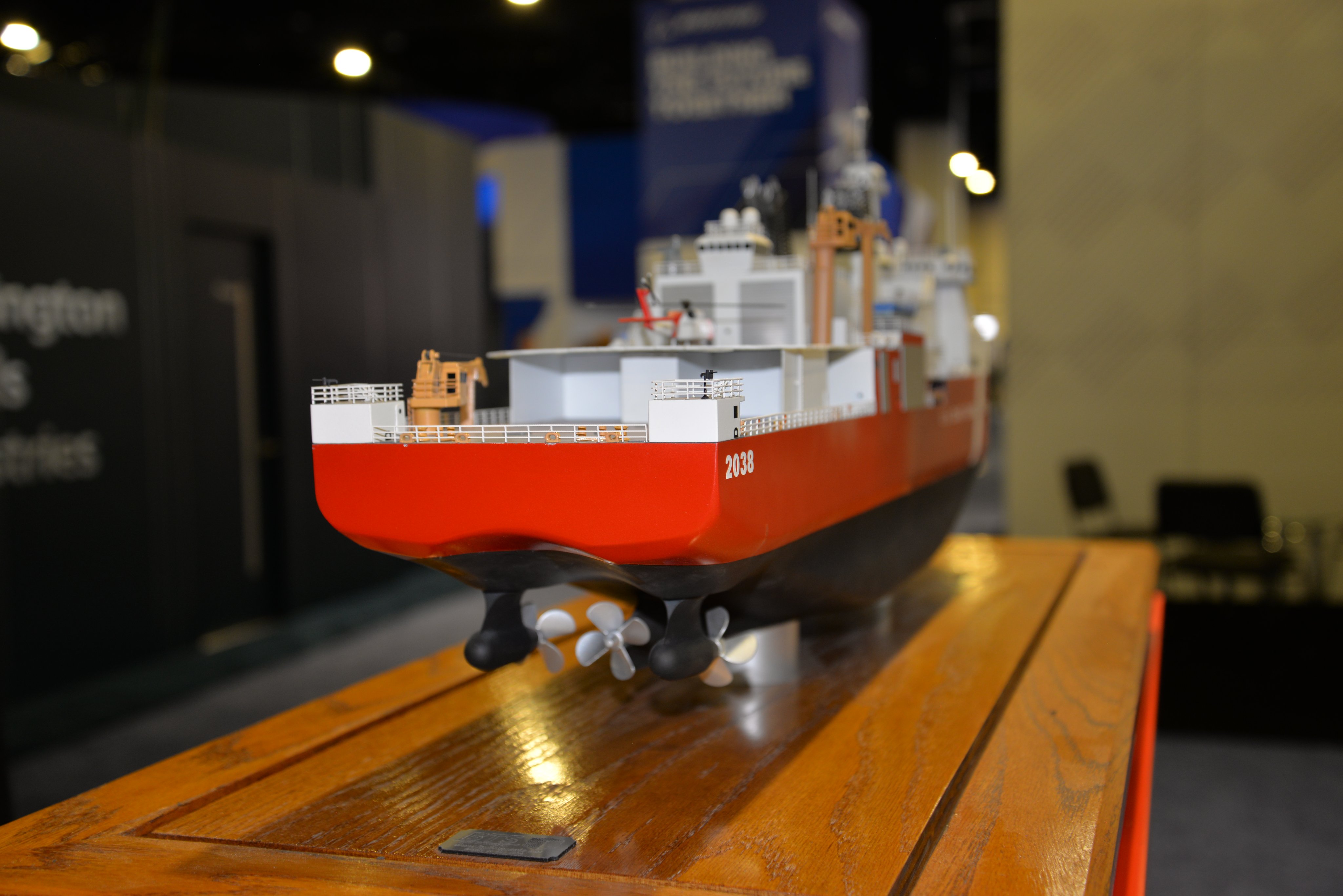
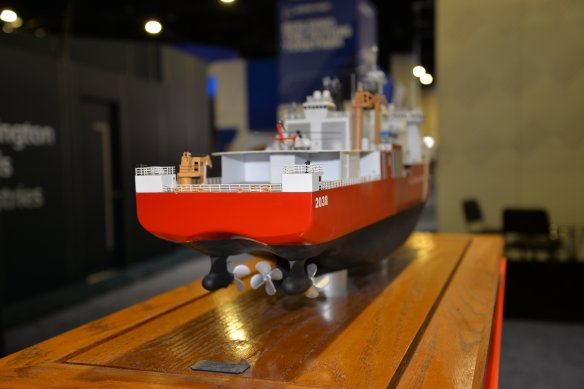
Photo of a model of Halter Marine’s Polar Security Cutter seen at Navy League’s Sea-Air-Space Exhibition have surfaced. Photo credit Chris Cavas.

The Congressional Research Service has once again updated their look at the Polar Security Cutter (heavy icebreaker) program. (See the latest version here.) My last look at this evolving document was in regard to the September 15, 2021 revision.

The one page summary, which has not changed, is reproduced below, but first I will point out what appears to have changed since the September 15 edition.

The Senate Appropriations Committee recommended funding for Long Lead Time items for the third Polar Security Cutter be deferred. (See Table 2 on page 28.) They also recommended additional support for acquisition of a Great Lakes icebreaker. (see below)

If approved, this will mean that the FY2022 ship building budget will be extremely low. The reasons are logical and valid, but generally GAO and Congress like to see consistency from one year to the next. I hope this does not set a pattern.

On the other hand, this could make room on the top line for increases in infrastructure and operations funding. If that results in an improved pattern for these accounts, it could be a good thing.

Or, we could use about $120M to exercise an existing option and buy two more Webber class FRCs to meet a recognized need for a Coast Guard presence in the South Pacific. Spending a little more could buy three Webber class FRCs that could be based in Pago Pago, American Samoa and provide an essentially continuous 24/7/365 underway Coast Guard presence in the South Pacific.

From pages 28/29:

Senate

The Senate Appropriations Committee, in the explanatory statement it released on October 18, 2021, for the FY2022 DHS Appropriations Act (S. XXXX), recommends the funding level shown in the SAC column of Table 2. The explanatory statement states:

Polar Ice Breaking Vessel.—The Committee recognizes the value of heavy polar icebreakers in promoting the national security and economic interests of the United States in the Arctic and Antarctic regions. Due to delays that are consistent with complex, first-in-class surface acquisition programs as well as management delays exacerbated by the global pandemic, the schedule projects that the amount requested for LLTM for the third heavy polar icebreaker is not necessary in fiscal year 2022. Therefore, the recommendation does not include $120,000,000 from the request. (PDF page 69 of 160; see also PDF page 145 of 160)

Regarding the Coast Guard’s Operations and Support (O&S) account, funding for which is not shown in Table 2, the explanatory statement states:

Great Lakes Icebreaking [GLIB] Program Management Office.—The recommendation includes $5,500,000, $3,500,000 above the request for pre-acquisition activities, for a new Great Lakes icebreaker that is as capable as USCGC MACKINAW. (PDF page 65 of 160)


Summary

The Coast Guard Polar Security Cutter (PSC) program is a program to acquire three new PSCs (i.e., heavy polar icebreakers), to be followed years from now by the acquisition of up to three new Arctic Security Cutters (ASCs) (i.e., medium polar icebreakers). The PSC program has received a total of $1,754.6 million (i.e., about $1.8 billion) in procurement funding through FY2021, including $300 million that was provided through the Navy’s shipbuilding account in FY2017 and FY2018. With the funding the program has received through FY2021, the first two PSCs are now fully funded.

The Coast Guard’s proposed FY2022 budget requests $170.0 million in procurement funding for the PSC program, which would be used for, among other things, procuring long leadtime materials (LLTM) for the third PSC.

The Navy and Coast Guard in 2020 estimated the total procurement costs of the PSCs in then year dollars as $1,038 million (i.e., about $1.0 billion) for the first ship, $794 million for the second ship, and $841 million for the third ship, for a combined estimated cost of $2,673 million (i.e., about $2.7 billion). Within those figures, the shipbuilder’s portion of the total procurement cost is $746 million for the first ship, $544 million for the second ship, and $535 million for the third ship, for a combined estimated shipbuilder’s cost of $1,825 million (i.e., about $1.8 billion).

On April 23, 2019, the Coast Guard-Navy Integrated Program Office for the PSC program awarded a $745.9 million fixed-price, incentive-firm contract for the detail design and construction (DD&C) of the first PSC to VT Halter Marine of Pascagoula, MS, a shipyard owned by Singapore Technologies (ST) Engineering. VT Halter was the leader of one of three industry teams that competed for the DD&C contract. The first PSC is scheduled to begin construction in 2021 and be delivered in 2024, though the DD&C contract includes financial incentives for earlier delivery.

The DD&C contract includes options for building the second and third PSCs. If these options are exercised, the total value of the contract would increase to $1,942.8 million (i.e., about $1.9 billion). The figures of $745.9 million and $1,942.8 million cover only the shipbuilder’s costs; they do not include the cost of government-furnished equipment (GFE), which is equipment for the ships that the government purchases and then provides to the shipbuilder for incorporation into the ship, post-delivery costs, costs for Navy-specific equipment, or government program-management costs.

The operational U.S. polar icebreaking fleet currently consists of one heavy polar icebreaker, Polar Star, and one medium polar icebreaker, Healy. In addition to Polar Star, the Coast Guard has a second heavy polar icebreaker, Polar Sea. Polar Sea, however, suffered an engine casualty in June 2010 and has been nonoperational since then. Polar Star and Polar Sea entered service in 1976 and 1978, respectively, and are now well beyond their originally intended 30-year service lives. The Coast Guard plans to extend the service life of Polar Star until the delivery of at least the second PSC. The Coast Guard is using Polar Sea as a source of spare parts for keeping Polar Star operational


“Report to Congress on Coast Guard Cutter Procurement” –CRS, Updated October 19, 2021″ –CRS

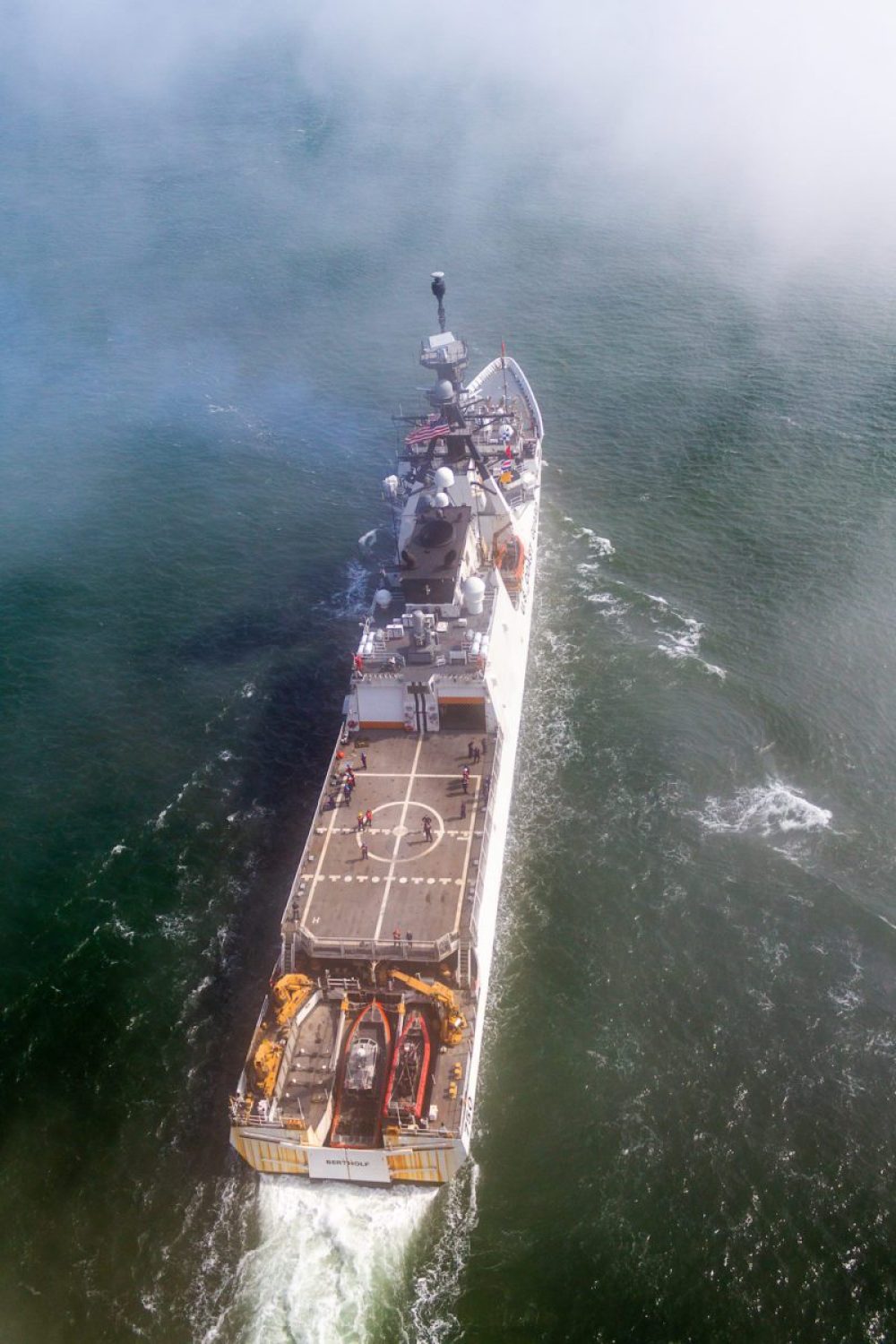
The Coast Guard Cutter Bertholf enters the San Francisco Bay en route to their Alameda, California homeport following a three-month multi-mission patrol, Oct. 3, 2020. Bertholf is one of four Legend-class national security cutters homeported in Alameda. (Photo by Pablo Fernicola)

The Congressional Research Service has again updated their “Report to Congress on Coast Guard Cutter Procurement”. (This link will always take you to the most recent edition of the report.) My last post on this evolving document was in reference to a 15 September, 2021 update. The questions raised in that report remain largely unanswered. I have reproduced the one page summary in full below. The summary does not appear to have changed, except to reflect the commissioning of the 45th FRC. But first I will highlight what I believe to be the changes since the last update. The significant changes reflect the Senate’s actions reported on pages 27 and 28.

Senate

The Senate Appropriations Committee, in the explanatory statement it released on October 18, 2021, for the FY2022 DHS Appropriations Act (S. XXXX), recommends the funding levels shown in the SAC column of Table 2. (PDF page 144 of 160) The explanatory statement states:

Offshore Patrol Cutter [OPC].—The Committee provides the requested amount of $597,000,000 for the construction of the fourth OPC and LLTM for the fifth OPC. While the Committee supports OPC procurements, the Committee remains concerned about costs for the program and continues the requirement for the Coast Guard to brief the Committee within one week prior to taking any procurement actions impacting estimated costs for the OPC program.

Fast Response Cutter [FRC] Program.—In accordance with the Coast Guard’s recapitalization plan, the Committee has completed funding for the replacement of legacy 110-foot Island Class patrol boats with FRCs that will operate similarly in the coastal zone. The Coast Guard is encouraged to notify the Committee if additional FRCs are necessary to support the Department of Defense in Patrol Forces Southwest Asia. (PDF page 69 of 160)

The explanatory statement also states:

Fleet Mix Analysis.—The Committee recognizes ongoing acquisition programs for various cutter classes that are responsible for many of, but not all, Coast Guard missions. While programs have correctly been prioritized around recapitalizing the oldest vessels in the fleet, several cutter classes are rapidly approaching the end of their service lives, while others have long surpassed their service lives. In order to best understand future capital investment needs, the Coast Guard shall provide to the Committee within 180 days of the date of enactment of this act, a comprehensive analysis that provides a fleet mix sufficient to carry out the assigned missions of the Coast Guard and other emerging mission requirements. The Coast Guard shall brief the Committee within 60 days of the date of enactment of this act on its plans to carry out this requirement.

Full-Funding Policy.—The Committee again directs an exception to the administration’s current acquisition policy that requires the Coast Guard to attain the total acquisition cost for a vessel, including long lead time materials [LLTM], production costs, and postproduction costs, before a production contract can be awarded. This policy has the potential to make shipbuilding less efficient, to force delayed obligation of production funds, and to require post-production funds far in advance of when they will be used. The Department should position itself to acquire vessels in the most efficient manner within the guidelines of strict governance measures.

Domestic Content.—To the maximum extent practicable, the Coast Guard shall utilize components that are manufactured in the United States when contracting for new vessels. Such components include: auxiliary equipment, such as pumps for shipboard services; propulsion equipment, including engines, reduction gears, and propellers; shipboard cranes; and spreaders for shipboard cranes. (PDF page 68 of 160)


Summary

The Coast Guard’s program of record (POR), which dates to 2004, calls for procuring 8 National Security Cutters (NSCs), 25 Offshore Patrol Cutters (OPCs), and 58 Fast Response Cutters (FRCs) as replacements for 90 aging Coast Guard high-endurance cutters, medium-endurance cutters, and patrol craft. The Coast Guard’s proposed FY2022 budget requests a total of $695.0 million in procurement funding for the NSC, OPC, and FRC programs, including $597 million for the OPC program.

NSCs are the Coast Guard’s largest and most capable general-purpose cutters; they are replacing the Coast Guard’s 12 Hamilton-class high-endurance cutters. NSCs have an estimated average procurement cost of about $670 million per ship. Although the Coast Guard’s POR calls for procuring 8 NSCs to replace the 12 Hamilton-class cutters, Congress through FY2021 has fully funded 11 NSCs, including the 10th and 11th in FY2018. In FY2020, Congress provided $100.5 million for procurement of long lead time materials (LLTM) for a 12th NSC, so as to preserve the option of procuring a 12th NSC while the Coast Guard evaluates its future needs. The Coast Guard’s proposed FY2022 budget requests $78.0million in procurement funding for activities within the NSC program; this request does not include further funding for a 12th NSC. The Coast
Guard’s proposed FY2022 budget also proposes rescinding $65.0 million of the $100.5 million in FY2020 funding for LLTM for a 12th NSC, “allowing the Coast Guard to focus investments on building, homeporting, and crewing Polar Security Cutters and Offshore Patrol Cutters.” The remaining $35.5 million appropriated in FY2020 for LLTM would be used to pay NSC program costs other than procuring LLTM for a 12th NSC. Nine NSCs have entered service; the ninth was commissioned into service on March 19, 2021.

OPCs are to be less expensive and in some respects less capable than NSCs; they are intended to replace the Coast Guard’s 29 aged medium-endurance cutters. Coast Guard officials describe the OPC and PSC programs as the service’s highest acquisition priorities. OPCs have an estimated average procurement cost of about $411 million per ship. The first OPC was funded in FY2018. The Coast Guard’s proposed FY2022 budget requests $597.0 million in procurement funding for the fourth OPC, LLTM for the fifth, and other program costs. On October 11, 2019, the Department of Homeland Security (DHS), of which the Coast Guard is a part, announced that DHS had granted extraordinary contractual relief to Eastern Shipbuilding Group (ESG) of
Panama City, FL, the builder of the first four OPCs, under P.L. 85-804 as amended (50 U.S.C. 1431-1435), a law that authorizes certain federal agencies to provide certain types of extraordinary relief to contractors who are encountering difficulties in the performance of federal contracts or subcontracts relating to national defense. The Coast Guard is holding a full and open competition for a new contract to build OPCs 5 through 15. On January 29, 2021, the Coast Guard released a Request for Proposals (RFP) for this Stage 2 contract, as it is called. Responses to the RFP were due by May 28, 2021. The Coast Guard plans to award the Stage 2 contract in the second quarter of FY2022.

FRCs are considerably smaller and less expensive than OPCs; they are intended to replace the Coast Guard’s 49 aging Island-class patrol boats. FRCs have an estimated average procurement cost of about $65 million per boat. A total of 64 have been funded through FY2021, including four in FY2021. Six of the 64 are to be used by the Coast Guard in the Persian Gulf and are not counted against the 58-ship POR quantity for the program, which relates to domestic operations. As of October 19, 2021, 45 of the 64 have been commissioned into service. The Coast Guard’s proposed FY2022 budget requests $20.0 million in procurement funding for the FRC program; this request does not include funding for any additional FRCs

Britain and France Fight Over Fish

British and French fishing vessels were involved in clashes in the English Channel on Tuesday over a longstanding dispute over scallop fishing regulations.

British and French fishing vessels were involved in clashes in the English Channel, 2018, over scallop fishing regulations. Photo: France Televisions

Europeans take their fishing seriously as demonstrated by the latest conflict between the UK and France. Here is one of many reports on the subject.

The question revolves around the Brits agreeing to license a number of French fishing vessels, but requiring proof that they had fished in British waters prior to Brexit.

If it were I, I would say, you French can decide which boats should get the limited number of licenses, that would make it an internal French conflict rather than UK vs France (and EU).

SOUTHCOM Change of Command

GEN Laura J. Richardson, Commander, United States Southern Command

This from “The D Brief” by DefenseOne. Significant because of how much work the Coast Guard does with SOUTHCOM. 

SOUTHCOM gets a new leader. Defense Secretary Lloyd Austin and Joint Chiefs Chairman Army Gen. Mark Milley are in Florida today for a change of command ceremony at U.S. Southern Command, near Miami.
Outgoing: Navy Adm. Craig Faller, who will retire after more than four decades of service.
Incoming: Army Gen. Laura Richardson, who last commanded U.S. Army North. Catch the ceremony’s livestream at 1 p.m. ET on DVIDS, here.
This afternoon in D.C., climate change and the Pentagon will be the focus of a virtual event hosted by New America, and featuring Under Secretary of Defense for Policy Colin Kahl, as well as the Defense Department’s Senior Climate Advisor Joseph Bryan. That gets underway at 1:30 p.m. ET. Details, here.

Task Force 59 Unmanned Surface Vessels Operate With PATFORSWA Cutter

US Navy TF59 Integrates MANTAS USV with Patrol Vessels

Two MANTAS T-12 unmanned surface vessels (USV), front, operate alongside U.S. Coast Guard patrol boat USCGC Maui (WPB 1304) during exercise New Horizon in the Arabian Gulf, Oct. 26. Exercise New Horizon was U.S. Naval Forces Central Command Task Force 59’s first at-sea evolution since its establishment Sept. 9. (U.S. Navy photo by Mass Communication Specialist 2nd Class Dawson Roth)

Naval News reports an exercise conducted by Task Force 59, Fifth Fleet’s Unmanned systems development group. As I thought they might, they have been working with Coast Guard Patrol Force South West Asia (PATFORSWA) as well as Navy Cyclone class and allied navies.

“Kongsberg, Raytheon ready to keep up as Naval Strike Missile demand grows” –Defense News

The U.S. Navy littoral combat ship USS Gabrielle Giffords (LCS-10) launches a Naval Strike Missile (NSM) during exercise “Pacific Griffin” on 2 October 2019. The NSM is a long-range, precision strike weapon that is designed to find and destroy enemy ships. Pacific Griffin is a biennial exercise conducted in the waters near Guam aimed at enhancing combined proficiency at sea while strengthening relationships between the U.S. and Republic of Singapore navies. U.S. Navy photo by Mass Communication Specialist 2nd Class Kenneth Rodriguez Santiago

Defense News reports, there is no production bottleneck delaying the rapid deployment of large numbers of Naval Strike Missiles (NSM).

“Demand is not an issue. If they suddenly come out and they say we need 200 a year, 300 a year, 500 a year, we can do that,” Schreiber added.

So, should the Navy and Coast Guard see a need to add NSM to Coast Guard vessels, it could be done relatively quickly. NSM is a relatively small cruise missile, 13 feet long and about 900 pounds.

On the other hand, the Navy has been relatively slow to add them to their own vessels, limiting NSM to LCS as they go through regularly scheduled yard periods.

11 Island Class WPBs have been transferred to foreign partner nations, 15 Continue USCG Service

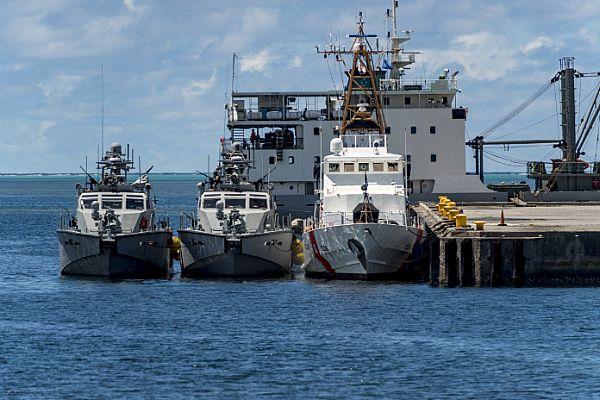
COLONIA, Yap (July 4, 2019) The U.S. Coast Guard Island-class patrol boat USCGC Kiska and Mark VI patrol boats assigned to Coastal Riverine Squadron (CRS) 2, Coastal Riverine Group 1, Detachment Guam, moored in the Micronesia port of Yap. CRG 1, Det. Guam’s visit to Yap, and engagement with the People of Federated States of Micronesia underscores the U.S. Navy’s commitment to partners in the region. The Mark VI patrol boat is an integral part of the expeditionary forces support to 7th Fleet, capability of supporting myriad of missions throughout the Indo-Pacific. (U.S. Navy photo by Mass Communication Specialist 2nd Class Jasen Moreno-Garcia/Released)

In the photo above we see the former USCGC Kiska in an earlier life. Foreign military sales and transfer of excess property seem to be a growing Coast Guard mission. This does to some extent justify earlier recapitalization than might otherwise be the case. It is part of our attempt to build capacity in like minded partners’ navies and coast guards.

Coast Guard celebrates completion of training as part of cutter transfer to Ukraine

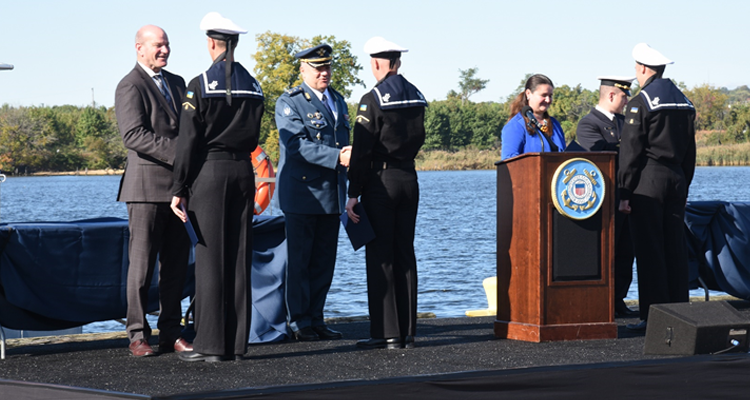
Members of the Ukrainian Navy receive congratulations following completion of Coast Guard training to operate and maintain a 110-foot Island Class patrol boat. These crewmembers will serve on Kubrak, the former Coast Guard Cutter Kiska, which will be delivered to Ukraine in early 2022. U.S. Coast Guard photo.


The Coast Guard Office of International Acquisition recognized 16 members of the Ukrainian Navy in a ceremony Oct. 22, 2021, at Coast Guard Yard in Baltimore. The Ukrainian crew just completed a rigorous six-week training program as part of the transfer of a 110-foot Island Class patrol boat to Ukraine.

The Coast Guard Cutter Transition Division Training Team helped the Ukrainian crew master the art of damage control, engineering maintenance, ship handling and watchstanding on Kubrak, which is the former Coast Guard Cutter Kiska. The Coast Guard officially transferred the title of the ex-Kiska Oct. 23, 2020. Since the title transfer, the cutter has been undergoing maintenance and upgrade work at Coast Guard Yard.

Kiska is the fifth patrol boat to be transferred to Ukraine under the Coast Guard Excess Defense Articles Program. Two cutters (ex-Drummond and ex-Cushing) were delivered to Ukraine in 2019, and two cutters (ex-Ocracoke and ex-Washington) will be transported to Ukraine later this month. Delivery of Kubrak to Ukraine is anticipated in early January 2022.

During its service as a Coast Guard cutter, the ex-Kiska was homeported in Hilo, Hawaii, and Apra Harbor, Guam, with primary missions of search and rescue, counter-drug activities and homeland security in addition to patrolling international and territorial waters as a humanitarian, law enforcement and Department of Homeland Security asset.

The ex-Kiska is the 11th 110-foot patrol boat transferred to a foreign partner nation; other patrol boats have been transferred to Pakistan, Georgia and Costa Rica. Congress has authorized transfer of two additional boats to Ukraine in fiscal year 2022. Recipients of former Coast Guard assets are determined by an interagency committee, led by the State Department.

Each 110-foot patrol boat transfer saves the Coast Guard money in remediation and disposal costs and helps build and sustain international maritime partnerships that foster greater global maritime security. One of the United States’ goals in this transfer is to help equip Ukraine with the means to project national sovereignty.

Coast Guard 110-foot patrol boats entered service in the mid-1980s; 15 of the 49 cutters originally in the class remain in service. The ships are being replaced with 64 154-foot fast response cutters, 45 of which are in service.

“Coast Guard Cutter Kimball returns to homeport after patrol in Bering Sea and Arctic” –D14

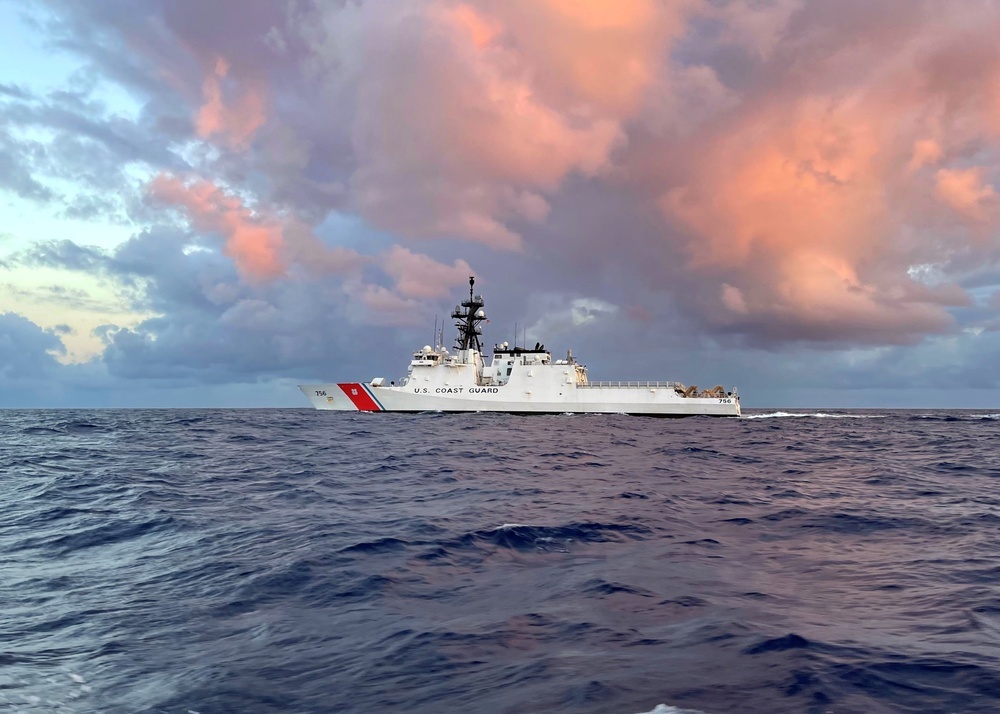
The crews of the Coast Guard Cutter Kimball (WMSL 756) and the USS Tulsa (LCS 16) conduct a passing exercise in the Pacific, April 3, 2021. The Kimball was underway conducting an expeditionary patrol which covered approximately 20,000 nautical miles. (U.S. Coast Guard photo courtesy of the Coast Guard Cutter Kimball)

USCGC Kimball seems to have had an unusual ALPAT (Alaska Patrol). They got up into the Chukchi Sea North of the Bering Strait that separates Alaska from Russian Siberia, interacted with vessels of our Canadian and Japanese allies, and shadowed Chinese warships transiting in the US EEZ off the Aleutians.

It may seem odd sending a Hawaii based cutter to Alaska, but Oahu is almost exactly due South of Kodiak. It is only about 520 nautical miles further away than Alameda, the only other Pacific base for Bertholf class cutters.

united states coast guard

News Release

U.S. Coast Guard 14th District Hawaii and the Pacific
Contact: 14th District Public Affairs
Office: (808) 535-3230

Coast Guard Cutter Kimball returns to homeport after patrol in Bering Sea and Arctic

Kimball

Editors’ Note: Click on stock image to download a high-resolution version.

JUNEAU, Alaska – The crew of Coast Guard Cutter Kimball returned to homeport in Honolulu, Hawaii Thursday following a 66-day patrol in the Bering and Chukchi Seas.

The crew traveled nearly 13,000 nautical miles since departing Honolulu Aug. 21, including through the Bering Strait and into the Arctic Ocean. With Arctic sea ice melting, these distant travels are important in helping the U.S. Coast Guard conduct a range of operations in the high latitudes as fish stocks and maritime traffic moves north.

The Kimball crew conducted 18 targeted living marine resources boardings; the most a national security cutter has completed during a single patrol in the 17th District area of responsibility.

“These law enforcement boardings maximized our presence in the Bering Sea,” said Petty Officer 1st Class Samuel Cintron, Kimball lead law enforcement petty officer. “Each boarding team member was instrumental to the success of the operation and reinforced the Coast Guard’s position on protecting national security and domestic fisheries.”

More than 65 percent of fish caught in the United States is harvested from Alaskan waters, generating more than $13.9 billion annually.

The Kimball crew conducted at-sea drills with key maritime partners including the Royal Canadian Naval Ship Harry DeWolf and Japanese Maritime Self-Defense Force training vessel Kashima. In each instance, the ships operated alongside one another and exchanged visual communications, followed by honors. This display of maritime cooperation and mutual respect emphasizes the United States’, Canada’s, and Japan’s continued commitment to one another and to partnership at sea.

During the deployment, Kimball crew observed four ships from the People’s Liberation Army Navy (PLAN) operating as close as 46 miles off the Aleutian Island coast. While the PLAN ships were within the U.S. exclusive economic zone, they followed international laws and norms and at no point entered U.S. territorial waters. All interactions between the Kimball and PLAN were in accordance with international standards set forth in the Western Pacific Naval Symposium’s Code for Unplanned Encounters at Sea and Convention on the International Regulations for Preventing Collisions at Sea.

The Kimball crew conducted astern refueling at sea with Coast Guard Cutter Oliver Berry, a fast response cutter also homeported in Honolulu. This capability significantly extends the operational range of FRCs.

Commissioned in 2019, Kimball is the Coast Guard’s seventh national security cutter.  These assets are 418-feet-long, 54-feet-wide and have a displacement of 4,600 long-tons. With a range of 13,000 nautical miles, the advanced technologies of this class are designed to support the national objective to maintain the security of America’s maritime boundaries and provide long range search and rescue capabilities.

For breaking news follow us on twitter @USCGHawaiiPac