“Coast Guard concludes Operation Arctic Shield 2020” –D17

Below is a District 17 press release. 
united states coast guard


News Release

U.S. Coast Guard 17th District Alaska
Contact: 17th District Public Affairs
Office: (907) 463-2065
After Hours: (907) 209-8731
17th District online newsroom

Coast Guard concludes Operation Arctic Shield 2020

   Arctic Shield operations arctic shield operations

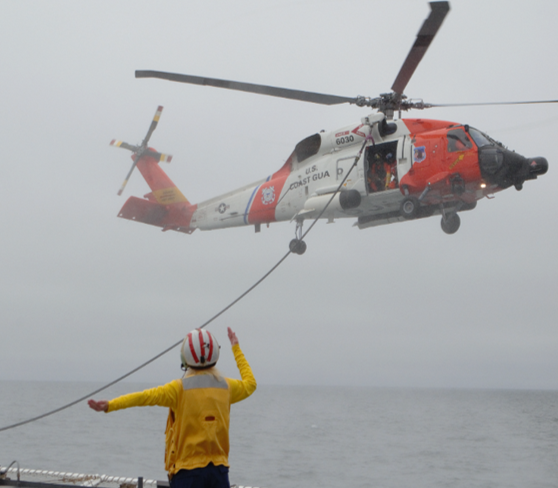
JUNEAU, Alaska – The Coast Guard concluded its annual Arctic Shield operations Sunday with the seasonal closure of its Forward Operating Location in Kotzebue, Alaska.

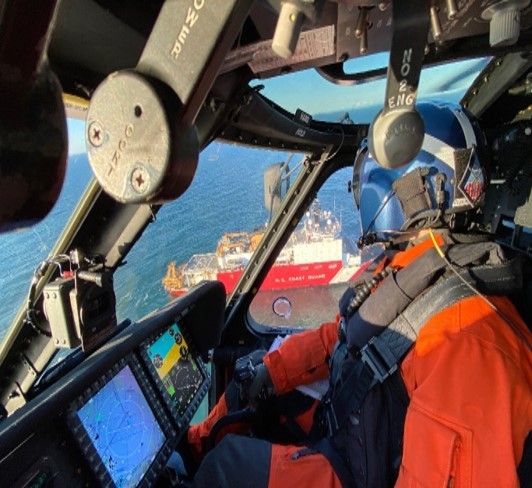
Air Station Kodiak air crews and two MH-60 Jayhawk helicopters were forward deployed to Kotzebue to provide better response times and coverage to remote regions of Alaska during increased summer boating traffic.

In addition, the crews of the Coast Guard Cutters Kukui, a 225-foot seagoing buoy tender homeported in Sitka, Alaska; and the Healy, a 420-foot medium icebreaker homeported in Seattle, Washington, patrolled the Bering, Chukchi and Beaufort Seas in support of maritime domain awareness, search and rescue, community relations, partnership building and scientific research.

Coast Guard crews deployed in support of Operation Arctic Shield, which commenced July 1, responded to 10 search and rescue cases, saving 25 lives.

To prevent hazards at sea, Coast Guard personnel from the 17th Coast Guard District and Sector Anchorage completed 172 facility inspections, and 405 commercial fishing vessel safety exams. The Coast Guard also continued its partnerships and provided critical support to the National Oceanic and Atmospheric Administration, Fish and Wildlife Service, and Office of Naval Research.

“The Coast Guard is dedicated to ensuring the protection of the Arctic maritime environment and all those who depend upon it,” said Cmdr. Molly Hayes, Operation Arctic Shield operational planner, Coast Guard District 17. “Our crews recognize and respect the sensitive environmental characteristics of the region and partner with Northern Alaskan communities to advance our shared interests in maritime safety and security.”

Operation Arctic Shield is the Coast Guard’s mobile and seasonal presence focused on performing the service’s 11 statutory missions throughout the Arctic to ensure maritime safety, security and stewardship. It is an annual operation that began in 2009.

White Hull Diplomacy, “The Coast Guard and Stability Operations” –Small Wars Journal

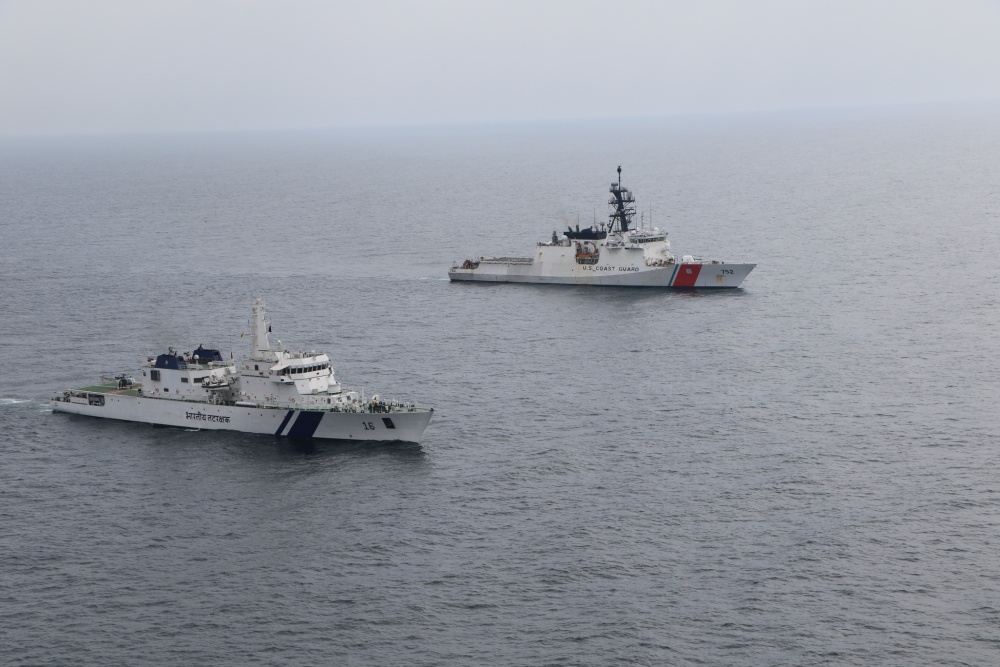
Coast Guard Cutter Stratton (WMSL 752) sales alongside the Indian coast guard ships Abheed and Shaurya (16) Aug. 23, 2019, while transiting in the Bay of Bengal off the coast of Chennai, India. The Stratton is participating in a professional exchange with the Indian coast guard that includes operational exercises at sea and on shore. (U.S. Coast Guard photo by Petty Officer 3rd Class Stephen Esterly)

Small Wars Journal makes the case for designating the Coast Guard to maintain expertise in and conduct maritime stability operations.

Historically, the United States military is regularly involved in some sort of stability operation despite the military preference for high intensity conflict. … The United States risks losing some of the lessons learned if it does not develop a holistic and complementary Joint Force that can both dominate a peer enemy and conduct stability operations at and below the level of armed conflict. Competition means that forces will be employed across the spectrum of operations with equal emphasis. Designating specific services to conduct stability as a primary mission is one means of ensuring a Joint Force that is equally capable across the spectrum. The Coast Guard is uniquely suited to a lead role in maritime focused stability operations. As a military force that is resident within the inter-agency, the Coast Guard provides a presence that is “instantly acceptable because of their worldwide humanitarian reputation.” This forward presence dovetails with the Department of Homeland Security mission of “safeguarding the American people” by pushing the boundaries of U.S. law enforcement into regions and countries where it can mentor and develop partner capabilities in the areas it is needed most.

It quotes the Coast Guard Strategic Plan 2018-2022.

“The Coast Guard plays a critical role in strengthening governance in areas of strategic importance. We mature other nations’ inherent capabilities to police their own waters and support cooperative enforcement of international law through dozens of robust bilateral agreements. Our leadership on global maritime governing bodies and our collaborative approach to operationalize international agreements drives stability, legitimacy and order. As global strategic competition surges, adversaries become more sophisticated and the maritime environment becomes more complex. The Coast Guard provides a full spectrum of solutions, from cooperation to armed conflict.”

The post states,

“At its heart the primary stability tasks fall into seven military missions and activities:  protecting civilians, security sector reform, support to security cooperation, peace operations, foreign humanitarian assistance, counterinsurgency, and foreign internal defense.”

It then goes on to describe how the Coast Guard has done each of these tasks in the past.

What we may be seeing here is a preview of the roles the Coast Guard may be expected to perform when the expected Tri-Service Strategy is published.

Thanks to Geoff for the “White Hull Diplomacy” portion of the title. 

“This Is The Elite Unit That Raided The Tanker Threatened By Stowaways Off The UK Coast” –The Drive

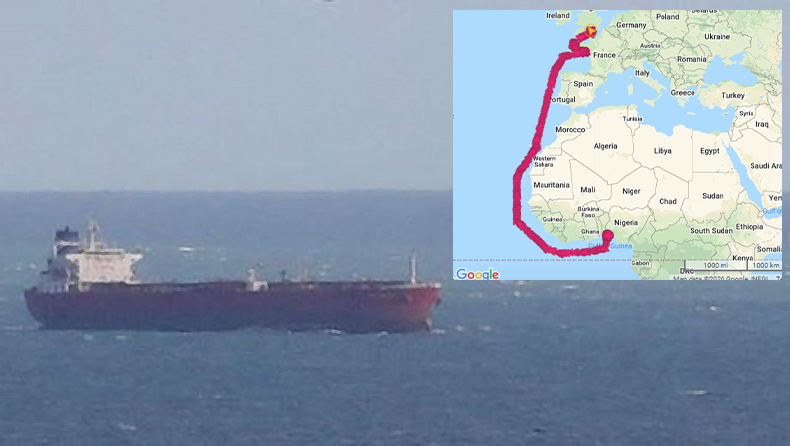
LLOYD’S LIST INTELLIGENCE DATA CONFIRMS THAT THE VESSEL LEFT LAGOS ON OCTOBER 6, WHERE THE STOWAWAYS ARE THOUGHT TO HAVE BOARDED.

The Drive reports on the recapture of the 42,000-gross-tonnage Liberian-registered tanker Nave Andromeda.

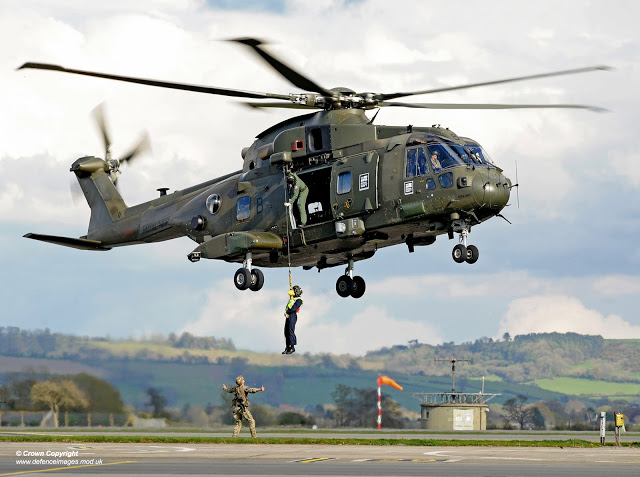
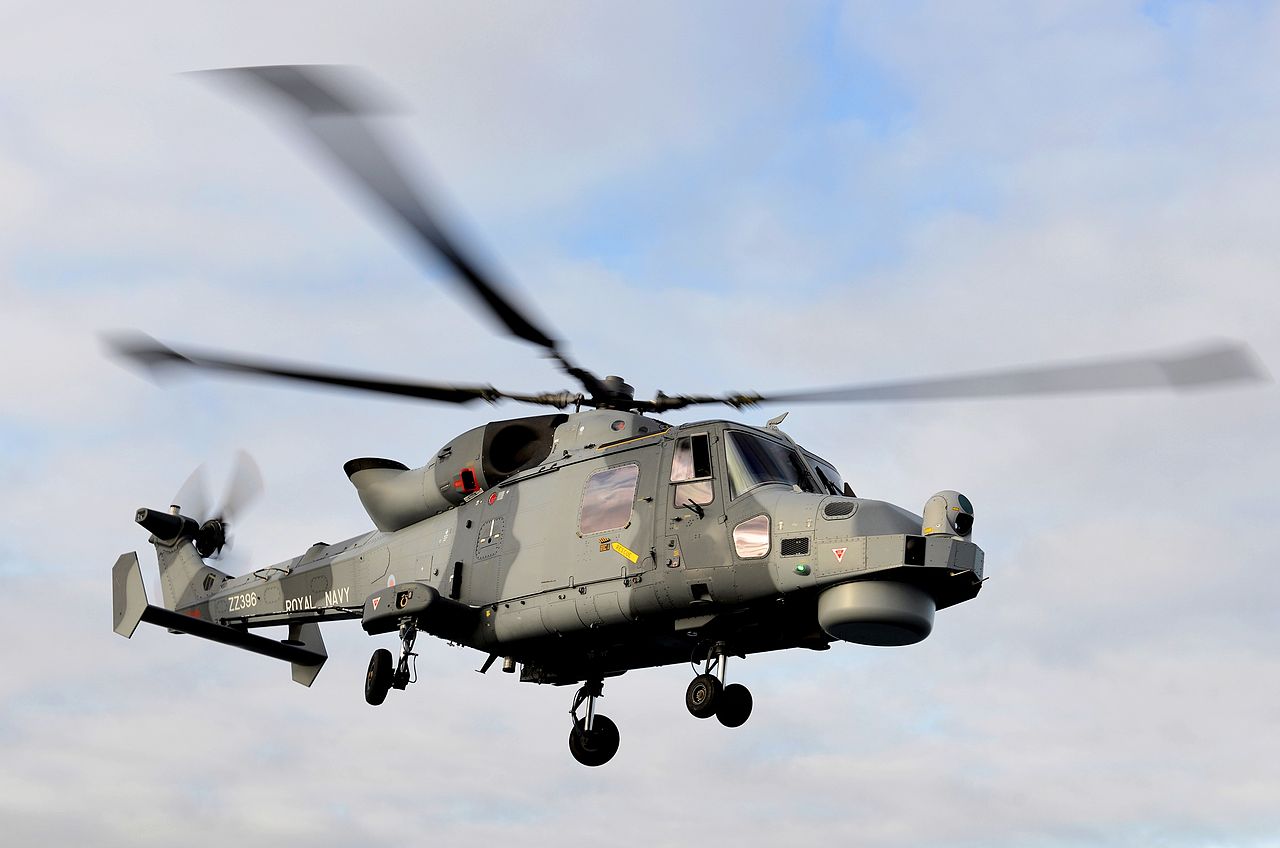
While this incident did not involve terrorists that might have had weapons capable of bringing down a helicopter, in this and a previous incident the Royal Navy’s Special Boat Service used not one, but four helicopters to land a team on the ship. Apparently the team, probably consisting of 16 members, was transported on two Merlin helicopters while Wildcat helicopters provided over-watch.

Merlin MK3 Helicopters ( 846 Naval Air Sqdn) Commando Helicopter Force (pics)

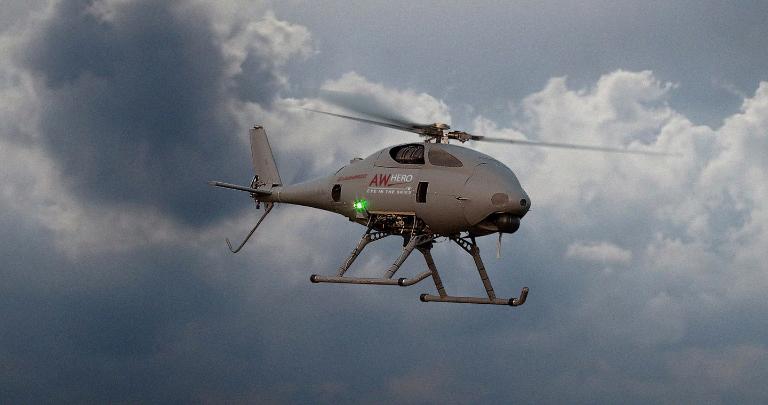
AWHero, a 200 kg Rotary Wing Unmanned Air System

AWHERO is a new-generation, short-range, rotary-wing unmanned aerial vehicle (RUAV) being developed by Leonardo for both military and civilian applications.

Another UAV has entered the market. (more here) This system is likely to serve on the numerous French OPVs being built that have aviation facilities designed to support UAVs rather than helicopters like the POM, though the indication was that their UAV would be in the 700 KG class. 

It appears to be very direct competition for the very successful Schiebel Camcopter S-100, being very close in specifications.

USCGC Oliver Berry (WPC-1124), 45 Days Away from Homeport, 9,300 Nautical Mile Patrol, Hawaii to Guam and Return

The crew of the Oliver Berry (WPC-1124) travel in a round-trip patrol from Sept. 12 to Oct. 27, 2020, from Hawaii to Guam, covering a distance of approximately 9,300 miles during their journey. The crew sought to combat illegal fishing and other maritime threats across the Pacific to protect the United States and our partner’s resource security and sovereignty. (U.S. Coast Guard photo courtesy of the CGC Oliver Berry)

Below is a District 14 News Release. Not your typical WPC operation. 9300 nautical miles and 45 days away from home port. I was a bit surprised that it sounds like they did not board any of the fishing vessels they encountered, “We executed 19 observation reports on fishing vessels, 6 of which had not been previously contacted by the Coast Guard.” Perhaps there were no ship-riders aboard from the nations in whose waters they were sighted. 

This might also have served as a dry run for the three Webber class WPCs that will be transiting to Guam. Presumably they took the opportunity to introduce this new type asset to representatives of the Republic of the Marshall Islands and the Federated States of Micronesia and perhaps to the supporting Coast Guard staff in Guam. Notably there is no mention of transiting in company with a larger ship as happened in previous long range operations.

united states coast guard

News Release

U.S. Coast Guard 14th District Hawaii and the Pacific
Contact: 14th District Public Affairs
Office: (808) 535-3230
After Hours: HawaiiPacific@uscg.mil
14th District online newsroom

Coast Guard Cutter Oliver Berry returns to homeport after a 6 week patrol in Pacific


Editors’ Note: Click on images to download a high-resolution version.

HONOLULU — The Coast Guard Cutter Oliver Berry (WPC 1124) returns to homeport in Honolulu after a mission in the Pacific to curtail illegal fishing and increase maritime law enforcement self-sufficiency with international partners. 

The crew of the Oliver Berry traveled in a first-of-its-kind round-trip patrol spanning from Sept. 12 to Oct. 27, 2020, from Hawaii to Guam, covering a distance of approximately 9,300 miles during their journey. 

“Traveling just under 10,000 nautical miles, we (CGC Oliver Berry) operated further from our homeport than any other FRC to combat illegal, unreported, and unregulated fishing in portions of Oceania,” said Ensign Michael Meisenger, weapons officer on the Oliver Berry.

The Oliver Berry collaborated with the governments of Republic of the Marshall Islands and Federated States of Micronesia strengthening maritime domain awareness and resource security within their Exclusive Economic Zones. An EEZ is an area of coastal water within a certain distance of a country’s coastline for which the country claims exclusive rights for drilling, fishing, and other economic ventures.

The Oliver Berry aided international enforcement efforts by sending observational reports and imagery to the Maritime Security Advisors and the Pacific Island Forum Fisheries Agency, Regional Fisheries Surveillance Center, thereby increasing mission success and showcasing the Coast Guard’s unwavering commitment to partner nations during the COVID-19 pandemic. 

“We worked to increase awareness of unlawful fishing operations in remote portions of the United States, Republic of Marshall Islands, and Federated States of Micronesia’s EEZs, and on the high seas,” said Meisenger. “We executed 19 observation reports on fishing vessels, 6 of which had not been previously contacted by the Coast Guard.” 

Fast Response Cutters are equipped with new advanced command, control, communications, computers, intelligence, surveillance, and reconnaissance systems and boast greater range and endurance compared to their predecessor, the 110 foot Island-class patrol boats. 

The FRCs represent the Coast Guard’s commitment to modernizing service assets and maintaining a strong presence and support for a free and open Indo-Pacific. Oceania covers an area of 3.3 million square miles and has a population of approximately 40 million people. Its melting pot of cultures depends on the living marine resources and maritime commerce to allow their people to thrive. 

The Coast Guard combats illegal fishing and other maritime threats across the Pacific to protect their resource security and sovereignty. Combating illegal fishing is part of promoting maritime governance and a rules-based international order that is essential to a free and open Oceania. 

“We made great contributions to our partnerships and increasing maritime domain awareness,” said Meisenger. “As a crew, we could not be happier to be back home after a highly successful and trailblazing patrol.”


Time to Revive Coast Guard’s ASW Capability?: “DOD MAP SHOWS RUSSIAN AND CHINESE SUBS ARE TOO CLOSE FOR COMFORT” –Sandboxx

russian subs

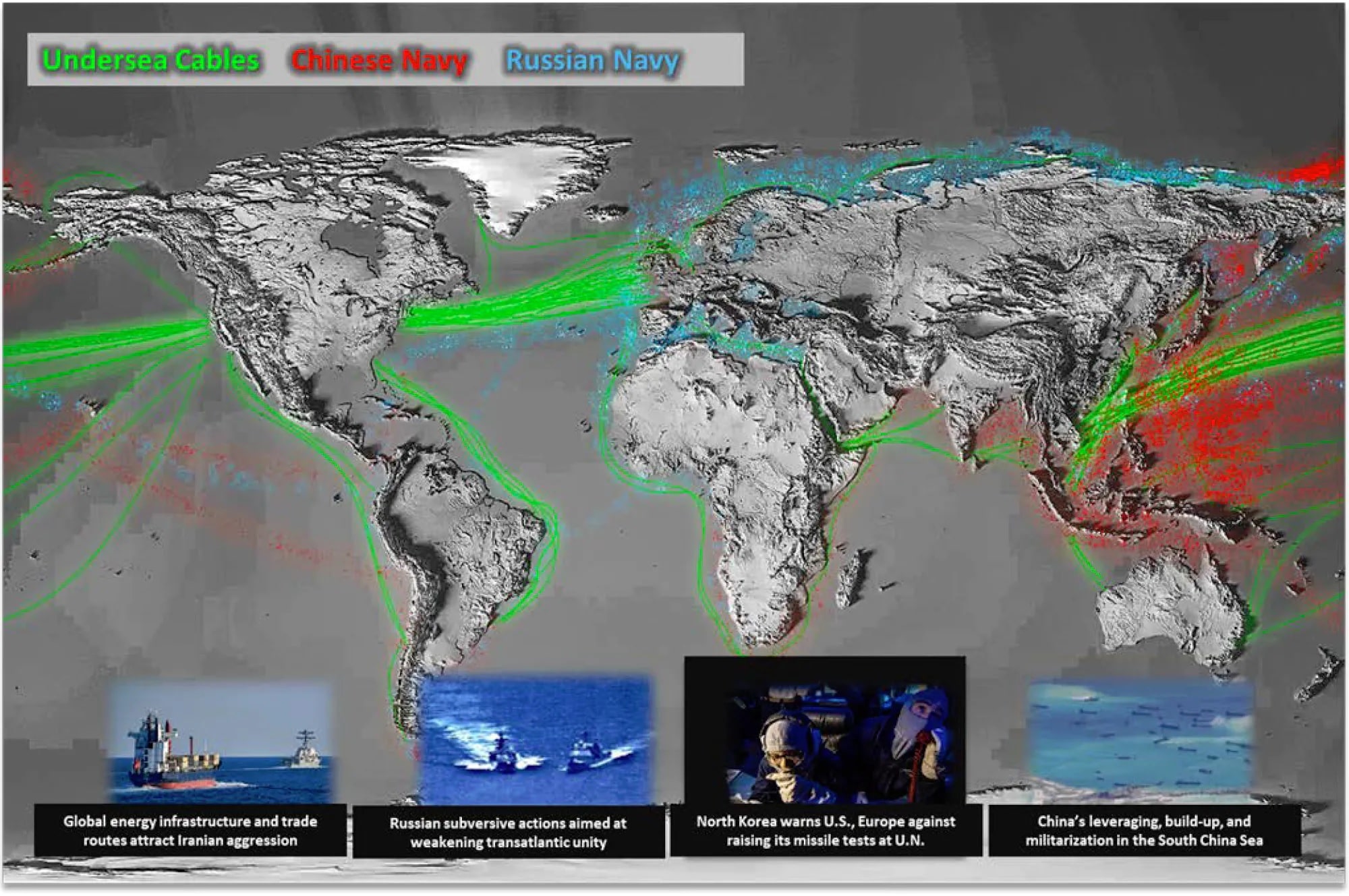
Sandboxxx reports the release of a map illustrating the operations of the Russian and Chinese naval forces.

The Pentagon recently released a map showing the travel paths of Russian and Chinese naval vessels, alongside important undersea cables, as a part of its 2021 National Defense Authorization Act request, commonly referred to as the DoD’s budget. The map clearly shows the heavy traffic in both The Atlantic and Pacific oceans, with Russian subs encroaching on America’s eastern seaboard and Chinese submarines creeping up in the west.

The Russian Navy operations, including those just outside US territorial waters on the East Coast, are discussed in the post.

What I also see in the map, is a great deal of Chinese activity around Guam, significant activity around Hawaii, some activity extending to the Americas, and a surprising amount of Chinese activity in the Arctic, North of Siberia, that presumably passed through the Bering Strait. There is also Chinese activity near the Aleutians.

The Philippines, India, and Australia must also find this map interesting.

The map looks looks like more reason to consider providing cutters with an Anti-Submarine Warfare capability.

If we ever do have a “near peer” conflict with Russia and/or China, there is a good possibility, when we go to rescue the crews of torpedoed ships, cutters may find, they themselves have become targets. An ASW capability may be necessary just to allow the cutters to operate in a threat environment that could reach up to the US coast line.

If cutters were given an ASW capability, I would think their wartime role would be to escort logistics shipping from outload ports in the lower 48 to rear staging areas and return. Air and Surface threat levels would not be non-existent, but they would be low.

“Nation’s sole heavy icebreaker to deploy to the Arctic this winter” –News Release

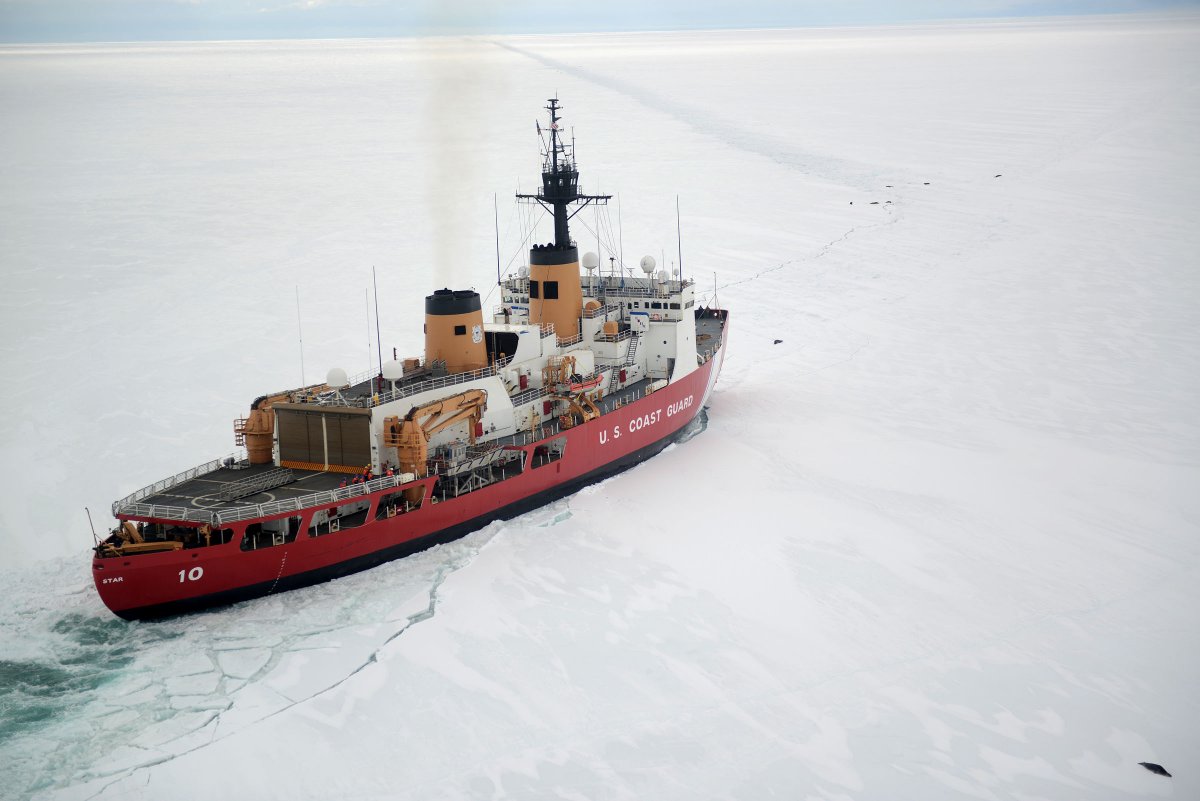
The Coast Guard Cutter Polar Star cuts through Antarctic ice in the Ross Sea near a large group of seals as the ship’s crew creates a navigation channel for supply ships, January 16, 2017. The resupply channel is an essential part of the yearly delivery of essential supplies to the National Science Foundation’s McMurdo Station.US Coast Guard photo by Chief Petty Officer David Mosley

Below is a press release from Pacific Area, making it official that Polar Star will not make the trip to Antarctica this Winter. Instead they will be going to the Arctic this winter. Winter deployments to the Arctic are unusual, but it is something the Coast Guard expects to do, once the planned fleet of six icebreakers is complete. Really I do not  know if we have ever done this before. It will certainly be a unique experience. Much of the time, there will be no sun at all. 

united states coast guard

News Release

U.S. Coast Guard Pacific Area
Contact: Coast Guard Pacific Area Public Affairs
Office: (510) 437-3375
After Hours: (510) 816-1700
Oct. 29, 2020
D11-DG-M-PACAREA-PA@uscg.mil
Pacific Area online newsroom

Nation’s sole heavy icebreaker to deploy to the Arctic this winter

The Coast Guard Cutter Polar Star (WAGB-10) is in the fast Ice Jan. 2, 2020, approximately 20 miles north of McMurdo Station, Antarctica. The 399-foot icebreaker is the only ship in U.S. service capable of clearing a path through the Antarctic ice to escort three refuel and resupply ships to McMurdo Station during Operation Deep Freeze. The ships deliver enough cargo and fuel to sustain year-round operations on the remote continent. U.S. Coast Guard photograph by Senior Chief Petty Officer NyxoLyno Cangemi


ALAMEDA, Calif. — The U.S. Coast Guard Cutter Polar Star (WAGB-10) will deploy to the Arctic this winter to help protect the nation’s maritime sovereignty and security in the region. 

The United States is an Arctic nation, and the Coast Guard has served as the lead federal agency for homeland security, safety, and environmental stewardship in the Arctic region for more than 150 years.  As the nation’s primary maritime presence in the polar regions, the Coast Guard advances U.S. national interests through a unique blend of polar operational capability, regulatory authority, and international leadership across the full spectrum of maritime governance.

In April 2019, the Coast Guard released the Arctic Strategic Outlook, which reaffirms the service’s commitment to American leadership in the region through partnership, unity of effort, and continuous innovation.

“The Arctic is no longer an emerging frontier, but is instead a region of growing national importance,” said Vice Adm. Linda Fagan, commander of U.S. Coast Guard Pacific Area. “The Coast Guard is committed to protecting U.S. sovereignty and working with our partners to uphold a safe, secure, and rules-based Arctic.”  

Typically, the Polar Star travels to Antarctica each year in support of Operation Deep Freeze, the annual military mission to resupply the United States’ Antarctic stations, in support of the National Science Foundation.

This year’s maritime resupply at McMurdo Station was cancelled due to COVID safety precautions, and a limited resupply will be conducted via aircraft.  However, Operation Deep Freeze is an enduring mission that requires a heavy icebreaker for a full resupply, and the Coast Guard anticipates resuming this critical deployment next year.

“Coast Guard Waterways Commerce Cutter (WCC) Program: Background and Issues for Congress” –CRS

The Coast Guard Cutter Bluebell sits moored on the Willamette River waterfront in Portland, Ore., June 4, 2015. The Bluebell, which celebrated her 70th anniversary this year, is one of many ships participating in the 100th year of the Portland Rose Festival. (U.S. Coast Guard photo by Chief Petty Officer David Mosley.)

The Congressional Research Service has issued a two page look at the Coast Guard’s Waterways Commerce Cutter (WCC) program.

The program is expected to replace 35 small tenders, including 18 WLRs, 13, WLICs, and four WLIs, with the first vessel completed in 2025 and all delivered by 2030.

“The Long Blue Line: Operation “Relevant Ursa”–Bear training in West Africa” –Coast Guard Compass

Coast Guard’s 270-foot medium endurance cutter Bear underway in Africa. (Ensign Connor Brown, U.S. Coast Guard)

Coast Guard Compass reports on an unusual 95 day deployment by USCGC Bear to the West Coast of Africa, primarily with the island nation of Cabo Verde but sailing as far north as Morocco.


“Coast Guard Foundation’s Tribute to the United States Coast Guard from Our Nation’s Capital” –MyCG

I am passing this along from the MyCG web site. 


Coast Guard Foundation’s Tribute to the United States Coast Guard from Our Nation’s Capital

Please join us to view the Coast Guard Foundation’s first virtual tribute event, Oct. 29 from 7:00 – 8:00 pm Eastern. This new platform allows the Foundation to continue its tradition of honoring and celebrating the men and women of the Coast Guard. It will feature live remarks by the Commandant and the Vice Commandant, a performance by the Coast Guard Band, mission excellence videos, interviews, and more. Hosting the event is ABC News Correspondent, Kyra Phillips.

Link to join: https://CGFDC.givesmart.com

The link will be available at the time of the broadcast.

Coast Guard Foundation Background

Since 1969, the Coast Guard Foundation has been committed to inspiring leadership, education, and a proud legacy of service to our Nation by supporting the men and women of the United States Coast Guard. The Foundation provides college scholarships to enlisted members, their spouses and their children, scholarships and support for families of Coast Guard members lost in the line of duty, and support for morale programs, including funding recreation, exercise and family-oriented facilities.

Disclaimer: The appearance of hyperlinks does not constitute endorsement by the U.S. Coast Guard or the Department of Homeland Security of non-U.S. Government sites or the information, products, or services contained therein. Such links are provided consistent with the stated purpose of this website and for the convenience of our members, who commonly use these websites in their personal and private capacities. The U.S. Coast Guard does not exercise control over the information that visitors may find at these websites. Visitors use the hyperlinks at their own risk. To suggest an additional resource for inclusion on MyCG, please email MyCG@uscg.mil.