“Cooperative Maritime Law Enforcement and Overfishing in the South China Sea” –CIMSEC

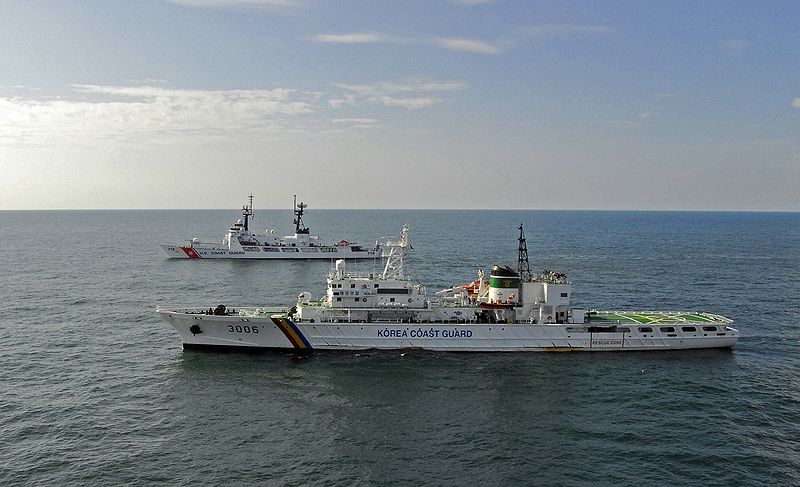
Republic of Korea Coast Guard vessel #3006 in company with U.S. Coast Guard cutter USCGC Boutwell (WHEC-719) during the North Pacific Coast Guard Forum in August 2007. This forum was created to increase international maritime safety and security in the Northern Pacific Ocean and its borders. The Boutwell worked with the Korean coast guard while on their way to Yokosuka, Japan. The Japanese coast guard is one of the six nations involved in the forum.

CIMSEC brings us a discussion of the possibility of cooperative fisheries enforcement in the South China Sea to stop both overfishing and Illegal, Unregulated, Unreported (IUU) fishing and perhaps bring China into a more mutually beneficial relationship with her neighbors.

Earlier, I had a suggestion about how we might form an instrument of cooperative enforcement by forming a “Combined Maritime Security Task Force Pacific,” a law enforcement alliance rather than a military one.

Probably before that could be fully realized, the various nations with competing claims to the waters of the South China Sea, need to take their claims to the UN’s International Tribunal. The more nations use it, the more pressure on China to participate. If, they do not present a cases before the international their claims will be weakened.


“GeoSpectrum Launches Low Frequency Active VDS Deployable by USVs”

Geospectrum’s new, compact version of the Towed Reelable Active Passive Sonar (TRAPS) suitable for Unmanned Surface Vessels (USVs)

NavyNews reports that Canadian Company GeoSpectrum has developed a version of their “Towed Reelable Active Passive Sonar” (TRAPS) that is scaled to fit vessels as small as 12 meter Unmanned Surface Vessels (USV).

We talked earlier about an earlier version of this system. If it fits on a 12 meter (39’4″) USV, then it should certainly be able to fit on anything WPB or larger. If we should ever have to go to war, this might be a capability we would want to protect our harbor approaches from submarines. We would probably also want to add an ASW torpedo launching capability.

It might be worth doing some experimentation to see how it works, and if desirable, draw up plans for adding this or a similar system for mobilization. First of course we should take a look at the results of Canada’s tests.

Might also be desirable to have something like this for the Webber class cutters going to PATFORSWA, since the Iranians have a large number of small conventionally powered submarines.

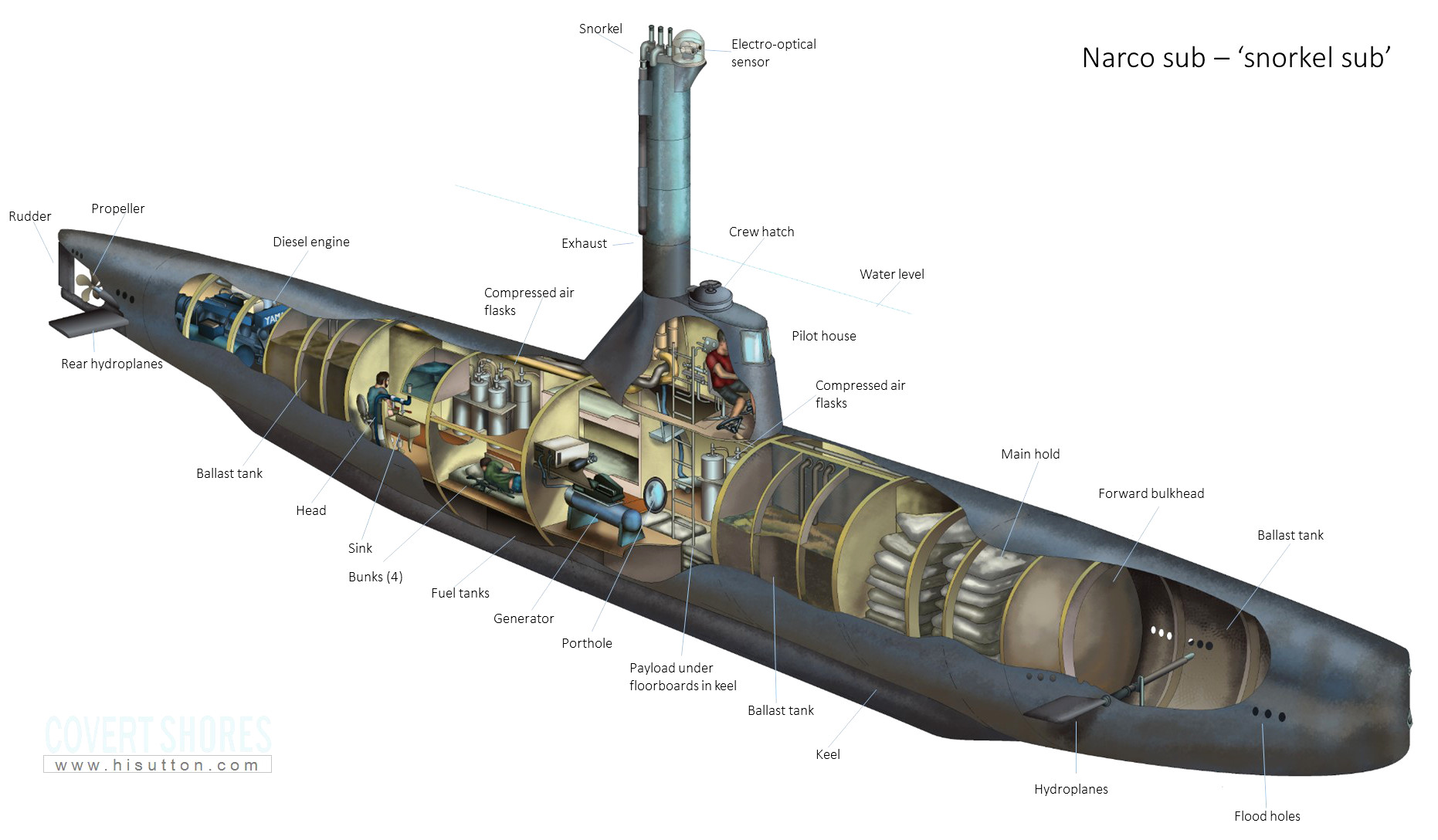
Maybe it could help us find semi-submersibles smuggling drugs as well. 

“Coast Guard Modifies Contract to Construct Second Offshore Patrol Cutter, Acquire Long Lead-Time Material for Third Offshore Patrol Cutter” –CG-9

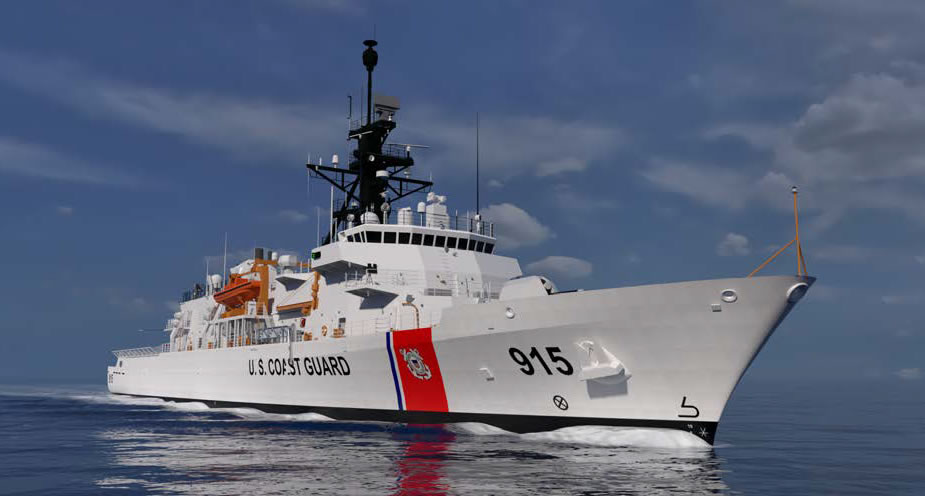
Above: Artists rendering from Eastern Shipbuilding Group

Contract for the Second Offshore Patrol Cutter, the future USCGC Chase, and long lead time items for the third. Presumably this is a contract modification, rather than the  exercise of a contract option, because the price is higher than the original option. Still this does not look a great deal higher than the previous contract ($317.5M), for the first OPC and long lead time items for the second. Following from the Acquisitions Directorate, CG-9:

The U.S. Coast Guard modified its contract with Eastern Shipbuilding Group (ESG) April 2 to begin construction of the second Offshore Patrol Cutter (OPC) and to acquire long lead-time material (LLTM) for the third OPC. Contract delivery of the second OPC, to be named Chase, is scheduled to occur in 2023.

The total value of the construction and LLTM orders is $343 million. In addition to ordering construction of the second OPC, this contracting action also covers the initial order of components and materials necessary to support the future construction of the third OPC by acquiring propeller and steering components, marine diesel engines, the ship integrated control system, switchboards, and generators.

The lead OPC is currently in production at ESG’s shipyard in Panama City, Florida.  Production of the lead cutter, Argus, commenced January 7, 2019. Delivery of Argus is scheduled for 2022.

The OPC meets the Service’s long-term need for cutters capable of deploying independently or as part of task groups and is essential to stopping smugglers at sea, interdicting undocumented migrants, rescuing mariners, enforcing fisheries laws, responding to disasters and protecting our ports. The acquisition of 25 OPCs will complement the capabilities of the Service’s National Security Cutters, Fast Response Cutters and Polar Security Cutters as an essential element of the Department of Homeland Security’s layered security strategy.

For more information: OPC program page

Hollywood’s Greats Come Out to Dance to ‘Chase Hall Funk’ (the Academy Class of 1969 Theme Song)

Now for something completely different, to lighten the mood. In prep for my Academy class’ 50th graduation anniversary, a classmate, Bob Pokress, wrote new lyrics for Bruno Mars “Uptown Funk” and had it professionally recorded, to be used as the class marched onto the field. He also produce a couple of videos. First the one below staring some now old Coasties before they went to their first assignment. More recently the one above. Looking at the video below, you’ll see that the composition of the class of 1969 was very different from the population of today’s Academy classes.

The Gauntlet has been thrown down. Other Coast Guard unit videos out there that might equal or top this one?

“Trump: US to deploy anti-drug Navy ships near Venezuela” –Navy Times

Orthographic map of Venezuela centered on Caracas
Controlled territory in dark green.
Claimed territory in light green.
From Wikipedia, Author: Addicted04

The Navy Times reports,

“President Donald Trump announced Wednesday that Navy ships are being moved toward Venezuela as his administration beefs up counter-narcotics operations in the Caribbean following a U.S. drug indictment against Nicolás Maduro.”

Most of the narcotics trafficking seems to be in the Eastern Pacific rather than the Caribbean. Venezuela’s coasts are on the Caribbean and the Atlantic. Apparently not all the effort will off Venezuela,

“The mission involves sending additional Navy warships, surveillance aircraft and special forces teams to nearly double the U.S. counter-narcotics capacity in the Western Hemisphere, with forces operating both in the Caribbean and eastern Pacific. Esper said the mission would be supported by 22 partner nations.”

Hope we have enough law enforcement detachments.

“Venezuelan Navy Patrol Ship Sinks After Collision With Cruise Ship ” –Maritime-Executive

Graphic from FleetMon report

Maritime-Executive and FleetMon report a curious case in the Caribbean. Looks like, perhaps the Venezuelan Navy attempted an act of piracy against an ice strengthened cruise ship, RCGS Resolute with 35 crewmen aboard, and lost a ship as a result. Warning shots were fired and the Venezuelan vessel attempted to shoulder the cruise ships.

Also this is the second Navantia built warship to sink as a result of collision. The Venezuelan patrol vessel, NAIGUATA, was commissioned in 2011 and is about the size of a Coast Guard 270 foot WMEC, 1720 tons full load, 79.9 m (262 ft) in length. Navantia is also teamed with Bath Ironworks in the US Navy’s FFG(X) Competition.

“Defense Primer: United States Transportation Command” –CRS

Emblem of the United States Transportation Command (TRANSCOM or USTRANSCOM). The original emblem was designed by the U.S. Army Institute of Heraldry.

The Congressional Research Service has issued a short “primer” on TRANSCOM, the US Transportation Command.

The component the Coast Guard has most frequent contact is the Military Sealift Command, MSC.

Coast Guard fixed wing assets may from time to time also be called upon to assist the Air Mobility Command, AMC.

“Coast Guard Directs Cruise Ships To Remain At Sea ‘Indefinitely’”

Cruise ships are docked at PortMiami, Tuesday, March 31, 2020, in Miami. (AP Photo/Wilfredo Lee)

TalkingPointsMemo reports that,

“The U.S. Coast Guard has directed all cruise ships to remain at sea where they may be sequestered “indefinitely” during the coronavirus pandemic and be prepared to send any severely ill passengers to the countries where the vessels are registered.”

This directive is only softened somewhat later in the report.

“The document requires all ships in U.S. waters to report their numbers of sick and dead on board each day or face civil penalties or criminal prosecution.

“Cruise ships with sick passengers must consult with the Coast Guard, which may now recommend keeping the sick person on board the ship. The Coast Guard will decide if a transfer is absolutely necessary, but the cruise line would be responsible for arranging on-shore transportation and hospital beds.”