The Forgotten American Explorer Who Discovered Antarctica — and Why It Is Important

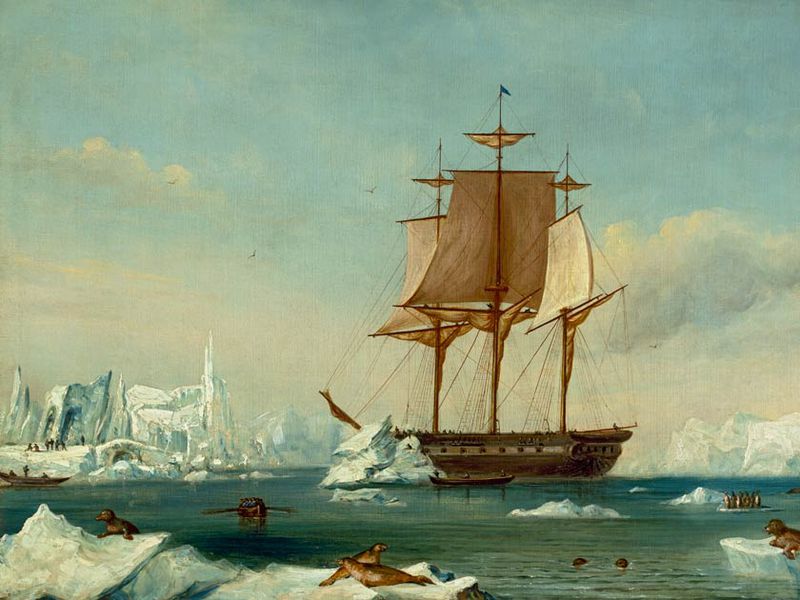
USS Vincennes in Disappointment Bay, Antarctica, during the Wilkes expedition. (Public Domain)

Smithsonian Magazine brings us the story of American explorer Charles Wilkes, who while commanding USS Vincennes, was the first to map the coast of Antarctica. They talk about why it is important and why the apparent decline in US interest in Antarctica is dangerous.

As the northern ice melts, the Arctic Ocean is already the scene of international jockeying for mining rights. But as China scholar Anne-Marie Brady has documented extensively, Beijing views Antarctica as the last great terrestrial frontier on Earth, hosting great deposits of coal, natural gas, precious minerals, added to plentiful fish stocks in the surrounding ocean and even vast freshwater reserves locked up in Antarctic ice. China intends to exploit the continent fully once the current Antarctic Treaty expires in 2048, if not sooner. With nations hungry for new sources of oil and mineral wealth, and China laying the groundwork for industrialization of the pole, the stakes for Antarctica couldn’t be higher.

This is why we need icebreakers, and why they have to have provision installing effective self defense weapons. We cannot expect the Antarctic treaty to extend beyond 2048. As soon as one nation withdraws there is going to be a land rush there and it could lead to armed conflict.

As the nation with the greatest historical investment in Antarctica, the U.S. has the resources and authority to lead an international re-commitment to south polar conservation. By reaffirming its leadership role at the pole, America can ensure that the great game of the 21ar century does not repeat the mistakes of those of centuries prior, when the world’s pristine frontiers were fought over and ransacked with little thought for environmental damage, or for what future human generations might do once the last wilderness on Earth melts away.
 

Emerging Unmanned Air System Technologies

The unmanned air system (UAS) market is rapidly expanding and innovation has been rapid. The Coast Guard is just entering the field. Current plans are to provide ScanEagle UAS on all Bertholf class National Security Cutters (NSC) and all Argus class Offshore Patrol Cutters OPC). There is also an intention to procure long range, long endurance land based UAS for maritime domain awareness.

So far there is no indication of a decision to procure UAS for smaller vessels (like WPBs or WPCs) or for sectors or air stations for use in support of local Search and Rescue (SAR) or Marine Environmental Protection (MEP) missions. Issues of operating UAS in domestic airspace are still unresolved, but the potential is too great not to find solutions. Ultimately they are likely to become ubiquitous in Coast Guard operations.

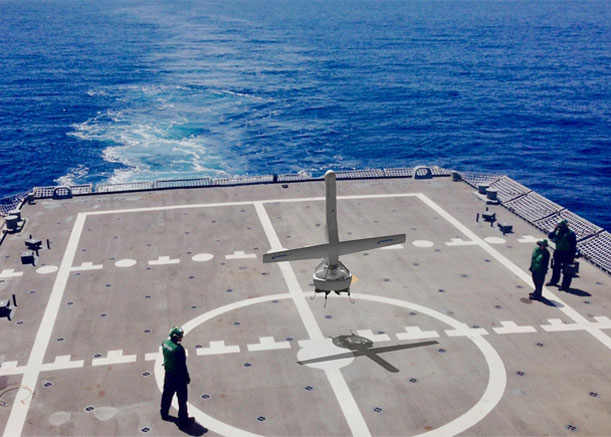
Meanwhile the Army is looking at procuring a new generation of UAS. They are testing four airframes, all are vertical take-off.

Three of the contenders – Arcturus UAV’s Jump 20, L3 Harris Technologies’ FVR-90, and Textron’s Aerosonde HQ – share a similar configuration, something we’ve never seen on a full-size manned aircraft. Each of them has wings and a pusher propeller in back for forward flight, but also quadcopter-style mini-rotors for vertical takeoff and landing. The fourth, equally unconventional design is Martin UAV’s V-Bat, a “tail-sitter” that has a single large fan for both vertical and forward flight, changing from one mode to the other by simply turning 90 degrees.

The potential to operate these from small spaces is obvious and with autonomous take-off and landing it is likely training for operators may not be too demanding, as the Coast Guard will one day, hopefully, move to providing their own operators for Coast Guard owned systems.

There is even emerging technology that may allow autonomous landing on moving ships.

“One of the technologies we’ve been looking at is very simple, but will help in the landing of our UAVs,” Venable said. “It’s an optical landing system by Planck Aerosystems that uses something like a QR code that is about 3 feet square, and the aircraft scan it, locks on and lands on it.”


“Cooperative Maritime Law Enforcement and Overfishing in the South China Sea” –CIMSEC

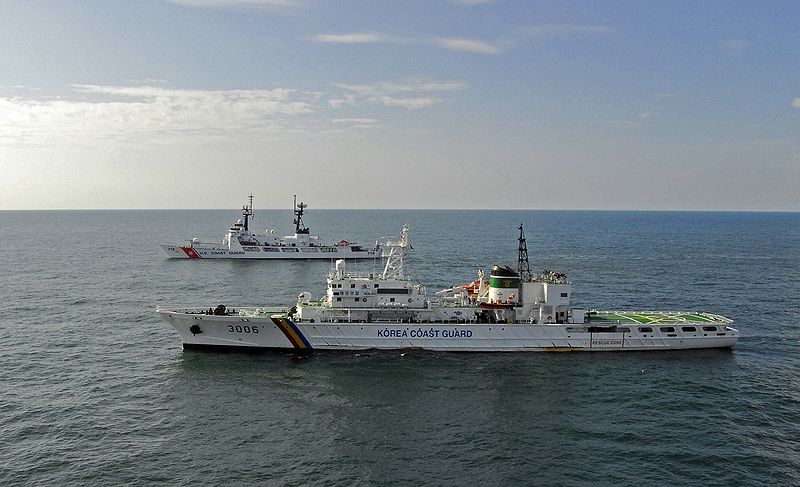
Republic of Korea Coast Guard vessel #3006 in company with U.S. Coast Guard cutter USCGC Boutwell (WHEC-719) during the North Pacific Coast Guard Forum in August 2007. This forum was created to increase international maritime safety and security in the Northern Pacific Ocean and its borders. The Boutwell worked with the Korean coast guard while on their way to Yokosuka, Japan. The Japanese coast guard is one of the six nations involved in the forum.

CIMSEC brings us a discussion of the possibility of cooperative fisheries enforcement in the South China Sea to stop both overfishing and Illegal, Unregulated, Unreported (IUU) fishing and perhaps bring China into a more mutually beneficial relationship with her neighbors.

Earlier, I had a suggestion about how we might form an instrument of cooperative enforcement by forming a “Combined Maritime Security Task Force Pacific,” a law enforcement alliance rather than a military one.

Probably before that could be fully realized, the various nations with competing claims to the waters of the South China Sea, need to take their claims to the UN’s International Tribunal. The more nations use it, the more pressure on China to participate. If, they do not present a cases before the international their claims will be weakened.


“GeoSpectrum Launches Low Frequency Active VDS Deployable by USVs”

Geospectrum’s new, compact version of the Towed Reelable Active Passive Sonar (TRAPS) suitable for Unmanned Surface Vessels (USVs)

NavyNews reports that Canadian Company GeoSpectrum has developed a version of their “Towed Reelable Active Passive Sonar” (TRAPS) that is scaled to fit vessels as small as 12 meter Unmanned Surface Vessels (USV).

We talked earlier about an earlier version of this system. If it fits on a 12 meter (39’4″) USV, then it should certainly be able to fit on anything WPB or larger. If we should ever have to go to war, this might be a capability we would want to protect our harbor approaches from submarines. We would probably also want to add an ASW torpedo launching capability.

It might be worth doing some experimentation to see how it works, and if desirable, draw up plans for adding this or a similar system for mobilization. First of course we should take a look at the results of Canada’s tests.

Might also be desirable to have something like this for the Webber class cutters going to PATFORSWA, since the Iranians have a large number of small conventionally powered submarines.

Maybe it could help us find semi-submersibles smuggling drugs as well. 

“Coast Guard Modifies Contract to Construct Second Offshore Patrol Cutter, Acquire Long Lead-Time Material for Third Offshore Patrol Cutter” –CG-9

Above: Artists rendering from Eastern Shipbuilding Group

Contract for the Second Offshore Patrol Cutter, the future USCGC Chase, and long lead time items for the third. Presumably this is a contract modification, rather than the  exercise of a contract option, because the price is higher than the original option. Still this does not look a great deal higher than the previous contract ($317.5M), for the first OPC and long lead time items for the second. Following from the Acquisitions Directorate, CG-9:

The U.S. Coast Guard modified its contract with Eastern Shipbuilding Group (ESG) April 2 to begin construction of the second Offshore Patrol Cutter (OPC) and to acquire long lead-time material (LLTM) for the third OPC. Contract delivery of the second OPC, to be named Chase, is scheduled to occur in 2023.

The total value of the construction and LLTM orders is $343 million. In addition to ordering construction of the second OPC, this contracting action also covers the initial order of components and materials necessary to support the future construction of the third OPC by acquiring propeller and steering components, marine diesel engines, the ship integrated control system, switchboards, and generators.

The lead OPC is currently in production at ESG’s shipyard in Panama City, Florida.  Production of the lead cutter, Argus, commenced January 7, 2019. Delivery of Argus is scheduled for 2022.

The OPC meets the Service’s long-term need for cutters capable of deploying independently or as part of task groups and is essential to stopping smugglers at sea, interdicting undocumented migrants, rescuing mariners, enforcing fisheries laws, responding to disasters and protecting our ports. The acquisition of 25 OPCs will complement the capabilities of the Service’s National Security Cutters, Fast Response Cutters and Polar Security Cutters as an essential element of the Department of Homeland Security’s layered security strategy.

For more information: OPC program page

Hollywood’s Greats Come Out to Dance to ‘Chase Hall Funk’ (the Academy Class of 1969 Theme Song)

Now for something completely different, to lighten the mood. In prep for my Academy class’ 50th graduation anniversary, a classmate, Bob Pokress, wrote new lyrics for Bruno Mars “Uptown Funk” and had it professionally recorded, to be used as the class marched onto the field. He also produce a couple of videos. First the one below staring some now old Coasties before they went to their first assignment. More recently the one above. Looking at the video below, you’ll see that the composition of the class of 1969 was very different from the population of today’s Academy classes.

The Gauntlet has been thrown down. Other Coast Guard unit videos out there that might equal or top this one?

“Trump: US to deploy anti-drug Navy ships near Venezuela” –Navy Times

Orthographic map of Venezuela centered on Caracas
Controlled territory in dark green.
Claimed territory in light green.
From Wikipedia, Author: Addicted04

The Navy Times reports,

“President Donald Trump announced Wednesday that Navy ships are being moved toward Venezuela as his administration beefs up counter-narcotics operations in the Caribbean following a U.S. drug indictment against Nicolás Maduro.”

Most of the narcotics trafficking seems to be in the Eastern Pacific rather than the Caribbean. Venezuela’s coasts are on the Caribbean and the Atlantic. Apparently not all the effort will off Venezuela,

“The mission involves sending additional Navy warships, surveillance aircraft and special forces teams to nearly double the U.S. counter-narcotics capacity in the Western Hemisphere, with forces operating both in the Caribbean and eastern Pacific. Esper said the mission would be supported by 22 partner nations.”

Hope we have enough law enforcement detachments.

“Venezuelan Navy Patrol Ship Sinks After Collision With Cruise Ship ” –Maritime-Executive

Graphic from FleetMon report

Maritime-Executive and FleetMon report a curious case in the Caribbean. Looks like, perhaps the Venezuelan Navy attempted an act of piracy against an ice strengthened cruise ship, RCGS Resolute with 35 crewmen aboard, and lost a ship as a result. Warning shots were fired and the Venezuelan vessel attempted to shoulder the cruise ships.

Also this is the second Navantia built warship to sink as a result of collision. The Venezuelan patrol vessel, NAIGUATA, was commissioned in 2011 and is about the size of a Coast Guard 270 foot WMEC, 1720 tons full load, 79.9 m (262 ft) in length. Navantia is also teamed with Bath Ironworks in the US Navy’s FFG(X) Competition.

“Defense Primer: United States Transportation Command” –CRS

Emblem of the United States Transportation Command (TRANSCOM or USTRANSCOM). The original emblem was designed by the U.S. Army Institute of Heraldry.

The Congressional Research Service has issued a short “primer” on TRANSCOM, the US Transportation Command.

The component the Coast Guard has most frequent contact is the Military Sealift Command, MSC.

Coast Guard fixed wing assets may from time to time also be called upon to assist the Air Mobility Command, AMC.