Vietnam Coast Guard Becoming More Military?

Vietnamese Coast Guard Damen 9014 Offshore Patrol Vessel. Photo: lancercell.com

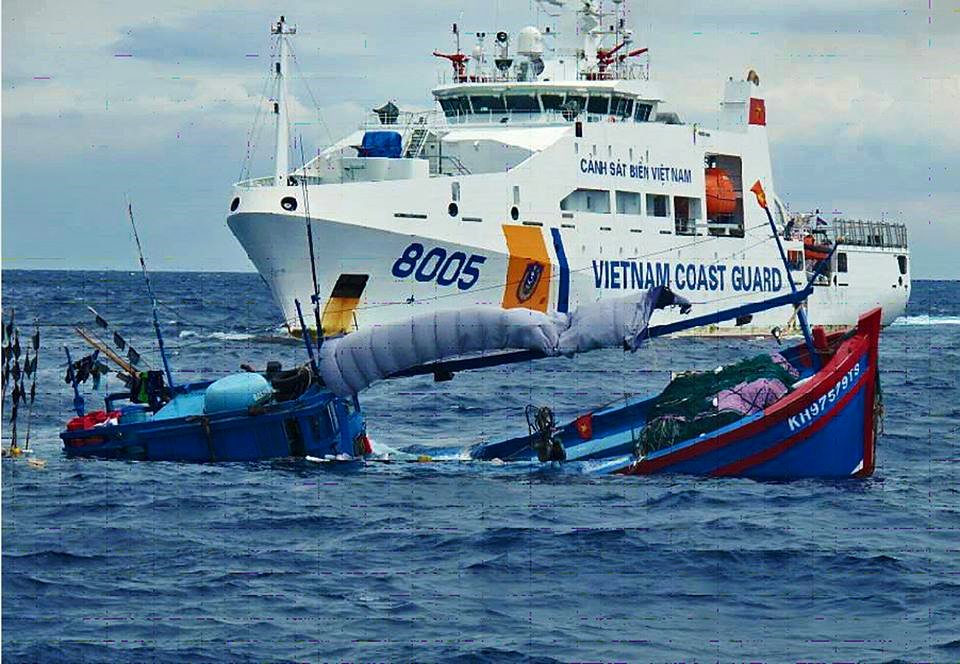
SeaWaves reports Vietnam is seeking to better define its Coast Guard’s roles and it sounds like it may be moving toward a more military posture.

“Therefore, making the Vietnamese Coast Guard a member of the country’s armed forces is an important and necessary step to protect and manage Việt Nam’s maritime interests and resources,” Linh said.

Deputy Nguyễn Minh Sơn asked for the draft law to clearly define the coast guard’s jurisdiction and chain of command to ensure the force can respond to various situations and demands while on patrol at sea.

The US Coast Guard has been instrumental in formation of Vietnam’s Coast Guard and Vietnam recently added the former USCGC Morgenthau to its Coast Guard. Vietnam is one of the few countries in SE Asia that actively confronts Chinese aggressiveness in the South China Sea.

The Former USCGC Morgenthau, now in Vvietnamese service

“White House Recognizes Superior Drug Interdiction Efforts” –Nov. 1, 2018, Office of National Drug Control Policy

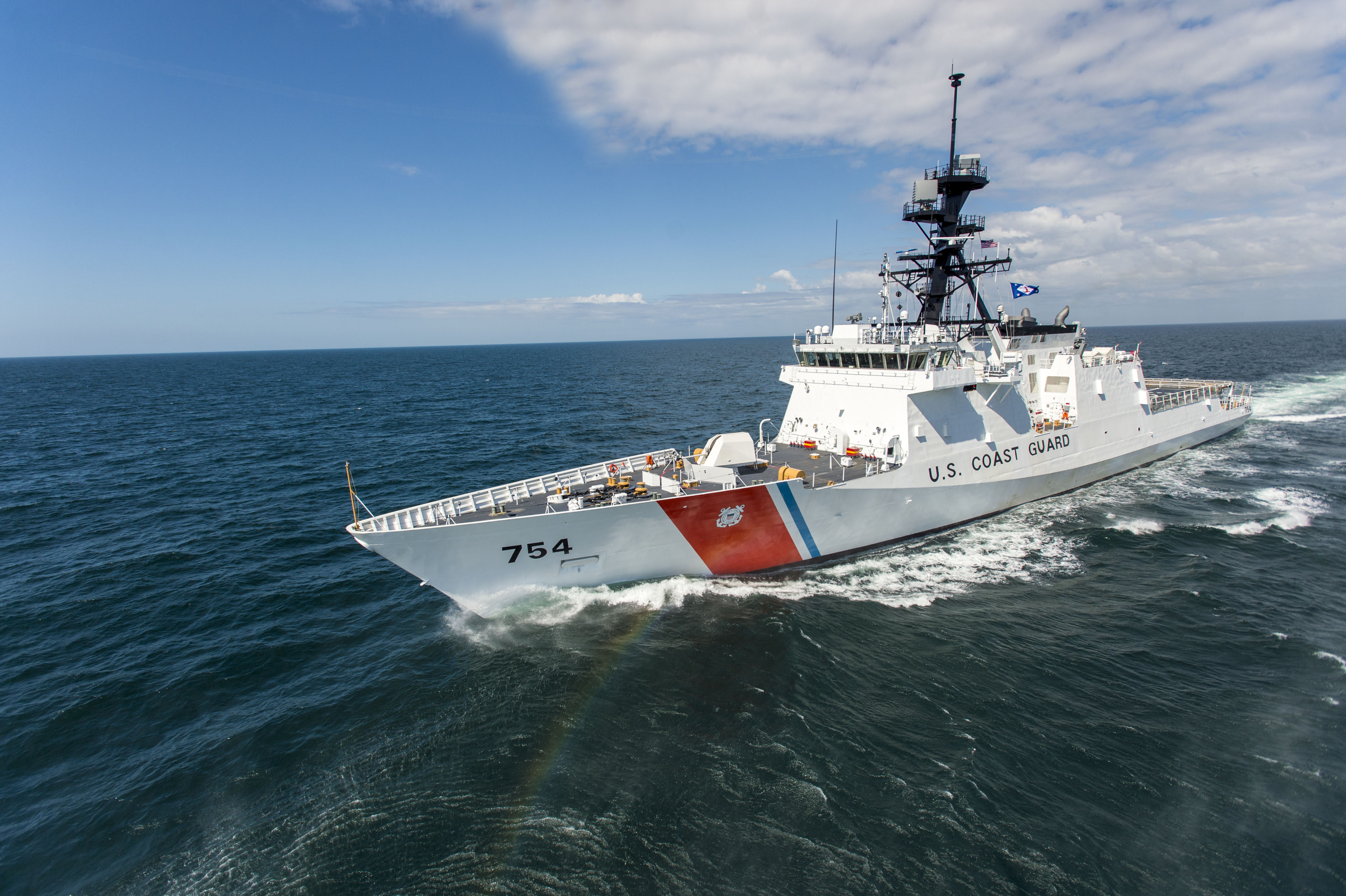
NSC 5 James on builders trials in the Gulf of Mexico March 30, 2015.

Two Coast Guard units were recently recognized by the Office of National Drug Control Policy for exceptional performance

  • US Coast Guard Cutter James (WMSL 754) is receiving the award in the Detection & Monitoring category for their unprecedented 11 days of tactical control while JIATF South was shutdown for Hurricane IRMA.
  • S. Coast Guard Helicopter Interdiction Tactical Squadron Aviation Detachment 17-22 is recognized for their Maritime Interdiction & Apprehension successes during a 79-day shipboard deployment.

That USCGC James could take over tactical control of Join Interagency Task Force South for eleven days is truly remarkable.


Budget Watch, “Focus on defense budgets leaves Coast Guard high and dry” –The Hill

“The Hill” has a plea for passing the Coast Guard’s 2019 budget rather than relying on continuing resolutions.

It makes a good point that time will be short.

“Unfortunately, the Coast Guard budget did not get reported to the House until Sept. 12, 2018.  This is an issue because the House and Senate now are out until Nov. 13. After the election, they will have only 12 workdays before the CR ends on Dec. 7, 2018 (Pearl Harbor Day).”

Considering there is likely to be a lot of churn, particularly in the House, those twelve days are likely to very busy. Hopefully the DHS budget will get passed.

“Coast Guard Cutter Procurement: Background and Issues for Congress” –Congressional Research Service


Mr. O’Rourke has been busy (as usual). Also on 26 Oct. 2018, the Congressional Research Service also Issued an updated version of his study of Coast Guard Cutter procurement programs, specifically for National Security Cutters (NSC), Offshore Patrol Cutters (OPC), and Fast Response Cutters (FRC). Again I have reproduced the summary here. I do think it is strange that we are still talking about initial testing of the NSCs more than ten years after the first of these was commissioned (see page 14).

The Coast Guard’s acquisition program of record (POR) calls for procuring 8 National Security Cutters (NSCs), 25 Offshore Patrol Cutters (OPCs), and 58 Fast Response Cutters (FRCs) as replacements for 90 aging Coast Guard high-endurance cutters, medium-endurance cutters, and patrol craft. The Coast Guard’s proposed FY2019 budget requests a total of $705 million in acquisition funding for the NSC, OPC, and FRC programs.

NSCs are the Coast Guard’s largest and most capable general-purpose cutters; they are intended to replace the Coast Guard’s 12 aged Hamilton-class high-endurance cutters. NSCs have an estimated average procurement cost of about $682 million per ship. Although the Coast Guard’s POR calls for procuring a total of 8 NSCs to replace the 12 Hamilton-class cutters, Congress through FY2018 has funded 11 NSCs, including two (the 10th and 11th) in FY2018. Six NSCs are now in service, and the seventh, eighth, and ninth are scheduled for delivery in 2018, 2019, and 2020, respectively. The Coast Guard’s proposed FY2019 budget requests $65 million in acquisition funding for the NSC program; this request does not include additional funding for a 12th NSC.

OPCs are to be smaller, less expensive, and in some respects less capable than NSCs; they are intended to replace the Coast Guard’s 29 aged medium-endurance cutters. Coast Guard officials describe the OPC program as the service’s top acquisition priority. OPCs have an estimated average procurement cost of about $391 million per ship. On September 15, 2016, the Coast Guard announced that it was awarding a contract with options for building up to nine ships in the class to Eastern Shipbuilding Group of Panama City, FL. The first OPC was funded in FY2018 and is to be delivered in 2021. The Coast Guard’s proposed FY2019 budget requests $400 million in acquisition funding for the OPC program for the construction of the second OPC (which is scheduled for delivery in 2022) and procurement of long leadtime materials (LLTM) for the third OPC (which is scheduled for delivery in 2023).

FRCs are considerably smaller and less expensive than OPCs; they are intended to replace the Coast Guard’s 49 aging Island-class patrol boats. FRCs have an estimated average procurement cost of about $58 million per boat. A total of 50 have been funded through FY2018. The 28th was commissioned into service on July 25, 2018. The Coast Guard’s proposed FY2019 budget requests $240 million in acquisition funding for the procurement of four more FRCs.

The NSC, OPC, and FRC programs pose several issues for Congress, including the following: 

  • whether to fully or partially fund the acquisition of a 12th NSC in FY2019;
  • whether to fund the acquisition of four FRCs in FY2019, as requested, or some other number, such as six, which is the maximum number that has been acquired in some prior fiscal years;
  • whether to use annual or multiyear contracting for procuring OPCs;
  • the procurement rate for the OPC program;
  • the impact of Hurricane Michael on Eastern Shipbuilding of Panama City, FL, the shipyard that is to build the first nine OPCs;
  • planned procurement quantities for NSCs, OPCs, and FRCs; and
  • initial testing of the NSC.

Congress’s decisions on these programs could substantially affect Coast Guard capabilities and funding requirements, and the U.S. shipbuilding industrial base. .

“Coast Guard Polar Security Cutter (Polar Icebreaker) Program: Background and Issues for Congress” –Congressional Research Service

The Coast Guard Cutter Healy breaks ice around the Russian-flagged tanker Renda 250 miles south of Nome Jan. 6, 2012. The Healy is the Coast Guard’s only currently operating polar icebreaker. The vessels are transiting through ice up to five-feet thick in this area. The 370-foot tanker Renda will have to go through more than 300 miles of sea ice to get to Nome, a city of about 3,500 people on the western Alaska coastline that did not get its last pre-winter fuel delivery because of a massive storm. If the delivery of diesel fuel and unleaded gasoline is not made, the city likely will run short of fuel supplies before another barge delivery can be made in spring. (AP Photo/US Coast Guard – Petty Officer 1st Class Sara Francis) NY112

Oct. 26, 2018 The Congressional Research Service issued an update of their research into the Coast Guard’s “Polar Security Cutter” (Polar Icebreaker) program. Summarizing the major relatively recent developments:

  • The likely price of three cutters is expected to be $2.1B meaning the price of the icebreaker is very close to that of the National Security Cutter. 
  • Building a single class of more than three ships, rather than a mix of Heavy and Medium capability ships is being seriously considered. This is now more likely as it appears a ship, smaller cheaper than previously envisioned, can provide the “Heavy Icebreaker” capability.

I have provided the Summary below. 

The Coast Guard Polar Security Cutter (PSC) program, previously known as the polar icebreaker (PIB) program, is a program to acquire three new heavy polar icebreakers, to be followed years from now by the acquisition of up to three new medium polar icebreakers. The Coast Guard wants to begin construction of the first new heavy polar icebreaker in FY2019 and have it enter service in 2023. The PSC program has received about $359.6 million in acquisition funding through FY2018, including $300 million provided through the Navy’s shipbuilding account and $59.6 million provided through the Coast Guard’s acquisition account. The Coast Guard’s proposed FY2019 budget requests $750 million in Coast Guard acquisition funding for the program.

The acquisition cost of a new heavy polar icebreaker had earlier been estimated informally at roughly $1 billion, but the Coast Guard and Navy now believe that three heavy polar icebreakers could be acquired for a total cost of about $2.1 billion, or an average of about $700 million per ship. The first ship will cost more than the other two because it will incorporate design costs for the class and be at the start of the production learning curve for the class. When combined with the program’s $359.6 million in prior-year funding, the $750 million requested for FY2019 would fully fund the procurement of the first new heavy polar icebreaker and partially fund the procurement of the second.

The operational U.S. polar icebreaking fleet currently consists of one heavy polar icebreaker, Polar Star, and one medium polar icebreaker, Healy. In addition to Polar Star, the Coast Guard has a second heavy polar icebreaker, Polar Sea. Polar Sea, however, suffered an engine casualty in June 2010 and has been nonoperational since then. Polar Star and Polar Sea entered service in 1976 and 1978, respectively, and are now well beyond their originally intended 30-year service lives. The Coast Guard has used Polar Sea as a source of spare parts for keeping Polar Star operational.

A Department of Homeland Security (DHS) Mission Need Statement (MNS) approved in June 2013 states that “current requirements and future projections … indicate the Coast Guard will need to expand its icebreaking capacity, potentially requiring a fleet of up to six icebreakers (3 heavy and 3 medium) to adequately meet mission demands in the high latitudes….”

The current condition of the U.S. polar icebreaker fleet, the DHS MNS, and concerns among some observers about whether the United States is adequately investing in capabilities to carry out its responsibilities and defend its interests in the Arctic, have focused policymaker attention on the question of whether and when to acquire one or more new heavy polar icebreakers as replacements for Polar Star and Polar Sea.

On March 2, 2018, the U.S. Navy, in collaboration with the U.S. Coast Guard under the polar icebreaker integrated program office, released a request for proposal (RFP) for the advance procurement and detail design for the Coast Guard’s heavy polar icebreaker, with options for detail design and construction for up to three heavy polar icebreakers.

Issues for Congress for FY2019 for the polar icebreaker program include, inter alia, whether to approve, reject, or modify the Coast Guard’s FY2019 acquisition funding request; whether to use a contract with options or a block buy contract to acquire the ships; whether to continue providing at least some of the acquisition funding for the PSC program through the Navy’s shipbuilding account; and whether to procure heavy and medium polar icebreakers to a common basic design.

“Nobody Asked Me, But . . . Rename the Coast Guard Districts”–USNI

The US Naval Institute has a short article by Cdr. Jim Hotchkiss (USCG Reserve). Unfortunately it is behind the paywall for those of you who are not members, but in short he points out that the current district number designations can be traced back to WWII and a desire to correspond to Naval District designations. Now that that is no longer a consideration, why not use more descriptive geographic designations?

His proposal is captured in the diagram above.

Certainly Cdr. Hotchkiss has a point. I only have a couple of comments. It would ease the transition if we continue to use the term “District” rather than the less specific term, “Command,” which he uses above, e.g., “Coast Guard District Northeast” rather than “Coast Guard Northeast Command.”

The actually choice of names would justify some additional thought, but I will suggest alternatives for three of the Districts.

  • For the current 7th District–CG District Southeast
  • For the current 8th District–CG District Gulf and Inland
  • For the current 11th District–CG District Southwest

“In Budget Squeeze, Coast Guard Set to Extend Life of Dolphin Helicopter Fleet”–USNI

180710-G-ZV557-1313 PACIFIC OCEAN (July 10, 2018) Crewmembers aboard the USCGC Bertholf (WMSL 750) check the flight deck July 10, 2018, alongside the flight crew of the a U.S. Navy HSC-4 Black Knight MH-60 helicopter 15 miles south of Oahu, Hawaii, while in support of RIMPAC 2018. Photo by Petty Officer 2nd Class David Weydert

We previously discussed the fact that the Coast Guard is working on life extension programs for both the MH-65s and the MH-60s, but a recent post from the Naval Institute News Service brought up an interesting possibility that might offer increased capability.

We would like to enlarge the MH-65 fleet, but, because that now appears impossible, we will be obtaining and rejuvenating some Navy H-60 airframes.

“Part of the Coast Guard’s strategy includes refurbishing used Navy MH-60 Seahawks and keep them flying for about 20,000 more hours.”

Presumably these airframes will bring along their folding rotor blades and tails that would permit them to be hangered on most of our larger ships.

I’m wondering if we will retain the ability to take these helicopters to sea. It could substantially improve shipboard helicopter range, endurance, and weight carrying ability.. Perhaps the helicopter Interdiction Tactical Squadron (HITRON) in Jacksonville  should get some of these aircraft. (They currently have ten MH-65Ds. They will probably need to retain some H-65s as long as we are using 210s for drug interdiction.)

Surface Navy in the Arctic

The Coast Guard has been at this for quite a while, but for the first time in about 27 years, the Surface Navy has ventured north of the Arctic Circle in force. Its been a learning experience for the fleet and for the people of Reykjavik, Iceland

They are participating in Exercise Trident Juncture, taking place in and around Nordic Europe Oct. 25 to Nov. 23, including the Baltic Sea, Iceland, and the airspace of Finland and Sweden. There are expected to be “More than 50,000 participants – including 14,000 U.S. service members – … utilizing approximately 150 aircraft, 65 ships and more than 10,000 vehicles in support of the exercise.”

US Navy units include the Harry S. Truman Carrier Strike Group (HSTCSG) with the carrier, a cruiser, and four destroyers and the Iwo Jima Amphibious Ready Group (ARG), USS Iwo Jima (LHD-7), USS New York (LPD-21) and USS Gunston Hall (LSD-44).

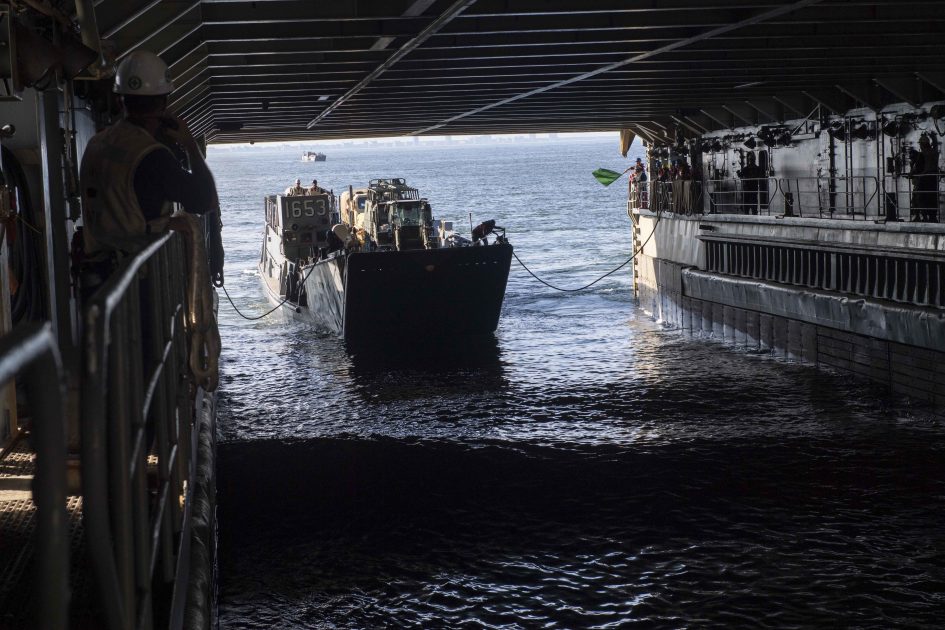
A landing craft utilities (LCU) enters the well deck of the Whidbey Island-class dock landing ship USS Gunston Hall (LSD 44) on Oct, 3, 2018, to embark on the ship for Trident Juncture 2018. US Navy photo.

Apparently Gunston Hall experienced some minor injuries and damage.

According to a Navy news release, “the amphibious dock landing ship USS Gunston Hall (LSD-44) experienced heavy seas during the evening of Monday, October 22, 2018. As a result, the ship’s Landing Craft Utilities (LCU) and well deck experienced damage. The Gunston Hall is in port Reykjavik, Iceland for further assessment….Amphibious transport dock USS New York (LPD-21) also returned to port as a precautionary measure…”

But now we hear from the poor victims in Iceland. 7000 sailors and marines invaded the town of Reykjavik (population about 125,000) and drank all their beer.

Will We Start Seeing LCS in SOUTHCOM?

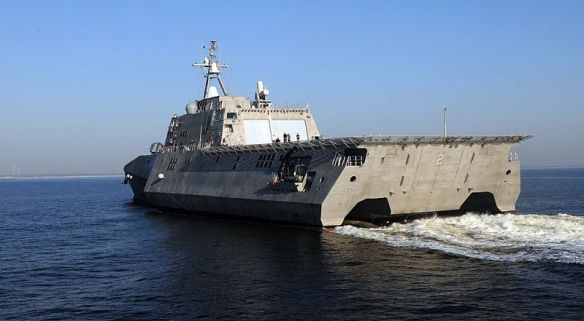
USS Independence (LCS-2)

Are we going to see any Littoral Combat Ships (LCS) joining the Coast Guard in interdicting drugs? They seem to be saying yes, but the level of effort, and when it will start, is still not clear. In April DefenseNews reported, “The Pentagon is poised to send the LCS to thwart narcos.,” but then the first line said they were “poised to decide,” which is not really the same thing.

The report indicated that four ships would deploy in 2019 (“The Navy has been piecing together a strategy to get at least four ships back down to SOUTHCOM to perform counter-drug ops.), and that 24 LCS deployments are planned between 2019 and 2024.

August 22 we had another DefenseNews report, “Newly reorganized littoral combat ship program faces its first big test in 2019,” that reported , “Four littoral combat ships are on track to be available to deploy in 2019,” but it is still unknown when that will be, for how long, and even what kind of deployment.

SOUTHCOM and others are pushing for additional assets from the Navy, but it is unclear what, if any, additional support he will be given.

Both articles had the same quote from Secretary of Defense Mattis,

“Is it primarily law enforcement? Do they need to have people with badges, which would mean Coast Guard cutters were going to have to shift and go to the Department of Homeland Security? Or is it LCSs, because of the nature of an evolving threat?” Mattis said. “We don’t have the answer yet, sir, but we’re working it.”
I find that statement a bit troubling. It looks like SecDef does not know how the ships are used. There certainly seems to be no urgency. So when will we see them? Given the current lack of commitment, probably not until mid to late 2019 at best, and even then we are unlikely to see all four committed to SOUTHCOM. The Navy will probably want to send at least one to IndoPacific Command (INDOPACOM) and one to Central Command (CENTCOM).
Ships expected to be deployed in 2019 are two of the trimaran Independence class,
USS Montgomery (LCS-8) and USS Gabrielle Giffords (LCS-10), both based in San Diego, and two mono-hull Freedom-class, USS Detroit (LCS-7) and USS Little Rock (LCS-9), both based in Mayport. One of these, USS Detroit is now expected to deploy with Naval Strike Missile installed. I can’t believe they have accelerated integration of this anti-ship cruise missile so that they could go chase drug runner. Detroit is likely to go to INDOPACOM, although it might pass through SOTHCOM AOR in transit.
There are potentially a couple of interesting things to watch if they do deploy.
  • How long can they deploy given their apparent strong dependence on contractor support and the short cruising range of particularly the mono-hull Freedom class? Hopefully deployment will be more than a photo-op.
  • If they bring an MQ-8 Fire Scout, particularly the larger “C” model which the Coast Guard has not had a chance to try, it will be interesting to see how useful it is for a Coast Guard mission.

MQ-8C Fire Scout Ground Turns and Telemetry Testing onboard USS Montgomery (LCS 8)

Photo: MQ-8C seen in the hangar of USS Montgomery (LCS-8)