
Military.Com has a post reviewing the Coast Guard’s last year, including how the CG has been viewed and funded. It is a great read. It will make you proud of the service and its leadership.

Military.Com has a post reviewing the Coast Guard’s last year, including how the CG has been viewed and funded. It is a great read. It will make you proud of the service and its leadership.
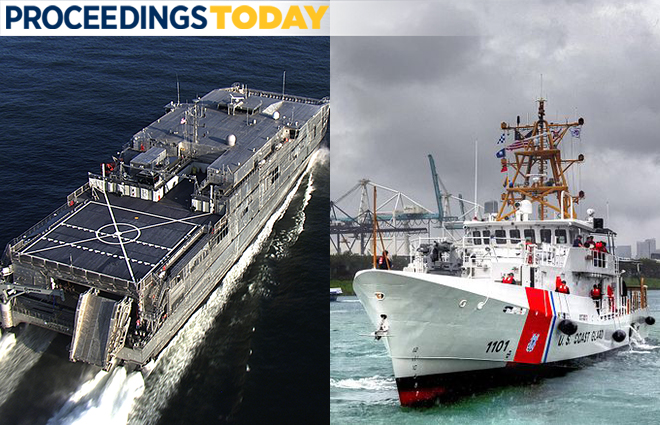
The US Naval Institute Proceedings has a short discussion of two possible replacements for the Navy’s Cyclone class PCs and the Webber class is one of them.
These might help us in the Caribbean and Eastern Pacific too.
Don’t neglect the comments. Some good points there.
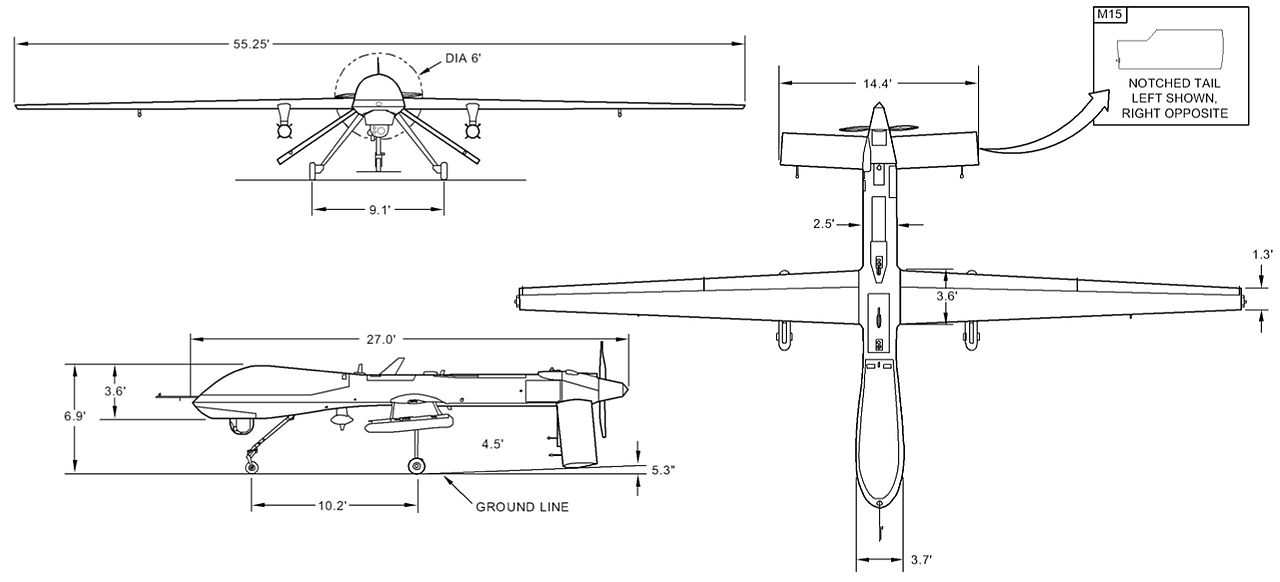
3-View line drawing and dimensions of MQ-1B Predator UAV, – Department of the Air Force, Engineering Technical Letter (ETL) 09-1: Airfield Planning and Design Criteria for Unmanned Aircraft Systems (UAS), 28 Sept 2009
The Coast Guard Compass has a post on the Coast Guard’s investigation of possible future procurement of land based long-range and ultra-long endurance unmanned aircraft systems (LR/ULE UAS).
The Air Force has recently decided to retire all their MQ-1 Predator UAVs replacing them with the MQ-9 Reaper. Perhaps we could get a near term interim capability and gain valuable experience by taking over some of the Air Force Predators and modifying them for a Maritime role..
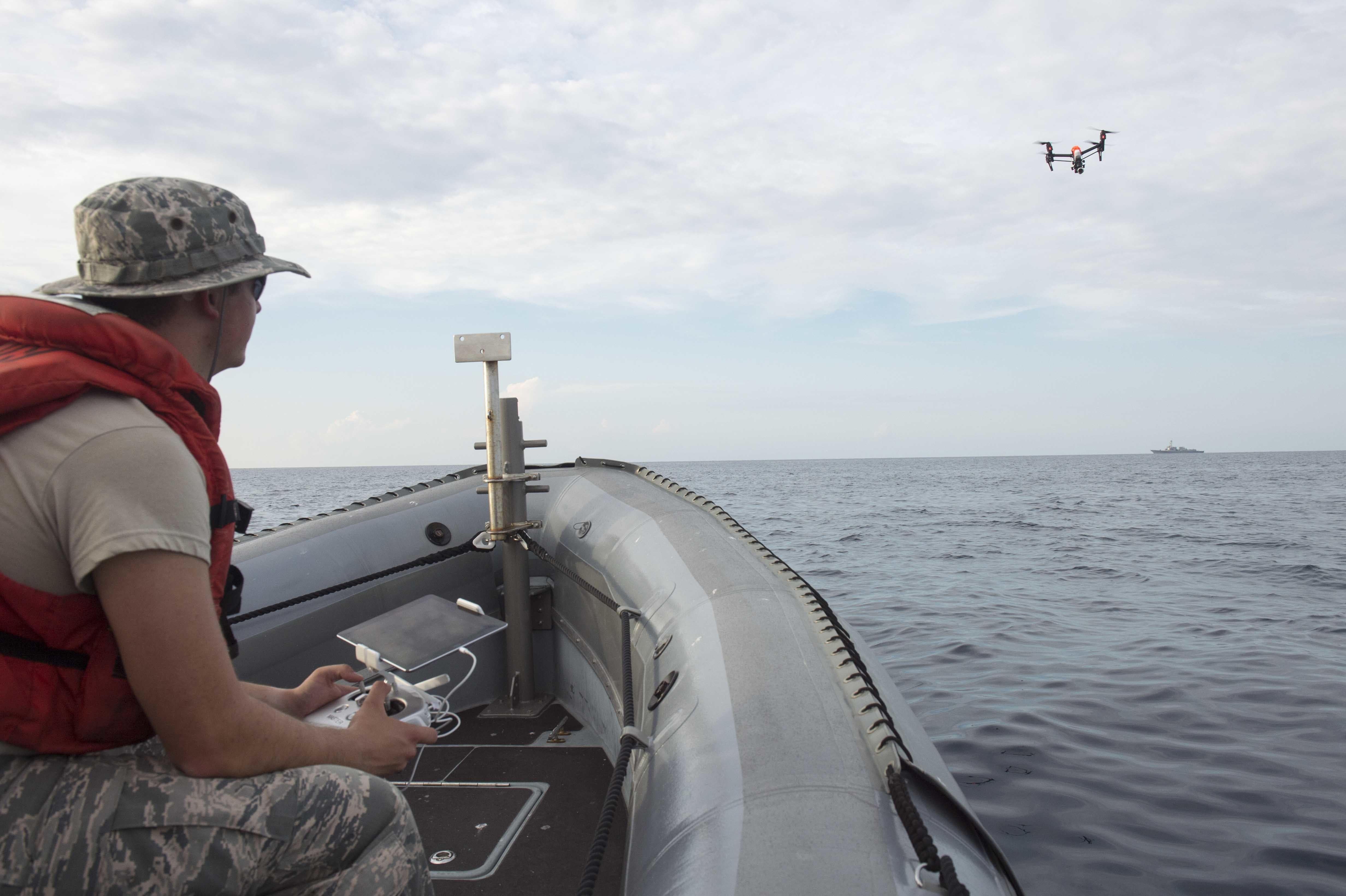
160919-N-AT101-177 GULF OF MEXICO (Sept. 19, 2016) Cadet 1st Class Hanson Oxford, a student at the U.S. Air Force Academy, operates an unmanned aerial system aboard a rigid hull inflatable boat during exercise Black Dart, Sept. 19. Black Dart is the largest Department of Defense (DoD) live-fly, live-fire, counter Unmanned Aerial Systems (UAS) technology demonstration. (U.S. Navy photo by Mass Communication Specialist 1st Class Maddelin Angebrand/Released)
There is a new ALCOAST that addresses short range unmanned air system. I have reproduced it below.
These are the commonly available battery powered “drones” that generally cost a few hundred to a few thousand dollars. They must weigh less than 55 pounds (25 kilos). Unless restrictions are waived by the FAA, they can generally only be operated below 400 feet AGL (above ground level) during hours of day light and civil twilight.
Becoming a certified remote operator is not very difficult, particularly if you already a pilot. It is not a skill test, it is primarily about how to fit into the air space control system. The FAA has study material on line.
U.S. Coast Guard sent this bulletin at 01/05/2018 05:13 PM EST
R 051700Z JAN 18
FM COMDT COGARD WASHINGTON DC//CG-7//
TO ALCOAST
UNCLAS //N03710//
ALCOAST 004/18
SUBJ: AUTHORIZED USE OF COAST GUARD UNMANNED AIRCRAFT SYSTEMS (UAS)
A. SMALL UNMANNED AIRCRAFT SYSTEMS, 14 CFR Part 107
B. COAST GUARD AIR OPERATIONS MANUAL, COMDTINST M3710.1 (SERIES)
C. COMDT (CG-7) memo 3700 of 15 May 2017
1. Short-Range UAS (SR-UAS) constitutes one of the most significant
new and emerging technologies available to the Coast Guard today.
In support of the COMDT’s strategic commitment to invest in new
technologies, the Office of Aviation Forces (CG-711) is leveraging
opportunities to deliver this new technology to the field. Pursuant
to REF C, COMDT (CG-711) established the Group-1 UAS Prototype Program
Initiative (GUPPI) as a mechanism for testing SR-UAS use in the fleet
while simultaneously developing a sustainable Program of Record (PoR).
GUPPI will develop and test potential capability solutions to
integrate, train, and standardize this technology.
2. The USCG recognizes that small, hand-launched SR-UAS have the
potential to be a highly effective and affordable tool for many
missions. In the future, SR-UAS may supplement or even replace
legacy capabilities in order to meet existing mission requirements.
GUPPI will assist units in identifying mission requirements which
are more effectively met through the use of SR-UAS. Ice
reconnaissance, post-storm survey, pollution response, antenna tower
inspection, search and rescue, and law enforcement are a small
sample of the potential uses of SR-UAS.
3. GUPPI is a pilot program that will provide SR-UAS capabilities to
meet the operational commander’s needs at the deck-plate level,
employing properly trained personnel to test potential SR-UAS
capability solutions. Simultaneously, SR-UAS remote pilots will
generate the doctrine, training, and TTP necessary to validate a
long-term PoR. The GUPPI team, consisting of FAA-certified remote
pilots within COMDT (CG-711), will equip six fleet units with SR-UAS
and assist unit personnel with obtaining the necessary training and
certification to operate the device for authorized missions.
As operations progress and mature through 2018-2019, GUPPI membership
will expand and authority to approve SR-UAS operations will be
disseminated and delegated down to the appropriate level. This
initiative will sunset once a formal PoR has been established to
fund and sustain the SR-UAS fleet. To understand our customers’
needs most effectively, I request that units forward any internally-
identified UAS requirements up their respective chains of command
for consideration by the mission managers and COMDT (CG-711).
4. In August 2016, REF (A) established a viable certification method
and operating procedures for both public and private operators to
operate SR-UAS within the National Air Space. GUPPI was founded to
explore potential avenues for Coast Guard operation of SR-UAS and
will likely incorporate large elements for REF (A) into REF (B).
Unit personnel interested in obtaining their Part 107 Remote Pilot
certification are encouraged to visit the COMDT (CG-711) SR-UAS
Portal Page for further guidance: https://cg.portal.uscg.mil/units/
cg711/SR-UAS/default.aspx Units interested in participating in
GUPPI shall route their request to COMDT (CG-711) through the
appropriate chain of command for consideration.
5. In addition to GUPPI, units are authorized to contract select UAS
services from commercial vendors in order to obtain cost effective
near-term solutions to current capability gaps. Units are reminded
that the USCG should not acquire any property or retain any property
rights in the UAS or associated hardware, or technology under these
service contracts.
a. Notify COMDT (CG-711) and the next level chain of command prior
to initiating any UAS contract obligations.
b. Coast Guard units are authorized to seek photo or video imagery
services from commercial UAS operators, in accordance with established
contracting procedures.
The following apply for any UAS services:
1) The UAS may be used for photo or video imagery in support of infra-
structure inspections, environmental observation, pollution response,
post-storm survey, ice survey, communications support, and public relations.
Commercial UAS support for other missions, including law enforcement,
intelligence, defense operations, or search and rescue requires explicit
COMDT (CG-711) and chain of command approval.
2) The UAS shall not be used to collect any Personally Identifiable
Information (PII).
3) CG units contracting for UAS services, and their servicing legal
offices, will ensure that the contract specifies that the commercial
UAS operator shall be solely responsible for the operation of the UAS
and compliance with applicable FAA laws and regulations.
4) CG units contracting for UAS services or flying organic UAS shall
contact the nearest CG AIRSTA and District (DM) to ensure that CG manned
aircrews are aware of the UAS operations and have a plan to deconflict
the airspace.
c. Use of commercial UAS for missions not listed here or for any uses
other than capturing photo or video imagery requires further review
by COMDT (CG-711) and shall be forwarded for consideration.
6. Units may also partner with local, State, or Federal government
agencies that operate UAS to obtain information from their UAS
operations in support of Coast Guard operations.
7. SR-UAS will require specific operator qualifications, airworthiness
certifications, and spectrum authority, at a minimum. SR-UAS
operations could subject the USCG to liability for any associated
damage, injury, or death. GUPPI is addressing these challenges
and policies by identifying a controlled, risk-mitigated, environment
for SR-UAS operational development.
8. The U.S. Army, Navy, and Marine Corps ceased all use of the prolific,
industry-standard DJI SR-UAS products on 02 August, 2017. This
manufacturer of SR-UAS was found to have significant cyber security
concerns, and current USCG policy is in alignment with our DoD
counterparts. The Office of the Secretary of Defense plans to release
DoD-wide guidance shortly on which COTS systems will be authorized by
the DoD.
9. The Research and Development Center and the Coast Guard Academy
currently have authorization from COMDT (CG-711) for UAS use in support
of education and research activities. Units may request GUPPI team
support through their chain of command in support of field missions.
Unless specifically provided in this ALCOAST, all other access to SR-UAS
by fleet units remains prohibited.
10. POC is CDR Daniel Broadhurst, COMDT (CG-7114).
11. RDML M.P. Ryan, Assistant Commandant for Capability, sends.
12. Internet release is authorized.

NSC 5 James on builders trials in the Gulf of Mexico March 30, 2015.
The 2017 “Hopley Yeaton Cutter Excellence and Superior Cutterman” awards have been announced.
R 211106 DEC 17
FM COMDT COGARD WASHINGTON DC//CG-7//
TO ALCOAST
UNCLAS //N01650//
ALCOAST 360/17
COMDTNOTE 1650
SUBJ: WINNER ANNOUNCEMENT – 2017 HOPLEY YEATON CUTTER EXCELLENCE AND SUPERIOR CUTTERMAN AWARDS
1. The Douglas Munro Chapter of the Surface Navy Association is honored to announce and congratulate the recipients of the 2017 Hopley Yeaton Cutter
Excellence and Superior Cutterman Awards. Each of the winners was selected from amongst a superb group of highly deserving candidates by a diverse panel of officer and enlisted Cuttermen. The winners selected for this year are:
A. Cutter Excellence Award (Large Cutter): CGC JAMES (WMSL 754)
B. Cutter Excellence Award (Small Cutter): CGC JOHN MCCORMICK (WPC 1121)
C. Superior Cutterman Award (Officer): LTJG Anna Ruth – CGC HAMILTON
D. Superior Cutterman Award (Enlisted): MK2 Jason Tribeck – CGC DILIGENCE
2. Hopley Yeaton Cutter Excellence Award (Large):
A. CGC JAMES (WMSL 754) led 22 successful drug interdictions, spearheaded hurricane relief and recovery efforts as Command Task Unit (CTU) Maria,
aggressively pursued opportunities for community involvement, and exemplified dedication to their crewmembers’ personal well-being. On their first patrol, the JAMES made an unprecedented AUF interdiction of three go-fast vessels, over 40 NM apart within a two hour window. When JIATF-S was forced to evacuate ahead of Hurricane Irma, JAMES assumed Alpha Victor (AV), taking TACON of all assets in the Eastern Pacific for a week. As AV, JAMES facilitated 61 cases through 11 partner nations, five interagency entities, 12 surface assets, and over 24 flight missions. This resulted in the interdiction of 10,881 kgs of cocaine and 747 kgs of marijuana, and set a new benchmark for WMSL capabilities.
B. Honorable Mentions for the Large Cutter Award were:
CGC ALEX HALEY
CGC CYPRESS
CGC NORTHLAND
3. Hopley Yeaton Cutter Excellence Award (Small):
A. As the first Fast Response Cutter (FRC) assigned to District 17, CGC JOHN MCCORMICK (WPC 1121) set lofty standards in crew readiness and training. This ensured JOHN MCCORMICK’s safe and timely transit of more than 6,000 NM from Key West to homeport of Ketchikan, and the crew’s rapid response to engineering and damage control casualties along the way. Upon arrival at homeport, JOHN MCCORMICK was an immediate asset to D17 where the crew conducted 77 fisheries boardings, saved 10 lives, and developed close bonds with the community.
B. Honorable Mentions for the Small Cutter Award were:
CGC BISCAYNE BAY
CGC JOSEPH TEZANOS
CGC WASHINGTON
4. Hopley Yeaton Superior Cutterman Award (Officer):
A. While serving as Combat Systems Officer aboard CGC HAMILTON, LTJG Anna Ruth led her cutter’s pursuit and boarding teams on all 19 of HAMILTON’s drug interdictions, netting over $500 million worth of cocaine in 2017. Shortly after reporting aboard, LTJG Ruth set about correcting 38 mission critical electronics casualties, ensuring the cutter’s full suite of sensors was available for its first patrol. Additionally, LTJG Ruth helped re-establish Naval Weapons Station Charleston, SC for use in ammunition onloads. LTJG Ruth served as a sought-after mentor and role-model for junior shipmates, streamlined the onboard qualification process, and promoted the afloat career path to others.
B. Honorable Mentions for the Superior Cutterman Award (Officer) were:
LCDR Amy Lockwood – CGC WAESCHE
LT Daniel Halsig – CGC CONFIDENCE
LT Paul Ledbetter – CGC SHERMAN
5. Hopley Yeaton Superior Cutterman Award (Enlisted):
A. MK2 Jason Tribeck epitomized dogged perseverance and showcased his ingenuity on numerous troubleshooting and repair efforts. MK2 Tribeck meticulously prepared DILIGENCE for AVSTAN, which earned high praise by Aviation Training Center Ship-Helo Branch throughout the inspection. His attention to detail played a critical role in his success as a government quality assurance inspector for $545K in dockside availability work. Additionally, MK2 Tribeck’s dedication and drive were on full display when he earned his Underway Engineer of the Watch (EOW) qualification, helping his shipmates through a heavy transfer season by improving the watch rotation.
B. Honorable Mentions for the Superior Cutterman Award (Enlisted) were:
MK1 Michael Hilbert – CGC HAMILTON
EM1 Shaun Ryan – CGC LIBERTY
ME1 Daniel Brooks – CGC SHERMAN
6. Awards will be presented in Washington, DC in conjunction with the January 2018 Surface Navy Association National Symposium. If a unit representative is not available to receive the Cutter Excellence Award at the symposium, the award will be sent to the winning cutter’s OPCON for presentation. The Surface Navy Association (SNA) will contact award winners to discuss and coordinate their travel and symposium arrangements. Please contact SNA at navysna@aol.com with any questions or concerns.
7. We applaud all of the deserving nominees for their phenomenal performance. There were an especially large number of nominations this year, all of which represented highly deserving candidates and made the selection of a single winner in any category especially challenging. We also thank the commanding officers and supervisors who took the time to submit high quality nominations for their deserving units and personnel, as well as ADCON units for reviewing and screening nominations.
8. RDML Michael P. Ryan, Assistant Commandant for Capability, sends.
9. Internet release authorized.

“Coast Guard Cutter John F. McCormick (WPC 1121), March 4, 2017. Coast Guard photo by Petty Officer 2nd Class Loumania Stewart”
Reuters is reporting that a collision between a loaded Iranian owned tanker and a Chinese freighter has resulted in a fire and possibly the loss of all 32 aboard the Iranian vessel. The tanker was carrying 136,000 tons of condensate, an ultra-light crude.
There was relatively minor damage to the Chinese freighter, and apparently no serious injuries. .
Above is a video of a symposium conducted by the Center for Strategic and International Studies, November 29, 2017, with Rear Admiral Michael F. McAlister, Commander, 17th Coast Guard District, as the speaker. He talked about:
Thanks to Lee for bringing this to my attention.
Above is the video of the Senate Subcommittee hearing for which I provided the Commandant’s prepared remarks earlier.
Participating Senators I noted were:
You can also check out the original post from the Senate Committee on Commerce, Science, and Transportation. (Same video is available there, but the meeting does not actually start on that version of the video until minute 36.) There you can also find the written statements of the other three witness who constituted the second panel. The Commandant was the sole witness on the first panel.
This was something of a love fest for the Coast Guard with repeated praise for the people and actions of the Coast Guard.
This hearing was reputedly about how the Coast Guard had been impacted by the unusually severe Hurricane season. There is not a lot new here but there were some interesting remarks.
Polar Icebreaker Contracts
The intention is to Contract for the first Icebreaker and then employ block buy for the next two (28m). To me this seems to negate most of the advantage of a block buy. I don’t believe we will or should buy one and then wait until we have tried it out before contracting for the next two. That would necessitate a delay of at least five years during which we would still have the nightmare scenario of our only heavy icebreaker having no rescue if it should break down in the ice–certainly not an impossibility even with a new ship. If we are going to contract for the remaining two before testing the first, we might as well block buy all three.
First of class is always the most expensive. If the shipyard gets a block buy they know that initial improvements in productivity can be amortized over the entire block buy quantity. In some cases, in order to win the whole project, the shipyard will cut the price of the first ship substantially knowing they will make a profit over the entire project.
If we buy one and then block buy the second and third, we have paid for improvements to the winning yard with the first contract and minimized the chances for a competitive bid for numbers two and three.
Legislation has capped DOD participation in icebreaker procurement, so the bulk of icebreaker procurement costs will come out of the Coast Guard budget.
Authorization
There was a lot of discussion about the need to have the Coast Guard Authorization Bill signed into law, still not approved. You can see it here.
Other topics
There was a discussion of the high cost of the Coast Guard response to the recent series of Hurricanes.
Representative Sullivan spent a lot of time, discussing and advocating for an eleven mile road from King Cove (population estimate–989) to Cold Bay, Alaska (population estimate–122) which has an all-weather airport with two runways, one 10,180 feet and one 6285 feet in length. The Coast Guard connection is that the road would minimize or eliminate the necessity for the Coast Guard to Medivac emergencies from King Cove by helicopter, which is frequently hazardous. It is a Federal issue, because the road would run through a Federal reserve. The Commandant fully supported the desirability of completing the proposed single lane gravel road as a means of minimizing the requirement for helicopter medivac.
Video Breakdown
28m Domestic icebreakers–Design work on new domestic icebreakers is expected to start in 2030. That sounds a bit late to me. Mackinaw was commissioned in 2006 so if that is what he is really talking about, that makes sense, but the 140 foot icebreaking tugs are a different story. The first for of these will be 51 years old in 2030. More than half of them have already completed in-service which was expected to add 15 years to their service life. Morro Bay, at least, is expected to reach the end of her service life in 2030, and considering how long it takes us to build a ship we really need to start the process not later than 2025.
45m Western Pacific Fisheries Protection–They have not seen much risk of Illegal, Unregulated, or Unreported fishing.
51m Inland River Tenders
56m We may need to replace the 52 ft MLBs with something larger than the 47 foot MLB sometime in the future, but their end of life is not yet apparent
58m Coast Guard Museum in New London
60m Sexual Assault in the CG
1h02m Puerto Rico/Virgin Islands continuing commitment and its effects on drug seizures and alien migrant interdiction.
1h05m Vessel homeporting
1h08 CG center of expertise, particularly in regard to clean up spills in ice and fresh water
1h16m Army Corp of Engineers dredging backlog.
1h17m Second Panel begins.
1h19m Medivac from King Cove
1h31m Mr Smithson regarding Deepwater Horizon experience, unified approach, investment in mitigation.
The Coast Guard is directing the documentation of possible exposure to asbestos and lead on ships that were built before 1991, which of course means most of them.
This TD applies to all Coast Guard members currently and previously assigned to CG cutters that were constructed prior to 1991. Documentation is for the purpose of identifying potential exposure to low levels of asbestos and lead below the Medical Surveillance Action Level (MSAL) required for enrollment into OMSEP. Medical documentation of these exposures may facilitate the processing of future Veterans Administration disability claims.
This is primarily aimed at active duty personnel, but an entry on the Coast Guard Retired Facebook page indicates an intention to also document possible exposure of those no longer on active duty.
Statistically 2017 was the best year yet for this blog. We had 215,180 views and 54,412 visits. Both represent a least modest increases over previous years. I have wondered occasionally, if I was running out of things to say, but there is always seems to be something new. Fortunately, I get a lot of help from readers who share their expertise and experience in the comments.
There were 259 posts this year, growing the total archive for this blog to 1,935 posts.
We continue to have an international readership. The US Is of course the largest with 158,165 views but, aside from the US, 15 countries had more than 1,000 views and 40 had more than 200. Aside from the US, the top 10 were the UK (8,807), Philippines, Canada, Japan, Australia, Spain, Netherlands, Ireland, Chile, and Germany (1,976). We even had a few readers from Russia (#16 with 968 views) and China (#30.Hong Kong SAR China with 294 views and #33 China with 282).
The next statistic (top posts of 2017) is a bit deceptive in that, because of the way the blog is structured, most of the time, posts are read on the homepage. The figures below are for the times a post has been accessed directly.
I would also like to particularly thank Center for International Maritime Security (CIMSEC) “Next War Blog”, Eaglespeak, and Thinkdefence, for linking to this website and bringing more readers here.
Thanks for the interest.
I wish you all a happy New Year with just the right blend of adventure, excitement, romance, and a sense of belonging.
Chuck
 Chuck Hill's CG Blog