The US Naval Institute blog has a post I think you may find worth reading about the water side of the European Immigration crisis.
“Government Sponsored Anarchy at Sea,” by CDR Salamander

The US Naval Institute blog has a post I think you may find worth reading about the water side of the European Immigration crisis.
“Government Sponsored Anarchy at Sea,” by CDR Salamander
I have to say I screwed up. I didn’t look up the current instruction before writing this.
The current instruction is COMDTINST M1020.8H “COAST GUARD WEIGHT AND BODY FAT STANDARDS PROGRAM MANUAL.” change 1, dated 17 April, 2015.
The current standards go beyond BMI and are more exhaustive than my suggestions.
1. General. Coast Guard body fat standards are mandated by reference (a), which states: “All the DoD components shall measure body fat using only the circumference-based method with one set of measurements (males: height, neck circumference, and abdominal circumference at the naval; females: height, neck circumference, waist circumference at the thinnest portion of the abdomen, and hips). This standardization avoids unnecessary confusion and perceptions of unfairness between services. No substitute methods of assessment are permitted.”
2. Standards for Separation. All members who exceed both their maximum allowable body fat (MABF) percentage by more than eight percent and exceed their maximum screening weight by more than 35 pounds are subject to separation. Screening weights and MABF percentages are listed in enclosure (1)
My original post is below.
————————————————————————————————–
Last October I wrote a post about why Body Mass Index (BMI) should not be used as a sufficient indicator of excess weight for the service to forcibly discharge an individual, because it does not differentiate between fat and muscle, and because it unfairly penalizes taller people.
I related how it resulted in the discharge of a very fit petty officer whose only crime was that he had spent too much time in the gym building muscle mass.
BMI has only one overriding advantage–it is easy to determine.
Recently found this article, “Calling BS on BMI: How Can We Tell How Fat We Are?” which provides two simple and quick alternatives that, in fact, reflect fat content rather than simply weight.
- “For adults, Laursen suggests getting out a tape measure. Measure your circumference at your belly button. If your waist circumference is half your height or less, you are at a healthy fat level, if you are over that number, your fat could put you at risk for ill health.
- “If you want something even simpler, look at your hip to waist ratio. It’s something even a doctor could eyeball quickly. “If the waist is bigger than the hips, it tells me that the risk carried with that weight is much higher for that person for premature death,” Lopez-Jimenez said.”
These two tests, which might be used in combination, give a better indication of fat content (and fat, particularly belly fat, is really what we should be concerned with) than BMI. Additionally it insures that the individual will look reasonably “military” in uniform, something BMI does not do.
If we consider meeting these two criteria sufficient, BMI would no longer useful for setting upper weight limits. Lower limits perhaps, but I believe there are better standards for that as well.
NavyRecognition reports DARPA conducted a three day demonstration of the “Towed Airborne Lift of Naval Systems” (TALONS) aboard the Cyclone class patrol coastal USS Zephyr (PC-8).
The Cyclone class is very familiar to the Coast Guard, three of them including Zephyr, having been loaned to the Coast Guard. Ten of the class are now homeported in Bahrain alongside six USCG 110s. The remaining three are stationed in Mayport and regularly work with the Coast Guard performing drug interdiction. As built they were slightly smaller than the Webber class, but most, including Zephyr, were lengthened and are now slightly larger than the Webbers (387 tons vs 353)
We have talked about TALONS previously here and here.
Reportedly they are working toward a fully automated launch and recovery system that would make the system even easier to use. The installation on Zephyr looked rather neat.

Chinese icebreaking research vessel Xue Long (Snow Dragon), Photo by Bahnfrend
Found an interesting post regarding China’s interest in the Arctic, considering the Northern Sea Route near Russia a part of their Belt and Road Initiative. Apparently the Russians are supporting the move.
“…China formally incorporated the Arctic into its plans for maritime cooperation under the Belt and Road Initiative, also sometimes called One Belt, One Road. The Vision for Maritime Cooperation under the Belt and Road Initiative, released on June 20 by China’s National Development and Reform Commission and the State Oceanic Administration, explains that a “blue economic passage” is “envisioned leading up to Europe via the Arctic Ocean.””
Of course they also want to exploit the resources. Cooperatively. In a sustainable fashion. Like they have done elsewhere.
The following from the CG-9 web site.
Aug. 14, 2017
The first Coast Guard aircraft outfitted with the Minotaur mission system suite – CGNR 2003, an HC-130J long range surveillance aircraft based at Air Station Elizabeth City, North Carolina – conducted its first operational search and rescue mission Aug. 7.
The Minotaur mission system suite integrates multiple sensor data streams and easily tracks detected targets, sending improved information to other platforms and units. CGNR 2003 is currently used to train new mission system operators and build familiarization with the system.
After receiving news of a distress signal from Sector Hampton Roads, Virginia, during a routine training flight, the aircraft located the sailboat in Pamlico Sound, North Carolina, and used its sensors to determine that the vessel was disabled. The HC-130J transmitted vessel location information to the MH-60T Jayhawk helicopter launched by Air Station Elizabeth City, North Carolina, so it could transport the sailor to the nearest hospital.
What I think significant and new here is the quality of the video, particularly as you see the small sailboat, remembering that this video is taken from a moving C-130. This is only a part of the Minotaur system that is going on all Coast Guard fixed wing search aircraft. The Minotaur system is shared with the Navy and other Federal agencies.
Israel Aerospace Industries IAI successfully test ship launch of LORA artillery missile
TheDrive reports that IAI (Israel Aerospace Industries) has successfully tested a long ranged (400 km/216 nautical miles) ballistic artillery missile launched from a container ship.
The missile is called LORA. LORA is a quasi-ballistic missile, meaning, it “has a low trajectory and/or is largely ballistic but can perform maneuvers in flight or make unexpected changes in direction and range.” It is advertised to both Armies and Navies and now has a man in the loop capability against moving targets (like ships). It is comparable to the US Army and Marine Corps’ ATACMS which has been upgraded to use against naval targets and is expected to be replaced by DeepStrike. Deepstrike will have greater range than 160km/86 nmile ATACMS (nearer the treaty limit for such weapons, or about 269 nautical miles) and will require only half the space of ATACMS, permitting four ready missiles on the M270 MLRS and two on the HIMARS launch vehicles.
There is already an indication that the next RIMPAC exercise will include an ATACMS launched from a ship against a ship.
Missiles with similar capabilities, at least against fixed targets, are available to, and in some cases for sale by, Russia, China, Iran, Syria, N. Korea, India, Pakistan, and Hezbollah. Rebels in Yemen have been using ballistic missiles against Saudi Arabia.
Like most military developments these tactical ballistic missiles may be a blessing or a curse.
They might be used in a terrorist attack against the US:
Cruise missiles have already fallen into the hands of terrorist. We have seen them used against ships off Lebanon and Yemen. Use of ballistic artillery missiles from ships to land targets would not be much of a stretch. These small ballistic missile are not that different from cruise missiles in their support requirements. The LORA is claimed to require no maintenance for at least five years. Both cruise and ballistic missiles are now commonly truck mounted.
The US has basically no defense against cruise missile attack, and what little defense there is against ballistic missiles is targeted against ICBMs, not these shorter range missiles with their depressed trajectories and short time of flight.
If we could call on Marine or Army units equipped with these missiles, they might be used to thwart a terrorist attack:
Earlier we talked about the difficulties the Coast Guard would have dealing with any terrorist attack that might use a medium to large vessel as the attacking vehicle (here, here, here, and here) .
These weapons might provide a partial solution. At least some of the Army and Marine units armed with these missiles will spend time State-side.
With proper planning, equipment, training, and exercises we might be able to exploit the proximity of some of these units to provide a credible anti-ship capability.
A significant contributor to making this or other forms of cooperation with other military services possible would be to equip Coast Guard surface and air units with laser designators so we can make sure they pick out the right target.
Coast Guard cutters might take them aboard as temporary, extemporised weapons or they might even be permanently installed in wartime:
The option of loading Army or Marine Artillery rocket launchers on ships, including perhaps cutters and icebreakers may provide a quick upgrade.
During war-time, loading these rocket launchers on cutters, perhaps placing them on the flight deck, might be a way to provide more Naval Surface Fire Support or an anti-ship capability.
These tactical ballistic missiles might be particularly effective against the Russian or Chinese Navies that have had decades of effort developing countermeasures against sub-sonic, low altitude anti-ship missiles like the Harpoon, but have never had to deal with ballistic missiles.
If we find ourselves at war, adding several launchers to the flight-deck, might allow cutters to become dedicated Naval Surface Fire Support vessels (with an equally effective anti-ship capability).

Photo: LSM(R)-197 firing rockets at Okinawa, 1945.
It could give the Coast Guard the capability to deal with peacetime terrorist threats in the form of medium to large ships that I had hoped we could provide by using LRASM:
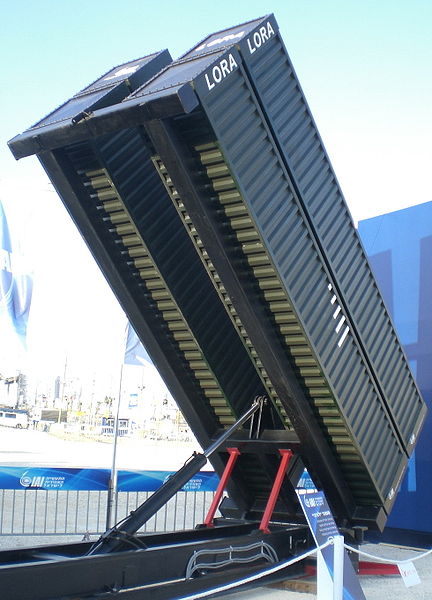
Photo: LORA missile launcher, 14 Sept. 2008, Hebrew Wikipedia, by Tal Inbar (טל ענבר)
Earlier I suggested that equipping our larger cutters with the LRASM missile might provide a means to deal with a medium to large vessel being used by terrorist. While the range and claimed precision of LRASM make it a good choice, the Deepstrike missile may be an alternative, assuming it also receives the ability to hit moving targets. While it isn’t clear that it is going to be accurate enough to target a ship’s propulsion, a penetrating warhead that comes in almost vertically, penetrates the ship from top, goes through the bottom and explodes below hull could be effective. The shorter time of flight of the ballistic missile would also be an advantage.
Another bit of extemporaneous weaponry was seen recently on an Egyptian LPD. These ships had been ordered by Russia from a French shipbuilder. Ultimately the French were convinced that building ships for Russia was not a good idea. Instead the two ships were sold to Egypt, but they never received the self-defense systems that would have come from Russia. NavyRecognition reports the vessel was seen with four Boeing AN/TWQ-1 Avenger short-range air-defense vehicles secured on deck as a stop-gap AAW system.

Boeing AN/TWQ-1 Avenger (fitted with Raytheon FIM-92 Stinger missiles) on the flight deck of the Mistral-class LHD Anwar El-Sadat (L 1020) during the joint French-Egyptian naval exercise “Cleopatra 2017”. Picture: Ministry of Defense of Egypt
India’s OPV mounted ballistic missiles. Really a test rather than an expediency but below you can see that the Indians have launched fairly large ballistic missiles from an Offshore Patrol Vessel.

Dhanush missile launching from INS Subhadra offshore patrol vessel
(Picture: DRDO)

It looks like the Healy has been having an interesting voyage. They had aboard a team from the Research and Development Center that were aboard to try out some new technologies.
Here you will find a listing of what they hoped to do while aboard. Projects included.
A later post shows how it turned out–lots of photos. It is presented in reverse chronological order, August 6 to July 21, so you might want to read it from bottom up.
The video above records an recent event, a “Maritime Security dialogue” presented by the Center for Strategic and International Studies (CSIS) and the United States Naval Institute (USNI) featuring Admiral Paul F. Zukunft, Commandant of the U.S. Coast Guard, for a discussion on the “U.S. Coast Guard’s future priorities.”
Despite the title, don’t expect a recitation of Coast Guard priorities. Most of the material is familiar, but there were a few interesting comments, including some that might be surprising. A number of things the Commandant said here made news.
I’ll give a quick outline of what was talked about. At the end I will rant a bit about some of my pet peeves.
The Commandant’s prepared statement is relatively short beginning at time 2m45s and ending about 11m.
6m00 In our listing of missions, the Commandant said Defense Operations should be listed first. He noted that there are 20 ships chopped to Combatant Commanders including eleven ships operating under SOUTHCOM.
Q&A begins at 11:00.
16m20s The Commandant noted there is a Chinese ship rider on a USCG cutter off Japan and that Coast Guard aircraft are flying out of Japan.
17m30s Boarder protection/drug interdiction
20m Called the OPCs “light frigates”
22m As for priorities the Commandant noted a need to invest in ISR and Cyber
23m Cyber threat.
24m Expect return to sea duty because of length of training.
26m30s “Demise of the cutterman”/Human Capital Plan–fewer moves–removed the stigma of geographic stability
29m25s Highest percentage of retention of all services–40% of enlisted and 50% of officers will still be in the service after 20 years
30m Law of the Sea. Extended continental shelf in the Arctic.
32m30s Need for presence in the Arctic.
36m ISR, 38m15s Firescout. An interesting side note was that the Commandant seemed to quash any possibility of using the MQ-8 Firescout. He noted when they deployed on a cutter 20 people came with the system. He called it unoccupied but not unmanned.
40m Icebreakers
43m30s Comments on transgender members
45m15s Icebreakers–will drive the price down below $1B.
47m NSC as frigate–no conversations with the Navy about this. Performance of Hamilton.
49m50s Count the NSCs toward the 355 ship Navy.
50m30s Illegal migration and virulent infectious disease
53m35s CG training teams in the Philippines and Vietnam to provide competency to operate platforms to be provided by Japan. Two patrol boats going to Costa Rica. Other efforts to build capacity.
56m DHS is the right place for the CG.
The Commandant touched on a couple of my pet peeves, specifically
Because of the ease with which GPS signals can be jammed or spoofed, it looks like an enhanced version of LORAN (eLORAN) may be making a comeback as a back up Navigation system. GPS signals are very weak and can be easily swamped. LORAN has an “average signal is an estimated 1.3 million times stronger than a GPS signal.”
In July, the United States House of Representatives passed a bill which included provisions for the U.S. Secretary of Transportation to establish an eLoran system.
“This bill will now go over to the Senate and we hope it will be written into law,” said Dana Goward, president of the U.S. non-profit Resilient Navigation and Timing Foundation, which supports the deployment of eLoran.
“We don’t see any problems with the President (Donald Trump) signing off on this provision.”
LORAN has not been an active Coast Guard program for some time. For those who don’t know the history and technology, you can find it here.
A lot of CG Junior Officers got their command ashore pins by spending a year in exotic places such as Iwo Jima, French Frigate Shoals, Gardner Island (Kiribati), or Attu.
Station Lampedusa was even targeted by Scud missiles fired from Libya. This from Jeff Patterson on the LORAN Veteran’s Facebook page, “I was in the LORAN shacks on watch when the Scuds hit. I though some idiot lost control of the truck and hit the side of one. Felt like an earthquake. Come to think of it they couldn’t have hit all of them at once! Ha! I was heading towards the door to check things out and another one rocked the place. I was flabbergasted. I thought, “OH MY GOSH!! The idiot backed up and hit me again!!” Best time ever!!”


NavyRecognition reports a contract for a system that might have application for the Coast Guard.
“MARSS Group have announced an important new contract with the installation of NiDAR command and control system on a flotilla of Zodiac Hurricane RIB fast patrol vessels. The contract with Zodiac Milpro, is valued at over USD 2million and was for the supply and installation of an expeditionary version of NIDAR command and control system and the complete sensors package. The NiDAR X(eXpeditionary) is to be fitted to a flotilla of 11m Hurricane RIB fast patrol and intercept vessels for an undisclosed special forces unit.
“With NiDAR X installed, the RIB’s are transformed into a fully networked wide-area surveillance system, providing a shared situational awareness picture between each of the craft. NiDAR X is completely sensor agnostic so it integrates multiple sensors from each of the craft including; cameras, radar, sonar (optional) plus AIS, digital radio, tracker and transponder inputs to detect, identify and monitor unknown and known air, surface and underwater objects.
“…With the addition of these high-performance sensors and NiDAR, this flotilla of RIBs becomes a fully integrated tactical network able to monitor, detect and respond to threats over an area of some 200 nautical square miles.“
200 square nautical miles is not a huge area, about 14×14 or 20×10, more likely a 16 mile diameter circle, but it might work for a station.
More information here.
Thanks to Lee for bringing this to my attention.
 Chuck Hill's CG Blog