Hull Vane Claims Improved Performance

“Wake behind transom on patrol boat at 11 kn without Hull Vane® (left) and with Hull Vane® (right), leading to 25% lower fuel consumption”

NavyRecognition reports on Hull Vane’s presentation at the MAST-Asia 2017 Conference.

The new NSCs and FRCs are costing more to fuel than the ships they replace. The OPCs will almost certainly cost more in fuel than the 210s and 270s, they will be replacing. This should not be surprising. These ships are larger and have much greater installed horsepower. Since our operating budget has not been growing, the greater fuel used, as more of these ships come on line, is going to become a problem. Surely we will try to get increased operating funding, but in the mean time we need to work on operating more economically.

If we have not already evaluated this design modification, we probably should.

In addition to fuel savings, addtional side benefits are claimed.

While reducing the energy consumption is usually the main goal, the Hull Vane® has additional effects which are very desirable for naval ships. When a ship sails in waves, the Hull Vane® dampens the pitching and yawing motions, making helicopter landings safer and improving the performance of onboard systems and personnel. As the Hull Vane® reduces the stern wave, the propeller loading and the engine power for a given speed, the ship will also have a reduced acoustic (and visual) signature. On newbuild naval ships, the cost savings on engine power to reach a given speed are generally much higher than the cost of the Hull Vane. Retrofitting a Hull Vane® on existing naval ships typically has a payback period of one to three years.

We did discuss this innovation earlier. I am going reproduce comments from my previous post on this topic.

First a disclaimer: I am from the Hull Vane sales team and I have presented the paper at the FAST conference. You can download a copy of this paper on our website (www.hullvane.com) from the news section. That will clarify a lot.

Then to answer some of the comments here (and the email quoted, which is not from our team as far as I know):

1. The Hull Vane is very different from a trim tab, because it’s a hydrofoil. Actually the design is not so much speed-dependent, but hull-shape dependent. When it works, it works on quite a wide speed range, as long as the speed is high enough (Froude number in general above 0.2). On the Holland-Class, we achieve a positive result over the entire speed range (from 5 knots to 22 knots), but that’s in part because the Hull Vane allowed (and actually required) a reduction of the depth of the trim wedge which is currently installed.

2. The Hull Vane is a new and patented fuel saving device. Of course hydrofoils have been used before, but never on displacement vessels with the purpose of generating forward thrust and reducing the wavemaking resistance.

3. The angle of attack is more a function of the buttock angle of the bottom plating than it is of the speed. That’s why having an adjustable Hull Vane (we looked at it) gives you a very marginal performance increase, while adding a lot of complexity (hydraulics, control mechanism, maintenance, etc.). The fixed Hull Vane works really well and is not more complex than bilge keels or a bulbous bow. The design is indeed complex and requires both know-how and accurate CFD simulations, taking into account both frictional and pressure drag. From our 12+ years of experience, we know how to get it right, but we also know that it’s very easy to get it wrong. There are ship types where we can’t achieve a positive result, but on patrol vessels and naval vessels, we have consistently achieved very good results.

4. Just like the rudders, and propellers, you indeed want to avoid marine growth, which has a more detrimental effect on appendages than on the main hull. There are solutions to this (coatings), and furthermore the Hull Vane is easily accessible for cleaning without drydocking. On the vessels sailing with the Hull Vane, marine growth has not been an issue.

5. Regarding our “limited abilities to accurately predict the flow field below and aft of a bluff transom vessel”, I completely disagree on that. Our parent company Van Oossanen Naval Architects has used CFD (Fine/Marine) for many years with excellent results, confirmed both by model tests and sea trial results. This includes the results we have obtained for the Hull Vane performance. For stuff like the Hull Vane, where viscous effects (and the thickness of the boundary layer) are important, we believe CFD to be more accurate than model tests.

6. The Hull Vane is not limited to “short fat frigate territory”. We have achieved good results also on the DTMB 5415, a slender destroyer hull shape released for research purposes. The performance is better however on the fuller-bodied and wider-transomed hull shapes like the typical US Coast Guard cutters, which we would very much like to do some work on.

To sum it up briefly, the Hull Vane is very comparable with the bulbous bow, although it looks totally different. If the bulbous bow hadn’t been applied as widely as it is, people would also find it hard to believe that it can reduce the resistance. The bulbous bow also requires careful design to work well and has a speed range in which it works well. One of the main advantages of the Hull Vane is that it also improves the seakeeping (reduced pitching, heaving, yawing and rolling). There’s a video on our website explaining the working principles very clearly. If you have any questions, don’t hesitate to contact me.
Smugglers’ Boats Evolve

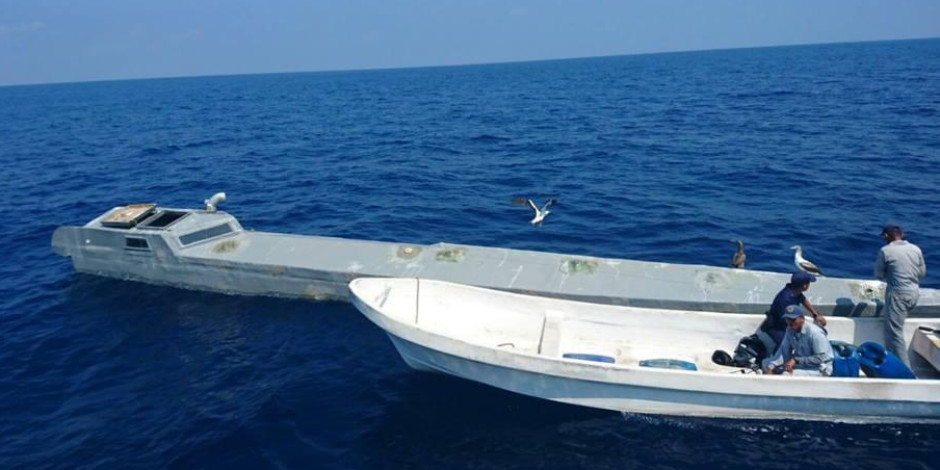
Very Slender Vessel (VSV). Guatemalan Ministry of Defense photo.

Popular Mechanics has a post on the way drug smuggling craft are evolving in an attempt to avoid detection. Specifically they have begun to use very slender hull forms for their self propelled semi-submersibles.

The post also has a link to perhaps the best collection of photos of smuggling craft I have ever seen.

Thanks to Peter O. for bringing this to my attention. 

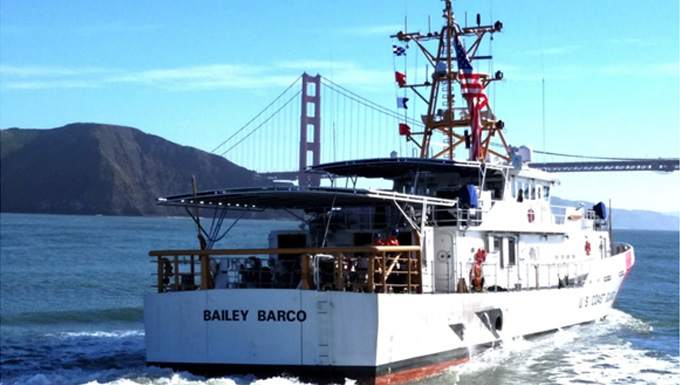
Contract Award for FRC 39-44, Thoughts on Patrol Craft

Coast Guard Cutter Bailey Barco (WPC-1122) enters San Francisco Bay during the 6,200-mile trip from Key West, Florida, to its homeport in Ketchikan, Alaska, April 28, 2017. The cutter is the second fast response cutter based in Alaska. U.S. Coast Guard photo.

Following is quoted verbatim news from the Acquisitions Directorate (CG-9) Website.

Acquisition Update: Coast Guard Exercises Contract Option For FRCs 39-44

June 16, 2017

The Coast Guard awarded a $289 million contract option to Bollinger Shipyards of Lockport, Louisiana, June 9 for the production of six more fast response cutters (FRCs). This option award brings FRCs 39-44 under contract with Bollinger. The current FRC contract contains options for up to 58 cutters and is worth $1.5 billion if all options are exercised.

The Coast Guard is acquiring 58 FRCs to replace the 1980s-era Island-class 110-foot patrol boats. FRCs feature advanced command, control, communications, computers, intelligence, surveillance and reconnaissance equipment; over-the-horizon cutter boat deployment to reach vessels of interest; and improved habitability and seakeeping. The cutters are designed for multiple missions, including drug and migrant interdiction; ports, waterways and coastal security; fishery patrols; search and rescue; and national defense.

Twenty-two FRCs are in service, with six stationed in Miami; six in Key West, Florida; six in San Juan, Puerto Rico; two in Cape May, New Jersey; and two in Ketchikan, Alaska. Future FRC homeports include: Pascagoula, Mississippi; Atlantic Beach, North Carolina; San Pedro, California; and Honolulu.

Note a few things:

  1. While this is not the total cost of the vessel, the shipyard cost is less than $48.2M. As I recall this is a decrease from previous buys, reflecting the maturity of the program and the decision to order six at a time.
  2. This is presumably FY2017 money and it leaves 14 vessels for future funding. Both the previous and current administration have consistently requested four or fewer vessels be funded, but the Congress has been fairly consistent in funding six per year. It seems likely the remaining 14 will be funded over the next three years. If so all 58 will be fully funded by FY2020.
  3. Bollinger is delivering at a rate of five per year. We just commissioned #22, so we can expect the last of the currently planned 58 in FY2024.
  4. The first three of the 87 foot Marine Protector class WPB were commissioned in 1998. It was 26 years from the commissioning of the first 110 to the commissioning of the first Webber class WPC. If there is a similar 26 year span from the first 87 footer to the commissioning of the first of its replacement class, we should see that boat come on line in FY2024, just as Webber class construction is ending. To make that happen, we need to start market research and planning in FY2021, the year after the last WPC is funded or FY2022 at the latest.
  5. There is talk of building six additional WPCs to replace the six 110s currently in Bahrain. I’ll have more on this later.

What’s in a Name

The program currently stands at 23 vessels delivered with 22 commissioned. They are being delivered at a rate of 5 per year meaning the last of 58 planned should be commissioned by the end of FY2024. 

MarineLink has a story about Bollinger and their production of the Webber class WPBs. I found this particular paragraph interesting.

Making it Personal
To help combat complacency Bollinger came up with the Sentinel Program, to both incentivize its shipbuilders and to make each vessel more meaningful to them. “Each of these vessels is named for a hero in the Coast Guard,” Remont said. For every vessel Bollinger creates a name board, a 4 x 3 board that describes the ship’s namesake with details of their heroic act. “What we’re trying to do is personalize it for our shipbuilders. It’s not just some big hunk of metal with a bunch of cables, it (the ship) is there for a real reason. We erect these sign posts at each station where the vessel is getting created, and the name board follows the ship, traveling with the boat as it moves through the production line. “Every time our shipbuilders get on that vessel they can read about the person, and understand why we are building it.” When the vessel is delivered the name board is given to the CO of the boat so that they and the crew can be reminded of the namesake, too. Following the delivery ceremony, Bollinger selects one employee from each department who exhibits the same characteristics of the vessel’s namesake, and they are publicly recognized and awarded.
 –
This points to yet another reason the decision to name these cutters after Coast Guard heroes was a good one. I knew it would mean something to the crew, but apparently it means something to put a human face on the ships, even to the shipyard works, and perhaps to others that come in contact with the ships. It also teaches Coast Guard history in easily digestible bits.
 –
Hopefully we will continue with this when we name the Offshore Patrol Cutters. I don’t think we could do better than name the first of class for the captain of the Revenue Cutter Hudson during the Spanish-American War, Frank H. Newcomb. There has never been a cutter named after him, and the honor is long overdue.
Newcomb02

Frank H. Newcomb

USRC/USCGC McCulloch Wreck located

n 1914, USRC Cutter McCulloch was ordered to Mare Island Navy Shipyard where the cutter’s boilers were replaced, the mainmast was removed and the bowsprit shortened. In 1915, McCulloch became a US Coast Guard Cutter when the US Revenue Cutter Service and US Life-Saving Service were combined to create the United States Coast Guard. (Credit: Gary Fabian Collection)

You may have heard the wreck of the Cutter McCulloch, a participant in the Battle of Manila Bay, has been found of Pt. Conception.

The best coverage I have found is on the NOAA website.

There does seem to be an error in that it refers to the guns on the McCulloch as four 6-pounder, 3-inch rapid firing guns. 6-pounders were 57mm weapons (sound familiar?) while 3-inch guns typically fired a projectile of 13 pounds. Those figures are very close to projectile weights of the modern 76mm Mk75 and 57mm Mk110. The confusion may have originated from the fact that while the McCulloch, as built, was armed with 6-pounders, before the Battle of Manila Bay, she was up-gunned.

There is an interesting footnote on the McCulloch’s Spanish American War service.

Dewey presented USRC McCulloch with four of the six 1-pounder revolving Hotchkiss guns taken from the Spanish flagship, Reina Cristina. Each of these Hotchkiss cannons had five, revolving 37mm barrels. These four guns are displayed in pairs to either side of the front of Hamilton Hall facing the parade ground at the United States Coast Guard Academy.

As an advocate of torpedoes on cutters, I liked seeing the McCulloch had a torpedo tube, see, there is precedence.

uscg-mcculloch-factsheet

Interview: Adm. Paul Zukunft demands Coast Guard respect–Defense News

DefenseNews had an interview with the Commandant. You can read it here. I will not repeat the Commandant’s responses here, but I will repeat one of the questions and add my own thoughts.

Admiral, you have said that the Coast Guard’s identity as an armed service is forgotten. Can you tell me what you mean by that?

The Commandant talks here about budget, but I think this starts with self image. We do SAR. We rescue sea turtles. Armed services are first and foremost ARMED. We are by law a military service, but we are currently inadequately armed for even our peacetime counter terrorism, DHS mission. We are less capable of forcibly stopping a ship than we were 90 years ago.

Do our people know what their role will be if there is a major conflict with the Chinese or Russians? You can bet Navy and Marine Personnel have a pretty good idea of their roles.

We have had a quarter century hiatus in a mono-polar world where no one could challenge American seapower. That is changing rapidly and it is time for the Coast Guard to see itself in a new light. Just as the nation has benefited from having two land forces (Army and Marines), it can benefit from having two sea forces. The Coast Guard is a substantial naval force. Certainly we will not replace the Navy’s sophisticated systems, but there is a need for a high low mix and the marginal cost of adding capability to Coast Guard vessels that are going to be built anyway is very small.

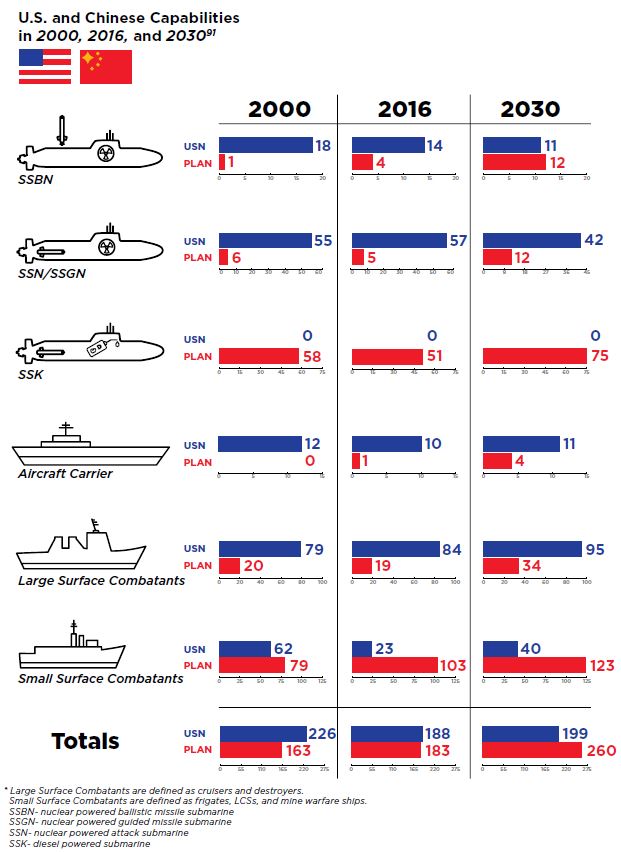
We are currently in an unrecognized naval arms race with China. It is time to give the Coast Guard back the ASW and ASuW capabilities it was building before the collapse of the Soviet Union.

When I reported to the academy in 1965, it had a gun lab, and we were taught ASW (badly) during swab summer. The Coast Guard had 36 ships equipped with sonar, ASW torpedoes and 5″ guns. The ships were old (not as old as now), but we were building a new fleet of 36 Hamilton Class WHECs equipped with a better sonar in addition to torpedoes and a 5″ gun. Being armed did not stop us from doing SAR, fisheries, or aids to navigation.

At that time (1965) in terms of personnel, the US Navy was about 25 times larger than the Coast Guard and had 287 cruisers, destroyers, and frigates. Now it is only eight times as large as the Coast Guard and has only 85 ASW equipped surface ships. We also had a powerful naval ally in Europe in the form of the Royal Navy. Now the Coast Guard is supplying personnel to the Royal Navy and in terms of personnel the Coast Guard is larger than the Royal Navy or the French Navy. Equipping our planned 33 to 35 large cutters as true surface combattants could make a real difference.

Even if we never go to war, preparation can make us better at our peacetime roles. Drug interdiction, migrant interdiction, and even SAR benefit from military grade ISR and C4I. Recognition of naval capabilities in the Coast Guard may justify additional resorces that have dual use for peacetime missions. Its a win-win.


Marines (or Army) Sink Ship with Missiles from Coast Guard Ship–It Could Happen

PACOM wants the services to operate across domains. The Navy already operates aircraft over land, but he also wants the Army, Air Force, and Marine Corp to help control the sea areas. We noted earlier, that it appears the Army may be moving to form something like the old Coast Artillery.

Now the US Naval Institute reports the Army is set to sink a ship during the 2018 RIMPAC exercise, presumably from land. In addition,

“Headquarters Marine Corps and [Marine Corps Forces Pacific] are working to deploy HIMARS (M142 High Mobility Artillery Rocket System) rapidly aboard ships to shoot at other ships.”

Now the Marines will probably do this from a Navy amphibious assault ship, but wouldn’t it be cool if the Army did this from a Coast Guard Cutter. That would really demonstrate cross service cooperation.

It is also something we might want to do operationally from an Icebreaker in the Arctic some day.