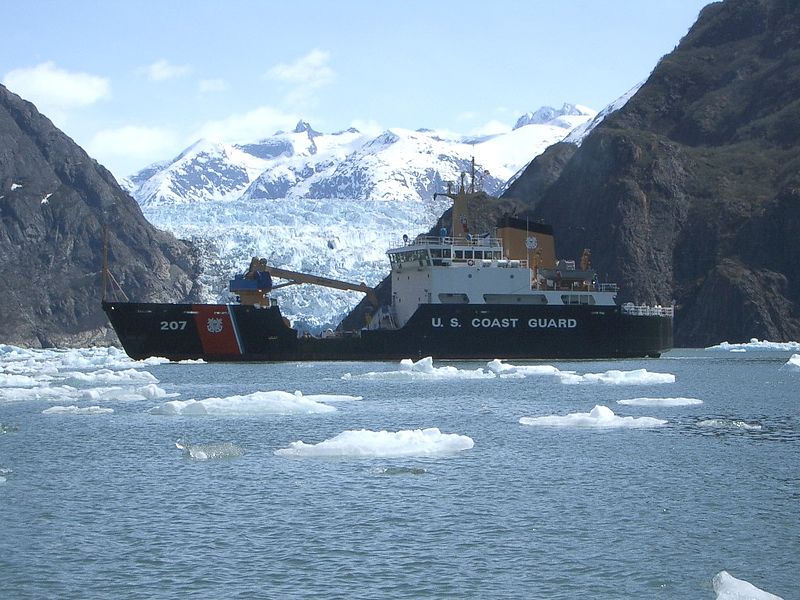
The following is a Coast Guard news release. USCGC Maple will be using the NorthWest Passage to transit to the Coast Guard Yard for its In Service Sustainment mid-life renovation, and will be doing some scientific research along the wah
ANCHORAGE, Alaska — The crew of the Coast Guard Cutter Maple, a 225-foot seagoing buoy tender homeported in Sitka, Alaska, departed Wednesday on a historic voyage through the Northwest Passage.
This summer marks the 60th anniversary of the three Coast Guard cutters and one Canadian ship that convoyed through the Northwest Passage. The crews of the U.S. Coast Guard Cutters Storis, SPAR and Bramble, along with the crew of the Canadian ice breaker HMCS Labrador, charted, recorded water depths and installed aids to navigation for future shipping lanes from May to September of 1957. All four crews became the first deep-draft ships to sail through the Northwest Passage, which are several passageways through the complex archipelago of the Canadian Arctic.
The crew of the cutter Maple will make a brief logistics stop in Nome, Alaska, to embark an ice navigator on its way to support marine science and scientific research near the Arctic Circle. The cutter will serve as a ship of opportunity to conduct scientific research in support of the Scripps Institution of Oceanography.
The Maple crew will deploy three sonographic buoys that are used to record acoustic sounds of marine mammals. A principal investigator with the University of San Diego embarked aboard the cutter will analyze the data retrieved from the buoys.
The Canadian Coast Guard Ship Sir Wilfrid Laurier will rendezvous with the Maple later this month to provide icebreaking services as the Maple makes it way toward Victoria Strait, Canada. The Maple has a reinforced hull that provides it with limited ice breaking capabilities similar to Coast Guard 225-foot cutters operating on the Great Lakes.
“We’re very excited to make this voyage through the Northwest Passage and to assist in the Scripps Institute research,” said Lt. Cmdr. Patrick Armstrong, commanding officer of the Maple. “In planning this, we have worked very closely with our Canadian counterparts and we look forward to continuing that cooperation in the Arctic.”
All scientific research, icebreaking and marine science activities that occur during the voyage will be conducted in accordance with the 1988 Canada-US Agreement on Arctic Cooperation.
The Maple crew is expected to conclude their historic voyage in Baltimore, Maryland, during late August. The cutter will undergo scheduled maintenance in dry dock at the Coast Guard Yard in Baltimore for repairs and upgrades. The crew will return to Sitka to take command of the 225-foot Coast Guard Cutter Kukui, which was previously homeported in Honolulu.
Looking at this little film, it struck me that the technique that was usable in the heaviest seas was that used by the Canadians (12:45-16:20), claiming a capability to Sea State Six, and they were the only ones that chose to run the ship parallel to the seas during recovery, rather than into the waves. This may be a bit counter intuitive, but it means the ship’s pitching is reduced and consequently there is less vertical displacement of the recovering ship’s stern.
As we saw in an earlier study, “The stern ramp availability is driven by sill depth and pitch motions…” In other words pitching is what limits the ability to recover the boat, and the problem becomes progressively worse as the size of the “host” vessel increases because there is a growing difference between the movement of the ship’s stern and the small boat.
I don’t know what our current doctrine is, but steaming parallel to the seas for recovery might be worth consideration if we are not already doing so.
Thanks to Adroth for bringing this to my attention.
For reference purposes I wanted to publish a table of hull speed versus ship’s water line length. As a rule of thumb, “hull speed” typically establishes the maximum economical cruise speed of a displacement hull as a result of wave making. Hull speed is a speed to length ratio where
Speed in knots / square root of the waterline length in feet = 1.34
I am also including the speed where the ratio equals 2 because this is typically an effective limit on maximum speed.
Like most rules of thumb, there are exceptions, but in most cases, the hull is at least to some degree “planing.”
Length Hull Speed Speed to Length=2
64 10.72 16
81 12.06 18
100 13.4 20
121 14.74 22
144 16.08 24
169 17.42 26
196 18.76 28
225 20.1 30
256 21.44 32
289 22.78 34
324 24.12 36
361 25.46 38
400 26.8 40
Not that it matters to the Coast Guard, but when ships get really large, wave making is not much of a problem. For a ship (like an aircraft carrier) that has a waterline length of say 1,000 feet, hull speed is 42.4 knots and they would not reach a Speed to Length ratio of 2 until they are going 63.2 knots.
Navy Recognition brings us news of a newly developed propulsion system for operating on the margins where the water meets the land. Where vegetation and debris make operating conventionally powered boats difficult.
Perhaps applications for disaster relief or operating on the North Slope as well.
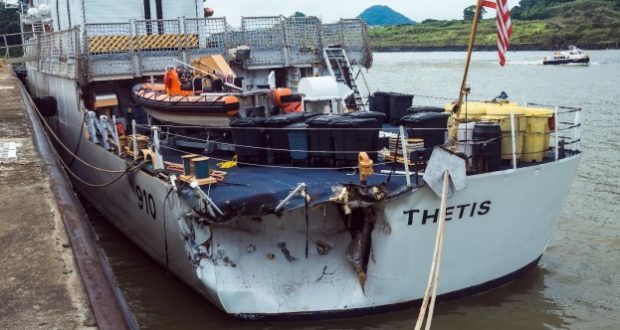
USCGC Thetis damage sustained in a collision in the Panama Canal 0111 local, 2 June 2016
The Cutter Thetis (WMEC-910) was hit in the stern by a barge being pushed by a tug, while transiting the Panama Canal, 2 June 2016. The channel was about 270 yards wide at the site of the collision. Thetis was ahead slow at about 4-4.5 knots. The tug and barge combination was full ahead doing 10.5-11 knots. Its radar was off because “he had clear forward visibility.” The captain of the tug never saw the Thetis until after the collision.
The tug was clearly at fault, but the NTSB also found that “Thetis did not maintain a sufficient and proper lookout.”
Mostly Thetis was doing everything right, but they only had one lookout and he was unable to see traffic over a wide sector astern and to port. A longer sound powered telephone cord that would have allowed the lookout to move to the port side might have made a difference.
Thetis had watches on AIS and on radar on the bridge and CIC, but attempts to mitigate or prevent the collision came to late. There was also no mention of sounding the danger signal.
Some times it is missing the basics that come back to bite you.
Since the accident, the Coast Guard cutter Thetis has implemented the following changes:
The shipping officer’s responsibilities, as outlined in the onboard guidance, were amended to require that an individual be qualified as deck watch officer, preferably as an underway deck watch officer, before assuming the role of shipping officer.
An additional dedicated lookout position was added to the aft area of the Thetis for long transits in restricted waters.
A radar-tuning policy was established that prohibits both the SeaWatch and the radar systems from being offset from the automatic tuning mode when transiting in restricted waters, in order to ensure the optimal traffic image.
I might add you don’t have to be in “long transits in restricted waters” for someone to come up your ass. Check your GQ watch bill as well.
Wanted to point to the US Naval Institute Coast Guard Essay Contest. Would love to see one of my readers win this. Other than this paragraph, this is a copy of the USNI online announcement where they also have a link for submission.
The Challenge:
Advance new thinking about the U.S. Coast Guard’s critical role in the 21st century. No issue is too big or too narrow as long as it makes the Coast Guard stronger. This does not mean authors cannot be critical and take on conventional wisdom and current practices. In fact, we encourage you to push the “dare factor.”
Prior Publication: We will assume that your essay has not been previously published (online or in print) or being considered for publication elsewhere, unless otherwise notified by you. All previously published essays are ineligible.
Submission Guidelines:
Email essay (preferably as a Microsoft Word attachment) by 31 August 2017 to: essay@usni.org
Include Coast Guard Essay Contest Submission on subject line of email
Include word count on title page of essay but do not include your name on title page or within the essay
Provide separate attachment to include biography and compete contact information — i.e., work, home, and cell phone numbers; and home mailing address
Selection Process: The Proceedings staff members will evaluate every essay and screen the top essays to a special Essay Selection Committee of at least six members who will include two member’s of the Naval Institute’s Editorial Board and four subject experts. All essays will be judged in the blind — i.e., the Proceedings staff members and judges will not know the authors of the essays.
Announcement of the Winners: The winning essays will be announced in the October Proceedings. Some entrants will be awarded a one-year membership in the Naval Institute.
About Naval Institute Essay Contests
Essay contests have been central to the work of the Naval Institute for more than 130 years. They directly fulfill the Institute’s educational mission by encouraging writing on issues of concern to the Sea Services. They provide thought-provoking articles that spur ongoing discussion of these same issues, not only in Naval Institute media, print and digital, but also in other leading defense and national security forums.
Winners will be published in a future issue of Proceedings.
First Prize: $5,000 Second Prize: $2,500 Third Prize: $1,500
The winners will be recognized at the U.S. Coast Guard Academy Conference.
Open to all contributors–active-duty military, reservists, veterans, and civilians.
2,500 words maximum (excludes footnotes/endnotes/sources).
Looks like fisheries has become a new sticking point in the BEXIT negotiation. A lot of bluster over EU fisheries chief’s interview on BBC. The Brits take it as an insult. He may have just been saying the fishermen are an unruly bunch and will go where the fish are. The reaction seems to indicate the Brits are taking this as a planned EU invasion of their waters.
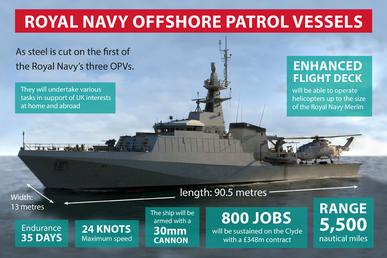
There was a lot of criticism of the building of more River class Offshore Patrol Vessels (Infographic above) for the Royal Navy as a means of keeping the shipbuilding industry alive until the Mk26 frigates were ready to be built. It was said they were not needed and the Navy did not want them. Now they may now have a use for them. Contrary to what you see on the graphic (now out of date), they are building five of these, which will bring their total OPV fleet to nine vessels.
The hearing recorded above was held 7 June. The original video was found here. That page also provides the chairman’s opening statement and links to the witnesses’ written statements that are also provided immediately below. The video does not actually start until time 4:30.
Below, you will find my outline of the highlights.
Witness List:
Vice Admiral Charles W. Ray, Deputy Commandant for Operations, United States Coast Guard | Written Testimony
Vice Admiral Sandra L. Stosz, Deputy Commandant for Mission Support, United States Coast Guard | Written Testimony Ms. Marie A. Mak, Director, Acquisition Sourcing & Management Team, Government Accountability Office | Written Testimony
Mr. John Acton, Chairman, Coast Guard Affairs Committee, Navy League of the United States | Written Testimony
The GAO’s written testimony is particularly comprehensive. They report that new assets (NSCs and FRCs) are not meeting planned availability. There have been an unexpected number of engine replacements. In the case of the National Security cutters it appears to me the down time was predictable, a normal part of introducing new ships and availability should return to planned levels as more ships join the fleet. The known defect, that when operating in waters 74 degrees or warmer, the NSCs cannot maintain maximum speed has apparently not been corrected. Max speed must be reduced two to four knots to allow adequate cooling.
Planning Documents: The Congressional Representatives repeatedly complained that they were not getting an unsensored statement of the Coast Guard’s needs. It appears the Coast Guard is not being allowed provide this information. Rather it appears the GAO is telling the Coast Guard how much they will be getting and told to submit a budget that fits the predetermined amounts. Reportedly the Unfunded priorities list will be provided by the end of June. They also asked for the 5 year and 20 year plan (1h04:30). Coast Guard representatives were repeatedly told the Coast Guard does not say what they really need, that information provided by the Coast Guard is inadequate for the sub-committee to make decisions (1h48m).
It appears that the GAO continues to ask the Coast Guard to plan procurements based on historically low AC&I appropriations that were adequate for a time because of the sporadic character of Coast Guard ship building. They acknowledge that the current budget is not realistic. (43:45)
The Coast Guard is now consistent in requesting $2B in the AC&I annually and a 5% annual increase in its operating budget and that we need 5,000 additional active duty billets and 1,100 addtional reservists. There was a statement from one of the Representatives to the effect, We need you to fight for yourselves (1h50:30). The representatives were informed that the 5 year, 20 year plans and unfunded will be delivered together (1:56)
Webber Class WPCs: The Coast Guard is reportedly pushing WPCs operations down as far as the coast of South America. (50:00) This confirms my earlier speculation that these ships would be operated in what had been WMEC roles. Six cutters for CENTCOM The representative confirmed that they had approved procurement of six Webber class requested by CENTCOM. Apparently their approval was in the form of the Coast Guard reauthorization bill which has still not been made law. Adm. Ray stated that these would be in addition to the 58 currently planned (9:30) and it is not clear how or when they would be funded. Adm Stosz indicated it was not certain six Webber class would be the Coast Guard’s choice in how to fill this requirement and the question required more study. (1h11)(1h41m).
Shore Facilities: Reportedly there is a $1.6B shore construction backlog. $700M shore facilities maintenance backlog. Some infrastructure improvements that directly support new operational platforms.are being accomplished under the platform programs (55:00) The representatives asked, why we have asked for only $10M if the total shore facilities backlog is $2.3B?(1h35)
Icebreakers: The possibility of leasing the commercial icebreaker Aiviq is still being considered. (1h27) The owners have offered a plan for Ice trials and the Coast Guard has said it would be interested in observing. (1h29:50)
Great Lakes Icebreaker: Rep. Lewis brought up icebreaker for Great Lakes.Adm Ray says for now we will address with the existing fleet. (1h00:30) Priority is still Polar Ice Breakers.
eLoran: There seems to be considerable interest in eLoran to deal with GPS vulnerabilities. (1:22) The Navy League representative supported the need. The Re-Authorization Bill directs Secretary of Transportation to initiate E-Loran testing. There was a clear anticipation that the Coast Guard would support implementation.
Coast Guard Health Care: Looks like the Coast Guard heath care records system which reverted to paper now may be able to piggy back on the VA’s conversion to the DOD system. (1h25)/(1h32:30) There is currently a major gap in funding for medical care of CG retirees
A Better Armed Coast Guard: Not that the Representatives were specific, but there was a statement, “We want to weaponize you.” (5:55) I think I heard essentially a second time as well. I’m not sure what that means.
Rising Sea Levels: There was concern expressed regarding rising sea level and how they might impact shore facilities (1h12:20)
WMEC Service Life Extension: The Coast Guard was given money several years ago to plan a service life extension program for 270. The Congress has not seen or heard any result and they questioned, why delay? (1:09) See fig. 4 on page 17 of the GAO’s written testimony
Operating Expenses: Replacement ships are costing more.(26:25)(50:55). This is becoming problematic without an increase in operating budget.
Changing the way we buy ships: Included in the Reauthorization Bill are changes in the way the Coast Guard can fund its shipbuilding, putting us on par with the Navy (5:50)
Cyber: Budget includes 70 additional billets. (19:45) What are we doing for the ports? (1h13:45)
Inland Tender Fleet: Budget includes $!M to investigate alternatives. (52:30) (1h19)
It is remarkable that there seemed to be no sentiment that the Coast Guard budget should be cut, while there was considerable evidence the Representatives believe the Coast Guard is underfunded.
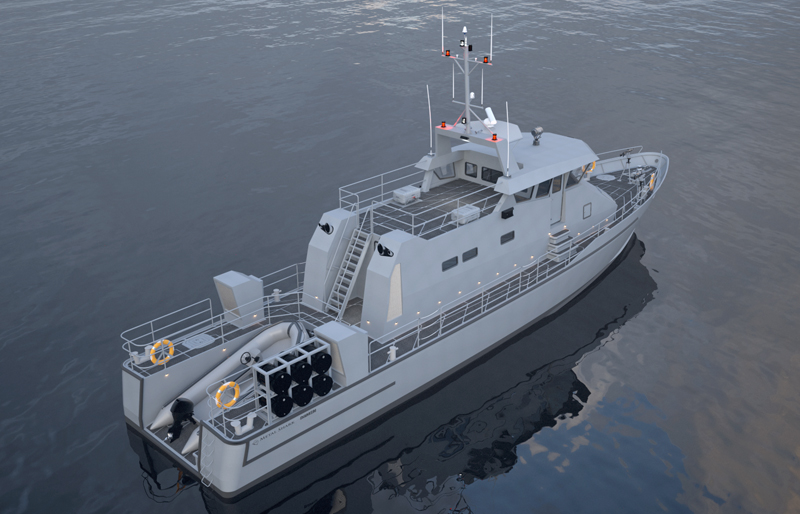
“…potentially worth upwards of $54 million, Metal Shark will build up to thirteen 85-foot Defiant-class welded aluminum cutters for the Dominican Republic, El Salvador, Honduras, Costa Rica, Guatemala, and other United States partner nations. Additionally, Metal Shark will supply electro-optical infrared sensors, diagnostic equipment, in-country reactivation, crew familiarization, and test support to NCPV (Near Coastal Patrol Vessel–Chuck) operators.
That is only $4.154M/ boat. This looks an awful lot like a potential replacement for the Marine Protector class 87 foot WPBs, the first of which should be replaced in 2023. The Metal Shark boats are a version of Damen’s Stan Patrol 2606 design, so nominally 26 meters long and 6 meters of beam, but according to the Website, 87′ length overall with a beam of 19’6″. The Marine Protector Class were also a Damen 2600 series design, so the two classes share a great deal of DNA.
There is more information on the boats at the company website here. Unfortunately there appears to be no information on speed, range, or endurance. I would presume those characteristics would at least equal those of the Marine Protector class
Would not be surprised to see the Coast Guard personnel tasked with some training for the crews of these new patrol boats.





 Chuck Hill's CG Blog