Reuters is reporting the Coast Guard is currently investigating the collision between USS Fitzgerald and the container ship ACX Crystal.
Coast Guard Investigating USS Fitzgerald Collision
6

Reuters is reporting the Coast Guard is currently investigating the collision between USS Fitzgerald and the container ship ACX Crystal.
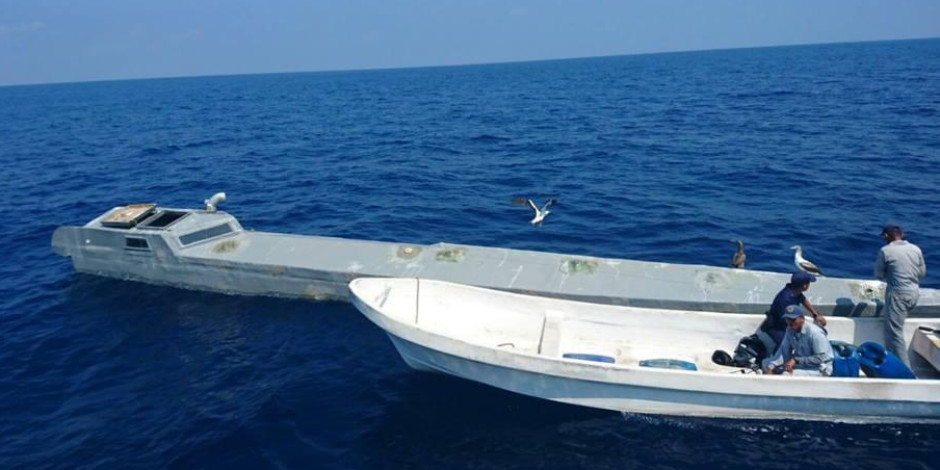
Very Slender Vessel (VSV). Guatemalan Ministry of Defense photo.
Popular Mechanics has a post on the way drug smuggling craft are evolving in an attempt to avoid detection. Specifically they have begun to use very slender hull forms for their self propelled semi-submersibles.
The post also has a link to perhaps the best collection of photos of smuggling craft I have ever seen.
Thanks to Peter O. for bringing this to my attention.
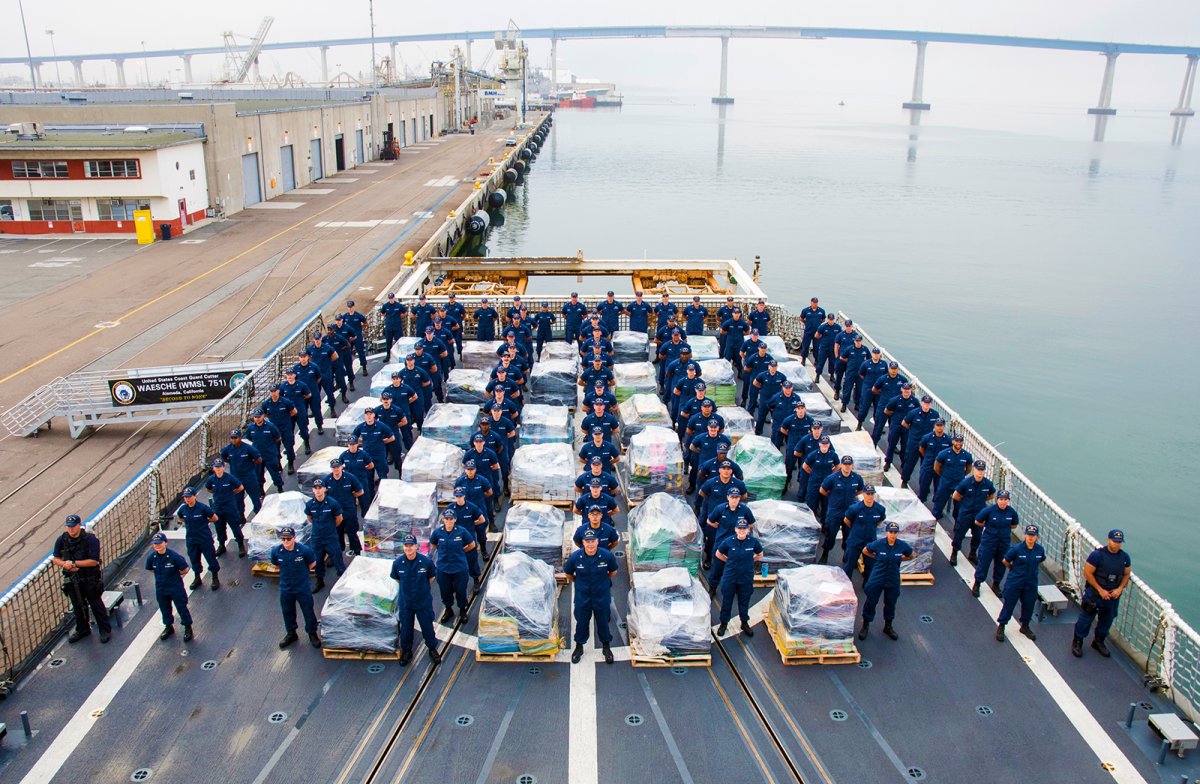
Waesche delivers 18 tons of illegal drugs to San Diego
Business Insider took a tour of the Waesche when she stopped in San Diego to offload 18 tons of seized illegal drugs. Nice coverage of the bridge and hangars, nothing of the machinery spaces or berthing areas.
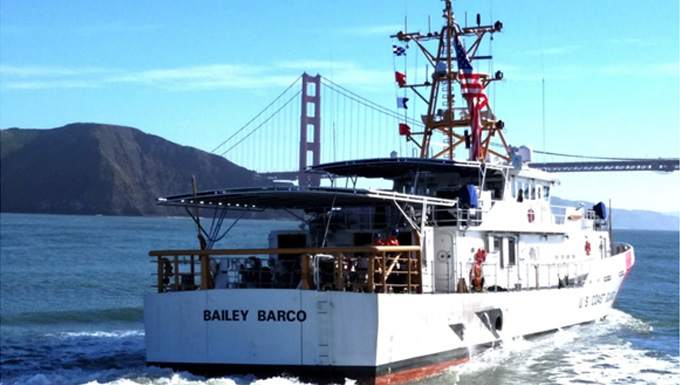
Coast Guard Cutter Bailey Barco (WPC-1122) enters San Francisco Bay during the 6,200-mile trip from Key West, Florida, to its homeport in Ketchikan, Alaska, April 28, 2017. The cutter is the second fast response cutter based in Alaska. U.S. Coast Guard photo.
Following is quoted verbatim news from the Acquisitions Directorate (CG-9) Website.
Acquisition Update: Coast Guard Exercises Contract Option For FRCs 39-44
June 16, 2017
The Coast Guard awarded a $289 million contract option to Bollinger Shipyards of Lockport, Louisiana, June 9 for the production of six more fast response cutters (FRCs). This option award brings FRCs 39-44 under contract with Bollinger. The current FRC contract contains options for up to 58 cutters and is worth $1.5 billion if all options are exercised.
The Coast Guard is acquiring 58 FRCs to replace the 1980s-era Island-class 110-foot patrol boats. FRCs feature advanced command, control, communications, computers, intelligence, surveillance and reconnaissance equipment; over-the-horizon cutter boat deployment to reach vessels of interest; and improved habitability and seakeeping. The cutters are designed for multiple missions, including drug and migrant interdiction; ports, waterways and coastal security; fishery patrols; search and rescue; and national defense.
Twenty-two FRCs are in service, with six stationed in Miami; six in Key West, Florida; six in San Juan, Puerto Rico; two in Cape May, New Jersey; and two in Ketchikan, Alaska. Future FRC homeports include: Pascagoula, Mississippi; Atlantic Beach, North Carolina; San Pedro, California; and Honolulu.
Note a few things:

The program currently stands at 23 vessels delivered with 22 commissioned. They are being delivered at a rate of 5 per year meaning the last of 58 planned should be commissioned by the end of FY2024.
MarineLink has a story about Bollinger and their production of the Webber class WPBs. I found this particular paragraph interesting.
Making it PersonalTo help combat complacency Bollinger came up with the Sentinel Program, to both incentivize its shipbuilders and to make each vessel more meaningful to them. “Each of these vessels is named for a hero in the Coast Guard,” Remont said. For every vessel Bollinger creates a name board, a 4 x 3 board that describes the ship’s namesake with details of their heroic act. “What we’re trying to do is personalize it for our shipbuilders. It’s not just some big hunk of metal with a bunch of cables, it (the ship) is there for a real reason. We erect these sign posts at each station where the vessel is getting created, and the name board follows the ship, traveling with the boat as it moves through the production line. “Every time our shipbuilders get on that vessel they can read about the person, and understand why we are building it.” When the vessel is delivered the name board is given to the CO of the boat so that they and the crew can be reminded of the namesake, too. Following the delivery ceremony, Bollinger selects one employee from each department who exhibits the same characteristics of the vessel’s namesake, and they are publicly recognized and awarded.

Frank H. Newcomb

n 1914, USRC Cutter McCulloch was ordered to Mare Island Navy Shipyard where the cutter’s boilers were replaced, the mainmast was removed and the bowsprit shortened. In 1915, McCulloch became a US Coast Guard Cutter when the US Revenue Cutter Service and US Life-Saving Service were combined to create the United States Coast Guard. (Credit: Gary Fabian Collection)
You may have heard the wreck of the Cutter McCulloch, a participant in the Battle of Manila Bay, has been found of Pt. Conception.
The best coverage I have found is on the NOAA website.
There does seem to be an error in that it refers to the guns on the McCulloch as four 6-pounder, 3-inch rapid firing guns. 6-pounders were 57mm weapons (sound familiar?) while 3-inch guns typically fired a projectile of 13 pounds. Those figures are very close to projectile weights of the modern 76mm Mk75 and 57mm Mk110. The confusion may have originated from the fact that while the McCulloch, as built, was armed with 6-pounders, before the Battle of Manila Bay, she was up-gunned.
There is an interesting footnote on the McCulloch’s Spanish American War service.
Dewey presented USRC McCulloch with four of the six 1-pounder revolving Hotchkiss guns taken from the Spanish flagship, Reina Cristina. Each of these Hotchkiss cannons had five, revolving 37mm barrels. These four guns are displayed in pairs to either side of the front of Hamilton Hall facing the parade ground at the United States Coast Guard Academy.
As an advocate of torpedoes on cutters, I liked seeing the McCulloch had a torpedo tube, see, there is precedence.
DefenseNews had an interview with the Commandant. You can read it here. I will not repeat the Commandant’s responses here, but I will repeat one of the questions and add my own thoughts.
Admiral, you have said that the Coast Guard’s identity as an armed service is forgotten. Can you tell me what you mean by that?
The Commandant talks here about budget, but I think this starts with self image. We do SAR. We rescue sea turtles. Armed services are first and foremost ARMED. We are by law a military service, but we are currently inadequately armed for even our peacetime counter terrorism, DHS mission. We are less capable of forcibly stopping a ship than we were 90 years ago.
Do our people know what their role will be if there is a major conflict with the Chinese or Russians? You can bet Navy and Marine Personnel have a pretty good idea of their roles.
We have had a quarter century hiatus in a mono-polar world where no one could challenge American seapower. That is changing rapidly and it is time for the Coast Guard to see itself in a new light. Just as the nation has benefited from having two land forces (Army and Marines), it can benefit from having two sea forces. The Coast Guard is a substantial naval force. Certainly we will not replace the Navy’s sophisticated systems, but there is a need for a high low mix and the marginal cost of adding capability to Coast Guard vessels that are going to be built anyway is very small.
We are currently in an unrecognized naval arms race with China. It is time to give the Coast Guard back the ASW and ASuW capabilities it was building before the collapse of the Soviet Union.
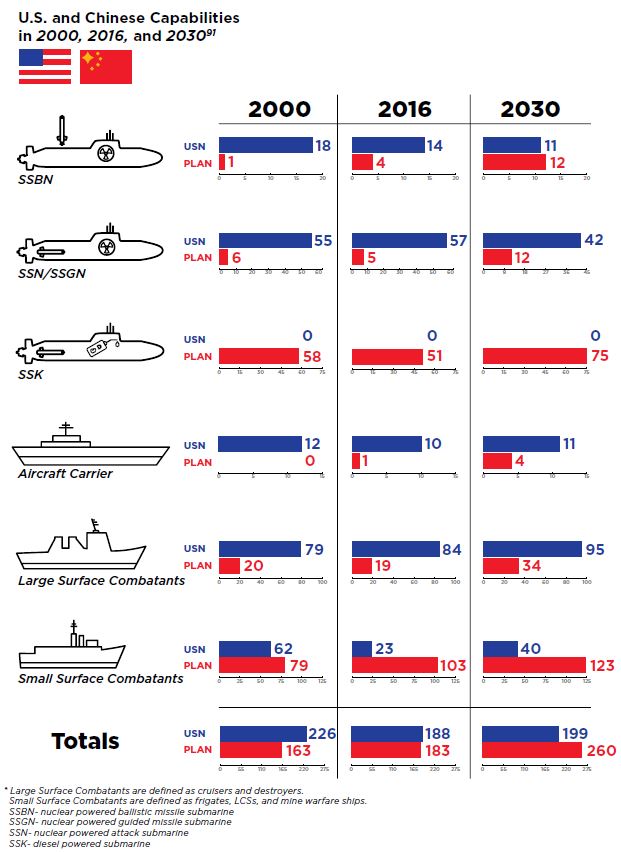
When I reported to the academy in 1965, it had a gun lab, and we were taught ASW (badly) during swab summer. The Coast Guard had 36 ships equipped with sonar, ASW torpedoes and 5″ guns. The ships were old (not as old as now), but we were building a new fleet of 36 Hamilton Class WHECs equipped with a better sonar in addition to torpedoes and a 5″ gun. Being armed did not stop us from doing SAR, fisheries, or aids to navigation.
At that time (1965) in terms of personnel, the US Navy was about 25 times larger than the Coast Guard and had 287 cruisers, destroyers, and frigates. Now it is only eight times as large as the Coast Guard and has only 85 ASW equipped surface ships. We also had a powerful naval ally in Europe in the form of the Royal Navy. Now the Coast Guard is supplying personnel to the Royal Navy and in terms of personnel the Coast Guard is larger than the Royal Navy or the French Navy. Equipping our planned 33 to 35 large cutters as true surface combattants could make a real difference.
Even if we never go to war, preparation can make us better at our peacetime roles. Drug interdiction, migrant interdiction, and even SAR benefit from military grade ISR and C4I. Recognition of naval capabilities in the Coast Guard may justify additional resorces that have dual use for peacetime missions. Its a win-win.

USCGC Acushnet (WMEC-167), 10 Feb. 2005, USCG photo.
A group, Ocean Guardian, is planning on restoring the former WMEC-167 USCGC Acushnet (former USS Shackle (ARS-9)). They are in Washington State and looking for volunteers and donations. Sorry I can’t vouch for them.
Sounds like they plan on making the former WMEC a working ship rather than a museum. More on the Ocean Guardian organization here.
PACOM wants the services to operate across domains. The Navy already operates aircraft over land, but he also wants the Army, Air Force, and Marine Corp to help control the sea areas. We noted earlier, that it appears the Army may be moving to form something like the old Coast Artillery.
Now the US Naval Institute reports the Army is set to sink a ship during the 2018 RIMPAC exercise, presumably from land. In addition,
“Headquarters Marine Corps and [Marine Corps Forces Pacific] are working to deploy HIMARS (M142 High Mobility Artillery Rocket System) rapidly aboard ships to shoot at other ships.”
Now the Marines will probably do this from a Navy amphibious assault ship, but wouldn’t it be cool if the Army did this from a Coast Guard Cutter. That would really demonstrate cross service cooperation.
It is also something we might want to do operationally from an Icebreaker in the Arctic some day.
NavyRecognition gives us a great tour of the new Singapore Navy “Littoral Mission Vessel” (corvette) RSS INDEPENDENCE. The boat handling arrangement and the integrated bridge/CIC are very interesting. Do take a look at the original post, there is much more there
We talked about this class earlier as a possible example of what a cutter “X” might be.

 Chuck Hill's CG Blog