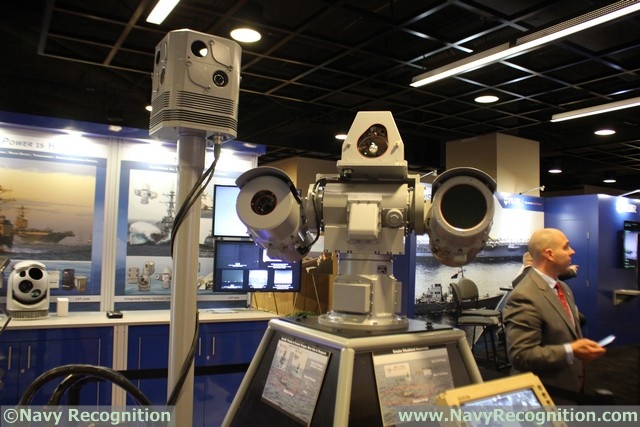
Mk20 mod1 Electro Optic Sensor System

Mk20 mod1 Electro Optic Sensor System (EOSS)

Mk20 Mod1 Electro Optic Sensor System (EOSS)

Two reports by NavyRecognition from the Surface Navy Symposium on the L3 Mk20 Mod1 Electro Optic Sensor System (EOSS). The video report above discusses the system from time 00:45 to 2:55, and there is this short written post reporting successful testing. Reportedly this EOSS will weigh half as much as the previous mk20 mod0 system, but have greater resolution and range. According to the report it is currently planned to be installed aboard U.S. Navy Cruisers/Destroyers and U.S. Coast Guard Cutters, presumably the Offshore Patrol Cutters (OPC).

The earlier Mk20 Mod0 is on the National Security Cutter.

The three parts visible are, I believe, a day light TV camera, a thermal imaging camera, and a laser range finder. I wonder if it could also function as a laser target designator?

Other than using it as a firecontrol for ASuW and AAW, this system can be used for:

– Spotting and kill assessment
– Target detection and identification
– Naval gunfire support
– Safety check-sight
– Location and track of man overboard
– Channel position and navigation


BAE at SNA 2017

Above is a short presentation by a BAE representative brought us by NavyRecognition from the 2017 Surface Navy Association Meeting.

  • 00:00–00:20 is intro.
  • 00:20–01:15 discusses the electromagnetic rail gun.
  • 01:15–02:30 covers the hypervelocity projectile that they expect to fire from the Mk45 5″ naval gun, the 155mm howitzer, and the electromagnetic railgun.
  • 02:30–03:35 is about the Mk45 mod4 5″ and an automated, unmanned magazine designed for an international customer (It is planned for the UK’s Type 26 frigate).
  • 03:35–04:42 is about the Mk110 57mm gun and a special purpose round they are developing, the ORKA (Ordnance for Rapid Kill of Attack Craft).

Below I have included a video with more detail on the ORKA round. Note this is a specialized guided round intended for use against small surface targets and inbound air targets. It should have a much higher probability of hit than the ballistic round, but is unlikely to have the full range (17,000 meters) or high altitude reach (PFHE: 24,930 feet) credited to the Mk110 because the round appears heavier than the ballistic round, control surfaces will add drag, and because of its larger size displaces some of the propellent that would have been in a more conventional round. The video claims an effective range of 10,000 meters (about 11,000 yards). That may also be its maximum range.

Coast Guard Commandant Will Stress Maritime Security to Trump Administration–USNI News

The US Naval Institute reports, “The Commandant of the Coast Guard will stress maritime security – particularly south of the border — in future discussions with the incoming Trump administration.” Read the rest.

This is one of the topics the Commandant has consistently hit. It should not not surprise anyone who has been reading or hearing his addresses.

Icebreakers and Motherships at SNA 2017

Defense & Aerospace Report Editor Vago Muradian interviews General Dynamics NASSCO’s Tom Wetherald regarding its US Coast Guard icebreaker and US Navy ship programs with during the 29th Surface Navy Association Symposium in Arlington, Virginia.

Interestingly NASSCO, like Eastern, teamed with VARD to develop their icebreaker concept.

Notably I see not weapons or positions for weapons on the icebreaker concept.

It may be good news for us that more Expeditionary Sea Bases (formerly “Afloat Forward Staging Bases”). It is likely one will go to to SOUTHCOM and may be available to support counter drug operations.

TRS-3D Baseline D Multi-Mode Radar for 9th NSC.

NavyRecognition reports, “Airbus Defense and Space, Inc., under contract with its affiliate Airbus DS Electronics and Border Security GmbH, will provide the TRS-3D Baseline D multi-mode radar (MMR) for the U.S. Coast Guard’s ninth National Security Cutter (NSC).”

The Bertholf Class have been equipped with the rotating Active Electronically Scanned Array (AESA) TRS-3D multi-mode (air search, surface search, helicopter control, and firecontrol) radars from the first. My understanding is that this is an improved version of the same radar that equips earlier National Security Cutters and the Freedom class LCS.

Airbus (formerly EADS) has an excellent multi-paged description of the system here.

It is not clear to me how this compares with the TRS-4D system, also from Airbus. The TRS-4D will equip Freedom Class LCS beginning with LCS-17, and I expected it to be used on the Offshore Patrol Cutter (OPC). (Late note: in fact the OPCs will have the SAAB Sea Giraffe multi-mode radar– Chuck) The TRS-4D appears to be very similar in many respects, but it looks at higher elevations and is lighter. Is it a replacement for the TRS-3D or is it a “junior” version of the same technology?

110 WPBs for Costa Rica

uscgcknight_island

US Coast Guard Cutter Knight Island (WPB-1348), photo by Rnendza

Some how I missed this when it came out, but the Tico Times reports the Coast Guard is planning on donating two of the 110 foot WPBs to Costa Rica this year.

That will bring to six the number escorted including two to the Republic of Georgia, two to Pakistan, and these two.

Thanks to Sanjay Badri-Maharaj for bringing this to my attention. 

Former Commandant, Adm. Papp Goes to Work for OPC Builder Eastern

papprobertadmuscg

gCaptain is reporting,

Florida-based Eastern Shipbuilding Group has appointed Admiral Robert Papp, former Commandant of the U. S. Coast Guard, as President of the company’s new Washington Operations division.

Significantly, Admiral Papp retired well before Eastern was selected as builder of the Offshore Patrol Cutter.

I regarded Admiral Papp as a friend of the Blog and a good man. I wish him all the best and success in his new endeavour.

A Little More on the Offshore Patrol Cutter

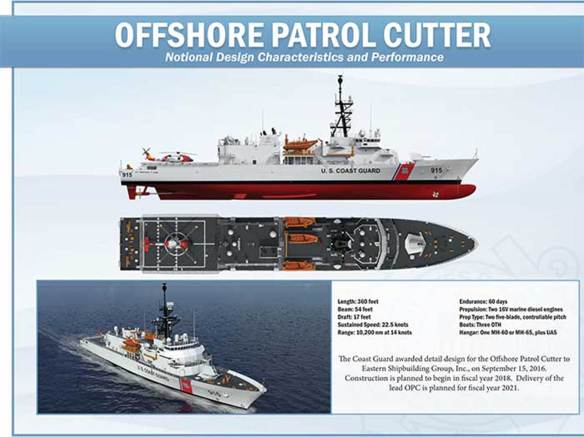
OPC "Placemat"

OPC “Placemat”

MarineLink has a story on the OPC, and it includes a bit more detail, and it raises some questions. I’ve also seen a couple of stories about how they will be equipped that will be referred to below.

There is this:

“Zukunft’s budget suggests at least one cutter, or an immediate separate order, will be arctic capable, and Vard and Canadian engineering consultancy BMT Fleet are already understood to be working on project documents for a Canadian “arctic offshore patrol ship” of Vard 7 100 type.”

VARD 7-100 ICE, the Canadian AOPS

VARD 7-100 ICE, the Canadian AOPS

Vard actually has two designs designated “7-100,” an offshore patrol vessel (pdf) very similar to the OPC and the 7-100 ICE. Apparently, it is the 7-100 ICE they are referring to here. The VARD 7-100 ICE (pdf) is also known as the Canadian Navy’s Arctic Offshore Patrol Ship (AOPS). Does that mean the Coast Guard is looking at the Canadian AOPS as a possible Arctic Patrol Vessel, perhaps filling the role of one or two of the three medium icebreaker? They do have power similar to the old Wind class icebreakers.

We also have this indication the standard OPCs are still expected to patrol the Arctic. (Var refers to the OPC as the Vard 7 110.)

“…the Vard 7 110’s will also patrol the “increasingly accessible Arctic”, a theatre which might require a more closed superstructure, more akin to the Vard 7 100.”

The Vard 7 100 ICE has its ground tackle below the foc’sle deck to protect it from freezing. Perhaps that is what this means. This has also been done on some European Frigates.

Then there is this little bit of speculation about who will build follow on ships”

“Owned by the Italian state via Fintecna, Fincantieri doubled after its acquisition of Vard to become the fourth largest shipbuilder in the world and the largest in the Med. As we wrote these words, Financtieri’s Trieste-based minds were making a friendly offer for the 44 percent of Vard they don’t own. It’s worth noting that in January 2009, Fincantieri bought Manitowoc Marine Group and its two yards in Wisconsin, including the Marinette Marine that built the first Freedom Class littoral combat ship. So, Eastern, it seems, has a rival and a friend in Fincantieri, another maker of mid-sized vessels for the U.S. Navy. So, who knows what may be next from U.S. military-industrial strategists keen to share financial resources with capable NATO allies while also creating jobs at home. For now, all eyes will be on those remaining OPVs.

They are pointing out that there may be competition for the follow on contract. That is good for the Coast Guard.

I would also point out that it also means Marinette might make modified OPCs for the Navy, if the Navy ever realizes that the LCS is not going to make a very good “small surface combatant.”

Northrop Grumman Corporation reports they have been awarded a contract for the design of the C4ISR and machinery control systems (MCS).

“The systems being supplied include integrated bridge systems, command and control consoles, navigation and combat data distribution systems, ship-wide computer network systems, machinery control systems and propulsion control systems

“Included in the design phase of the OPC program is a MCS land-based test facility, as well as a C4ISR test and integration facility, both of which will be located in Charlottesville. Additional work will be conducted at company facilities in San Diego, and Ocean Springs, Mississippi. Northrop Grumman will also provide key C4ISR and MCS integration roles during production testing and shipboard trials to be held in Panama City, Florida.”

MarineLog identified the engines to be used.

Each 360 foot-long vessel will be powered by two FM-MAN 16V 28/33D diesel engines, each rated at 9,763 bhp at 1,000 rpm.

We have consistently seen the speed quoted as 22.5 knots sustained or 22 or more. I suspect they are being conservative. With almost 20,000 HP, the ship ought to make 24 or even 25 knots, in all but the most adverse conditions of load and bottom fouling.

I would have preferred the 20,000 KW (26820 HP) engines advertised for the VARD 7 1000 which would have assured 25 knots, but it’s not bad. If the 7 110 follows the pattern of the 7 100 OPV, than there will be hybrid propulsion, with electric motors on the shaft in addition to geared diesel drive from the main engines. For a cruising speed of 14 knots, that would require two electric motors of about 1,500 HP each.

 “In order to provide fuel efficiency and greater range, this vessel is powered by CODELAD (combined diesel and electric) which allows for instantaneous changeover.”

This would make a lot of sense, in that in addition to the fuel economy benefits it would improve the ships survivability. It could lose both main diesel engines and still have propulsion.

Alex Haley’s Last Sistership

ah2k5


LastStandOnZombieIsland reports USCGC Alex Haley’s last sister ship, the former
USS Beaufort (ATS-2), now the Republic of (South) Korea Navy Ship ROKS Peyongtaek (ATS-27), is to be decommissioned and scrapped.

The blog has a suggestion that might be worth pursuing.

“Maybe the South Koreans will let the USCG go over Peyongtaek for spare parts before they send her to the breakers.”

These ships were built in Britain by Broke Marine. That is very unusual for any US Navy ship. It probably also means finding spares may be more difficult that it would be for a US built ship.

Thanks to MSR for bringing this to my attention.