Convoy SG-19 and the Sinking of USAT Dorchester–When Things Went Terribly Wrong

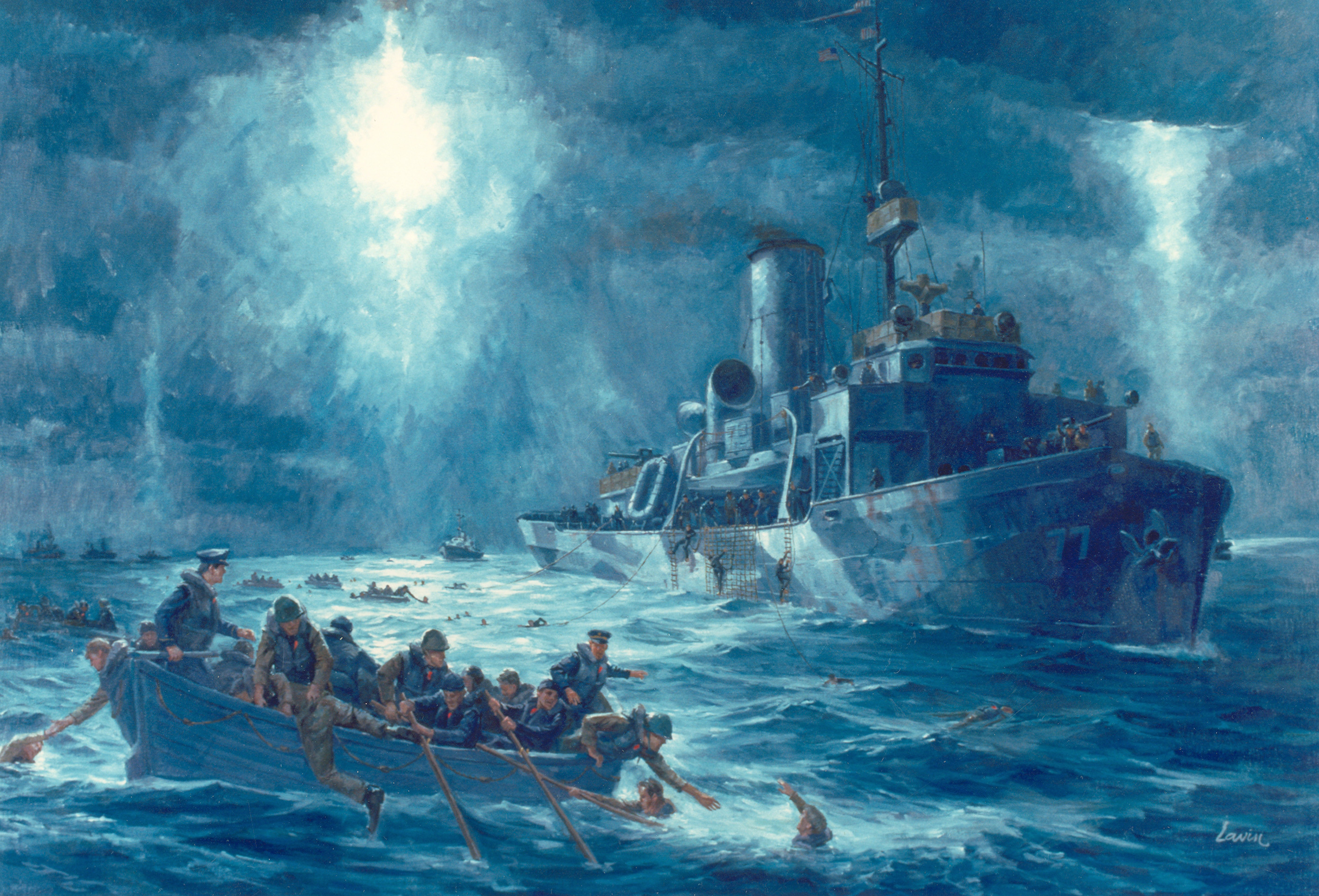
Escanaba rescuing survivors from USAT Dorchester. USCG Image.

Escanaba rescuing survivors from USAT Dorchester. USCG Image.

The following is based on Samuel Eliot Morison’s History of the United States Naval Operations in World War II, Volume I, The Battle of the Atlantic, 1939-1943, pp 330-334 and information from Uboat.net.

The current list of names selected for the Webber class WPCs includes the names of Charles Walter David Jr. and most recently Forrest O. Rednour. These two men are representative of about two dozen rescue swimmers who risk their lives to rescue survivors from the chartered US Army Transport Dorchester. torpedoed on February 3, 1943, 74 years ago.

These men did the best they could to mitigate a disaster, but it was still a disaster. This was the largest loss of personnel on a US flag merchant vessel during WWII.

SG-19 was a small convoy bound from St Johns Newfoundland to Greenland, three ships, two merchantmen and the 5,252 ton Army transport Dorchester, with about 1000 tons of cargo, a crew of 130 men, an armed guard of 23, and 751 passengers, mostly Army reinforcements, and among them some 23 Coast Guard personnel, for a total of 904, of these only 229 would survive. As might be expected, the weather was cold and nasty as they approached Greenland.

The convoy was escorted by three cutters, the 240 foot Tampa (WPG-48) and two 165 foot “A” class cutters, Escanaba (WPG-77) and Comanche (WPG-76). The convoy escort was commanded by Capt. Joseph Greenspun, USCG. Tampa, commissioned in 1921, was fairly old, her speed, officially 15.5 knots but according to Morison actually 14.5, was less than that of a surfaced U-boat (17.7), but it was similar to that of the smaller Flower Class corvettes that made up the majority of convoy escorts and she was larger and better armed than a corvette.

The two 165 foot cutters, Escanba and Comanche, were really ill-suited for the mission. They were small with a low freeboard, and while credited with a speed of 12.8 knots, according to Morison their actual speed was 11.5 knots, and this was further reduced by icing, slowing the convoy. Icing also effected the escorts’ weapons. According to Morison, “At times they had to heave-to and remove ice with live steam; guns, depth charges and mousetraps (anti-submarine rockets–Chuck) sealed tight by thick ice, and excessive water noise rendered sound gear of little value.” Unable to do more than keep up with the convoy, the two smaller cutters struggled to maintain station on the flanks of the convoy.
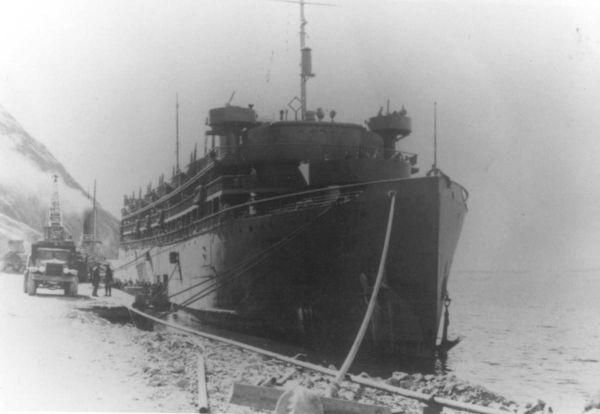
US Army Tansport Dorchester

US Army Tansport Dorchester

The convoy was sailing at a speed of ten knots. The three merchant ships were in line abreast with Dorchester in the center. Tampa led 3,000 yards ahead of Dorchester, and Comanche and Escanaba were 5,400 yards on the flanks, to port and starboard respectively.

On Feb. 2 the weather had moderated, but the convoy was informed that there was U-boat activity in the area.

59 degrees 22′ N, 48 degrees 42′ W, 150 miles West of Cape Farewell, Greenland, during the night, very early on 3 Feb., a torpedo struck the Dorchester on the starboard side in the machinery spaces. About 20 minutes later the Dorchester had sunk.

U-223, on her first war patrol, had approached the convoy from starboard, probably on the surface in the dark, probably having passed between Tampa and the Escanaba. Even at this late date the Escanaba still had no radar.

The U-boat had loosed five torpedoes, meaning she had fired all four of her bow tubes and turned and fired the single stern tube as well. One of the first hit the Dorchester. All the rest missed.

There was confusion on the transport. Many never heard the order to abandon ship. “Three of the 14 lifeboats had been damaged by the explosion, the crew managed only to launch two more overcrowded boats and 33 men left with rafts, but many men evidently did not realize the seriousness of the situation, stayed aboard and went down with the ship.” Most went into the water with nothing more than a lifebelt.

Initially Escanaba and Comanche attempted to find the U-boat, but Escanaba then moved in to rescue survivors while Comanche attempted to protect Escanaba. Comanche joined the rescue effort about two hours after the torpedoing.

From Uboatnet,

“Escanaba … picked up 81 survivors from the water and rafts and 51 from one lifeboat. Comanche picked up 41 survivors from another lifeboat and 56 from rafts and the water. Hundreds of floating bodies or frozen to wreckage were checked for signs of life. The survivors were landed at Narsarssuak (Greenland) later the same day. 675 lives were lost: the master, three officers, 98 crewmen, 15 armed guards and 558 troops and passengers (including 16 Coast Guardsmen). The following were saved: three officers, 25 crewmen, 44 civilian workers, three Danish citizens, twelve armed guards, seven US Coast Guard personnel and 135 US Army personnel.”

U-223 was a reasonably successful U-boat being responsible for the loss of three merchant ships, a frigate, and a destroyer. She was sunk 30 March 1944 in the Mediterranean Sea, 60 nautical miles northeast of Palermo, Sicily, in a battle with four British destroyers in which she sank one of her pursuers, HMS Laforey.

Four months after the loss of Dorchester, 13 June, 1943, at 0510 Escanaba blew up and sank within three minutes in the North Atlantic.  All but two of her crew of 103 were lost.

Would the result have been any different if the cutters had been more capable? We will never know, but it suggest that if we are ever again in a general war, prepared or not, our cutters will be pressed into service even if they are unsuitable, poorly trained, or inadequately equipped.

US COAST GUARD LAUNCHES NEW ONLINE NEWSROOM

The following is a verbatim news release:

WASHINGTON — The Coast Guard is scheduled to launch its new, online digital newsroom, http://www.news.uscg.mil, Thursday afternoon.

The mobile-friendly content management system replaces the service’s previous news site, www.uscgnews.com, and offers an email subscription service that delivers both regional and national Coast Guard news.

Users can click here to subscribe to the news delivery service. This new capability will allow users to manage their Coast Guard news preferences through the service’s subscription preferences page.

Users currently receiving Coast Guard news via uscgnews.com will continue to receive news releases via email; however, users can opt-out of the emails by clicking the unsubscribe button at the bottom of any Coast Guard email sent from the new system.

For more information, please contact 202-372-4630.

4.1 Miles–NY Times

New York Times has a video and story about the Greek Coast Guard on the Island of Lesbos and their effort to save refugees attempting the passage from Turkey to Greece.

You might want to watch the video on the New York Times site, because I think the sound is better than the YouTube video version I found and included above.

The film is an Oscar nominated short subject.

A total of 600,000 refugees reportedly made the crossing from 2015 through 2016.

Navy Getting New Fire Retardant Coveralls for Underway

NAV_IFRV_7

Navy Times is reporting that the Navy has selected a new underway work uniform referred to as the Improved Fire Retardant Variant, or IFRV, that is not only fire-retardant, but also reportedly more comfortable while providing arc-flash protection.

Also the Navy is reportedly looking at a two piece (shirt and pants I suppose) fire-retardant underway work uniform.

One thing I notice in the photo above is that the woman’s sleeve comes down well over her hand. Makes it look like she is wearing her daddy’s clothes. Maybe an adjustment in the cuff, like a second button, is in order.

US Navy New Improved Flame Resistant Variant IFRV Coverall 2

NORFOLK, Va. (Jan. 19, 2016) Lt. Cmdr. Heather Flores, assigned to U.S. Fleet Forces Command, poses in the Improved Fire Retardant Variant (IFRV) coverall onboard Naval Support Activity Hampton Roads. The IFRV, made of a light weight, tri-fabric blend, is flame resistant and will replace the current flame retardant variant coverall in use by the fleet. (U.S. Navy photo illustration by Mass Communication Specialist 2nd Class Stacy M. Atkins Ricks/Released)

Found the illustration above at Navy Recognition.

“SNA 2017 Surface Navy Association Day 3 – Part 2/2”–NavyRecognition

This is one of a series of videos from NavyRecognition discussing sponsors’ presentations at the Surface Navy Symposium. This one includes:

  • Extended Range Harpoon from 00:20 to 02:45
  • SeaRAM launcher from 02:45 to 05:15
  • RAM Block 2 from 05:15 to 5:45
  • Lockheed Martin export Multi Mission Surface Combatant 5:45 to 7:00
  • Curtis-Wright towed sonar (TRAPS) 7:00 to 08:30
  • Atlas North America SeaCat AUV 08:30 to 10:54

The things I found interesting were:

  • The growing use of SeaRAM, which has been being fitted to the trimaran Independence Class LCS, has replaced Phalanx on some destroyers and will replace the Mk49 RAM launcher on the mono-hull Freedom Class beginning with LCS-17. It is also expected to be fitted on the follow on LCS derived Frigate as well. If things start to get tense we may see these on NSCs and OPCs as well.
  • The fact that the extended range RAM Block 2 is now operational. The SeaRAM has the same degree of autonomy as Phalanx but because it is a “fire and forget” missile, will be able to engage multiple incoming anti-ship missiles at extended range.
  • More info on the Curtis-Wright TRAPS containerized active passive towed array which should be able to fit on anything WMEC sized and larger.

How Does the Program of Record Compare to Historic Fleets

 The U.S. Coast Guard cutter USCGC Morgenthau (WHEC-722) heads out to sea from its home port in Alameda, California (USA), passing under the Golden Gate Bridge.


The U.S. Coast Guard cutter USCGC Morgenthau (WHEC-722) heads out to sea from its home port in Alameda, California (USA), passing under the Golden Gate Bridge.

A question from a reader prompted me to look at how the “Program of Record” (POR) compares with Coast Guard patrol fleets of the past.

The program of record is
8 NSCs
25 OPCs
58 FRCs
—————

91 vessels total

1990: Looking back at the “Combat Fleets of the World 1990/1991” the Fleet was:
12 WHEC 378′
32 WMECs (16×210′, 10×270′ (three building), Storis, 3×213′, 3×205′)
34 WPB 110′ (plus 15 building)
3 WSES 110′ surface effects ships
4 WPB 95′
——————-
85 vessels total
(There were also five Aerostat Radar Balloon tenders.)
 –
2000: “The Combat Fleets of the World 2000-2001” showed
 –
12 WHEC 378′
32 WMEC (13×270′, 16×210′, Alex Haley, Storis, Acushnet)
49 WPB 110′
——————-
93 vessels total.
 –
2013: “The Combat Fleets of the World, 16th Edition,” copyright 2013 listed:
 –
3 NSCs
8 WHEC 378′
28 WMEC (13×270′, 14×210′, Alex Haley)
4 FRCs
41 WPB 110′
——————–
84 vessels total
 –
Comparing the Program of Record (plus NSC #9) to the fleet of 2000: You can look at it this way,
  • 9 NSCs and 3 OPCs is more than adequate replacement for the 12 WHEC 378s
  • 49 of the FRCs is more than adequate replacement for 49 WPB 110s (and we have only had 41 anyway since the WPB 123 screw up)
  • That leaves 22 OPCs and 9 FRCs to cover for the 32 WMECs.
Conclusion: 
I think we would all be pretty happy, if we had the Program of Record fleet in place right now. It really would be a substantial improvement, but while the NSCs and the FRCs are well on the way, the first of the long-delayed OPCs will not be delivered until 2021, and, if everything goes according to plan, the last probably not before 2034, at which time even the newest 270 will be 44 years old. A lot can happen between now and then.
The 2000 fleet was, I believe, the benchmark against which the program of record was measured in the Fleet Mix Study. By 2013 we were already down nine vessels. By my estimate, by the time the last 210 is replaced it will probably be 60 years old. That is expecting a lot. Can we possibly expect that none of these ships will become unserviceable before they are replaced? Building no more than two OPCs a year is really too slow. Once the first ship is built, tested, and approved for full rate production, we should accelerate construction to the maximum. That can’t happen until at least FY2022, probably FY 2023.
By the end of FY2022 we should have already funded 7 ships. The remaining 18 would take nine years, if we buy them at the currently projected schedule. Instead we could fund the entire remaining program from FY2023-2027 by doing a single Multi-Year Procurement of 18 ships. If Eastern alone could not do it, Marinette, which like the designer VARD, is also a Fincantieri company, would probably be more than willing to build an additional couple a year, particularly if the Navy stops building Freedom class LCS/frigates.
 –
We could have the program complete by FY2030, four years early.
 –
Thanks to Peter for initiating this line of thought. 
uscgc_citrus_1984

USCGC Citrus (WMEC-300), USCG photo

storisfoam

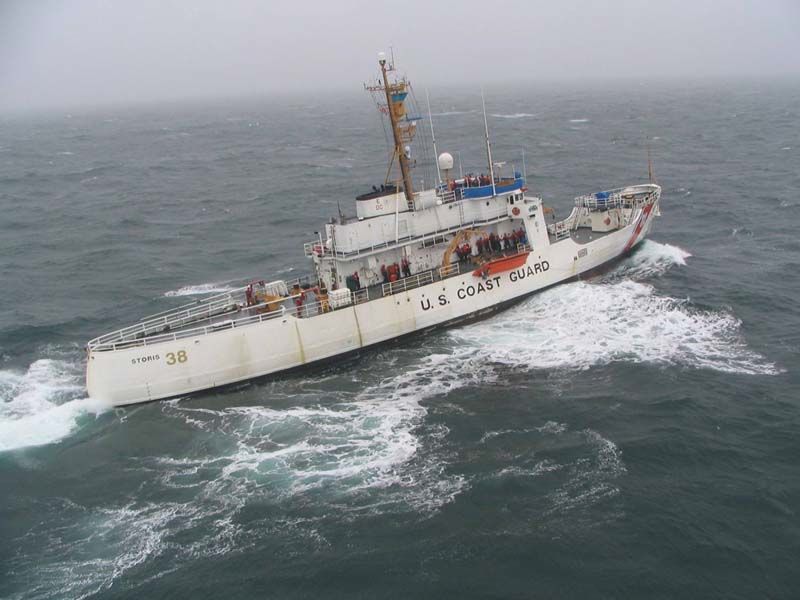
USCGC Storis WMEC-38)

USCGC Acushnet

USCGC Acushnet (WMEC-167), USCG photo


Intelligence Upgrade for the OPC?

Allen Balough, a lead engineer for the C4ISR program (right), tests the new interior communications system with a Coast Guard Cutter Spencer crewmember after installation of leaky coax cable. The installation took place in Boston July 18-21. U.S. Coast Guard photo.

U.S. Coast Guard photo.

The Coast Guard has been enjoying the benefits of better intelligence available to (and from) the National Security Cutters (NSC).

The Acquisitions directorate (CG-9) recently issued a press release that suggests they hope to get more of the same from the Offshore Patrol Cutters (OPC).

Acquisition Update: Acquisition Directorate Looks To Continue Operational Successes With OPC C4ISR Design

Jan. 13, 2017

The Coast Guard shattered its record for drug interdictions in fiscal year 2016 due in large part to the enhanced capabilities of the national security cutters and their advanced command, control, communications, computers, intelligence, surveillance and reconnaissance (C4ISR) systems. The Acquisition Directorate’s C4ISR Program is working to bring similar success to the offshore patrol cutters.

The Coast Guard seized more than 400,000 pounds of cocaine in fiscal year 2016, worth around $5.6 billion, and much of that is thanks to the advanced intelligence-gathering capability of the NSC class.

“Since the post-9/11 reorganization of the intelligence community, the Coast Guard has a much greater responsibility for intelligence gathering,” said Wayne Jacobs, intelligence system acquisition manager. “Instead of simply acting on intelligence reports, NSC crews have an improved ability to gather information themselves and share it with the intelligence community.”

Part of the NSC’s success is thanks to its ability to access the most up-to-date intelligence reports from shore-based intelligence networks in addition to its own intelligence data collection systems. “Before the NSC, a cutter would use intelligence which could be eight to 12 hours old to find smugglers,” he said. “The NSC gives the Coast Guard the capability to guide their patrols with real-time intelligence to better locate drug traffickers.”

Once on patrol, the NSC’s advanced sensors and surveillance equipment help its crews identify, locate and interdict smugglers. For example, NSC crews can use infrared sensors to better locate smugglers at night.

However, perhaps the most important feature of the NSC is interoperability. “The Link 11 system is the best part,” Jacobs said. “It allows ships and aircraft in a group to share their tactical data so the NSC crew can better see the command and control picture around the cutter.” Link 11 allows tactical information sharing with other U.S. military branches and with allied militaries.

An advanced communications suite makes coordinating operations easier for NSC crews, improving interoperability further. The NSC uses both line-of-sight and satellite radios to provide voice communications, chat rooms and data transfers to better coordinate with partners.

Jacobs says that the NSC has led to a notable increase in the Coast Guard’s interdiction of semisubmersibles – vessels that operate partially underwater to avoid detection. “It’s a technique that we’ve seen more in recent years, and they’re very hard to find in the water,” he explained. “We’ve caught a lot of semisubmersibles thanks to operations guided by better intelligence data from these systems.”

Recognizing the success of the intelligence-gathering systems on the NSC, the C4ISR Program is working to bring similar systems to the OPC. “The OPC systems will provide similar capabilities to what the Coast Guard uses and needs on the NSC,” Jacobs said.

The OPC will feature the Link 11 system and similar intelligence-sharing equipment to the NSC. The C4ISR Program is also hoping to include a data collection system that will integrate and analyze information from the cutter’s sensors to provide the crew with better situational awareness. An advanced, Navy-provided electronic warfare system and gun system will also be included to help the cutter perform defense readiness missions. The Navy is also providing the latest multimode air search radar.

“Because they operate closer to shore, the OPCs are more focused on Coast Guard-specific missions like drug interdiction,” Jacobs explained. “We’re designing intelligence systems with that in mind.”

I am not sure what this means. The only likely change I see, to what was already planned for the OPC, is that perhaps the Ships Signals Exploitation Space (formerly referred to as a SCIF (Sensitive Compartmented Information Facility)) for which space was to be provided but with no immediate plans to equip and man it, will in fact be fully furnished. That would be a step in the right direction.

This might also be an attempt to head off any attempt to dumb down the OPC.

It might also be a “thank you and more, please” to the Navy for the “Navy Type/Navy Owned” equipment they have been providing.

It might be all three, but it is formal recognition that thermal imaging, Link 11, secure satellite radio, high level intel access, and sophisticated radars make our ships more effective.

OPC to Have Hybrid Propulsion

OPC "Placemat"

OPC “Placemat”

We have confirmation that the Offshore Patrol Cutter will have a hybrid propulsion system.

Shephard Media is reporting that, “DRS Technologies, a Leonardo Company, has been selected to provide the hybrid-electric drive propulsion system for the US Coast Guard Offshore Patrol Cutter.”

As to the exact configuration, we have this. Clive Wilgress-Pipe, director of business development and strategic programs at DRS Power Technology said,

“…that the new Offshore Patrol Cutter design solution uses the gearbox mount configuration.”

This suggests to me that the electric propulsion motors (EPM) will be physically close to the main diesel engines (MDE). Assuming the ship will retain redundant machinery spaces, I will speculate and say, this probably means the ship will have two machinery spaces each with a complete propulsion set (MDE, clutch, gearbox, and EPM) for one shaft, plus one or two generators. Previously I had expected one engine room with both main diesel engines, and a motor room with both electric motors.

We don’t have a speed capability for the ship on electric propulsion alone. I had assumed it would provide at least 14 knots to give the long endurance (10,400 n.mi.) claimed for that speed, which might have required only a pair of 1,500 HP motors, but Mr. Wilgress-Pipe’s remarks suggest it might be more.

“Typically you rate it up to about 17 or 18 knots.”

That would require something more like a total of 6,000 HP. As noted, in the linked post, some configurations (COmbined Diesel Electric And Diesel, CODLAD) allow the power of the electric motors to suppliment the main propulsion engines. If that is the case, and we could add something like 6,000 HP to the two 16V 28/33D diesel engines, each rated at 9,763 bhp, then the ship would almost certainly have a 25 knot max speed. (This is of course speculation, so we can only be sure of the 22.5 knots sustained previously reported.)

Giving these ships the option of cruising on electric power, provided only by the ship’s service generators, makes these ship potentially more useful as ASW ships. In this mode, they will be quieter and, in noisy littoral environments, more difficult for a submarine to distinguish from other traffic.

Thanks to Luke for bringing this to my attention.