Navy’s new 40 foot Force Protection Patrol Boat

Navy 40 foot PB(X) to be built by Metal Shark

The Navy has recently awarded Metal Shark a contract for a new “force protection” patrol boat.

The basic information is:

LOA: 43′ 11″app
HULL LENGTH: 40’ 3″
BOA: 11’ 10″
Metal Shark claims the boat is optimized for normal patrol speeds of 10-12 knots while capable of economical operation at higher speeds of 35+ knots.
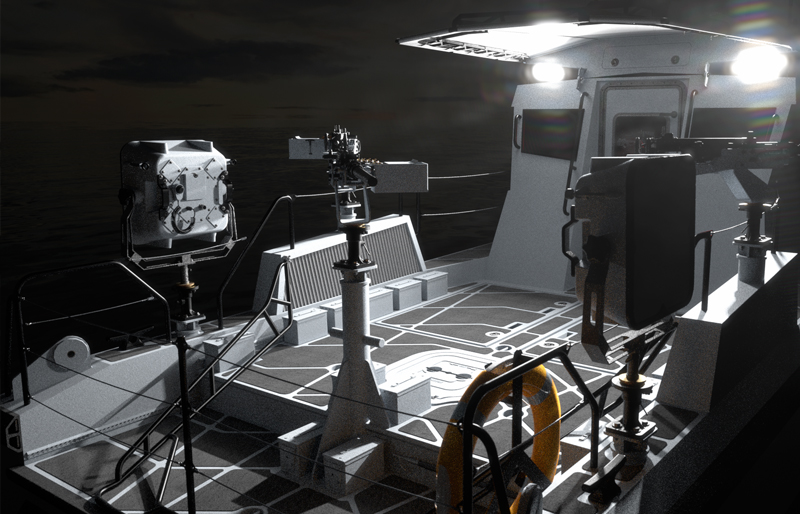
It appears the expected weapons fit is a .50 caliber in a remote weapons station forward and three crew served .50 calibers aft. Two LRAD (long range audio devices) also appear to planned.

PB-X aft, LRAD and .50 cal.

Undoubtedly there will be comparisons drawn between these and the Coast Guard boats that also do escorting duties. After all, the Coast Guard probably does many more escort missions as part of the Ports, Waterways, and Coastal Security mission than the Navy ever will. The Coast Guard escorts passenger vessels, hazardous cargoes, Navy surface ships, and even Fleet Ballistic Missile Submarines.
Our closest comparable boat is the Response Boat, Medium. The RB-M may be a bit faster. It appears that this new Navy boat may be better equipped for the escort mission than the RB-M or even most 87 foot WPBs. The LRAD looks like a good idea to warn away the innocent, and if the use of deadly force is necessary, the Navy boat looks like it will have heavier weapons and the remote weapon station means greater accuracy and less chance of collateral damage.
I have quoted the Metal Shark news release below. In addition there is a lot more information about the boat here.

October 2, 2017: Metal Shark Wins U.S. Navy PB(X) Patrol Boat Contract

Jeanerette, LA – October 2, 2017: Louisiana-based shipbuilder Metal Shark has been awarded the contract to produce the U.S. Navy’s next-generation patrol boat, the PB(X).

This award is the culmination of a multi-year process by the Navy to select the replacement for the fleet of force protection boats currently in use with Navy Expeditionary Combat Command’s Coastal Riverine Forces (CRF). Subject to annual appropriations, the Navy intends to replace approximately 100 to 160 of its existing 25-foot and 34-foot CRF patrol boats with the larger and more modern PB(X) platform over the next fifteen years.

The Navy has placed an initial, immediate order for eleven of the new vessels. Under the terms of the award, potentially worth over $90 million, Metal Shark will build up to 50 PB(X) vessels for the Navy, along with trailers, spares and training packages, and technical support.

“PB(X) was one of the most challenging and most sought-after U.S. military boat procurement opportunities in recent history; the result of a years-long process pitting Metal Shark’s engineering and manufacturing capabilities against multiple leading U.S. naval architect firms and nearly all of our competitors,” said Metal Shark’s CEO Chris Allard. “The award of PB(X) to Metal Shark is the result of a tremendous team effort and I couldn’t be more proud of our people.”

The winning PB(X) design is a 40-foot, welded-aluminum pilothouse patrol boat designed by Metal Shark’s in-house engineering team. Leveraging its extensive experience with military patrol craft of similar size, Metal Shark designed a bespoke craft ideally suited to accommodate all mission parameters.

Immediately identifiable thanks to its chiseled, angular profile and a unique faceted hull, the PB(X) is powered by twin diesel inboards and water jets. Metal Shark designed a moderate aft deadrise, wide-waterplane, sharp-entry hull form that not only achieves 35+ knot sprint speeds while displaying superb dynamic stability in a range of conditions, but also offers enhanced handling and greatly reduced operating cost at the 10-15 knot escort and cruise speeds where the vessel will spend the bulk of its operational life. The PB(X) features ballistic protection and can be armed with a range of crew-served and remotely operated weapons systems.

In order to fully optimize the hull and propose a more mature design, Metal Shark built a PBX running prototype hull, designated PB(X)-P1, which was extensively tested in a wide range of operating conditions. This test platform became the basis for Metal Shark’s resistance, powering, and weight testing, and determined the final configuration proposed to the Navy.

“The testing of PB(X)-P1 validated our design choices, mitigated our areas of concern, and resulted in a design proven to perform exactly as expected under real-world loads and conditions,” explained Mr. Allard. “We made this up-front investment to eliminate any and all potential concerns and to deliver a thoroughly tested and proven, next-generation patrol boat platform to the U.S. Navy.”

The PB(X) will be built at Metal Shark’s Jeanerette, Louisiana production facility, which specializes in the rapid, serialized assembly of military patrol boats. Other significant military fleet builds currently underway at the facility include ongoing production of the Navy’s 32’ Force Protection Boat – Medium (FPB-M) and 26’ High Speed Maneuverable Surface Target (HSMST), and the U.S. Coast Guard’s 29’ Response Boat – Small (RBS).

This is the second major U.S. Navy contract awarded to Metal Shark in 2017. In June, Metal Shark was selected to build up to thirteen Near Coastal Patrol Vessels (NCPVs), for the Navy. These 85’ patrol boats are being produced at Metal Shark’s Franklin, Louisiana waterfront shipyard.

“Winning PB(X) is a crowning achievement for us, but there’s a lot of work ahead,” said Mr. Allard. “The Navy is a long-standing customer we’re extremely familiar with and whose needs we understand intimately. We are eager and ready to commence PB(X) production and to begin supplying the world’s greatest Navy with the world’s most advanced patrol boat.”


Metal Shark PBX Prototype
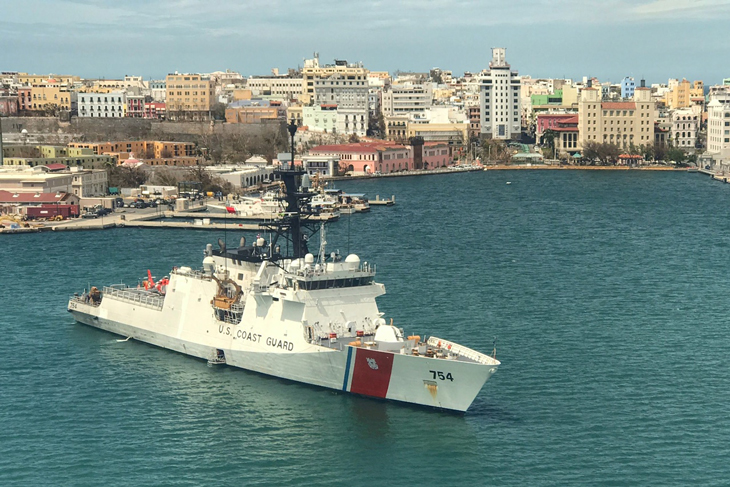
USCGC Maui in Trilateral Exercise Persian Gulf

An exercise that you might not have heard of.

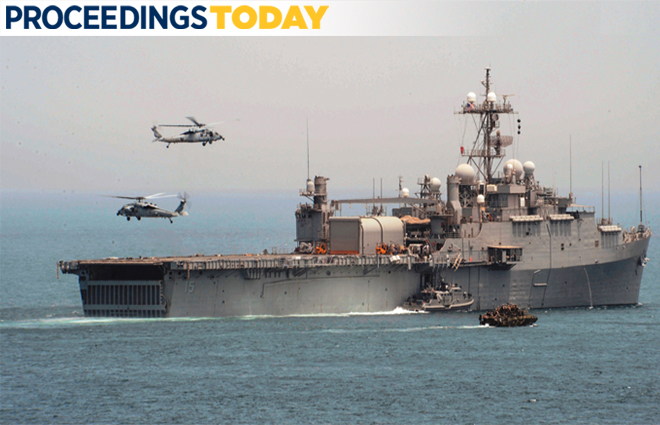
USCGC  Maui (WPB-1304) exercised with USS “Vella Gulf” (CG-72), a cruiser, USS “Squall“ (PC-7) and USS “Thunderbolt“ (PC-12), both U.S. Navy Cyclone-class patrol (coastal) ships, a US Army Logistics Support Vessel, the Iraqi Navy, and the Kuwaiti Navy and Coast Guard.

JPALS landing aid for Coast Guard?

US Navy Photo. JPALS tactical prototype

The Navy has already chose Joint Precision Approach & Landing Systems (JPALS) and BreakingDefense reports Raytheon is offering it to the Air Force and Army. Perhaps the Coast Guard should take a look. Like the Navy, the Coast Guard operates aircraft from moving ships, with perhaps even more  “pitch, roll, surge, sway, heave, yaw, and translation”

JPALS fills the role of a TACAN, giving bearing and range to the landing area, but does it with much greater accuracy, directing the aircraft to a 20 cm (7.8″) square area, using differential GPS. It does it all in any weather and zero visibility with very low probability of intercept and in an encrypted format by data link, minimizing the need for radio communications.

Every time we turn on TACAN we broadcast the position of ship. 

Potentially it can provide a autonomous recovery for aircraft and UAVs.

“What’s more, Raytheon is finishing development of a capability for JPALS to take over the flight controls and bring the aircraft in for an automated landing with no input from the pilot – or potentially with no pilot on board at all. That is why the Navy has contracted with Raytheon to put JPALS on its future MQ-25 carrier-based drone.”

Maybe our over-the-horizon boats could use it too.

The Navy’s Problems and Underway Time as a Measure of Availability

USS John S. McCain

The US Naval Institute reports the Navy is acknowledging that they have too often let training slip, particularly among those ships forward deployed to Japan.

The Navy has been largely unable to say no to missions it’s been tasked to do in the Pacific despite not having dedicated training time or keeping up with required certifications, the chief of naval operations said in a Tuesday Senate Armed Services Committee, highlighting the bad confluence of high-demand, low resources and a “can-do attitude” within the service.


SASC Chairman Sen. John McCain (R-Ariz.) said in his opening statement that “the McCain (DDG-56) had expired training certifications in six out of the 10 key warfare mission areas. The Fitzgerald (DDG-62) had expired certifications in all 10 mission areas.”

The Coast Guard certainly has suffered its share of “Can-Do-i-tus”

I suspect much of the Navy’s overworking of their personnel is self-inflicted. Why?–Take a look at how much the Navy is underway as I will explain below.

We have all made those reports that apparently served no purpose; well intentioned reports that should have been limited to a specific period to answer a specific question; programs that are well intentioned but relatively unimportant that just crowd out what should be priority work. Even the Navy’s certification program may be unrealistically onerous. They may not have support, facilities, or funding, particularly those based in Japan, but at least I think they have time if they could get rid of the unnecessary.

How much is the Navy underway?

The USNI also provides a weekly update entitled “USNI News Fleet and Marine Tracker” (https://news.usni.org/?s=USNI+News+Fleet+and+Marine+Tracker). Having looked at the last eleven weeks, less than a third (31%) of the Navy’s 276 “Battle Force” ships (including 58 MSC ships) are underway at any one time ranging from 81 to 90 ships (average 85.9). They do have a bit over a third of their ships are “deployed” (36.5%, 100.6 on average) but only 65.5% of those are underway. Ships that are not “deployed” are only underway 11.7% of the time.

The Coast Guard has historically used 185 days away from homeport criteria as a reasonable upper bound for scheduling ships, but that of course does not translate into mission days. It may include logistic stops, time in other ports, or even maintenance in a shipyard in a city other than the homeport. Congress has asked us to use another metric to measure availability. Perhaps percent of time underway is a good measure. Undoubtably it would be less than 50%, but I suspect we compare favorably with the Navy in percentage of time actually underway. We probably should make an effort to use the same criteria the Navy does.

Western Pacific Coast Guard Forum and CUES for Coast Guards

The US Naval Institute Proceedings has an article advocating the formation of a Western Pacific Coast Guard Forum and CUES (Code for Unplanned Encounters at Sea).

While it is certainly desirable to establish norms of behavior, unfortunately many of the incidents of the recent past have not been “unplanned,” they have apparently been orchestrated attempts at intimidation.

New Light Weight Armor–Army Times

The spheres inside the composite metal foam absorb the energy of a bullet. (North Carolina State University)

Army Times has a story about a new form of armor that might be use to provided repeated protection against small arms and fragments.

A 7.62mm rifle round will go through 3 inches of steel, so a catcher material is put behind the steel, he said. (This is probably incorrect. Probably should have been 0.3 inches–Chuck)

“When the bullet hits the ceramic, it stops and absorbs the energy,” Portanova said. “The problem is you can only shoot it once because then it’s cracked.”

Composite metal foam, however, has a bunch of hollow spheres inside. When struck with a bullet, the spheres are crushed, similar to bubble wrap.

Because of its resilience, you can hit it numerous times,  Portanova said.

Researchers at the directorate have helped make the material lighter and also stop bigger threats.

“It would only be slightly more expensive and will weight half or one-third of what they’re hanging on the side of a Humvee.”


Blockading North Korea–A Coast Guard Role?

Photo: Yellow Sea from DeepSeaWaters

I have seen several references lately to the possibility of blockading North Korea. A good explanation of why this is apparently being considered is in a Bloomberg article by Retired Admiral James Stavridis, who previously served as Commander, U.S. Southern Command; Commander, U.S. European Command; and NATO Supreme Allied Commander Europe. Quoting Wikipedia,

James George Stavridis (born February 15, 1955) is a retired United States Navy admiral and the current dean of the Fletcher School of Law and Diplomacy at Tufts University, a graduate school for international affairs. Stravidis serves as the chief international diplomacy and national security analyst for NBC News in New York. He is also chairman of the board of the U.S. Naval Institute and a Senior Fellow at the Johns Hopkins University Applied Physics Laboratory.

So perhaps we should consider this as a serious possibility. If it happens, would the Coast Guard have a role?

Certainly Coast Guard boarding teams would be high demand.

North Korea shares borders with South Korea to the South, a long border with China to the North, and a short Border with Russia to the Northeast. If the US attempts to blockade North Korean waters in the Yellow Sea and the Sea of Japan, it will bring US naval units into close proximity to both China and Russia including major Chinese and Russian Navy bases. We have to consider how they might react.

Both China and Russia might be more comfortable if the blockading units operating closest to them were Coast Guard rather than Navy. This applies equally to both ships and aircraft.

Certainly to protect Coast Guard units they would have to have Navy and Air Force backup.

OPC Derived Frigate? Designed for the Royal Navy, Proposed for USN

Earlier I suggested that a derivative of the Offshore Patrol Cutter might fill the role of a frigate.

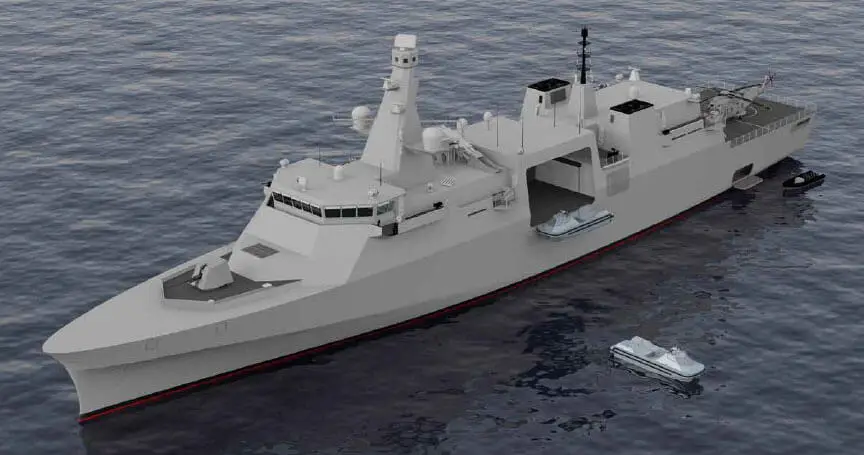
It now appears that a ship with the OPC’s DNA has been proposed as a frigate for the Royal Navy and has been offered to the US Navy. The Babcock Arrowhead 120 is the latest of five candidates for the Royal Navy’s Type 31e (the other four are outlined here).

The common thread is Vard designs. The family tree looks like this.

  • Róisín-class patrol vessel, two ships, 1500 tons, 79 meters (259 ft) in length, 23 knots, built by Babcock, commissioned into the Irish Naval Service in 1999.
  • Protector-class offshore patrol vessel, two ships, 1900 tons, 85 meters (279 ft) in length, 22 knots, built by BAE Systems Williamstown, Australia, for the New Zealand Navy, the first commissioned in 2010.
  • Samuel Beckett-class offshore patrol vessel, three ships completed and a fourth under construction, 2256 tons, 90 meters (300 ft) in length, 23 knots, built by Babcock and commissioned into the Irish Navy Service in 2014.
  • USCG Offshore Patrol Cutter, 4,000 tons, 110 meters (360 ft), to be built by Eastern in the US with the first expected to be commissioned in 2021.

OPC “Placemat”

NavyRecognition has the most complete description of the ship I have seen so far, and also has three protos of a model of the proposed ship.

Arrowhead 120 has a length of 120 meters, a breadth of 19 meters for a displacement of 4000 tonnes. Its speed is 24+ knots and range is 6000 nautical miles at 15 knots. Crew complement is 80 (plus 40). The vessel was design with commercial standard with applied naval engineering standards.

Missions bays: Space for numerous containerized units within the optimally located mission bays. Facilities for launch & recovery of UXVs. Flexible, reconfigurable infrastructure.

Missile options: Deck space for up to 8 surface to surface guided weapons. Up to 16 cells VLS.

Small calibre guns: Design provision for SCGs up to 30mm with associated EO sensors and magazine arrangements. Weapons can be fitted at a number of upperdeck positions.

Medium calibre guns: Design provision for MCG up to 5 Inch (127mm) with associated infrastructure.

Aviation: Flight deck sized for AW-101 Merlin/MH-60 Seahawk. Hangar capable of accommodating a medium organic naval helicopter (e.g. Seahawk or NH90) or a lighter helicopter plus a VTOL UAV (e.g. AW-159 Wildcat & MQ-8C Firescout). Design can accommodate all envisaged customer naval aircraft.

Type 31e, outline of requirements (click on to enlarge)

Babcock is offering the design to meet the US Navy’s frigate requirement.

Among companies vying for the Type 31e design contract is Babcock International, which this week unveiled proposals for a 120-meter, 4,000-ton rapidly reconfigurable warship with multiple mission bays; deck space for eight surface-to-surface missiles, 16 vertical launch cells and a 5-inch gun; a flight deck large enough for a V-22 Osprey tilt-rotor aircraft and hanger for MH-60 Seahawk helicopter; and launch/recovery facilities for unmanned vehicles.

Babcock claims that its Arrowhead 120 design will reduce through-life costs by embedding real-time equipment health monitoring sensors during the build process, allowing information about key systems to be gathered during deployments to inform subsequent maintenance periods.
With transatlantic exports in mind, the company also points to its collaborative venture with Florida-based Eastern Shipbuilding to design a new offshore patrol cutter for the U.S. Coast Guard. (emphasis applied–Chuck)
Craig Lockhart, the managing director of Babcock’s Naval Marine business, said that an advisor for U.S. naval procurement had expressed interest in the Arrowhead design, and specifically its innovative ‘iFrigate’ platform monitoring system, at the DSEI event.

The length is up ten meters compared to the OPC, as I thought might be the case, but I am a bit surprised at the reported beam, 19 meters. Since the OPC is 4,000 tons full load and the Arrowhead proposal is both ten meters (33 ft) longer and 2.5 meters (8 ft) greater in beam, the full load displacement of the Arrowhead would likely be considerably greater. The 4,000 tons reported may be a light displacement, meaning this ship is actually larger than the FFG-7 class.

Given the relatively small stacks and the 24+ knot speed, this is obviously an all diesel ship. It will be economical to run and have a long range at relatively high cruising speeds. While I think 24+ knots may be enough, most of the ships to be escorted make 20 knots or less, a speed well below the 29 knots of the FFG-7 class will be a hard sell to the US Navy.

NavyRecognition also has news of another of the Type 31e competitors, the BMT Venator-110 also apparently being proposed to meet the US Navy requirement.

Meanwhile BAE is also offering the much larger and more expensive Type 26 to the USN as well, however with its size and cost (U.S. $4.9 billion for the first three British ships) approaching that of a Burke class DDG, I think that is a long shot.

By contrast the Type 31e is being designed to a price of 250M Pounds or about $340M. That much lower price may be the Type 31e’s best selling point.

Late addititon, Sept. 12, 2019

type31e

Babcock Arrowhead 140 chosen for the Royal Navy Type 31e project.