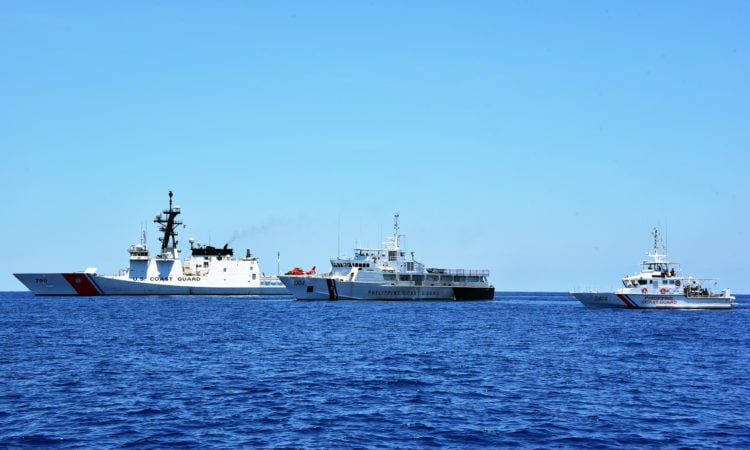
“How a new Vietnam-Indonesia deal will affect South China Sea disputes” –Defense News

Defense News reports that Vietnam and Indonesia have agreed on demarcation of their respective EEZs where they had previously been in dispute.

Peaceful settlement of conflicting SE Asian nation claims would go a long way toward presenting a united front against China’s expansive 9 Dash Line claims and clarify IUU fisheries enforcement.

“Practically, the successful Indonesia-Vietnam EEZ [exclusive economic zone] demarcation will help both countries to resolve illegal, unreported, and unregulated (IUU) fishing, which has been a serious bilateral irritant and a broader issue involving third-party countries, including China and Thailand,” according to Bich Tran, a visiting fellow writing in the Fulcrum, a publication of the ISEAS—Yusof Ishak Institute in Singapore.

“Philippines Says China Ship Used Laser Against Coast Guard” –Real Clear Defense

RealClearDefense reports,

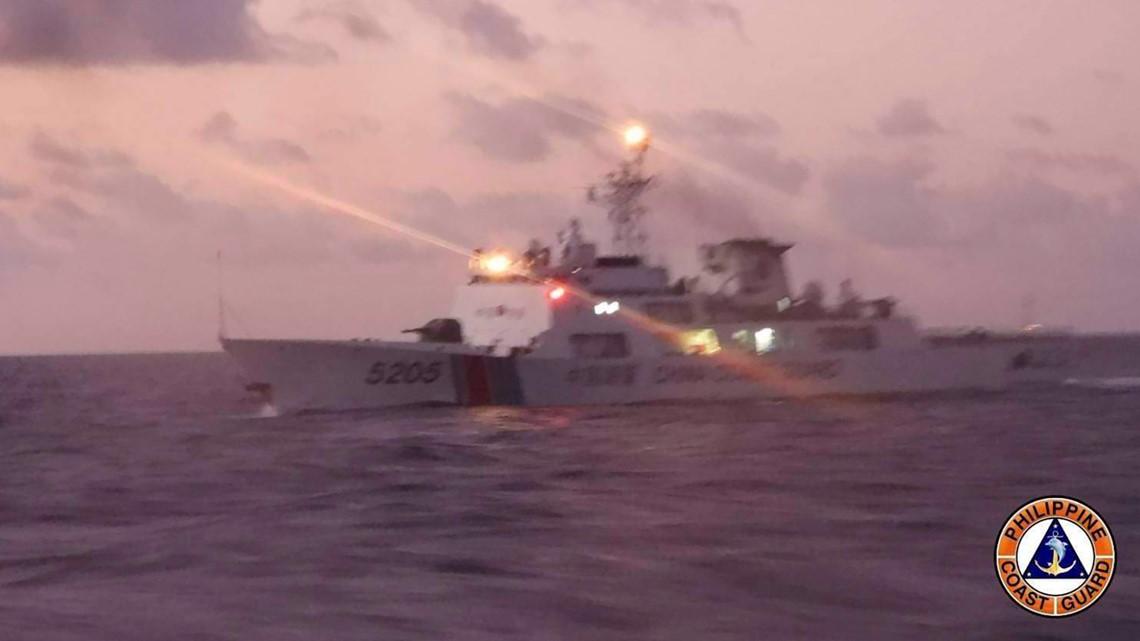
 “The Philippines on Monday accused a Chinese coast guard ship of hitting a Philippine coast guard vessel with a military-grade laser and temporarily blinding some of its crew in the disputed South China Sea, calling it a “blatant” violation of Manila’s sovereign rights.”

The incident occurred near Second Thomas Shoal, as the Philippine cutter BRP Malapascua was escorting a resupply mission to the BRP Sierra Madre, a Philippine LST deliberately, permanently grounded on Second Thomas Shoal. (Video here). Apparently the resupply effort was turned back.

Philippine CG statement on the incident here.

None of the Philippine Coast Guard cutters seem to be armed with anything larger than a .50 cal. machine gun, so they are at a disadvantage in facing down a large China CG cutter armed with a 76 mm gun, like the one in the photo above.

“Discover the French Navy’s New OPV for the Indo-Pacific” –Naval News

The video above is from Naval News via YouTube. Below is the information provided on the YouTube page.

Presentation of the first POM (Patrouilleur Outre-Mer or Offshore Patrol Vessel – OPV – for the overseas territories), the “Auguste Bénébig”, by its commander. This new French Navy (Marine Nationale) vessel will be based in Noumea, New Caledonia, in the Southern Pacific Ocean.

This new class of modern OPVs marks the renewal of the assets of the French Navy based overseas to protect French interests in the Indo-Pacific.

The increased autonomy (endurance–Chuck) of the patrol boat and its state-of-the-art equipment give it the capacity to operate far and for a long time in the wide French maritime zones in the Indo-Pacific.

This class of ships was designed by SOCARENAM. It can implement the SMDM drone. The POM vessel are 79.9 meters long and 11.8 meters wide, with a draft of 3.5 meters for a displacement of 1,300 tons at full load.

We have looked at the UAS these ships will deploy with here, “First Three SMDM Fixed-Wing UAS Delivered To The French Navy” –Naval News.

We talked about these ships in regard to how similar their missions are to those of Coast Guard cutters here, “SOCARENAM Shipyard Selected to Deliver 6 French Navy OPVs for Overseas Territories” –Naval News.

And about how close these were to my concept of Cutter X here, “France confirms order for six new POM Offshore Patrol Vessels” –Naval News, Another Cutter X

Like an FRC:

I always thought these looked like oversized Webber class, the proportions are similar and the much larger POM is not much more complicated than the Webber class. The crew of the POM is 30, only six more than that of the FRC. Both have a bridge with a 360-degree view positioned well aft, minimizing vertical acceleration. Both have an 8 meter boat in a stern ramp. The armament is similar with four .50 cal. machine guns and a single medium caliber gun in the bow, a 20mm on the POM and a 25mm on the FRC. The POM has a diesel electric and diesel powerplant but despite its much greater displacement, I doubt it has any more horsepower than the FRC (I have not been able to find a figure for the POM). With similar crew and systems, they should not cost much more than the FRCs to operate.

Unlike an FRC:

It appears the thinking was that they wanted a ship to do the same sorts of missions the Webber class Fast Response cutters (FRC) are doing out of Guam, but they also recognized that these ships would be far from any major naval base and that they would need to travel great distances and would be exposed to extreme weather conditions, so they needed to be larger (1300 tons vs 353 tons) and have greater endurance (30 days vs 5 days). Their range is 5500 nmi compared to 2500 for the FRC.

Having chosen a larger hull, they took advantage of the greater volume and deck space to add a second RHIB, a multimode radar, space for 29 passengers (roughly a platoon of Marines), a sickbay, a dive locker, space for a 20 foot containerized mission module, a flight deck and hangar for a 700-kilogram-class rotor-blade drone (not yet deployed), and a holding area for up to six prisoners.

Upgrades to the Philippine WHECs

BRP Ramon Alcaraz (former USCGC Dallas) equipped with new Sea Giraffe multi-mode radar in Cebu.

NavyRecognition reports, “China Coast Guard try to intercept Philippine Navy’s BRP Andres Bonifacio.” We talked about this incident earlier, but this report also includes information about the upgrades to the former US Coast Guard cutter. We did talk about upgrades earlier, but this has more specifics, particularly in regard to the sonar. All three of the Philippines’ former cutters are being upgraded.

The OPV is equipped with various sensors and processing systems, including the Naval Shield Baseline 2 Integrated Combat Management System, a Saab AB AN/SPS-77 Sea Giraffe AMB 3D air/surface search radar, a Furuno FAR3220BB 25KW X-band navigational radar, a Sperry Mk 92 Mod 1 Fire Control System, and an ELAC Hunter 2.0 hull-mounted sonar.

BRP Andres Bonifacio is armed with a Mk 75 Oto Melara 76mm Compact gun, two Mk 38 25mm autocannons, six M2HB Browning .50 caliber guns, and two USN-Mark 36 SRBOC (Super Rapid Blooming Offboard Countermeasures) mortar-type launching systems.

The combat management system, AN/SPS-77, sonar, and 25mm Mk38 Mod2/3s are all upgrades since the hand-over. I also found some additional information, that also mentioned Radar Electronic Support Measure (R-ESM), a new Identification Friend or Foe (IFF), and the SeaFLIR 230 electro-optical/infra-red (EO/IR) system.

The AN/SPS-77 is also used on Independence class LCS and will equip the US Coast Guard Offshore Patrol Cutter.

The sonar is by a German company and offers mine avoidance and torpedo detection as well as passive and active submarine and UUV detection capabilities. We don’t know which of the various sized transducers associated with this system was chosen. Transducers of 4 kHz to 30 kHz are available that span the range from low frequency long range systems to relatively short ranged high frequency systems. A medium frequency seems most likely.

Some of these upgrades, particularly the multimode radar, support helicopter operations. The Philippine Navy currently has two AW159 Wildcat helicopters with significant ASW and anti-surface capability. So far these are the only Philippine aircraft with an ASW capability and they may be based on other Philippine Navy warships.

The upgrades were done in South Korea. The Philippine military seems to have developed a relationship with South Korea. The Philippine Navy has purchased two 2600 ton light frigates from S. Korea and has contracts out for two 3200 ton corvettes and six 2400 ton 94.4 meter Offshore Patrol Vessels.

The three Philippine ships are probably now the best equipped of the 12 former US Coast Guard 378s currently serving in five different navies and coast guards, but there are still some desirable possible additions, including anti-ship cruise missiles (ASCM), close in weapon systems (CIWS), light weight ASW torpedoes, and towed array sonars.


Philippines Standing Up to China? Joint Patrols?

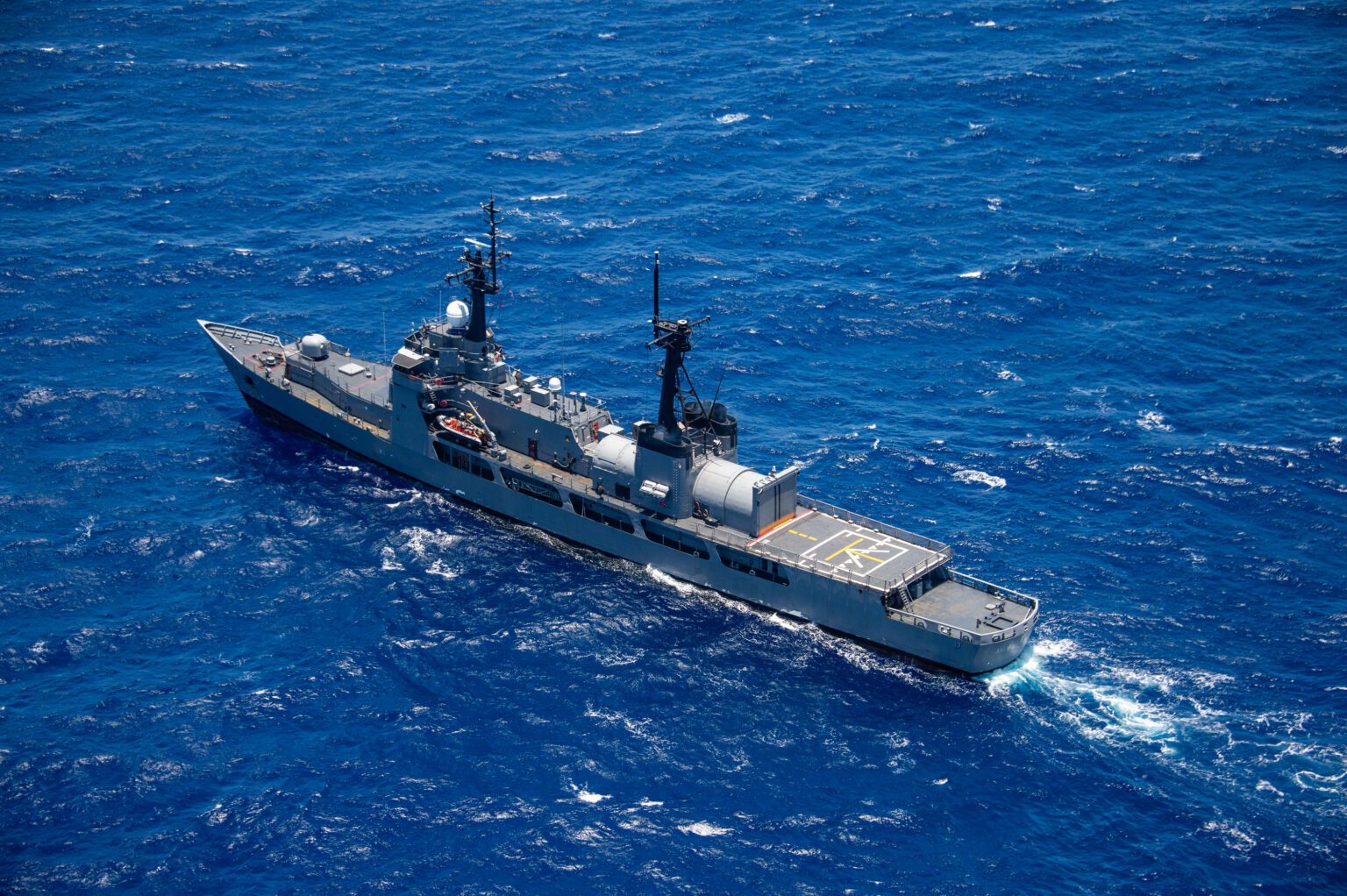
Philippine Navy frigate BRP Andrés Bonifacio (FF 17), the former USCGC Boutwell, participates in a group sail during the Rim of the Pacific (RIMPAC) exercise off the coast of Hawaii, July 26, 2018. (U.S. Navy photo by Arthurgwain Marquez)

A couple of recent reports seem to indicate the Philippines is becoming more aggressive in the protection of their EEZ.

Marine Link reports, “Philippines Coast Guard Boosts South China Sea Presence.”

“The Philippine Coast Guard has stepped up its presence in the disputed South China Sea by deploying additional vessels and conducting more sorties and overflights to protect maritime territory and the country’s fishermen, its chief said on Monday.”

gCaptain reports, “Philippine Navy Says China Tailed Its Warship.”

“The navy’s BRP Andres Bonifacio was conducting a patrol and search mission on Feb. 1 when it was monitored and tailed by the Chinese vessels near the reef, which is within the Philippines’ 200-nautical mile exclusive economic zone, said Armand Balilo, a spokesman for the coast guard. The militia boats “even conducted an intercept course,” he added.”

That the Philippine Navy is sending one of its largest ships (painted gray), the former USCGC  Boutwell, to confront Chinese trespassing is, I believe, a change from their previous policy.

Since the US and the Philippines have agreed to resume joint patrols, I would not be surprised to see a US Coast Guard cutter backstopping a Philippine CG cutter as it boards and perhaps seizes a Chinese fishing vessel. There are certainly plenty of them that are violating Philippine law.

“Japanese, Malaysian coast guards hold South China Sea security drill” –Indo-Pacific Defense Forum

This photo released by Malaysian Maritime Enforcement Agency shows the Japan Coast Guard ship Tsugaru (PLH02) and helicopters of the Malaysian Maritime Enforcement Agency during a joint exercise between the both agencies off Kuantan, Malaysia, Monday, Jan. 29, 2018. (Malaysian Maritime Enforcement Agency via AP)

Indo-Pacific Defense Forum reports on efforts by the Japan Coast Guard to assist the Malaysia Coast Guard, including, in this case, with Long Range Acoustic Devices that are being provided by Japan.

The Malaysia Coast Guard is a relatively young organization, having become operational in 2005. Two of the largest vessels in the Malaysia CG have been provided by Japan.

Japan has been helping to strengthen other coast guards in SE Asia as well, including those of Vietnam and the Philippines

“FLOODING THE ZONE: CHINA COAST GUARD PATROLS IN 2022” –CSIS

The Asia Maritime Transparency Initiative of Center for Strategic and International Studies provides a report showing the extent of China Coast Guard patrols of five features of the South China Sea, Second Thomas Shoal, Luconia Shoals, Scarborough Shoal, Vanguard Bank, and Thitu Island, in 2022 and comparing that to 2020. (There was no explanation for why no information regarding 2021 was included.)

The report also indicated that China Coast Guard is using automatic identification system (AIS) in a deceptive manner.

Thanks to Paul for bringing this to my attention.

“Sri Lankan CARAT 2023 Completed” –SeaWaves

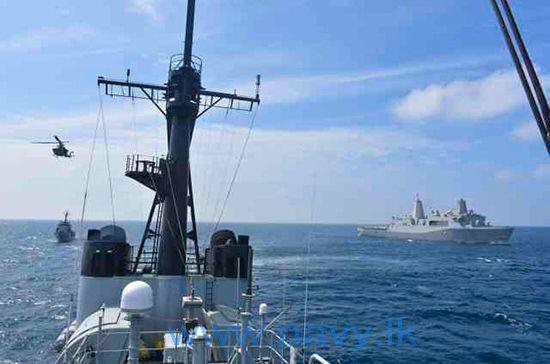
USS Anchorage seen from Sri Lanka’s SLNS Gajabahu. CARAT 2023

SeaWaves Magazine reports,

“Taking part in the sea phase of Cooperation Afloat Readiness and Training (CARAT) exercise 2023, SLNS Gajabahu and SLNS Samudura of the Sri Lanka Navy and ‘USS Anchorage’ of the U.S. Navy successfully conducted a series of naval exercises off Negombo on 22nd and 23rd January 2023.”

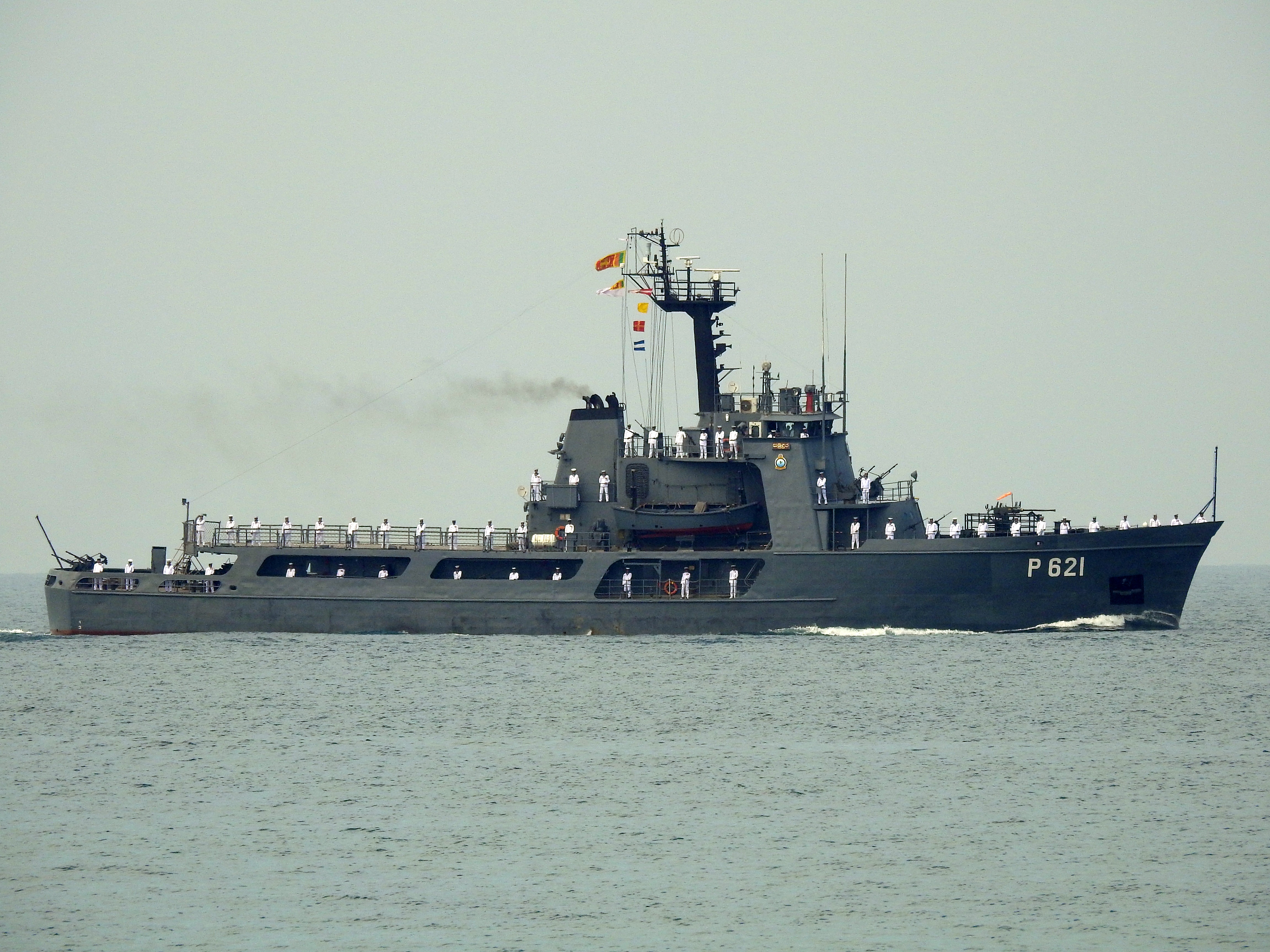
I had to point this out because both Sri Lankan ships mentioned are former US Coast Guard Cutters. SLNS Samudura is the former USCGC Courageous (WMEC-622) transferred to Sri Lanka in 2004 and SLNS Gajabahu is the former USCGC Sherman (WHEC-720) transferred to Sri Lanka in 2018.

Former USCGC Courageous, now SLNS Samudura P621. Photo by Rehman Abubakr

SLNS Gajabahu (P626), SLNS Sayurala (P623) and SLNS Sindurala (P624) during 2022 Colombo Naval Exercise. SLNS Samudura (P261) also visible in the distance. Photo defence.lk

“Navy Wants Independence LCS in Bahrain for Mine Countermeasure Mission” –USNI / “Navy considers non-LCS option for mine countermeasures in 5th Fleet” –Defense News

191227-N-PY805-1005
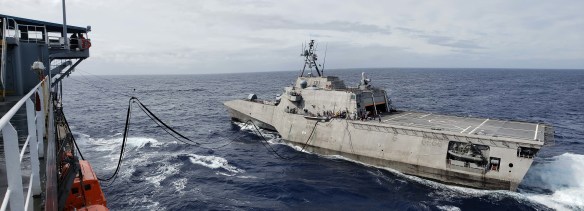
SOUTH CHINA SEA (Dec. 27, 2019) The Independence-variant littoral combat ship USS Gabrielle Giffords (LCS 10) receives fuel from the Henry J. Kaiser-class fleet replenishment oiler USNS Pecos (T-AO 197) during a replenishment-at-sea. Gabrielle Giffords is on a rotational deployment to INDOPACOM, conducting operations, exercises and port visits throughout the region and working hull-to-hull with allied and partner navies to provide maritime security and stability, key pillars of a free and open Indo-Pacific. (U.S. Navy photo by Nicholas J. Beihl/Released)

Two reports, one from US Naval Institute and one from Defense News. They appear to disagree, but they both were based on the same presentation. Really it is good news that both 5th and 7th Fleet want Independence class LCS. Trouble is, they don’t think they have enough to go around, if they are all based in San Diego, as they currently are. So, the Navy is looking at alternatives including forward basing or using other assets to provide the required Mine Counter Measures capability to 5th Fleet.

Their decision has potential consequences for Coast Guard forces’ efforts in the Eastern Pacific drug transit zone, Western Pacific IUU fisheries enforcement, and Southwest Asia.

The US Naval Institute report basically says the current plan is to supply 5th Fleet’s MCM requirement by using Independence class LCS operating from their base in San Diego, but they are looking at alternatives including forward basing or perhaps letting Freedom class LCS fill in.

The Defense News report tells us why the Navy wants an alternative solution.

The U.S. Navy is considering alternatives to deploying littoral combat ships to the Middle East for a mandatory mine countermeasures mission, hoping to instead maintain LCS deployments to the Western Pacific. (2)

“We’re trying to leverage that as much as we can and see how that fits into the mix,” he said. “There’s several different things going on, but right now I think the plan of record as it stands would be an Independence-variant MCM capability out there — but … we are working on several other options to see how we can fill that, and I personally think the answer is going to be something that is forward-deployed to Bahrain.” (Emphasis applied–Chuck)(2)

The Independence class (trimaran) LCSs in the Western Pacific are, or at least could be, helping to counter Illegal, Unreported, and Unregulated (IUU) fishing.

Once expected to go to the 5th Fleet/CENTCOM, the remaining Freedom class (mono-hull) LCSs are now expected to support 4th Fleet/SOUTHCOM including drug interdiction with embarked Coast Guard Law Enforcement Teams. If they are diverted to 5th Fleet to fill in, it could potentially hurt the drug interdiction effort.

An Alternative: As MCM can now be modularized, there appears to be less reason to have dedicated MCM ships or that all the elements have to be collocated on a single ship.

The service plans to buy 24 packages to equip 15 of the Independence-class LCS. That leaves nine mine countermeasure packages for potential use on “vessels of opportunity,” as Capt. Mike Egan, branch head for mine warfare in the Office of the Chief of Naval Operations, said last May at the 2022 International Mine Warfare Technology Symposium of the Mine Warfare Association. (3)

The aviation components and the Uncrewed Surface Vessel and its mine hunting sonar could be operated from shore or from an Expedition Base Ship. The Lionfish Unmanned Underwater Vehicle is the Remos 300. It is relatively small.

Part of the Navy’s planned family of systems, Lionfish’s main role will be intelligence gathering with the Navy’s expeditionary mine countermeasures company. As its name suggests, the SUUV is only 150 pounds and requires just a few sailors to deploy it. It will be based on HII’s Remus 300, a “man-portable UUV” that is “designed for modularity… [and] can be reconfigured with a range of sensors and payloads to meet mission requirements,” according to a statement the company published last year when announcing the government of New Zealand had ordered four UUVs. (4)

It could be operated from shore, from Expeditionary MCM Company RHIBs, or from Webber class WPBs.

More Reading: Good article on the state of US Navy Mine Warfare here.

Naval Strike Missile: Incidentally, there is affirmation that the Freedom class LCS, in addition to the Independence class LCS, will be equipped with Naval Strike Missile. From the USNI post,

“As of right now, the Navy still plans to put the Naval Strike Missile on the remaining Freedom-class hulls, Rear Adm. Fred Pyle, the director of surface warfare on the chief of naval operations’ staff (OPNAV N96), told reporters.” (1)

Sources: 

  1. Navy Wants Independence LCS in Bahrain for Mine Countermeasure Mission
  2. Navy considers non-LCS option for mine countermeasures in 5th Fleet
  3. Navy Mine Warfare Teeters Between Present, Future
  4. Navy moving ahead with HII for small UUV program

“Global Piracy Incidents Fall to Lowest Level in Decades” –gCaptain

USCGC Mohawk sails alongside a Nigerian navy ship in the Atlantic Ocean, Aug. 22, 2022. Mohawk was on deployment in the U.S. Naval Forces Africa area of operations. (Jessica Fontenette/U.S. Coast Guard)

gCaptain reports,

“Incidents of maritime piracy and armed robbery attacks last year fell to the lowest recorded level in almost three decades…”

While incidents are up in Southeast Asia, there has been a notable drop in incidents in the Gulf of Guinea, where the Coast Guard has been actively engaged in capacity building.

“The Gulf of Guinea saw a continued and much needed reduction is attributed to an overall decrease of pirate activity, with the number of incidents falling from 35 in 2021 to 19 in 2022.”

Off Somalia there has been both a sustained counterpiracy effort and allied patrols to interdict arms bound for rebels in Yemen.

“For a fourth year in row, there were no incidents of piracy or armed robbery by Somali-based pirates…”