Above you will find a video of a hearing held on June 7, 2018 regarding “Transportation in the Arctic”. You will find the subcommittee webpage here. It includes the video, the list of witnesses which I have reproduced below, and the Chairman’s opening remarks.
The video does not actually start until time 21:45.
Witnesses:
Admiral Charles W. Ray, Vice Commandant United States Coast Guard | Written Testimony
Mr. David Kennedy, Senior Arctic Advisor, National Oceanic and Atmospheric Administration | Written Testimony
Ms. Heather A. Conley, Senior Vice President for Europe, Eurasia, and the Arctic, Center for Strategic and International Studies | Written Testimony
Dr. Lawson Brigham, Faculty and Distinguished Fellow, International Arctic Research Center, University of Alaska Fairbanks | Written Testimony
Ms. Molly McCammon, Executive Director, Alaska Ocean Observing System | Written Testimony
Rear Admiral David W. Titley, USN (Ret.), Professor of Practice, Department of Meteorology and Atmospheric Science, Pennsylvania State University | Written Testimony
As you may see, the new Vice Commandant, Adm. Ray is the first witness. He completes his prepared remarks at time 32:30.
Incidentally one of the Witnesses Lawson Brigham (prepared testimony begins at time 44:00 to 48:25) is a retired Coast Guard captain with extensive polar icebreaker experience.
There are few surprises here. There is almost no infrastructure in the Arctic. Apparently there is a slow effort to provide better domain awareness. Only about 5% of the American Arctic waters are charted to international standards.
You thought the USCG was small. They have less than 400 people but operate nine ocean going ships as well as inshore patrol vessels. They are part of the Norwegian Navy and have no aircraft of their own, so they don’t have the same range of responsibilities, but by any measure, they are a small force.
Global warming has increased access for fisheries and tourism. Traffic is increasing around the island of Svalbard and they are unable to meet the demanding new conditions.
We are likely to face similar problems in the American Arctic EEZ. How far is it from the nearest Coast Guard Air Station (Kodiak) to the Bering Strait? (677 nautical miles). To Barrow (822 n.mi).
How many ships do we expect to keep north of the Bering Strait? Would be surprised if it more than one.
The latest edition of the Congressional Research Service report on Coast Guard Polar Icebreakers, by Ronald O’Rourke, was published on 23 May, 2018. You can see it here.
I have reproduced the summary immediately below.
The Coast Guard polar icebreaker program is a program to acquire three new heavy polar icebreakers, to be followed years from now by the acquisition of up to three new medium polar icebreakers. The Coast Guard wants to begin construction of the first new heavy polar icebreaker in FY2019 and have it enter service in 2023. The polar icebreaker program has received about $359.6 million in acquisition funding through FY2018, including $300 million provided through the Navy’s shipbuilding account and $59.6 million provided through the Coast Guard’s acquisition account. The Coast Guard’s proposed FY2019 budget requests $750 million in Coast Guard acquisition funding for the program.
The acquisition cost of a new heavy polar icebreaker had earlier been estimated informally at roughly $1 billion, but the Coast Guard and Navy now believe that three heavy polar icebreakers could be acquired for a total cost of about $2.1 billion, or an average of about $700 million per ship. The first ship will cost more than the other two because it will incorporate design costs for the class and be at the start of the production learning curve for the class. An April 13, 2018, Government Accountability Office (GAO) report on the polar icebreaker program states that the Coast Guard has reduced its estimated cost for the first heavy polar icebreaker to less than $900 million, which would imply an average cost of something more than $600 million each for the second and third icebreakers. When combined with the program’s $359.6 million in prior-year funding, the $750 million requested for FY2019 would fully fund the procurement of the first new heavy polar icebreaker and partially fund the procurement of the second.
The operational U.S. polar icebreaking fleet currently consists of one heavy polar icebreaker, Polar Star, and one medium polar icebreaker, Healy. In addition to Polar Star, the Coast Guard has a second heavy polar icebreaker, Polar Sea. Polar Sea, however, suffered an engine casualty in June 2010 and has been nonoperational since then. Polar Star and Polar Sea entered service in 1976 and 1978, respectively, and are now well beyond their originally intended 30-year service lives. The Coast Guard has used Polar Sea as a source of spare parts for keeping Polar Star operational.
A Department of Homeland Security (DHS) Mission Need Statement (MNS) approved in June 2013 states that “current requirements and future projections … indicate the Coast Guard will need to expand its icebreaking capacity, potentially requiring a fleet of up to six icebreakers (3 heavy and 3 medium) to adequately meet mission demands in the high latitudes….”
The current condition of the U.S. polar icebreaker fleet, the DHS MNS, and concerns among some observers about whether the United States is adequately investing in capabilities to carry out its responsibilities and defend its interests in the Arctic, have focused policymaker attention on the question of whether and when to acquire one or more new heavy polar icebreakers as replacements for Polar Star and Polar Sea.
On March 2, 2018, the U.S. Navy, in collaboration with the U.S. Coast Guard under the polar icebreaker integrated program office, released a request for proposal (RFP) for the advance procurement and detail design for the Coast Guard’s heavy polar icebreaker, with options for detail design and construction for up to three heavy polar icebreakers.
Issues for Congress for FY2019 for the polar icebreaker program include, inter alia, whether to approve, reject, or modify the Coast Guard’s FY2019 acquisition funding request; whether to use a contract with options or a block buy contract to acquire the ships; whether to continue providing at least some of the acquisition funding for the polar icebreaker program through the Navy’s shipbuilding account; and whether to procure heavy and medium polar icebreakers to a common basic design.
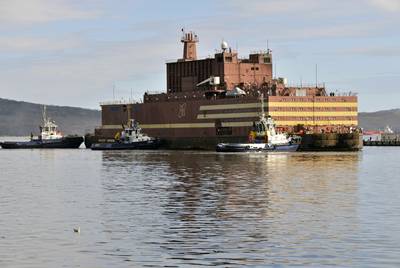
CORRECTION: The MarineLink report this was based on, and the virtually identical report at gCaptain, is misleading. The town, Pevek, population less than 5,000, is not “across the Bering Strait from Alaska.” It is on the North coast of Siberia. The entire region, Chukotka, has a population of about 50,000. The Russian town on Bering Strait is Uelen, population about 720.
An interesting note from MarineLink. The Russians are deploying a floating nuclear power plant to a small community, the town of Pevek, on their side of the Bering Strait, 53 miles (86 km) from Alaska.
Greenpeace is concerned.
“Nuclear reactors bobbing around the Arctic Ocean will pose a shockingly obvious threat to a fragile environment which is already under enormous pressure from climate change,” Jan Haverkamp, nuclear expert for Greenpeace Central and Eastern Europe, said in a statement last month.
Cube shaped satellite, 100mm (3.9″) on a side. This photo shows the Norwegian student satellite NCUBE2 ready for shipment to the Netherlands for integration with the ESA student satellite SSETI-Express, photographer, Bjørn Pedersen, NTNU.
National Defense is reporting that the Air Force is building two “Polar Scout” SAR satellites for the Coast Guard, expected to be launched this year.
These satellites, or “cubesats,” are capable of detecting transmissions from emergency position indicating radio beacons (EPIRBs), which are carried on board vessels to broadcast their position if in distress. The Coast Guard will deploy the cubesats in cooperation with the Department of Homeland Security (DHS) Science and Technology Directorate’s Polar Scout program, the Air Force Operationally Responsive Space Office, and the National Oceanographic and Atmospheric Administration (NOAA).
These two satellites will only provide intermittent coverage of EPIRB signals from the polar regions so more satellites may follow.
This appears to be first fruit of a growing cooperation between the Coast Guard’s R&D Center and the Air Force Research Laboratory which has been formalized by a recent Memorandum of Understanding (MOU) signed by the heads of the two organization on April 12, 2018.
MarineLog brings us some details of the new Norwegian Icebreaker/Research vessel Kronprins Haakon which has been moved from Fincantieri’s Integrated shipyard of Riva Trigoso and Muggiano, Italy, where the bulk of the construction took place, to Fincantieri Group member Vard’s Langsten shipyard in Norway, where it will be completed. Apparently it is behind schedule.
It may not look like it, but it has a hangar for two medium size helicopters.
Length over all (LOA): 100,0m (328′)
Breadth: 21,0m (69′)
Draft: 8.5 m (28′)
Gross tonnage: 10900T
Maximum cruising range of approx. 15.000 nautical miles
Endurance 65 days at cruising speed
Designed to operate in winter ice with pressure ridges and multi-year ice
Accommodation for 55 persons in 38 cabins (15-17 crew).
There is space for 20 containers (20′)
“…project was said to have a total value of about 175 million Euros” ($215M–Chuck)
This looks like something that might evolve into our medium icebreaker. Might also make a pretty good Great Lakes icebreaker. 10,000 KW propulsion makes it about 50% more powerful than the USCGC Mackinaw (WLBB-30). Of course Marinette Marine, which is also a division of Fincantieri, and the yard that built the Mackinaw, would probably be happy to build one or more–and the ship is narrow enough to pass the Saint Lawrence Seaway locks. .
The US Naval Institute Proceedings has a short article that is available on line here. It not only advocates for an Arctic Fleet, but also explains why it has not happened, but suggests the operation of the 4th Fleet as an organizational model.
“…While naval forces are not permanently assigned to Fourth Fleet, the organizational structure remains in place both to support force assignment and to represent Navy interests in the region. The same can be true in the Arctic.
“This new Arctic Fleet can be established in a step-wise fashion, tailored across time and married to changing force structure. A sensible first step would be to augment the small Navy staff assigned to AlCom (Alaska Command–Chuck). Subsequently, in the mid-term, a joint inter-agency task force (JIATF) could be established out of the AlCom office, as resources and activity grew. Certainly, this JIATF would include the Coast Guard, but it also should include liaison officers from Canada, Norway, and other key allies. Ultimately this fleet would be stood up and merged with the NorthCom’s NCC. The Arctic Fleet could be commanded by, for example, either a Navy reserve admiral or a Coast Guard admiral.”
If we could get it to work:
This might end up looking a lot like 4th Fleet where the COCOM says all my ships are white with a racing stripe.
I would suggest that the Fleet would need much more than token Canadian representation. Ultimately any Arctic fleet is likely to have substantial Canadian representation.
Why the 4th Fleet Model probably will not work:
The proposed inclusion of “Norway and other key allies” seems to suggest that the author sees a single fleet working out Alaska Command (ALCOM), but while NORTHCOM includes Arctic waters as far east as the West coast of Greenland (which is a “constituent country” of the Kingdom of Denmark), realistically, there will be ships based in the Atlantic, and ships based in the Pacific, and the two are unlikely to have much interaction. Arctic waters that connect to the Atlantic are closely connected to NATO and LANTFLT operations. Operations in those areas would not logically come under the control of a small Naval staff in Alaska. Our Arctic Fleet would mostly be needed for the Pacific/Arctic/Alaska. The proximity of Russia and China reinforce the point.
The 4th Fleet model works because their AOR is part of the Atlantic Fleet AOR and Fleet Forces, as Atlantic Fleet, sees 4th Fleet as one of their responsibilities, all be it a minor one. Pacific Fleet does not see sending forces to answer to NORTHCOM as part of their responsibility.
The Bureaucratic Hurdles:
There are at least two major problems in overcoming “the way we have always done things” in making this happen.
There is a mismatch between who is in charge of the area and who is in charge of the ships that are needed.
There is a mismatch between the resources needed and the way the Navy packages its forces.
Areas of Responsibility:
The Arctic, note the US includes the Aleutians and the Bearing Sea as part of the Arctic even though they are below the Arctic Circle
U.S. Fleet Forces (USFF) Command serves as the supporting Navy commander to Commander, U.S. Northern Command (USNORTHCOM) and USFF also serves as the Joint Forces Maritime Component Commander (JFMCC) to U.S. Northern Command (including AlaskaCommand), but they are also Commander Atlantic Fleet. Notably for our purposes Commander, Pacific Fleet is someone different with a different set of priorities.
These are the Unified Combatant Commander’s Areas of Responsibility. Note Alaska in the extreme upper left
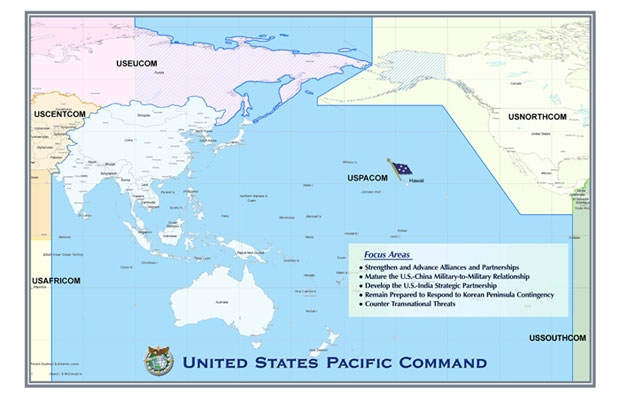
PACOM Area of Responsibility. Note all of Alaska is outside PACOM AOR, even though they are nominally 3rd Fleet waters.
The most likely areas of operation for an Arctic Fleet, the Bearing Sea and the Chukchi Sea, are split between PACOM and NORTHCOM. The most critical choke point in the entire area, Bearing Strait, is similarly split.
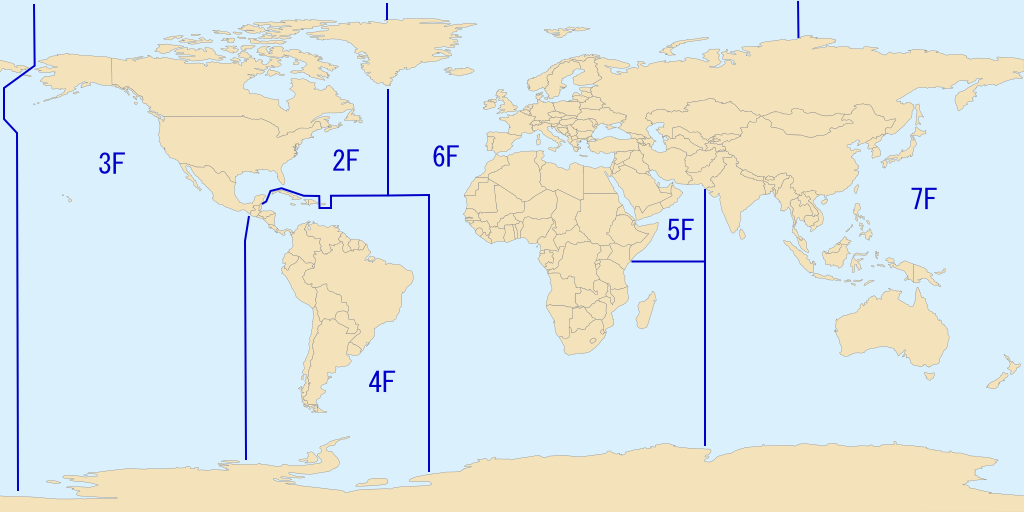
US Navy Fleet Organization. Note 2nd Fleet has now been subsumed into 6th Fleet.
Tactical Organization:
Another potential hang up is that the Navy has three primary organizational subsets.
Carrier Strike Groups (CSG)
Amphibious Ready Groups (ARG)
Submarines
Carrier strike groups and amphibious ready groups are in high demand and are rotated through customary assignments to 5th, 6th, and 7th Fleet. If you look at the USNI fleet tracker reports on a regular basis, you will see that there is never a sufficient number of Navy ships deployed to Fleet Forces, 3rd Fleet, or 4th Fleet to actually constitute a “fleet.”
Only submarines operate normally as single units and even they are frequently assigned to support CSGs.
Rarely, the Navy has dispatched groups of destroyers and frigates (when they had them) as “Surface Action Groups” (SAG) but generally these are fully committed to support of carrier strike groups.
Suggestion:
Make Alaska part of USPACOM. It is the only way to rationalize this as an area of potential Combat.
Note the video does not really start until approximately time (17m08s).
This is going to be a hodgepodge, but it is all about the 2019 budget. There is a video above. There will be my own observations on the video. There will be a brief outline of the Procurement, Construction, and Improvement (formerly AC&I) portion of the budget copied from the “Summary of Subject Matter.” At the tail end I have reproduced the Commandant’s prepared statement that was presented at the hearing
You can look here for the FY2018 budget request. I haven’t found the actual final FY2018 as enacted.
ABOUT THE VIDEO
Above is a video of a 14 March, 2018, House Coast Guard and Maritime Transportation Subcommittee. The commandant testified as well as Master Chief Steven W. Cantrell, Master Chief Petty Officer of the Coast Guard, United States Coast Guard, Rear Admiral Mark H. Buzby, USN, Ret., Administrator, Maritime Administration, and The Honorable Michael A. Khouri, Acting Chairman, Federal Maritime Commission
You can find more information including all the prepared statements and the subcommittee chairman’s opening remarks here.
MY OBSERVATIONS
This subcommittee has been highly supportive of the Coast Guard, and we see the same in this hearing. The chairman, Duncan Hunter (R, CA), (17m30s) expressed his opinion that the Coast Guard was not fairing well under the Department of Homeland Security (DHS). He also noted the apparent obstruction of measures of effectiveness by DHS.
Ranking member, John Garamendi (D, CA), (22m) noted that there had been a welcomed significant bump in Coast Guard funding, but questioned if this would continue or would it prove an anomaly. He noted that attempting to stop drug trafficking would be better served by putting more money into the Coast Guard than by building a border wall.
(29m30s) The Coast Guard’s unfunded priority list, submitted long ago is still hung up in the administration.
(33m30s) MCPO Cantrell addressed quality of life concerns.
(55m30) Ranking member Garamendi noted the addition of $720M added to the budget for Heavy Polar Icebreaker(s) (HPIB) in addition to $30M already in the budget, and stated that he saw this as money for the second icebreaker because the DOD was not relieved of their obligation to fund a HPIB.
(1h03m) Commandant expressed his confidence in the helicopter life extension programs expected to keep them in operation until 2033 when the Coast Guard would be able to join in the Army lead Future Vertical Lift program. He suggested that a single helicopter type might be able to replace both the MH-65 and MH-60s.
(1h07m) Commandant answering a question about AMIO in the Caribbean noted that the Webber class Fast Response Cutters (FRC) we working well in this role, but there is a shortage of ISR assets that he believed might be addressed by land based unmanned air systems (UAS).
(1h17m) In answer to a question about replacement of the Island Class six 110 foot Island class cutters currently assigned to CENTCOM as PATFORSWA, the Commandant, noting the 110s would time out in 2022, said this has been discussed at the highest levels with the Navy and there was a possibility that Webber class replacements could be funded by the Navy. Interestingly, he also noted that the Navy’s Cyclone class patrol craft would time out in 2023 suggesting to me perhaps he believes the Navy is considering a version of the Webber class.
(1h39m) Concern was expressed that while the Commandant has consistently expressed a need for $2B annual in the AC&I account (now PC&I) and $1.8B was provided in FY2018 and $1.9B in FY2019, that the current projection is only $1.4B in FY2020.
There is also a note on a change in accounting procedure.
In FY 2019, the Coast Guard will transition to the DHS Common Appropriations Structure (CAS). Accordingly, activities funded through the previous Operating Expenses, Reserve Training, Environmental Compliance and Restoration, and Medicare Eligible Retiree Health Care Fund Contribution are included as part of the new Operations and Support (O&S) account. In addition, acquisition personnel costs previously funded through the Acquisition, Construction, and Improvements account ($118.2m in the FY2018 budget request–Chuck) are included as part of the O&S account. The Acquisition, Construction, and Improvements account transitions into the Procurement, Construction, and Improvements account and the Research, Development, Test and Evaluation account becomes the new Research and Development account.
Below is the summary information on the PC&I section that replaces the AC&I portion of the budget.
Procurement, Construction, and Improvements (previously Acquisitions, Construction, and Improvements)The President requests $1.89 billion for the Procurement, Construction, and Improvements (PC&I) account, a $516.7 million (or 37.7 percent) increase over the FY 2017 enacted level. The PC&I account funds the acquisition, procurement, construction, rebuilding, and physical improvements of Coast Guard owned and operated vessels, aircraft, facilities, aids-to-navigation, communications and information technology systems, and related equipment.The FY 2019 budget request includes $1.76 billion for the acquisition of aircraft, vessels, and the continued build-out of Command, Control, Communications, Computer, Intelligence, Surveillance, and Reconnaissance (C4ISR) systems. This represents an increase of $597.1 million (or 51.7 percent) from the FY 2017 enacted level. The budget request includes:$30 million for the construction of a Heavy Polar Icebreaker. The FY 2019 Budget Addendum included an additional $720 million, for a total of $750 million;
$65 million to conduct Post Delivery Activities on National Security Cutters (NSC) 7 through 9;
$240 million for the production of four Fast Response Cutters (FRC);
$400 million for the construction of the second Offshore Patrol Cutter (OPC) and to facilitate evaluation of the Long Lead Time Materials for OPC 3. The OPCs will replace the Service’s aging 210-foot and 270foot Medium Endurance Cutters (MEC);
$80 million to fund the requirement to establish logistics for 14 newly acquired HC-27J aircraft. The request funds HC-27J Asset Project Office activities, logistics, training, and engineering studies to assess and resolve aircraft obsolescence issues;
$20 million for the continued modernization and sustainment of the HH-65 Dolphin helicopter fleet;
$23.3 million for C4ISR design, development, and integration; and
No funding for the Alteration of Bridges program in FY 2019. The program did not receive funding in FY 2017 or FY 2016. Established by the Truman-Hobbs Act of 1940 (33 U.S.C. 511 et. seq.), the Alteration of Bridges program authorizes the Coast Guard to share with a bridge’s owner the cost of altering or removing privately or publicly owned railroad and highway bridges that are determined by the Service to obstruct marine navigation.
The budget requests $135 million to construct or renovate shore facilities and aids-to-navigation. This request is a $35.5 million (or 26.3 percent) increase over the FY 2017 enacted level. The Coast Guard currently has a backlog of 95 prioritized shore facility improvement projects with an estimated combined cost of over $1.5 billion
____
THE COMMANDANT’S PREPARED TESTIMONY
Below you will find “TESTIMONY OF ADMIRAL PAUL F. ZUKUNFT COMMANDANT, U.S. COAST GUARD ON “THE COAST GUARD’S FISCAL YEAR 2019 BUDGET REQUEST” BEFORE THE HOUSE COAST GUARD AND MARITIME TRANSPORTATION SUBCOMMITTEE” which I have copied in full.
Introduction
Mr. Chairman and distinguished members of the Committee, I appreciate the opportunity to testify today. Thank you for your enduring support of the United States Coast Guard, particularly the significant investments provided in the FY 2017 Consolidated Appropriations Act, recent Hurricane Supplemental, and ongoing deliberations to support our FY 2018 and FY 2019 President’s Budget requests.
As the world’s premier, multi-mission, maritime service, the Coast Guard offers a unique and enduring value to the Nation. The only branch of the U.S. Armed Forces within the Department of Homeland Security (DHS), a federal law enforcement agency, a regulatory body, a first responder, and a member of the U.S. Intelligence Community – the Coast Guard is uniquely positioned to help secure the maritime border, combat transnational criminal organizations (TCO), and safeguard commerce on America’s waterways.
The Coast Guard’s combination of broad authorities and complementary capabilities squarely aligns with the President’s national security and economic prosperity priorities; furthermore, it offers an agile toolset to address the Nation’s most pressing challenges. Appropriately positioned in DHS, the Coast Guard is a military service and a branch of the Armed Forces of the United States at all times.1 We are also an important part of the modern Joint Force2 and currently have forces assigned to each of the five geographic Combatant Commanders, as well as Cyber Command.
As demonstrated in the 2017 record hurricane season, the Coast Guard is the Nation’s “maritime first responder” and plays a leading role in executing the National Response Plan (NRP) for disaster situations. Our ability to rapidly surge in response to emerging threats or contingencies are critical to success across the spectrum of missions we prosecute.
We live in an increasingly volatile, uncertain, complex, and ambiguous world. Rapid technological advancement, increasing globalization, and intensifying threats from state and nonstate actors alike challenge international norms and threaten global governance.
To ensure we meet the demands of today while preparing for tomorrow, the Coast Guard is guided by a five-year Strategic Intent and suite of regional and functional strategies that drive our Service’s operations and investments.
These strategic efforts are informed by the National Security Strategy and applicable DHS strategies, and are coordinated to augment Department of Defense (DoD) priorities. Using these strategies as guideposts, leveraging the intelligence community, and employing a risk-based approach to focus our limited resources allows us to address maritime threats with the greatest precision and effect.
Strategic Effects
Fueled by the Service’s unique authorities and capabilities, our Western Hemisphere Strategy continues to yield large-scale successes in our counter-drug mission. The Coast Guard’s persistent offshore presence and associated interdiction efforts sever the supply lines of criminal networks where they are most vulnerable—at sea. Leveraging over 30 multilateral and bilateral agreements with a host of government organizations, the Coast Guard’s long-term counter-TCO efforts promote stability and strengthen the rule of law throughout these regions. Working with interagency partners, the Coast Guard seized 223 metric tons of cocaine and detained and transferred 606 smugglers for criminal prosecution in FY 2017. Highlighting our record-breaking mission performance for drug interdiction was the STRATTON’s offload of over 50,000 pounds of illicit narcotics, with an estimated street value of over $6.1 billion. This was a result of collaborative efforts between four U.S. Coast Guard cutters, DHS maritime patrol aircraft, and a U.S. Navy ship in over 25 separate interdictions. Beyond the important task of removing cocaine from the illicit system that gets it to U.S. streets, prosecuting smugglers facilitates deeper understanding of TCOs and ultimately helps our unified efforts to dismantle them.
Without question, National Security Cutters (NSC) have been a game-changer not only for our drug interdiction and counter-TCO operations in the southern maritime transit zone, but also in contributing to other national security priorities, such as supporting DoD Combatant Commander requirements across the globe and projecting sovereign rights in the Arctic.
Looking forward, the Offshore Patrol Cutter (OPC) will provide the tools to more effectively enforce Federal laws, secure our maritime borders, disrupt TCOs, and respond to 21st century threats. Continued progress on this acquisition is absolutely vital to recapitalizing our aging fleet of Medium Endurance Cutters (MECs), some of which will be over 55 years old when the first OPC is delivered in 2021. In concert with the extended range and capability of the NSC and the enhanced coastal patrol capability of the Fast Response Cutter (FRC), OPCs will be the backbone of the Coast Guard’s strategy to project and maintain offshore presence.
As one of the five Armed Forces, the Coast Guard deploys world-wide to execute our statutory Defense Operations mission in support of national security priorities. On any given day, 11 cutters, two maritime patrol aircraft, five helicopters, two specialized boarding teams, and an entire Port Security Unit are supporting DoD Combatant Commanders on all seven continents. In the Middle East, our squadron of six patrol boats continues to police the waters of the Northern Arabian Gulf in close cooperation with the U.S. Navy, promoting regional peace and stability. Likewise, as one of the principal Federal agencies performing detection and monitoring in the southern maritime transit zone, the Coast Guard provides more than 4,000 hours of maritime patrol aircraft support and 2,000 major cutter days to DoD’s Southern Command each year.
In the high latitudes, the Arctic region is becoming increasingly accessible at a time when global interests in energy, clean water, and subsistence continue to intensify. The Coast Guard is committed to the safety, security, and environmental stewardship of the Arctic, and we will remain closely engaged with our partners, including Russia, via the Arctic Coast Guard Forum. By focusing on collaboration over conflict, we are promoting governance and building a shared approach to prevention and response challenges in the region.
Meanwhile, the 42-year old POLAR STAR recently completed another Operation DEEP FREEZE patrol in Antarctica. Just one major casualty away from leaving the Nation without any heavy icebreaking capability, POLAR STAR supported U.S. strategic interests and the National Science Foundation by breaking a navigable shipping lane to deliver fuel and critical supplies to the U.S. base at McMurdo Sound.
I appreciate your support for the $150 million appropriated in Shipbuilding and Conversion, Navy (SCN) funding in the FY 2017 Omnibus. This is a great step forward to secure our future in the Polar Regions and finally recapitalize the Nation’s icebreaker fleet. This funding coupled with the $750 million in the FY 2019 President’s Budget, would enable the Coast Guard to award a contract for detail design and construction and deliver the first new heavy polar icebreaker in 2023. These critical investments reflect our interests and standing as an Arctic Nation and affirm the Coast Guard’s role in providing assured access to the Polar Regions.
At the same time the Service was conducting counter-drug missions in the Eastern Pacific and projecting sovereign rights in the Arctic, the Coast Guard also launched one of the largest responses in history during a historic 2017 hurricane season. Over a five week period, Hurricanes HARVEY, IRMA, MARIA, and NATE impacted over 2,540 miles of shoreline3, and Coast Guard men and women in helicopters, boats, cutters, vehicles and on foot rescued over 11,300 people and over 1,500 pets.
During our 2017 hurricane response, the Coast Guard resolved over 1,269 aids to navigation discrepancies, handled 290 pollution cases, located and assessed more than 3,623 grounded vessels, with more than 1,585 removed to date. Within hours after each storm’s passage, Coast Guard damage and recovery assessment teams were on-scene determining the status of ports and waterways, leveraging electronic aids to navigation when feasible to facilitate the rapid reopening of key ports and waterways, and assessing impacts to Coast Guard facilities and capabilities. This enabled a vital portion of the country’s waterways to reopen, helping maintain our Maritime Transportation System (MTS) which contributes $4.6 trillion annually to our Gross Domestic Product.
The daily activities of Coast Guard men and women are heroic, as they support nearly every facet of the Nation’s maritime interests, protect our homeland, and secure our economic prosperity. In addition to the hurricane responses, the Coast Guard prosecuted over 16,000 search-and-rescue cases and saved more than 4,200 lives; interdicted more than 2,500 undocumented migrants; completed over 9,100 Safety of Life at Sea safety exams on foreign vessels; and responded to over 12,200 reports of pollution incidents.
Beyond operations, we earned our fifth consecutive clean financial audit opinion – the only Armed Service that can make such a claim. Further, our major acquisition programs and product lines are delivering new assets on schedule and on budget that have proven to meet our operational requirements. To better guide our modernization, we developed a Long Term Major Acquisitions Plan (LTMAP), a roadmap to field modern platforms to address 21st century threats. We have been working with the Administration to finalize the details of the LTMAP and are committed to delivering this report to Congress as soon as possible.
Our greatest strength is undoubtedly our people. Coast Guard operations require a resilient, capable workforce that draws upon the broad range of skills, talents, and experiences found in the American population. In FY 2019, the Coast Guard will maintain a proficient, diverse, and adaptable workforce that responds effectively to changing technology, an increasingly complex operating environment, and dynamic partnerships. Together, modern platforms and a strong, resilient workforce will maximize the Coast Guard’s capacity to meet future challenges.
Conclusion
History has proven that a responsive, capable, and agile Coast Guard is an indispensable instrument of national security. Funding 21st century Coast Guard platforms and people are especially prudent investments given today’s challenging fiscal environment. I firmly believe no other investment will return more operational value on every dollar than the extraordinary men and women of the U.S. Coast Guard—which includes 48,000 Active Duty and Reserve members, 8,500 civilians, and over 27,000 volunteer members of the Coast Guard Auxiliary. As illustrated by our sustained response to an historic hurricane season, another record year removing illicit narcotics from the maritime approaches, and unique support to Combatant Commanders around the globe; our ability to rapidly surge resources to emerging threats continues yield unprecedented results for the Nation.
With the continued support of the Administration and Congress, the Coast Guard will continue to live up to our motto – Semper Paratus – Always Ready. Thank you for all you do for the men and women of the Coast Guard.
180316-N-KC128-269 BEAUFORT SEA(March 16, 2018) Chief Hospital Corpsman Kristopher Mandaro, assigned to Underwater Construction Team (UCT) 1, surfaces from a waterhole during a torpedo exercise in support of Ice Exercise (ICEX) 2018. ICEX is a five-week exercise that allows the U.S. Navy to assess its operational readiness in the Arctic, increase experience in the region, advance understanding of the Arctic environment and continue to develop relationships with other services, allies and partner organizations. (U.S. Navy photo by Mass Communication Specialist 1st Class Daniel Hinton/Released)
The following is a Navy news release, but it does show that the Coast Guard’s recently revived capability for diving in the Arctic ice is definitely making a strong come back. Includes information about the Coast Guard’s Cold Water Ice Diving course.
Story Number: NNS180319-22Release Date: 3/19/2018 2:05:00 PM
By Lt. Courtney Callaghan, ICEX Public Affairs
ARCTIC CIRCLE (NNS) — Divers from U.S. Navy Mobile Diving and Salvage Unit (MDSU) Two, Underwater Construction Team (UCT) One and the U.S. Coast Guard braved harsh Arctic waters to play a critical role during a torpedo exercise as part of Ice Exercise (ICEX) 2018.
ICEX 2018 is a five-week biennial exercise that allows the Navy to assess its operational readiness in the Arctic, increase experience in the region, advance understanding of the Arctic environment, and continue to develop relationships with other services, allies and partner organizations.
During the exercise, the Seawolf-class fast-attack submarine USS Connecticut (SSN 22) and the Los Angeles-class fast-attack submarine USS Hartford (SSN 768) each fired several training torpedos under the ice. Training torpedoes have no warheads and carry minimal fuel.
“The primary objective of this year’s ICEX is to test new under-ice weapons systems and validate tactics for weapon employment,” said Ryan Dropek, Naval Undersea Warfare Center Division Newport, Rhode Island Weapons Test Director. “Once the divers recover these torpedoes, we can extract important data about how they perform and react in these conditions.”
After the submarines fire the torpedoes, helicopters transport gear and personnel to the location where the positively-buoyant torpedo is expected to run out of fuel. Each torpedo has a location device in order to assist in the search. Once found, a 3-4 person team will then drill a series of holes for the divers to enter and exit, as well as one hole for the torpedo to be lifted by helicopter.
“Once we know the location of the torpedo and drill holes, our divers slip into the water to begin placing weights on a line attached to the tail end of the torpedo,” Chief Warrant Officer Michael Johnson, officer-in-charge of MDSU-2 divers, explained. “The weights help shift the torpedo from a state of positive buoyancy to neutral buoyancy under the ice.”
Once the torpedo is neutral, the divers place brackets with cables to the top and bottom of the body of the torpedo. A helicopter then connects to the torpedo before lifting it vertically out of the hole.
The three dive teams completed additional training in preparation for diving in the unique environment of the Arctic Ocean.
“To prepare for ICEX, we completed training at the Coast Guard’s Cold Water Ice Diving (CWID) course and earned our ordnance handling certification from the Naval Undersea Warfare Center,” said Johnson. “Additionally, each unit completed MK48 Torpedo recovery training and Unit Level Training (ULT) classroom training on hypothermia, frostbite, ice camp operations, dry-suit, and cold-water ice diving.”
The USCG CWID course is a two-week course in Seattle, Washington hosted by the USCG instructors at Naval Diving and Salvage Training Center (NDSTC) which focuses on the use of equipment and diving operations in harsh Arctic waters. During the course, divers complete a diving practical in Loc de Roc, British Columbia at 5,000 ft. elevation to put environmental stresses on the divers and equipment to acclimate to the cold and altitude.
“Our underwater construction teams have always had the ice-diving capabilities, so it was awesome to be invited out to this exercise to make sure we’re keeping up with something that we say we can do,” said Builder 1st Class Khiaro Promise, assigned to Construction Dive Detachment Alfa.
During ICEX, the divers conducted dives using two different types of diving methods. UCT-1 and the USCG dove with SCUBA equipment, which provides divers with an air supply contained in tanks strapped to the backs of the divers. The divers equip themselves with a communication “smart rope” which is a protected communication cable to the surface that acts as a tending line so support personnel on the surface has positive control of the divers and so they can quickly return to the dive hole.
MDSU-2 divers used the diving system DP2 with configuration one, which provides voice communications and an air supply provided by the surface. This configuration allows the divers to swap the composite air bottles without the diver resurfacing and without interrupting their air supply.
“We decided to use the DP2 system because it performs in arctic conditions very well,” said Navy Diver 1st Class Davin Jameson, lead diving supervisor for MDSU-2. “The ability to change our air supply during the dive is critical and allows us to stay under the water a lot longer.”
Not only did the divers have an essential role in torpedo recovery, they were also essential to camp operations. “Prior to torpedo retrieval dives, all the divers on ice helped set up the camp and in the building of two runways (one 1,300 and one 2,500-ft),” Senior Chief Navy Diver Michael McInroy, master diver for MDSU-2. “In the camp, everyone has responsibilities to keep operations on track. The divers worked hard to do their part in and out of the water.”
MDSU-2 is an expeditionary mobile unit homeported at Joint Expeditionary Base Little Creek-Ft. Story (JEBLCFS) in Norfolk, Virginia. The unit deploys in support of diving and salvage operations and fleet exercises around the world. The primary mission is to direct highly-mobile, fully-trained and equipped mobile diving and salvage companies to perform combat harbor clearance, search and expeditionary salvage operations including diving, salvage, repair, assistance, and demolition in ports or harbors and at sea aboard Navy, Military Sealift Command, or commercial vessels of opportunity in wartime or peacetime.
UCT-1 is also homeported at JEBLCFS and is worldwide deployable to conduct underwater construction, inspection, repair and demolition operations. Seabees operated off the coast of Alaska for the first time in 1942 when they began building advanced bases on Adak, Amchitka and other principal islands in the Aleutian chain.
ICEX divers and their support elements are a proven and vital component to the success of this five-week exercise. The partnership between the Navy and Coast Guard builds on the foundation of increasing experience and operational readiness even in the one of the harshest regions of the world.
“The brotherhood in diving means we have a lot of trust in that other person when you go underwater, and you get close to your coworkers, it’s more of a family,” Promise said.
The Request for Proposal for detailed design and construction of new Heavy Polar Icebreaker(s) (HPIB) has been issued. You can see it here. I have only taken a quick look at the first few pages of the 197 page document, but it does include, not just a request for costs to construct one icebreaker, but also prices for numbers two and three as well.
This paragraph is worth noting.
To enable ongoing program planning and responses to Congressional inquiries, the Coast Guard and Navy HPIB IPO desire input from prime offerors related to the benefits of Congressional authorization of Block Buy and/or Economic Order Quantity. Submission of this information is voluntary and will not be used to evaluate any proposal submitted by the offeror in response to this RFP. Email submissions providing dollarized estimated savings per ship for authorization provided for 1) all three cutters and 2) only the second and third cutters should be emailed to the Bidders Question contacts identified below with the email title “HPIB Block Buy/EOQ Input – Contractor Name.” Submissions within 60 days of RFP release are preferred.





 Chuck Hill's CG Blog