“Republic Of Singapore Navy Stands Up New Maritime Security And Response Flotilla” –Naval News

Note the graphic may be distorted here, click on it for a better view. 

Naval News reports that the Singapore Navy has formed a new “Maritime Security and Response Flotilla.”

“As part of the restructured Maritime Security Command, the new MRSF is set up to better trackle evolving maritime threats that have grown in scale and complexity, particularly in the Singapore strait area. According to a recent French Navy report on worldwide maritime piracy and robbery, robbery is on the rise in South East Asia, particularly in the Straits of Singapore and Malacca.”

Aside from a pair of tugs, the primary assets of the new flotilla are four renovated and renamed Fearless Class patrol craft that will fill the function until a new class is completed (expected in 2026).

Perhaps most interesting, are the changes made to the vessels for their new role. These include enhanced communications equipment, a long range acoustic device and laser dazzler system, installation of a fender system, and modular ballistics protection–and a red racing stripe.

The Fearless Class patrol craft: Twelve vessels commissioned 1996-98. All out of service by the end of 2020, replaced by eight Littoral Missions Ships.

  • Displacement: 500 tons fl
  • Length: 55 m (180 ft)
  • Beam: 8.6 m (28.2 ft)
  • Draft: 2.2 m (7.2 ft)
  • Speed: 36 knots
  • Propulsion: 16,860 HP, two KaMeWa waterjets
  • Range 1,800@15 knots

Singapore also has a Police Coast Guard as part of its Police Force with patrol craft of up to 35 meters in length.

“Huge New Chinese Ships Are Made For Ramming” –Forbes

Forbes suggests that the Chinese are planning to use some of their new ships to shoulder US ships.

Those flat sides aren’t an aesthetic choice, according to Jerry Hendrix, an American naval expert and author of the new book To Provide and Maintain a Navy. They’re for what sailors calls “shouldering.” That is, muscling into a rival ship and forcing it to change course.

Given that the Coast Guard is sending ships into the Western Pacific and participating in Freedom of Navigation Exercises, this threat is significant for us.

I have a lot of respect for Jerry Hendrix. I bought his book. But first, of course, most ships incorporate flat sides over a significant length simply because it is the cheapest construction method. Our National Security Cutters may have stealth incorporated in their design, but look at the OPCs.

OPC “Placemat”

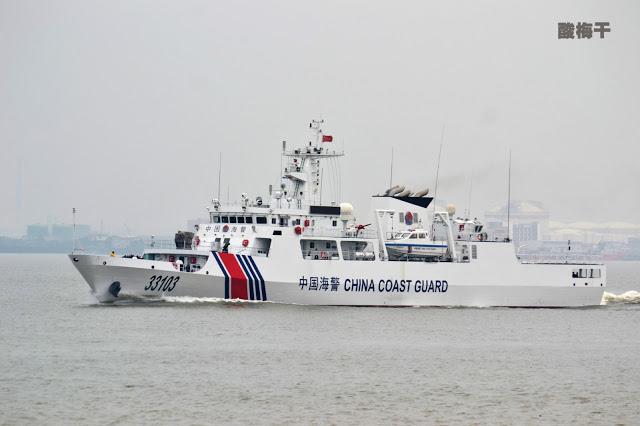
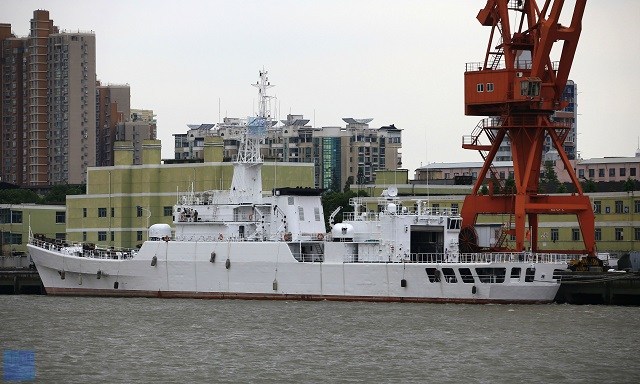
The article specifically calls out two classes of Chinese ships as likely to be used for shouldering, the Type 055, which is a cruiser or large destroyer, and the “Chinese coast guard’s patrol ship Haixun.”

I certainly would not dispute the Chinese’s propensity for employing shouldering or even ramming. They have employed these techniques in enforcing their claims of sovereignty over the South China Sea, as identified by their still ill defined “nine dash line,” but I think they have called out the wrong ships.
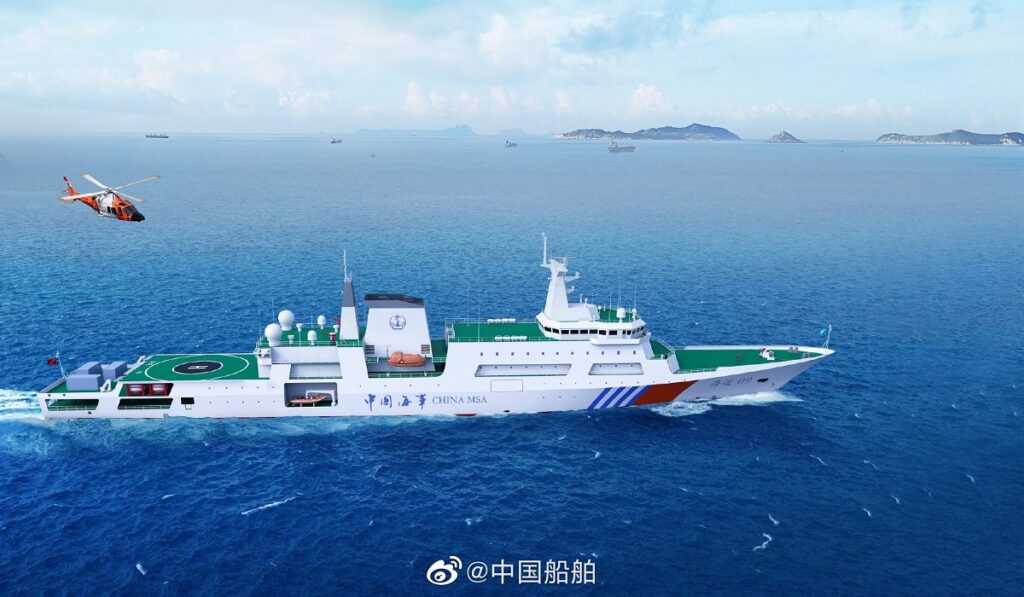
Artist impression of 10,000 tons class patrol vessel Haixun

Haixun is not part of China Coast Guard, it is a unit of the China Maritime Safety Administration which is their SAR agency. This agency has not been used for law enforcement.

The Type 055 is a very well equipped combatant and probably one of the most expensive units in the Chinese Navy. Her hull is not unusual and not a significant departure from that of the preceding Type 052D class. Their sides are not particularly flat. They are not units the Chinese would risk damaging.Zhaotou class cutter Haijing 2901. Photo from http://defence-blog.com/news/photos-charge-of-the-10000-ton-china-coast-guard-cutter.html

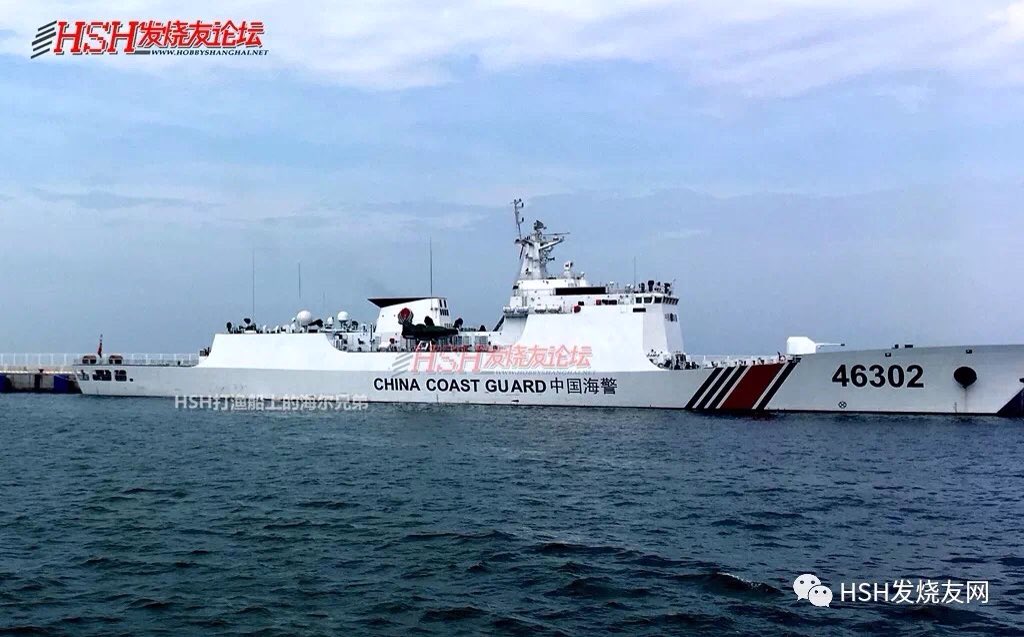
Any of the China Coast Guard units could be used for shouldering or even ramming, but their heavy weights are two ships of the Zhaotou class, Haijing 2901 and Haijing 3901. These are the world’s largest Cutters and probably over 12,000 tons full load–about three times the size of the National Security Cutters. They are also capable of 25 knots.

china-defense.blogspot.com

The post suggests that the Mumford Point class T-ESDs and ESBs, based on a double hull tanker design would be an appropriate counter, but while they are large (60,000 tons and 785 ft (239 m) long), they are also slow (15 knots), not very powerful for their size (24 MW or about 32,000 HP), and not very maneuverable.

If we had more icebreakers, we might want to send one of them. We know what can happen when a lightly built ship plays bumper boats with an ice class vessel.  On the other hand, the Chinese have started building icebreakers and ice strengthened merchant vessels, so we might want to keep that in mind.

Maybe the Navy has another reason to consider ice-strengthened ships.

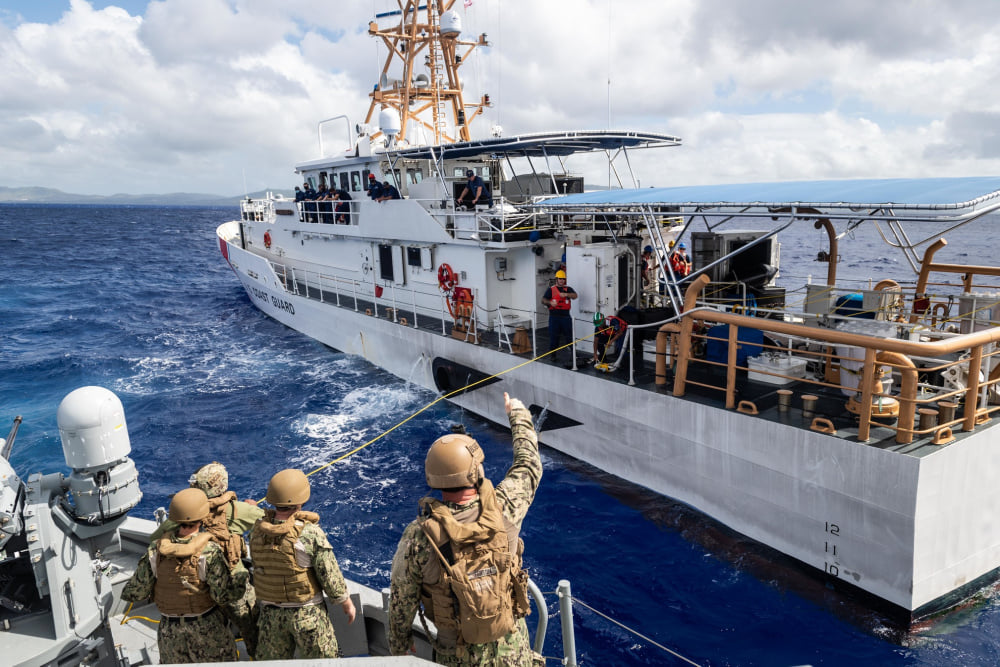
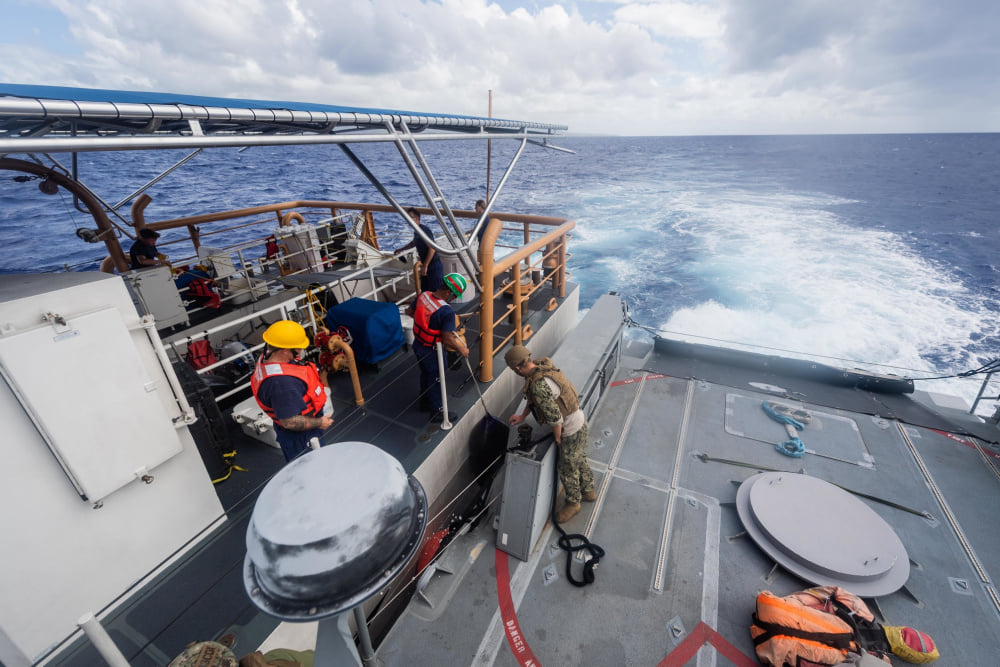
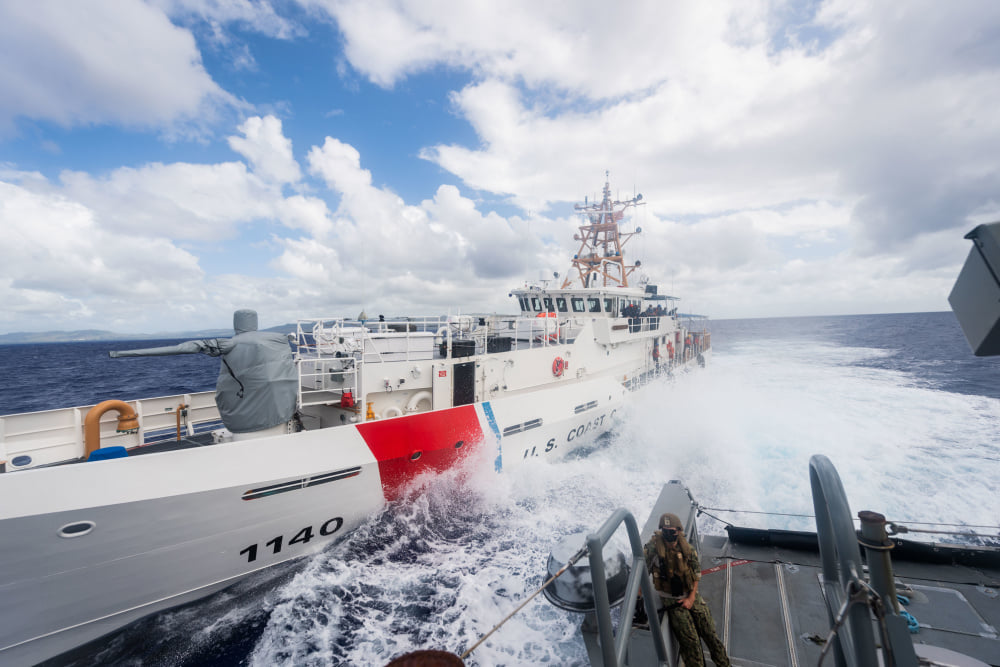
USCGC Oliver Henry, WPC-1140, Exercises with the Navy in the Philippine Sea

Some photos from Twitter,

“The crew of USCG Cutter Oliver Henry participated in an integrated exercise alongside Navy Maritime Expeditionary Security Squadron TWO in the Philippine Sea last month under the direction of U.S. 7th Fleet.”

The Navy vessel is apparently a MkVI patrol boat.

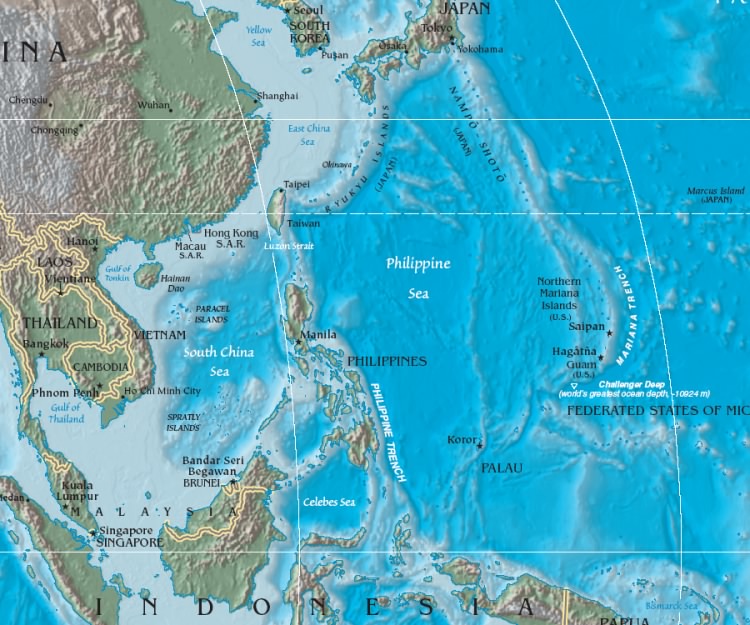
USCGC Oliver Henry is the second FRC to be homeported in Guam, so the Philippine Sea is practically just out the front door.

The location of the Philippine Sea. (Section of a world map from the CIA World Factbook)

Thanks to Walter for bring this to my attention. 

“U.S. presence in Palau could balance Beijing’s aggression, analysts say” –Indo-Pacific Defense Forum

The Indo-Pacific Defense Forum has a short article about the desirability of a US defense presence in Palau. Much of it is about Illegal, Unregulated, Unreported fishing, so it is largely concerning the Coast Guard.

There has already been some talk about basing Webber class WPCs in Palau.

The area may best be remembered for the Battle of Peleliu.

“Coast Guard Cutter to Deploy to U.S. 5th Fleet; Escort New FRCs to Bahrain” –Seapower

CARIBBEAN SEA
09.04.2019
Courtesy Photo
U.S. Coast Guard District 7 PADET Jacksonville
Subscribe 19
The Coast Guard Cutter James conducts Hurricane Dorian relief operations alongside the Coast Guard Cutter Paul Clark in the Caribbean Sea, Sept. 6, 2019. During their 62-day counter-drug patrol, the James’ crew, along with members from Tactical Law Enforcement Team-South, Helicopter Interdiction Tactical Squadron, Cryptologic Direct Support Element and multiple partner agencies, contributed to the interdiction of 7 drug-smuggling vessels and were responsible for the seizure of more than 12,677 pounds of cocaine and 4,085 pounds of marijuana bound for the United States. (U.S. Coast Guard photo courtesy of Coast Guard Cutter James)

The Navy League’s on line magazine, Seapower, reports that a Bertholf class cutter will escort two Webber class WPCs when they transit to Bahrain to begin the replacement of the six 110 foot WPBs that are currently there. Presumably this will be happening a couple of additional times, as the new ships are commissioned. Since typically, about 5 cutters are completed annually, deployments will likely be four to six months apart. It will be interesting to see how long the larger cutters remain in 5th Fleet’s AOR.

It would not be surprising to see them doing some “capacity building” in East Africa before returning home.

“Bangladesh, U.S. and regional organizations discuss shared maritime domain awareness goals” –IndoPacificDefenseForum

A report from IndoPacificDefenseForum about an aspect of the CARAT exercise with Bangladesh, with emphasis on Maritime Domain Awareness and Illegal, Unregulated, Unreported fishing.

There is no mention of the Coast Guard, but you can be sure Coast Guardsmen were involved and the vessel, seen in the distance, in the accompanying photo (above) is a former USCG 378, BNS Somudra Avijan, the former USCGC Rush, one of two Hamilton class now serving in the Bangladesh Navy.

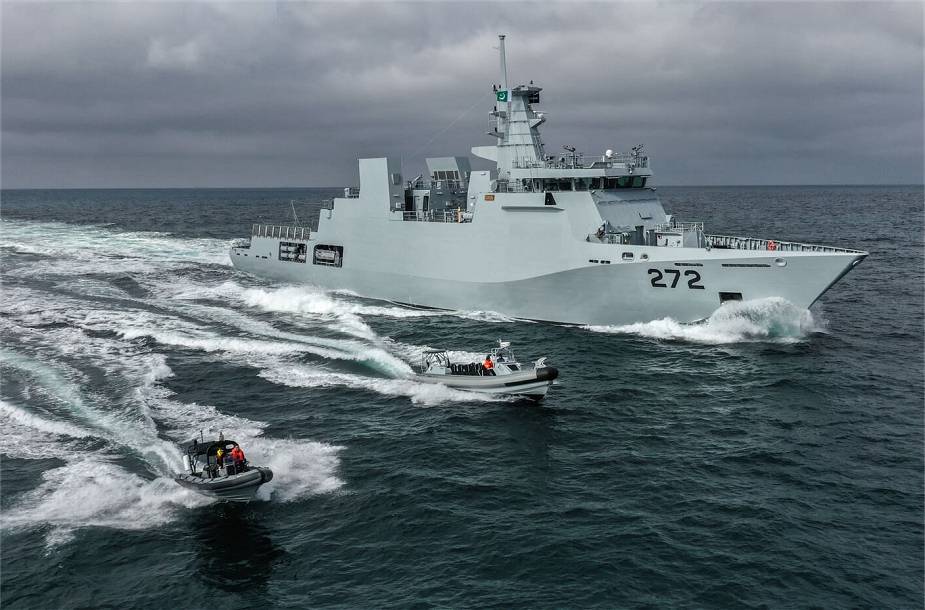
“Pakistan Navy commissioned its new PNS Tabuk Damen corvette OPV 1900” –Navy Recognition

PNS Tabuk during sea trials. (Picture source Damen)

NavyRecognition reports the commission of the second of two Damen designed offshore patrol vessels (OPV) built in Romania for the Pakistani Navy.

The Damen OPV 1900 has a hull-length of 90 m, a maximum speed of 22 knots, and a full-load displacement of 1,900 tons. The ship can launch two high-speed RHIBs of 11.5 meters and 6.5 meters simultaneously and also has the capability to accommodate two TEUs for special mission-based operations. The rear deck of the ship is able to transport both a helicopter and a UAV.

According to Janes, the ships are 2,300 tons (presumably full load), 91.3 meters (299.5′) in length, with a beam of 14.4 m (47.2′), a draft of 4 m (13.1′), and a complement of 138.

Below is a video shot on the first ship of the class. You can see that it also includes a hangar. Weapons and additional sensors are to be fitted in Pakistan. The video indicates the ship will be equipped with two 30mm cannon and anti-ship cruise missiles. The model, seen in the video at time 1m30s, shows the vessel equipped with what appears to be a single barrel mount similar to the Mk38 forward, but the mount on the aft starboard corner of the superstructure, looks like a Chinese Type 730 CIWS that includes a seven barrel Gatling gun. That weapon is currently in service with the Pakistani Navy. You would think the same weapon would be used in both positions, but the more sophisticated CIWS might not take kindly to the green water that is likely to come over the bow. The model also shows launchers for eight anti-ship cruise missiles, presumably of Chinese origin, like the C-802. The ships are also reportedly being given an ASW capability. 

“China Coast Guard to be allowed to use force in case of territorial infringement” –People’s Liberation Army Daily

This Chinese People’s Liberation Army Daily post concerning use of deadly force, linked here, may be particularly interesting for its call out of the US Coast Guard.

Law enforcement on land, sea and in airspace under its own jurisdiction, with the use of weapons on necessary occasions, are the rights granted to sovereign states by international law. The Japan Coast Guard (JCG) also stipulates that lethal weapons can be used when enforcing the law in waters under its own jurisdiction. For the US Coast Guard (USCG), the use of force is even more common, and it is even planning to apply long-arm jurisdiction to China.

Admiral Karl Schultz, Commandant of the USCG, claimed to strengthen deployment in the Asia-Pacific region and participate in security patrols in the waters surrounding China in response to Chinese maritime militia’s declaration of sovereignty in the South China Sea in April last year. Robert O’Brien, US National Security Advisor, announced on October 24 that the USCG would deploy Enhanced Response Cutters in the Western Pacific. . Without providing any evidence, he accused Chinese fishing boats of illegal fishing and claimed that the sovereignty of the United States and its neighbors in the Pacific had thus been threatened.

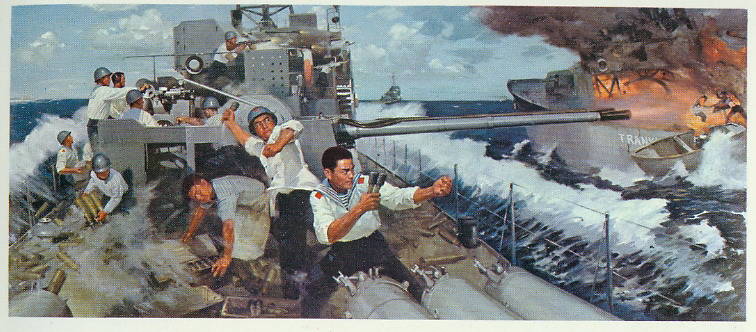
If they should choose to employ force against one of our cutter in their claimed “Nine Dash Line,” it is likely they would attempt to get several units in at very close range before opening fire, as they did in this engagement.

Chinese depiction of the fighting Battle of Paracels Islands

Next time we send a cutter into this area, it might be a good idea to have a squad of Marines along armed with shoulder fired missile or rocket launchers.

Might also be a good idea to provide a bit of ballistic protection (and here) for our .50 cal. gun crews. Not too difficult because you can buy it on the GSA catalog.

Most China Coast Guard Cutters are not as well armed or as fast as the Bertholfs, but there are exceptions. In all likelihood they would be more interested in causing casualties and chasing us off, than actually sinking a cutter. This is more likely to serve their purpose without getting themselves in a war. Not that I think such an attack would go unanswered, but they, or a mid-level commander, might be foolish enough to think they could get away with it. Still probably better not to have a lone cutter doing “Freedom of Navigation Operations,” although air cover might be sufficient. Really I would like to see an international repudiation of their claims in the form of an multi-national demonstration.

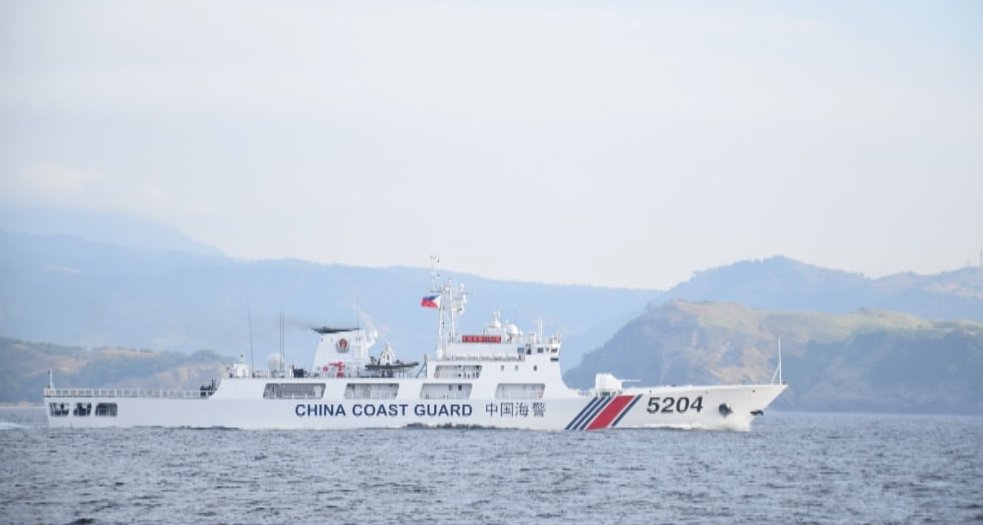
Combinations of CCG cutters with weapons larger than 14.5mm machine guns could be extremely dangerous at close range. Some of those are shown below.

The China CG version of the Type 056 Corvette


China Coast Guard Cutters Converted  from Type 053H2G frigates

USCGC Oliver Berry (WPC-1124), 45 Days Away from Homeport, 9,300 Nautical Mile Patrol, Hawaii to Guam and Return

The crew of the Oliver Berry (WPC-1124) travel in a round-trip patrol from Sept. 12 to Oct. 27, 2020, from Hawaii to Guam, covering a distance of approximately 9,300 miles during their journey. The crew sought to combat illegal fishing and other maritime threats across the Pacific to protect the United States and our partner’s resource security and sovereignty. (U.S. Coast Guard photo courtesy of the CGC Oliver Berry)

Below is a District 14 News Release. Not your typical WPC operation. 9300 nautical miles and 45 days away from home port. I was a bit surprised that it sounds like they did not board any of the fishing vessels they encountered, “We executed 19 observation reports on fishing vessels, 6 of which had not been previously contacted by the Coast Guard.” Perhaps there were no ship-riders aboard from the nations in whose waters they were sighted. 

This might also have served as a dry run for the three Webber class WPCs that will be transiting to Guam. Presumably they took the opportunity to introduce this new type asset to representatives of the Republic of the Marshall Islands and the Federated States of Micronesia and perhaps to the supporting Coast Guard staff in Guam. Notably there is no mention of transiting in company with a larger ship as happened in previous long range operations.

united states coast guard

News Release

U.S. Coast Guard 14th District Hawaii and the Pacific
Contact: 14th District Public Affairs
Office: (808) 535-3230
After Hours: HawaiiPacific@uscg.mil
14th District online newsroom

Coast Guard Cutter Oliver Berry returns to homeport after a 6 week patrol in Pacific


Editors’ Note: Click on images to download a high-resolution version.

HONOLULU — The Coast Guard Cutter Oliver Berry (WPC 1124) returns to homeport in Honolulu after a mission in the Pacific to curtail illegal fishing and increase maritime law enforcement self-sufficiency with international partners. 

The crew of the Oliver Berry traveled in a first-of-its-kind round-trip patrol spanning from Sept. 12 to Oct. 27, 2020, from Hawaii to Guam, covering a distance of approximately 9,300 miles during their journey. 

“Traveling just under 10,000 nautical miles, we (CGC Oliver Berry) operated further from our homeport than any other FRC to combat illegal, unreported, and unregulated fishing in portions of Oceania,” said Ensign Michael Meisenger, weapons officer on the Oliver Berry.

The Oliver Berry collaborated with the governments of Republic of the Marshall Islands and Federated States of Micronesia strengthening maritime domain awareness and resource security within their Exclusive Economic Zones. An EEZ is an area of coastal water within a certain distance of a country’s coastline for which the country claims exclusive rights for drilling, fishing, and other economic ventures.

The Oliver Berry aided international enforcement efforts by sending observational reports and imagery to the Maritime Security Advisors and the Pacific Island Forum Fisheries Agency, Regional Fisheries Surveillance Center, thereby increasing mission success and showcasing the Coast Guard’s unwavering commitment to partner nations during the COVID-19 pandemic. 

“We worked to increase awareness of unlawful fishing operations in remote portions of the United States, Republic of Marshall Islands, and Federated States of Micronesia’s EEZs, and on the high seas,” said Meisenger. “We executed 19 observation reports on fishing vessels, 6 of which had not been previously contacted by the Coast Guard.” 

Fast Response Cutters are equipped with new advanced command, control, communications, computers, intelligence, surveillance, and reconnaissance systems and boast greater range and endurance compared to their predecessor, the 110 foot Island-class patrol boats. 

The FRCs represent the Coast Guard’s commitment to modernizing service assets and maintaining a strong presence and support for a free and open Indo-Pacific. Oceania covers an area of 3.3 million square miles and has a population of approximately 40 million people. Its melting pot of cultures depends on the living marine resources and maritime commerce to allow their people to thrive. 

The Coast Guard combats illegal fishing and other maritime threats across the Pacific to protect their resource security and sovereignty. Combating illegal fishing is part of promoting maritime governance and a rules-based international order that is essential to a free and open Oceania. 

“We made great contributions to our partnerships and increasing maritime domain awareness,” said Meisenger. “As a crew, we could not be happier to be back home after a highly successful and trailblazing patrol.”


“US to base Coast Guard ships in western Pacific to tackle China” –Aljazeera

United States Exclusive Economic Zone – Pacific centered NOAA map

Aljazeera reports that,

The US Coast Guard was “strategically homeporting significantly enhanced Fast Response Cutters … in the western Pacific,” White House National Security Advisor Robert O’Brien said in a statement.

What does that mean? Is this just a reference to the three Webber class WPCs that will be homeported in Guam? Or will we see a replication of PATFORSWA in the Western Pacific? Does “significantly enhanced” mean these FRCs will have improvements to sensors, communications, and/or weapons, or does it just mean they will be better than the two 110 foot WPBs they are replacing?

There is also this interesting tidbit,

O’Brien added that the Coast Guard, which is under the Department of Homeland Security (DHS), was also studying whether to permanently station several of its patrol ships in the area of American Samoa in the South Pacific.

Thanks to Walter for bringing this to my attention.