Worried about the Size of the U.S. Navy? Rearm the Coast Guard–The National Interest

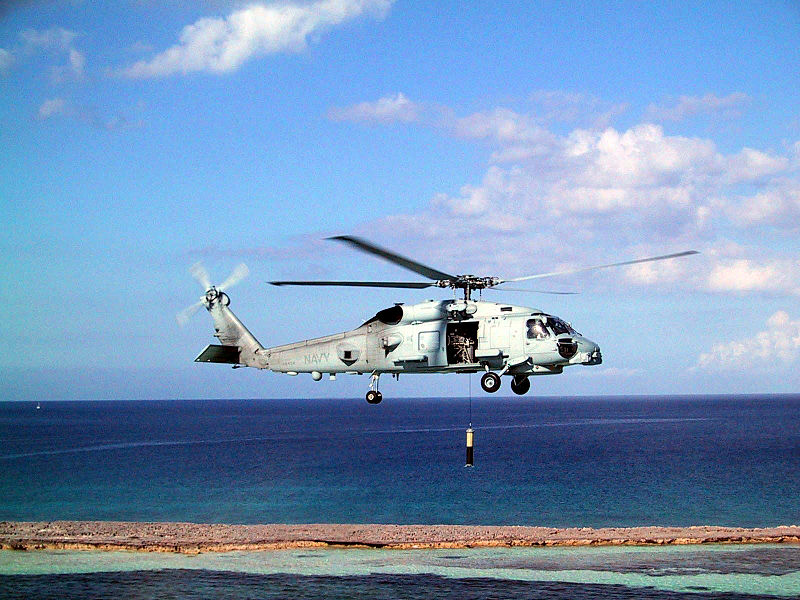
Navy photo. MH-60R “Knighthawk” helicopters conducts an airborne low frequency sonar (ALFS) operation during testing and evaluation

Navy photo. MH-60R “Knighthawk” helicopters conducts an airborne low frequency sonar (ALFS) operation during testing and evaluation

The National Interest has a post subtitled, “A new challenge for Trump: redefine the U.S. Coast Guard’s defense roles” you might find interesting.

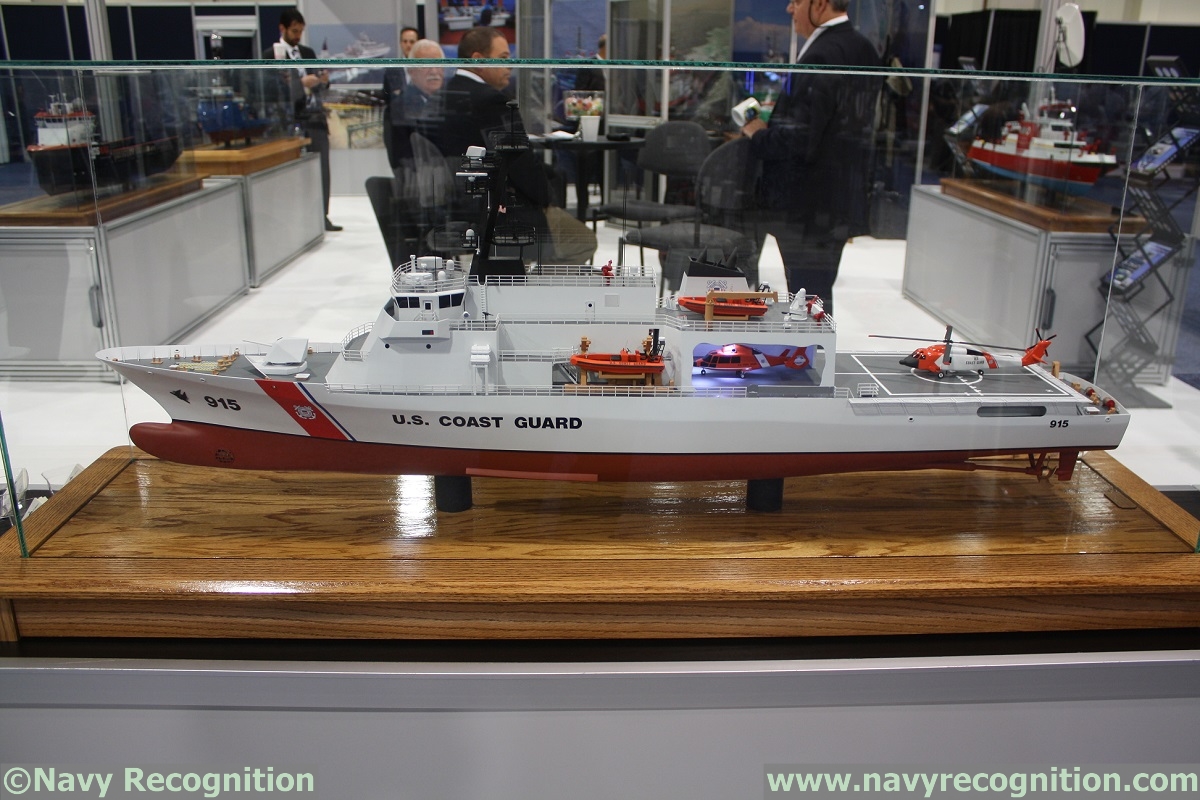
The author, a Coast Guard Officer and Cutterman, wants to see our larger cutters better armed. He recommends specifically, provision for support of the Navy’s MH-60R

“The U.S. Coast Guard should explore adding the ability to embark, operate with, maintain and rearm these aircraft from both the National Security Cutter and Offshore Patrol Cutter. Only complete solutions that see cutters equipped with ordnance handling facilities, surge berthing for a full-maintenance detachment and sensor integration through data links should be considered.”

and the 5″ Mk45 for the National Security Cutter.

“The addition of a true major caliber-deck gun offers immediate utility, but the system’s real potential will be unlocked if efforts to develop hypervelocity projectiles bear fruit. If so, the National Security Cutter would emerge as a true utility warship capable of providing fires to forces ashore at substantial range and meaningfully contributing to air defense.”
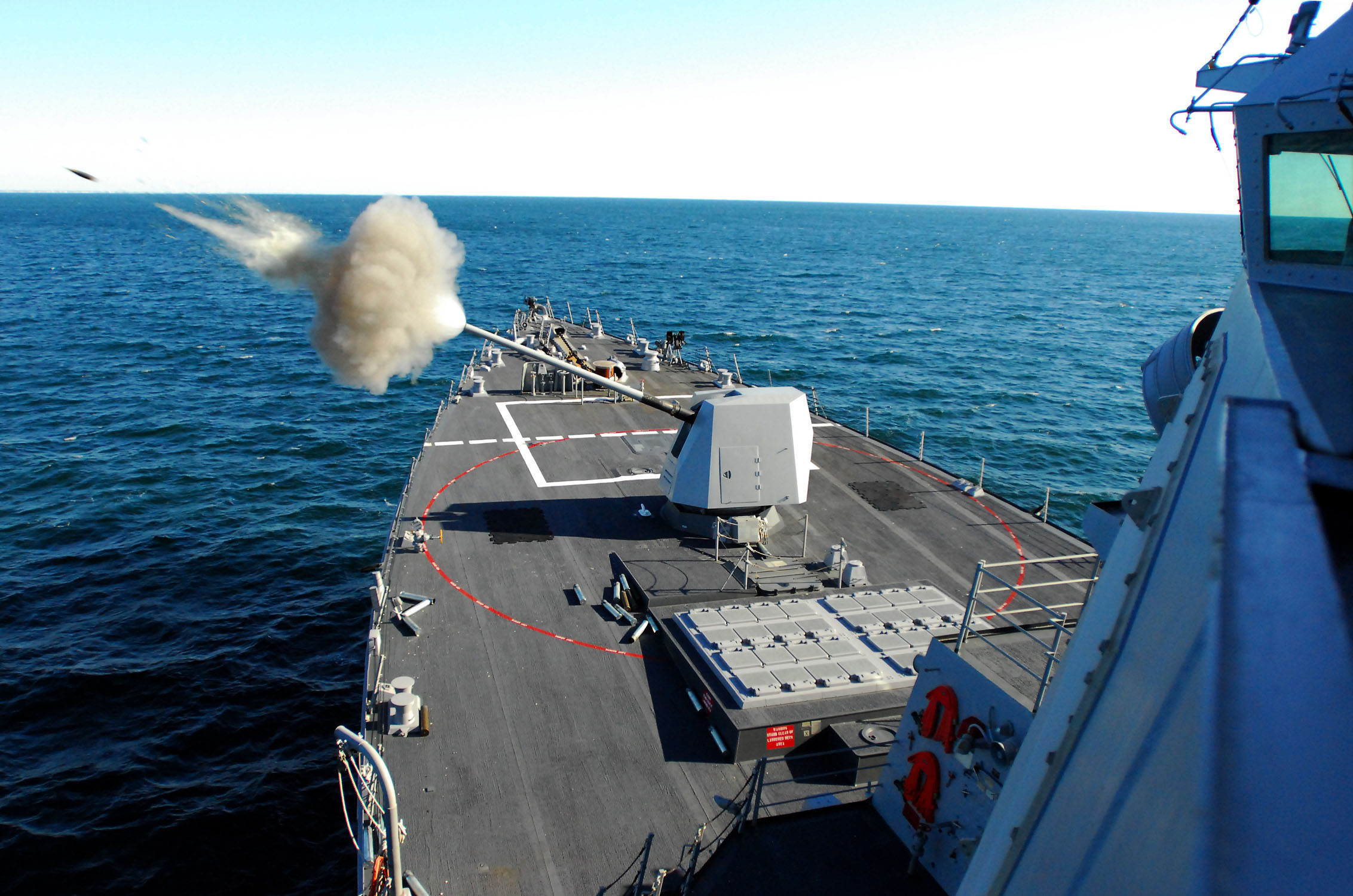
070111-N-4515N-509 Atlantic Ocean (Jan. 9 2007) - Guided missile destroyer USS Forest Sherman (DDG 98) test fires its five-inch gun on the bow of the ship during training. The Sherman is currently conducting training exercises in the Atlantic Ocean. U.S. Navy photo by Mass Communication Specialist Seaman Apprentice Joshua Adam Nuzzo (RELEASED)

Atlantic Ocean (Jan. 9 2007) – USS Forest Sherman (DDG 98) test fires its five-inch Mk 45 mod4 gun during training.U.S. Navy photo 070111-N-4515N-509 by Mass Communication Specialist Seaman Apprentice Joshua Adam Nuzzo

He does, however, see the services culture as an impediment.

“The lesson of the twenty-five years following the Hamilton experience is that a challenge to maintaining the U.S. Coast Guard’s warfighting capability lies in managing the service’s perception of its character…

He also notes that previous concepts of the Coast Guards wartime environment may be unrealistic.

“Attempts to define the U.S. Coast Guard’s defense roles following the Cold War have been challenging. Published in 1998, Coast Guard 2020 proclaimed that the “Coast Guard will be prepared to operate in low-threat conflict environments, and to provide specialized functions at all levels of operation.” The notions of low-threat operations and service-unique specialization are obstacles to interoperability. While U.S. Coast Guard buoy tenders and icebreakers absolutely provide specialized capability, the major cutter fleet’s warfighting role was never—nor should it have ever been—unique to the U.S. Coast Guard. Rather, the major cutter fleet provided an active augmentation force trained and equipped to provide service in any theater of war. This should be the target for the fleet’s future employment as the community of nations returns to its more normal mode of great power competition. As for the limitation of a low-threat environment, U.S. Coast Guard cutters have deployed recently to Southeast Asia, the Black Sea, the Arctic and the Arabian Gulf. Saber rattling among great powers and the HSV-2Swift incident demand that we ask: which of these locations will qualify as a low-threat environment on the first day of a global or major regional war?

Generally I agree with the thrust,

“The immediate challenges are acquiring and integrating combat systems and training crews in their employment. These are not trivial tasks and will necessarily consume time and resources. Better to act with dark clouds forming on the horizon, however, than in the midst of the storm.”

It is a two page post. The first page is mostly history lesson on the Coast Guard’s participation in past conflicts, but if he gives the impression the Coast Guard was historically ready for these roles on day 1, that would be a mistake. The Coast Guard entered WWII terribly unprepared. The cutters had no sonar or radar and no depth charge racks. There is nothing new about our current lack of readiness for war, it is not the exception, it is the norm.

Trouble is, we tend to have a binary approach. Either we are at peace and could care less about war-time roles, or we are all in after an attack. We need a more measured approach that responds to changing circumstance.

We really need to do better at preparing for a transition from peace to war. 

I don’t necessarily think removing the ASW systems from the 378s following the collapse of the Soviet threat was a mistake. It was a rational response to rapidly changing circumstance. Since then, we have had a quarter century without a substantial ASW threat, and the 378s are now on their way out. We probably should have removed the CIWS too, unfortunately it did mean we lost all the Coast Guard’s accumulated expertise in ASW. Hopefully we can rebuild it with the Navy’s help if needed.

But circumstances have changed again.

To me, a major conflict now appears more likely in the next ten to twenty years than at any time since I entered the Academy in 1965. We have a true peer challenger, with a chip on its shoulder and a belief in its inherent right to rule, in China. If that was not enough, Russia is rearming and acting increasingly obnoxious. Iran and North Korea may be annoying, but they are really not in the same league, at least in terms of a naval threat. Dealing with them would not stress our Navy, so would not really require Coast Guard assistance. China is the real threat, and if Russia sides with them, things could get dicey. Even without the Russians, the Chinese are building credible surface combattants at least as fast as the US. They already have a local superiority in the Western Pacific. We have to spread our fleet out, while they can concentrate their forces. To concentrate our forces in the Western Pacific, the US will be fighting at arm’s length with long vulnerable supply lines.

I don’t necessarily think war with China inevitable, but we need to recognize the possibility and plan for it.

Theoretically the process should start with an agreement between the Navy and the Coast Guard about what the Coast Guard, particularly its vessels and aircraft, will do in a general war. I see few indications that is happening. Certainly the OPC Concept of Operations did not include anything beyond a simple contingency operation.

I may be wrong about this, since I am way out of the loop, but if the service had an established general war mission focus to prepare for, it should be generally known. It should be reflected in our procurements. Perhaps the Navy thinks it would be presumptuous of them to assign the Coast Guard missions, and the Coast Guard does not want to push itself into Navy planning, but this is too important for delicate feelings to get in the way. Right now the Coast Guard is probably proportionately larger compared to the Navy than at any time in the last 100 years. When I entered the service, the Navy was 22 times larger than the Coast Guard in terms of personnel. Now it is only eight times larger. A combat ready Coast Guard may be the difference between victory and defeat.

Plans:

The Coast Guard has potentially important roles to fill in any general conflict. If the Navy cannot envision these roles, perhaps the Coast Guard should think for itself. Plans should include our aircraft as well as our vessels, but I will stick to the vessels for now.

What we need is not an overall strategy to defeat China, but a well developed range of options for employment and a good idea of what upgrades would be required.

In a major war, I see a major shortfall in open ocean escorts. Thirty years ago, when the threat was the Soviet Navy and the problem was projecting American power across the shorter distances of the Atlantic, the US had 36 cruisers, 69 destroyers, and 115 frigates (plus 12 WHEC 378s). Now they have 22 cruisers, 63 destroyers, and 8 LCS.

Then we had the advantage, that the Soviet Fleet was split into four parts and their egress to our supply lines was limited by the presence of powerful European Allied navies that restricted their access to our supply lines.

In a Pacific War with China, the distances are much greater, our allies fewer, and, with the exception of Japan and S. Korea, much weaker. Our Navy’s fleet, currently 274 ships, with ambitions of 355, is scattered across three oceans while China’s fleet, likely soon to be 500 ships, is geographically concentrated.

If we needed over a hundred frigates to cross the Atlantic, we probably need at least that many to push across the Pacific. As it is, the Navy cannot meet their current peacetime commitments, and replenishment ships cross the oceans unescorted and unarmed.

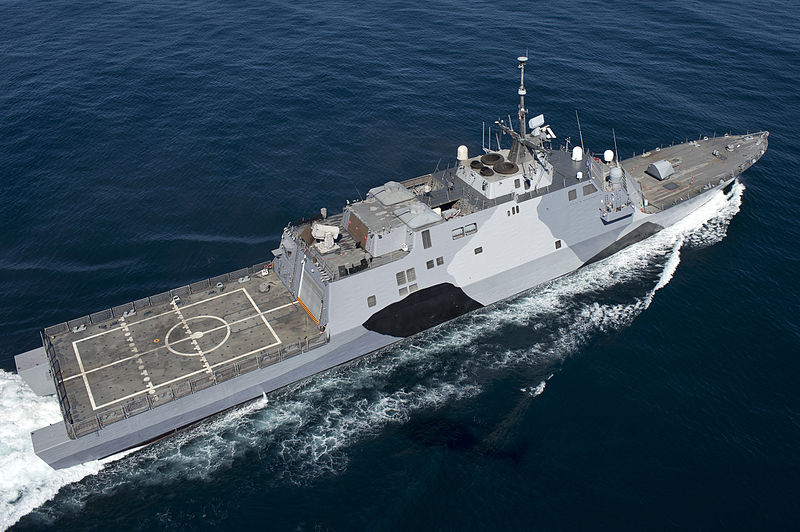
The Navy seems to have belatedly recognized this with moves toward a new frigate to be based on one of the LCS designs, but even if they complete all 52 small surface combattants currently planned, less than half will be completed as frigates, and if based on the LCS designs, they will have limited range, survivability, and crew size. The Independence class LCS will likely be permanently employed as mine countermeasures (MCM) vessels (There were 22 of those in 1987). The Freedom class will likely be employed in enforcing a blockade (perhaps with help from Webber class WPCs). Even with some backfitting of LCS  25-32, that leaves at most 28 frigates in the current plan. 35 ASW equipped cutters could make a huge difference.

The Cutters:

Cutters should be designed with wartime roles in mind, even if they will not be initially fully equipped with combat systems.

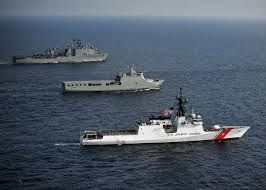
In the Bertholf class and Offshore Patrol Cutters, we will have most of the elements of modern warships. To not be prepared to add the few systems necessary to make them effective warships, if the nation were engaged in combat, would be criminal. If we do not already have plans to upgrade the Bertholf class National Security Cutters and the Offshore Patrol Cutters to give them significantly improved ASW, AAW, and ASuW capability we should start those plans.

At some point perhaps we should prototype an installation of these capabilities on at least one NSC and one OPC. Then we need to wring them out by deploying with the Navy and getting feedback on their performance, and periodically update plans for mobilizing their war-time potential.

The People: 

Just as we have marine inspection, fisheries, and drug enforcement specialist, the Coast Guard needs a cadre of officers in the Office of Counter Terrorism and Defense Operations Policy (CG-ODO) who have a deep understanding of the needs of modern naval warfare, who will advocate for naval capabilities consistent with both wartime missions and the Ports, Waterways, and Coastal Security (PWCS) mission. Likely this means revival or strengthening of officer exchange programs, Tactical Action Officer training, and War College education.

Perhaps the longest lead time item in mobilizing the Coast Guard for war would be the senior enlisted we would need for rating not currently found in the peacetime Coast Guard. It might be possible for the Navy to identify some reservist to augment the crews of Coast Guard cutters upon mobilization, but even a small cadre within the Coast Guard, founded on prototyping systems on at least a couple of cutters would provide valuable continuity and advice in defining required capabilities.

Bottom Line–When we get in trouble, we cannot make it up as we go along. Sweat now, saves blood later.

Thanks to Lyle for bringing this to my attention.

OPC to Have Hybrid Propulsion

OPC "Placemat"

OPC “Placemat”

We have confirmation that the Offshore Patrol Cutter will have a hybrid propulsion system.

Shephard Media is reporting that, “DRS Technologies, a Leonardo Company, has been selected to provide the hybrid-electric drive propulsion system for the US Coast Guard Offshore Patrol Cutter.”

As to the exact configuration, we have this. Clive Wilgress-Pipe, director of business development and strategic programs at DRS Power Technology said,

“…that the new Offshore Patrol Cutter design solution uses the gearbox mount configuration.”

This suggests to me that the electric propulsion motors (EPM) will be physically close to the main diesel engines (MDE). Assuming the ship will retain redundant machinery spaces, I will speculate and say, this probably means the ship will have two machinery spaces each with a complete propulsion set (MDE, clutch, gearbox, and EPM) for one shaft, plus one or two generators. Previously I had expected one engine room with both main diesel engines, and a motor room with both electric motors.

We don’t have a speed capability for the ship on electric propulsion alone. I had assumed it would provide at least 14 knots to give the long endurance (10,400 n.mi.) claimed for that speed, which might have required only a pair of 1,500 HP motors, but Mr. Wilgress-Pipe’s remarks suggest it might be more.

“Typically you rate it up to about 17 or 18 knots.”

That would require something more like a total of 6,000 HP. As noted, in the linked post, some configurations (COmbined Diesel Electric And Diesel, CODLAD) allow the power of the electric motors to suppliment the main propulsion engines. If that is the case, and we could add something like 6,000 HP to the two 16V 28/33D diesel engines, each rated at 9,763 bhp, then the ship would almost certainly have a 25 knot max speed. (This is of course speculation, so we can only be sure of the 22.5 knots sustained previously reported.)

Giving these ships the option of cruising on electric power, provided only by the ship’s service generators, makes these ship potentially more useful as ASW ships. In this mode, they will be quieter and, in noisy littoral environments, more difficult for a submarine to distinguish from other traffic.

Thanks to Luke for bringing this to my attention. 
Towed Reelable Active Passive Sonar

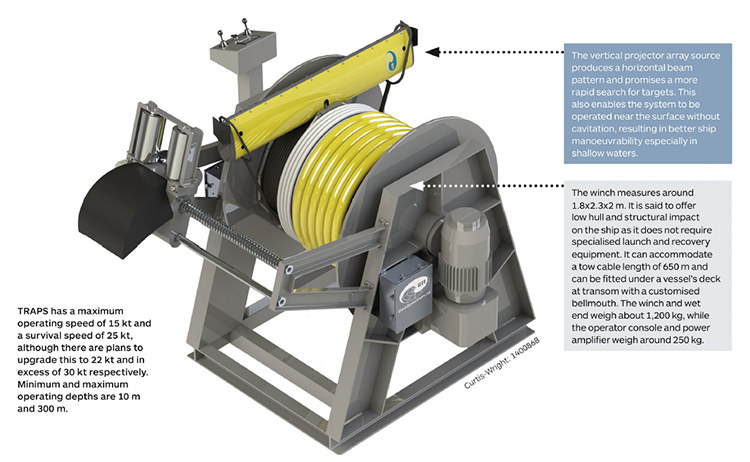
traps-janes-article1

NavyRecognition reports, “GeoSpectrum Technologies Inc. is pleased to announce that it has received a contract through the Build in Canada Innovation Program. Defence Research and Development Canada will test the TRAPS (Towed Reelable Active Passive Sonar) variable depth ASW sonar on Royal Canadian Navy ships.”

This system is seen as a possibility for both the twelve Kingston class “Coastal Defense Vessels” (970 tons, slightly smaller than the 210s) and the projected six icebreaking Arctic Offshore Patrol Ships. There is apparently no intention of using these on the more capable frigates.

TRAPS towing configuration, diagram from GeoSpectrum, Canada

TRAPS towing configuration

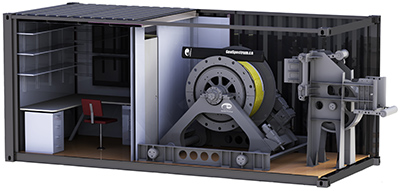
The system can be fitted in a standard sized 20 foot container.

TRAPS in 20 foot iso container.

TRAPS in 20 foot iso container.

GeoSpectrum claims :

“The modular design of TRAPS provides a variety of installation options, including containerization on multi-mission vessels and standard deck-mounting.

“The TRAPS system is ideal for small combatants such as OPVs, corvettes, ships of opportunity, and USVs. Applications include naval defence/surveillance, drug interdiction, homeland security, and other water-borne policing.”

In addition to detecting submarines and surface vessels, the system is claimed to be usable for:

  • Active torpedo detection
  • Torpedo decoy
  • Passive receiver
  • Black box pinger detection
  • Sonobuoy processor

A typical detection range of 50 nautical miles is claimed. If it works as advertised this might give most of our larger ships an ASW capability and perhaps help us detect semi-submersibles. Thales’ CAPTAS series is similar, with CAPTAS 2 and CAPTAS 1, designed for ships of over 1,500 and 300 tons respectively.

Navy Rethinks the LCS–Manning, Crew Rotation, Homeporting

800px-USS-Freedom-rear-130222-N-DR144-367

Photo: USS Freedom (LCS-1)

The US Naval Institute news service reports “Results of New LCS Review is Departure from Original Vision.”

Why should we care?:

For one thing the LCS were planned to be multi-crewed. Their plan was a bit different from our Crew Rotation Concept, but the idea was the same, multiple crews rotating among multiple ships to provide more deployed time. The Coast Guard had planned to apply the Crew Rotation Concept to the National Security Cutters, but I have also seen it referred to with regard to the Offshore Patrol Cutters.

Earlier I called the Offshore Patrol Cutter, the other LCS, and it does look like they will continue to share some systems and training. If the OPCs emerge with space for modular systems, we may see even more cross talk between the programs. The two types (LCS and OPCs) are similar in size, so comparisons are inevitable.

Hopefully we can learn from their experience.

The results: 

The Navy is abandoning their planned rotation of three crews among two ships in favor of a plan that would assign two crews to a single ship, much like the way SSBNs are manned by blue and gold crews. The significant difference is that the crews “own” the ships, they don’t expect to walk away to a different hull and never see it again.

The size of the crews is to be increased. Originally there was to have been a core crew of 40. That was increased to 50, and it is now planned to increase the core crew to 70 plus a 23 person air detachment. Maximum berthing is reportedly 98. Adding a CG LE team should max out the berthing. This pushes the crew much closer to what the Coast Guard was planning for the OPC, (pdf) a crew of 104. That means a full crew for each LCS is really 163, two core crews of 70 and 23 in the air detachment.

Instead of basing a mix of both types of LCS on each coast, the new plan would put the trimaran Independence class, with its longer range, on the West Coast (San Diego) while the shorter legged, monohull Freedom class will be based on the East Coast (Mayport, FL). That makes a lot of sense.

The ships will be organized into six four ship divisions with each division assigned a single mission (mine countermeasures, anti-surface, or antisubmarine). The four oldest ships will be single crewed, will not be assigned to a division and will instead be used for training and testing. Again this makes sense since subsequent ships are somewhat different, having incorporated lessons learned on the first ships.

That doesn’t necessarily mean there will be one division of each class assigned each of the three missions although that may the result. To me the Independence class appears better suited for ASW and the Freedom class by default better used as minecountermeasures ship.

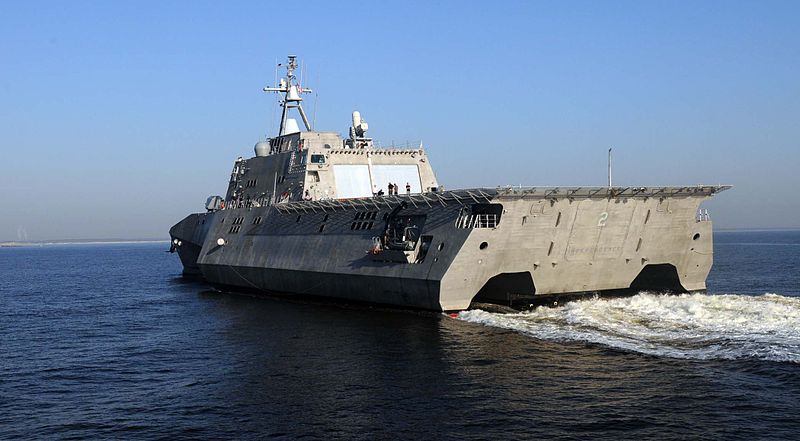
uss_independence_lcs_2

Photo: USS Independence (LCS-2), U.S. Navy photo by Mass Communication Specialist 2nd Class Justan Williams 

Lessons: 

When the Coast Guard finally decides to abandon the Crew Rotation Concept, as currently envisioned–four crews for three ships. They can point to the LCS experience as justification.

As a means to allow increased time underway, permanently augmenting the NSCs’ crews to allow generous leave and TAD assignments is probably a better solution. After all, if we have a crew of 160 or so assigned to each NSC or OPC, we could probably keep them underway at least as much as the LCS are.

Applying a division staff organization to the NSCs and perhaps the OPCs is probably a good idea. In addition to a post command captain, that could, among other things, provide initial advice to newly arrived COs and possibly a relief CO function; it could provide personnel augmentation for those specialists positions that have little or no redundancy in the typical ship’s organization, allowing them some leave and/or TAD while the ship is underway, with the objective of keeping the crew members underway time at 185 days or less, while the ship is away from homeport for a considerably longer time.

Elbit’s Unmanned Surface Vessel for ASW and MCM

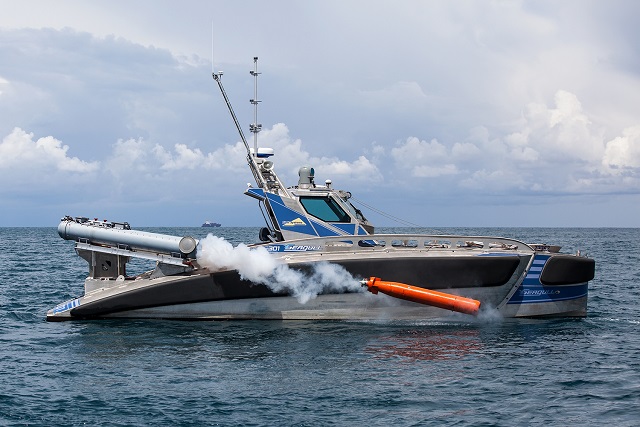
DefenseNews reports the Israeli company Elbit has been working on developing an unmanned surface vessel system, and they have gone beyond simply patrolling the surface and employing remotely controlled machine guns.  They are attempting to use it for Anti-Submarine Warfare and mine countermeasures.

In a separate post, Navy recognition reports that this system has successfully test launched a light weight torpedo.

Seagull_torpedo_trial_1

If you compare the vessel in the video and the one in the photo above, it is apparent that the equipment has been changed and that the craft probably could not carry both the sonar sensor and the light weight torpedoes, but it is possible multiple units might operate in groups.

Using small vessels for ASW and MCM has a long history, although not always particularly successful. As ASW assets they do offer the advantage that they are too small to be good targets for a submarine’s torpedoes. On the other hand their ability to support sensors and weapons is severely limited, and the crews’ limited ability to deal with adverse weather has always been problematic. Making them unmanned will at least help with that.

Thanks to Jim for suggesting the topic.

More on the Navy’s New Design for Maintaining Maritime Superiority

Waesche Carat 2012

This is a post I wrote for CIMSEC. under the title “A Design for Maintaining Maritime Superiority”–A Coastie’s View.” It is an expanded version of an earlier post that appeared here. The rewrite really begins about half way down under the header, “What I Want to See.”

Recently the new Chief of Naval Operations issued a document “Design for Maintaining Maritime Superiority” that outlines how, hopefully, the US Navy can maintain a maritime superiority our foes will recognize and avoid confronting.

If you look for anything specifically regarding the Coast Guard here, you will not find it (other than the cutter in the formation on the cover). The Coast Guard is not mentioned even once, but it does talk about some things that are Coast Guard related. Perhaps the Coast Guard should not feel bad about this. It only mentions the Marine Corps once.

Three Forces that are Changing the Environment

  • The first global force is the traffic on the oceans, seas, and waterways, including the sea floor – the classic maritime system.
  • A second increasingly influential force is the rise of the global information system – the information that rides on the servers, undersea cables, satellites, and wireless networks that increasingly envelop and connect the globe.
  • The third interrelated force is the increasing rate of technological creation and adoption.

Obviously the Coast Guard facilitates and regulates marine traffic, and is tapped into the global information system. In wartime, these contacts will become essential since they will form the basis for naval control of shipping. He also talks about new trade routes opening in the Arctic. These will only be reliable if we have new icebreakers. He also talks about illegal trafficking.

“This maritime traffic also includes mass and uncontrolled migration and illicit shipment of material and people.”

A Document That Explicitly Recognizes the Competition

“For the first time in 25 years, the United States is facing a return to great power competition. Russia and China both have advanced their military capabilities to act as global powers. Their goals are backed by a growing arsenal of high-end warfighting capabilities, many of which are focused specifically on our vulnerabilities and are increasingly designed from the ground up to leverage the maritime, technological and information systems. They continue to develop and field information-enabled weapons, both kinetic and non-kinetic, with increasing range, precision and destructive capacity. Both China and Russia are also engaging in coercion and competition below the traditional thresholds of high-end conflict, but nonetheless exploit the weakness of accepted norms in space, cyber and the electromagnetic spectrum. The Russian Navy is operating with a frequency and in areas not seen for almost two decades, and the Chinese PLA(N) is extending its reach around the world.

“…Coupled with a continued dedication to furthering its nuclear weapons and missile programs, North Korea’s provocative actions continue to threaten security in North Asia and beyond.

“…while the recent international agreement with Iran is intended to curb its nuclear ambitions, Tehran’s advanced missiles, proxy forces and other conventional capabilities continue to pose threats to which the Navy must remain prepared to respond.

“…international terrorist groups have proven their resilience and adaptability and now pose a long-term threat to stability and security around the world.”

Recognizing Budgetary Limitations

“There is also a fourth ‘force’ that shapes our security environment. Barring an unforeseen change, even as we face new challenges and an increasing pace, the Defense and Navy budgets likely will continue to be under pressure. We will not be able to “buy” our way out of the challenges that we face. The budget environment will force tough choices but must also inspire new thinking.”

Throughout there is an emphasis on understanding history and the strategic concepts of the past. There is also a recognition of the need to work with partners.

“EXPAND AND STRENGTHEN OUR NETWORK OF PARTNERS: Deepen operational relationships with other services, agencies, industry, allies and partners – who operate with the Navy to support our shared interests.”

Other than the Marine Corps, the US Navy has no closer partner than the US Coast Guard. And while only about one eighth the size of the US Navy, in terms of personnel, the US Coast Guard is larger than Britain’s Royal Navy or the French Navy. The partnership has been a long and successful one, but I would like to see the Navy be a better partner to the Coast Guard. This is how the Navy can help the Coast Guard help the Navy.

What I Want to See

If we have a “run out of money, now we have to think” situation, one thing we can do is to try to get the maximum return from the relatively small investment needed to make the Coast Guard an effective naval reserve force.

WPC Kathleen_Moore

We need explicit support from the Navy at every level, particularly within Congress and the Administration, for Coast Guard recapitalization. While the Navy’s fleet averages approximately 14 years old. The Coast Guard’s major cutters average over 40. The proposed new ships, are more capable than those they replace. They are better able to work cooperatively with the Navy. The nine unit 4,500 ton “National Security Cutter”program is nearing completion with funds for the ninth ship in the FY2016 budget. The 58 unit, 154 foot, 353 ton Webber Class  program is well underway with 32 completed, building, or funded. But the Coast Guard is about to start its largest acquisition in history, 25 LCS sized Offshore Patrol Cutters. Unfortunately, it appears that while the first ship will be funded in FY2018 the last will not be completed until at least 2035. This program really needs to be accelerated.

We need an explicit statement from the Navy that they expect the Coast Guard to defend ports against unconventional threats, so that they can keep more forces forward deployed. This is in fact the current reality. The Sea Frontiers are long gone. Navy vessels no longer patrol the US coast. The surface Navy is concentrated in only a handful of ports. No Navy surface combatants are homeported on the East Coast north of the Chesapeake Bay. If a vessel suspected of being under the control of terrorists approaches the US coast the nearest Navy surface vessel may be hundreds of miles away.

We need the Navy to supply the weapons the Coast Guard need to defend ports against unconventional attack using vessels of any size, with a probability approaching 100%. These should include small missile systems like Hellfire or Griffin to stop small, fast, highly maneuverable threats and we need a ship stopper, probably a light weight anti-ship torpedoes that target propellers to stop larger threats. We need these systems on not just the largest cutters, in fact they are needed more by the the smaller cutters that are far more likely to be in a position to make a difference. These include the Webber class and perhaps even the smaller WPBs.

We need to reactivate the Coast Guard’s ASW program and ensure that all the new large cutters (National Security Cutters and Offshore Patrol Cutters) have an ASW capability, if not installed on all of the cutters, at least planned, prototyped, tested, and practiced on a few ships (particularly in the Pacific). The National Security Cutters and the Offshore Patrol Cutters are (or will be) capable of supporting MH-60R ASW helicopters. Adding a towed array likeCAPTAS-4 (the basis for the LCS ASW module) or CAPTAS-2 would give them a useful ASW capability that could be used to escort ARGs, fleet train, or high value cargo shipments. Towed arrays might even help catch semi-submersible drug runners in peacetime.

IMG_4128

The Coast Guard is the low end of America’s Naval high-low mix. It is a source of numbers when numbers are needed. The Coast Guard has more assets for low end functions like blockade than the Navy. The Navy has about 105 cruisers, destroyers, LCS, PCs, and is not expected to have more than 125 similar assets for the forseeable future. The Coast Guard has about 165 patrol cutters  including 75 patrol boats 87 feet long, about 50 patrol craft 110 to 154 feet in length (58 Webber class WPCs are planned), and about 40 ships 210 foot or larger that can be called on, just as they were during the Vietnam War, when the Coast Guard operated as many as 33 vessels off the coast in support of Operation MarketTime, in spite of the fact that the Navy had almost three times as many surface warships as they do now. The current program of record will provide 34 new generation cutters including nine 4500 ton National Security Cutters and 25 Offshore Patrol Cutters that should be at least 2500 tons.

The Coast Guard provides peacetime maritime security, but is currently under-armed even for this mission. A small investment could make it far more useful in wartime.

(Note there is another post on this looking at the “design” from a Navy point of view.)

Sensor Hosting Autonomous Remote Craft (SHARC)

These little Unmanned Surface Vehicles (USVs) may be one way to enhance our Maritime Domain Awareness. They have already traveled a million nautical miles.

NavyRecognition has the story.

I could see a line of these in the Eastern Pacific, used to detect drug smuggling semi-submersibles.

Perhaps we will also see them used to cue Anti-Submarine Warfare Continuous Trail Unmanned Vessels.(ACTUV) or maritime patrol aircraft to the presence of submarines. It might not be too expensive to provide a line of them covering an entire trans oceanic route.

There will almost certainly be a war time role for launching these or something similar. Maybe a role for our buoy tenders.

The Navy’s New Design for Maintaining Maritime Superiority–CNO

Download the pdf here.

Recently the new Chief of Naval Operations has issued a document , “A Design for Maintaining Maritime Superiority” that outlines how, hopefully, the US Navy can maintain a maritime superiority our foes will recognize and avoid confronting.

If you are looking for anything specifically regarding the Coast Guard here, you will not find it (other than the cutter in the formation on the cover). The Coast Guard is not mentioned even once, but it does talk about some things that are Coast Guard related. Perhaps we should not feel bad about this. It only mentions the Marine Corps once.

He talks about three forces that are changing the environment: 

  • The first global force is the traffic on the oceans, seas, and waterways, including the sea floor – the classic maritime system.
  • A second increasingly influential force is the rise of the global information system – the information that rides on the servers, undersea cables, satellites, and wireless networks that increasingly envelop and connect the globe.
  • The third interrelated force is the increasing rate of technological creation and adoption.”

Obviously the Coast Guard facilitates and regulates marine traffic and is tapped into the global information system. In wartime, these contacts will become essential. He also talks about new trade routes opening in the Arctic, that will only be reliable if we have new icebreakers. He also talks about illegal trafficing.

“This maritime traffic also includes mass and uncontrolled migration and illicit shipment of material and people.”

For once, finally, a document explicitly recognizes the competition,

“For the first time in 25 years, the United States is facing a return to great power competition. Russia and China both have advanced their military capabilities to act as global powers. Their goals are backed by a growing arsenal of high-end warfighting capabilities, many of which are focused specifically on our vulnerabilities and are increasingly designed from the ground up to leverage the maritime, technological and information systems. They continue to develop and field information-enabled weapons, both kinetic and non-kinetic, with increasing range, precision and destructive capacity. Both China and Russia are also engaging in coercion and competition below the traditional thresholds of high-end conflict, but nonetheless exploit the weakness of accepted norms in space, cyber and the electromagnetic spectrum. The Russian Navy is operating with a frequency and in areas not seen for almost two decades, and the Chinese PLA(N) is extending its reach around the world.

“…Coupled with a continued dedication to furthering its nuclear weapons and missile programs, North Korea’s provocative actions continue to threaten security in North Asia and beyond.

“…while the recent international agreement with Iran is intended to curb its nuclear ambitions, Tehran’s advanced missiles, proxy forces and other conventional capabilities continue to pose threats to which the Navy must remain prepared to respond.

“…international terrorist groups have proven their resilience and adaptability and now pose a long-term threat to stability and security around the world.”

He recognizes budgetary limitations.

“There is also a fourth ‘force’ that shapes our security environment. Barring an unforeseen change, even as we face new challenges and an increasing pace, the Defense and Navy budgets likely will continue to be under pressure. We will not be able to “buy” our way out of the challenges that we face. The budget environment will force tough choices but must also inspire new thinking.”

Throughout there is an emphasis on understanding history and the strategic concepts of the past. There is also a recognition of the need to work with partners.

“EXPAND AND STRENGTHEN OUR NETWORK OF PARTNERS: Deepen operational relationships with other services, agencies, industry, allies and partners – who operate with the Navy to support our shared interests.

Other than the Marine Corps, the US Navy has no closer partner than the USCG. The partnership has been a long and successful one, but I would like to see the Navy be a better partner to the Coast Guard.

What I want to see:

If we have “run out of money, now we have to think.” One thing we can do, is to try to get the maximum return from the relatively small investment needed to make the Coast Guard an effective naval reserve force.

  • We need explicit support from the Navy at every level, particularly within the Congress and Administration, for Coast Guard recapitalization.
  • We need an explicit statement from the Navy that they expect the Coast Guard to defend ports against unconventional threats, so that they can keep more forces forward deployed.
  • We need the Navy to supply the weapons we need to defend ports against unconventional attack with a probability approaching 100% ,including small missile systems like Hellfire or Griffin to stop small, fast, highly maneuverable threats and light weight anti-ship torpedoes that target propellers to stop larger threats, and we need those systems on at least all cutters of Webber class and larger.
  • We need to reactivate the Coast Guard’s ASW program and insure that all the new large cutters (NSC and OPC) have and ASW capability, if not installed on all of the cutters, at least planned, prototyped, tested, and practiced on a few ships (particularly in the Pacific).

(Note there is another post on this looking at the “design” from a Navy point of view.)

Finland Seeks Unique Warship

Hamina-luokka_Hanko

Photo: Hamina class missile boat Hanko (82) by kallerna, 2009

NavyRecognition reports, the Finnish Navy is looking for some small warships with unique characteristics.

Finnish Minister of Defence, Jussi Niinistö, has given the Defence Forces a mandate to start the Finnish Navy project, Squadron 2020. The aim of the Squadron 2020 project is to construct four new corvette-size fighting ships for year-round operation in the special weather and ice conditions at the Baltic Sea (emphasis applied–Chuck).

The Request for Information informs shipyards about the project and inquires know-how and price information from shipbuilders and suppliers to base the Request for Quote on. The RFI was sent out on 18 December 2015 and answers are requested by the end of March next year.

The expected cost for the four is 1.2B Euros or abut $1.31 B. Right now the Offshore Patrol Cutter is probably the closest thing to what they are looking for, but in all probability the final design will be both smaller and much better armed. The Finns have shown an ability to cram a lot of fight into very small packages, but then, they have no need for the long range that is a characteristic of most Coast Guard or US Navy ships.

Their Hamina class patrol craft (wikipedia here) which are smaller than our Webber class (268 tons vs 353 tons fl) are equipped with a 57 mm gun, both a radar and an optronic fire control system, an EADS-TRS-3D multi-mode radar just like the National Security Cutter, an eight cell vertical launch system for anti-aircraft missiles, four anti-ship cruise missiles, ESM, and sonar. They have an aluminum hull, a composite superstructure, and NBC protection. They also have an RHIB ramp in the stern.

Possible New Sonar for Even Small Cutters

NavyRecognition reports the Navy has selected the sonar for their Anti-Submarine Warfare Continuous Trail Unmanned Vessel.(ACTUV). Since this vessel is quite small at 140 tons and 132 feet long, there is a good chance the sonar would fit nicely on cutters as small as the Webber class, and certainly on the Offshore Patrol Cutter.

“MS3 (Modular Scalable Sonar System–Chuck) marks an improvement in the performance and reliability of proven sonar technologies. It performs active and passive search and tracking; incoming torpedo warning; and small-object avoidance for safer navigation.”

Maybe it is time to “Bring Back the Coast Guard ASW Mission.”