“Unified Response: Joint Naval Drills in South China Sea” –MSN

Vessels from Australia, the USA, the Philippines, and Japan navigate in formation. (AFP Photo)

MSN reports,

The United States, Japan, Australia, and the Philippines … have announced preparations to perform cooperative naval exercises to preserve freedom of navigation and the rule of law as a display of unity…The combined forces of the participating nations will conduct a series of exercises aimed at improving interoperability and cooperation on April 7 as part of the joint naval and air drills.

Notably, there don’t seem to be any coast guard assets from any nation involved in this exercise.

There has been a lot of speculation about the timing of this exercise being so close to that of the trilateral summit which begins April 11, but the exercise is actually pretty small, with only one ship each from the US, Australia, and Japan. The exercise involves no aircraft carriers, submarines, or amphibious assault ships.

The largest ship participating is the Japanese Destroyer Akebono (DD-108) which is not an Aegis ship, and it is one of their smaller destroyers at 6200 tons full load. The US representative is a Littoral Combat Ship, USS Mobile (LCS-26) at 3,104 tons full load.

“Australian Border Force crackdown nets 30 foreign fishers, destroys three boats off Kimberley coast” –ABC.net.AU

Map showing the Kimberley Marine Park. The shaded area is a National Park Zone (‘no take’ zone).

ABC.net.au reports the Australian Border Force has seized 30 Indonesian fishers and destroyed three boats in a crackdown against illegal fishing in the 74,469 km2 (28,753 sq mi) Kimberley Marine Park, established in 2018, off Northwestern Australia. The combined catch of the three fishing vessels was over a ton of trepang (sea cucumber).

Australian sea cucumber sells for about $350 (presumably Australian $) per kilogram.(ABC Midwest & Wheatbelt: Chris Lewis)

In addition to the loss of marine catch, there is fear that the fishermen, who frequently come ashore, may bring with them livestock diseases common in Indonesia but not present in Australia.

An illegal fishing vessel is destroyed at sea.(Supplied: Australian Border Force)

Australia has been seeing a resurgence of illegal fishing in their EEZ including Marine Parks, and there have been calls for more vigorous enforcement.

Cutter Size Combatants for Australia

Australia is seeing an urgent need to augment the Strike capability of their Navy. This is reflected in a requirement for light frigate/corvette sized combatants with strong anti-surface (ASuW) and self-defense as well as ASW capability.

The resulting ships are about the size of the latest large US Coast Guard patrol cutters, the 4,600 ton Bertholf class National Security Cutter (NSC) and the 4,500 ton Argus class Offshore Patrol Cutter (OPC), in fact two are smaller. While this may not be an exhaustive list of potential competitors, all three proposals I have seen, are discussed in the video above and outlined below. Each includes 16 to 32 vertical launch system (VLS) cells for a variety of missile types and 16 to 24 deck launchers for Anti-Ship Cruise Missiles (ASCM, presumably Naval Strike Missiles). (As these designs are about a decade newer than the OPC, the winning design might form the basis for a future cutter class.)

Navatia’s offer, the Tasman class corvette, is the same length as the Argus class Offshore Patrol Cutters (110 meters / 360′), but considerably lighter at 3,600 tons full load (vs 4500 tons). This class is to be based on a class built for Saudi Arabia, which is in turned based on a class of Offshore Patrol Vessels built for Venezuela. The proposal includes 16 VLS and 16 ASCM launch tubes. Presumably they will be diesel powered with a speed about the same as the parent designs, 25 knots.

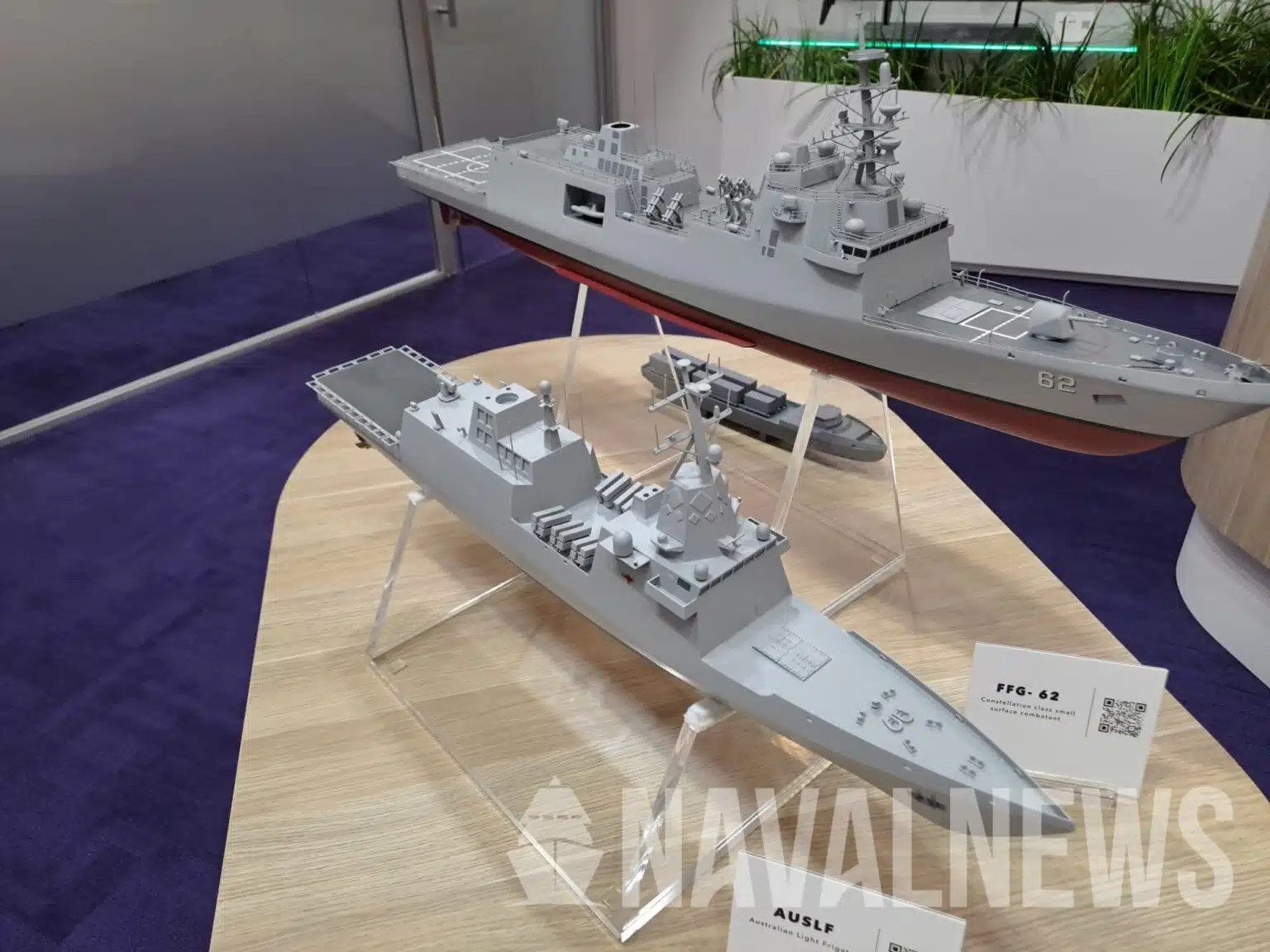
The Australian Light Frigate (foreground) and Constellation class (background) on the Gibbs and Cox stand during Indo Pacific 2023.

Gibbs and Cox proposal (pictured above), at 117 meters in length and 3,800 tons, this design is also smaller than the OPC by 700 tons. It takes the novel approach of deleting the usual main gun entirely in favor of 32 VLS and 24 ASCM launch tubes. CIWS would be provided by Phalanx or SeaRAM and close-in anti-surface and “shot across the bow” signaling would be provided by Mk38 gun mount or equivalent. (This may be taking the trend to smaller main guns to its logical conclusion.) Speed will be at least 30 knots using CODELAG GE LM2500+ propulsion.

TKMS offers MEKO A210 Frigate. This is a bit larger, at 4700 tons, 200 tons larger than the OPC and 100 tons larger than the National Security Cutter. The proposal includes 32 VLS and 16 ASCM. It is powered, like the earlier A200 frigates, by two diesels each driving conventional propellers and a gas turbine driving a central water jet, a system TKMS calls CODAG-WARP (WAter jet and Refined Propellers). Speed is likely 28-29 knots.

“End of NASSE Operation 2023” –Sea Waves

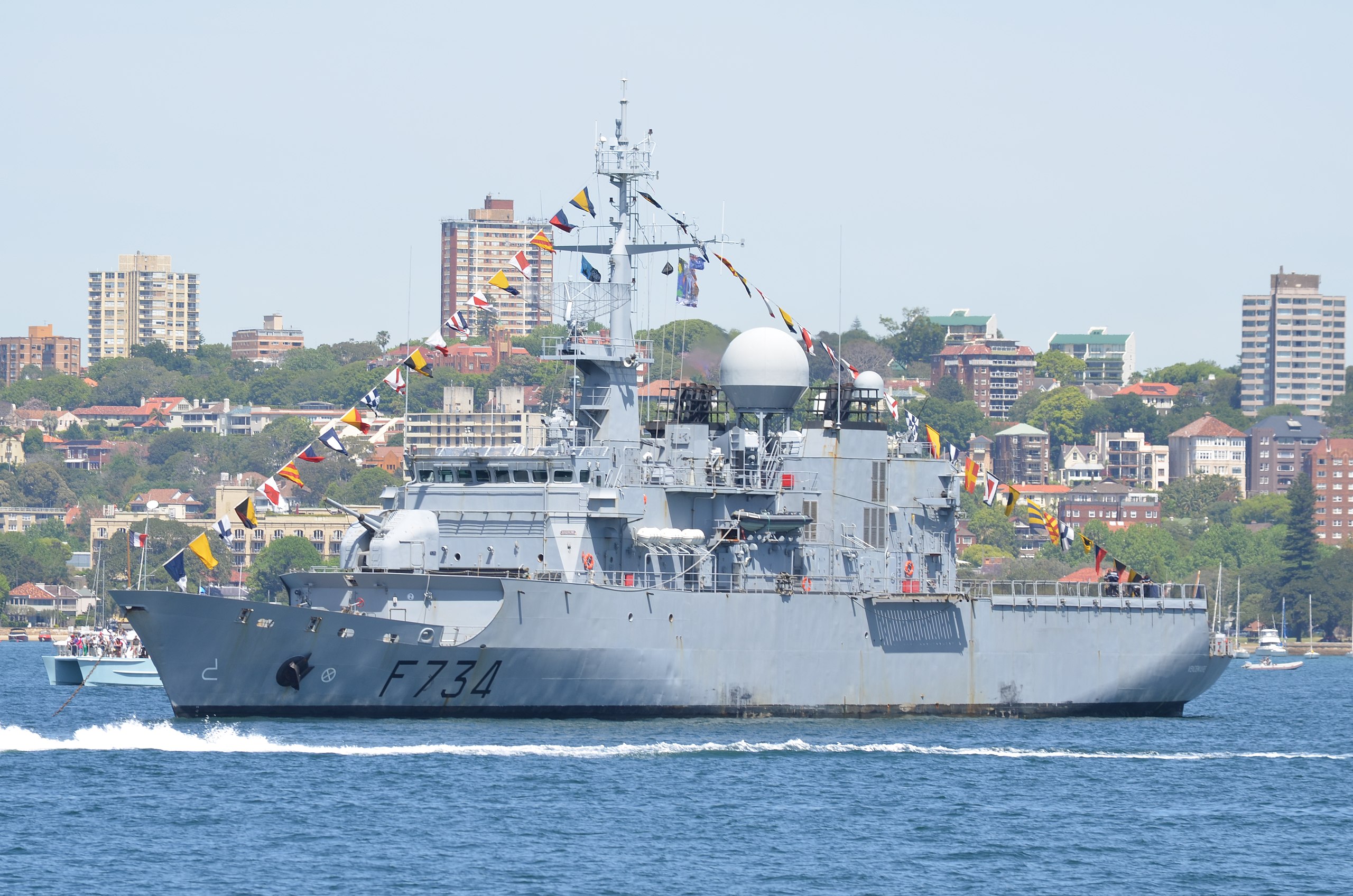
French frigate Vendemiaire, moored in Sydney Harbour. This 20 knot ship of the Floréal class looks a lot like a coast guard cutter. Photo by Saberwyn

Sea Waves reports the completion of a multi-national Fisheries Management exercise involving the US, Australia, New Zealand, France, and Fiji, from 20 June to 15 August.

The US Coast Guard deployed a C-130 to participate in the exercise. US vessels were involved but they were not identified. I am a bit surprised I have seen nothing from the USCG on this exercise.

The Sea Waves report appears to be a French news release. There is a New Zealand Defense Force view of the exercise here.

More on the developing relationship between Australia and France here. including an explanation of the “Pacific quadrilateral defense coordinating group* (PQUAD),” e.g., Australia, France, New Zealand, and the US, referred to in the post, as opposed to the “Quad,” e.g., Australia, India, Japan, and the US.

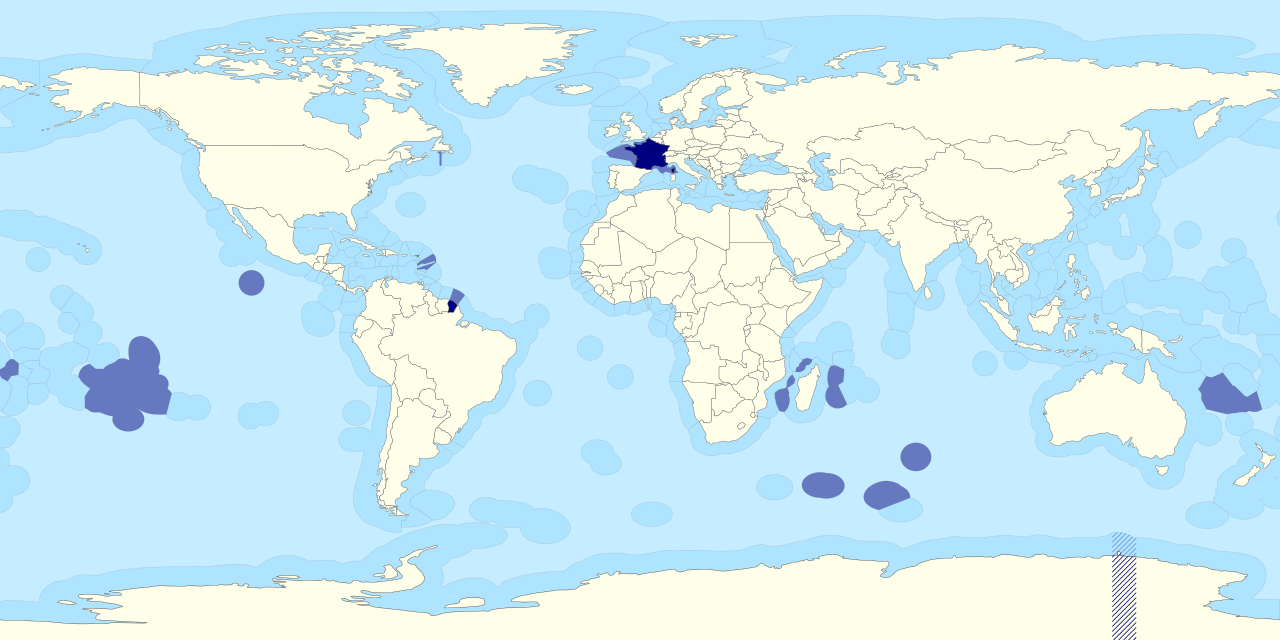
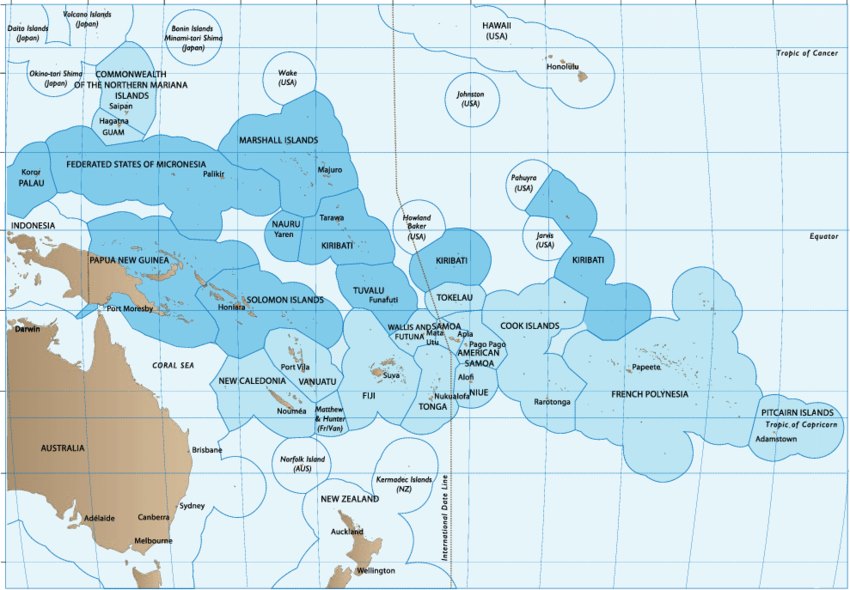
The French don’t normally have a lot of military assets in the Pacific. Much of what they have looks like coast guard, but they have the largest EEZ in the world and great strategic geography.

French Exclusive Economic Zone. Photo credit: B1mbo via Wikipedia.

This exercise is another step along the way to what appears to be inevitable international fisheries management and enforcement.

“Navy makes sure helicopters cannot land on new Offshore Patrol Vessels” –The Australian

Australia Considering Modular C-Dome For Arafura OPVs
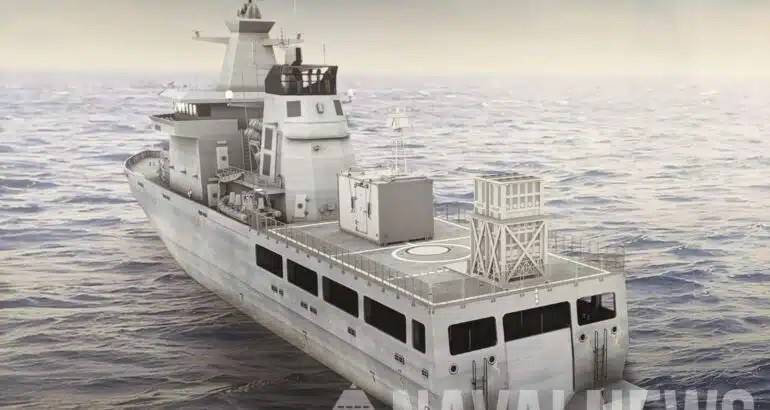
Illustration of Arafura-class OPV fitted with C-DOME

The Australian reports,

“Normally when a navy acquires a new ship, they want it to be as capable as possible. Not so the Royal Australian Navy, which has down-designed the Arafura class Offshore Patrol Vessels (OPVs) so that they can no longer support the weight of a helicopter on the large rear deck.”

The article goes on to criticize this and other decisions regarding the ship, but there may be method to this madness.

I would assume the Australian Navy is putting some thought into these decisions and it may be related to my observations in a post only two days ago, “When is a Flight Deck Not a Flight Deck?”

The intention may be to save topside weight so that an additional load or loads, heavier than an 11 ton helicopter, can be placed high on the ship.

A helicopter deck must be very strong everywhere, because it may be required to take high dynamic loads concentrated on just a few square inches, that may occur unpredictably, almost anywhere on the deck. By contrast even a large load like SURTASS-E, that spreads the load over a much larger area, requires less deck strength.

SURTASS-E. (U.S Department of Defense)

It may be that the Australian Navy has decided to use the “flight deck” as a mission load area where they anticipate placing heavy loads. The weight savings from weakening the flight deck may also permit additional topside weight for other systems, like weapons, if it is not required for loads on the flight deck.

When is a Flight Deck Not a Flight Deck?

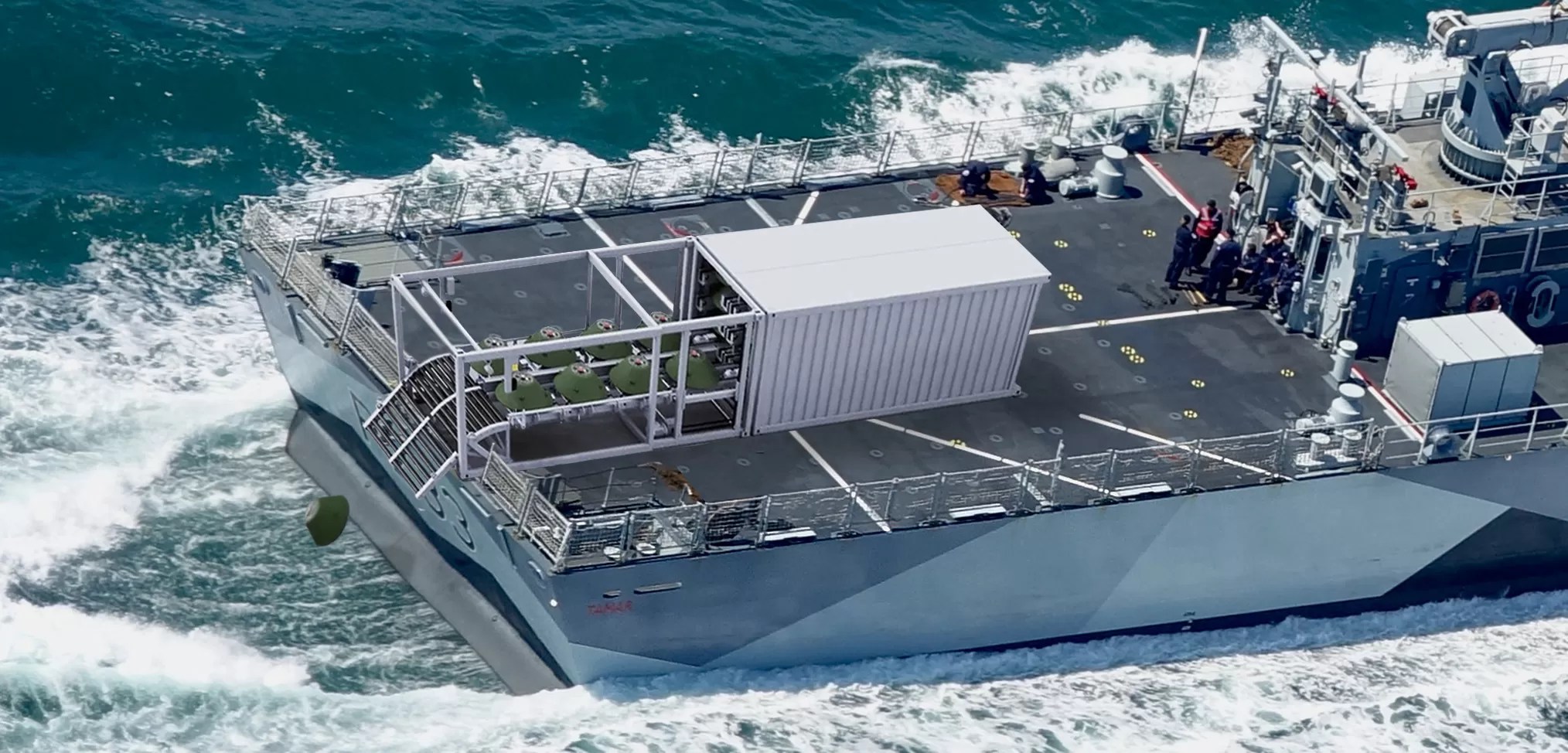
Containerized minelaying system on a River Batch 2 Offshore Patrol Vessel

It has been said that aircraft carriers are the ultimate modular warships because their primary weapons (aircraft) are interchangeable.

A flight deck on an Offshore Patrol Vessel (OPV) certainly offers a degree of aviation options. General purpose, cargo, ASW, and ASuW helicopters and a range of Unmanned Air Systems, but it appears our allies, the UK and particularly Australia may be looking at other ways to use this large open space.

Royal Navy:

Navy Lookout had a post that talked about restoring a naval mining capability in the Royal Navy. There was no specific reference to using flight decks or to Offshore Patrol Vessels.

The RN does not need dedicated minelaying vessels. The SSNs have a theoretical minelaying capability but XLUUVs are a much lower risk and stealthier solution for covert and sensitive missions. Where stealth is less important, containerised minelaying solutions are being developed that can be secured to the deck and dispense mines over the stern. (emphasis applied–Chuck)

But the photo, above, definitely got my attention. There we see an SH Defence “CUBE” containerized mine laying system developed by RWM Italia S.p,A. (Rheinmetall). on the flight deck of a River Batch 2 Offshore Patrol Vessel (HMS TAMAR).

Australian Navy:

Australia is planning to produce up to 14 flight deck equipped Arafura class OPVs including two intended specifically for Mine Counter Measures (MCM). These ships were always intended to accept containerized mission loads. It appears they are now planning what these ships will do in wartime.

Missile Launcher:

We already saw “Australia Considering Modular C-Dome For Arafura OPVs” –Naval News

Australia Considering Modular C-Dome For Arafura OPVs
Illustration of Arafura-class OPV fitted with C-DOME

Mine Layer:

As noted in the Navy Lookout, Australia is planning to buy and produce large numbers of mines. Naval News reports,

“Australia is set to accelerate the procurement of sea mines as part of Project SEA 2000…The decision to rapidly procure the capability, reportedly from a European supplier, will deliver a ‘significant’ deterrent effect according to Defence…it’s understood that the government has budgeted approximately $500 million to 1 billion Australian dollars for the acquisition…the weapons being brought are smart mines, able to disseminate between civilian vessels and a variety of military targets, allowing a strategic anchorage to be denied to hostile forces, all the while preserving access for aligned vessels(emphasis applied–Chuck)

This all points to large numbers of mines being used in defensive fields. Such minefields will almost certainly be laid by surface vessels. Australia does have some civilian crewed support ships that might be used for mine laying, but as the Arafura class comes online, they will be the most likely surface minelayers.

SURTASS-E:

SURTASS-E. (U.S Department of Defense)

Then there is these reports from Naval News and The Drive that Australia is getting SURTASS-E systems.

SURTASS-E is expected to provide long range detection and cuing for tactical weapons, against both diesel- and nuclear-powered submarines. Again, the Arafura class seems a likely host, because the system is intended for military crew manning and, unlike the civilian manned National Support Squadron ships, these ships are armed and have communication systems that include tactical data link.

Now About the Coast Guard:

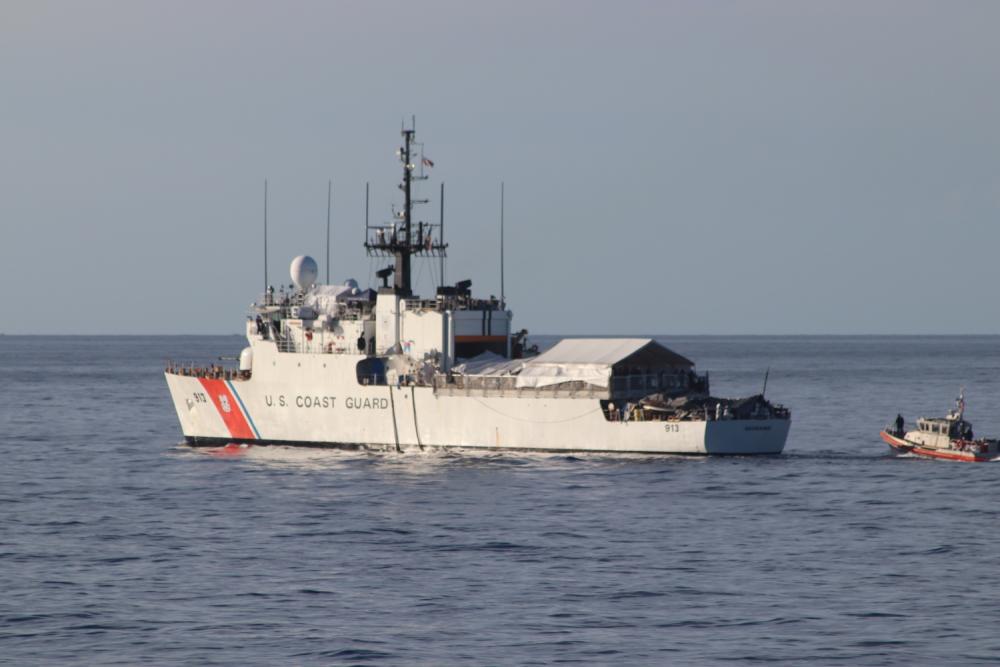
Using a flight deck for non-aviation purposes is not a foreign idea to the Coast Guard. They do it all the time to provide a holding area for migrants. 

USCGC Mohawk’s (WMEC 913) crew patrols the South Florida Straits during Operation Vigilant Sentry, Jan. 5, 2023. Mohawk’s crew patrolled the Florida Straits and Caribbean Sea in support of Homeland Security Task Force—Southeast and Operation Vigilant Sentry in the Coast Guard Seventh District’s area of operations for a 46-day patrol. (U.S. Coast Guard photo by USCGC Legare (WMEC 912)

“Australia Considering Modular C-Dome For Arafura OPVs” –Naval News

Australia Considering Modular C-Dome For Arafura OPVs
Illustration of Arafura-class OPV fitted with C-DOME

Naval News reports,

“The Royal Australian Navy (RAN) is in talks to procure a containerised variant of Rafael’s C-Dome in an effort to increase the firepower of its future Offshore Patrol Vessels (OPV).”

Arafura class OPVs:

The Arafura-class is based on the Lürssen-designed Darussalam-class, operated by the Royal Brunei Navy. This is expected to be a class of 14, 12 off shore patrol vessels and two dedicated to mine counter-measures. They are expected to displace 1640 tons, be 80 meters (262 ft) long and 13 meters  (43 ft) of beam with a draft of four meters (13 ft) with a speed of 22 knots.

C-DOME Missile System:

C-Dome is the naval version of the Israeli Iron Dome missile system which was developed with considerable US support. There has been considerable US interest in the Iron Dome system (here, here, and here). Systems are coproduced by Rafael and Raytheon. Complete systems are built in the US.

The new Israeli Sa’ar 6 corvettes are expected to have forty vertical launch cells for C-Dome in addition to 40 Barrak 8.

From Wikipedia specifications for the Iron Dome interceptor:

  • Weight: 90 kg (200 lb)
  • Length: 3 m (9.8 ft)
  • Diameter: 160 mm (6.3 in)
  • Proximity fuse

By comparison, the Evolved Sea Sparrow Missile weighs 620 pounds, is 12 feet in length, and has a diameter of 10 inches. It can be quad packed in the Mk41 vertical launch cells.

The RIM-116, Rolling Airframe Missile (RAM), weighs 162 pounds, is 9’2″ long, and has a diameter of 5″ so smaller than the Israeli system, but it has yet to be deployed in a vertical launcher so it apparently needs two launch systems to provide 360 degree coverage.

“U.S. Coast Guard arrives for planned port visit in Cairns, Australia” –Adventures in Paradise with the Webber Class

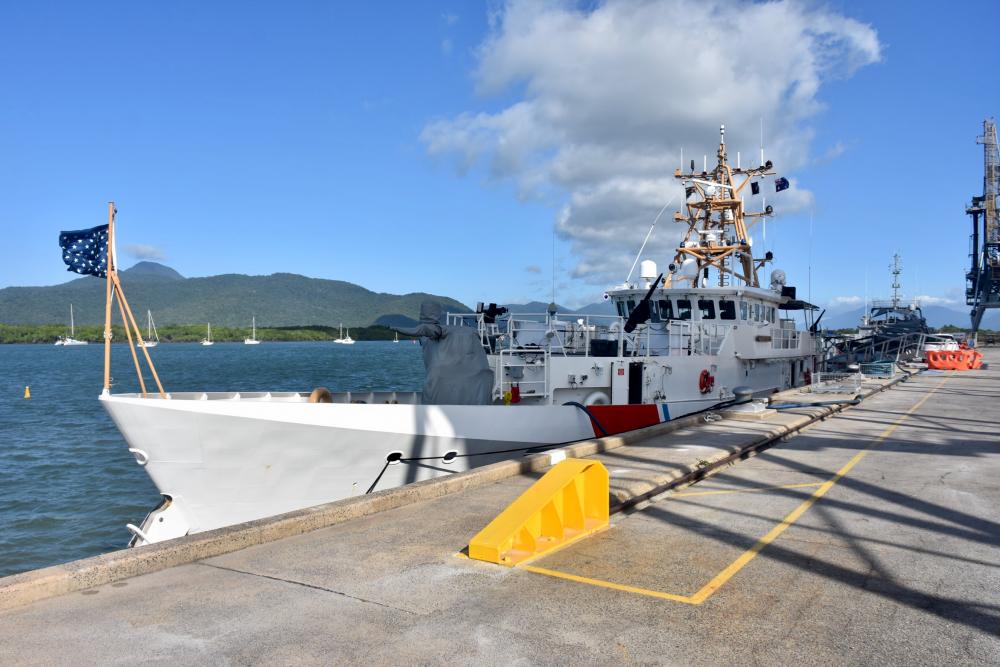
The Sentinel-class fast response cutter USCGC Oliver Henry (WPC 1140) arrive in Cairns for engagements with Australian Defence and Home Affairs partners and local representatives, Aug. 31, 2022. The U.S. Coast Guard is conducting a routine deployment in Oceania as part of Operation Blue Pacific, working alongside Allies, building maritime domain awareness, and sharing best practices with partner nation navies and coast guards. Op Blue Pacific is an overarching multi-mission U.S. Coast Guard endeavor promoting security, safety, sovereignty, and economic prosperity in Oceania while strengthening relationships with our regional partners. (U.S. Coast Guard photo courtesy USCGC Oliver Henry)

The six Hawaii and Guam based Webber class Fast Response Cutters do seem to get around. USCGC Oliver Henry made it to North Eastern Australia, mooring at Her Majesty’s Australian Station Cairns, which is home to some Australian Navy patrol, hydrographic, and survey vessels. Cairns looks like a delightful little city (population in June 2019 was 153,951). Not bad after no one tossed out the welcome mat in the Solomon Islands. The crew is going to have a lot of sea stories.

Cairns is a bit over 1800 nautical miles South of Oliver Henry’s homeport in Guam.

News Release

U.S. Coast Guard Forces Micronesia / Sector Guam

U.S. Coast Guard arrives for planned port visit in Cairns, Australia

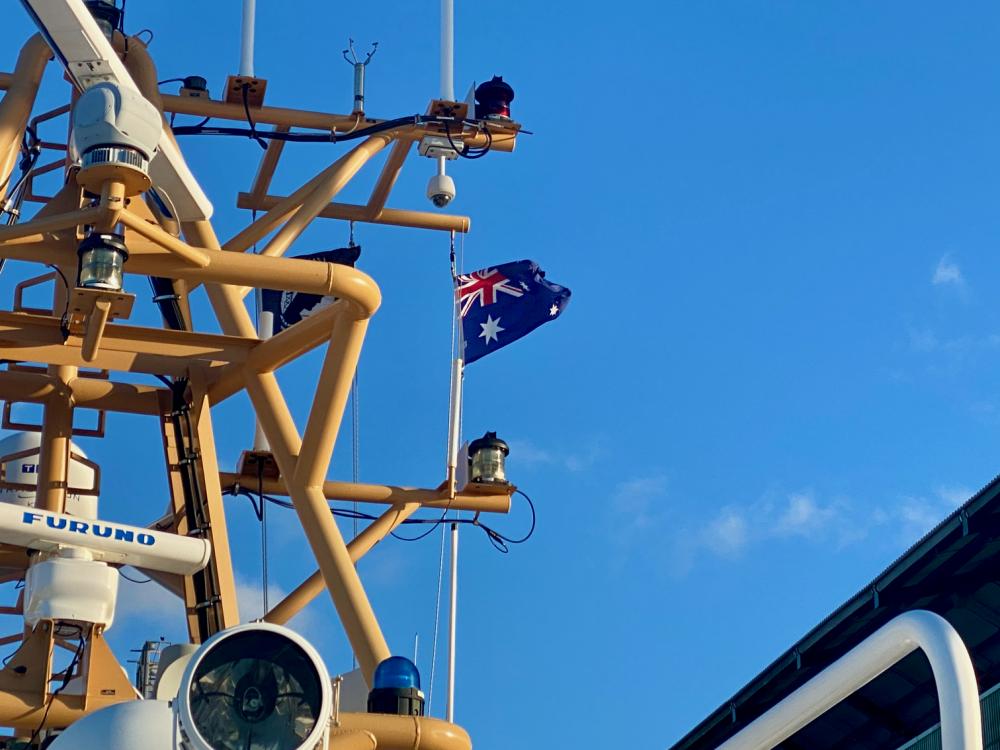
The Oliver Henry is the first U.S. Coast Guard fast response cutter ever to fly the Australian ensign.  The Sentinel-class fast response cutter USCGC Oliver Henry (WPC 1140) command stand for a photo with Cmdr. Alfonso Santos, commander of HMAS Cairns, and Capt. Toby Reid, U.S. Coast Guard representative to the defense attache office of the U.S. Embassy in Australia,
USCGC Oliver Henry meets with Cairns regional Council and mayor The Sentinel-class fast response cutter USCGC Oliver Henry (WPC 1140) arrive in Cairns for engagements with Australian Defence and Home Affairs partners and local representatives, Aug. 31, 2022

Editor’s Note: Click on the images above to view or download more.

CAIRNS, Australia — The Sentinel-class fast response cutter USCGC Oliver Henry (WPC 1140) crew arrived in Cairns for engagements with Australian Defence and Home Affairs partners and local representatives, Aug. 31.

“A cutter arrival to Australia is another first, not only for U.S. Coast Guard Forces Micronesia but also our fast response cutter fleet and is a reminder of our Service’s commitment to our partners and our enduring presence in the region,” said Capt. Nick Simmons, commander U.S. Coast Guard Forces Micronesia/Sector Guam. “The ship driver in me was envious when Lt. Hofschneider reported ‘OH transiting southbound along Inner Great Barrier Reef Passage enroute to Cairns. No issues or concerns.’ Not the kind of thing many Coast Guard members have ever written or said.”

Before arrival in port, Oliver Henry’s crew operated at sea with aerial support from the Australian Border Forces in the Torres Strait. While in port, the two nations will continue to build on the relationship forged at sea. Upon arrival, the crew was greeted by representatives from the Royal Australian Navy HMAS Cairns and the U.S. embassy. They were also guests of the Cairns Regional Council.

“It is an honor for Oliver Henry and her crew to visit and host our Australian friends,” said Lt. Freddy Hofschneider, the Oliver Henry commanding officer. “The U.S. and Australia have been standing side-by-side for more than 100 years. This is more than a partnership, it is mateship. The U.S. Coast Guard looks forward to more opportunities where we can work with the Australian Border Force, Royal Australian Navy, and other Australian partners to advance the rule of law at sea.”

During their stop in Cairns, members of Oliver Henry anticipate engagements with local officials and the community while also experiencing local culture.

The U.S. Coast Guard is conducting a routine deployment in Oceania as part of Operation Blue Pacific, working alongside Allies, building maritime domain awareness, and sharing best practices with partner nation navies and coast guards. Op Blue Pacific is an overarching multi-mission U.S. Coast Guard endeavor promoting security, safety, sovereignty, and economic prosperity in Oceania while strengthening relationships with our regional partners.

The Oliver Henry is the 40th Sentinel-class fast response cutter. The ship was commissioned along with its sister ships, Myrtle Hazard and Frederick Hatch, in Guam in July 2021. In the time since, the crew has participated in several search and rescue cases, completed a counternarcotics patrol off Guam with the Japan Coast Guard, and conducted sovereignty and fisheries patrols in the Forces Micronesia/Sector Guam area of responsibility.

For more U.S. Coast Guard Forces Micronesia/Sector Guam news, visit us on DVIDS or subscribe! You can also visit us on Facebook at @USCGForcesMicronesia.

For more U.S. Coast Guard Forces Micronesia/Sector Guam news, visit us on DVIDS or subscribe! You can also visit us on Facebook at @USCGSectorGuam.

“The Pacific Islands” –Congressional Research Service (CRS) Report

Estimated exclusive economic zones (EEZs) of Pacific Island countries and territories (PICTs). The EEZs of countries that are the Parties to the Nauru Agreement are shown in darker blue. Note that not all EEZs of PICTs have been officially delineated under the United Nations Convention on the Law of the Sea. Source: Patrick Lehodey

The Congressional Research Service (CRS) has published a two page “IN FOCUS” brief on “The Pacific Islands” of Micronesia, Melanesia, and Polynesia. Like all my links to CRS reports, this link will always take you to the latest version. It has already been updated at least once, 17 August, 2022.

Given the increased Coast Guard activity in the region, the report may provide useful background. The topics discussed are:

  • Overview
  • Geopolitical Context
  • The United States and the Region
  • The Freely Associated States
  • International Assistance
  • China’s Influence
  • Security Challenges
  • Self Determination

RSV NUYINA – AUSTRALIA’S ANTARCTIC ICEBREAKER

Bairdmaritime provides a review of Australia’s new icebreaking research and supply vessel.

Looking for more information, I found a very extensive description here (click on the menu tab on the upper right). This is a big, powerful, very versitile ship, but I wonder about the choice of propulsion and hope our resident icebreaker expert, Tups, will comment.

First, at 25,500 tons, it is much larger than either Healy (16,000) or Polar Star (13,623 tons). It is way longer as well at 160.3 m (526 ft), compared to Healy (420 ft / 128 meters) and Polar Star (399 ft / 122 meters). She is even larger than the Polar Security Cutter PSC (22,900 tons and 460 ft / 140 meters in length).

A good part of the ship’s size is due to the fact that this ship is more than an icebreaker. While a typical US support mission to Antarctic would envolve three ships, an icebreaker, a supply ship, and a tanker, this ship is a combined icebreaker, dry cargo ship, tanker, and research vessel. The crew is small, 32, but there are accommodations for an additional 117 expeditioners plus 1200 tonnes of cargo and 1.9 million litres of fuel.

Aviation facilities are generous. The hangar can accommodate four small AS350 B3 helicopters or two Sikorsky S-92 that are larger than the H-60s.

It has a large number of boats including a pair of barges. Each barge has two 448 kilowatt (600 horsepower) engines and a water jet propulsion system that provides greater manoeuvrability than propellers. The barges carry general cargo from ship to shore in Antarctica.

On the cargo hatch covers near the bow of RSV Nuyina are two 16.3 metre-long, 6.2 metre-wide barges, each capable of carrying more than 45 tonnes of cargo.

The aluminium barges can operate in calm seas and up to 50 knots of wind, at a speed of eight knots.

Propulsion: 

What I found most surprising was the choice of propulsion systems. This is a seriously powerful icebreaker, but unlike most modern icebreakers, it does not use steerable podded diesel electric systems (such as Azipods). Instead all power goes through two shafts to controlable pitch propellers. Both the sources reported power comes from two V16 diesel engines (19,200 kW each) geared diesels and 4 diesel generators (7,400 kW each) powered by diesel generators. From the https://www.antarctica.gov.au/ site which Bairdmaritime seems to have copied.

RSV Nuyina can cruise efficiently in open water, operate silently (in ‘Silent R’ mode) during scientific operations, or continuously break ice up to 1.65 metres thick.

RSV Nuyina has a diesel-electric propulsion system that provides different levels of power depending on the task.

In icebreaking mode RSV Nuyina uses its full propulsion system – two V16 diesel engines (19,200 kW each), and 4 electric motors (7,400 kW each) powered by diesel generators.

In its 12–14 knot cruising mode, the ship relies on the electric motors.

There are two engine rooms to provide an enhanced level of safety and redundancy. Each room houses a V16 diesel engine and two diesel generators.

That seemed like an awful lot of power for the modest maximum and cruising speed reported. The descrtiption sounded like a total of 68,000 KW total (about 92,000 HP) but that seemed unlikely.

Wikipedia indicates they max total power is a still very respectable 26,600 KW or 35,657 HP (confirmed here). This would make her slightly more powerful than Healy (2 × 11.2 MW (15,000 hp).

Something did not sound right.

Looking up the MAN 16V32/44CR engines reportely installed I found that they were rated at 9600 KW not 19,200 each, rather that would be the total for the two. Given a total output in the icebreaking mode, of 26,600 KW, 19,200 of which comes from the two main diesels, that means the electric motors would provide an additional 7400 KW total, or probably 3700 KW each which be enough for a 12 knot cruise. That makes sense.