“USS LEYTE GULF DEPLOYS FROM NORFOLK TO U.S. 4TH FLEET” –2ND FLEET

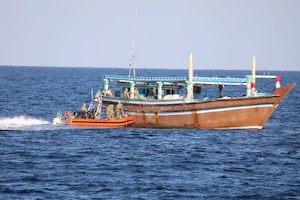
040501-N-7586B-122, Gulf of Oman (May 1, 2004) – Members of the Vessel Board Search and Seizure (VBSS) team return to the guided missile cruiser USS Leyte Gulf (CG 55) in a Rigid Hull Inflatable Boat (RHIB) after searching several fishing dhows in the Gulf of Oman. U.S. Navy photo by Photographer’s Mate 1st Class Bart Bauer. (RELEASED)

Below is a US 2nd Fleet news release.

News about Navy ships deployed to 4th Fleet has been sparse, but recently I noted the return of a destroyer, USS Farragut, from the 4th Fleet and remarked on how I was surprised they used a DDG rather than an LCS for this drug interdiction mission. Before they were all decommissioned, these missions were typically done by Perry class frigates. DDGs have been used in the past but lately the mission has been done almost exclusively by LCS. At one point in 2020, the administration made a big point of “surging” ships to the Drug interdiction zone, but in fact, that only happened because the carrier in a carrier strike group was unable to make its deployment and the escorts were suddenly at loose ends and available.

Cruisers are normally AAW coordinators for carrier strike groups. Deploying one independently to 4th Fleet is rare indeed.

Again, I suspect they may be there for reasons unrelated to drug interdiction. The DDG apparently stayed in the Caribbean rather than entering the Eastern Pacific, where we have a greater shortage of capable drug interdiction assets.


USS LEYTE GULF DEPLOYS FROM NORFOLK TO U.S. 4TH FLEET

By Lt.J.G. Jayden Hodgson, USS Leyte Gulf Public Affairs

28 January 2024, 

The Ticonderoga-class guided-missile cruiser USS Leyte Gulf (CG 55) departed Naval Station Norfolk on deployment, Jan. 28.

Leyte Gulf will independently deploy to the U.S. 4th Fleet area of operations.

Throughout the fall, the ship conducted extensive underway operations throughout the Western Atlantic in preparation for their tasking.

“Leyte Gulf and her crew are excited to work with our partner nations and services to maintain maritime security and interoperability in the Caribbean and South American areas of operation,” said Capt. Nate Diaz, commanding officer of Leyte Gulf.

The ship’s crew is comprised of more than 40 officers and nearly 350 enlisted Sailors.

“The crew continued to display a high level of proficiency and readiness during our sustainment phase,” said Leyte Gulf Command Master Chief Jason Kutsch. “We look forward to exercising the capabilities of our ship and crew while deployed.”

While deployed, Leyte Gulf will host Helicopter Maritime Strike Squadron (HSM) 50 and Coast Guard Law Enforcement Detachment 404 to provide robust expertise in keeping illegal drugs from reaching the shores of the U.S. and its regional partner nations. Leyte Gulf is scheduled to conduct passing exercises with other regional partners as well as several theater security cooperation port visits to strengthen maritime partnerships, enhance U.S. maritime posture and counter threats such as illicit drug trafficking.

Leyte Gulf was commissioned Sept. 26, 1987, and commemorates the largest naval battle in modern history fought in Oct. 1944. The Battle of Leyte Gulf was critical in turning the tide in the Pacific during World War II.

“USS Farragut Returns Home Following a Successful SOUTHCOM Deployment” –4th Fleet

190914-N-KK394-029.MAYPORT, Fla. (Sept. 14, 2019) USS Farragut (DDG 99) (U.S. Navy photo by Mass Communication Specialist 2nd Class Anderson W. Branch/Released)

Below is a news release from USNAVSOUTH/4TH FLEET PUBLIC AFFAIRS.

We have not seen much recently about Navy support of drug interdiction efforts. The US Naval Institute’s Fleet and Marine Tracker no longer includes tabular information about the number of Navy ships deployed to the various fleets, which used to give us some indication. Hopefully we will be seeing more reports like the one below.

Does seem like an LCS would have been a more appropriate choice for the operation, but perhaps there were other considerations. Farragut was deployed for more than three months. Sounds like they spent their time in the Caribbean rather than the Eastern Pacific. Their Deployment began long before the Venezuela/Guyana flap, but I am sure Guyana and the British felt more comfortable, knowing a DDG and other assets were in the neighborhood.


Feb. 3, 2024

MAYPORT, Fla. – The Arleigh Burke-Class Destroyer USS Farragut (DDG 99) returned to U.S. Naval Station Mayport, Fla., Feb. 3, 2024, following the ship’s successful deployment under U.S. 4th Fleet to the U.S. Southern Command area of responsibility.

Farragut, along with the “Valkyries” of Helicopter Maritime Strike Squadron (HSM) 50 Det 2 deployed in September 2023 to support Joint Interagency Task Force (JIATF)-South’s counter-narcotics operations in the Caribbean Sea.

During the deployment, Farragut, with her embarked U.S. Coast Guard Law Enforcement Detachment (LEDET), apprehended or disrupted an estimated 1,770 kilograms of cocaine worth an estimated street value of more than $44 million and the detention of 18 suspected illicit drug runners.

“Every Sailor and Coast Guardsmen had a role in this team effort,” said Farragut Commanding Officer Cmdr. Tom Roberts. “We, alongside allies and partners, seized the opportunity to advance regional and strategic objectives in the area of operations, supporting our nation and our Navy. I could not be more proud of our team and their accomplishments.”

Farragut, the LEDET, and HSM 50 Det 2 conducted operations with the Dominican Navy and British Royal Navy to assist with the apprehension and transfer of personnel and cargo. Farragut also conducted deck landing qualifications with Joint Task Force Bravo (JTF-B) Soldiers, qualifying 18 UH-60A Black Hawk helicopter pilots for maritime operations.

Farragut’s port visits included Willemstad, Curacao, where the ship hosted local students and military personnel to showcase the capabilities of Farragut and discuss the daily lives of Sailors onboard a U.S. naval warship.

“The crew of USS Farragut demonstrated tremendous proficiency and professionalism while executing theater security cooperation events and counter illicit trafficking operations throughout their extended 4-month deployment.” said Capt. Bryan Gallo, Commodore of Task Force FOUR FIVE.

CTF 45 is the U.S. 4th Fleet surface task force charged with executing combined naval operations, building and strengthening regional maritime partnerships, and acting as a DoD-ready service provider to JIATF-South in support of counter-illicit trafficking operations in Central and South American waters.

U.S. Naval Forces Southern Command/U.S. 4th Fleet is the trusted maritime partner for Caribbean, Central and South America maritime forces leading to improved unity, security and stability.

” U.S., CARICOM reaffirm cooperation on guns, drugs and youth violence” –The Watch

Map of the Caribbean Sea and its islands. Photo credit: Wikipedia Commons, author–Kmusser, all data from Vector Map.

Below is a post from the NORTHCOM on-line magazine “The Watch.” This seems to suggest we will be getting better Caribbean Maritime Domain Awareness.


THE WATCH STAFF, Jan. 17, 2024

The U.S. and the Caribbean Community (CARICOM, an intergovernmental organization linking 15 member states), along with the Dominican Republic, have reaffirmed their efforts to combat illegal activities in the Caribbean that threaten their national security interests.

The signatory nations released a diplomatic note on November 22, 2023, outlining steps to achieve three goals: substantially reduce illicit trafficking, advance public safety and security, and prevent youth crime and violence in the Caribbean.

The agreement reiterates goals set out in a 2010 agreement, the note states, and promises new efforts to tackle regional issues.

CARICOM, the Dominican Republic and the U.S. also “welcome” a U.N. mission to restore safety and security in Haiti, according to the statement.

The agreement authorizes work to strengthen maritime prosecutions and encourage regional cooperation on maritime law enforcement, implementing the Caribbean Maritime Security Strategy to improve defense and law enforcement cooperation, as well as operational capacity and security.

Maritime domain awareness technology will be employed to disrupt criminal networks and deter narcotics, firearms, human trafficking, and illegal fishing. To do that, the agreement states, CARICOM countries will need to complete a memorandum of understanding to access and share information via live feeds from sensors, radars and identification systems.

The U.S., CARICOM and the Dominican Republic pledged to create two working groups on maritime issues and border and port security in 2024.

The agreement also bolsters efforts to stem youth violence, tighten efforts to bring transnational criminal organizations to justice, and promises help to improve Caribbean judicial and law enforcement capabilities.

The goals echo homeland defense objectives articulated by the commander of U.S. Northern Command and the North American Aerospace Defense Command, Gen. Glen D. VanHerck, who singled out the Bahamas, a key Caribbean ally, as crucial to the defense of the southeastern approaches to the homeland.

VanHerck praised the Bahamas for its cooperation in increasing domain awareness in the region and enhancing Caribbean security.

“Our partners in the Royal Bahamian Defence Force (RBDF) continue to punch above their weight as they continue to provide important contributions to regional security. USNORTHCOM and the RBDF operate maritime surveillance systems at Great Inagua and Coral Harbour, and plans are on track to add a third site in the coming years. That shared capability has significant benefits for domain awareness in the southern approaches to North America,” VanHerck told Congress in March 2023 testimony.

The agreement also promises to increase cooperation with France, the Netherlands and U.K. to improve regional security in their Caribbean overseas territories.

“Navy’s 4th Fleet sets sights on command center upgrades for drone ops” –Defense Scoop

Commercial operators deploy Saildrone Voyager Unmanned Surface Vessels (USVs) out to sea in the initial steps of U.S. 4th Fleet’s Operation Windward Stack during a launch from Naval Air Station Key West’s Mole Pier and Truman Harbor, Sept. 13, 2023. (U.S. Navy photo by Danette Baso Silvers/Released)

Defense Scoop reports,

“We have the robots and we’re making lots of progress there, but in terms of what we have at the headquarters and how we actually manage the command for it [and] how we manage that data — it’s overwhelming,” Rear Adm. Jim Aiken said.
I have been a bit disappointed, we have heard so little from 4th Fleet about their effort to integrate uncrewed systems into their operations.
4th Fleet is particularly important to the Coast Guard since it manages drug interdiction operations in the Caribbean and Eastern Pacific. There are also a significant number of Coast Guard personnel on the 4th Fleet staff, so there is an opportunity to learn a lot from their experience with uncrewed systems.
From what we had heard, 4th Fleet has had a good picture of drug smuggling traffic but were short of surface assets to do the actual intercepts and boardings. The uncrewed assets are obviously not helping with that. While they almost certainly provide some good data, they are also introducing a lot of noise into the system that 4th Fleet was not ready to filter out.

“Coast Guard reports fatality following counter drug mission in Caribbean Sea” –Coast Guard News

Below is a press release from Coast Guard news.

Coast Guard reports fatality following counter drug mission in Caribbean Sea

MIAMI – A Coast Guard crew’s airborne use of force to stop a non-compliant vessel suspected of smuggling illicit narcotics in the Caribbean Sea resulted in a fatality, Jan. 2, 2024.

Two other suspected smugglers were apprehended and face prosecution in U.S. federal courts by the Department of Justice. The seized contraband, approximately 385 kilograms of cocaine with an estimated wholesale value of $11.1 million, will be transferred ashore at a later date.

On Jan. 1, a U.S. Coast Guard law enforcement detachment deployed aboard a U.S. Navy ship in the Caribbean Sea for a counter drug patrol identified a vessel suspected of smuggling narcotics and attempted to stop the vessel. The vessel failed to stop and Coast Guard District Seven authorized airborne use of force in accordance with policy, including warning shots and disabling fire, for a non-compliant vessel suspected of smuggling illicit narcotics in international waters.

The law enforcement boarding team arrived on scene and identified that one of the crewmembers suffered an injury as a result of the use of force. Navy and Coast Guard members performed first aid and transferred the injured individual to the Navy ship before they were medically evacuated by a Navy helicopter to higher level care ashore in the Dominican Republic. The Coast Guard later received a report from Dominican authorities that the patient, a Dominican national, succumbed to their injuries.

“The critical homeland security missions the Coast Guard conducts every day as America’s primary maritime law enforcement agency are inherently dangerous,” said Lt. Cmdr. John W. Beal, Coast Guard District Seven public affairs officer. “The Coast Guard takes any loss of life seriously and is working to investigate the incident in accordance with Coast Guard policy.”

Detecting and interdicting illegal drug traffickers on the high seas involves significant interagency and international coordination. Once interdiction becomes imminent, the law enforcement phase of the operation begins and control of the operation shifts to the U.S. Coast Guard throughout the interdiction and apprehension phases. Interdictions in the Caribbean Sea are performed by members of the U.S. Coast Guard under the authority and control of the Coast Guard’s Seventh District, headquartered in Miami.

Coast Guard Patrol Forces Southwest Asia, PATFORSWA, Three FRCs, Three Drug Seizures in Four Days

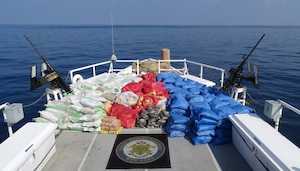
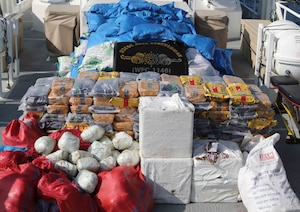
ARABIAN SEA (Dec. 28, 2023) Bags of illegal narcotics seized from a vessel are stacked on the deck of the U.S. Coast Guard Sentinel-class fast response cutter USCGC Robert Goldman (WPC 1142) in the Arabian Sea, Dec. 28. Robert Goldman was operating under Combined Task Force 150, one of five task forces under Combined Maritime Forces, the largest multinational naval partnership in the world. CTF 150 focuses on maritime security operations outside the Arabian Gulf. (Photo by U.S. Coast Guard courtesy photo)

Below is a U.S. Naval Forces Central Command – Combined Maritime Forces – U.S. 5th Fleet news release, followed by a second earlier news release. Something puzzling is that there seems to be a relatively new “catch and release” policy regarding the smugglers and smuggling vessels. 

CMF-assigned Cutter Seizes Hashish and Methamphetamines in North Arabian Sea | January 02, 2024, MANAMA, Bahrain

A U.S. Coast Guard cutter patrolling under the command of Combined Task Force 150 of the Combined Maritime Forces seized hashish and methamphetamines with a total estimated street value of $24.3 million Dec. 28 in the North Arabian Sea.

It was the third seizure by a CMF-assigned cutter in four days, following seizures by USCGC Clarence Sutphin Jr. (WPC 1147) and USCGC John Scheuerman (WPC 1146) of hashish, heroin, methamphetamines and pills with a total estimated street value of $24.5 million Dec. 24 and Dec. 26 in the Gulf of Oman.

A team from USCGC Robert Goldman (WPC 1142), a Sentinel-class cutter, boarded a dhow at approximately 6:30 a.m. local time Dec. 28 after it displayed indicators consistent with illicit drug trafficking.

Aboard, the team discovered over 300 bags of drugs containing 3,514 kilograms of hashish and 417 kilograms of methamphetamines.

The Robert Goldman team released the dhow and disposed of the illicit drugs.

The mission of Combined Task Force 150 is to disrupt the ability of non-state actors to move weapons or drugs, or engage in other illicit activities, in the Gulf of Oman, Arabian Sea and Indian Ocean.

This interdiction marked the twelfth time Combined Task Force 150 assets have seized illegal narcotics at sea since France took command in July 2023.

Combined Maritime Forces is a multinational maritime partnership committed to disrupting criminal and terrorist activities by restricting their freedom of maneuver across approximately 3.2 million square miles of international waters encompassing some of the world’s most important shipping lanes.

Since 2021, units assigned to the Combined Maritime Forces have seized more than $1 billion in illegal drugs while patrolling waters across the Middle East.


CMF Forces Seize Illegal Drugs in Gulf of Oman, January 02, 2024, MANAMA, Bahrain

U.S. Coast Guard cutters assigned to the Combined Maritime Forces seized illegal drugs with a total estimated street value of $24.5 million on Dec. 24 and Dec. 26 from vessels in the Gulf of Oman.

GULF OF OMAN (Dec. 26, 2023) Bags of illegal narcotics seized from a vessel are stacked on the deck of the U.S. Coast Guard Sentinel-class fast response cutter USCGC John Scheuerman (WPC 1146) in the Gulf of Oman, Dec. 26. John Scheuerman was operating under Combined Task Force 150, one of five task forces under Combined Maritime Forces, the largest multinational naval partnership in the world. CTF 150 focuses on maritime security operations outside the Arabian Gulf. (Photo by U.S. Coast Guard courtesy photo)

At approximately 2 p.m. local time (10 a.m. Greenwich Mean Time) on Dec. 24, a team from USCGC Clarence Sutphin Jr. (WPC 1147), a Sentinel-class cutter patrolling under the command of Combined Task Force 150 of the Combined Maritime Forces, boarded a dhow after it displayed several indicators consistent with illicit drug trafficking.

Aboard, the crew discovered 90 kilograms of heroin with an estimated street value of $3.2 million.

After testing and seizing the narcotics, the team disembarked the dhow, allowing it to continue on its journey.

GULF OF OMAN (Dec. 26, 2023) Bags of illegal narcotics seized from a vessel are stacked on the deck of the U.S. Coast Guard Sentinel-class fast response cutter USCGC John Scheuerman (WPC 1146) in the Gulf of Oman, Dec. 26. John Scheuerman was operating under Combined Task Force 150, one of five task forces under Combined Maritime Forces, the largest multinational naval partnership in the world. CTF 150 focuses on maritime security operations outside the Arabian Gulf. (Photo by U.S. Coast Guard courtesy photo)

At approximately 5 a.m. local time (9 a.m. Greenwich Mean Time) on Dec. 26, a team from USCGC John Scheuerman (WPC 1146), a Sentinel-class cutter patrolling under the command of Combined Task Force 150 of the Combined Maritime Forces, boarded a dhow after it also displayed several indicators consistent with illicit drug trafficking.

Aboard, the team discovered 261 kilograms of methamphetamines, 2,936 kilograms of hashish, 142 kilograms of heroin and 75,000 pills with the potential to be abused as opium substitutes, with a total estimated street value of more than $21.3 million.

The John Scheuerman team released the dhow’s crew and disposed of the illicit drugs.

The mission of Combined Task Force 150 is to disrupt the ability of non-state actors to move weapons or drugs, or engage in other illicit activities, in the Gulf of Oman, Arabian Sea and Indian Ocean.

These interdictions marked the tenth and eleventh times Combined Task Force 150 assets have seized illegal narcotics at sea since France took command in July 2023.

Combined Maritime Forces is a multinational maritime partnership committed to disrupting criminal and terrorist activities by restricting their freedom of maneuver across approximately 3.2 million square miles of international waters encompassing some of the world’s most important shipping lanes.

Since 2021, units assigned to the Combined Maritime Forces have seized more than $1 billion in illegal drugs while patrolling waters across the Middle East.

“Allies, partners tap into technology to monitor maritime domain” –Indo-Pacific Defense Forum

Winkel Tripel projection, WGS84 datum, central meridian : 150°E. Source Wikipedia Commons, Author: Eric Gaba

The Indo-Pacific Defense Forum reports,

“Maritime domain awareness (MDA) in the Indo-Pacific is moving from an abstract aspiration to a functional collective security approach for managing the region’s dynamic offshore spaces,” noted an April 2023 article in PacNet, a publication of Pacific Forum, a Hawaii-based foreign policy research institute. “Much of the cost-savings in maritime enforcement activities is due to emerging technologies including access to satellites that provide clearer and more accurate images, as well as artificial intelligence and big data platforms dedicated to vessel tracking, prediction, and anomaly detection.”

There are fusion centers in India, Singapore and Vanuatu. These fusion centers would be useful in wartime, but they are essentially a cooperative exchange of information among maritime law enforcement agencies. In addition to its importance in countering IUU and drug smuggling, better maritime domain awareness may give warning of a terrorist attack. Shouldn’t the US Coast Guard have a fusion center in Alameda under Pacific Area? Probably should be one on the West coast of South America too.

“U.S. Coast Guard Cutter Seizes Illegal Narcotics in Gulf of Oman” –NAVCENT

GULF OF OMAN (Dec. 12, 2023) Coast Guardsmen from the U.S. Coast Guard Sentinel-class fast response cutter USCGC Glen Harris (WPC 1144) seize illegal narcotics thrown over the side of the fishing vessel in the Gulf of Oman, Dec. 12. Glen Harris operates in the U.S. 5th Fleet area of operations to help ensure maritime security and stability in the Middle East region. (Photo by U.S. Coast Guard )

Below is a news release from U.S. Naval Forces Central Command Public Affairs. While apparently drugs were seized, there is no indication they seized the smuggling vessel nor arrested its crew. That seems surprising.


MANAMA, Bahrain —A U.S. Coast Guard ship seized illegal drugs worth over $6 million from a fishing vessel in the Gulf of Oman, Dec. 12.

Crewmembers from the Sentinel-class fast response cutter USCGC Glen Harris (WPC 1144) observed individuals on a fishing vessel throw seven bales of material over the side. The material was discovered to be 174 kilograms of heroin.

Glen Harris arrived in the Middle East region last year and operates from Naval Support Activity Bahrain.

The fast response cutter is part of a contingent of U.S. Coast Guard ships forward-deployed to the region under Patrol Forces Southwest Asia (PATFORSWA). PATFORSWA deploys Coast Guard personnel and ships alongside U.S. and regional naval forces throughout the Middle East.

Footwear Fashion for Boarding Drug Subs

Members of the Coast Guard Cutter Waesche (WMSL-751) law enforcement boarding team inspect a self-propelled semi-submersible (SPSS) in international waters of the Eastern Pacific Ocean, Nov. 20, 2023. The interdiction of the SPSS yielded more than 5,500 pounds of cocaine. In November 2023, Waesche crewmembers seized approximately 18,219 pounds of cocaine, with an estimated street value of over $239 million, during four separate suspected drug smuggling vessel interdictions or events off the coasts of Mexico and Central and South America. (U.S. Coast Guard photo)

It is a small thing but must be slippery boarding one of these at sea. Took a close look at their footwear. Was a bit surprised, but this would make sense. (Click on the photo to enlarge)

“Combined Maritime Forces, U.S. Coast Guard Make $21 Million Drug Seizure in the Gulf of Oman” –NAVCENT

GULF OF OMAN (Nov. 14, 2023) Illegal narcotics seized from a stateless vessel are stacked on the deck of the U.S. Coast Guard Sentinel-class fast response cutter USCGC Emlen Tunnell (WPC 1145) in the Gulf of Oman, Nov. 14. Emlen Tunnell was operating under Combined Task Force 150, one of five task forces under Combined Maritime Forces, the largest multinational naval partnership in the world. CTF 150 focuses on maritime security operations in the Gulf of Oman, Arabian Sea and Indian Ocean. (Photo by U.S. Coast Guard courtesy photo)

Below is a NAVCENT news release.


Combined Maritime Forces, U.S. Coast Guard Make $21 Million Drug Seizure in the Gulf of Oman

By U.S. Naval Forces Central Command Public Affairs | November 20, 2023

MANAMA, Bahrain —

A U.S. Coast Guard cutter crew seized about $21 million worth of illegal drugs from a stateless vessel while operating in the international waters of the Gulf of Oman, Nov. 14.

Coast Guardsmen from the Sentinel-class fast response cutter USCGC Emlen Tunnell (WPC 1145), working under the command of Combined Maritime Forces’ Combined Task Force (CTF) 150, seized 2,000 kilograms of hashish and 384 kilograms of methamphetamine from the vessel during an interdiction operation.

“This new seizure shows once again the operational effectiveness of Combined Maritime Forces assets and nations,” said French navy Capt. Yannick Bossu, CTF 150 commander. “It illustrates that nations from all around the world are committed to regional maritime security in the Indian Ocean alongside their regional partners.”

This event marks the fifth time in recent months the French-led CTF 150 has interdicted illicit narcotics at sea. In those previous operations, CTF ships seized more than 4,522 kilograms of methamphetamine, heroin, and hashish from stateless vessels during interdiction operations, with a street value of more than $94 million.

CTF 150 is one of five task forces under Combined Maritime Forces, the largest multinational naval partnership in the world. CTF 150 focuses on maritime security operations in the Gulf of Oman, Arabian Sea and Indian Ocean.

Since 2021, Combined Maritime Forces has seized more than $1 billion in illegal drugs while patrolling waters across the Middle East.

The 38-nation naval partnership upholds the international rules-based order by promoting security and stability across 3.2 million square miles of water encompassing some of the world’s most important shipping lanes.