More on the Navy’s New MkVI Patrol Boat

NavyMKVIPB

CIMSEC brings us a report on the new MkVI patrol boat. This one written by a former Coastie, Lawrence A. Hajek, reportedly previously he “served active duty with the US Coast Guard’s Deployable Specialized Forces as a Tactical Law Enforcement Team South LEDET Boarding Officer & later as a Sector Boarding Officer.”

We have talked about these boats before. In fact it has been one of the blog’s mot popular posts.

He gives us some indication of the possible concept of they will operations for the class, stating they will operate in pairs and suggesting they may be teamed with LCS. Perhaps not surprisingly Mr. Hajek see great advantage in teaming these boat with Coast Guard deployable boarding teams.

The post has a video (very gung ho) and a particularly good interior shot. There are several workstations with monitors and everyone has a shock mitigating seat.

It appears the crew served weapons mounts on top of the deck house have a panel outboard of the mounts. I suspect they are to provide ballistic protection. This seems like a reasonable precaution, if you are going to put gun crews out in the open. We did talk about protection alternatives three years ago.
American Made Patrol Boats for Qatar

NavyRecognition reports, “The State Department has made a determination approving a possible Foreign Military Sale to Qatar for Mk-V Fast Patrol Boats, equipment, training, and support. The estimated cost is $124.02 million.”

Based on the number of .50 calibers ordered, it appears that this will include four boats.

Looking back, in 2009 DefenseIndustryDaily reported the sale of ten of these craft to the Kuwaiti Navy under the Foreign Military Sales (FMS) Program for $61.6M. Saudi Arabia is also interested in these boats and is reportedly planning to buy 30 at an estimated $1.2B.

These are apparently an extended version of the US Navy Mk5 Speicial Operations Craft. The company web site has more information on both versions.

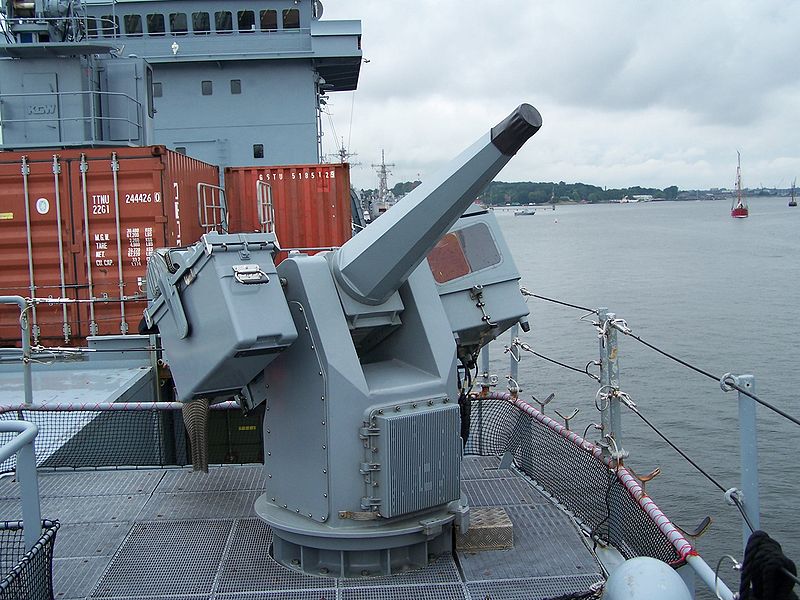
I don’t recognize the 27 mm reportedly included in the Qatar deal as a weapon in US service, but the Germans (Mauser, now Rheinmetall) do make a 27mm and this is the gun used on the Kuwati boats, and it appears to be gun used on the boats for Qatar.

 MLG27 onboard Elbe Class Tender Rhein at the en:Kiel Week 2007. Photo by Rebell18190

MLG27 onboard Elbe Class Tender Rhein at the en:Kiel Week 2007. Photo by Rebell18190

The size of the boat seen on the stern ramp in the video is not clear.

These 90 foot boats is clearly optimized more for speed than our 87 footers. They also have a shorter range and with water jets, are probably less manuverable at the slow speeds often required for SAR.

“Latin American Navies Combat Illegal Fishing”–CIMSEC

CIMSEC has a short background article on the scope of, and reaction to, illegal fishing in Latin America.

You might recognize the ship pictured at the head of the CIMSEC post. It is one of a class we talked about earlier.

The post also talks about the sinking of a Chinese Fishing Vessel by an Argentine patrol vessel, an incident we also discussed here.

The two Peruvian patrol vessels seen launched in the post and in the YouTube video above, BAP Rio Cañete (PM-205) and BAP Rio Pativilca (PM-204), are according to a Google translation of this post,  55.3 meters (181 feet) long, 8.5 meters (28 feet) of beam, and a draft of 2.3 meters (7’7″). They have two diesels totaling 6690 HP for a 22 knot max speed, a range of 3600 miles at 14 knots. The crew is 25 with additional space for up to 14 additional boarding party members to man the two RHIBs carried in davits. They are expected to be armed with a Typhoon weapon system, similar to the Mk38 mod2 but with a 30mm gun plus two .50 cal. Their design is based on the South Korean Taegeuk class cutters.

Commandant’s Strategic Intent, Mid-Term Report

Coast Guard Capt. Douglas Nash, commanding officer of Coast Guard Air Sation Sacramento, salutes a Coast Guard C-27J pilot during a change of watch ceremony at Air Station Sacramento's hanger in McClellan Park, Thursday, July 1, 2016. The ceremony marked the final day that an HC-130 Hercules crew stood the watch at Air Station Sacramento and introduced the newest aircraft. Coast Guard photo by Petty Officer 3rd Class Loumania Stewart

Procurement of 14 C-27J aircraft was one of the achievements sited. C-27Js replace C-130s at CGAS Sacramento. 

The Commandant has issued a mid-term update on his earlier published “Strategic Intent, 2015-2019” (pdf). The new document is available in pdf format. You can find it here: “United States Coast Guard Commandant’s Strategic Intent, 2015-2019, Mid-Term Report.”

It is relatively short and readable at 21 pages. The recurring themes of the Commandant’s administration are all there, starting with TOC (transnational organized crime) and its deleterious effect on Western Hemisphere governance and prosperity. It does read a little like an Officer Evaluation Report input.

There is nothing particularly surprising here, but even for me, the enumeration of the scope the Coast Guard’s authorities, responsibilities, and international contacts is still mind boggling.

I am not going to try to summarize the report, but there were a few things that struck me.

The Commandant mentions service life extension programs for the seagoing buoy tenders (already begun), the 47 foot MLBs, and the 87 foot WPBs (in the future), but there is no mention of what we will do about the inland tender fleet. There will also be a life extension program for helicopters before they are finally replaced.

“Extend the service life of our rotary wing assets and align with DOD’s Future Vertical Lift initiative.”

There is mention of a program I was not aware of, the “Defense Threat Reduction Agency National Coast Watch System project.” The Defense Threat Reduction Agency attempts to track and reduce the WMD threat. It is not really clear what our role is here. We know about the container inspection programs in foreign ports. Is that it, or is there more to this? (that can be discussed at an unclassified level.)

Navy PCs Support Operation Martillo, WPCs Next?

USS_Hurricane_(PC-3),_USS_Typhoon_(PC-5)_and_USS_Chinook_(PC-9)_underway_in_March_2015

Navy photo: The U.S. Navy Cyclone-class coastal patrol ships assigned to Patrol Coastal Squadron 1 (PCRON 1), USS Hurricane (PC-3), USS Chinook (PC-9) and USS Typhoon (PC-5), transit in formation during a divisional tactics exercise in the Persian Gulf.

The Navy has announced they have three 387 ton (fl) Cyclone class patrol craft based in Mayport, rotating through the 4th Fleet’s area in support of Operation Martillo, the counter drug operation off Central America.

We know there are not enough ships to respond to all the intelligence we have on drug trafficing in SouthCom’s area of responsibility.

These little ships are considerably smaller than those we normally send South, but they are very similar in size to the new 353 ton Webber class WPCs. We have six Webber class in Miami, six in Key West, and will soon have six in Puerto Rico. If we could rotate some of these through the Transit zones, they might make a difference.

Thanks to Lee for bringing this to my attention.


Trimaran Patrol Boat

Our friend at NavyRecognition offers this video of the CMN Ocean Eagle 43 prototype built for the Navy of Mozambique, in sea trials in what are reported to be State 5 seas.

There is no displacement listed, but, except in beam, this vessel is notably smaller than the Webber class WPCs (143 ft vs 154 for the Webber class). It has a smaller crew (7) and accommodations (15), but otherwise appears to have similar capabilities with a speed of 30 knots, a range of 3000 miles at 20 knots, and a 7 meter RHIB in a ramp at the stern.

They also advertise a proposed mine hunter version that is more limited in speed and dispenses with the small UAS flight deck in favor of unmanned underwater vehicles for mine hunting and destruction. Assuming the same hull is used, the dimensions for both are 43.6 meter in length, 15.7 meter beam, and two meter draft.

When it comes time to replace the 87 footers, perhaps we should consider something similar, though dealing with the much greater beam might be a bit of a challenge in some places.