Australian Designed Catamaran Patrol Boat for Royal Thai Police

ThaiCatamaranPB_IncatCrowther

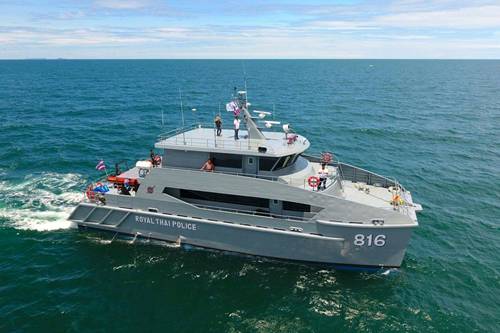
MarineLink reports the delivery of two locally built catamaran patrol boats to the Royal Thai Police, based on an earlier Australian designed vessel.

  • Length Overall: 86’ / 26.2m
  • Max Speed: 34 knots
  • Crew: 2 + 12

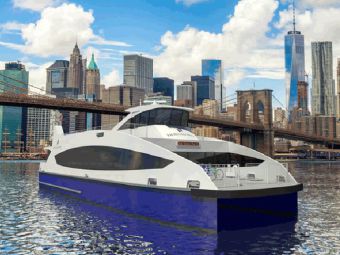
Actually these sound an awful lot like 19 new 26 meter ferries being built by Horizon Shipbuilding, Inc., Bayou La Batre, AL, and Metal Shark Aluminum Boats, Jeanerette, LA for New York City also designed by Incat Crowther.

InnatNYCferries


More on the Navy’s New Design for Maintaining Maritime Superiority

Waesche Carat 2012

This is a post I wrote for CIMSEC. under the title “A Design for Maintaining Maritime Superiority”–A Coastie’s View.” It is an expanded version of an earlier post that appeared here. The rewrite really begins about half way down under the header, “What I Want to See.”

Recently the new Chief of Naval Operations issued a document “Design for Maintaining Maritime Superiority” that outlines how, hopefully, the US Navy can maintain a maritime superiority our foes will recognize and avoid confronting.

If you look for anything specifically regarding the Coast Guard here, you will not find it (other than the cutter in the formation on the cover). The Coast Guard is not mentioned even once, but it does talk about some things that are Coast Guard related. Perhaps the Coast Guard should not feel bad about this. It only mentions the Marine Corps once.

Three Forces that are Changing the Environment

  • The first global force is the traffic on the oceans, seas, and waterways, including the sea floor – the classic maritime system.
  • A second increasingly influential force is the rise of the global information system – the information that rides on the servers, undersea cables, satellites, and wireless networks that increasingly envelop and connect the globe.
  • The third interrelated force is the increasing rate of technological creation and adoption.

Obviously the Coast Guard facilitates and regulates marine traffic, and is tapped into the global information system. In wartime, these contacts will become essential since they will form the basis for naval control of shipping. He also talks about new trade routes opening in the Arctic. These will only be reliable if we have new icebreakers. He also talks about illegal trafficking.

“This maritime traffic also includes mass and uncontrolled migration and illicit shipment of material and people.”

A Document That Explicitly Recognizes the Competition

“For the first time in 25 years, the United States is facing a return to great power competition. Russia and China both have advanced their military capabilities to act as global powers. Their goals are backed by a growing arsenal of high-end warfighting capabilities, many of which are focused specifically on our vulnerabilities and are increasingly designed from the ground up to leverage the maritime, technological and information systems. They continue to develop and field information-enabled weapons, both kinetic and non-kinetic, with increasing range, precision and destructive capacity. Both China and Russia are also engaging in coercion and competition below the traditional thresholds of high-end conflict, but nonetheless exploit the weakness of accepted norms in space, cyber and the electromagnetic spectrum. The Russian Navy is operating with a frequency and in areas not seen for almost two decades, and the Chinese PLA(N) is extending its reach around the world.

“…Coupled with a continued dedication to furthering its nuclear weapons and missile programs, North Korea’s provocative actions continue to threaten security in North Asia and beyond.

“…while the recent international agreement with Iran is intended to curb its nuclear ambitions, Tehran’s advanced missiles, proxy forces and other conventional capabilities continue to pose threats to which the Navy must remain prepared to respond.

“…international terrorist groups have proven their resilience and adaptability and now pose a long-term threat to stability and security around the world.”

Recognizing Budgetary Limitations

“There is also a fourth ‘force’ that shapes our security environment. Barring an unforeseen change, even as we face new challenges and an increasing pace, the Defense and Navy budgets likely will continue to be under pressure. We will not be able to “buy” our way out of the challenges that we face. The budget environment will force tough choices but must also inspire new thinking.”

Throughout there is an emphasis on understanding history and the strategic concepts of the past. There is also a recognition of the need to work with partners.

“EXPAND AND STRENGTHEN OUR NETWORK OF PARTNERS: Deepen operational relationships with other services, agencies, industry, allies and partners – who operate with the Navy to support our shared interests.”

Other than the Marine Corps, the US Navy has no closer partner than the US Coast Guard. And while only about one eighth the size of the US Navy, in terms of personnel, the US Coast Guard is larger than Britain’s Royal Navy or the French Navy. The partnership has been a long and successful one, but I would like to see the Navy be a better partner to the Coast Guard. This is how the Navy can help the Coast Guard help the Navy.

What I Want to See

If we have a “run out of money, now we have to think” situation, one thing we can do is to try to get the maximum return from the relatively small investment needed to make the Coast Guard an effective naval reserve force.

WPC Kathleen_Moore

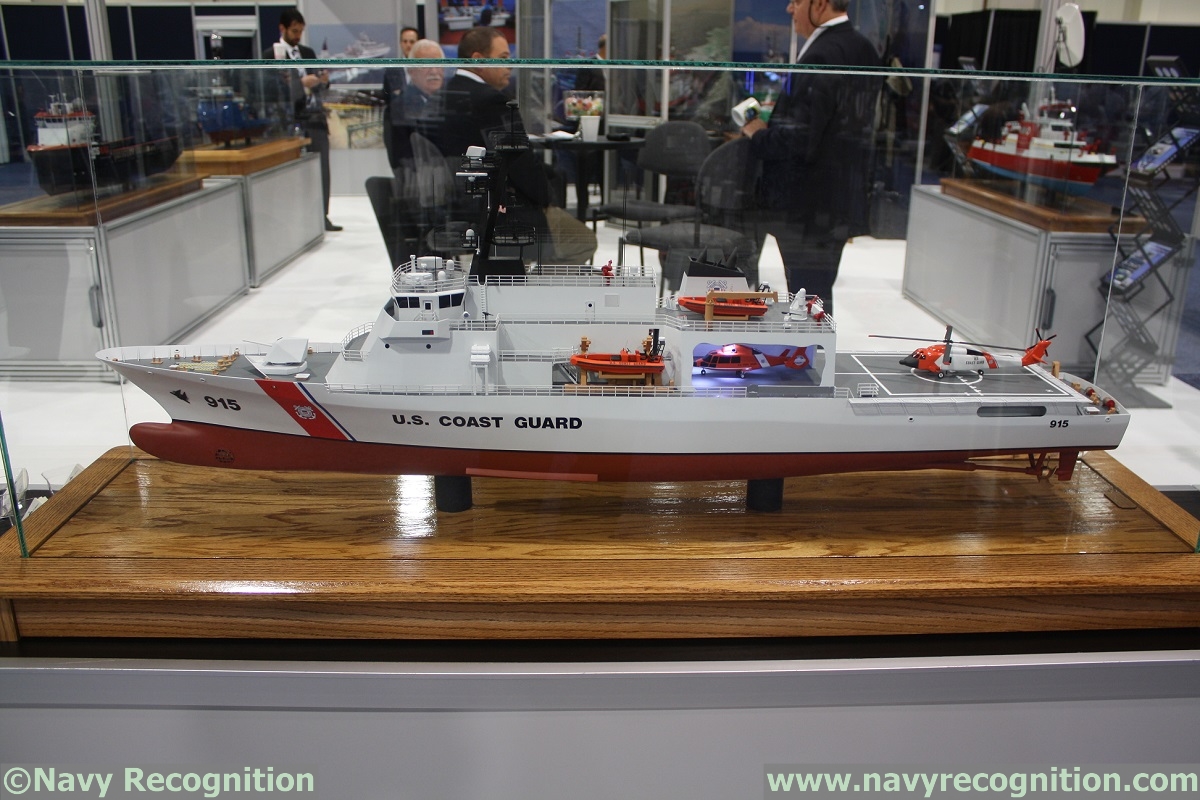
We need explicit support from the Navy at every level, particularly within Congress and the Administration, for Coast Guard recapitalization. While the Navy’s fleet averages approximately 14 years old. The Coast Guard’s major cutters average over 40. The proposed new ships, are more capable than those they replace. They are better able to work cooperatively with the Navy. The nine unit 4,500 ton “National Security Cutter”program is nearing completion with funds for the ninth ship in the FY2016 budget. The 58 unit, 154 foot, 353 ton Webber Class  program is well underway with 32 completed, building, or funded. But the Coast Guard is about to start its largest acquisition in history, 25 LCS sized Offshore Patrol Cutters. Unfortunately, it appears that while the first ship will be funded in FY2018 the last will not be completed until at least 2035. This program really needs to be accelerated.

We need an explicit statement from the Navy that they expect the Coast Guard to defend ports against unconventional threats, so that they can keep more forces forward deployed. This is in fact the current reality. The Sea Frontiers are long gone. Navy vessels no longer patrol the US coast. The surface Navy is concentrated in only a handful of ports. No Navy surface combatants are homeported on the East Coast north of the Chesapeake Bay. If a vessel suspected of being under the control of terrorists approaches the US coast the nearest Navy surface vessel may be hundreds of miles away.

We need the Navy to supply the weapons the Coast Guard need to defend ports against unconventional attack using vessels of any size, with a probability approaching 100%. These should include small missile systems like Hellfire or Griffin to stop small, fast, highly maneuverable threats and we need a ship stopper, probably a light weight anti-ship torpedoes that target propellers to stop larger threats. We need these systems on not just the largest cutters, in fact they are needed more by the the smaller cutters that are far more likely to be in a position to make a difference. These include the Webber class and perhaps even the smaller WPBs.

We need to reactivate the Coast Guard’s ASW program and ensure that all the new large cutters (National Security Cutters and Offshore Patrol Cutters) have an ASW capability, if not installed on all of the cutters, at least planned, prototyped, tested, and practiced on a few ships (particularly in the Pacific). The National Security Cutters and the Offshore Patrol Cutters are (or will be) capable of supporting MH-60R ASW helicopters. Adding a towed array likeCAPTAS-4 (the basis for the LCS ASW module) or CAPTAS-2 would give them a useful ASW capability that could be used to escort ARGs, fleet train, or high value cargo shipments. Towed arrays might even help catch semi-submersible drug runners in peacetime.

IMG_4128

The Coast Guard is the low end of America’s Naval high-low mix. It is a source of numbers when numbers are needed. The Coast Guard has more assets for low end functions like blockade than the Navy. The Navy has about 105 cruisers, destroyers, LCS, PCs, and is not expected to have more than 125 similar assets for the forseeable future. The Coast Guard has about 165 patrol cutters  including 75 patrol boats 87 feet long, about 50 patrol craft 110 to 154 feet in length (58 Webber class WPCs are planned), and about 40 ships 210 foot or larger that can be called on, just as they were during the Vietnam War, when the Coast Guard operated as many as 33 vessels off the coast in support of Operation MarketTime, in spite of the fact that the Navy had almost three times as many surface warships as they do now. The current program of record will provide 34 new generation cutters including nine 4500 ton National Security Cutters and 25 Offshore Patrol Cutters that should be at least 2500 tons.

The Coast Guard provides peacetime maritime security, but is currently under-armed even for this mission. A small investment could make it far more useful in wartime.

(Note there is another post on this looking at the “design” from a Navy point of view.)

Cost of German Built Patrol Boats for Saudi Arabia

NavalToday reports the Saudis are having 15 patrol boats built in Germany by boat builder Lürssen, famous for building missile and torpedo boats.

“German naval shipyard Lürssen has started construction of the 15 patrol vessels for Saudi Arabia under the €1.5 billion (approx $1.63b) contract despite of talks (sic) about cancelling the deal amidst the Middle Eastern country’s public executions early January 2016.”

That is about $109M each for craft of 35 and 38 meters. Our Webber class are 47 meters in length and cost typically $60M. Maybe not a bad deal.

Incidentally, these do not appear to be the 20 to 24 patrol boats 40 to 45 meters in length, discussed earlier as part of the Saudi Naval Modernization.

WAR IN THE SHALLOWS, VIETNAM, 1965–1968

WAVPmarkettime

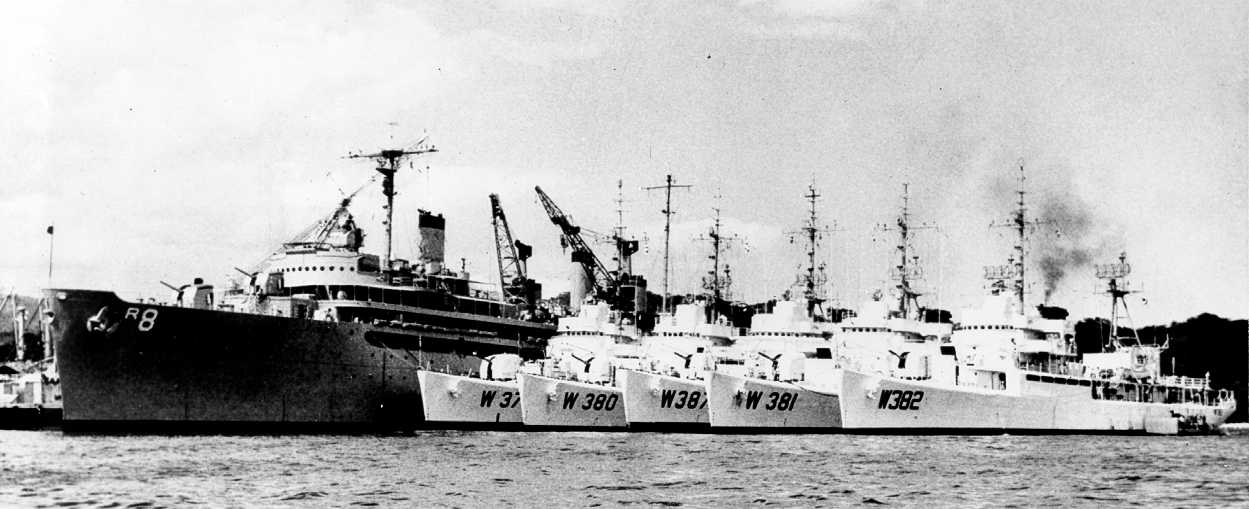
Photo: “COAST GUARD IN VIETNAM: Five white 311-foot cutters of the recently established Coast Guard Squadron Three assigned to “Market Time” coastal surveillance in South Vietnam are tied up alongside Navy repair ship USS JASON (AR-8) after arriving at Subic Bay, P.I.  From the left are the USCGC HALF MOON, USCGC YAKUTAT, USCGC GRESHAM, USCGC BARATARIA, and USCGC BERING STRAIT.” Coast Guard Photo Rel. No. 6201; 4 August 1967; photo by CDR Richard Morse, USCG, commanding officer of Barataria.”

There is a new book available that includes extensive coverage of the Coast Guard role in the Vietnam war. Best of all it is free and is available for download in pdf format. Just click on the link.

WAR IN THE SHALLOWS, U.S. NAVY COASTAL AND RIVERINE WARFARE IN
VIETNAM, 1965–1968

Yes, I know it says US Navy, but it does seem to give the Coast Guard its due, despite the title.

Thanks to Lee for bringing this to my attention.

Coast Guard Outlook 2015-2016

http://issuu.com/faircountmedia/docs/uscg15#embed

DefenseMediaNetwork has published an online version of the new “Coast Guard Outlook.” I have not read it all, there is a lot there, 164 pages. Fortunately, it allowed me to embed it above.

It includes an interview with the Commandant, a story about the 100 year history of Coast Guard Aviation, one about the Coast Guard in Vietnam, and another about the Offshore Patrol Cutter, along with several others.

When I first brought it up, the print was too small to read comfortably on my laptop, but you have two ways to get a larger view. Clicking on the page twice enlarges it (maybe too large). There is also a slider at the lower left that changes the size of the page you are viewing. Unfortunately neither adjustment is carried over when you go to the next page.

Thanks to Lee for bringing this to my attention.


Azerbaijan CG’s New WPC and WPB

AzerbaijanSaar62

Photo: Azerbaijan Coast Guard’s first Saar 62. Source: President’s Office, Azerbaijan

We have talked about these before, but now we have more details, particularly about how they are equipped.

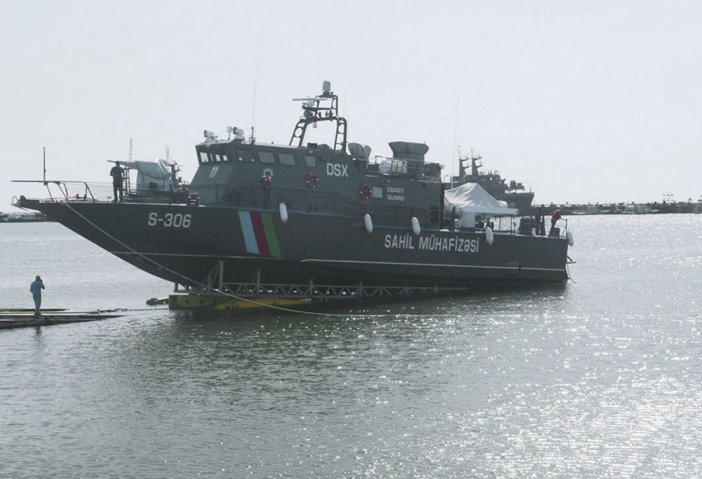
Janes 360 reports the launching of two new vessels for the Azerbaijan Coast Guard, the first of up to six helo deck equipped, 203 foot, 470 ton, 32 knot Sa’ar 62s based on the Israeli Sa’ar 4.5 missile boat, and a sixth 32.65 m-long, 95-ton Shaldag Mk V.

AzerbaijanShaldagMkVFAC

Photo: Azerbaijan Coastguard’s sixth Shaldag Mk V (Azerbaijan State Border Guard Service)

Both types use the Typhoon gun mount which is basically the same as the Mk38 mod2 used by the Coast Guard, except that, instead of using the 25 mm chain gun, these use a Soviet era 23 mm, with a higher rate of fire. Both use the Toplite Electro-Optic fire control system that is also part of the Mk38 mod2.

Most interesting, they are armed with small missile systems. the larger vessels will have an eight cell launcher for the 25 kM range Spike-NLOS.

TYPHOON MLS NLOS configuration has eight Spike NLOS missile launchers and integrated Toplite stabilized observation and target acquisition system. Photo: RAFAEL

TYPHOON MLS NLOS configuration has eight Spike NLOS missile launchers and integrated Toplite stabilized observation and target acquisition system. Photo: RAFAEL via defense-update.com

The smaller vessels have a four tube launcher for the 8 km range Spike-ER.

Azerbaijan’s neighbors on the Caspian Sea are Russia to the North, Iran to the South, and Turkmenistan and Kazakhstan on the other side of the water. They have a small navy in addition to their Coast Guard, but these will constitute a substantial reinforcement. There is appears to be a miniature naval arms race going in the Caspian Sea.


Trimaran Patrol Boat

Our friend at NavyRecognition offers this video of the CMN Ocean Eagle 43 prototype built for the Navy of Mozambique, in sea trials in what are reported to be State 5 seas.

There is no displacement listed, but, except in beam, this vessel is notably smaller than the Webber class WPCs (143 ft vs 154 for the Webber class). It has a smaller crew (7) and accommodations (15), but otherwise appears to have similar capabilities with a speed of 30 knots, a range of 3000 miles at 20 knots, and a 7 meter RHIB in a ramp at the stern.

They also advertise a proposed mine hunter version that is more limited in speed and dispenses with the small UAS flight deck in favor of unmanned underwater vehicles for mine hunting and destruction. Assuming the same hull is used, the dimensions for both are 43.6 meter in length, 15.7 meter beam, and two meter draft.

When it comes time to replace the 87 footers, perhaps we should consider something similar, though dealing with the much greater beam might be a bit of a challenge in some places.

ASuW Hellfire Test Success–Operational Late 2017

Navyrecognition reports that a successful test of modified Hellfire missiles for use in the Surface to Surface Missile Module (SSMM) planned for the Littoral Combat Ship has paved the way for operational deployment of the system in late 2017.

We have talked about these missiles before. They seem to be an ideal way to deal with the threat of small, fast, highly maneuverable boats that might be employed by terrorists, and absent more effective weapons, may provide some capability against even large vessels. Unlike gun systems, they promise high first round accuracy and lethality, with very little chance of a round going astray and hitting something unintended.

The projected SSMM would provide storage and launch facilities for up to 24 rounds. 24 rounds would weigh only about 2500 pounds. The launcher and support systems is unlikely to weigh more than that, suggesting and all up weight of about 5000 pounds, far less than either the 76mm Mk75 gun or the 57mm Mk110 (two and a half tons compared to eight or nine tons). Both of these guns are commonly used on missile and patrol boats smaller than the Webber class WPCs. Also unlike a gun system, the SSMM is unlikely to require any significant deck reinforcement.  It would almost certainly fit on all large cutters and perhaps the WPCs and WPBs as well. (It should be included on Offshore Patrol Cutters from day 1.) If the 24 round system is too large to be comfortably carried by smaller cutters, it is likely a smaller, say four round, system could be quickly and economically developed for Coast Guard use and perhaps for the Navy’s MkVI patrol boat as well.

If we take the Ports, Waterways, and Coastal Security mission seriously we really should be looking seriously at acquiring these systems, not just for the new ships as they are built, but also for the existing fleet with the idea that the systems would be transferred to the newer ships as the older ones are replaced.

The Navy should be willing to pay for these systems under existing inter-service agreements.

As noted before, if we need to stop a terrorist attack, we are far more likely to have a WPC or WPB on scene than a larger cutter. For this reason, arming some the Webber class in each homeport should be the first priority. Unfortunately the Webber Class are not geographically wide-spread, so we should look at mounting systems on existing MECs and WPBs to insure all potential targets have some protection until the entire fleet is armed.

I would say there are places where they might be mounted on Coast Guard stations ashore, to act as gate keepers for the ports against clandestine attacks, but coast defense is still an Army mission. Perhaps this is something we should be talking about too. If not Coast Guard manned defenses (which is probably the proper solution), then perhaps placement of unused SSMMs with their associated Navy crews on Coast Guard facilities or small detachments of army troops with their weapons to perform this function.

US to Help Fund Vietnamese Patrol Boats

Metal-Shark-75-Defiant-Firefighting-Fireboat-Craft

“The Metal Shark 75 Defiant Patrol boat, capable of achieving 40+ knots. For the ideal balance of performance, economy, and reliability, twin Caterpillar C32 diesels mated to Hamilton HM-651 waterjets will propel the vessel to speeds in the 30-knot range.” Photo via DBA METAL SHARK

gCaptain is reporting that the US has pledged $18M to help Vietnam buy US made patrol boats. gCaptain does not specifically state which boats will be bought or how many, but the choice of illustration above certainly suggests that they will be Metal Shark 75 Defiants. There is more information on this boat here.