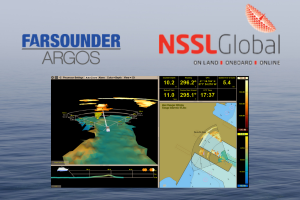
FarSounder 3D Forward Looking Sonar

Below is a heavily edited news release. I have no personal knowledge of the product, so this is not an endorsement, but if it does what is says, it sounds very useful.

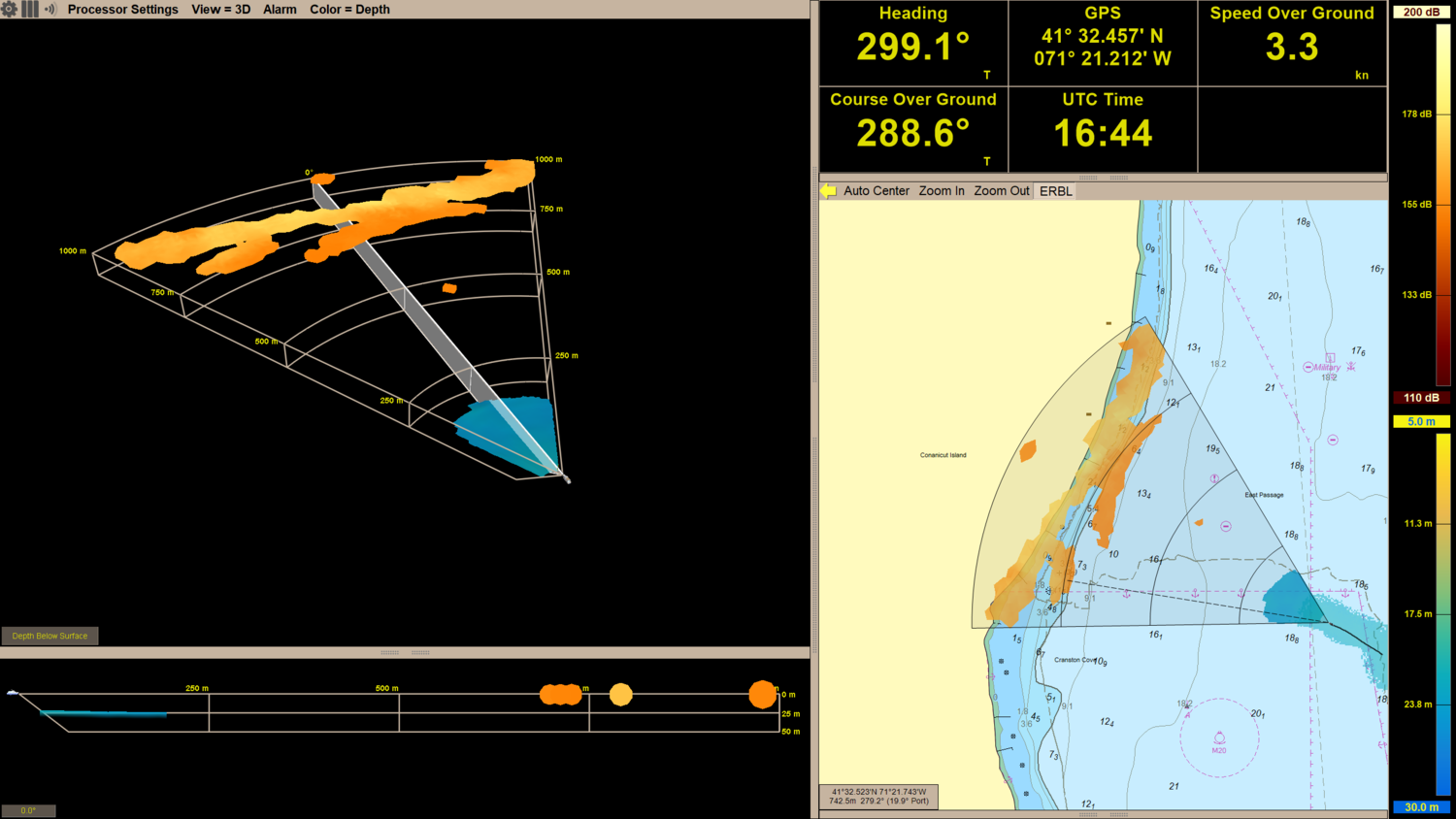
In a near shore SAR case, how close can you get in shallow water? After a natural disaster, are there unknown obstructions? Can you leave the channel to avoid a collision or get to a distressed vessel faster?

We have talked about FarSounder before. They make three different models,

  • Argos 350, range 350 meters at speeds up to 18 knots, for vessels as small as 14 meters (about 45 feet, e.g. the size of a response boat, medium).
  • Argus 500, range 500 meters at speeds up to 20 knots
  • Argus 1000, range 1000 meters at speeds up to 25 knots

There is a retractable version of Argus 1000 available for icebreakers.

I have sonar on my car now, so shouldn’t I have it on my boat?

October 18, 2023
Warwick, RI USA


For immediate release:

NSSLGlobal expands product portfolio with FarSounder’s innovative 3D Forward Looking Sonar

FarSounder and NSSLGlobal have joined forces to introduce FarSounder’s Argos product line to their defense, commercial, and leisure clients. These innovative Forward Looking Sonars (FLS) are used for safe navigation and obstacle avoidance. FarSounder’s technology is renowned in the cruise and leisure markets and is increasingly being adopted in both the Scientific/Exploration and Defence sectors both of which are moving towards Unmanned Surface Vessels (USV).

Vessels are often operating in more challenging environments such as higher latitudes where there may be ice, poorlyFarSounder/NSSL Global chartered areas, or austere ports. This unique patented technology paints a clear picture of what lies ahead underwater of the vessel, reducing the likelihood of collisions, which in turn prevents costly damage to property, the environment, and marine and human lives alike.

NSSLGlobal’s customers will benefit from FarSounder’s technology, which is the only product capable of generating a true, 3-dimensional image ahead of a vessel at navigationally significant ranges at each ping of the sonar. FarSounder’s most recent addition is the Argos 350 Forward Looking Sonar system which is the ideal solution for USVs and mid-sized vessels ranging from 18 – 40+ meters.

For more information, visit http://www.farsounder.com

“Christening and Launch Ceremony for U.S. Coast Guard’s First Offshore Patrol Cutter Friday, October 27, 2023” –Eastern Shipbuilding

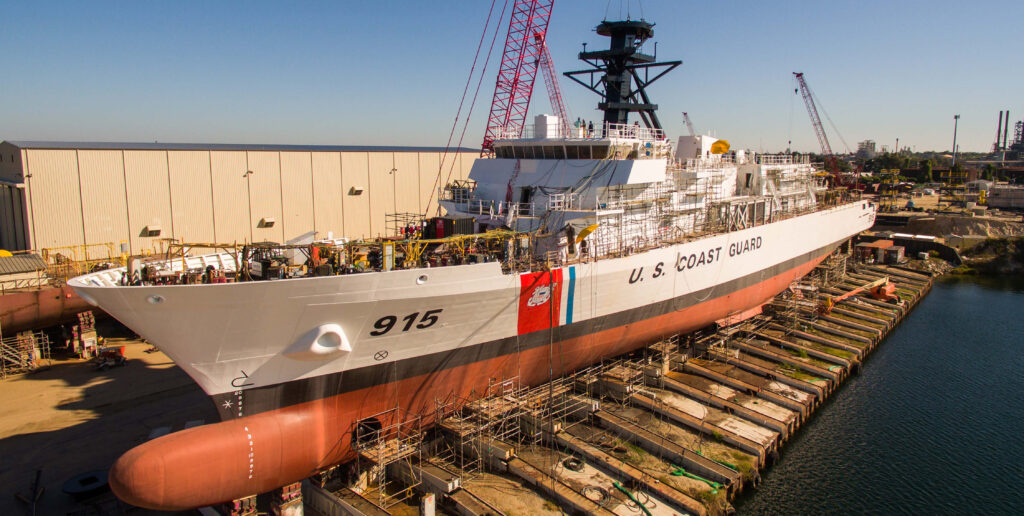
Future USCGC Argus building at Eastern. Eastern Shipyard photo.

Below is a news release from Eastern Shipbuilding. Good to see. 

MEDIA ADVISORY

Tuesday, October 17, 2023

Eastern Shipbuilding Group to Host Christening and Launch Ceremony for U.S. Coast Guard’s First Offshore Patrol Cutter

Friday, October 27, 2023

What:  Christening and Launch Ceremony for USCGC ARGUS (WMSM – 915)

Who:

Joey D’Isernia, CEO, Eastern Shipbuilding Group, Inc.

Admiral Linda Fagan, Commandant, USCG

Captain (Ret.) Beverly Kelley, Sponsor

Rear Admiral Chad L. Jacoby, Assistant Commandant for Acquisitions & Chief Acquisition Officer, USCG

Where: Eastern Shipbuilding Nelson Facility

2200 Nelson Street, Panama City, FL

When: Friday, October 27, 2023 – 1:00 PM central set up / 2:00 PM central event

The Christening and Launch of U.S. Coast Guard Offshore Patrol Cutter ARGUS (WMSM-915) is scheduled to take place at Eastern Shipbuilding Group’s Nelson Shipyard on October 27, 2023. The christening of the lead vessel of the Heritage Class Offshore Patrol Cutters is a historic event for the Coast Guard and marks the beginning of a new fleet of national security assets that will support critical missions at sea for decades to come. The christening ceremony is a time-honored tradition in shipbuilding that will recognize the history and significance of ARGUS and her sponsor, Capt. Beverly Kelley.

Request Media Credentials:
Please email Jessica Ditto at jditto@easternshipbuilding.com by Tuesday, October 24, 2023 to request media credentials and parking instructions.

FRC #54, “Fifth New England-based Fast Response Cutter to be commissioned in New Castle” –D1

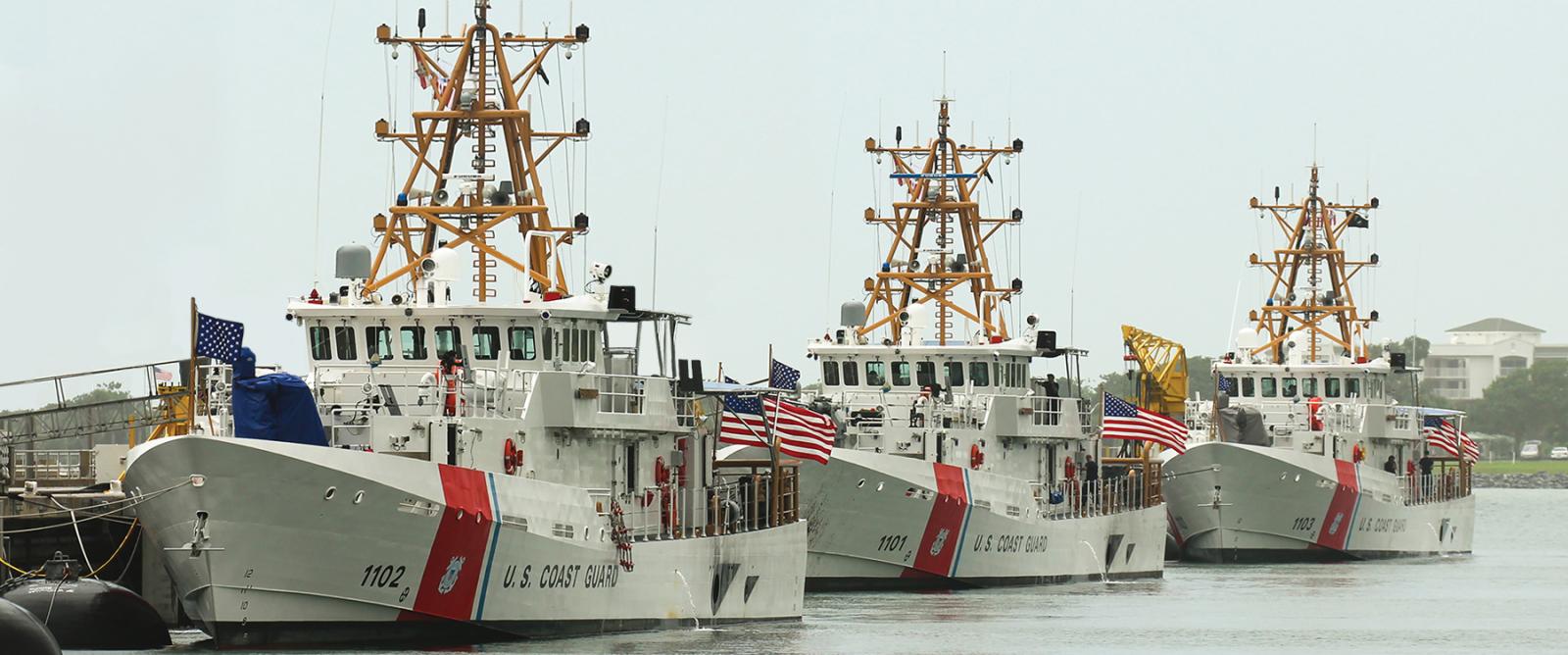
Sister ships. The first three fast response cutters—the USCGC Richard Etheridge (WPC-1102), Bernard C. Webber (WPC-1101), and William Flores (WPC-1103). U.S. COAST GUARD

Below is a news release from District 1. This is #54 with 11 more in the pipeline. The last will probably arrive in 2026 unless more are added.


Oct. 16, 2023

CORRECTED MEDIA AVAILABILITY: Fifth New England-based Fast Response Cutter to be commissioned in New Castle

Editors’ Note: This correction notes updated time for the ceremony and arrival, as well as ship information.
Media interested in attending the ship’s commissioning ceremony are requested to RSVP with d1publicaffairs@uscg.mil no later than 4 p.m. Wednesday, October 18th. Media are requested to arrive by 8:30 a.m. to clear security and be escorted to the event, and must provide media credentials and government-issued photo ID.

WHO: Lt. Jacklyn Kokomoor, commanding officer of Coast Guard Cutter William Sparling (WPC-1154), Caroline S. Sparling, the cutter’s sponsor, along with additional Sparling family members

WHAT: Commissioning ceremony for the Coast Guard Cutter William Sparling

WHEN: Thursday, October 19th, at 9 a.m.

WHERE: 25 Wentworth Rd New Castle, NH 03854

BOSTON — The Coast Guard Cutter William Sparling (WPC-1154) is scheduled to be commissioned during a ceremony Thursday at 9 a.m.

The Coast Guard’s newest cutter was accepted by the Coast Guard on July 20, 2023 and will be the fifth of six Fast Response Cutters homeported in Boston.

The Sentinel-class fast response cutter (FRC) is designed for multiple missions, including drug and migrant interdiction; ports, waterways and coastal security; fishery patrols; search and rescue; and national defense. The Coast Guard has ordered a total of 65 FRCs to replace the 1980s-era Island-class 110-foot patrol boats. The FRCs feature advanced command, control, communications, computers, intelligence, surveillance and reconnaissance equipment; over-the-horizon cutter boat deployment to reach vessels of interest; and improved habitability and seakeeping.

William Sparling was one of the first Coast Guard enlisted members to be awarded the Silver Star Medal, one of the nation’s highest military awards for valor in combat. Sparling served as a landing craft coxswain during the Battle of Tulagi, a strategically important island in the Pacific theater, during World War II. The island was captured by enemy forces in May 1942, and Allied forces were concerned that the occupation of Tulagi would be used to threaten Allied units and supply routes in the region. Allied forces arrived at Tulagi on August 7, 1942, to reestablish control of the island.

The amphibious assault, supported by the landing craft piloted by Sparling and other coxswains, was the first U.S. offensive of World War II and was one of the first in a series of battles that defined the Guadalcanal campaign. During the invasion, Sparling and other coxswains landed the first wave of U.S. Marines from USS McKean on the beaches of Tulagi. Over the next three days of fighting, Sparling and others made repeated trips between the Navy destroyer and Tulagi to deliver equipment, ammunition and other supplies to Marines as they engaged a determined occupying force of 800 troops. On August 9, the remaining enemy forces surrendered, and the Allies successfully secured Tulagi.

Buoy Tender, FRC, C-130 Used for International Fisheries Enforcement–Operation Southern Shield

PERU, 10.06.2023, Courtesy Photo, USCG District 11
San Francisco based USCGC Alder (WLB-216) raises the South Pacific Regional Fisheries Management Organization (SPRFMO) flag while patrolling the Eastern Pacific Ocean during Operation Southern Shield in October 2023. The Coast Guard recently completed the first high-seas boardings and inspections off the coast of Peru under a newly adopted multi-lateral agreement to monitor fishing and transshipment operations within the SPRFMO Convention Area, a region which encompasses nearly a quarter of the Earth’s high seas. (U.S. Coast Guard photo by Petty Officer 2nd Class Kenneth Honore)

Below is a District 11 news release. It came with 24 photos. I have included a few here. The captions are informative. I have edited some of the captions to include homeports and minimize duplication. I have also added a few links and the schematic below.

SPRFMO CONVENTION AREA
This schematic is available only to illustrate the Area of application of the SPRFMO Convention, which is described in legal terms in Article 5. The schematic is not part of the Convention text and has no legal status; it is not intended to reflect exactly the maritime spaces of adjoining coastal states.
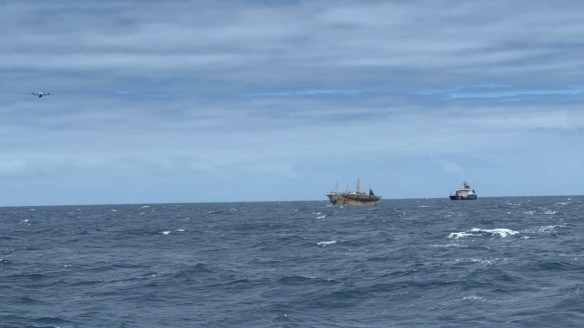
PERU, 10.07.2023, Courtesy Photo, USCG District 11
The Coast Guard Cutter Alder approaches a squid fishing vessel while CG-2007, a C-130 from Air Station Barbers Point in Hawaii, flies over (upper left) during Operation Southern Shield 2023, October 2023. The Coast Guard recently completed the first high-seas boardings and inspections off the coast of Peru under a newly adopted multi-lateral agreement to monitor fishing
and transshipment operations within the South Pacific Regional Fisheries Management Organization (SPRFMO)Convention Area. (U.S. Coast Guard photo)

LIMA, PERU, 10.06.2023, Courtesy Photo, USCG District 11
The aircrew of the Coast Guard 2007, an HC-130 based out of U.S. Coast Guard
Air Station Barbers Point, Hawaii, poses for a picture with observers from the Peruvian Navy and Air Force, in Lima Peru, October 2023. During the course of two weeks, Peruvian observers accompanied the USCG aircrew as they conducted overflights of the fishing fleet on the high seas during Operation Southern Shield 2023. (U.S. Coast Guard photo by pilot-in-charge, Lt. Zachary Hunter)

There was a Webber Class WPC involved as well. This follows the pattern of pairing a WLB with an FRC for distant operations that we have also seen in the Western Pacific.
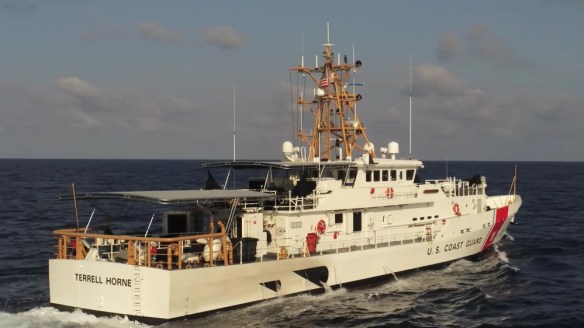
PERU, 10.06.2023, Courtesy Photo, USCG District 11
The crew of San Pedro based USCGC Terrell Horne (WPC-1131) conducts a patrol in the Eastern Pacific Ocean in support of Operation Southern Shield 2023, October 2023. (U.S. Coast Guard photo)

These operations followed an international exercise, GALAPEX 2023.

09.23.2023, Courtesy Photo, USCG District 11
Participants in GALAPEX 2023 pose for a group picture following a law enforcement boarding exercise during GALAPEX 2023, Sept. 23, 2023. Coast Guard Cutters Alder and Terrell Horne conducted a boarding of Ecuador Bae Isla Floreana as the first major exercise and introduction to GALAPEX, a recurring multi-national maritime exercise led by Ecuador and included participation with delegates from Argentina, Brazil, Chile, Colombia, Costa Rica, the European Union, France, Italy, Mexico, Panama, Peru, the United Kingdom, and the United States. (U.S. Coast Guard photo by Lt. j.g. Kimberly Byron)
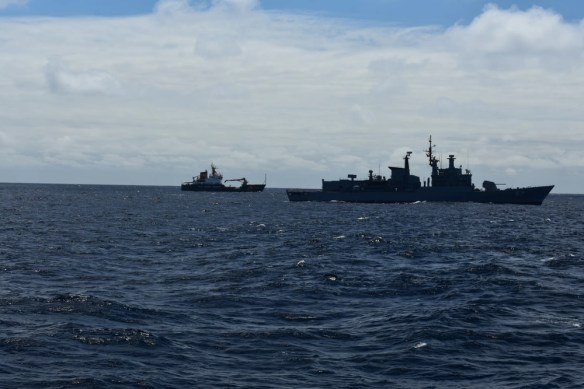
09.25.2023, Courtesy Photo, USCG District 11
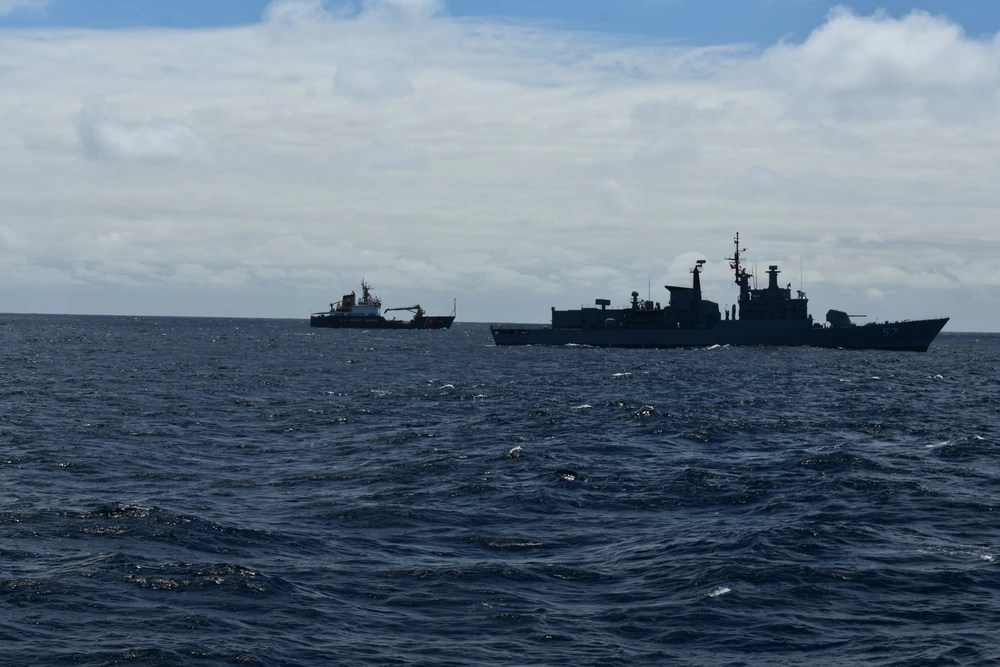
U.S. Coast Guard Cutter Alder (background) transits in formation alongside Peru BAP (Buque Armada Peruana) Bolognesi (FM-57) as it prepares for the next exercise during GALAPEX 2023, Sept.25, 2023. (U.S. Coast Guard photo)


 Oct. 16, 2023

Coast Guard Cutter crews conduct first high-seas boardings off the coast of Peru, under new SPRFMO measure

ALAMEDA, Calif. — The crews of the Coast Guard Cutters Alder, Terrell Horne and an HC-130 Hercules aircraft recently completed the first high-seas boardings and inspections, in the Eastern Pacific Ocean, under a newly adopted conservation and management measure to monitor and inspect fishing and transshipment operations at-sea in the South Pacific Regional Fisheries Management Organization (SPRFMO) Convention Area.

As part of Operation Southern Shield, the Coast Guard conducted boardings and overflights within the SPRFMO Convention Area on the high seas off the coast of Peru. For years, the Coast Guard has executed counter-illegal, unreported, or unregulated (IUU) fishing operations and participated in high seas boarding inspections (HSBI) around the globe. This operation was significant as it was timed to implement newly adopted rules in the SPRFMO Convention Area, which comprises nearly a quarter of the Earth’s high seas. The SPRFMO Commission consists of 17 members from Asia, Europe, the Americas, and Oceania, as well as two cooperating non-contracting parties. The primary species targeted in the Convention area are jack mackerel and jumbo flying squid.

Just prior to Operation Southern Shield, the Coast Guard participated in GALAPEX 2023, a recurring joint and multinational exercise hosted by Ecuador and executed in the vicinity of the Galapagos Islands. The Coast Guard conducted communications exercises, practiced counter-narcotics boarding scenarios, and hosted observers from Peru, Ecuador, and Brazil. GALAPEX culminated with full-scale exercises focused on a coordinated multinational response to counter IUU fishing. At the conclusion of the exercise, the Coast Guard patrolled south to focus on high seas boarding inspections off the coast of Peru.

“The U.S. Coast Guard remains committed to conducting combined maritime operations and exercises throughout the Eastern Pacific and will continue to capitalize on every opportunity to work with, learn from, and coordinate through our partners,” said Capt. James O’Mara, Chief of Enforcement for Coast Guard 11th District.  “The relationships our services build while planning and executing these operations are essential. The logistics required to enable these operations are significant, and it only happens with the tremendous support of partners like Ecuador and Peru.”

IUU fishing has replaced piracy as the leading global maritime security threat. Areas out on the high seas, beyond any country’s exclusive economic zone, can be exploited by fishermen engaged in IUU fishing, as they fish beyond the reach of most law enforcement entities. The Coast Guard’s actions provide inspection presence on the high seas among a distant water fishing fleet made up of more than 400 fishing and transshipment vessels. Much of the fishing in the Eastern Pacific is accomplished by these distant water fishing vessels, some which remain at sea for years at a time, and many of which are supported by transshipment vessels. The Coast Guard’s recent operation directly supported Central and South American partners and their desire to monitor and expand maritime domain awareness of fishing activity near their exclusive economic zones.

Each day during the operation a Coast Guard C-130 aircraft flew sorties over the fishing fleet on the high seas with observers from the Peruvian Navy and Air Force. The crew of the Coast Guard Cutter Terrell Horne also diverted to assist the Peruvian Navy in a search and rescue operation. The Terrell Horne located the vessel, then transported an injured fisherman back to shore to receive further medical care from local Peruvian officials.

“The U.S. Coast Guard is committed to working with our allies and partners to strengthen the international fisheries enforcement regime and stop the pervasive IUU fishing threat,” said Rear Adm. Andrew Sugimoto, commander, Coast Guard 11th District. “Operation Southern Shield is just the latest example of that commitment, and we will continue to model and support rules-based order. We applaud the SPRFMO Commission for adopting these latest inspection guidelines and hope to see additional management measures adopted in the future to ensure the sustainability of our ocean resources. Last year we operated off the Galapagos, this year off the coast of Peru, and we will continue to deploy aircraft, cutters, and personnel to support our partners and monitor these distant water fleets wherever they roam. These operations help bring like-minded countries closer together to protect vulnerable fish stocks, support the economic stability of coastal nations, the livelihoods of small-scale and artisanal fishermen, and safeguard ocean resources that fuel global populations and economies.”

Israeli Sa’ar 6 Corvette Conducts Shore Bombardment

The C-Dome air defense system mounted on Sa’ar 6 corvette includes a 40-round canister located at the front deck and loaded with vertically-launched Tamir surface-to-air missiles for 360-degree coverage. (Picture source NavalAnalyses.com)

Naval Technology reports that Israel had employed at least one newly commissioned Sa’ar 6 corvette to conduct shore bombardment with its 76mm gun.  We discussed this class earlier here, “Perhaps the Most Well Armed Cutter Sized Corvette in the World.”

Also found this video, which looks more like it was done by a 25mm (except the last 22 seconds), with some secondary explosions.

“Israel Navy takes out Hamas terrorists with grenades and machine guns after sinking boat” –Video

Felt I had to pass along this video, taken from what looks a lot like a Response Boat, Small. The accompanying narrative,

“An Israeli Navy patrol eliminates Hamas terrorists whose boat has been destroyed in this footage from the October 7 attacks. Soldiers from the Snapir harbour security unit throw grenades and open fire at Hamas fighters as they swim towards Zikim beach. Dvora class patrol boats had destroyed the terrorists’ inflatable boats. Several Hamas fighters made it to shore at Zikim and attacked a military training base and a Kibbutz. More than 1,000 Israelis died in the attacks.”

I would point out that following the Battle of the Bismarck Sea in March 1943, when US Army Air Corps and Allied aircraft sank eight loaded Japanese transports and four of their escorting destroyers, US Navy PT boats had a similar unpleasant task, killing the survivors in the water, rafts, and lifeboats so that they could not make it to Lae, a nearby island and their original intended destination, and continue the fight.

During the Vietnam War concussion grenades were also commonly used against combat swimmers.

There was also this video, apparently taken through the sighting system of a Remote Weapon Station, probably very similar to the Mk38 Mod2/3. This seems to be related to the incident in the video above.

The accompanying Narrative,

“On July 8, five Hamas terrorists infiltrated Israel from the sea near Zikim in order to carry out an attack. The IDF neutralized the terrorists through a combined effort of the ground, air and naval forces. This footage shows the Israel Navy targeting one of the terrorists on the beach.”

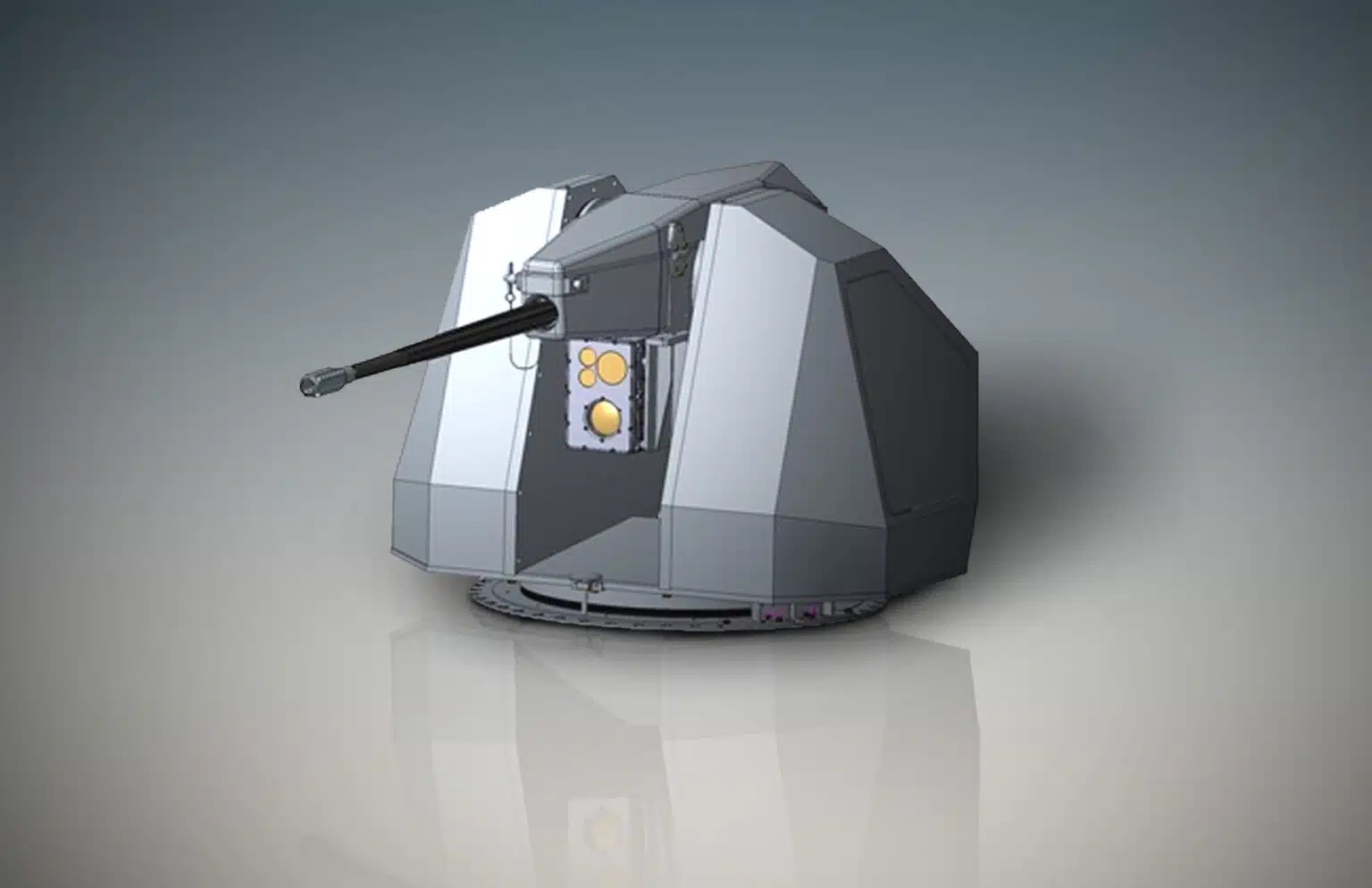
Greek Island Class Cutters to be Armed With Lionfish 20mm Remote Weapon Station

LIONFISH 20 RWS (Leonardo image)

Two separate reports from Naval News (here and here) that four Island class cutters being transferred to the Greek Navy will be equipped with the Leonardo Lionfish 20mm Remote Weapon Station.

The weapon has a reported rate of fire of up to 1000 rounds per minute with 250 rounds on the mount, and an effective range of at least 2000 meters.

Unlike the Mk38 Mod2/3/4 mounts, traversing the electro-optics also requires training the gun.

NSC #10 Delivered

Former Master Chief of the Coast Guard, Vince Patton, reported his attendance at the delivery ceremony for the tenth National Security Cutter on the Coast Guard Retired Veterans Facebook page,

“An enjoyable day with the crew of the USCGC CALHOUN as it has officially been signed over to the USCG today. The CALHOUN will be officially commissioned on April 20, 2024 in Baltimore, MD.”

The ship is expected to be homeported in Charleston, SC.

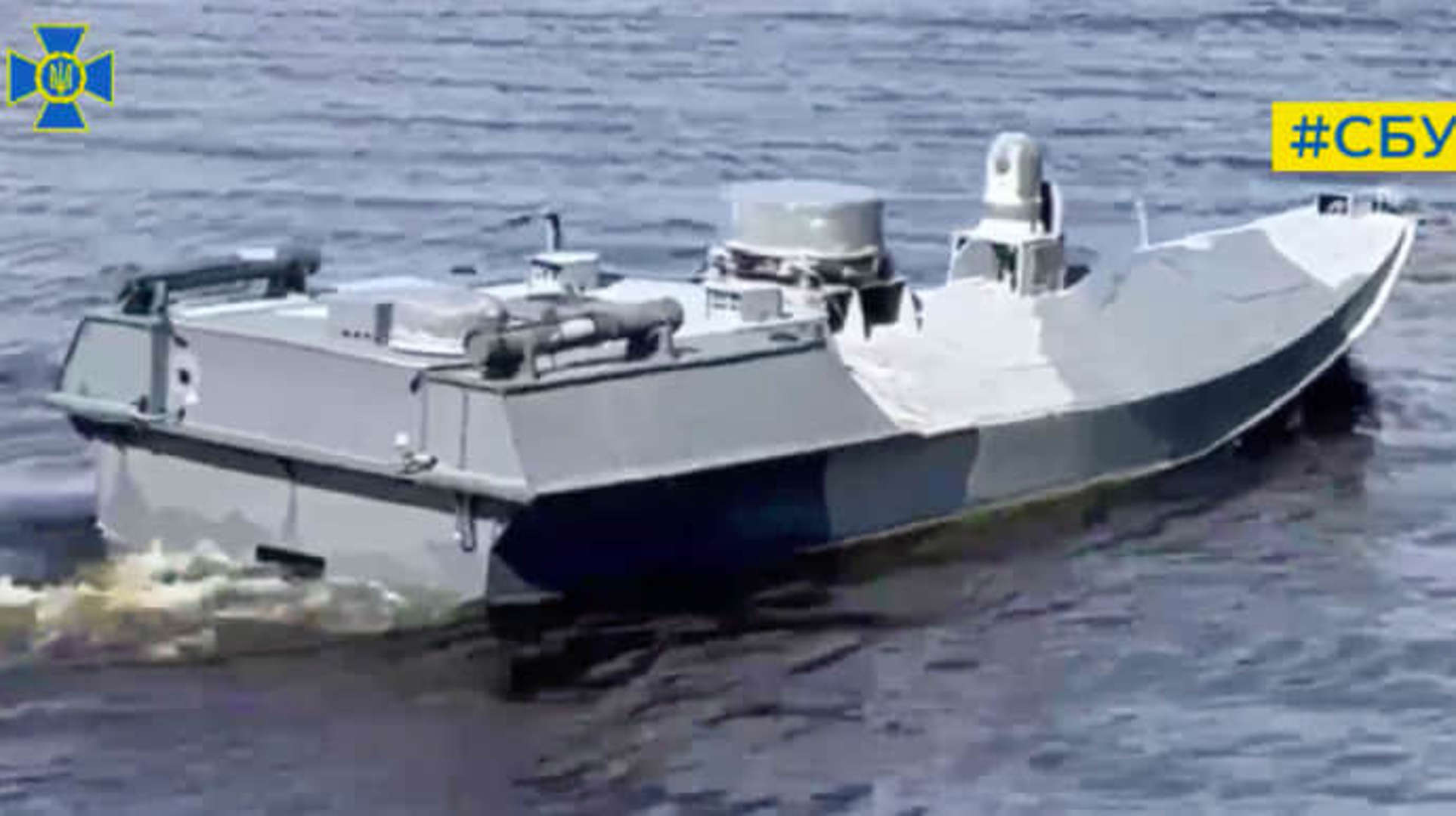
“Ukraine hits Russian Buyan cruise missile carrier and Pavel Derzhavin vessel with drones” –Ukrainska Pravda

©Sea Baby dron. screenshot.
© Ukrainska Pravda

Ukrainska Pravda reports,

The Security Service of Ukraine, together with the Ukrainian Navy, has attacked the Buyan cruise missile carrier and the ship Pavel Derzhavin using experimental weapons on uncrewed surface vessels…both vessels were hit by Sea Baby drones with experimental weapons.

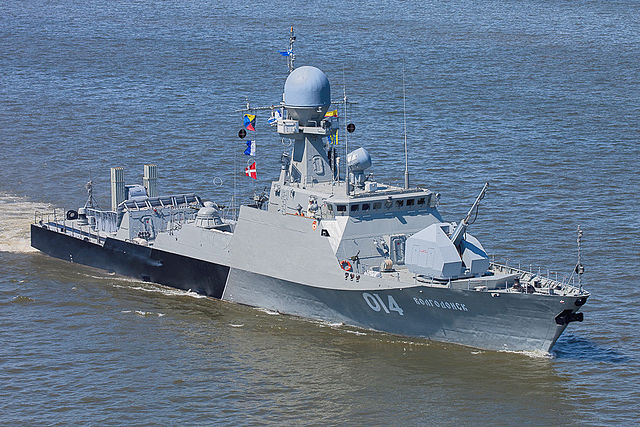
The Buyan cruise missile carrier or Buyan-M (that is the name of the class, not a specific ship) is a small, 949 ton full load, 75 meter (246′) corvette armed with up to eight cruise missiles similar in capability to the American Tomahawk.

Buyan-M class corvette, Volgodonsk in Astrakhan. Author Anton Blinov, via Wikipedia.

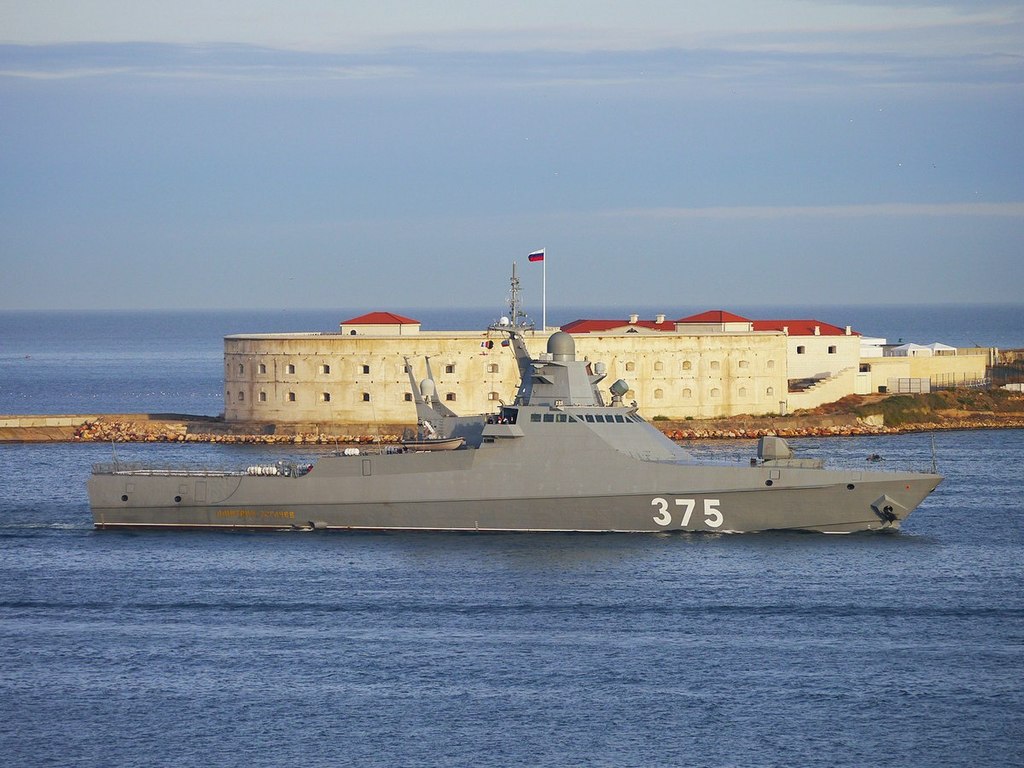
Pavel Derzhavin is a Project 22160 class patrol ship, a bit bigger than the Buyan-M at 94 meters (308 ft) in length, but not as heavily armed.

Russian Project 22160 Patrol Ship Dmitriy Rogachyov in Sevastopol, 12 April 2019. Photo from Ministry of Defence of the Russian Federation.

I found the reference to “Sea Baby drones with experimental weapons” interesting, not that the Sea Baby drone was experimental, so I presume the warhead was experimental. Various reports seem to indicate the explosion was extremely loud and created a great deal of smoke. This could have been the result of secondary explosions.

It is not clear if the two ships were sunk.

Information about the source here.