U.S. Navy Decommissions Last Patrol Craft Stationed in Bahrain –NAVCENT

DAHLGREN, Va. (Nov. 6, 2004) Coast Guard Cutter Shamal (WPC-13) patrols the Potomac River near the Naval Surface Warfare Center in Dahlgren, VA. On Sept. 29, 2004, USS SHAMAL was transferred to the U.S. Coast Guard in Little Creek, VA and placed in Commission Special status. After a two-month dockside availability at Integrated Support Command Portsmouth, SHAMAL will make itstransit to her new homeport of Pascagoula, MS., where it will be officially commissioned on December 6, 2004. SHAMAL’s planned major missions will be alien migrant and drug interdiction operations within the D7 and D8 AORs. MS. USCG photo by Joseph P. Cirone,USCGAUX

Below is a NAVCENT news release. More a Navy story than a Coast Guard one, but a class of ships the Coast Guard not only worked closely with, but also operated. Their departure puts an even greater load on the six Patrol Forces SW Asia Webber class cutters.

U.S. Navy Decommissions Last Patrol Craft Stationed in Bahrain

By U.S. Naval Forces Central Command Public Affairs | March 28, 2023

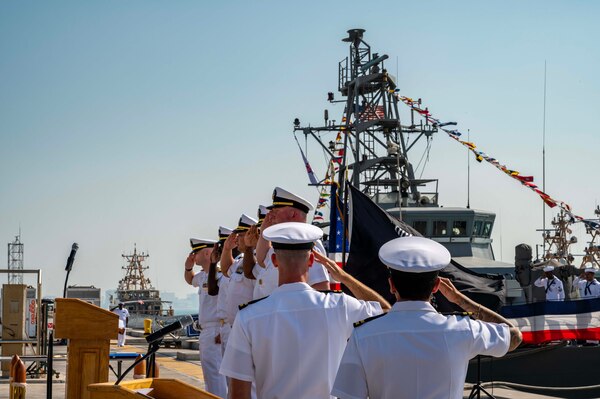
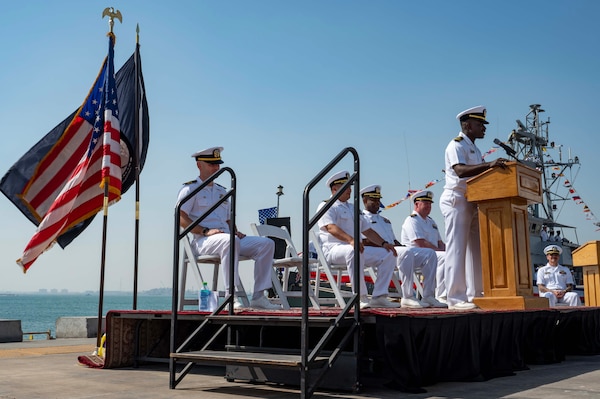
The U.S. Navy decommissioned the last two Cyclone-class patrol coastal ships stationed at Naval Support Activity Bahrain, March 28, during a pierside ceremony attended by U.S. 5th Fleet officials.

Leaders and crewmembers of USS Monsoon (PC 4) and USS Chinook (PC 9) marked the end of nearly three decades of U.S. naval service.

“I’m honored to be a part of the legacy on this waterfront,” said Lt. Cmdr. Dre Johnson, during the ceremony. “PC Sailors are a unique bunch, and only they can understand the amount of work they’ve done and the pride they have in what they’ve accomplished.”

Johnson is Monsoon’s last commanding officer. The U.S. Navy initially commissioned the ship in 1994 and then recommissioned it in 2008 after Monsoon served four years in the U.S. Coast Guard. Chinook was commissioned in 1995.

“With 28 years of crew covering multiple generations, each one was dedicated to the mission, adapting to rapidly changing mission sets, and working together as a team to accomplish whatever obstacle that came their way,” said Lt. Cmdr. David Hartmann, Chinook’s commanding officer.

Monsoon and Chinook are the last of a group of 10 ships designed for shallow-water operations that were stationed in Bahrain. The Middle East region includes 5,000 miles of coastline from the northern Arabian Gulf, around the Arabian Peninsula, through the Red Sea and Suez Canal.

Last year, the U.S. Navy decommissioned and transferred five patrol craft to the Royal Bahrain Naval Force: former ships USS Tempest (PC 2), USS Typhoon (PC 5), USS Squall (PC 7), USS Firebolt (PC 10) and USS Whirlwind (PC 11). Additionally, the U.S. Navy decommissioned and transferred former ships USS Hurricane (PC 3), USS Sirocco (PC 6) and USS Thunderbolt (PC 12) to the Egyptian Navy last week during a formal ceremony in Alexandria, Egypt.

Monsoon and Chinook are slated for transfer to the Philippine Navy. Officials from the Philippines attended the ceremony.

“I’m proud of our crews for reaching this milestone and representing our nation and Navy with utmost pride and professionalism,” said Capt. Anthony Webber, commander of Task Force 55, which oversees operations for U.S. 5th Fleet’s surface forces. “I’m also proud that we are turning over great ships to our Philippine partners.”

Bahrain, Egypt and the Philippines are members of the largest multinational naval partnership in the world called Combined Maritime Forces (CMF). Led by the United States, forces from the organization’s 38 nations operate across approximately 3.2 million square miles of international water space in the Middle East. The partnership ensures maritime security and stability in some of the world’s most important shipping lanes.

Another Rotary Wing Air Intercept (RWAI) Mission

MH-65E interior.

Below is a news release from the Acquistions Directorate (CG-9). This is only the second “Rotary Wing Air Intercept” (RWAI) unit that I have heard of, but this may be a trend. The first unit has been flying over the Washington DC area since the 9/11 attack. Over time, it is likely the realization of a need for air policing will grow, and it looks like at the low and slow end of the spectrum, the Coast Guard is getting the job. 


Air Station Savannah plays key role in airspace security during SpaceX launches

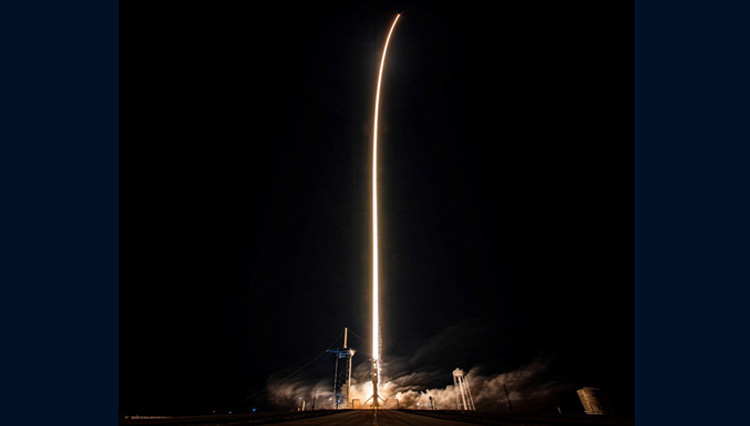
SpaceX Crew-6 launch

The SpaceX Crew-6 launch underway March 2, 2023. Photo courtesy of SpaceX.


Pilots from Air Station Savannah’s Rotary Wing Air Intercept (RWAI) unit stood ready to take to the skies March 2 in the air station’s new MH-65E Dolphin helicopter to provide security support for the manned SpaceX launch from Cape Canaveral, Florida. While this is the first time that the new Echo model was deployed, it marked the seventh launch for which the air station has provided critical flight restriction enforcement since NASA resumed manned space flights in 2020.

All airspace surrounding a space launch is restricted by the Federal Aviation Administration. The highly trained RWAI crew is poised to fly in very close quarters and intercept any unfamiliar aircraft that might trespass into the restricted airspace during a launch. Pilots who fly for the unit possess exceptional flight skills and decision-making abilities as the mission dictates pilots fly in extremely close quarters with other aircraft in order to intercept them.

The upgraded MH-65E helicopter is also more qualified for the task – the Echo configuration automates more flight control functions through use of the Common Avionics Architecture (CAAS) and Automatic Flight Control systems, allowing pilots to set parameters like altitude limits to prevent accidental overclimb into uncontrolled airspace. This and other upgrades ensure that pilots are able to focus on flying the mission with heightened awareness.

“The Echo drastically increases situational awareness and allows for much more complex mission calculations,” says RWAI pilot Lt. Cmdr. Sam Ingham. “This creates larger safety margins in an inherently dangerous environment.”

According to Aviation Special Missions policy director Lt. Cmdr. Mike Gibson, Air Station Savannah has sent NASA-requested RWAI resources to every official U.S. Government human spaceflight launch as part of Operation Noble Eagle. The latest launch was supported by Lt. Cmdr. Felipe Guardiola, Lt. Cmdr. Michael Gonzales and Petty Officer 2nd Class Connor Covert.

“NASA and the Coast Guard have a great relationship, and we’re happy to come down and help where we can,” said Ingham. “Also, it’s cool to have front row seats to watch rockets go to space.”

The MH-65 Conversion and Sustainment Program regularly receives feedback from the operational fleet on how the capabilities of the upgraded Echo allow the crew to continually be safer and more efficient when executing the mission. “It’s really incredible to hear from these crews that the upgrades to the Echo model are increasing their situational awareness,” said Cmdr. Karyn Forsyth, acquisition program manager for the MH-65. “Crews have more confidence in CAAS and its capabilities, especially when performing these special missions.”

The Coast Guard short range recovery helicopter program delivered the fifth and final MH-65E to Air Station Savannah Jan. 18, making it the ninth air station to fully transition to the upgraded configuration.

For more information: MH-65 Short Range Recovery Helicopter Program page

The National Fleet Plan–Redux

US Coast Guard cutter Munro transits the Taiwan Strait with US Navy destroyer USS Kidd in August. US Navy

A recent discussion with frequent contributor Peter Ong, lead to Peter pointing to “The National Fleet Plan.

It was an important publication for the Coast Guard and its interface with the Navy. It portended the FRCs in Guam and WMECs in Pensacola. Among other things, it listed equipment to be included in cutter classes, much of it supplied by the Navy (p.24). I did a post on it.

Trouble is, while much of the information is probably still accurate, it was published in August 2015. Maybe it is time for new edition.

“Coast Guard to Send Additional Cutter to Hawaii” –Military.com

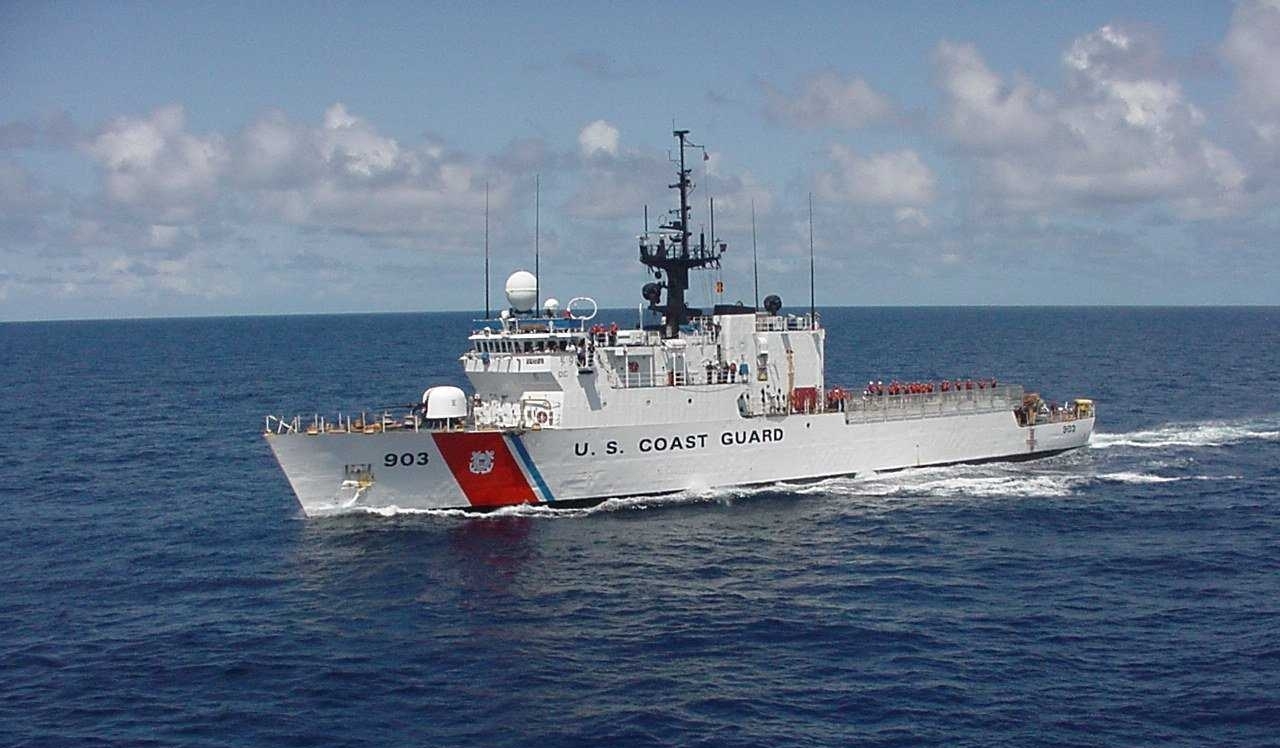
USCGC Harriet Lane (WMEC-903), March 17, 2009. US Coast Guard photo. She may look a little different now having gone through the Service Life Extension Program.

Military.com reports USCGC Harriet Lane is to be the new “Indo-Pacific Support Cutter,” and that she will be based in Honolulu beginning early FY2024. This is a change of homeport from Portsmouth, VA.

We knew this was coming, and Harriet Lane was the likely candidate. She will be the only WMEC 270 in the Pacific and will be used to counter Illegal, Unregulated, Unreported (IUU) fishing in the US EEZ and that of our friends and allies. They will also probably do a lot of training with friendly maritime law enforcement agencies. Her capabilities are a good match for the role. WMEC270s have been doing similar tasks off West Africa for years.

Thanks to Walter, a former dirt dart, for bringing this to my attention.

USCG Posture Statement, 2024 Budget Overview

US Capital West Side, by Martin Falbisoner

The Coast Guard has published their FY2024 Budget Overview. It is a 40 page document but easily readable. It is much more than a tabular budget request. In fact you don’t get to the actual budget summary until page 26. It is, after all, an attempt to justify the budget. There is a lot of why the Coast Guard is needed, what we have done for you lately, and what we are going to do in the future. It is pretty impressive.

Bottom line. The budget request is for about $13.45B of which $12.05B is discretionary funding, of which $1.55 is Procurement, Construction, and Improvement (PC&I).

The PC&I budget request is actually down a bit.

Procurement, Construction, and Improvements (in thousands)

  • 2021 enacted        2,264,041
  • 2022 requested     1,639,100
  • 2022 enacted        2,030,100
  • 2023 requested     1,654,858
  • 2023 enacted      $2,080,100

You can see how Congress has tended to add to the amount requested, which is why I believe several of the items on the Unfunded Priorities List will ultimately be funded.

There is a more complete comparison with the enacted FY 2022 and 2023 budgets on page six of this document.

Coast Guard’s FY2024 Unfunded Priority List

The crew USCGC Oliver Henry (WPC 1140) visit Ulithi Atoll on Oct. 31, 2022, the first time a fast response cutter visited the atoll and delivered 20 boxes of supplies, 50 personal floatation devices, and sporting equipment donated by the cutter crew, the extended U.S. Coast Guard Guam family, Ulithi Falalop Community Action Program, Guam Island Girl Power Foundation, and Ayuda Foundation. Ulithi was a central U.S. staging area during World War II, and home to a U.S. Coast Guard Loran-C communications station from 1944 to 1965 before operations relocated to Yap and ultimately shuttered in 1987. (U.S. Coast Guard photo by Petty Officer 3rd Class Zena Suzuki)

The Coast Guard has published its FY2024 Unfunded Priority List. The ten page document includes 26 line items totaling $1.6B. Much of it is infrastructure improvement, but there are also items to expand capabilities.

Four Additional Fast Response Cutters:

The single largest item is four additional Webber class WPCs. I think this will be approved and that this includes funding of facilities for a new base in American Samoa.

$400M “Funds the acquisition of four FRCs to further the Indo-Pacific Strategy of the United States through expanded presence and engagement to promote a free an open Indo-Pacific. Additional FRCs will begin to transform the Coast Guard from an organization which currently provides episodic presence, to be persistent and visible, strengthening coordination with Allied and partner nations to bolster regional security.”

Historically FRCs have been funded at about $65M each, and even that included support costs in addition to construction costs. There has been inflation, but the list gives us some information about that effect in a separate line item.

$34M “Fast Response Cutter (FRC) Economic Price Adjustment (EPA). Funding aids in reducing unfunded EPA growth resultant from the unprecedented rise in material and labor indices associated with contractual costs for production of hulls 1145 -1164 and procurement of spares. This amount provides the $34 million necessary for the projected EPA liability in FY 2024.

That is $34M spread over 20 ships or an increase of less than $2M per ship, so there is probably at least $120M for support costs over and above construction costs.

Aviation Improvements (note the third item indicates C-27Js will be assigned to CGAS Clearwater, FL, presumably replacing the C-130Hs there now)

  • $138.5M One Missionized HC-130J Aircraft. rovides funding to purchase one missionized HC-130J aircraft in the Block Upgrade 8.1 configuration, manufactured by Lockheed Martin, and currently missionized by L3 Technologies. This funding supports acquisition costs for one of the unfunded three missionized C-130Js required to achieve the Coast Guard’s current program of record of 22 airframes and initial sparing.
  • $113M Four MH-60T Aircraft. Provides funding to outfit and assemble 4 MH-60T aircraft that would facilitate a future Air Station transition from MH-65s to MH-60s in FY 2026. These aircraft would be assembled at the Coast Guard’s Aviation Logistics Center in Elizabeth City, NC.
  • $25M Sparing for Fixed-Wing Aircraft Transitions. Provides initial sparing to establish on-site inventory for HC-130J and HC-27J aircraft planned for delivery to Barbers Point, HI, ($10 million) and Clearwater, FL ($15 million). This funding includes spare parts for aircraft, sensor suites, depot maintenance material, and ground support equipment necessary for aircraft operations as well as LLTM required to accelerate the missionization of HC-27J aircraft. (Scalable)

Infrastructure improvements are requested for:

  • Polar Security Cutter (PSC) Homeport Seattle (Phase 1-2), $130M
  • FRC Homeport Astoria (Phase 2), $30M
  • Waterways Commerce Cutter (WCC) Homeports – Sault Ste Marie, MI and Memphis, TN, $48M
  • NSC and Ocean-Going Buoy Tender (WLB) Homeport – Honolulu, HI (Phase 2), $15M
  • Offshore Patrol Cutter (OPC) Homeport – NAVSTA Newport, RI (Phase 2), $100M
  • Training Center Cape May -Multipurpose Recruit Training Facility, $130M
  • Alaska Housing (Kodiak), $26M
  • Sector Facilities – Sector Sault Ste Marie, MI, $35M
  • Consolidated Base Facilities – Base Charleston, SC, $22.6
  • Coast Guard Yard Upgrade: Ship Handling Facility – Baltimore, MD (Phase 1), $60M
  • Sector Facilities – Sector Lower Mississippi River – Memphis, TN, $37M
  • Station Waterfront – Station Rockland, ME, $40.7M
  • Mission Support Facility (MSF) – Joint Base Andrews, MD (Phase 3), $20M

Miscellaneous:

  • Great Lakes Icebreaker – Long Lead Time Material (LLTM), $20M
  • Special Purpose Craft (MLB)– Heavy Weather Recapitalization, $24M
  • Mariner Credentialing Program, (Navita) Acquisition, $11M
  • National Security Cutter (NSC) –Follow-On Acquisition Funding, $50M
  • National Security Cutters Operational Support Initiatives, $9.7M
  • Operations and Defense Industrial Base, $42M
  • Recruiting & Retention, $9m
  • Modernized Learning Management System, $3M

What does it all mean:

None of these items are in the current budget request, but Congress has historically added to the Coast Guard request. The Coast Guard has been shy about providing an unfunded priority request in the past. Several years there was no unfunded priority list. This is the first time I have seen mention of the Coast Guard’s list in industry news publications (here and here). The new CG administration is making public a good case for increased funding.

We shouldn’t expect everything on the list to be approved, but I think we will definitely see the additional C-130 and at least three additional FRCs. Some of the other items will probably be approved as well. Those items not funded in FY2024 will likely be included in the FY2025 budget.

Pacific NW WMEC-210s Doing Drug Interdiction

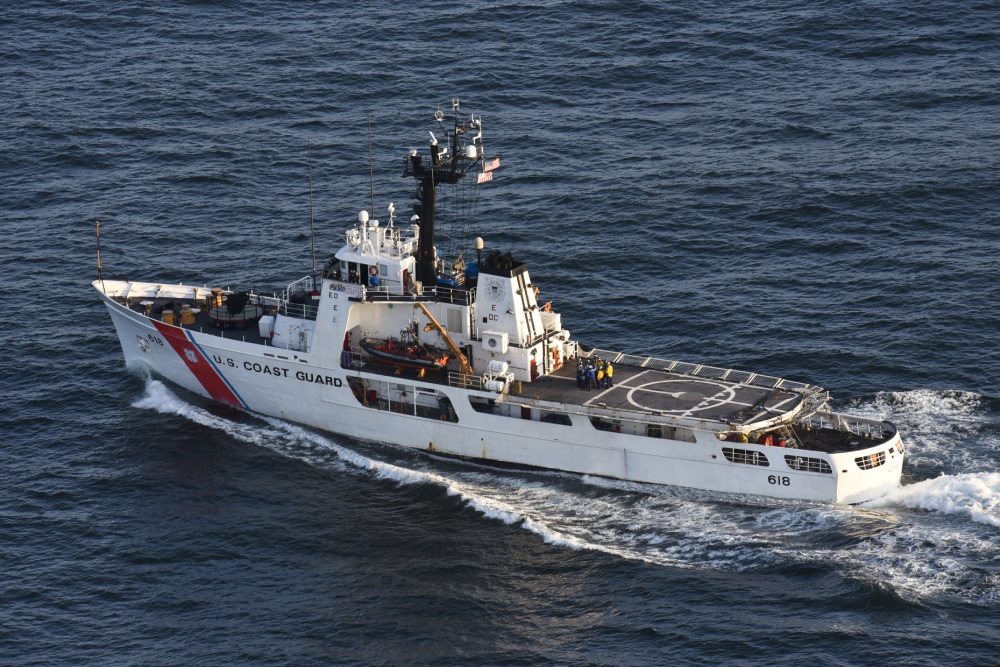
USCGC Active (WMEC 618) Aug. 16, 2019. Active is a 210-foot Medium Endurance based out of Port Angeles, Wash. (U.S. Coast Guard photo by Petty Officer 2nd Class Steve Strohmaier)

Below is a news release from the Coast Guard News website. What I would like to talk about is here:

  • The Waesche’s crew was responsible for two interdictions seizing approximately 881 pounds of cocaine and 9,500 pounds of marijuana. 
  • The crew of the Coast Guard Cutter Steadfast (WMEC 623) was responsible for one interdiction, seizing approximately 3,300 pounds of cocaine. 
  • The crew of the Coast Guard Cutter Active (WMEC 618) was responsible for two interdictions seizing approximately 2,116 pounds of cocaine and 3,716 pounds of marijuana.

The two WMECs, each over 50 years old, probably each seized drugs of higher street value than the 13-year-old National Security Cutter (NSC) that is about four times as large. No, they are not necessarily better at drug interdiction than the NSC. There is a lot of luck involved, but it does seem to suggest that, as the saying goes, “quantity has a quality all its own.

There are simply not enough cutters (or Navy ships) to interdict all the known smugglers being tracked.

Earlier, when the current Commandant was Commander PACAREA, we saw some attempts to use Webber class Fast Response Cutters (FRC) in the Eastern Pacific drug transit zones. For some reason those efforts don’t seem to have been continued. Perhaps their endurance was a problem.

There can be little doubt the Coast Guard needs more cutters, yet the current program of record will supply 8 fewer large cutters than we had in the year 2000. We need more large cutters, but they don’t all have to be 4500 tons.

Frankly, I do think they should be bigger than 210s. You can make a very capable cutter of around 2,000 tons with a crew smaller than that of the 210s, but we don’t seem to have been doing the analysis that would clearly identify our needs.

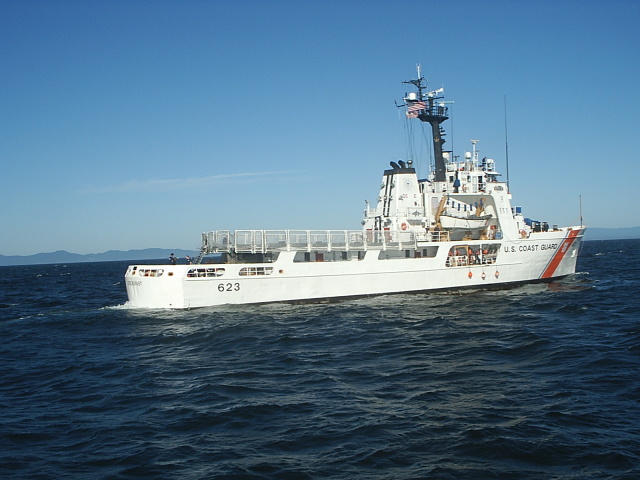
USCGC Steadfast (WMEC-623) (This is an old photo, given the hard sided boat and davits.)

 March 28, 2023

MEDIA ADVISORY: Coast Guard to offload approximately 6,325 pounds of cocaine and more than 13,000 pounds of marijuana in San Diego

WHO: Capt. Robert Mohr, commanding officer, Coast Guard Cutter Waesche, Alexandra (Sasha) Foster is the Criminal Chief in the Southern District of California U.S. Attorney’s Office

WHAT: The crew of the Coast Guard Cutter Waesche is scheduled to offload approximately 6,325 pounds of cocaine and more than 13,000 pounds of marijuana, worth more than $166 million, seized from the drug transit zones of the Eastern Pacific Ocean.

WHEN: Wednesday at 9:30 a.m.

WHERE: 10th Avenue Marine Terminal, 1150 Terminal St., San Diego, CA 92101

Editor’s Note: Media interested in attending should arrive no later than 9 a.m., and bring a government-issued photo ID, press credentials, proof of vehicle registration and insurance. Media will be escorted to the event location following security screening.

SAN DIEGO — The crew of the Coast Guard Cutter Waesche (WMSL 751) offloaded more than 6,325 pounds of cocaine and more than 13,000 pounds of marijuana estimating a value worth more than $166 million on Wednesday, in San Diego.

The interdictions were made late February and early March during four separate joint effort interdictions:

  • The Waesche’s crew was responsible for two interdictions seizing approximately 881 pounds of cocaine and 9,500 pounds of marijuana.
  • The crew of the Coast Guard Cutter Steadfast (WMEC 623) was responsible for one interdiction, seizing approximately 3,300 pounds of cocaine.
  • The crew of the Coast Guard Cutter Active (WMEC 618) was responsible for two interdictions seizing approximately 2,116 pounds of cocaine and 3,716 pounds of marijuana.

U.S. agencies from the Department of Defense, Department of Justice and Homeland Security coordinated in the effort to combat transnational organized crime. The U.S. Coast Guard, U.S. Navy, Customs and Border Protection, FBI, Drug Enforcement Administration, and Immigration and Customs Enforcement, along with allied and international partner agencies, served a vital role in counter-drug operations. The fight against drug cartels in the Eastern Pacific requires unity of effort in all phases from detection, monitoring and interdictions, to criminal prosecutions by U.S. Attorneys in districts across the nation

The U.S. Coast Guard Cutter Waesche (WMSL-751) is the second Legend-class cutter of the United States Coast Guard and is homeported at Coast Guard Island in Alameda, Calif. Waesche, the second of eight planned National Security Cutters, is 418 feet long with a top speed of 28 knots and a range of 12,000 nautical miles. The cutter is equipped with a flight deck and hangars capable of housing two multi-mission helicopters, and outfitted with the most advanced command, control, and communications equipment.

“Coast Guard awards contract for work on coastal buoy tenders” –CG-9

USCGC Ida Lewis

Below is a news release from the Acquisition Directorate (CG-9) about the next class of ships that will go through the “In-Service Vessel Sustainment Program,” the 175 foot, 840 ton, Ida Lewis or “Keeper” class 175 foot Coastal Buoy Tenders.

“…the primary objective of the MMA is to ensure that the 14 tenders reach the end of their 30-year designed service life…The 175-foot coastal buoy tenders were commissioned between 1996 and 2000. Work on the first hull, Coast Guard Cutter Ida Lewis, is scheduled to begin in July 2025 at Coast Guard Yard in Baltimore. The estimated project completion date for all 14 cutters is early 2036.”

There is a bit of double speak there, in that the program will not be finished until well after the “30-year designed service life” of all 14 tenders.  Even in the case of the first ship, USCGC Ida Lewis, she will have been in commission more than 28 years by the time her MMA starts and possibly 29 years before it is completed.

Obviously, these ships are expected to serve well past 30 years. That is not an unreasonable assumption. Many of the 180-foot WLBs built during WWII served more than 50 years, with the last, USCGC Acacia, decommissioned in 2006.

Nevertheless, with it taking 10 years from initial requirements to commissioning for new classes of ships, and both classes of large buoy tenders rapidly approaching 30 years in commission, it does seem like it may be time to start thinking about replacements.


Coast Guard awards contract for work on coastal buoy tenders

A 175-foot coastal buoy tender sets up a security zone for an event in San Francisco Bay. The 14 Keeper-class tenders will undergo a major maintenance availability starting in 2025. U.S. Coast Guard photo by Petty Officer 2nd Class Cory Mendenhall.


The Coast Guard awarded a contract to Adrick Marine Group of Cocoa, Florida, March 23 to procure HVAC systems as part of the upcoming 175-foot coastal buoy tender major maintenance availability (MMA). The contract has a total potential value of $5 million and supports continued operation of these Coast Guard surface assets through the remainder of each cutter’s expected service life.

This follows another important MMA contract awarded Dec. 19, 2022, for the main crane and central hydraulic system that was awarded to Appleton Marine of Appleton, Wisconsin, for $18.8 million.

A project of the In-Service Vessel Sustainment Program, the primary objective of the MMA is to ensure that the 14 tenders reach the end of their 30-year designed service life. MMA work facilitates fleet maintenance and increased mission availability during a cutter’s later years of service. MMA work focuses on hull and structural repairs and the replacement of obsolete, unsupportable or maintenance-intensive equipment.

The 175-foot coastal buoy tenders were commissioned between 1996 and 2000. Work on the first hull, Coast Guard Cutter Ida Lewis, is scheduled to begin in July 2025 at Coast Guard Yard in Baltimore. The estimated project completion date for all 14 cutters is early 2036.

Coastal buoy tenders play a vital role in directing the traffic of the nation’s Marine Transportation System and support the U.S. economy by maintaining aids to navigation critical in facilitating the safe and efficient flow of over $5.4 trillion worth of goods annually. These cutters also support the Coast Guard in various other missions including search and rescue, law enforcement, migrant interdiction, marine safety inspections, environmental protection and natural resources management. Keeper-class cutters are also used for light ice breaking operations.

For more information: In-Service Vessel Sustainment Program page

“China Coast Guard’s New ‘Monster’ Ship Completes Maiden Patrol in South China Sea” –The Diplomat

Photo credit: China Defense Blog

The Diplomat reports the maiden patrol of China Coast Guard’s second monster 12,000 ton cutter.

The patrol was only 19 days, but no telling how quickly they will come out again.

When you want to play bumper boats, size really does matter and the Chinese have raised the stakes considerably. Meanwhile the Japan Coast Guard (and here) and South Korean Coast Guard also have some very large cutters.

“Navy, Coast Guard Begin Oceania Maritime Security Initiative Patrol” –DVIDS

USS Mobile (LCS 26), an Independence-class littoral combat ship, was commissioned in 2021 and is homeported in San Diego. (U.S. Navy photo by Eric Parsons/Released)

Below is a press release from the Defense Visual Information Distribution Service (DVIDS). This may not be much different from the previous times Coast Guard Law Enforcement Detachments (LEDETs) were assigned to Navy units transiting to the Western Pacific. It is not at all clear how long they will be doing IUU fisheries enforcement.

SAN DIEGO— The U.S. Navy and U.S. Coast Guard began their joint patrol in the Western Pacific under the Oceania Maritime Security Initiative (OMSI) to reduce and eliminate illegal, unregulated, unreported fishing, combat transnational crimes, and enhance regional security, March 20.

“OMSI is imperative to ensure that the Western and Central Pacific Fisheries Commission Convention (WCPFC) agreement is upheld within the Indo-Pacific region,” said Cmdr. Richard Skinnell, commanding officer of the Navy’s primary participating unit, the Independence-variant littoral combat ship USS Mobile (LCD 26). “This initiative allows us the opportunity to work jointly with other branches of the military as well as our allies and partners.”

OMSI, a Secretary of Defense program, improves maritime security and domain awareness by enabling Coast Guard law enforcement personnel to conduct maritime law enforcement operations from Navy ships. These joint and combined operations ensure the U.S. military honors its security commitments to allies, partners, and friends.
“Collaborating with our partners throughout Oceania is essential in ensuring a free and open Blue Pacific,” said Cmdr. Jeff Bryant, chief of enforcement, U.S. Coast Guard District Fourteen. It is a privilege and we are proud to support the Federated States of Micronesia through dedicated partnership in the effort to maintain maritime governance and preserve maritime sovereignty.”

The WCPFC international fisheries agreement prioritizes the long-term conservation and sustainable use of highly migratory fish stocks in the Western and Central Pacific Ocean.

“The U.S. Coast Guard is always ready and looking forward to executing the OMSI mission alongside our U.S. Navy partners,” said Bryant.

Independence-variant littoral combat ship USS Mobile (LCS 26), with an embarked Coast Guard law enforcement detachment from the Pacific Tactical Law Enforcement Team, supports maritime law with partner nations by enforcing the WCPFC agreement and by suppressing illicit activities. Independence-variant LCS is the platform of choice for this mission due to its fast and agile maneuvering capabilities, large flight deck with manned and unmanned aviation assets and surface warfare mission set.

An integral part of U.S. Pacific Fleet, U.S. 3rd Fleet operates naval forces in the Indo-Pacific and provides the realistic, relevant training necessary to flawlessly execute our Navy’s role across the full spectrum of military operations–from combat operations to humanitarian assistance and disaster relief. U.S. 3rd Fleet works together with our allies and partners to advance freedom of navigation, the rule of law, and other principles that underpin security for the Indo-Pacific region.

I only saw this press release because this was buried in this US Naval Institute News Service article, “Makin Island ARG Docks in Busan, 3 LCS Now Underway in Indo- PACOM,”

“Meanwhile, a third U.S. Littoral Combat Ship, USS Mobile (LCS-26), is now deployed to the Indo-Pacific, joining USS Charleston (LCS-18) and USS Oakland (LCS-24), according to a 3rd Fleet release on Thursday.

The LCSs are taking part in U.S. Navy and U.S. Coast Guard joint patrol in the Western Pacific under the Oceania Maritime Security Initiative (OMSI) to reduce and eliminate illegal, unregulated, unreported fishing, combat transnational crimes and enhance regional security with the patrol being conducted by Mobile with an embarked Coast Guard law enforcement detachment from the Pacific Tactical Law Enforcement Team. Charleston is currently operating around the Indian Ocean while Oakland is around the South China Sea.”

The USNI article may give the impression that all three LCS have Coast Guard LEDETs aboard and that all three are countering IUU, but the referenced news release only mentions USS Mobile. 

It may be significant that USS Mobile is conducting these operations under 3rd Fleet rather than 7th Fleet. Recently 3rd Fleet, which previously was primarily a training and readiness organization, has been taking on more operational responsibility. We may start seeing more of this kind of activity.