Congressional Research Service Issues Revised Polar Security Cutter (heavy icebreaker) and Cutter Procurement Reports

US Capital West Side, by Martin Falbisoner

The Congressional Research Service issued updates to both their Polar Security Cutter (heavy icebreaker) program and Cutter Procurement reports on 22 December. (These links will always take you to the latest version of the reports.)

I haven’t really gotten into these revisions yet, but I would expect that any changes would likely be in the “Legislative Activity for FY2023” sections particularly the House-Senate (HAC-SAC) portion. Even a quick scan of the Cutter Procurement report shows how little guidance in the FY2023 National Defense Authorization Act (NDAA) meant to the actual budget negotiations.

The Polar Security Cutter report, of course, notes the sale of VT Halter to Bollinger.

Hopefully, I will have more commentary, but wanted to get the word out ASAP.

“U.S. Coast Guard leverages aviation workhorse to overcome challenges in cutter logistics in Oceania” –Forces Micronesia / Sector Guam

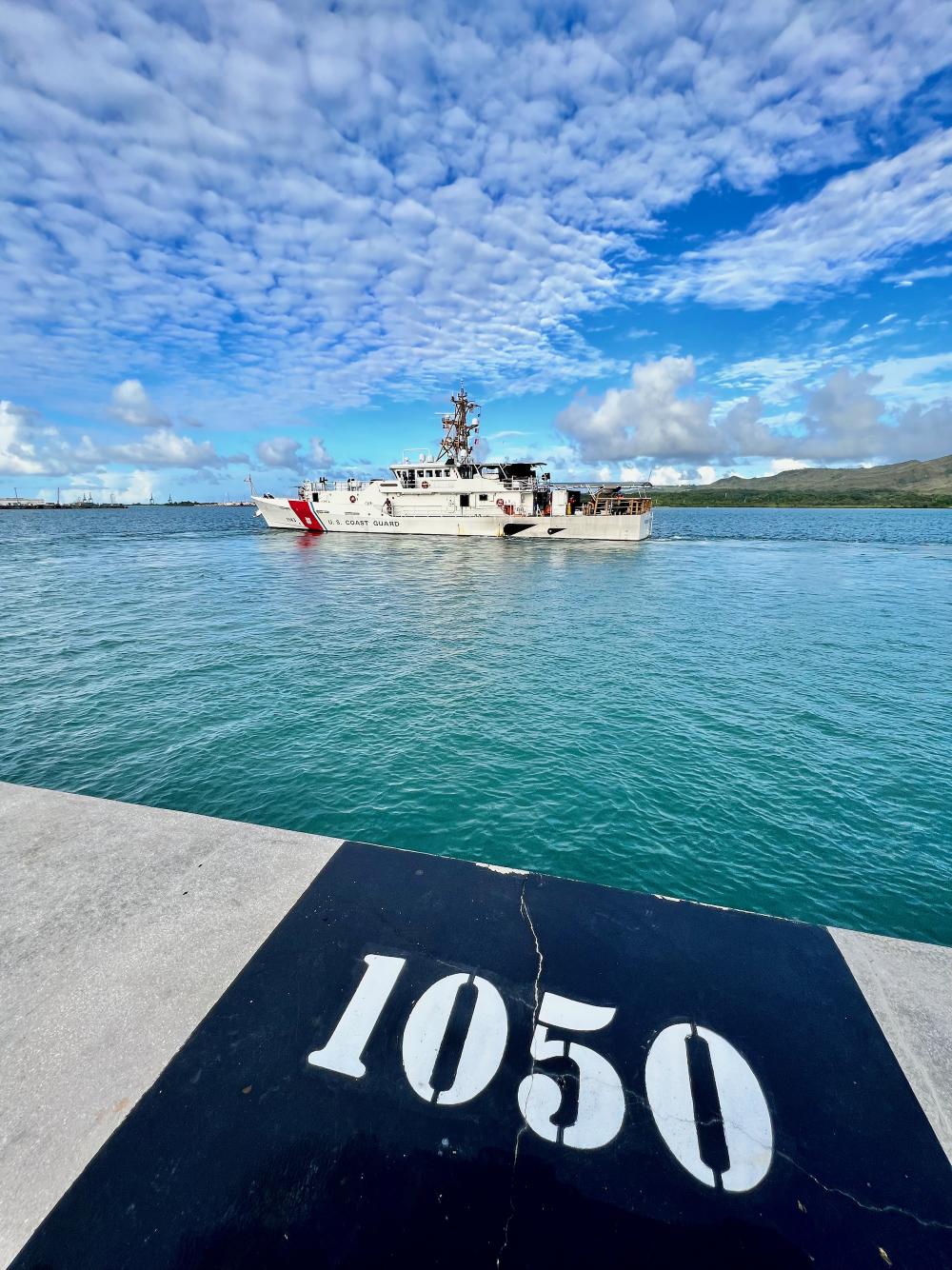
The crew USCGC Oliver Henry (WPC 1140) visit Ulithi Atoll on Oct. 31, 2022, the first time a fast response cutter visited the atoll and delivered 20 boxes of supplies, 50 personal floatation devices, and sporting equipment donated by the cutter crew, the extended U.S. Coast Guard Guam family, Ulithi Falalop Community Action Program, Guam Island Girl Power Foundation, and Ayuda Foundation. Ulithi was a central U.S. staging area during World War II, and home to a U.S. Coast Guard Loran-C communications station from 1944 to 1965 before operations relocated to Yap and ultimately shuttered in 1987. (U.S. Coast Guard photo by Petty Officer 3rd Class Zena Suzuki)

Below is a press release that highlights some changes in the way the Coast Guard is operating in the Western Pacific, the employment of Webber class Fast Response Cutters for long periods at great distances from homeport and the much greater reach of the J model C-130s.  

Feature Story

U.S. Coast Guard Forces Micronesia / Sector Guam

U.S. Coast Guard leverages aviation workhorse to overcome challenges in cutter logistics in Oceania
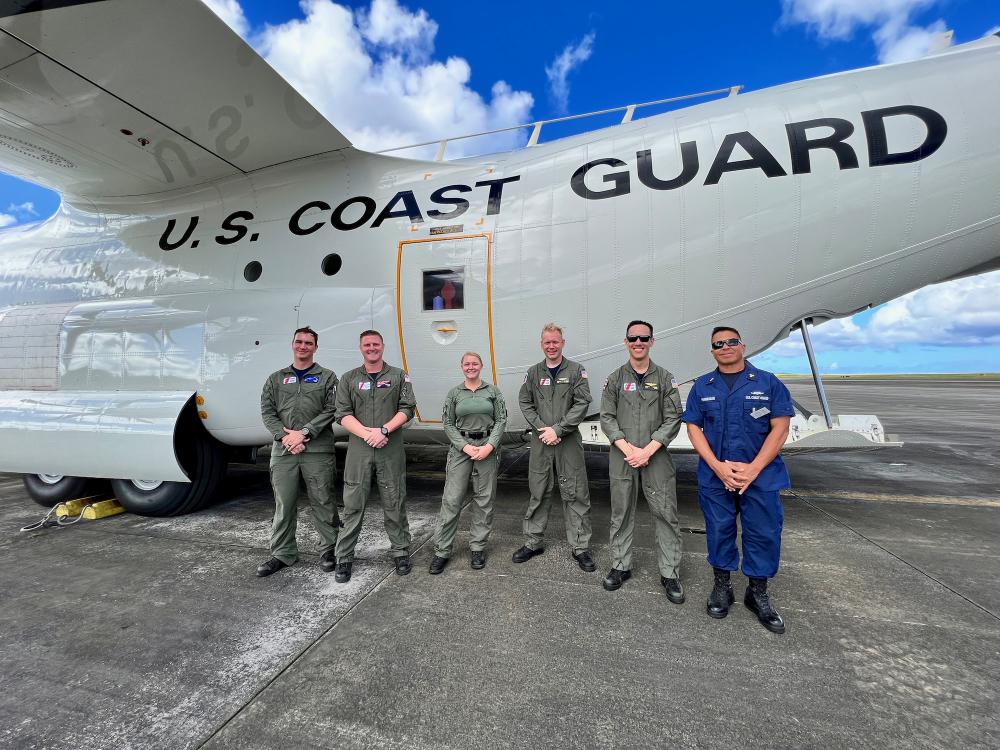
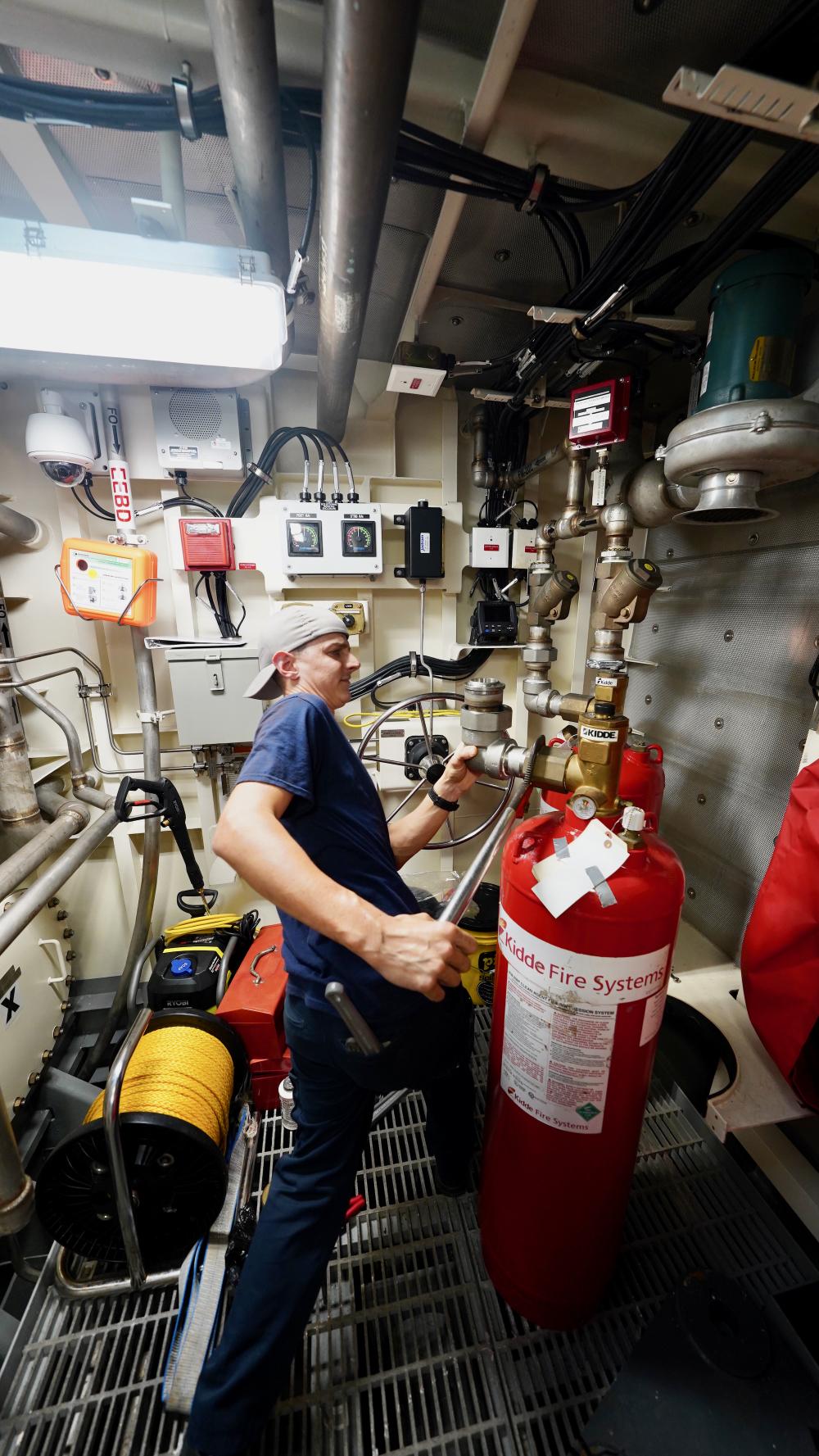
Group photo CGAS Barbers Point and CGFMSG EO FN200 offload from HC-130 Technical installs FN200 bottle  Frederick Hatch departs Guam for patrol

Editor’s Note: Click on the images above to view more or download high-resolution versions.

SANTA RITA, Guam — Guam is home to three 154-foot fast response cutters commissioned in 2021. These ships are built in Lockport, Louisiana. After initial workups, they sailed from Key West through the Panama Canal, more than 10,000 miles to Guam. In the time since the crews have stayed busy conducting the U.S. Coast Guard’s core missions in Micronesia and supporting our Blue Pacific partners.

The Operations Area

For many of the Nation’s fast response cutters, the transit to homeport from Key West is one of the most extended trips they make. Those stateside remain close to most essential services needed to maintain the vessels, designed to operate within 200 nautical miles of homeport. In the case of the Guam-based fleet, they routinely go more than 200 nautical miles to get to the operations area. U.S. Coast Guard Forces Micronesia/Sector Guam has one of the largest areas of responsibility of any sector at 1.9 million square miles. Like its other overseas counterparts, the region can be austere and presents unique challenges.

U.S. Coast Guard Forces Micronesia/Sector Guam (CGFM/SG) differs. The USCGC Oliver Henry (WPC 1140) undertook a more than 6,000-mile expeditionary patrol south through Oceania with inaugural FRC port calls in Papua New Guinea and Australia. Their sister ship, the USCGC Frederick Hatch (WPC 1143), just concluded a similar patrol in support of Operations Rematau and Blue Pacific, the southeast of Guam. The patrol countered illegal, unreported, and unregulated fishing off the Federated States of Micronesia, the Republic of the Marshall Islands, and the Republic of Nauru by enforcing regulatory schemes and individual countries’ sovereignty while strengthening partnerships through shiprider operations, subject matter exchanges, and community engagements.

“What often goes unsaid is the logistics piece enabling the operations,” said Chief Warrant Officer Manny Pangelinan, engineering officer for CGFM/SG. The Oliver Henry required a last-minute shipment of fuel injectors while underway, a package coordinated by the CGFM/SG logistics department with some support from the Surface Force Logistics Center in Baltimore. The package was shipped via a commercial carrier and met them in Australia.

But more oversized items and hazardous materials can present a more complex challenge. Guam is a strategic location, and as a U.S. territory, it is the first line of defense against regional competitors. Logistically, it is remote and depends on maritime cargo for most items. Nearly 90 percent of imports come through the Port of Guam, and travel by sea varies in cost and takes time. Commercial air freight requires less time but can be very expensive.

The Logistics Challenge

Each FRC has four bottles of compressed gas onboard as part of the fire suppression system. The current design of the FRCs uses FN200 powder and nitrogen gas. Over time these bottles lose nitrogen and need to be recharged, the same as any fire extinguisher. If an extinguisher or system loses its prime, it may malfunction and not adequately suppress a fire. Stateside servicing this equipment is a simple endeavor, but service providers in Guam still need to be created. To further complicate matters, if a local provider converted existing equipment to service this system, it could only be used on FN200 to prevent cross-contamination. The U.S. Coast Guard is currently the only FN200 client on the island.

As the Frederick Hatch prepared for their patrol, the crew noted one of the four bottles was borderline between yellow and red on its pressure. No one wants to be over a thousand miles from shore, with a fire, and risk a system malfunction. But how do you get a 277-pound replacement bottle, considered a hazardous material, shipped from the mainland United States to the territory of Guam? And how do you do it in time to meet the ship’s schedule and enable the crew to fulfill their mission requirements in Micronesia? You keep it in-house and leverage the naval aviation community.

Coast Guard Aviation in Oceania

U.S. Coast Guard Air Station Barbers Point in Hawaii conducts search and rescue, maritime domain awareness and surveillance, law enforcement, and cargo and transportation operations throughout Oceania. They are currently the only U.S. Coast Guard air station in the U.S. Coast Guard 14th District, with the next closest aviation unit in California. Still, from 1947 until 1972, they operated an air detachment in Guam known as Naval Air Station Agana to provide LORAN support for Western Pacific stations.

Today, the Barbers Point team operates four MH-65 Dolphin helicopters and four HC-130 Hercules airplanes. The Hercules airframes were recently upgraded from the H model to the J model. For Guam, this is significant. The J is more capable as a long-range surveillance aircraft providing heavy air transport and long-range maritime patrol capability. Each plane can serve as an on-scene command and control platform or as a surveillance platform with the means to detect, classify, and identify objects and share that information with operational forces. It also has “long legs.” Where the H crews needed to stop for fuel en route to Guam from Hawaii, the J could make the trip in one leg if necessary. This advantage matters when time is of the essence, particularly in search and rescue cases.

Capt. John Rivers, CGAS Barbers Point commanding officer, recently visited Guam. He met with the CGFM/SG team to discuss options for more aviation support to Western and Central Pacific operations. Those ideas include more hours of Hercules activity in this region and possible use of the Dolphin helicopters outside Hawaii.

The Workhorse

Regarding transporting equipment, the aircrew, particularly the loadmaster, has the final say on what goes aboard the plane. The Barbers Point team and the loadmaster were crucial to keeping the Frederick Hatch on schedule.

The team flew the HC-130 Hercules CG 2009 to Sacramento to pick up the shipment of fire bottles, then returned to Hawaii to rest and refuel. Subsequently, they flew to Majuro and landed in Guam on Nov. 9 at the A.B. Won Pat Guam International Airport. The CGFM/SG engineering team and environmental contractors met them to further transport the bottles to the pier.

All told, the movement cost flight hours and personnel time – but that is the nature of logistics. Per Commandant Instruction 7310.1V Reimbursable Standard Rates, the inside government rate for an HC-130J is $19,782 per hour. This includes Direct Costs like labor, employee benefits, fuel, maintenance, etc.; Support Costs: Costs allocated to a particular asset class for the support received from Coast Guard support activities, including but not limited to Area Commands, Districts, Sectors, Sector Field Offices, Bases, etc.; and General and Administrative: Costs allocated to a particular asset class to represent benefit received from Coast Guard general and administrative activities such as legal services, payroll processing, etc.

However, our aircrews make the most out of every flight, coupling logistics with other missions and training whenever possible. Flight crews must also fly a certain number of monthly hours to maintain currency and proficiency.

The personnel hours, in this case, include the coordination and research by the CGFM/SG Engineering Team to enable the technician from the fire services company to come out, install and certify the new bottle. The team kept the cost down by more than $16,000 by flying out one technician instead of two and doing all the manual labor of removing and replacing the existing bottle with the ship’s force. Transporting a 277-pound bottle across the pier, onto the cutter, and into the space with a tripod and chain fall in 90-degree heat with 90 percent humidity is quite an undertaking. According to Reimbursable Standard Rates, the inside government cost of a CWO2 is $79 per hour, a Chief Petty Officer is $71, and a Petty Officer 2nd Class is $55. Still, these personnel, like the aircrew, are salaried. The figures come into play if the Service seeks reimbursement from another branch or outside entity for services. The outside government rate is higher.

One might ask how to avoid this challenge in the future, as this won’t be the last time these bottles need to be recharged. One possible alternative was building a facility to support the maintenance of these systems in Guam to the tune of more than a million dollars. Ultimately, this option was deemed unrealistic. Instead of a new facility, the engineering team procured a larger bottle of FN200 and equipment to be kept onsite to recharge the FRCs’ systems. The team will do the heavy lifting and fly out a technician for the final assembly and certification. Two complete sets of bottles were procured at the same time. The first set came aboard the Hercules, and the second will come by cargo ship at a fee of just under $4,000. However, as of Christmas, the second set of bottles are still in transit and will take around 75 days total to arrive, emphasizing the importance of the Engineering Team’s efforts and choices.

Forecast

“This team continues to deliver on the Commandant’s mandate to be creative and innovative to craft solutions to the challenges we face as a service,” said Capt. Nick Simmons, commander of CGFM/SG. “I am impressed by their commitment and resolve to consistently deliver superior engineering support, keeping us operational in a remote environment.”

In the Fiscal Year 2022, the three Guam-based FRCs spent 324 days away from homeport, with 243 of those days physically underway conducting missions at sea. The other days away from homeport account for port calls, community engagements, and maintenance away from the home station. They worked 25 patrols throughout the region, enforcing the rule of law and strengthening partnerships. Guam’s sister sector in Honolulu also has three FRCs doing local and long-range missions. By comparison, they spent 202 days at sea for roughly the same number of patrols. This underscores the distances and demands Team Guam is covering.

“We have better platforms to help our crews get after the ever-growing mission demand here. But we must not lose sight of the demand on the crews and what is necessary to maintain our availability and effectiveness as a preferred partner in the region,” said Simmons. “That means putting steel on target, remaining flexible, and ensuring our crews have the support they need to succeed in a dynamic operational environment. I thank the CGAS Barbers Point team for ensuring our success and enabling the Frederick Hatch crew to work with our partners in Oceania and protect the Nation.”

This fire bottle transport is an excellent example of integrated logistics across the U.S. Coast Guard enterprise and innovation to find a timely cost-reasonable solution to keep the ship operational and on schedule. It is also a model for expanded Coast Guard aviation support to Guam.

For more U.S. Coast Guard Forces Micronesia/Sector Guam news, visit us on DVIDS or subscribe! You can also visit us on Facebook or Instagram at @USCGForcesMicronesia or Twitter @USCGFMSG. 

“Storm causes damage at beloved Portland Head Light in Maine” –WCVB5, Boston

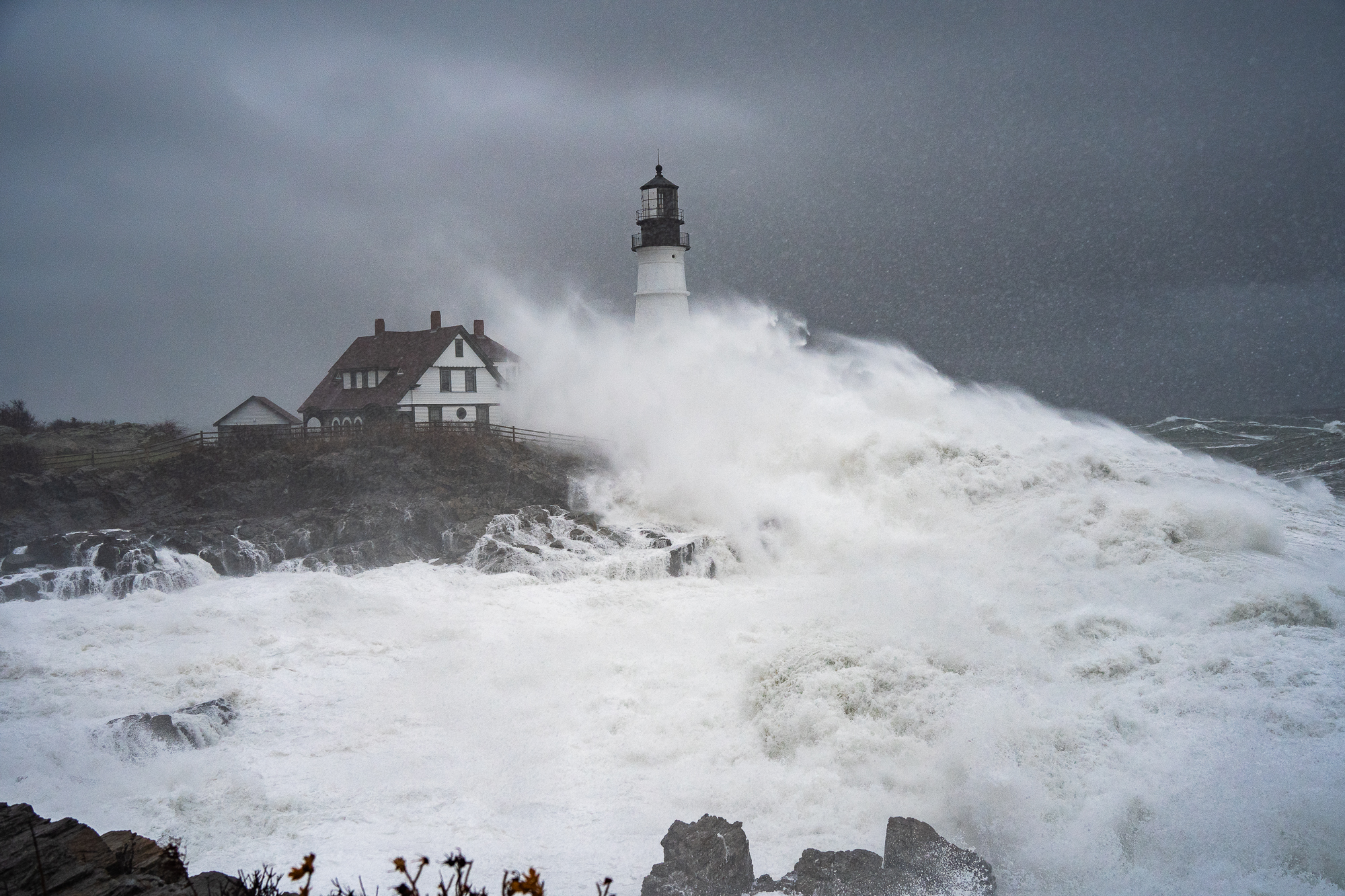
The Wave -“After reviewing my images, I determined that I captured the wave that took out the door and window at Portland Head Lighthouse. I’m not happy about it, but I am in awe of the power of nature. I believe this is a historic capture.”
#mewx #maine #winterstorm #elliott
12:00 PM · Dec 23, 2022 Benjamin Williamson @photographmaine

A Boston television station reports damage to Portland Head Light in Portland, Maine. I pulled the photo above off Facebook earlier today.

I have a personal attachment to the light, since I sailed out of Portland for two years as XO of cutter Duane. The light was always first sight of home and visited the light several times.

Fortunately, it all looks repairable.

Thanks to Paul for bringing the TV report to my attention.

Damen 5009 for Falklands Fisheries Protection

New Fishery Patrol Vessel (FPV) for the Falkland Islands provided under a 15-year contract by Seagull Maritime Ltd to begin patrols next year.@damen

There is not a lot here, just a bit on Twitter and a photo you can click on at the bottom of the page here. I have quoted the Twitter below.

Navy Lookout@NavyLookout
New Fishery Patrol Vessel (FPV) for the Falkland Islands provided under a 15-year contract by Seagull Maritime Ltd to begin patrols next year.

Stan 5009 Axe-Bow vessel built in Vietnam. To be named ‘Lilibet’ in honour of the late Queen.

The Brits do things differently. They have different fisheries protection agencies in different areas and in some cases, it is done by the Royal Navy. A Royal Navy River Class Batch II Offshore Patrol Vessel, HMS Forth, also patrols the Falklands, South Georgia, and South Sandwich Islands.
The Damen Stan Patrol 5009 basically replaced their Stan Patrol 4708 that was the basis of the Webber class WPCs in their product portfolio. (The number represents nominal length and beam in meters.) The 5009 is 50.1 meters in length and 9.4 meters of beam, so slightly larger than the Webber class. (More info here.)
Weather around the Falklands is not unlike that on Alaska Patrol, typically nasty. The “axe bow” would reduce pitch, but the bow might tend to be wetter.
We saw this class in an earlier post that may give some insight into how these little ships might be equipped.

“Of a titan, winds and power: Transnational development of the icebreaker, 1890-1954” –Sage Journals

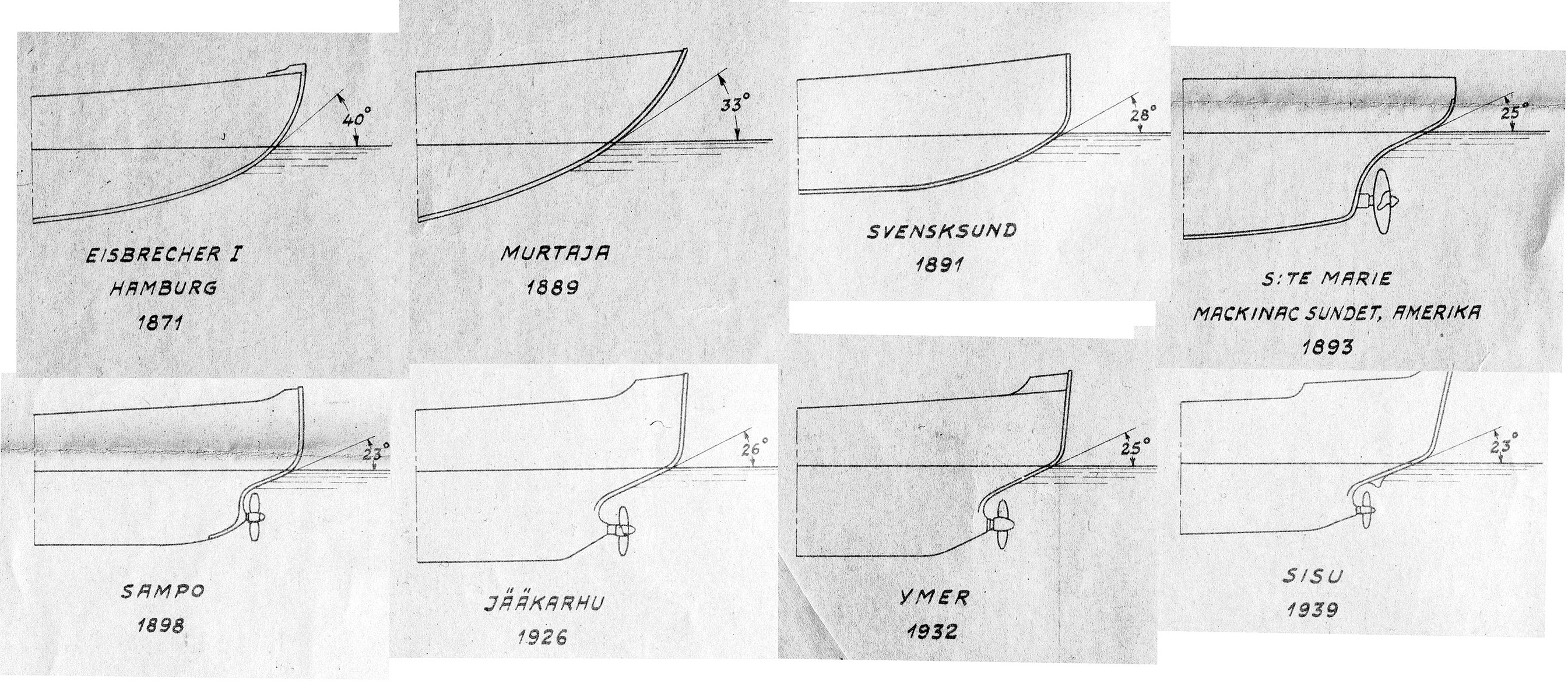
A concept drawing of the development and angle of the icebreaker bow.
Source: KA, HR, 21. The drawing dates from the 1940s during the design of icebreaker Voima. It was digitized, digitally rearranged and enhanced by Aaro Sahari.

The International Journal of Maritime History has a scholarly explanation of the evolution of icebreaker design. There is also an accompanying podcast from CIMSEC, if you prefer that format, but you would miss a lot.

“China Accused of Building on Unoccupied Reefs in South China Sea” –gCaptain

Satellite images obtained by Bloomberg News depict physical changes to a layered land feature at Sandy Cay between 2009 and 2021. Credit: Bloomberg

gCaptain reports,

China is building up several unoccupied land features in the South China Sea, according to Western officials, which they said was part of Beijing’s long-running effort to strengthen claims to disputed territory and potentially bolster its military presence in a region critical to global trade.

Apparently, China is not satisfied with the military outposts they have created in the South China Sea and are in the process of creating more. These actions may be taken by the Chinese both in support their systematic theft of EEZ resources from other nations and as support for a future blockade of Taiwan.

Certainly, these will be upgraded to military installations just as has been done with other artificial islands.

The nations whose EEZs are being violated by these activities have an opportunity to put a stop to it, while they are being done by fishing vessels, before there is a Chinese military presence, if they act quickly and aggressively to stop this illegal activity.

“Sea Machines and USCG partner on computer vision domain awareness” –Marine Link

Photo from Sea Machines website, https://sea-machines.com/ai-ris/

Marine Link reports that a 270 foot WMEC has been fitted with an artificial intelligence recognition and identification system (AI-ris) computer vision product by Sea Machines.

AI-ris uses artificial intelligence to identify and track visual targets of interest. Installation on the cutter was made possible under an ongoing Cooperative Research and Development Agreement (CRADA) between Sea Machines Robotics and the USCG Research and Development Center in an effort to evaluate how computer vision systems can be utilized for autonomous navigation, collision avoidance, and target detection. The deployment of AI-ris provides the USCG a new tool for maritime domain awareness and allows Sea Machines to refine its computer vision technology with feedback from the USCG across a range of environmental conditions and operational scenarios.”

No idea why the report did not name the cutter that got the system. Even the photo that accompanied the report has no hull number.

Sea Machines and the Coast Guard Research and Development Center (RDC) do have some history, having used their SM300 Autonomous Command & Control system.

“USCGC Hamilton to return home following historic transatlantic deployment to Baltic Sea” –LANTAREA

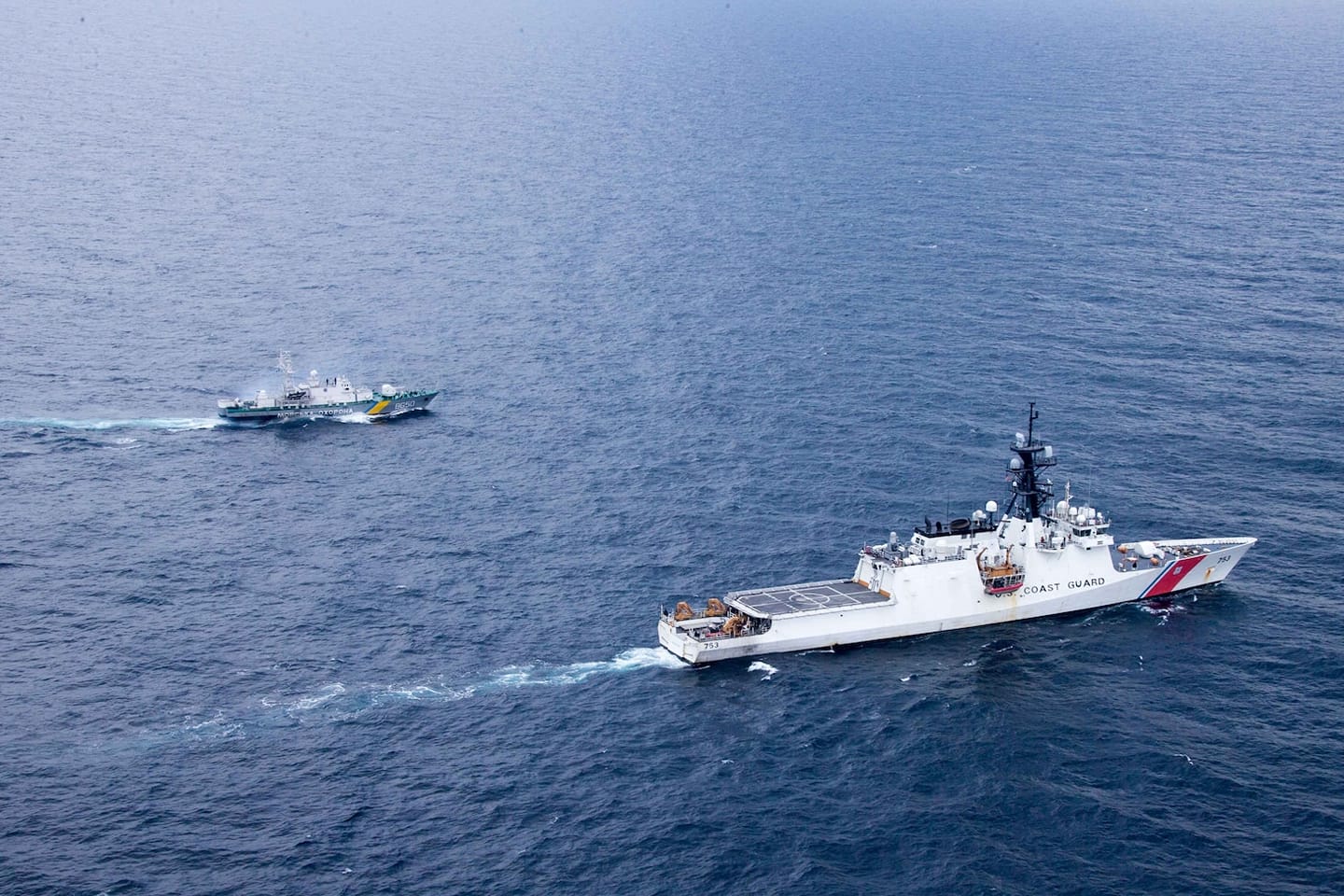
USCGC Hamilton and Ukraine CG during a previous European deployment, May, 2021

Below is an Atlantic Area news release reporting a very non-traditional deployment, but it is not the first time Hamilton has been deployed in support of 6th Fleet.

If you click on each of the photos below, each will allow you to see other photos from the deployment. Altogether, there are 26 photos.

Media Advisory

U.S. Coast Guard Atlantic Area

USCGC Hamilton to return home following historic transatlantic deployment to Baltic Sea

USCGC Hamilton Over the Horizon Cutter Boat Swedish Coast Guard vessel Amfitrite

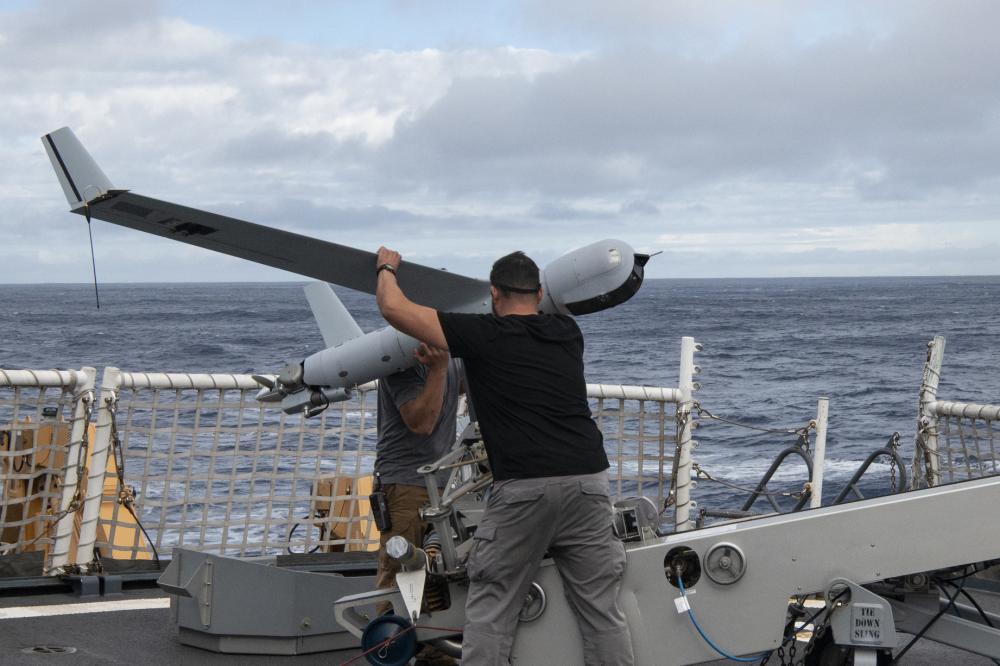
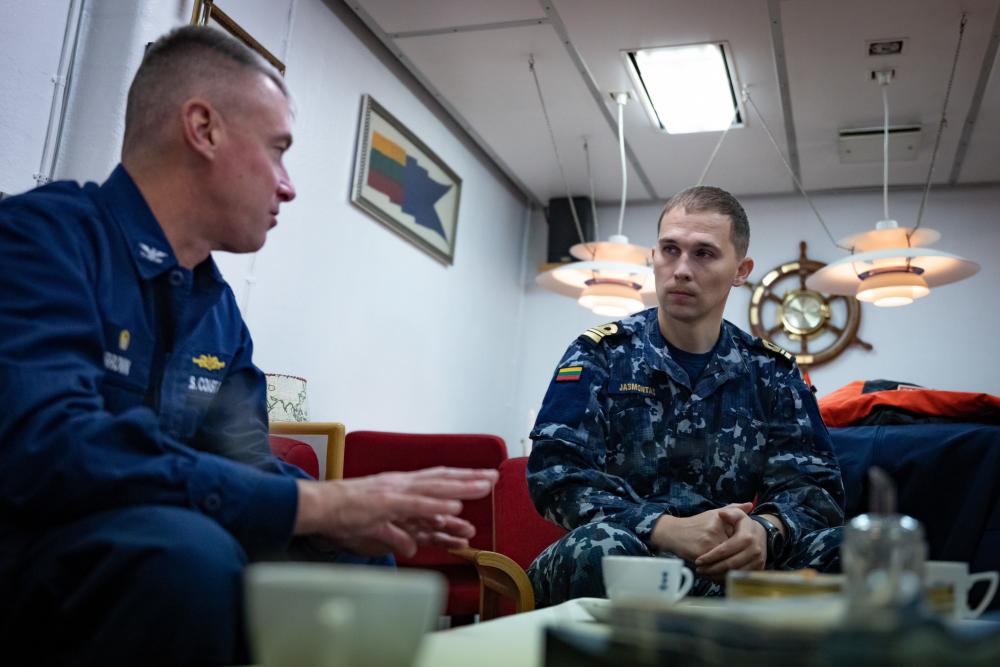
ScanEagle UAS Lithuanian Naval Officer Finnish Border Guard’s Special Intervention Unit

Editors’ Note: To view more or download high-resolution imagery, click on the photos above.

NORTH CHARLESTON, S.C. — The crew of the USCGC Hamilton (WMSL 753) is scheduled to return to their homeport in North Charleston Wednesday following a 94-day deployment in the U.S. Naval Forces Europe – Africa area of operations in support of U.S. Sixth Fleet.

WHO: Capt. Matthew Brown, commanding officer of Hamilton, and members of the crew

WHAT: Hamilton’s commanding officer and crew members will be available for interviews with interested media after they return home following 94-day Baltic Sea deployment in support of U.S. Sixth Fleet

WHEN: 2 p.m. Wednesday

WHERE: Federal Law Enforcement Center, 2000 Bainbridge Ave., North Charleston, South Carolina, 29405

Editors’ Note: Interested media are requested to RSVP by emailing a list of members’ names to ensure base access at D05-SMB-LANT-092P@uscg.mil or call PA2 Brandon Hillard at (757)-614-9755 no later than 2 p.m. Tuesday. Credentialed media are asked to arrive no later than 1 p.m. Wednesday with a driver’s license and proof of insurance in order to be processed through security. 

While deployed, Hamilton conducted at-sea exchanges with naval, coast guard and border guard forces of multiple Baltic Sea Allies and partners, including Sweden, Finland, Estonia, Latvia and Lithuania. Each engagement was oriented to support either traditional Coast Guard missions, or in combination with defense readiness exercises, used to enhance interoperability between the U.S. and NATO partners.

Hamilton’s deployment demonstrated the strategic value of conducing meaningful at-sea engagements, subject matter exchanges and port visits with Allies and partners in the high northern latitudes and Baltic Sea region. The U.S. maritime services regularly operate with partner nations to cultivate a cohesive force to maintain freedom of the seas, ensure free economic exchange and maintain maritime security.

Hamilton is a 418-foot, Legend-class national security cutter. With its robust command, control, communication, computers, intelligence, surveillance and reconnaissance equipment, the NSC is the most technologically advanced ship in the Coast Guard’s fleet. NSCs are a worldwide deployable asset that supports the Department of Homeland Security, Department of Defense and national objectives to include drug interdiction, migrant interdiction, national defense, search and rescue, fisheries enforcement and national intelligence collection.

“Indian Navy inducts new containerized missile systems” –Navy Recognition

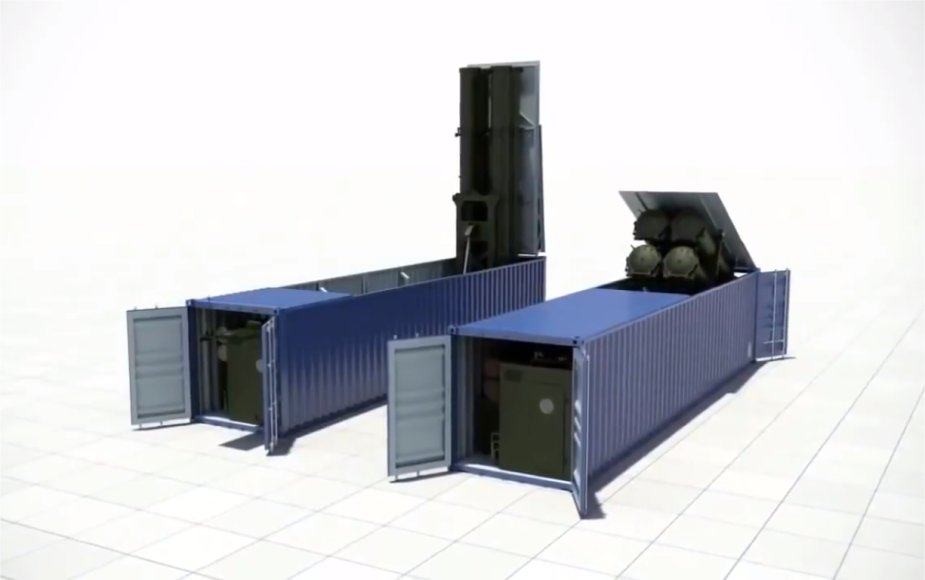
“Artist rendering of containerized missile system for the Indian Navy. (Picture source: Defence Decode)” Note this same illustration was used to portray a Russian system and later a Chinese system. 

NavyRecognition reports,

“According to information published by the Indian MoD on December 17, 2022, containerised missile systems are being inducted by the Indian Navy to enhance operational capability and augment flexibility in operations.”

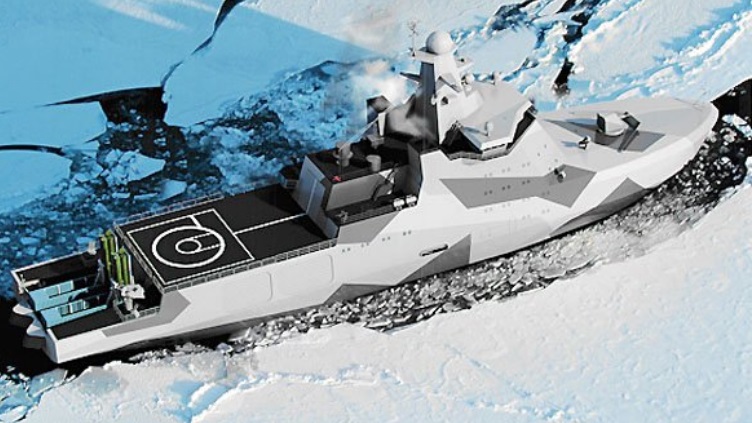
We have seen reports of similar containerized weapon systems before from China and Russia. We have seen artist concepts (and here) of containerized missile systems on Russia’s new Navy and Coast Guard icebreaker class (below), but we have not actually seen them mounted.

Project 23550, Ivan Papanin class icebreaking patrol vessel with towing capability and containerized cruise missiles.

This is the first time I have actually seen a Navy actually state explicitly that such a system was being procured.

Why should this be of interest to the Coast Guard?

  • Terrorist might use a similar system.
  • We have to worry that in the opening round of a near peer conflict, cruise missiles might be launched from apparently innocent looking container ships.
  • Containerized weapon systems might be a way to quickly improve the weapons capability of Coast Guard cutters should the need arise.

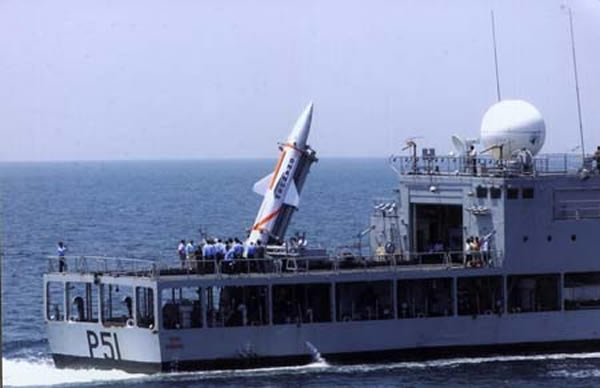
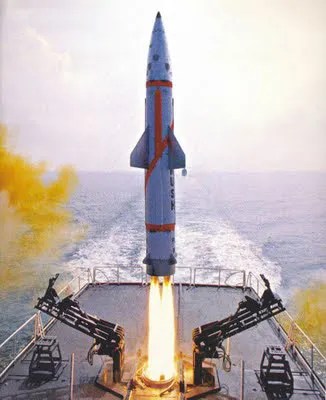
India has already demonstrated a willingness to mount missiles on their offshore patrol vessels, although it was essentially only a test.

Dhanush missile launching from INS Subhadra patrol vessel
(Picture: DRDO)

A Dhanush missile launching from a ship.

Some Posts of Interest

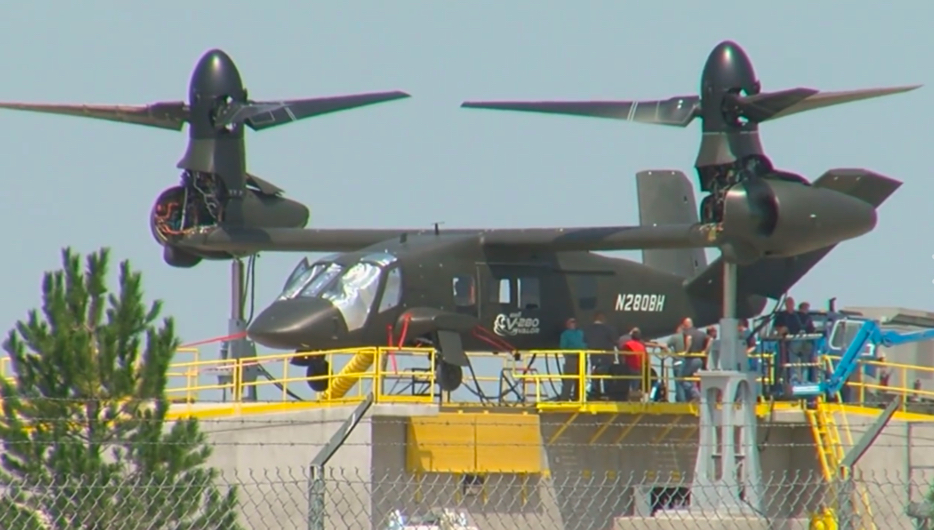
Bell’s V-280 prototype

There have been some posts that may be of interest published recently that I will point to below, with only brief comments.

“The New Coast Guard Funding Bill Is Really Good For The USCG” –Forbes There is a lot here, but you should recognize that this is the National Defense Authorization Act (NDAA), not an actual budget. It is not uncommon to have items in the authorization that are not included in the corresponding budget, so we have to wait a little longer to see what is actually funded.

The Coast Guard is directed to complete a number of studies. I hope they will be completed and delivered to Congress, but they may not be and if they are, we may never know. I have been told, a lot of reports get delivered late, because there is little penalty, and the committees don’t need to inform anyone else of whether they have received a report they requested.

“Some Fun Coast Guard Reads In Forbes” –Next Navy: This talks about the post above and a second post that suggests that the Coast Guard replace the C-27 with the Army’s recently selected V-280. I think the production version of the V-280 has a good chance of finding a place in the Coast Guard. Ultimately it might even replace all our land-based helicopters and all the fixed wing aircraft except the C-130, but that is many years in the future. It’s premature to consider replacing the C-27. (Thanks to Walter for bringing this to my attention.)

“Expand Seattle Coast Guard base without impacting working waterfront”: The local longshoremen’s union takes issue with the three proposals for expansion of Base Seattle. (Thanks to Mike for bringing this to my attention.)

“MOAA Interview: Coast Guard Commandant Charts the Path Forward” Admiral Zukunft emphasized the Cutter recapitalization. Admiral Schultz spent a lot of time talking about shoreside infrastructure. Admiral Fagan’s emphasis is on personnel issues, e.g., recruiting, incentives for afloat billets, afloat billets for women, and women the Coast Guard in general. There is also a nod to the Arctic.