A New Kind of Shiprider Agreement–Virtual / “U.S., Federated States of Micronesia sign expanded shiprider agreement”

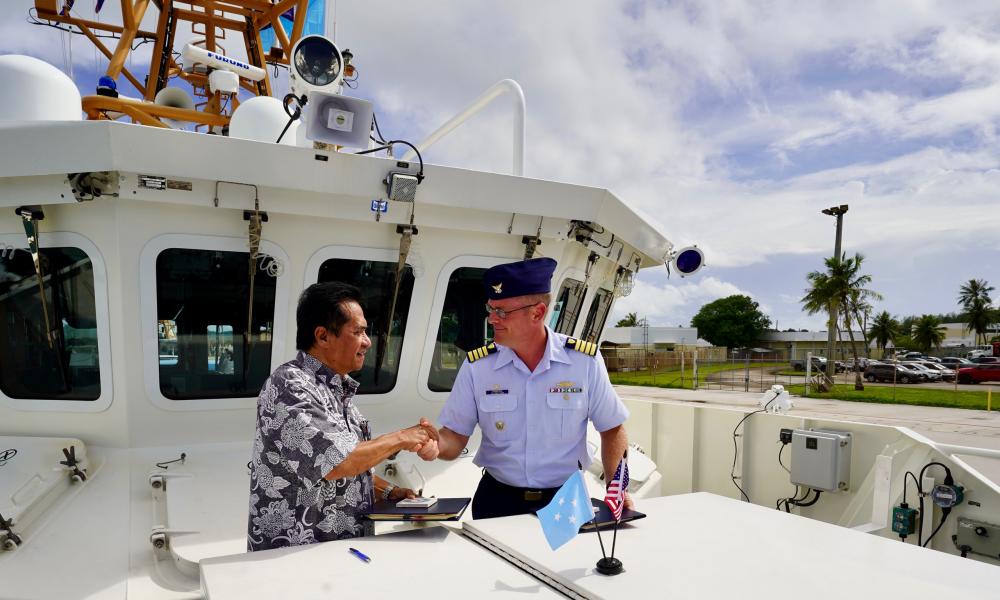
U.S. Coast Guard Forces Micronesia Sector Guam Commander Capt. Nicholas R. Simmons and the Honorable Joses R. Gallen, Secretary of Justice, Federated States of Micronesia, signed an expanded shiprider agreement allowing remote coordination of authorities, the first of its kind aboard the USCGC Myrtle Hazard (WPC 1139) in Guam, on Oct. 13, 2022. The agreement will enable to U.S to act on behalf of the FSM to combat illicit maritime activity and to strengthen international security operations. (U.S. Coast Guard photo by Chief Warrant Officer Sara Muir)

This is a lot more of a leap than it might seem from the news release. It is a huge vote of confidence from the Federated States of Micronesia.

More specifically, the agreement provides a coordinating mechanism and process for U.S. law enforcement personnel to work with the FSM National Police through command centers to receive approval from the FSM to act.

In all previous shiprider agreements, the Coast Guard team enforced the laws of the assisted nation under the authority of an agent of that nation, that accompanied the ship. What we have here is a virtual shiprider (my choice of words). Not only is it easier logistically, it means the decision by the nation assisted is probably being made at a higher level than would have been the case with a dedicated on-scene shiprider.

It also means that a cutter can begin acting on behalf of the Federated States of Micronesia as soon as the cutter enters their EEZ, rather than having to wait until the shiprider comes aboard. The cutter will also not have to drop the shiprider off before departing the area, or arrange other transportation that might delay the agent’s return to duty. It is a win-win.


News Release

U.S. Coast Guard Forces Micronesia / Sector Guam

U.S., Federated States of Micronesia sign expanded shiprider agreement

U.S., Federated States of Micronesia sign expanded shiprider agreement U.S., Federated States of Micronesia sign expanded shiprider agreement

Editor’s Note: Click on the images above to view or download more.

SANTA RITA, Guam — To overcome complex challenges to maritime enforcement in the Federated States of Micronesia (FSM), a nation with over six hundred islands, representatives of the United States and the FSM signed a remote shiprider agreement on Oct. 13, 2022, during a Joint Committee Meeting hosted by Joint Region Marianas.

Through remote coordination, this agreement, the first of its kind, will enable the U.S. to act on behalf of the country to combat illicit maritime activity when an FSM law enforcement officer is not present. More specifically, the agreement provides a coordinating mechanism and process for U.S. law enforcement personnel to work with the FSM National Police through command centers to receive approval from the FSM to act.

Shiprider agreements allow maritime law enforcement officers to observe, board, and search vessels suspected of violating laws or regulations within a designated exclusive economic zone (EEZ) or on the high seas. These law enforcement activities bolster maritime law enforcement operations and maritime domain awareness and provide a mechanism to conduct integrated operations within the Pacific.

“We’re thrilled to cooperate with our Federated States of Micronesia partners on this initiative that will reap benefits for FSM’s economic, environmental, and national security in the maritime domain,” said Alissa Bibb, Chargé d’affaires at the U.S. Embassy in Kolonia.

The dynamic nature of detecting, deterring, and suppressing illegal activity in the Pacific, like fisheries offenses and illicit maritime drug trafficking, requires creative and collaborative solutions. This agreement builds on the enduring partnership and long-standing shiprider agreement between the two nations by providing a new framework to conduct maritime operations and relies on the professionalism and expertise of U.S. and FSM maritime law enforcement officers.

The U.S. Coast Guard regularly exercises 13 bilateral fisheries law enforcement agreements with countries throughout the Pacific islands. These agreements enable U.S. Coast Guard personnel and U. S. Navy vessels with embarked U.S. Coast Guard law enforcement personnel to work with host nations to protect critical regional resources. Shiprider efforts greatly enhance host-nation sovereignty by enabling Pacific Island Nation partners to enforce their laws and regulations using U.S. assets.

The U.S. Coast Guard maintains strong partnerships with the maritime forces in the region through extensive training and subject matter expert exchanges. FSM, also known as the Big Ocean State, has one of the world’s largest EEZs, with waters rich in sea life. FSM consists of four states — Pohnpei, Chuuk, Yap, and Kosrae — each with a mix of unique peoples, languages, and cultures. FSM is a signatory to a Compact of Free Association with the United States. They are also a Pacific Islands Forum Fisheries Association member and a party to the South Pacific Tuna Treaty.

“This historic agreement significantly strengthens presence and enforcement options to counter illicit maritime activity in the region. It is only made possible by the deep and abiding relationships and respect between the Coast Guard and our FSM partners, “Capt. Nick Simmons, Commander of U.S. Coast Guard Forces Micronesia. “FSM has the 14th largest EEZ in the world and only two patrol boats. Our crews spend ample time within the region but getting a shiprider aboard our vessels can be a real logistical challenge. This agreement dramatically increases the capacity of available resources to act on FSM’s behalf to protect their living marine resources and sovereignty. We appreciate their continued trust and confidence as we work together.”

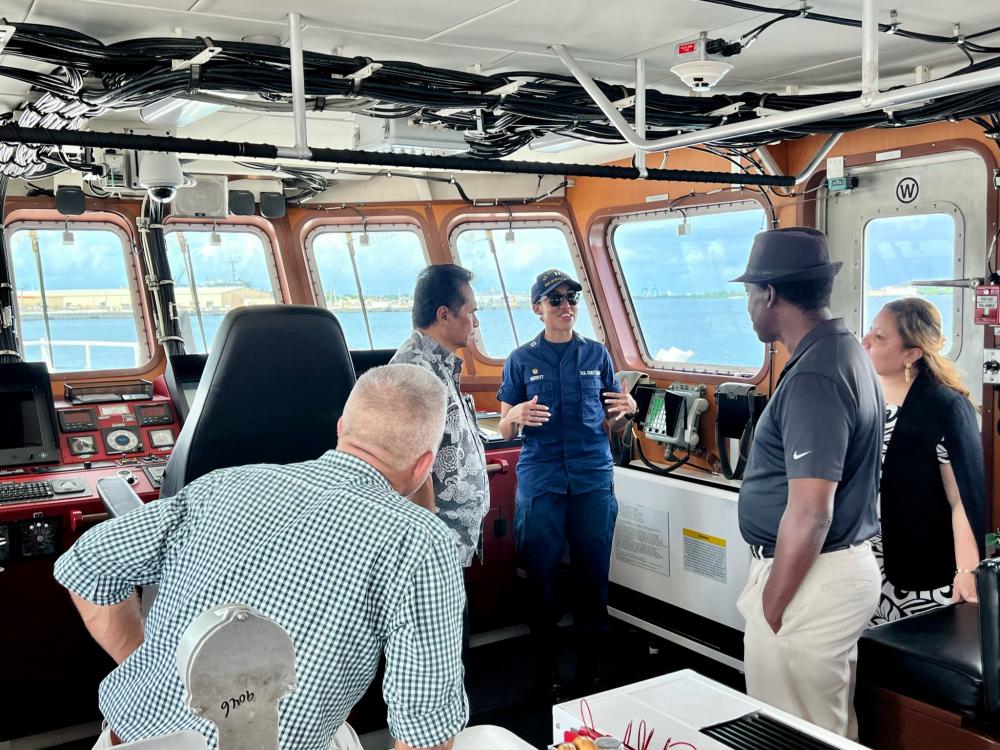
The USCGC Oliver Henry (WPC 1140) hosted Chargé d’affaires Bibb and her team aboard in Pohnpei in September. They met with several key officials, and members of the cutter’s engineering team conducted a subject matter exchange with the crew of FSS Palikir, the last active Pacific-class patrol boat, on shipboard repairs and assisting with preventative maintenance.

In May, USCGC Myrtle Hazard (WPC 1139) made a contactless crew rest and re-fueling stop in FSM during their expeditionary patrol across Oceania. In December 2021, USCGC Sequoia (WLB 215), working alongside the Navy’s Underwater Construction Team Two (UCT-2), conducted operations to widen the channel at Kapingamarangi Atoll. U.S. Coast Guard Forces Micronesia/Sector Guam also provides search and rescue support to FSM, with several successful cases in the last year, resulting in ten lives saved.

The shiprider program supports regional coordination and aligns with the National Security Strategy, U.S. Indo-Pacific Command efforts, and the U.S. Coast Guard’s Operation Blue Pacific. The bilateral agreements enacted in the Pacific are the bedrock of regional maritime law enforcement partnership. They convey the United States’ ongoing investment in protecting shared resources and interest in maritime safety and security, including fair and reciprocal trade, while standing against a current of aggressive and coercive influence in the region.

The U.S. is devoted to ensuring greater unity and a free and open Indo-Pacific for all nations who observe the rule of law. The U.S. Coast Guard continues to demonstrate our enduring presence in the Pacific and help facilitate increased regional stability, security, and resilience for U.S. partners.

For more U.S. Coast Guard Forces Micronesia/Sector Guam news, visit us on DVIDS or subscribe! You can also visit us on Facebook or Instagram at @USCGForcesMicronesia.

U.S. Coast Guard Ethos

A Coast Guard air crew member helps transport a critically injured child from the helicopter to awaiting emergency medical services at Port au Prince, Haiti, Aug. 15. (Lt. David Steele/Coast Guard)

I don’t remember having an ethos when I was in the Coast Guard. We just tried to do our jobs as best we could, and we were proud to be a part of the service. I am not sure having one published, changes the way we act, but the new Coast Guard Strategy includes a new ethos, which prompted me to compare the old with the new. Have to say, I like the new one better.

The Old Version:

I am a Coast Guardsman.
I serve the people of the United States.
I will protect them.
I will defend them.
I will save them.
I am their shield.
For them I am Semper Paratus.
I live the Coast Guard Core Values.
I am proud to be a Coast Guardsman.
We are the United States Coast Guard.

Ten lines, “I” nine times, “We” once, 57 words.

The New Version:

In Service to our Nation 
With Honor, Respect, and Devotion to Duty 
We protect 
We defend 
We save 
We are Semper Paratus 
We are the United States Coast Guard  

Seven Lines, no “I”, “We” five times, 29 words.

Short and to the point is always better, and I like the shift from “I” to “we.”

“Coast Guard cutter patrols near Port-au-Prince, Haiti” –District 7

USCGC NORTHLAND (WMEC-904)

Not uncommon for cutters to be in the area, but, if this is more than just training, that the Hatian government asked the Coast Guard to be there is unusual.

News Release

U.S. Coast Guard 7th District Southeast

Coast Guard cutter patrols near Port-au-Prince, Haiti

Editor’s km Note: Click on images to download high-resolution version.

MIAMI — The Coast Guard diverted one of its major cutters to patrol near Port-au-Prince, Haiti, Wednesday, at the request of the government of Haiti and in close coordination with the U.S. okay Department of State.

USCGC Northland (WMEC 904) was diverted to Haiti as a clear sign of U.S. resolve in support of the Government of Haiti and its people, and to rendezvous with the Haitian Coast Guard for training in the area.

Northland was previously patrolling within the Windward Pass under the direction of the Coast Guard’s Seventh District, headquartered in Miami, in support of Operation Vigilant Sentry, a standing maritime law enforcement operation.

“The U.S. Government has a vested interest in regional security throughout the Caribbean Sea and is aware of the ongoing situation of civil unrest and gang violence within Haiti,” said Rear Adm. Brendan C. McPherson, commander of the Seventh Coast Guard District. “The Coast Guard is one part of a whole-of-government approach to assist the Haitian government with security and stability throughout Haiti, especially as it relates to the deterrence and prevention of dangerous, irregular maritime migration.”

The Coast Guard has a longstanding relationship with the Haitian Coast Guard. In January 2010, USCGC Forward (WMEC 911), a 270-foot Famous-class medium endurance cutter, was the first U.S. asset to respond and render humanitarian aid and assistance following a 7.0-magnitude earthquake in Haiti. In August 2021, the Coast Guard was among the first U.S. agencies to respond with humanitarian aid following a 7.2-magnitude earthquake in Haiti.

In August 2022, USCGC Robert Yered (WPC 1104), a 154-foot Sentinel-class fast response cutter, delivered firefighting equipment sourced as a donation from Miami-Dade Fire Rescue to better equip the Haitian firefighting department at Port-au-Prince-Toussaint Louverture International Airport. In September 2022, the Coast Guard’s international training team visited Haiti to facilitate the second of two iterations of small boat operations training with the Haitian Coast Guard to ensure uniform and repeatable training standards for the maintenance and safe operation of the Haitian Coast Guard’s surface fleet.

The Coast Guard continues to patrol the Caribbean Sea to deter undocumented migration by sea. In fiscal year 2022, the Coast Guard interdicted 7,173 Haitian migrants attempting to enter the United States illegally by sea.

Northland is a 270-foot Famous-class medium endurance cutter homeported in Portsmouth, Virginia. Northland’s missions include law enforcement, search and rescue, drug interdiction, fisheries enforcement, migrant interdiction, homeland security and defense operations, international training, and humanitarian operations. Northland patrols the offshore waters from Maine to Florida, the Gulf of Mexico, the Eastern Pacific Ocean and the Caribbean Sea.

For more breaking news or information about D7 follow us on Twitter, Facebook and Instagram.

Three New Strategies, National, Arctic, Coast Guard

October seems to be the month for new strategic documents. Normally I would like to read and summarize the highlights, but I just have not had the time and I don’t want to delay getting the information out. Maybe we will take a look at them in more detail or we can discuss in the comments. You can access them here:

I have had a little time to look at the Arctic strategy and it tells me there will be Icebreakers on the Atlantic side as well as the Pacific. There is of course a lot more, but I did not see anything surprising.

“Suspected Ukrainian Explosive Sea Drone Made From Recreational Watercraft Parts” –USNI

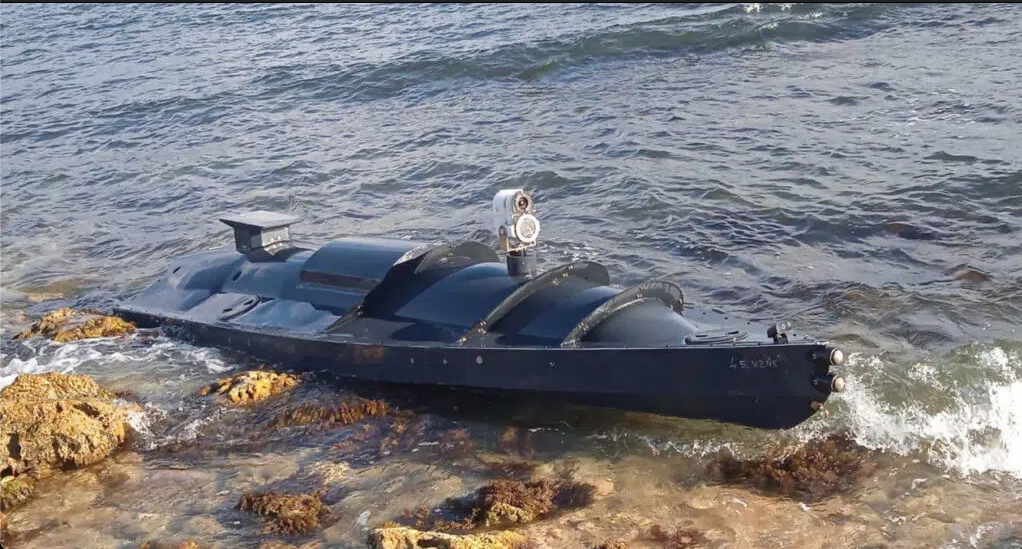
Image of the suspected Ukrainian USV circulating on Russian social media. Image via Naval News

The US Naval Institute has a closer look at what is believed to be an explosive Uncrewed Surface Vessel (USV) of Ukranian origin, found in Crimea.

According to the report, the propulsion appears to have been from a Sea-Doo personal recreational watercraft.

The report includes a comparison with past examples of explosive motor boat and significantly, the diagram of the suspected Ukrainian craft is along side an outline of an adult male, providing scale, that suggests the craft is about 12 feet in length.

Hopefully the Coast Guard is paying attention, because similar craft might be employed by terrorist against the US.

“Russia Launches Project 23550 Patrol Ship ‘Purga'” –Naval News

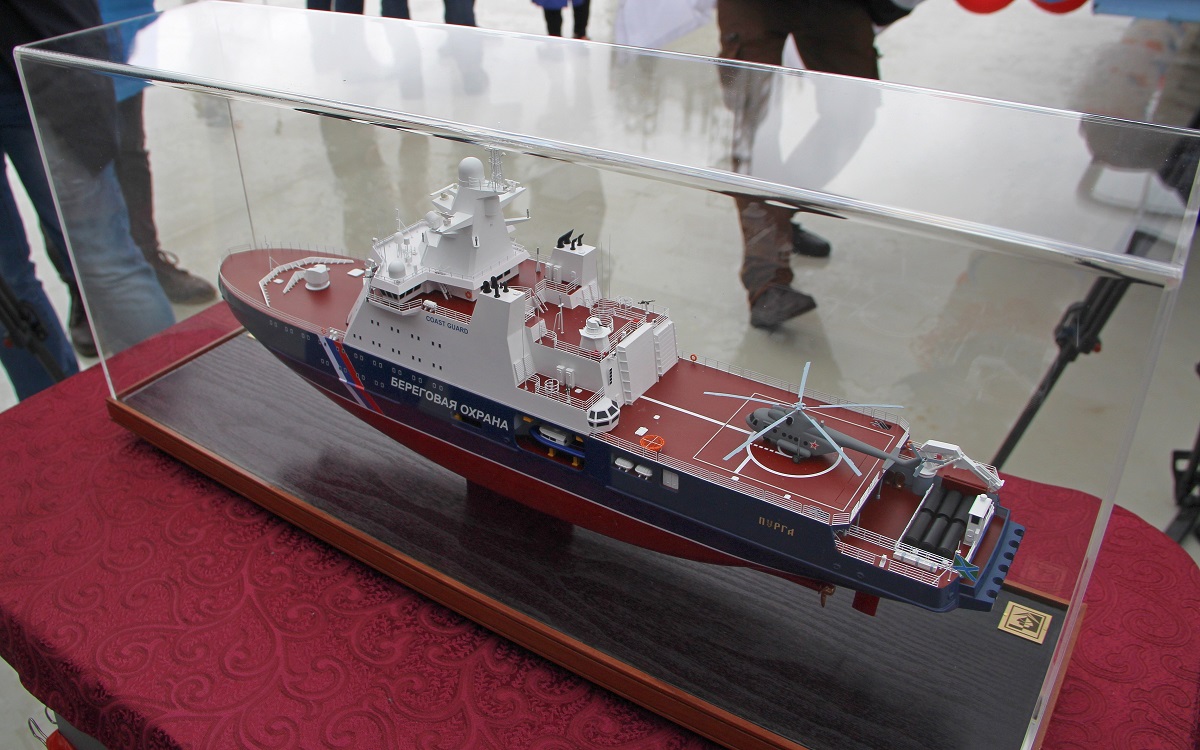
Official scale model of the Project 23550 ice-class patrol ship “Purga” for the Russian Coast Guard presented during the commissioning ceremony. Picture by Curious / forums.airbase.ru

Naval News reports the launch of a 9,000 tons, 114 meter icebreaker patrol ship for the Russian Coast Guard.

We have talked about this class before. Artist depictions of the class mounting containerized Kalibr cruise missile systems caused a bit of a stir, but we have yet to see containerized weapons on this class, nor have we seen Kalibr launched from containers against Ukraine. At this point, Russia may not have enough missiles to fully outfit its more capable combatants.

This is the first of the class for the Russian Coast Guard. The first two ships of the class were for the Russian Navy.

As I noted earlier, I really don’t think we need to mirror the Russian capability to put containerized missiles on our icebreakers, but the Polar Security Cutters will be valuable, almost irreplaceable auxiliaries, and unlike the Russians, we have very few icebreakers, so we need to be able to quickly upgrade their defensive capabilities.

These ships are in many respects similar to the Canadian Arctic Offshore Patrol Ships, but they are reportedly slightly faster at 18 knots and much better armed–but only to a level similar to the OPCs, unless containerized weapons are added. I expect our Artic Security Cutters may be more like these than the Healy, though they probably will be larger than the Russian ships.

“Hellfire Missile With Roughly Three Times More Range Tested…” –The Drive

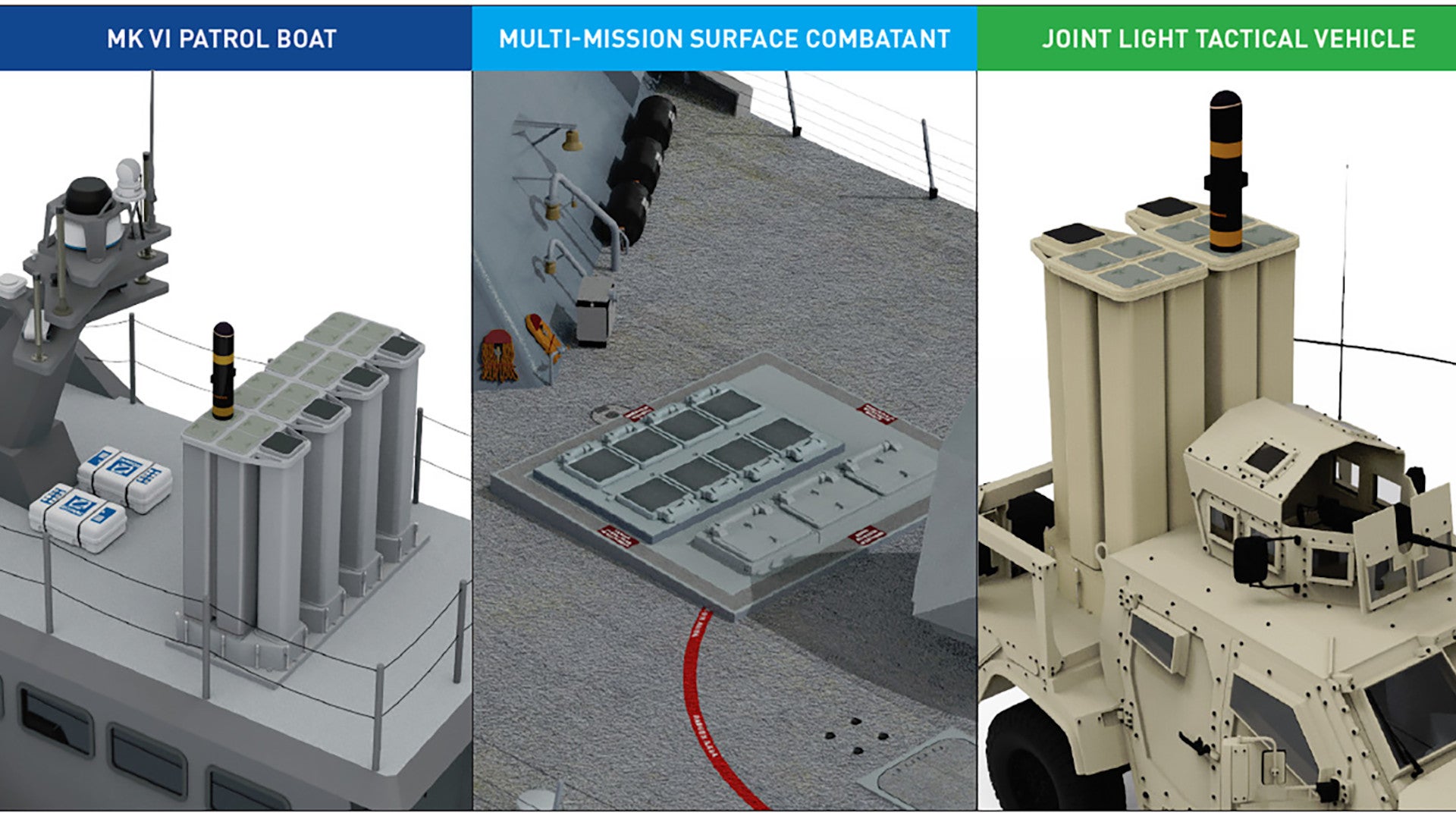
New Lockheed Hellfire/JASM launcher discussed earlier

The Drive reports an exercise that claimed to employ an enhanced version of Hellfire with a range about three times as great as that of the previous versions. Hellfire’s replacement, JASM, perhaps more accurately an upgraded Hellfire, has now been approved for full rate production and there have been reports that a longer range version was in the works.

Beyond the air-launched advantages, this missile would be hugely beneficial for sea-launched applications, such as the LCS. Beyond that, it could be extremely beneficial in servicing Hellfire’s growing surface-to-air role, as well.

Since the typically reported surface to surface range of the Hellfire is 8 km, three times that would be 24 km or over 26,000 yards (equal to the longest ranged battleship hit in WWII). In most cases, that means it can reach anything within the visual horizon. It would also mean, it would out range our 57 and 76mm guns. If this longer ranged Hellfire/JASM is mounted on the new 30 mm Mk38 Mod4, it could mean even Polar Security Cutters will have a potentially more potent weapon than the 57mm Mk110, with a much smaller footprint and lower maintenance requirements.

The weapon would certainly be a welcomed addition to the Webber class patrol craft of PATFORSWA because it would give them greatly enhanced capability against swarming small inshore attack craft, helicopters, and UAS, threats common in their operating area.

As I noted earlier, JASM could provide Coast Guard vessels as small as patrol boats, with a much more accurate, more powerful, and longer ranged response to the need to be able to forcibly stop vessels both small and large, while also providing counter UAS, a degree of anti-aircraft protection, and should it ever be required, a naval fire support ashore capability.

Coast Guard Los Angles Looks at MQ-8C

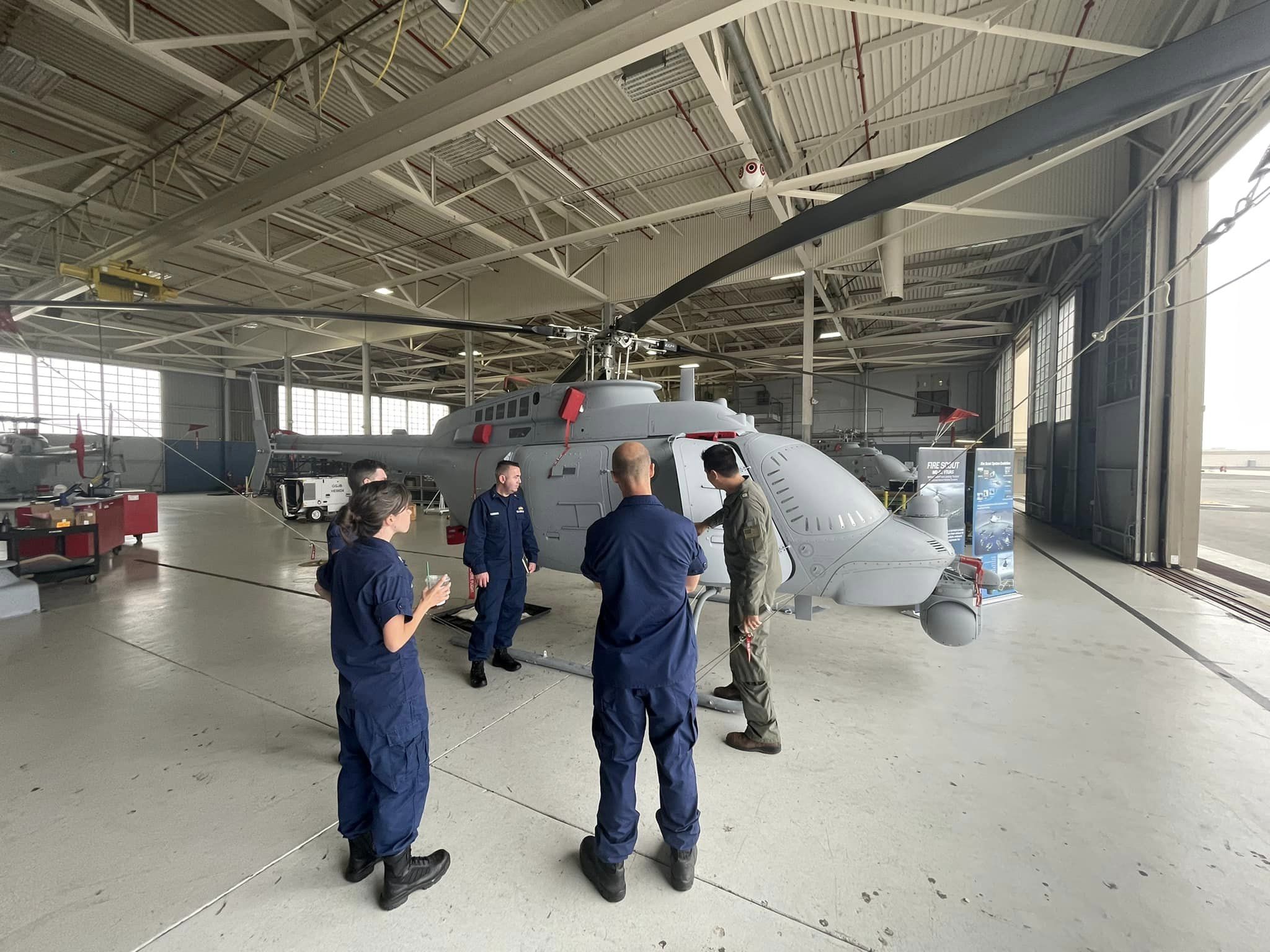
Picked this up off the Coast Guard Aviation Association’s Facebook page. A post by U. S. Coast Guard Los Angeles.

Today, members from Sector Enforcement travelled to Naval Base Ventura County at Point Mugu, Calif. to discuss the possible use of Unmanned Aerial Vehicles to support Coast Guard missions. Pictured is the Navy’s MQ-8C Fire Scout, an unmanned helicopter used for intelligence, surveillance, and reconnaissance.

Is the Coast Guard looking to buy MQ-8C? It is not unlikely, the Navy wants to exercise these assets in an operational environment. Cutters doing drug interdiction are almost perfect for them. This is more likely looking at an opportunity for a Navy Detachment to deploy with a cutter than that the Coast Guard is looking to buy MQ-8C.

The MQ-8C should be able to search a much larger area than the Scan Eagles we are using now. The four National Security Cutters in Alameda have room for one of these in addition to an H-65 and Scan Eagle. There are also two WMEC 210 on the West Coast that might use these, but I would expect to see Scan Eagle on the WMECs before Fire Scout, but it is a possibility.

The First two OPCs are coming to San Pedro, hopefully, beginning next year. They also have ample aviation space, so perhaps they are a possibility as well.

This could be a win-win.

“Army Set To Buy Computerized Rifle Sights For Shooting Down Drones” –The Drive / Marines Have Bought Some Too

The Drive reports on a new rifle sight that is much more than just a sight. You pick the target and when the weapon is on target, the rifle fires.

Obviously the PATFORSWA patrol craft have a Counter-UAS mission, but we have not seen any hard kill C-UAS system. This might work, though the range is relatively short.

This also looks like it could be useful for Coast Guard special teams as well, for something like a hostage situation, and perhaps for airborne use of force.

Wonder if you could get it to work on a .50 cal.?