“U.S. Coast Guard participating in Operation Island Chief, Operation Blue Pacific 2022” –News Release

The USCGC Oliver Henry (WPC 1140) crew arrives in Manus, Papua New Guinea, on Aug. 14, 2022, from Guam as part of a patrol headed south to assist partner nations in upholding and asserting their sovereignty while protecting U.S. national interests. The U.S. Coast Guard is participating with partners to support the Pacific Islands Forum Fisheries Agency-led Operation Island Chief and the larger Operation Blue Pacific through patrols in the Western Pacific in August and September 2022. The other two patrol boats are Australian built Guardian class. (U.S. Coast Guard photo by USCGC Oliver Henry)

Just passing along this news release from U. S. Coast Guard Forces Micronesia/Sector Guam.


U.S. Coast Guard participating in Operation Island Chief, Operation Blue Pacific 2022

 The USCGC Oliver Henry (WPC 1140) gets underway on Aug. 8, 2022, from Guam for a patrol headed south to assist partner nations in upholding and asserting their sovereignty while protecting U.S. national interests.  The USCGC Oliver Henry (WPC 1140) crew, including ship riders from Papua New Guinea, the U.S. Marine Corps, and the U.S. Navy, take a moment for a photo aboard the ship off Manus, Papua New Guinea, Aug. 14, 2022.

Editor’s Note: Click on the images above to view more images and b-roll video
or download high-resolution versions.

MANUS, Papua New Guinea — The U.S. Coast Guard is participating with partners to support the Pacific Islands Forum Fisheries Agency-led Operation Island Chief and the larger Operation Blue Pacific through patrols in the Western Pacific in August and September 2022.

“Employing our unique authorities, capabilities, and access within Oceania is a privilege. We are eager to further integrate with our Allies and regional partners to protect national interests and combat illicit maritime activity such as illegal, unreported, and unregulated fishing,” said Capt. Nick Simmons, U.S. Coast Guard Forces Micronesia/Sector Guam commander. “Strengthening governance and modeling professional maritime behavior on the high seas and the surrounding waters is one way to counter predatory activity and reinforce the Pacific as a positive center of gravity and sustainable economy.”

The operation covers a substantial area of the Pacific on the high seas and the exclusive economic zones of the Federated States of Micronesia, Papua New Guinea, Australia, and the Solomon Islands, while renewing relationships bolstered by local knowledge and expertise.

The USCGC Oliver Henry (WPC 1140), a 154-foot Sentinel-class fast response cutter, and crew deployed from Guam are making their first port call of the patrol in Manus, Papua New Guinea. During the patrol, the cutter will also have aerial support from a forward deployed HC-130 Hercules airplane crew from U.S. Coast Guard Air Station Barbers Point and New Zealand Defence Force P3 Orion airplane crew. Where possible, the crew will also conduct subject matter expert exchanges and engagements.

Operation Island Chief is one of four operations conducted annually under FFA. It includes the Pacific waters of 11 participating FFA member nations – Fiji, Federated States of Micronesia, Kiribati, Palau, Papua New Guinea, Nauru, the Marshall Islands, Samoa, the Solomon Islands, Tuvalu, and Vanuatu.

“The Oliver Henry crew are committed to regional collaboration and sharing best practices to strengthen our relationships and information sharing,” said Lt. Freddy Hofschneider, commanding officer of Oliver Henry. “The U.S. Coast Guard has been a dedicated partner in the region for decades. We appreciate the support of our colleagues as we take this ship across vast distances in this region, making some transits and port calls for the first time.”

A significant emphasis of the operation for the U.S. Coast Guard is the ongoing emphasis on fisheries and resource protection.

“The Pacific Ocean is home to some of the world’s most abundant fisheries,” said Simmons. “These fisheries are living marine resources, part of the global food chain, representing food security and an economic engine for many of the Pacific Island Nations. By leveraging our cutters, aircraft, and intelligence professionals, the U.S. Coast Guard continues our strong partnership with the Pacific Islands Forum Fisheries Agency and its members to protect this vital marine ecosystem and ensure continued economic prosperity and a thriving ocean for future generations.”

According to FFA, partners are seeing increasing success through multilateral operations in the Pacific to tackle IUUF. These operations evolved from a focus on protecting against illegal boats entering the fisheries to policing the operations of licensed vessels that haven’t followed the rules and regulations governing their activities. The Pacific region is a vast expanse, and collaboration across the many partners, providing personnel and assets, is crucial to ongoing success.

The Oliver Henry is the 40th Sentinel-class fast response cutter. The ship arrived in Guam and was commissioned along with its sister ships, Myrtle Hazard and Frederick Hatch, in July 2021. In the time since, the crew has participated in several search and rescues cases, completed a counternarcotics patrol off Guam with the Japan Coast Guard patrol vessel Mizuho, and conducted sovereignty and fisheries patrols in the Forces Micronesia/Sector Guam area of responsibility.

For more U.S. Coast Guard Forces Micronesia/Sector Guam news, visit us on DVIDS or subscribe! You can also visit us on Facebook at @USCGSectorGuam.

-USCG-

Late Addition:The Sentinel-class fast response cutter USCGC Oliver Henry (WPC 1140) crew arrives in Port Moresby for a port visit on Aug. 23, 2022, following a patrol in parts of the Coral Sea, and the Solomon Islands and PNG Exclusive Economic Zones. The U.S. Coast Guard is conducting a routine deployment in Oceania as part of Operation Blue Pacific, working alongside Allies, building maritime domain awareness, and sharing best practices with partner nation navies and coast guards. (U.S. Coast Guard photo by USCGC Oliver Henry)

“Coast Guard releases request for information for medium-range unmanned aircraft systems” –CG-9

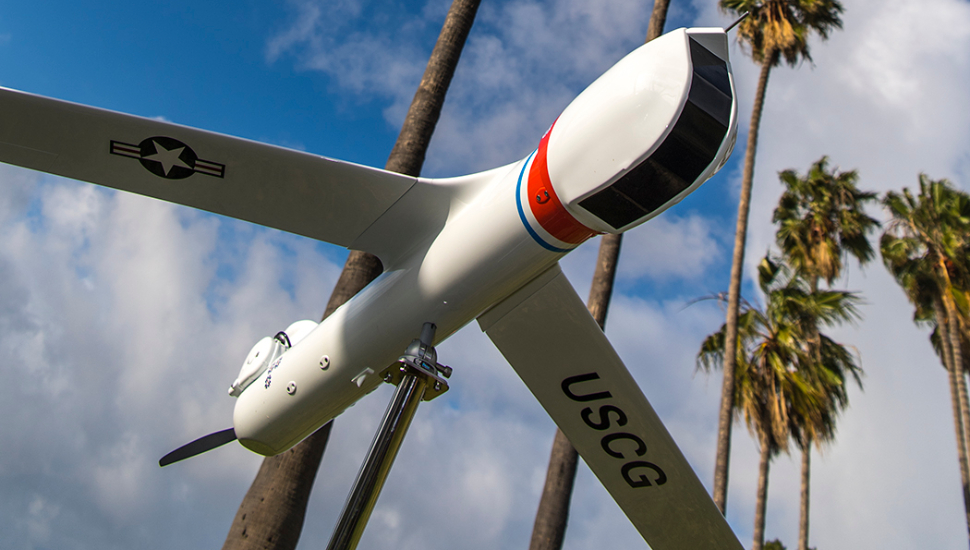
Insitu Scan Eagle in Coast Guard colors. Notably the RFI requires, “…the UA shall incorporate low-visibility, counter-shaded paint scheme consisting of FED-STD-595C FS 36320 (or similar) matte gray upper surfaces and FED-STD-595C FS 36375 (or similar) matte gray lower surfaces,” much like an Air Force F-16.

Below is an Acquisitions Directorate (CG-9) statement regarding a Request for Information,

The Coast Guard released a request for information (RFI) Aug. 5 to determine the potential sources and the technical capability of industry to provide Group II and Group III unmanned aircraft systems (UAS), capable of deploying from Coast Guard cutters.

The RFI can be found here.

So what are “Group II and Group III unmanned aircraft systems (UAS)?” Wikipedia identifies the groups and provides examples.

  • Group II: Maximum weight 21 to 55 pounds (25 kg); Nominal Operating Altitude <3500 feet above ground level (AGL) (1,067 meters); speed less than 250 knots
  • Group III: Maximum weight <1320 pounds (600 kg); Nominal Operating Altitude < flight level 180 (about 18,000 feet or 5,488 meters); speed less than 250 knots

Notably the Navy’s Fire Scout is a Group IV UAS, so will not be considered. These groups do include both Insitu’s Scan Eagle, currently being used on National Security Cutters and their larger RQ-21 Blackjack. Also included are the V-Bat which has been tested on a Coast Guard WMEC and a number other vertical take-off and landing capable UAS.

The RFI appendix 1, entitled “Draft System Performance Specifications (SPS)” is 11 pages long and provides much more detail. I will mention only some highlights and these are only the minimums, there are also higher objective criteria:

  • Endurance: 12 hours
  • Dash speed: 70 knots
  • Cruise speed: 50 knots
  • Service ceiling: 3,000 feet
  • Range: 40 nmi in clear weather, 35 in light rain
  • The UA shall provide fully automated flight operations, including launch and recovery.
  • The UA shall have space, weight, and power to concurrently operate: Electro-Optical (EO) sensor, Infra-Red (IR) sensor, AIS, VHF/UHF communications relay, aeronautical transponder, and non-visible IR marker. [KPP]
  • At an operating altitude of 3,000 feet when the UAS is directly overhead of the target of interest (no slant range), the UA shall be acoustically non–detectable per MIL STD-1474 (series), Level 1 requirements (quiet rural area with the closest heavily used highway and community noises at least 2.5 miles away).

Notably there is no mention of radar or vidar, although Vidar is an EO sensor currently used by Scan Eagle UAS operating from National Security Cutters. There is also this,

The UA shall be capable of accepting modular payloads. Modular payloads are defined as payloads that can be replaced or interchanged with the previously-installed EO or IR payload(s) within one to two hours (elapsed time). Modular payloads may be government provided.

I did find this interesting, “The UA shall launch and recover while a static MH-65 is spotted with blades unfolded on the flight deck.”

The drawings contained in Appendix 2 indicate that these Unmanned Aircraft are intended for Bertholf class “National Security” cutters. Appendix 1 also sounded like these would be contractor operated, as are the Scan Eagles currently being deployed on National Security Cutters.

Since these specs are not too different from the Scan Eagles already being used on National Security Cutters, the Coast Guard may be just checking the competition to see what else is out there. On the other hand, perhaps some of the requirements may not be being met by the Scan Eagle UAS we are currently using. That the RFI provided only 17 days from issue to deadline for response, suggests the Coast Guard had already been been in communications with “the usual suspects.”


Coast Guard releases request for information for medium-range unmanned aircraft systems

The Coast Guard released a request for information (RFI) Aug. 5 to determine the potential sources and the technical capability of industry to provide Group II and Group III unmanned aircraft systems (UAS), capable of deploying from Coast Guard cutters.

The Coast Guard is interested in UAS that include fully automatic flight operations, have a minimum endurance of 12 hours and can be launched and recovered from a cutter flight deck. For Coast Guard mission success, UAS need to be capable of carrying a payload including electro-optical and infrared sensors and communications relay. Technological readiness level and degree of commonality and interoperability with existing Department of Homeland Security or Department of Defense programs are also of interest.

The full RFI is available here. Responses are due by 1 p.m. EDT Aug. 22.

For more information: Unmanned Aircraft Systems Program page

“Coast Guard exercises contract option to build one fast response cutter” –CG-9

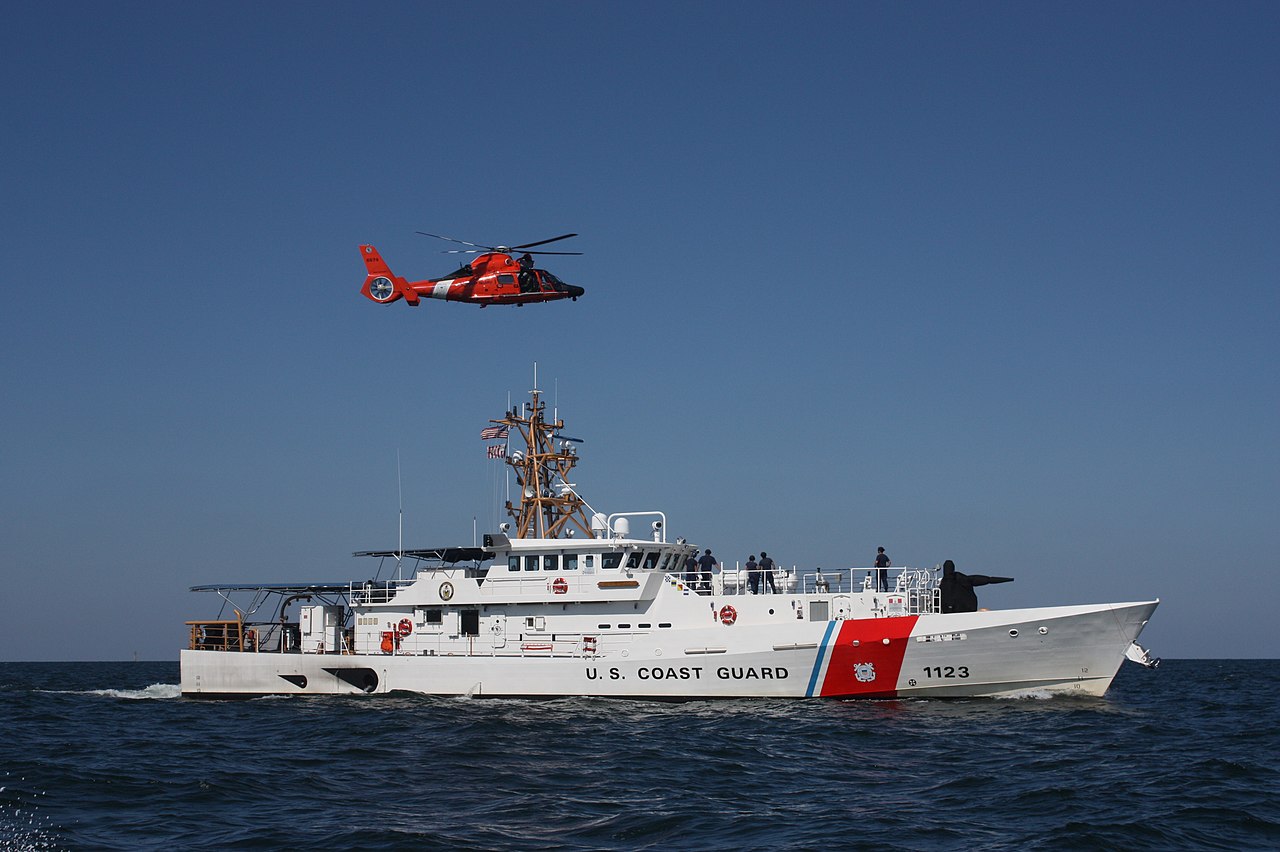
CGC BENJAMIN DAILEY, the first FRC stationed in Gulf of Mexico, conducts flight operations with a HH-65 from Air Station New Orleans. Photo by Bigshipdriver

The Acquistions Directorate (CG-9) reports exercise of a contract option to purchace one additional Webber class cutter. I had been under the impression money was in the FY2022 budget for two more.

On December 10, 2021, USCGC Benjamin Dailey (WPC-1123) was heavily damaged during a fire while in drydock in Tampa, FL. I have not heard if she had been repaired. This might be a replacement. Readers’ updates would be appreciated.

I think we still need additional cutters if we are going to open a base in American Samoa. 


Coast Guard exercises contract option to build one fast response cutter

The Coast Guard exercised a contract option Aug. 9 for production of one Sentinel-class fast response cutter (FRC) and associated deliverables valued at $55.5 million with Bollinger Shipyards of Lockport, Louisiana.

This option brings the total number of FRCs under contract with Bollinger to 65 and the total value of the Phase 2 contract to approximately $1.8 billion. The FRC built under this option will be delivered in 2025.

To date, 50 FRCs have been delivered, with 48 FRCs in operational service, operating out of 13 homeports.

FRCs have a maximum speed of over 28 knots, a range of 2,500 nautical miles, and an endurance of five days. The ships are designed for multiple missions, including drug and undocumented individuals interdiction; ports, waterways and coastal security; living marine resource protection and enforcement; search and rescue; and national defense. They feature advanced command, control, communications, computers, intelligence, surveillance and reconnaissance equipment; over-the-horizon cutter boat deployment to reach vessels of interest; and improved habitability and seakeeping.

For more information: Fast Response Cutter Program page

30mm as Replacement for the 25mm?

From Back Left: 40mm grenade casing, 30x173mm (A-10/M44), 30x113mm (M230), 25x137mm (M242/Mk38 gun mount), 20x103mm (Phalanx), 50 BMG
foreground: 300Blackout (typical rifle round), 9mmx19 (typical pistol round)

We have known for a long time, the 30mm was much more effective than the 25mm even against relatively small vessels. We really did not need the test to show that, physics is very much on the side of the larger round, but the revalation was how ineffective the 25mm using HEI rounds, really was.

More recently, two options that are not available for the 25mm, have made the case for the 30mm even more compelling, an airburst round that can be used against UAVs and a swimmer round that is much more likely to penetrate the hull if if it hits the water short of the target, subjecting the target to flooding.

Then we saw reports that the Navy was procuring a new, very different Mk38, the 30mm mod4.

Recently, one of our readers, Secundius, in an in comments discussion of the status of the ALaMO guided 57mm projectile program, pointed to a document that reports the funding of Navy Department ammunition purchases. (Incidentally the ALaMO round is in service now. MAD-FIRES is in a 27 month, third stage of development, that should end, January 2023.)

Using the document, I took a look at “other ship gun ammunition,” specifically looking at 25 and 30mm ammunition, in hopes of seeing evidence of fielding of the 30mm Mk38 Mod4.

If I am reading Vol. 1-127 correctly, the Navy bought only target practice rounds for the 25mm in FY2020 and 2021, and no 25 mm rounds in FY2022. On the other hand, in regard to 30mm ammunition, in addition to 120,010 training rounds purchased FY2020-2022, they bought 14,177 Armor Piercing Fin Stabilized Discarding Sabot Tracer (APFSDS-T) rounds in FY2021 and 8,245 in FY2022. 3,000 Counter UAS rounds were purchased in FY2021.

We know the Polar Security Cutter will get the Mk38 Mod4 and that, reportedly, existing installations of the Mk38 Mod2/3 are not expected to be replaced by the new mount.

I feel strongly that if the US ever experiences a terrorist attack, using a medium to large ship, the key asset, that will oppose them, will be a Webber class WPC.

Other US armed forces are not prepared to respond to this threat. There are no Navy ships near most of our ports. Our larger cutter will be either on distant patrol or unable to get underway in time. The Webber class will likely be the most heavily armed cutter available.

To be able to avoid being disabled by improvised armaments such a threat might bring along, e.g. ATGM, heavy machine guns, or anti-tank and anti-aircraft guns, we need to be able to engage from at least 4,000 yards.

Reportedly the 30mm MK258 MOD 1 APFSDS-T Swimmer round, “provides a short time of flight, high impact energy and maximum penetration capability out to more than 4 000 m,” so it should meet the range requirement. The effective range of the 25mm is only 2,700 yards (2,457 m) using HEI projectiles. It is probably over 3,200 yards using the APDS projectile.

The Coast Guard can make a strong case, that ships armed with nothing larger than the 25mm Mk38, specifically the Webber class, should either, be given the more capable 30mm Mk38 Mod4, or have short range missiles like APKWS or Hellfire mounted on the existing mounts (which might be the simplest and best solution). Similar missiles have already been mounted on the Israeli mount that is the Mk38 Mod2/3 and on the MSI mount that is the Mk38 Mod4. (My thoughts on countering such a terrorist threat and what we can do with what we have now are here.

To validate the capability of the 30mm with the APFSDS-T round, we really ought to do a SINKEX, using only this weapon from a range of 4000 yards or more. While a larger target might be more appropriate, the Coast Guard could offer up one or two of its decommissioned Island class 110 foot WPBs as targets for the 2024 RIMPAC. The 30mm used for the SINKEX might not be on a Coast Guard vessel, but perhaps if the first OPCs emerge with the 30mm Mk38 Mod4, they could have the honors. Using an OPC in a Coast Guard SINKEX would be a great debut for the new class, and if the 30mm proves ineffective, after expending the equivilent of an FRC’s ammo allowance, the OPC could then use the 57mm Mk110, perhaps with ALaMO ammunition.

We need to see how effective our weapons and their ammunition really are.

We have already had sort of a SINKEX using the 25mm, and it did not turn out well.

USCGC Campbell and USCGC Tahoma Change Homeport

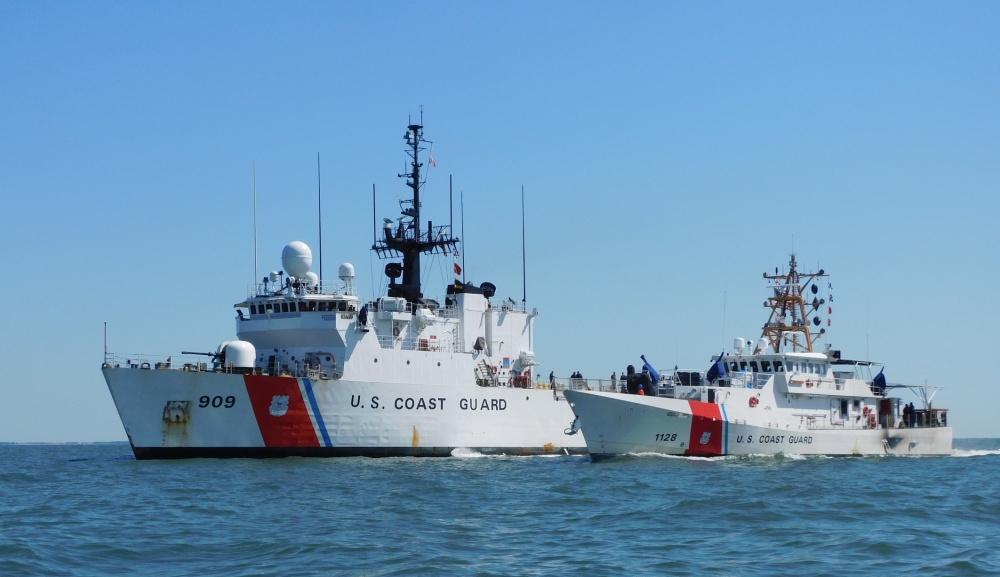
The crew of the Coast Guard Cutter Bruckenthal participates in a fueling exercise with the Coast Guard Cutter Campbell on the Chesapeake Bay, April 11, 2020. The Coast Guard acquired the first Sentinel Class cutter in 2012, with the namesake of each cutter being one of the service’s many enlisted heroes. (U.S. Coast Guard photo by Petty Officer 3rd Class Isaac Cross)

Below is a press release from the First District, announcing a homeport change for 270 foot WMECs Cambell and Tahoma from Portsmouth Naval Shipyard, Kittery, Maine to Naval Station Newport, RI. 

The reason given is, The relocation of these two cutters will allow the U.S. Navy to conduct infrastructure upgrades as part of a Shipyard Infrastructure Optimization Program at the Portsmouth Naval Shipyard,” but I think there is more to it than that. 

Naval Station Newport, RI is the planned homeport for two Offshore Patrol Cutters, #5 and #6. These will be the first two OPCs of the Stage 2 contract recently awarded to Austal. OPC#5 is expected to be completed in FY2026 and #6 in FY2027. Campbell and Tahoma are likely placeholders for the future OPCs and are unlikely to ever return to Kittery. No other major cutters remain at Portsmouth Naval Shipyard.

This updates an April 15, 2022 post, “Major Cutter Homeports.”

Media Advisory

U.S. Coast Guard 1st District Northeast

Coast Guard to hold welcome ceremony for USCGC Campbell and USCGC Tahoma in Newport, Rhode Island 

Editors’ Note: Click on images to download high resolution version.

Media interested in attending must RSVP no later than 4 p.m. Friday, August. 12, with the Coast Guard First District Public Affairs office at D1PublicAffairs@uscg.mil. Access to the event will only be granted to credentialed media. Directions will be provided following receipt of the RSVP.

WHO: Adm. Linda Fagan, commandant, U.S. Coast Guard, and team

WHAT: Welcome Ceremony for USCGC Campbell and USCGC Tahoma

WHEN: 10 a.m. Friday, Aug. 19, 2022

WHERE: Naval Station Newport, R.I., Pier 2

Security: Be prepared to show government-issued photo identification, such as a driver’s license or passport, and media credentials at the security checkpoint. We ask participating media to arrive no later than 9:30 a.m. for check-in.

BOSTON — The U.S. Coast Guard will hold a ceremony welcoming USCGC Tahoma (WMEC 908) and USCGC Campbell (WMEC 909) to their new homeport at Naval Station Newport, Rhode Island on Friday, August 19, 2022.

Due to COVID mitigation, in-person attendance is limited, and the event is not open to the public. Adm. Linda Fagan, commandant of the U.S. Coast Guard, will preside over the ceremony.

Campbell and Tahoma are relocating their homeport from the Portsmouth Naval Shipyard in Kittery, Maine to Naval Station Newport, Rhode Island. The relocation of these two cutters will allow the U.S. Navy to conduct infrastructure upgrades as part of a Shipyard Infrastructure Optimization Program at the Portsmouth Naval Shipyard.

“The Coast Guard wants your ideas for future research projects” –MyCG

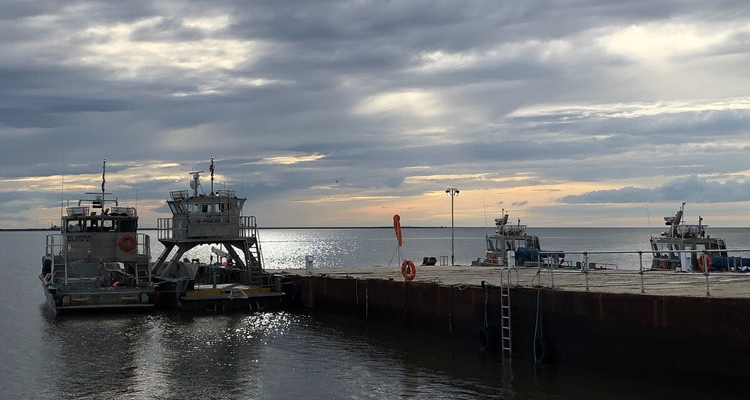
Members of the Coast Guard Research, Development, Test and Evaluation Program (CG-926) and the Research and Development Center are in Prudhoe Bay, Alaska, to test usage of unmanned systems in the Arctic in Arctic Technology Evaluation 2018. U.S. Coast Guard photo by Alexandra Swan.

Just passing this along, because I think some of my readers may have some good idea, but might otherwise miss this announcement


Aug. 8, 2022

The Coast Guard wants your ideas for future research projects

By Loretta Haring, Coast Guard Aquisitions

Do you have an idea you think might make Coast Guard operations easier? Or maybe there’s a new or ongoing challenge that makes completing your mission more difficult?

If so, the Coast Guard wants to hear from you.

That’s right. The service is currently soliciting ideas for research projects that could shape its future. The effort is in keeping with goals Adm. Linda Fagan laid out in her Commandant’s Intent: to sharpen our competitive edge and use new technologies to create a more agile workforce.

So, consider answering the admiral’s call to action by submitting your idea or challenge as a possible research and development project. The Office of Research, Development, Test & Evaluation and Innovation (RDT&E) is accepting ideas for its fiscal year 2024 research portfolio through Aug. 22.

How to participate 

You can submit ideas/challenges/gaps/potential solutions to the “FY24 Research and Development Project Ideas” challenge via CG_Ideas@Work at this link. If this is your first time on the crowdsourcing site, you’ll need to follow the instructions to register. Deadline to submit ideas is Aug. 22.

Anyone within the Coast Guard – military, civilian, reserve, auxiliary, and contract personnel – can submit ideas.

What are they looking for?   

Priority will be given to innovative ways to use Coast Guard assets and people for maximum effect, particularly during crisis response, as directed by the commandant.

To help guide idea submissions, the Deputy Commandant for Operations and Deputy Commandant for Mission Support have identified the following research priorities for fiscal years 2024-2025. All ideas, however, will be reviewed and considered on their merit.

  • Grow advanced computing capabilities to maximize readiness (data analytics).
  • Continue developing mobile solutions to deliver mission excellence anytime, anywhere.
  • Utilize autonomous systems to address the nation’s complex maritime challenges.
  • Strengthen resilience, safety, security, and sustainability of Coast Guard systems and personnel to deliver mission excellence anytime, anywhere.
  • Develop human machine teaming to maximize readiness.
  • Enhance C5I capabilities to maximize readiness today and tomorrow.
  • Develop service solutions to climate change impacts.

The RDT&E program champions ideas that future-proof the workforce and optimize for today while continually innovating and adapting for tomorrow. Fagan has said, “Tomorrow looks different. So will we.” Your idea could be instrumental in making that a reality.

Questions? Contact research@uscg.mil. If you are unable to access the idea submission form, please submit your idea to research@uscg.mil and include the title, a short summary, and your contact information.

Related: 

“Coast Guard cutter Winslow Griesser, 23-foot fishing vessel collide north of Dorado, Puerto Rico” –D7

Below is a News Release from D7.

News Release

U.S. Coast Guard 7th District Puerto Rico and U.S. Virgin Islands

Coast Guard cutter Winslow Griesser, 23-foot fishing vessel collide north of Dorado, Puerto Rico

SAN JUAN, Puerto Rico — The U.S. Coast Guard Cutter Winslow Griesser and the 23-foot commercial fishing vessel Desakata were involved in a collision Monday afternoon, approximately four nautical miles north of Dorado, Puerto Rico.

Following the collision, the crew of the cutter Winslow Griesser recovered the two fishermen aboard Desakata, identified as Carlos Rosario, who was fatally injured, and his brother Samuel Rosario Beltrán, who sustained injuries but survived the collision.

“We sincerely mourn the passing of Carlos Rosario following the collision between a Coast Guard cutter and the fishing vessel Desakata this afternoon,” said Capt. José E. Díaz, commander of Coast Guard Sector San Juan. “We send our most heartfelt condolences to his family, friends and loved ones, and pray they find strength during this most difficult time. A thorough investigation will be completed to determine the causal factors that led to this collision so that we can prevent this type of incident from occurring in the future.”

Coast Guard watchstanders at Sector San Juan were notified of the incident by the cutter Winslow Griesser crew at approximately 2:19 p.m. Monday. Coast Guard watchstanders directed the launch of a 45-foot response boat crew from Station San Juan who arrived on-scene and located the damaged fishing vessel.

The cutter Winslow Griesser transported both of the recovered fishermen to Coast Guard Base San Juan for transfer to awaiting Emergency Medical Services. EMS delivered Samuel Rosario Beltrán to the Centro Medico hospital in San Juan. The remains of Carlos Rosario will be transferred to Forensics Science Institute in San Juan.

Cutter Winslow Griesser is a 154-foot Sentinel Class fast response cutter homeported in San Juan, Puerto Rico.

The National Transportation Safety Board (NTSB) is leading the investigation into what caused the collision.

Media inquiries for the Coast Guard should contact the Coast Guard Seventh District public affairs office in Miami, FL at (305) 415-6680 or d7publicaffairs@gmail.com. Media inquiries about the investigation should contact the NTSB at (202) 314-6100 or ntsbmediarelations@ntsb.gov.

For more breaking news follow us on Twitter and Facebook.

-USCG-

“U.S. Coast Guard participates in multilateral search and rescue drill off Palau” –News Release

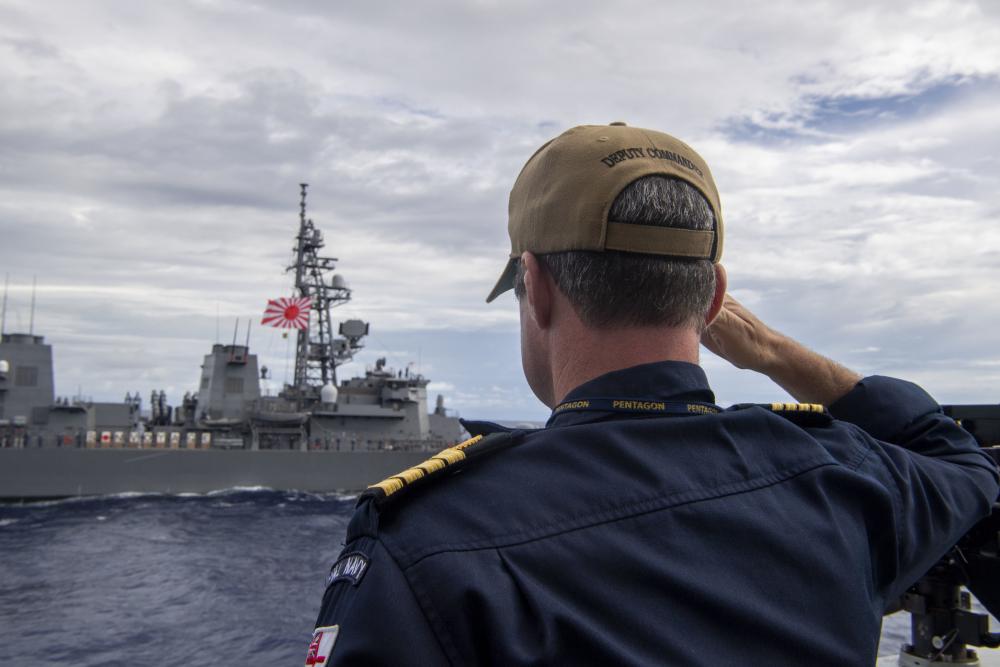
PACIFIC OCEAN (July 19, 2022) – Capt. Charles Maynard of the Royal Navy, serving as deputy mission commander of Pacific Partnership (PP22), renders honors as Japan Maritime Self-Defense Force (JMSDF) ship JS Kirisame (DD 104) passes Navy River Class vessel HMS Tamar (P233) during a multilateral search and rescue exercise (SAREX) coordinated with the U.S. Navy, Republic of Palau, U.S. Coast Guard, Japan Maritime Self-Defense Force and Royal Navy in support of PP22. Now in its 17th year, Pacific Partnership is the largest annual multinational humanitarian assistance and disaster relief preparedness mission conducted in the Indo-Pacific. (U.S. Navy photo by Mass Communication Specialist 2nd Class Brandie Nuzzi)

Below is a press release reporting a multinational SAR exercise involving units from the United Kingdom, Japan, and the Republic of Palau as well as the US Navy and Coast Guard. (46 photos here)

There are some noteworthy aspects to this exercise.

Re the USCG: First that there is a Coast Guard liaison officer to the Compact of Free Association States, Lt. Cmdr. Field Cassiano. Second, USCGC Myrtle Hazard, commissioned just over a year ago has conducted “sovereignty and fisheries patrols with five Pacific island nations.” She has been very busy. 

Re growing Allied interest: The participation of Britain and Japan is relatively new.

The UK has recently shown renewed interest in the Pacific after decades with virtually no forces in the Pacific. The Royal Navy vessel in the exercise, HMS Tamar, is one of two River Class Batch II Offshore Patrol Vessels that have embarked on a five year deployment to the Indian and Pacific Oceans. There are plans to permanently deploy a task force to the area and there is also a growing partnerships between the UK and Japan.

Since WWII, Japan has generally kept a low profile in international affairs but with the emergence of an agressive and overtly hostile China, Japan has started to assume a leadership role in the region. She has transferred offshore patrol vessels to several nations in SE Asia. For the first time, Japan is starting to maket weapons internationally. I found it interesting that the Japanese participant in the SAR exercise was a destroyer rather than a Japan Coast Guard vessel. I have yet to see any evidence, the Japan Coast Guard is taking on an expeditionary role, as the US Coast Guard has done.

News Release

U.S. Coast Guard Forces Micronesia / Sector Guam

U.S. Coast Guard participates in multilateral search and rescue drill off Palau

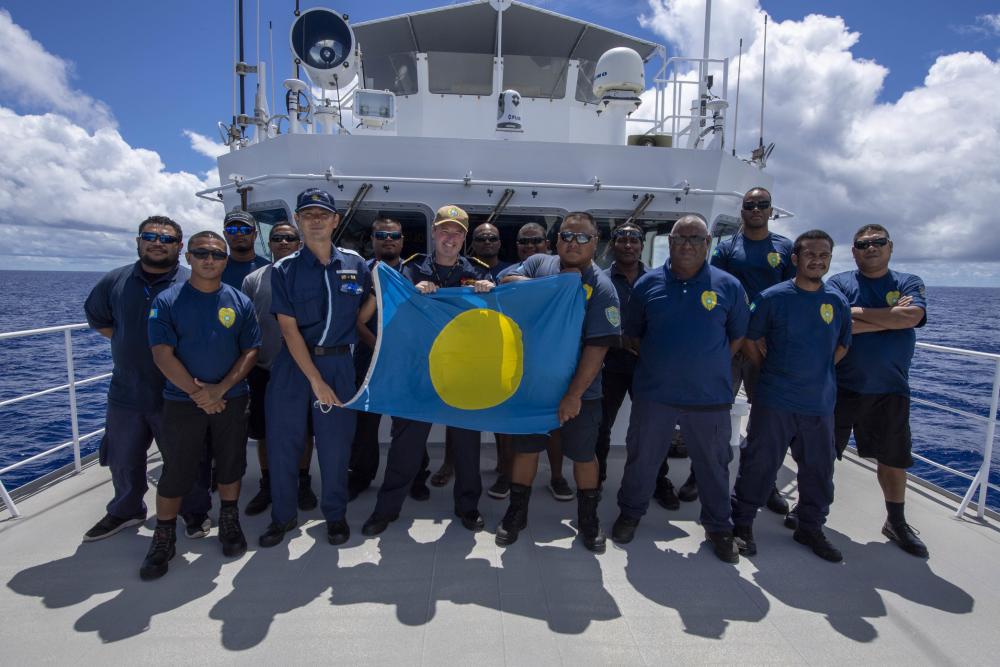
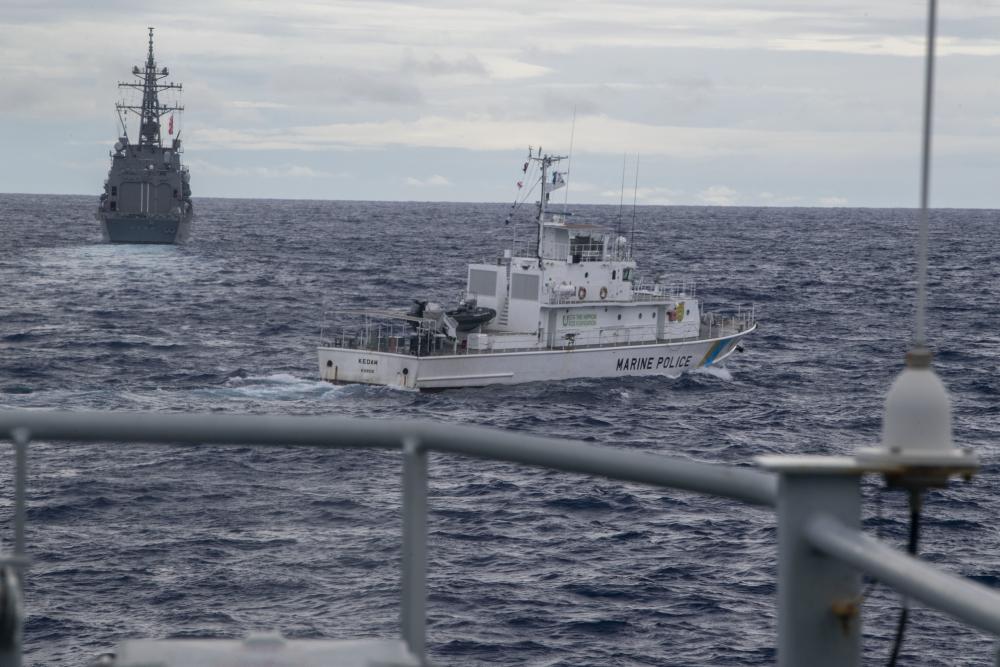
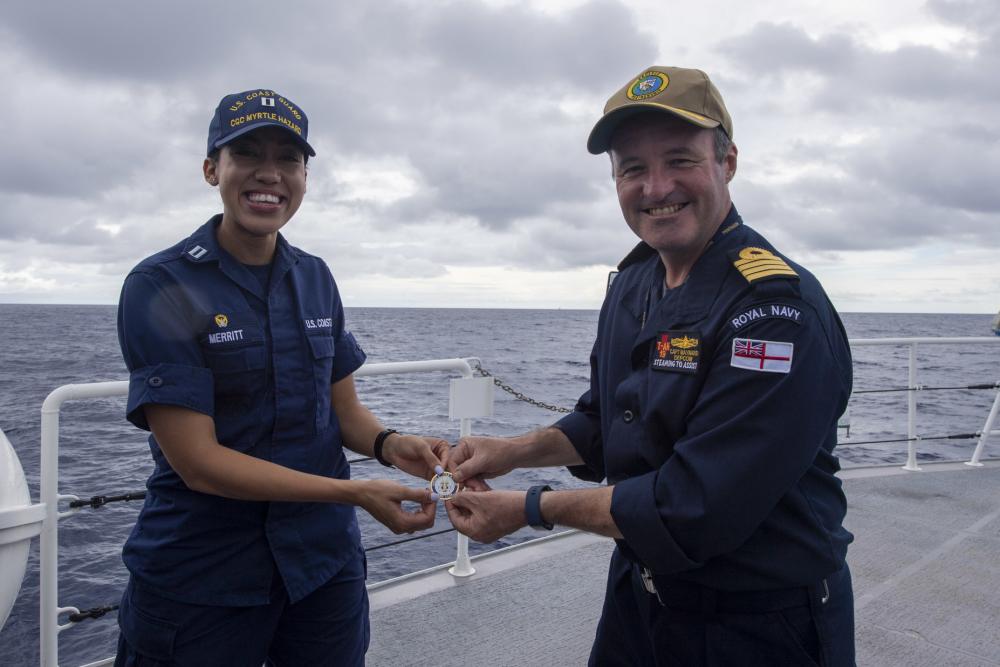
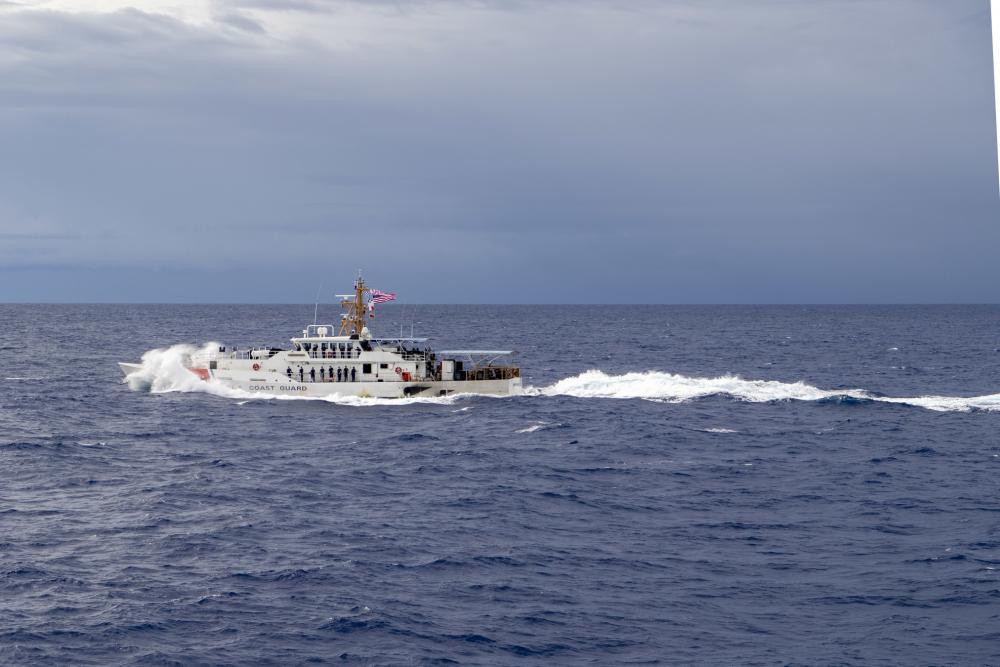
Royal Navy River Class vessel HMS Tamar (P233) sailors conduct boat operations with the USCGC Myrtle Hazard (WPC 1139)  Charles Maynard of the Royal Navy, serving as deputy mission commander of Pacific Partnership (PP22), center left, takes a photo with the crew of Palau Patrol Ship PPS Kedam Capt. Charles Maynard of the Royal Navy, serving as deputy mission commander of Pacific Partnership (PP22), renders a honors as Japan Maritime Self-Defense Force (JMSDF) ship JS Kirisame (DD 104) passes
Japan Self-Defense Force (JMSDF) ship JS Kirisame (DD 104), front left, Palau Patrol Ship PPS Kedam, center, and Royal Navy River Class vessel HMS Tamar (P233) transit the Pacific Ocean during a multilateral search and rescue exercise (SAREX) Capt. Charles Maynard of the Royal Navy, serving as deputy mission commander of Pacific Partnership (PP22), right, receives a U.S. Coast Guard challenge coin from Lt. Jalle Merritt, commanding officer of USCGC Myrtle Hazard (WPC 1139)  USCGC Myrtle Hazard (WPC 1139) transits the Pacific Ocean during a multilateral search and rescue exercise (SAREX) coordinated with the U.S. Navy, Republic of Palau, U.S. Coast Guard, Japan Maritime Self-Defense Force and Royal Navy in support of Pacific Partnership 2022

Editors’ Note: To view more or download high-resolution photos click on the images above. Photos courtesy Petty Officer 2nd Class Brandie Nuzzi, USN.

SANTA RITA, Guam — In a bid to strengthen relationships and interoperability, the U.S. Coast Guard conducted a multilateral search and rescue drill alongside longtime partners from the United Kingdom, Japan, and the Republic of Palau in late July.

“We thrive on these opportunities, and we all came away with a deepened appreciation for the work of our respective agencies,” said Lt. Cmdr. Field Cassiano, Coast Guard liaison officer to the Compact of Free Association States. “Anyone who spends time in the Pacific is no stranger to the region’s vast distances and limited resources. Evolutions like this provide invaluable face-to-face interaction and enable us to work through challenges before an incident or crisis.”

Such events range from something akin to the search for Amelia Earhart to the far more common activity of a small skiff of fishers gone missing. It could also include a large-scale response for a disabled cruise ship or search and rescue of the crew of a commercial vessel like the car carrier Cougar Ace which heeled over at sea before being towed into port in 2008.

In this drill, the USCGC Myrtle Hazard (WPC 1139) crew, with support from the U.S. Coast Guard Fourteenth District and U.S. Coast Guard Forces Micronesia / Sector Guam, worked with the crews of the Palau Patrol Ship PPS Kedam, the Japan Maritime Self-Defense Force ship JS Kirisame (DD 104), and Royal Navy River Class vessel HMS Tamar (P233).

“Thoughtful planning led to realistic scenarios that were positively challenging, which demanded teamwork, shared vision, and high-level navigational expertise,” said Lt. Jalle Merritt, commanding officer of USCGC Myrtle Hazard. “It is fully in the realm of possibility that our partners and we will be called upon to support those in need, in heavy weather, near reefs, with a limited time to respond. Through drills such as those conducted this week, our multinational maritime response team remains ready to not only meet but exceed the needs of those our team serves.”

With decades of experience and one of the largest maritime rescue regions in the world, the U.S. Coast Guard in the Pacific works together with partners and neighbors to provide life-saving coverage throughout the region. The United States maintains several formal agreements with partners under strict compliance with international laws and regulations. These agreements include Search and Rescue (SAR) agreements with Japan, Australia, and the Republic of Palau, among other regional nations.

Historically, the U.S. Coast Guard and Palau hold regular search and rescue engagements to improve cooperation and processes between the Service and counterparts in Palau. This drill, one facet of Pacific Partnership 22, comes on the heels of a very successful humanitarian assistance and disaster relief workshop with 120 personnel trained.

Charles Maynard of the Royal Navy, serving as deputy mission commander of PP22, was on hand to oversee the exercise, part of PP22’s Palau phase.

The coordination between partner nations during PP22 enhanced understanding and cooperation and prepared those involved to respond in the case of a natural disaster or other humanitarian assistance and disaster relief scenario. Pacific Partnership contributes to regional stability and security through exchanges that foster enduring partnerships, trust, and interoperability between nations.

Now in its 17th year, Pacific Partnership is the most extensive annual multinational humanitarian assistance and disaster relief preparedness mission conducted in the Indo-Pacific.

The Myrtle Hazard is the 39th Sentinel-class fast response cutter. The ship arrived in Guam and commissioned along with its sister ships, Oliver Henry and Frederick Hatch, in July 2021. In the time since, the crew has participated in Operation Blue Pacific, conducting sovereignty and fisheries patrols with five Pacific island nations.

For more U.S. Coast Guard Forces Micronesia/Sector Guam news visit us on DVIDS or subscribe! You can also visit us on Facebook at @USCGSectorGuam.

-USCG-
USNI Proceedings Coast Guard Issue

USCGC Mohawk (WMEC-913), Clarence Sutphin Jr. (WPC-1147), and John Scheuerman (WPC-1146)

Sorry this post is going to ramble a bit.

The Prize Winning Essays: 

The August issue of the U. S. Naval Institute Proceedings is again the “Coast Guard Issue,” and includes the three winning essays in their Coast Guard Essay contest.

First prize went to prolific author and repeat winner, Cdr. Craig Allen, Jr., USCG for his “Expeditionary Cutter Deployments Should Not Be a Mission to Mars.” It talks about some of the logistical difficulties encountered. His comments about the integrated C5ISR, navigation, and engineering systems and “controlled parts exchanges (taking working parts from one cutter and installing them in another) to deploy on schedule and/or remain underway” are partiuclarly troubling.

He offered three suggestions about how to make the Coast Guard more deployable.

  • Improved cutter self-sustainability.
  • Forward operating bases
  • Mission support cutter.

I would note that large cutters are probably already have more self-sustainability than their Navy counterparts making extended single ship deployments with minimal support easier for cutters than for Navy ships, but it does sound like we have made some choices that may put those capabilities at risk.

It is probably diplomatically easier to establish a Coast Guard forward operating base than one for the Navy, particularly in Latin America. Realistically we are probably only talking about a base in the Eastern Pacific, near the drug transit zone. To make that happen would probaby require some initiative from SOUTHCOM.

Elsewhere we could probably ride the coat tails of the Navy and our allies including Australia, New Zealand, Japan, the United Kingdom, France, and the Netherlands.

The mission support cutter, or, more generally, a floating base might be addressed in a number of ways. Presumably SOUTHCOM will get their own Expeditionary Sea Base. Wherever it is moored will become a defacto forward operating base. There should be room aboard for priority Coast Guard unique support requirements. Unfortunately I understand, dispite their tanker origins, they don’t carry fuel for tranfer to other ships. That is unfortunate, but probably something that could be fixed. Any kind of forward operating base could make Webber class deployments to the Eastern Pacific drug transit zones much more productive.

Effectively the Coast Guard has already been using buoy tenders as mission support cutters for Webber class in the Western Pacific.

One might think that a Navy owned MSC vessel might make a good mission support vessel, but the underway replenishment vessels they have currently, are far too large to be dedicated to supporting routine Coast Guard operations.

Something  to consider might be a routine teaming of Charleston based National Security Cutters (NSC) with District 7 Webber class Fast Response Cutters (FRCs). A NSC and a pair of FRCs could make a very effective team, with the NSC providing underway replenishment for the FRCs. There are three NSC in based in Charleston now and there are expected to be five when the program is completed. There are currently 20 FRCs based in district 7. These ships are the closest of their type to the Eastern Pacific Drug Transit Zones.

Second prize went to “The World’s Fishermen as a Maritime Sensor Network,” by Lieutenant Holden Takahashi, USCG, that suggest a cell phone based reporting system could provide additional eyes to Maritime Domain Awareness systems.

Third prize went to “Lost At Sea: Teaching, Studying, and Promoting Coast Guard History,” by Lt. Christopher Booth, USCG, and Mark Snell, U.S. Coast Guard Auxiliary contending,

“To foster pride in its heritage and promote its historic accomplishments to the public, the Coast Guard cannot continue to ignore its past. It must make a major shift in how it approaches, teaches, promotes, and preserves its history. The Coast Guard must rescue the history and heritage of “that long line of expert seamen” and their contributions to the nation, so they are no longer lost at sea.”

Other Posts of Interest:

There are also other posts that directly address the Coast Guard or at least would involve the Coast Guard.

A Campaign Plan for the South China Sea,” by Captain Joshua Taylor, U.S. Navy advocates for persistent low-end presence.

A South China Sea campaign that translates these principles into action in a resource- and diplomatically constrained—but feasible and effective—manner should be organized around the following lines of effort and accompanying messages:

  • Beat Cop. Persistent low-end presence—“The United States has skin in the game.”
  • Neighborhood Watch. Build a regional coalition— “We are stronger together.”
  • Vigilance. Information sharing—“We are always watching.”

ln terms of information sharing, also mentioned was this Maritime Domain Awareness program that I was not aware of.

Since 2016, the United States has invested more than $425 million through the Maritime Security Initiative to help Indo-Pacific countries develop the ability to “sense, share, and contribute” to a regional recognized maritime picture (RMP). While some of these funds have purchased secure communication systems, the standout success story has been the U.S. Department of Transportation’s unclassified web-based SeaVision maritime domain awareness and coordination tool. Drawing on government and commercially contracted datastreams, SeaVision fuses information from terrestrial and satellite Automated Identification System data, the satellite Visible Infrared Imaging Radiometer Suite, satellite synthetic aperture radar, and—soon—satellite electronic signal detection to form a high-quality unclassified RMP that could support a countercoercion campaign in the South China Sea. Indeed, naval services throughout Southeast Asia already use it—with the notable exception of the U.S. Navy.

(My own ideas for a persistent low-end presence are here, Combined Maritime Security Task Force Pacific.)

The Coast Guard’s Firefighting Fiction,” by Chief Boatswain’s Mate Phillip Null, U.S. Coast Guard (Retired) suggests the Coast Guard should take a more active role in marine fire fight.

“Recent tragedies have shown the need for the Coast Guard to revisit its stance on firefighting, not to supplant municipalities or absolve them of their responsibilities, but to support them with real capabilities and expertise and to provide capability in unprotected waters to avert tragedy. The Coast Guard trains and equips its cutter crews to combat fires on board their own vessels, the success of which was recently demonstrated on board the cutter Waesche (WMSL-751) during a Pacific transit.8 Now it needs only to increase the capacity and foam-delivery capability of the pumps carried on its boats, expand the training and equipment available to its boat crews who operate in coastal regions where fire poses the greatest threat, and revise policies that limit involvement and inhibit on-scene decision-making even in unprotected waters.

While on the topic of maritime firefighting, take a look at this post by Cdr Sal, “How Many Fireboats Can You Buy for $1.2 Billion?” that discusses the Navy’s lack of fireboats. In so many cases, a less than optimal resourse on scene in a timely manner is far better that the perfect resource arriving late. Perhaps Coast Guard assets could have helped.

Some people in the Coast Guard are thinking about major ship fires, “Coast Guard, Long Beach and LA fire departments train for maritime fires.

Today Show on Cutter Eagle

Al Roker of the Today Show took a ride on Eagle and the video above was the result. Nice to see the service get some national recognition. Perhaps important to see what the Nation sees of us, even if it did look like a lot of brass polishing. Too bad no shots looking down from the rigging.

I was a little surprised to see Eagle still has an old fashioned motor surf boat not much different from the one on my first ship, 53 years ago. Would have expected an RHIB.

Thanks to Lee for bringing this to my attention.