Three PATFORSWA Island Class Cutters Decommissioned

This from Chris Cavas on Twitter. More photos there.

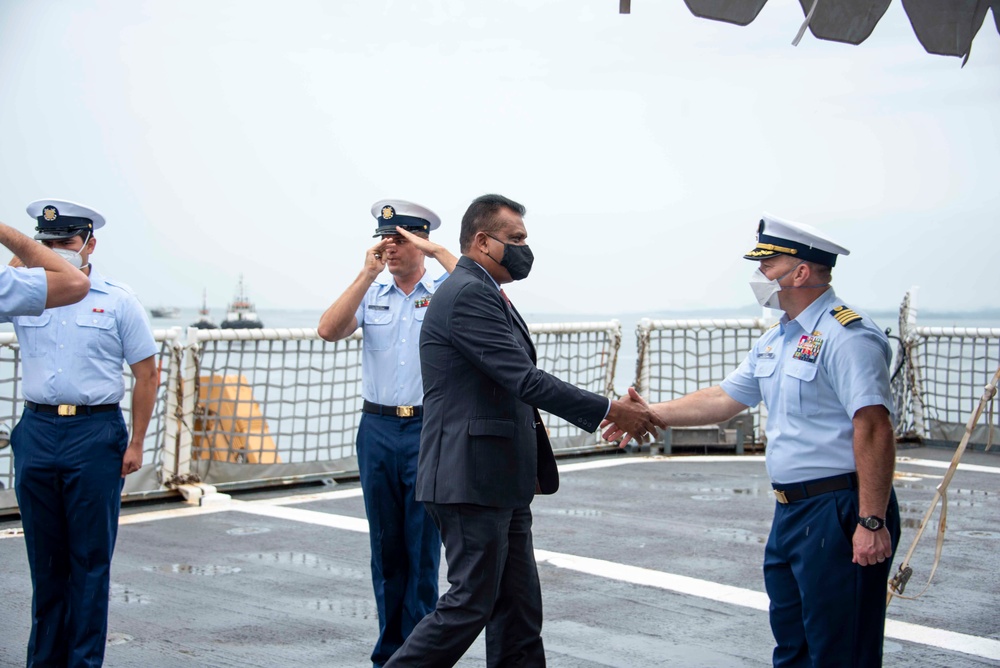
Three hard-working 110-foot US #Coast Guard cutters were decommissioned 22 March in a ceremony at Manama, #Bahrain. Cutters MAUI WPB1304, MONOMOY WPB1326 & WRANGELL WPB1332 served in the Persian Gulf since 2004, will now be available for foreign transfer.

USCGC Adak was previously decommissioned and sold to Indonesia. Likely these little ships will continue to provide useful service.

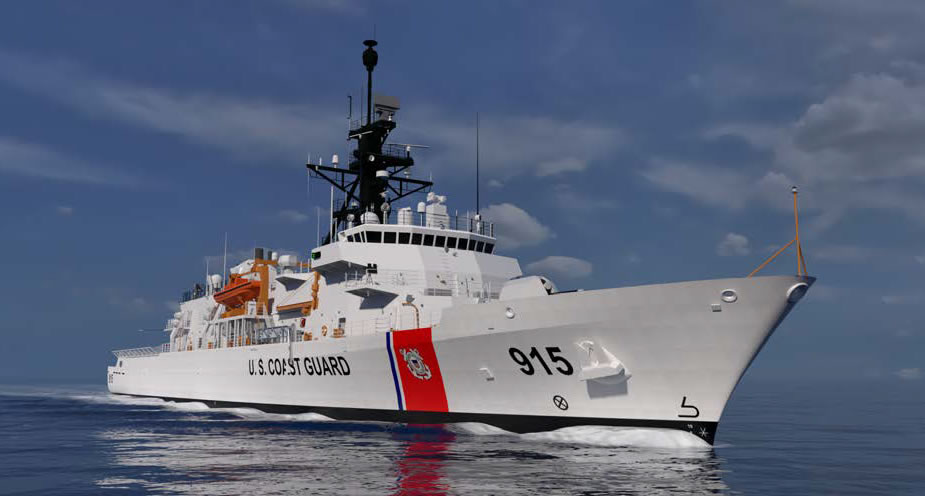
They are being replaced in Bahrain by larger and more capable Webber class Fast Response Cutters. It appears the newly arrived cutters are equipped to counter Unmanned Systems.

Thanks to Walter for bringing this to my attention. 

Naval News at DIMDEX2022

Naval News provides a review of some of the presentations made at the very first DIMDEX show in Qatar. Day One above.

Day Two looks at the Pakistani naval defense plans and industry and at a compact combined active/passive variable depth sonar and towed array system from Finland’s Patria.

There is also this video of ships that attended the show.

Naval News also provided this post about a new class of cutter sized (3,000 ton) corvettes for the Pakistani Navy, based on Turkey’s MILGEM project Ada class corvettes and Istanbul class frigates.  These are significant both because of the growth of Turkey’s defense industry and because most of Pakistan’s recent naval acquisition have been from China. Significantly none of the planned systems are Chinese except the helicopter. Here are some links to information about the weapons to be mounted on the corvette:

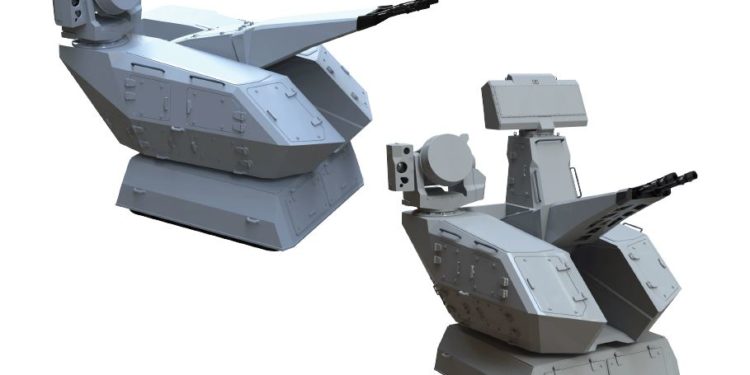
ASELSAN GOKDENIZ twin 35mm CIWS

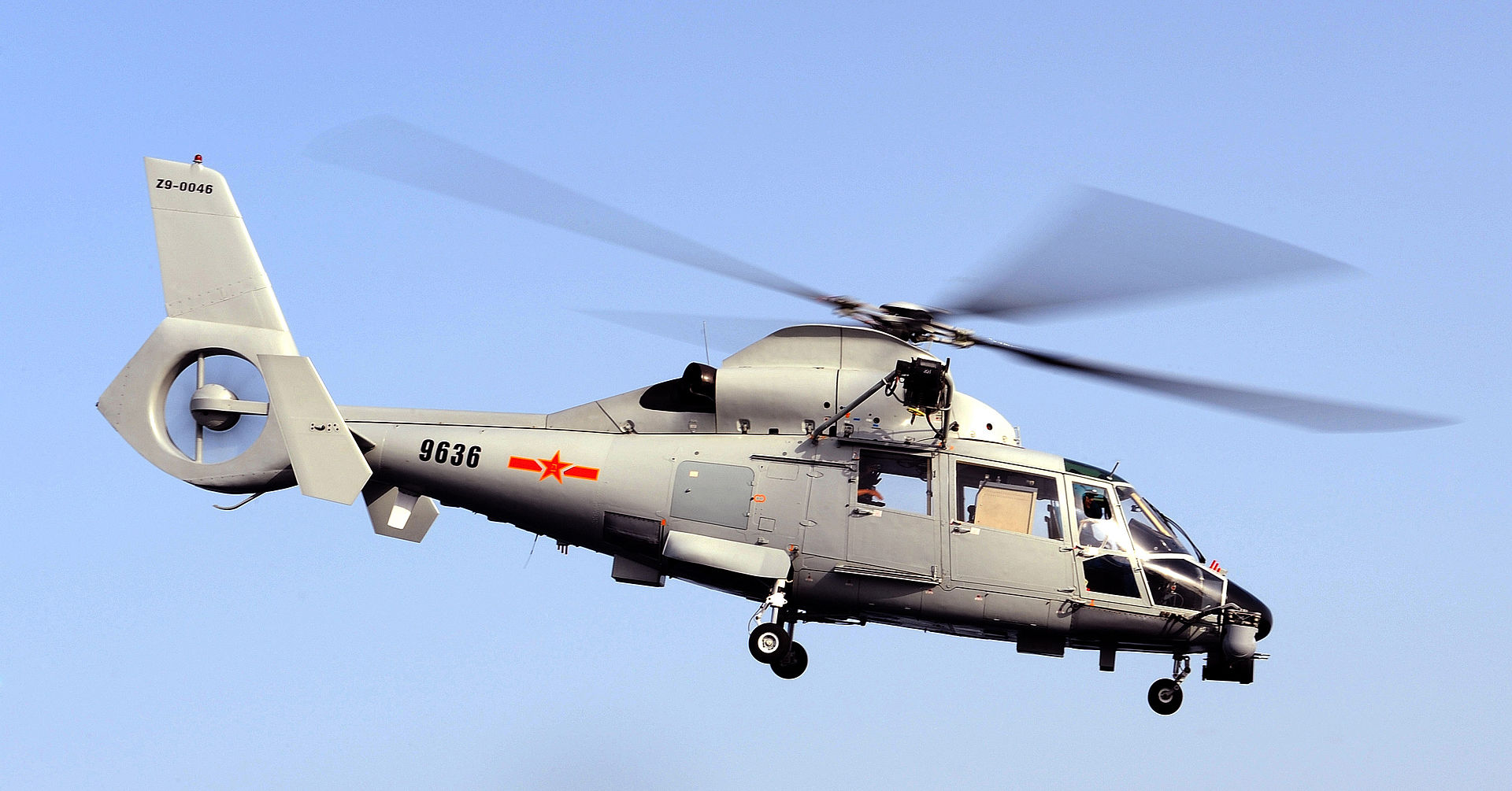
A Chinese Haifan II helicopter from the missile frigate ‘Zhoushan’ leaves the flight deck of HMS Cornwall. Members of the Chinese Public Liberation Army Navy (PLAN) were visiting the Type 22 frigate to discuss anti-piracy operations in the Gulf of Aden. Organization: Royal Navy Object Name: FB09002219

“Remembering Coast Guard Cutter Cushing” –MyCG

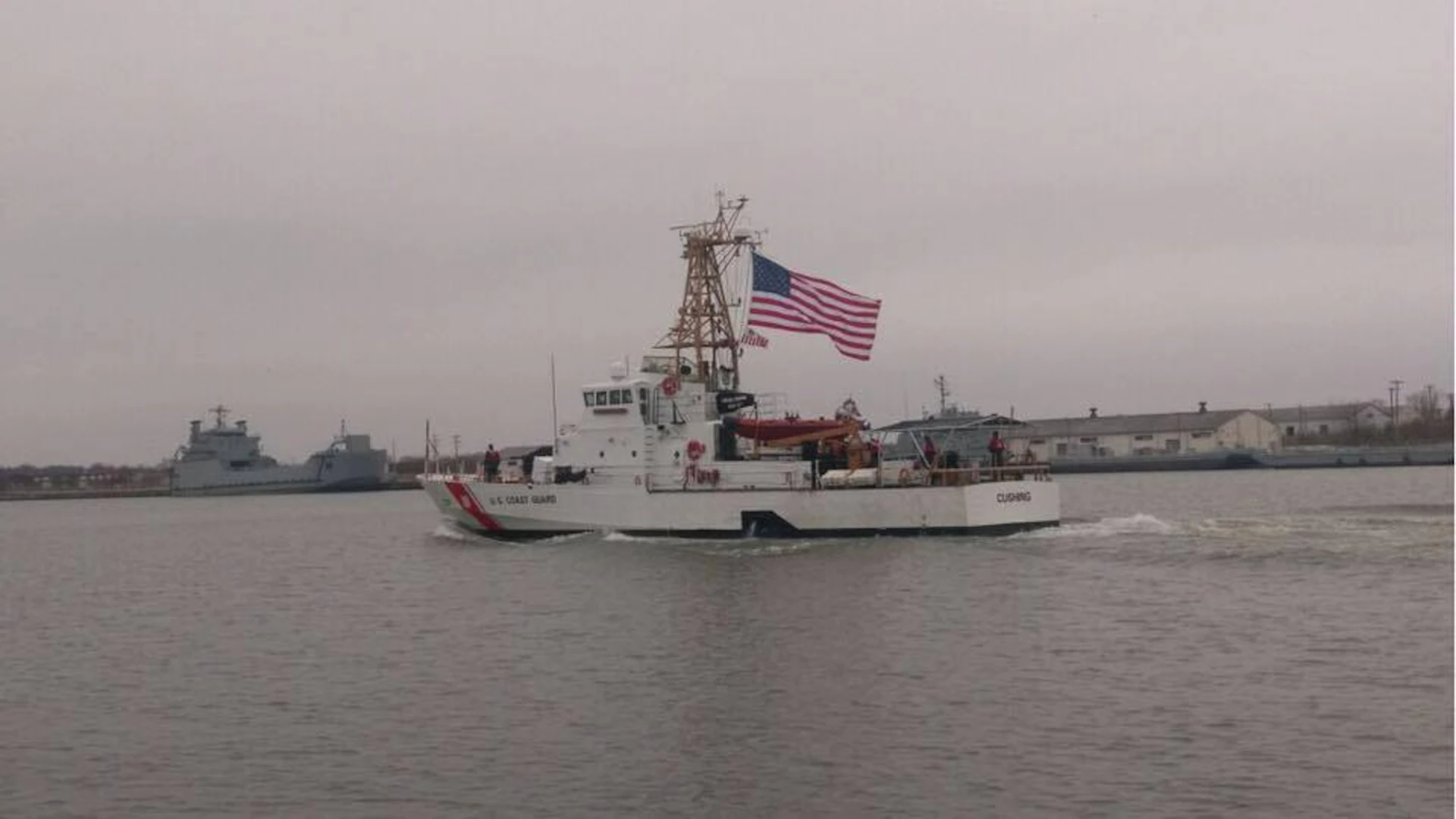
USCGC Cushing sails past the Statue of Liberty

MyCG has a retrospective on the USCGC Cushing, a WPB lost with all hands in action against Russia, after being transferred to Ukrainian Navy, apparently in an effort to lure a Russian corvette within range of shore batteries.

USCGC Cushing sails for her final Coast Guard mission before being decommissioned in 2017

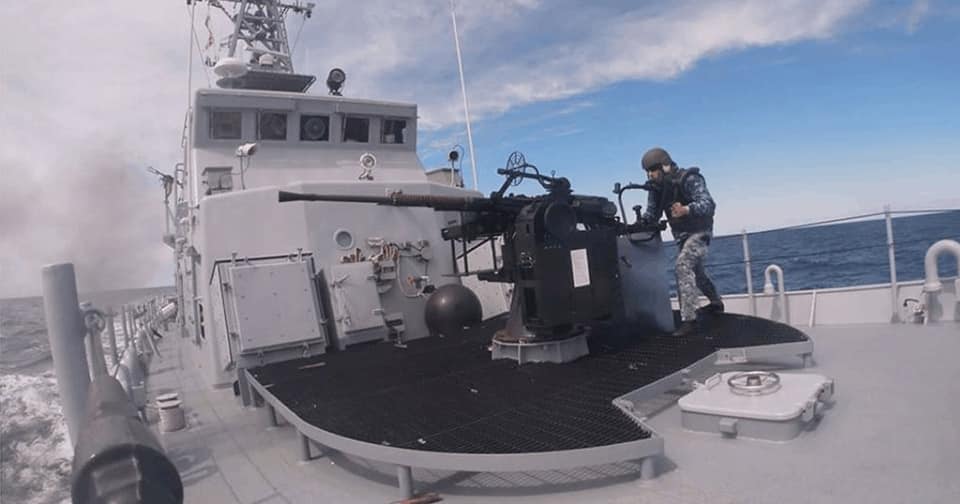
This was how she was armed in Ukrainian service.

Soviet era 25mm gun, the 110 PM.

“Coast Guard Cutter Stratton returns to Alameda following 97-day South Pacific patrol” –News Release

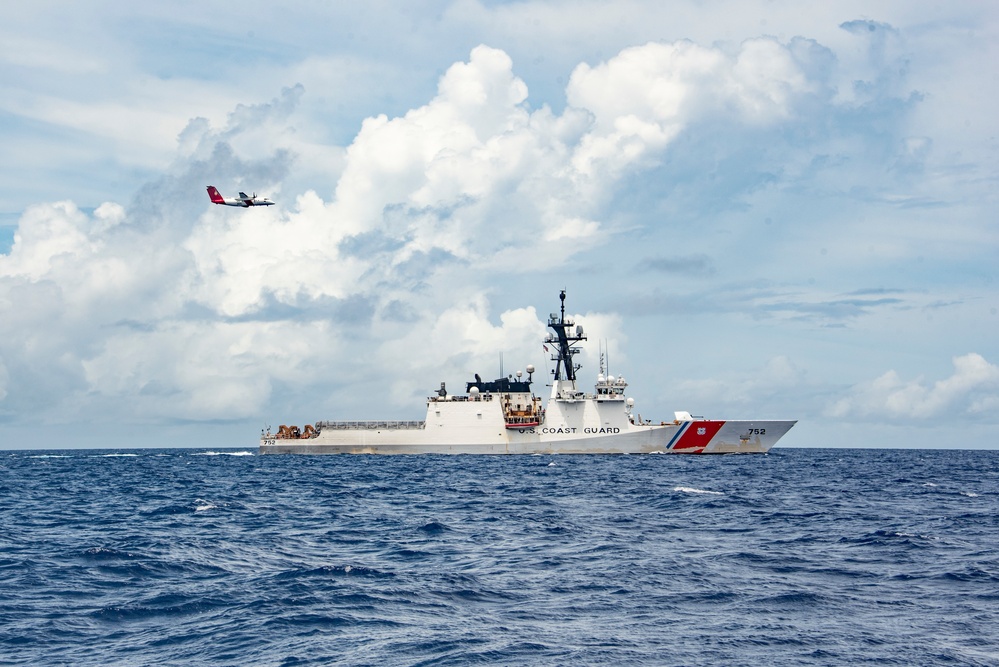
U.S. Coast Guard Cutter Stratton (WMSL 752) participates in a exercise with the Australian maritime surveillance aircraft in the South Pacific Ocean, Feb. 23, 2022. The Stratton is currently underway conducting exercises and operations with partner nations in the South Pacific region. (U.S. Coast Guard photo by U.S. Marine Corps Sgt. Sarah Stegall)

Just a news release, but it is about one of those increasingly common long deployments to the Western Pacific. Notable are the use of the small unmanned air system, presumably Scan Eagle, shiprider program with Fiji, and laying the ground work for a shiprider program with Papua New Guinea.

220130-N-CD319-1014 SOUTH PACIFIC OCEAN (Jan. 30, 2022) The Arleigh Burke-class guided-missile destroyer USS Sampson (DDG 102) participates in Divisional Tactics (DIVTAC) formations with U.S. Coast Guard Cutter Stratton (WMSL 752) and British Royal Navy ship HMS Spey (P 234). Sampson is positioned to conduct lifesaving actions in support of disaster relief efforts in Tonga. The ship is operating in support of the Australian Defence Force (ADF). The Australian Government response is coordinating closely with France and New Zealand under the FRANZ partnership, alongside Fiji, Japan, United Kingdom and the United States to assist Tonga in its time of need. Sampson is on a scheduled deployment in the U.S. 7th Fleet area of operations to enhance interoperability with alliances and partnerships while serving as a ready-response force in support of a free and open Indo-Pacific region. (U.S. Navy photo by Mass Communication Specialist 3rd Class Tristan Cookson)

News Release

March 21, 2022
U.S. Coast Guard Pacific Area

Coast Guard Cutter Stratton returns to Alameda following 97-day South Pacific patrol

Photo of CGC Stratton Photo of CGC Stratton Photo of boarding
Photo of boarding Photo of Fiji press event Photo of boarding

Editors’ Note: Click on images above to download high resolution versions. Additional photos are available here.

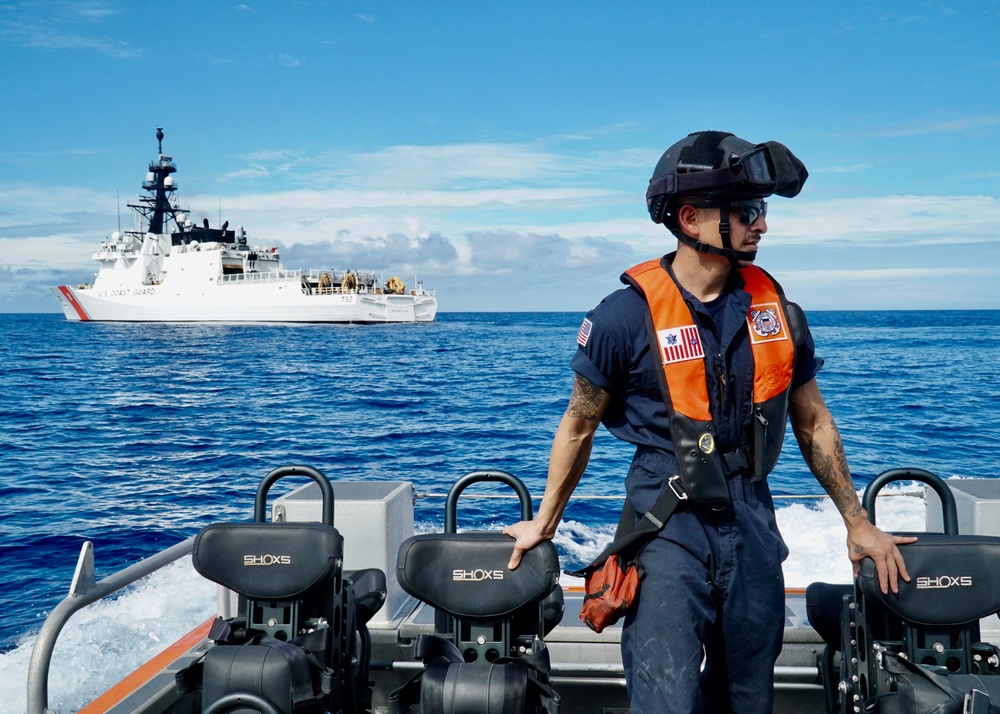
ALAMEDA, Calif. — The crew of Coast Guard Cutter Stratton (WMSL 752) returned to Alameda Saturday after completing an Operation Blue Pacific Patrol in the south Pacific.

While underway, Stratton’s crew worked with Pacific partner nations, including Fiji, France, New Zealand, Papua New Guinea, Australia, and the United Kingdom on an array of missions and prioritized combating Illegal, Unreported, and Unregulated fishing on the high seas or in partner nations’ exclusive economic zones.

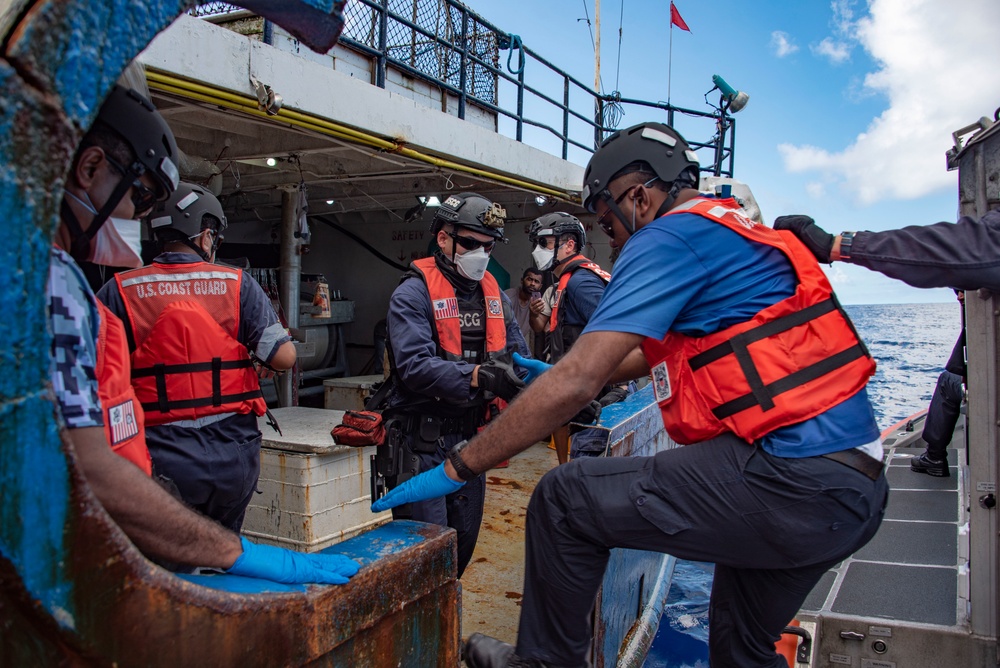
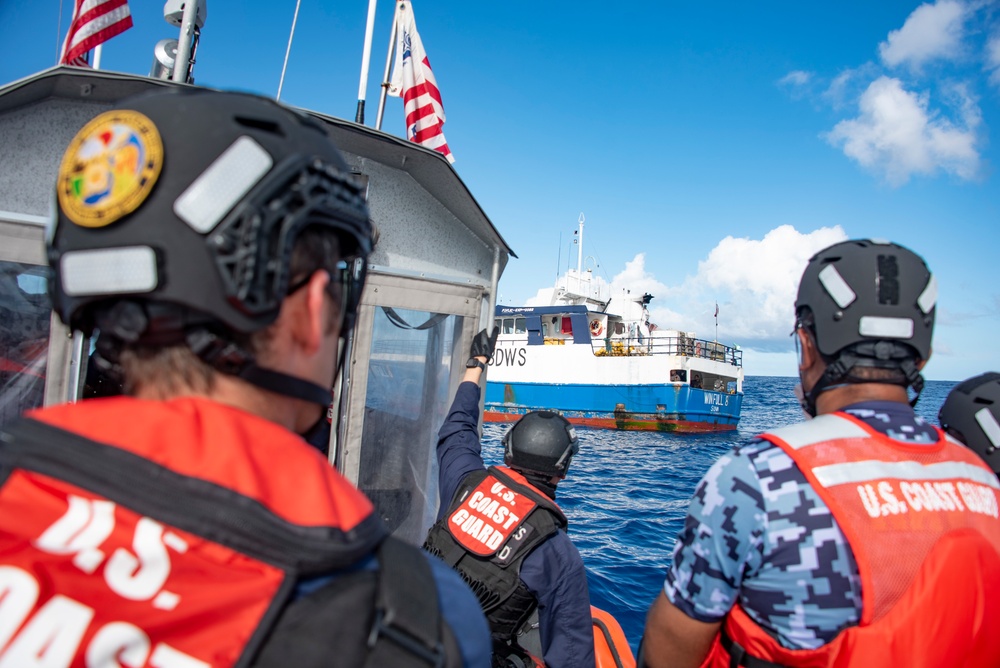
In the effort to combat IUU fishing, Stratton teams boarded 11 vessels during the 20,348-mile patrol and found 21 violations.

“Our collaboration with our partners and utilization of our shiprider agreements gave us the ability to accomplish our mission of combatting illegal, unreported, and unregulated fishing in order to maintain regional stability and protect the fishing industry,” said Capt. Steve Adler, Stratton’s commanding officer. “By bringing aboard shipriders from Fiji, we were able to patrol their exclusive economic zones to better assist them in enforcing their maritime laws.”

In February, Stratton embarked three shipriders from Fiji with representatives from the Fiji Revenue and Customs Services, the Fiji Ministry of Fisheries, and the Republic of Fiji Navy, who led bilateral enforcement efforts for Stratton to patrol their exclusive economic zones.

There is a shared interest for both Fiji and the United States, as well as other partner nations, to protect fisheries as they provide a renewable source of food and income to the Pacific nations.

The Stratton crew also used small Unmanned Aircraft Systems to increase the ship’s capabilities and further extend the cutter’s patrol area.

“Stratton’s capacity for employing cutting edge technology like sUAS, gives the Coast Guard the upper hand in the fight against IUU fishing,” said Cmdr. Charter Tschirgi, Stratton’s executive officer. “The vast area covered during patrols like these displays the reach the Coast Guard has and the length we will go to assist our partners in the Pacific.”

Stratton visited multiple countries while deployed, including Tahiti, Fiji, and Papua New Guinea. While in Suva, Fiji, Stratton hosted a joint media engagement with the Fijian Permanent Secretary for Ministry of Defense, Manasa Lasuma, and the Fijian Permanent Secretary for the Ministry of Foreign Affairs, Yogesh Karan. While anchored in Port Moresby, Papua New Guinea, Stratton also hosted an engagement and law enforcement demonstration in conjunction with U.S. Ambassador Erin McKee and representatives of Papua New Guinea: Chief Inspector Christopher Smith, Terry Udu, Moses Teng, Hiribuma Dabuma, MAJ Norbeth Fehi, and Ivan Salonica. This discussion and demonstration of law enforcement operations and regional partnerships helped facilitate a future signing of a bilateral shiprider agreement between Papua New Guinea and the United States.

“Communicating with our allies face-to-face is extremely valuable,” said Ensign Alexander Mastel, Stratton’s public affairs officer. “With IUU fishing replacing piracy as the leading global maritime security threat, it is more important than ever to join efforts in ensuring economic security in the Pacific.”

While on patrol, Stratton’s crew also participated in multiple joint exercises with partners in the region. These included a formation sailing with the HMS Spey, a tactical maneuvering drill with HMS Spey and USS Sampson, a joint patrol with an Australian Border Force patrol aircraft, fueling-at-sea with New Zealand’s newest replenishment vessel HMNZS Aotearoa, and joint steaming with the French Naval vessel FMS Arago and Fijian Patrol vessel Savenaca.

“Partnerships across the Pacific are the key to success in combatting illegal, unreported, and unregulated fishing. I am extremely proud of the crew for demonstrating tremendous success in partnering and operating with our regional partners and allies across Oceania, including navies and law enforcement officials from French Polynesia, Fiji, Papua New Guinea, New Zealand, Australia, and the United Kingdom,” said Adler. “Only by building these continued relationships and joint operations with patrols like Stratton’s Operation Blue Pacific will we be able to truly make a difference and impact against the global problem of IUU fishing. By training with our partners, we further our interoperability and cooperation, ultimately advancing a peaceful, free and open Indo-Pacific.”

“AWARDS 2021 | BEST ICE-CLASS TUG – SELENE – ROBERT ALLAN LTD & SANMAR SHIPYARDS” –Baird Maritime

Robert Allan designed Icebreaking Tug Selene

A recent article from Baird Maritime reminded me once again, of a type of vessel I think the Coast Guard should seriously consider, a replacement for the 65 foot icebreaking tugs. Reportedly the Coast Guard hoped to decommission the 65 foot tugs, but Congress would not allow it. Their breaking ice dams for flood prevention and domestic icebreaking was considered too important.

This particular design seems to offer some additional advantages I have not seen in previous designs. Designed to operate in the Baltic in ice up to 0.8 meters thick (that is 0.3 meters more than the 140 WTGBs), it is substantially larger than the 65 footers at 31.5 meters or about 103 feet. The report indicates seaworthiness was a major consideration.

The Congressional contingent from the Great Lakes area have repeatedly expressed concerns about Great Lakes Icebreaking (and here). They want another icebreaker comparable to the Mackinaw, but a few more icebreaking tugs might actually be a better response.

In addition to icebreaking, these could provide a ready response to pollution incidents (this one can transport a standard 20 foot container). Given fire monitors these vessels could function as fireboats.

Of course this tug isn’t the only option, nor is it the only icebreaking tug design out there. I had intended to talk about this earlier, so I have some old news to reference.

When you look at these options keep in mind what we have now.

  • The nine 140 foot WTGBs entered service August 1979 to August 1988 so they are 33 to almost 43 years old and have only 2500 HP, speed 14.7 knots. We have done life extension work on them, but maybe its time to look for their replacements too.
  • The eleven 65 foot WYTLs entered service July 1961 to May 1967 so they are 55 to almost 61 years old and have only 400 to 475 HP, speed 10 knots.

In addition to the tug above, Robert Allen has designed a number of tugs including an icebreaking/buoy tending tug built in the US for the Saint Lawrence Seaway. Check out this Marine Log report.

Gulf Island Fabrication to Build TundRA 3600 for Saint Lawrence Seaway Development Corporation

MarineLink reported that MedMarine (a Turkish shipbuilder) is building some icebreaking tugs for Danish company, Svitzer. (They also have an office in Florida.) The design designated “TundRA 3000″ is by Canadian designer Robert Allan Ltd.

Photo: Med Marine

Photo: Med Marine

TundRA 3000 design has following design particulars:

  • Length overall: 30m
  • Beam of hull: 12.6m
  • Extreme beam (including fenders): 13.2m
  • Depth moulded: 5.7m
  • Maximum draft: 5.6m
  • Gross tonnage: <500GT
  • Minimum bollard pull: 60ton
  • Power: Approx 3900 kW (5300 HP)

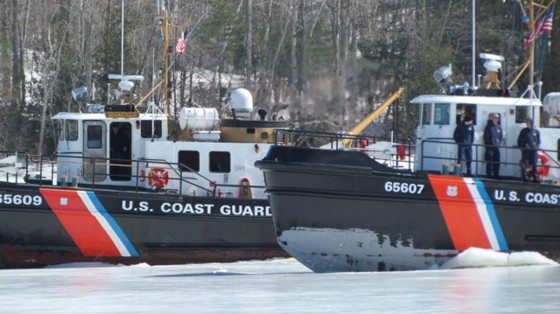
Breaking ice on the Kennebec River. USCG Photo

At the small end we have this 56 foot long icebreaking tug with 750 HP, almost twice that of our 65 foot tugs.

My point is not that any particular design is the answer, but that there are much better and more effective designs out there compared to vessels we are currently using. Crew size and operating costs are likely to the same or perhaps less. There is new technology that is more economical, offers better maneuverability, and lower emissions. Additionally they could be more generally useful than the tugs we have. They might have buoy tending capabilities, fire fighting monitors, or provide ready oil pollution incidence response.

Why It Would Make Sense to Award Two OPC Contracts.

Artists rendering from Eastern Shipbuilding Group

The Navy League’s online magazine “Seapower” reports,

 Bollinger Shipyards submitted on March 18 its final proposal to the United States Coast Guard to build Stage 2 of the Heritage-class Offshore Patrol Cutter program. If chosen, Bollinger would construct and deliver a total of 11 vessels to the U.S. Coast Guard over the next decade, helping to sustain the Bollinger workforce through 2031.

It is obviously a Bollinger press release, talking about how much good it would do for the local economy, but it does occur to me…

If we have two truly competitive bids, this could be an opportunity to have two shipyards building Offshore Patrol Cutters.

The program is already too long delayed. The phase II contract proposals are likely to be very competitive. In March 2020, contracts for industry studies were awarded to nine different yards.

  • Austal USA of Mobile, AL
  • General Dynamics/Bath Iron Works (GD/BIW) of Bath, ME
  • Bollinger Shipyards Lockport of Lockport, LA
  • Eastern Shipbuilding Group (ESG) of Panama City, FL
  • Fincantieri Marinette Marine (F/MM) of Marinette, WS
  • General Dynamics/National Steel and Shipbuilding Company (GD/NASSCO) of San Diego, CA
  • Huntington Ingalls Industries/Ingalls Shipbuilding (HII/Ingalls) of Pascagoula, MS
  • Philly Shipyard of Philadelphia, PA
  • VT Halter Marine Inc. of Pascagoula, MS

I know at least three yards, Eastern, Huntington Ingalls and Bollinger, and probably more, are submitting proposals for building first a single OPCs with options to build ten more. With Eastern already building the first four, this gives the Coast Guard the opportunity to contract for the remaining 21 ships based on the bids that will be received this year.

We could have the entire program completed by 2032 instead of 2038 and avoid the complication of a probably much less competitive phase III competition to build the last ten ships. Six years earlier completion would also probably allow us to avoid the expense of the life extension program planned for six of the WMEC 270s.

It would cost more in those years but this project really should have been funded ten to twenty years ago. It would be a big plus up for the PC&I budget but only a few percent increase compared to the Coast Guard’s total budget, small compared to the DHS budget and microscopic to the entire federal budget. It would align with the national objective of growing our naval shipbuilding capabilities, and further stimulate the economy. It might not be too hard to get Congressional support.

It would also provide a hedge against a natural disaster further delaying construction.


“Arctic Council boycotts Russia meetings over Ukraine invasion” –The Watch

This map show the exclusive economic zones (EEZs) within the Arctic: Canada (purple), Greenland (orange), Iceland (green), Norway (turquoise), Russia (light blue), and USA (dark blue). As sea ice reduces there will be more opportunity for ice to drift from one EEZ to another, which has implications for the potential spread of pollutants.
Credit: DeRepentigny et al., 2020

This looks important. NORTHCOM’s online magazine “The Watch” reports,

Countries of the Arctic Council declared March 4, 2022, they would boycott future talks in Russia over its Ukraine invasion, throwing international cooperation in the region into upheaval at a time when climate change is opening it up to resource exploitation.

The countries — Canada, Denmark, Finland, Iceland, Norway, Sweden and the United States — said they were suspending their work indefinitely and would skip planned talks in May 2022 in the northern Russian city of Arkhangelsk due to Moscow’s “flagrant violation” of Ukraine’s sovereignty and territorial integrity.

While the action is perfectly justifiable, and marks unity between the non-Russian Arctic nations, unfortunately, it further isolates Russia and cuts another line of communications.

“Develop an Indo-Pacific Fishing Security Apparatus to Compete with Illegal Chinese Fishing Fleets and Maritime Militia” -USNI

Chinese fishing vessel fleet (Photo: The Maritime Executive)

The US Naval Institute Blog has a short post recommending,

“…the United States…should spearhead the establishment of an Indo-Pacific Fishery Security Cooperation (IPFSC) that includes nations from Asia, South America and Africa. This organization would enable the member states to ensure territorial and economic integrity through diplomatic pressure, the sharing of intelligence and the sharing of security forces…The ultimate goal of the IPFSC would be to combat illegal, unreported, and unregulated fishing throughout the Indo-Pacific region. As the majority infringer, the PRC would have a unified treaty organization economically and diplomatically pushing back against their illicit activities and enforcing international decisions such as the South China Seas Arbitration case… This would be somewhat similar to the North Atlantic Treaty Organization…except with an economic and law enforcement focus rather than a military focus.”

A law enforcement alliance would seem to be much easier to sell than a military one.

There are a few multi-national fisheries management organizations already, but to my knowledge none of them involve sharing of enforcement assets, though, I believe Australia, New Zealand, France, and the US have all aided smaller countries in fisheries enforcement.

The fishing fleets ravaging the worlds oceans are mobile and so large that when they move into an area, they overwhelm the local enforcement agencies. Like military organizations, you can be sure fishing fleets share information about the location and practices of their adversaries–the fisheries enforcement agencies. That is why enforcement agencies need to coordinate and share resources.

Earlier I proposed something like the sharing of security forces proposed here, “Combined Maritime Security Task Force, Pacific,” that could be implemented using an expanded multilateral “ship-rider” program–a multi-ship, multi-national, highly mobile law enforcement task force that can follow the fishing fleets from one nations EEZ to the next. The advantages of having third party witnesses when there is a contentious law enforcement action is undertaken should not be underestimated.

The afloat assets should be supported by shore based aviation and intelligence assets all in support of a multi-laterally developed fisheries management plan.

The USNI blog proposal refers to the Indo-Pacific, and my earlier post was in regard to the Western Pacific. Frankly, similar organizations could be organized in several areas, including the Gulf of Guinea, the South China Sea, the Western Pacific, the West coast of South America, and the Caribbean. It’s likely if we could form one such law enforcement alliance somewhere, and it worked, others would follow the example.


“CANADIAN COAST GUARD ICEBREAKER MODERNISATION CONTRACT AWARDED TO QUEBEC SHIPYARD” –Baird Maritime

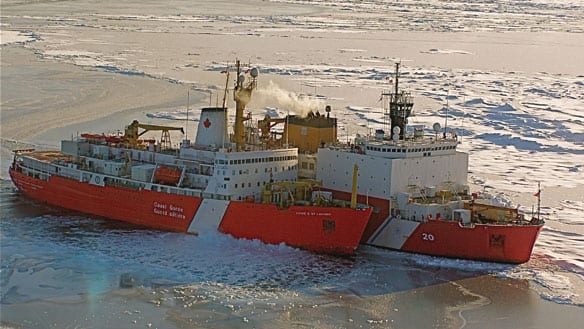
CCGS Louis S. St-Laurent alongside USCGC Healy

Baird Maritime reports Quebec shipbuilder Chantier Davie Canada has been awarded a contract to complete a service life extension program on Canada’s largest, most powerful, and oldest icebreaker, CCGS Louis S St-Laurent.

This ship entered service in 1969, about six and a half years earlier than Polar Star. Reportedly the modifications will be conducted in three phases in 2022,2024, and 2027.

The Canadian Coast Guard rates the ship a heavy icebreaker, but by current USCG standards, she is a medium icebreaker. Her size, power (27,000 HP), diesel electric propulsion, and large lab spaces, make her more similar to Healy than to the Polar Star.

The ship has already been extensively modified. In a major refit 1987-1992 the hull was lengthened about 24 feet. A new bow was fitted and her original steam turbines were replaced with diesels. A bubbler system was added and a new hangar forward of the flight deck replaced the previous below deck hangar and elevator system.

The ship has a crew of only 46 but accommodations for 216.

In 2008, a program was initiated to replace the St-Laurent with a 2017 expected in service date for the new icebreaker. After a series of delays and false starts new Polar Icebreakers are not now expected until 2030 (at least).

I wonder if perhaps the Canadian Coast Guard will attempt to keep the St-Laurent in service until their second polar icebreaker is completed, much as the USCG intends to keep Polar Star in service until the second Polar Security Cutter is delivered.