Coast Guard Would Play a Role in DoD’s North Korea Contingency Plan–Military.Com

Military.com reports a conversation with the Commandant that touched on possible Coast Guard participation if there should be a restart of the Korean War (it has never officially ended). There really isn’t a lot here.

“We are written into the campaign plans for North Korea,” Adm. Paul Zukunft said this week in an interview with Military.com at the Coast Guard’s Washington, D.C. headquarters. “So I’ve got a force identified; if called upon, it must be ready to carry out that mission as well.”

“Most plans are written to ask for everything and we’ve got a lot more going on in the world than just the [Democratic People’s Republic of Korea] right now,” he said. “…But we’ve got ships, planes, port security units that are written into these campaign plans.”

Not much detail, but good to know they are thinking about us.

The Commandant reminds us,

“They’re already doing current-day missions,” he said, of the elements identified for action. “I have no force in garrison. We will have to stop doing something else if we have a much bigger away game in support of a military campaign.”

That is of course true of our active duty assets, but we do have reserves which have been called on repeatedly to support the “Global War on Terror.” Beefing up the reserves is something we have not talked about much.

My earlier post concerning how the Coast Guard might be employed if the US attempted to blockade North Korea is here.

Coast Guard Space Program

Photo: This photo shows the Norwegian student satellite NCUBE2 ready for shipment to the Netherlands for integration with the ESA student satellite SSETI-Express, photographer, Bjørn Pedersen, NTNU.

Acquisitions Directorate reports that the Coast Guard is planning to have two satellites launched to provide additional EPIRB detection capability primarily in the Arctic.

Coast Guard Preparing To Launch Its First Satellites

Dec. 14. 2017

Two small satellites, scheduled for launch in 2018, will provide the Coast Guard with the opportunity to test the effectiveness of satellite communications in supporting Arctic search and rescue missions.

These satellites, or “cubesats,” are capable of detecting transmissions from emergency position indicating radio beacons (EPIRBs), which are carried on board vessels to broadcast their position if in distress. The Coast Guard will deploy the cubesats in cooperation with the Department of Homeland Security (DHS) Science and Technology Directorate’s Polar Scout program, the Air Force Operationally Responsive Space Office, and the National Oceanographic and Atmospheric Administration (NOAA).

There is more in the linked article. The satellites are cubes only 10 cm (3.9″) on a side. It is impossible to have geostationary satellites over the poles so coverage will be intermittent.


Navy Ships to Return to the Drug War

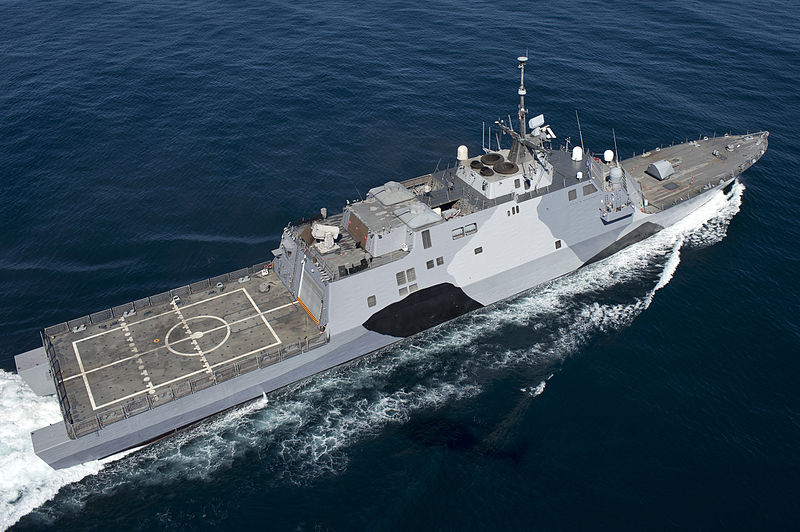
USS Freedom (LCS-1)

The US Naval Institute reports, “SECNAV Memo: Navy Won’t Reactivate Perry Frigates for SOUTHCOM Mission; Will Send Ships to Fight Drug War in 2018.”

The Navy has not been providing ships in support of the SouthCom drug interdiction mission since the last USN Oliver Hazard Perry class frigate was decommissioned in 2015, but it looks like the Navy will return to the mission.

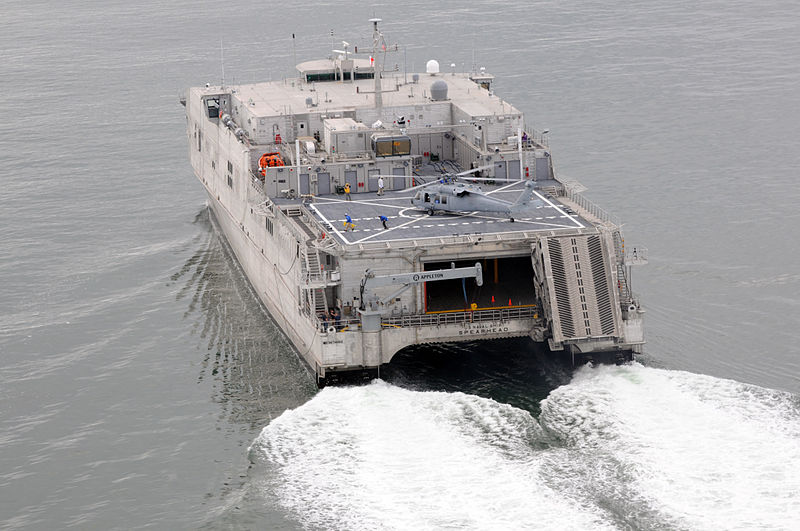
SecNav has directed the Navy provide four ship years in the form of either LCS or Spearhead-class expeditionary fast transports (T-EPF)(formerly called the Joint High Speed Vessel).. In addition, they will be bringing with them an unmanned air system, probably Scan Eagle.

They will certainly need Coast Guard Law Enforcement Detachments aboard, but the mention of Scan Eagle makes me wonder about the aviation support planned. No mention of helicopter or the larger MQ-8 UAS. Are they going to want a Coast Guard Airborne Use of Force helicopter detachment?

The Military Sealift Command joint high-speed vessel USNS Spearhead (JHSV 1) (Now T-EPF-1)conducted high-speed trials, reaching speeds of approximately 40 knots off the coast of Virginia. (U.S. Navy photo by Mass Communication Specialist 1st Class Phil Beaufort/Released) 130820-N-ZO696-135

Armed Drones: The Coast Guard’s Next New Frontier?–USNI Proceedings

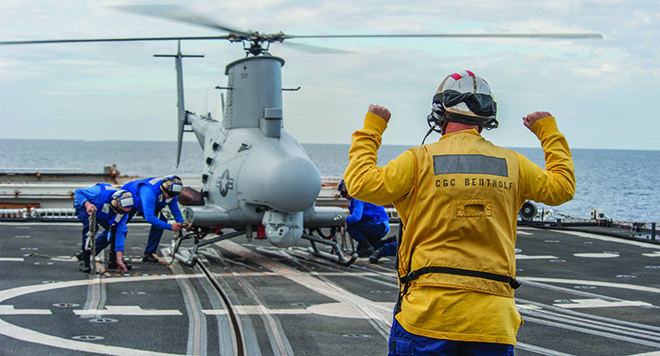
Coast Guard air crews unhook a Fire Scout UAS during a test on the Coast Guard Cutter Bertholf near Los Angeles, Dec. 5 2014. The Coast Guard Research and Development Center has been testing UAS platforms consistently for the last three years. (U.S. Coast Guard photo by Petty Officer 2nd Class Luke Clayton)

The Dec. 2017 issue of the US Naval Institute Proceedings magazine has an excellent article, by LCdr Craig Allen, Jr., USCG, considering the possibility of the Coast Guard employing armed drone, specifically to assume the airborne use of force (AUF) role.

He considers both the pros and cons of taking this step, and along the way makes a compelling case that it is not only feasible but probably also desirable.  Additionally he suggests that drones may allow the Webber class WPCs to employ AUF.

Surface Navy Association

The Coast Guard National Cuttermen Chapter is part of the Surface Navy Association (SNA). SNA is having their annual symposium in January. If you are interested in going, you might want to register ASAP. The following from SNA.

Where: Hyatt Regency Crystal City
When: January 9-11, 2018
Theme: Surface Forces & Cross-Domain Integration

If you have not registered for the Symposium and plan to attend, we encourage you to register 2 p.m. EST on Tuesday 12 December to qualify for the Tier 2 pricing.  Once registration is confirmed a payment link will be sent to you to complete the process.  This payment must be completed by 2 p.m. EST on Wednesday, 13 December to qualify for this pricing. Payment submitted after 2 p.m. EST on December 13 will be raised to the Tier 3 prices.
If you have already registered and have not paid you have until Noon on Wednesday 13 December to make a payment at the Tier 2 levels.  After that time you will be bumped up to the next pricing tier.

Where in the World are the WHECs?

The Former USCGC Morgenthau, now in Vvietnamese service

The Philippines has a continuing interest in the 378 foot WHECs, after all they already have three, and it appears they may want another. Certainly they and other operators (Nigeria, Bangladesh, and Vietnam) will want to cooperate in finding ways to keep them operational.

An online discussion group called “Defense of the Republic of the Philippines” has a page entitled “Where in the World are the WHECs?” devoted to the topic. It includes both the old and new names and hull numbers. It also looks at the future disposition of 378s still in US Coast Guard service (Sherman, Midgett, Mellon, and Douglas Munro). (Yes we currently have both a USCGC Douglas Munro (WHEC-724) and a USCGC Munro (WMSL-755).

Sherman is expected to be decommissioned in 2018, Midgett in 2019, Mellon in 2020. Douglas Munro’s decommissioning is not currently scheduled but will probably happen in 2021.

The decommissioning information is based on Annex J of a MARAD report, “OFFICE OF SHIP DISPOSAL PROGRAMS ANNUAL REPORT FOR FISCAL YEAR 2016.”


Mexican Navy’s New Helicopters

Mexican Navy AS365 MBe helicopter, by AIRBUS.

NavyRecognition reports that the Mexican Navy has taken delivery of ten new helicopters. They might look a bit familiar. These are the latest development of the AS365 family of aircraft.

As we have noted, the Mexican Navy parallels the USCG in many ways, including missions and equipment (here and here). They also are in the process of procuring a fleet of patrol craft that are smaller, 42 meters vice 47 meters over all, but closely related to the Coast Guard’s Webber Class cutters.


In the Arctic Ocean, at Least, Diplomacy Works–gCaptain

gCaptain reports on a ten nation accord to protect fisheries in the central Arctic Ocean.

For the next 16 years, commercial fishing will be prohibited in the central Arctic, a Mediterranean-sized patch of icy ocean more than 200 nautical miles from any nation’s coastline. This will give scientists time to study whether fishing might safely be allowed there. The goal is to avoid the overfishing that has depleted fish populations in other parts of the world — pollock in the Bering Strait, for instance, or krill in the Antarctic Ocean.”