Remembering, or Perhaps Losing the Memory, of Pearl Harbor

The video above is from last year. 

The Coast Guard Compass has a post in its Long Blue Line Series looking at the Coast Guard’s role in the events around Hawaii on December 7, 1941 and outlining Coast Guard activities leading up to and during World War II. The video above is from last year.

I looked back on previous posts on this topic, but unfortunately as a result of the Coast Guard’s migration of it’s on-line representation to new servers, it seems we have lost access to much of the historical material that was previously available, most notably the Coast Guard history Pearl Harbor index, as a result my previous posts which largely referred to this historical material now connect only to a singularly unhelpful page at Defense Media Activities.

For what it is worth, here are some previous commemorative post marking this day:

Hopefully I will address the Coast Guard’s Social media efforts relatively soon.

12/1/2017: Summary of keynote address at 11th Annual Arctic Shipping Summit–Coast Guard Maritime Commons

The Coast Guard Maritime commons provided this summary of the keynote address at the 11th annual Arctic Shipping Summit.

Director of Marine Transportation Systems Mr. Mike Emerson presented a Keynote Address on Arctic Waterways Management at the 11th Annual Arctic Shipping Summit in London, England on November 30, 2017.

The two day conference brought together experts and stakeholders to discuss some of the issues associated with Arctic operations, such as limited infrastructure and the harsh environment, and how regulations and technical advancements will impact commercial waterways management.

In his remarks, Emerson gave an overview of highlights from the U.S. Chairmanship of the Arctic Council from 2015-2017, and identified some emergent areas that warrant attention during chairmanships of the Scandinavian countries. He also discussed the Arctic Coast Guard Forum, which continues to demonstrate collaborative value, as evidenced by the success of the multi-national ARCTIC GUARDIAN Search and Rescue Exercise that was conducted off the coast of Iceland in September. Looking forward, Emerson said he anticipates increasing interest from countries outside the Arctic Circle to participate more fully in the Arctic Coast Guard Forum, as well as Arctic Council decision-making.

As Arctic ice recedes, a direct sea route from Europe to Asia is opening up along the coast of Russia, and Emerson said he expects the Northwest Passage across North America to follow suit.

“With more navigable waters, we can expect more shipping activities, and greater demands for waterways management,” Emerson said in his remarks. “The U.S. Coast Guard therefore, is engaging peer agencies across both borders in developing joint proposals for ship routes and areas-to-be-avoided in waterways that we share with Russia and Canada. These efforts, and a fresh focus on charting, polar codes, and acquisition of ice-capable assets are immediate priorities for ensuring marine safety and security.”

Emerson concluded his remarks by forecasting the need for government and industry leadership in infrastructure investments to support increased Arctic shipping, along with resource development, fisheries, and tourism. Finally, he emphasized the need to reconcile waterways management with indigenous communities – an area the Coast Guard is actively addressing.

Conference attendees also heard from representatives from the IMO, Canadian Coast Guard, Transport Canada, the Norwegian Ice Service, and many other private shipping and environmental organizations. Other topics covered included Arctic regulations, safe navigation and communications, effective infrastructure, and crew hiring and training.


Another Tug Rams Another Cutter in the Panama Canal

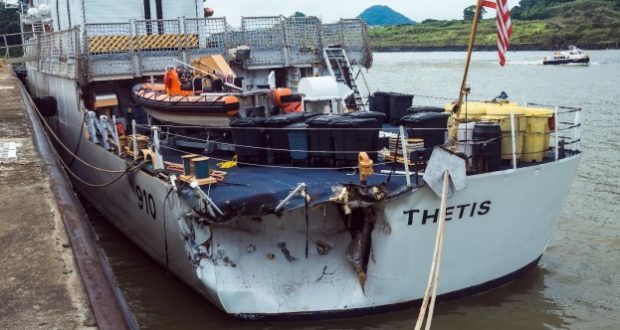
USCGC Thetis damage sustained in a collision in the Panama Canal 2 June 2016

USCGC Thetis was damaged when struck in the stern by a barge pushed by a tug in the Panama Canal on 2 June, 2016. Now there was a similar accident 18 April 2017. USCGC Tampa was struck in stern by a tug owned by the Panama Canal Authority. My first thought was that perhaps tug operators were being paid by the Drug cartels to disable cutters headed for the transit zone, but in fact Tampa had already finished her deployment to the Eastern Pacific.

Tampa was north bound in Miraflores Lake when the tug Cerro Santiago, south bound, having passed Tampa starboard to starboard, made an abrupt 180 and hit Tampa on the stern 29 minutes after midnight.

The tug master claimed he had fallen asleep. The NTSB  investigation found his claim of fatigue credible, working overtime, at the end of a seventh 8 hour workday, in a stressful environment.

Damage was relatively minor in both accidents, $170,018 in the case of Tampa‘s collision, but still there are lessons to be learned.

“Coast Guard Actions Postaccident:

“The Tampa added a written instruction on the vessel’s port entry checklist that requires the watchstander to verify that the AIS is operating in non-encrypted mode. (AIS was still encrypted when the collision occurred.–Chuck) In addition, for future transits of the canal, the Tampa’s aft lookout will be equipped with an air horn and handheld flares, which may be used when necessary to secure the attention of any vessel not operating in accordance with the rules of navigation. The position of shipping officer also was added back to the bridge watch composition. That position, which is charged with managing input from the CIC and the dedicated lookout, was staffed during the southbound transit; however, considering the staffing in the CIC, it was deemed a redundant capability and therefore removed for the northbound transit. As an organization-wide effort, the lessons learned from this accident have been added to the Coast Guard’s briefing program and will be discussed prior to future transits of the canal during briefings conducted on Coast Guard vessels.”

Thanks to Bryant’s Maritime Consulting for bringing this to my attention. 

The 378 (WHEC) Project Group–On Facebook

See the source image

There is a group on Facebook with the stated intention of obtaining a Hamilton Class 378 foot WHEC for use as a museum exhibit to be added to the Coast Guard Museum in New London. I have provided a copy of their “about” statement below. You can find the group here:  https://www.facebook.com/groups/139110530178903/

We are a large group of Coast Guard Veterans in the process of acquiring a 378′ High Endurance Cutter to convert into a museum. The response from Veterans all over the country has been overwhelming. We are determined to succeed. We are a non-profit corporation with a board of directors. Our CEOs name is Steve Howard and he is presently with a Coast Guard Attorney in negotiations with Comandant Zukunft and MCPOCG Patton for one of four 378s still in service. MCPOCG Patton is also on the board of directors of the National Coast Guard Museum. He informed me that the museum wanted a 378 to display. The 378 is unique. It was the first warship, in both the Coast Guard  or Navy,  equipped with twin jet turbine engines, bow thrusters, variable pitch props, helicopter flight deck, aluminum superstructure and fly by wire helms. It also had stealth tech, forerunner of Littoral. They served with  distinction in Vietnam as well as their roles in search and rescue and law enforcement. At least on of these ships should be preserved and that is our mission. Won’t you please find it in your heart to either volunteer and/or donate. We are getting the paperwork done so that you can deduct your contribution from your taxes. Join us!

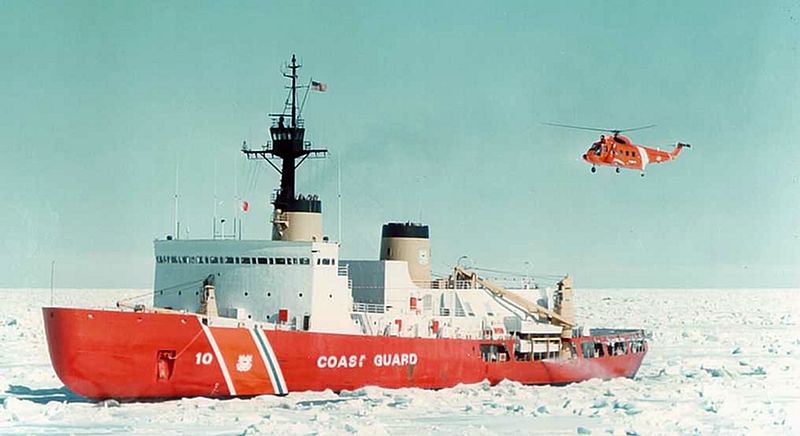
Rex Tillerson: Coast Guard has one ‘crummy’ icebreaking ship–Washington Examiner

USCGC Polar Star. USCGC photo.

“I think we have one functioning icebreaker today,” Tillerson said at the Wilson Center. “The Coast Guard’s very proud of it, as crummy as it is.”

I am only posting this because of who said it.

Secretary Tillerson may not well informed about our icebreaker situation, but generally he got it right. This is a bad news, good news story.

Bad news, the Coast Guard was the butt of the joke.

Good news, at least someone in the Administration knows we need more icebreakers.

19 More Names for Webber class WPCs

The graphic above is a bit dated. 26 of the class have been delivered to date. 

ALCOAST 349/17 has announced, and the Navy League has reported, the names selected for 19 more Webber class WPCs. I have provided a copy ALCOAST below.

To make it a bit easier to read, the Navy League’s listing is immediately below. Unlike the previous listings, I have not seen an explanation of what these individuals did. Hopefully their stories will be provided. I do recognize Maurice Jester as the CO of USCGC Icarus when she sank the U-352 These 19 bring the total number of names selected to 54.

■ Master Chief Angela McShan
■ Surfman Pablo Valent
■ Surfman Frederick Hatch
■ Mustang Officer Maurice Jester
■ Electrician Myrtle Hazard
■ Coxswain Harold Miller
■ Coxswain William Sparling
■ Coxswain Daniel Tarr
■ Coxswain Glenn Harris
■ Coxswain Douglas Denman
■ Pharmacist’s Mate Robert Goldman
■ Steward’s Mate Emlen Tunnel
■ Steward’s Mate Warren Deyampert
■ Seaman John Scheuerman
■ Seaman Charles Moulthrop
■ Boatswain’s Mate Clarence Sutphin
■ Boatswain’s Mate Edgar Culbertson
■ Keeper William Chadwick
■ Keeper John Patterson.

R 221121 NOV 17
FM COMDT COGARD WASHINGTON DC//CG-092//
TO ALCOAST
UNCLAS//N05700//
ALCOAST 349/17
COMDTNOTE 5700
SUBJ:  NEW FAST RESPONSE CUTTERS NAMED FOR COAST GUARD HEROES
1. In 1830, the Revenue Cutter Service, predecessor to the modern Coast Guard
launched its first standardized multi-ship class of cutters. The Morris-
class, named for the first cutter in the class, Robert Morris, was designed
with a topsail-schooner rig and a length of 78 feet. These cutters carried
six 9-pound cannons and a crew of 24 officers and men.
2. The thirteen Morris-class cutters fought pirates, interdicted smugglers,
enforced federal maritime laws and operated with American naval forces in
time of war. In the years leading up to the American Civil War, Cutter Morris
and her sister ships formed the backbone of the revenue cutter fleet.
3. As with the Morris class, the Coast Guard is building a class of cutters
designed to serve a multi-mission role. The “Sentinel” – Class Fast Response
Cutters (FRC) perform drug and migrant interdiction; ports, waterways and
coastal security; fishery patrols; search and rescue; and national defense.
4. In the next few years, the Coast Guard will deliver 32 additional cutters
bringing our service numbers up to 58 FRCs intended to replace the fleet of
1980s-era 110-foot patrol boats. The FRCs feature advanced command, control,
communications, computers, intelligence, surveillance and reconnaissance
equipment; over-the-horizon cutter boat deployment to reach vessels of
interest; and improved habitability and sea-keeping characteristics.
5. Twenty-six FRCs are currently in service, with six stationed in Miami
Beach, Florida; six in Key West, Florida; six in San Juan, Puerto Rico; two
in Ketchikan, Alaska; two in Cape May, New Jersey; two in Pascagoula,
Mississippi; and two in Honolulu, Hawaii.
6. As with their FRC sister cutters, the next flight of 19 FRCs will bear the
names of enlisted leaders, trailblazers and heroes of the Coast Guard and its
predecessor services of the U.S. Revenue Cutter Service, U.S. Lifesaving
Service and U.S. Lighthouse Service. These new cutters will be named for
Master Chief Angela McShan; Surfmen Pablo Valent and Frederick Hatch; Mustang
Officer Maurice Jester; Electrician Myrtle Hazard; Coxswains Harold Miller,
William Sparling, Daniel Tarr, Glenn Harris and Douglas Denman; Pharmacists
Mate Robert Goldman; Stewards Mates Emlen Tunnel and Warren Deyampert; Seamen
John Scheuerman and Charles Moulthrop; Boatswain’s Mates Clarence Sutphin and
Edgar Culbertson; and Keepers William Chadwick and John Patterson. These
enlisted namesakes include recipients of the Navy Cross Medal, Silver Star
Medal, Bronze Star Medal, Gold Lifesaving Medal, Silver Lifesaving Medal,
Navy & Marine Corps Medal and Purple Heart Medal.
7. The Fast Response Cutters are the mainstay of the Coast Guard’s coastal
patrol fleet, providing multi-mission capabilities and interagency
interoperability. For more information, check the Coast Guard Acquisition
Directorate’s FRC web page at: http://www.dcms.uscg.mil/Our-
Organization/Assistant-Commandant-for-Acquisitions-CG-9/Programs/Surface-
Programs/Fast-Response-Cutters/
8. RADM Peter W. Gautier, Director of Governmental and Public Affairs, sends.
9. Internet release authorized.

Australia Selects OPV Design

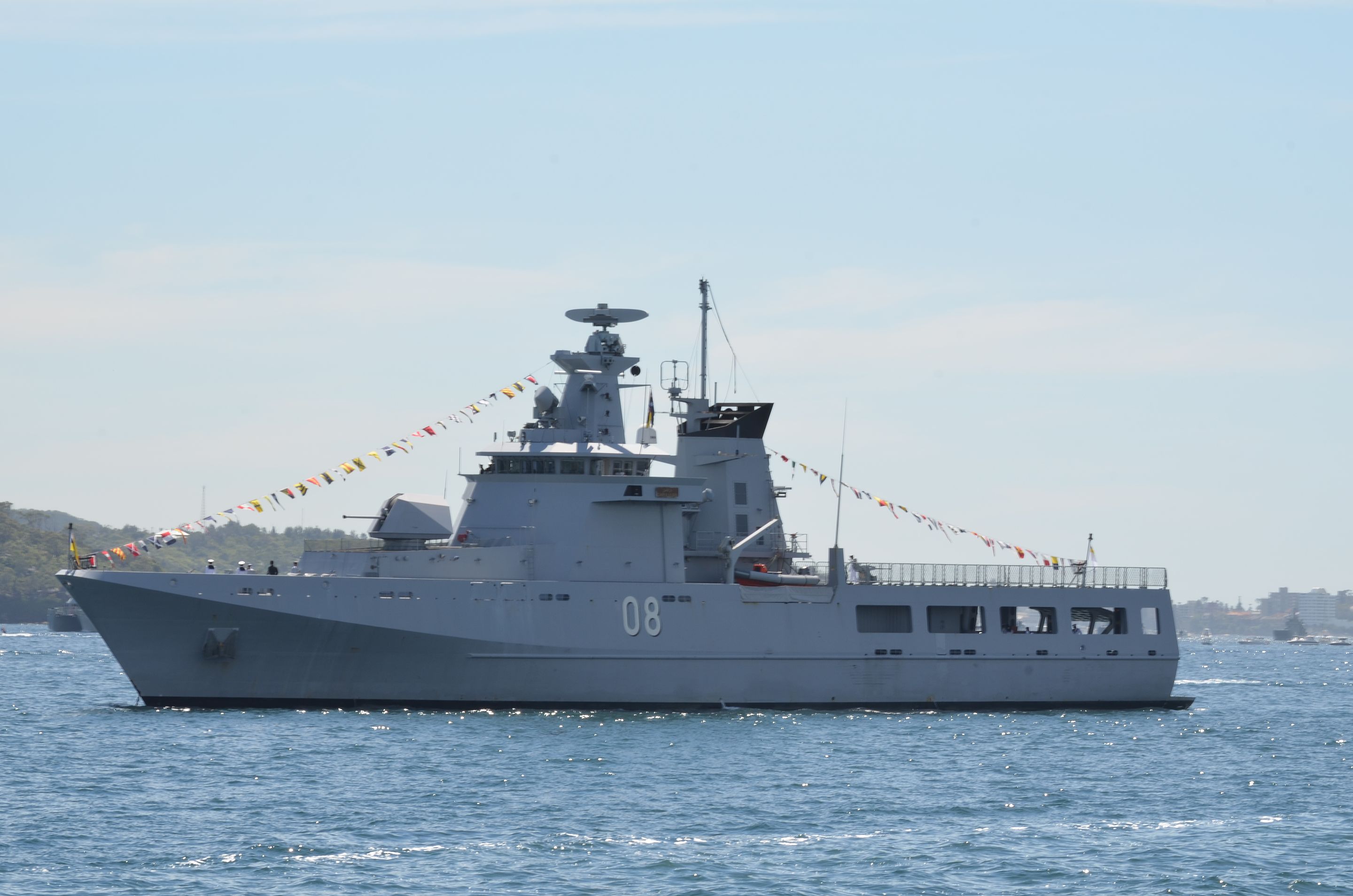
Photographs taken during day 3 of the Royal Australian Navy International Fleet Review 2013. The Bruneian patrol vessel Darulaman moored in Sydney Harbour. Photo by Saberwyn.

The Australian Navy has announced the selection of the design for a planned program of 12 Offshore Patrol Vessels to replace the 13 active 300 ton Armidale class patrol boats.

The new ships will be built in Australia. The design is based on that of the Durussalam class, four ships built for the Brunei Navy by Lurssen in Germany. Lurssen is famous for their torpedo and missile boats. The vessels are expected to be 80 meters (262 ft) long and 13 meters  (43 ft) of beam with a draft of four meters (13 ft) with a speed of 22 knots. Unlike most of the Brunei ships, the Australian ships will be armed with a 40mm gun rather than the 57mm seen in the illustration above. The Australian OPVs are expected to have provision for three 8.4 meter boats and mission modules.

I am a bit surprised by the choice because this appears to be the least capable of the contenders in that it has no hangar, but it does double the range of the patrol boats they will replace and is more than five times the displacements, so should prove a substantial improvement over the Armidale class that really seem to have been asked to do more than  could reasonably expected of them. 

In some ways these  are the embodiment of the Cutter X concept in that they seem to have the equipment and crew of a patrol craft in a more sea worthy hull, but they have also taken the opportunity to provide more boats and a helicopter deck.

Photograph taken during day 5 of the Royal Australian Navy International Fleet Review 2013. Stern view of the Bruneian patrol vessel Darulaman, The ship’s RHIB is deployed, and the RHIB well is open. Photo by Saberwyn.

Thanks to Nicky for bringing this to my attention. 

Senate Appropriations Committee Budget Recommendation

HMAS Success (AOR-304) refuelling probe goes in for a hook-up with the US Coast Guard Cutter USCGC Waesche (WMSL-751) as the Royal Australian Navy Auxilliary Oiler Replenishment Ship conducts a dual RAS (Replenishment at Sea) off the coast of Hawaii during the Sea Phase of Exercise RIMPAC 2014, 19 July 2014. (RAN Photo by Leading Seaman Brenton Freind RAN)

News on the FY2018 budget (edited for a Coast Guard readership):

“The Senate Committee on Appropriations today released the FY2018 chairmen’s recommendation and explanatory statement for the Department of the Homeland Security.”

Bill Highlights:

U.S. Coast Guard – $11.2 billion, including $7.3 billion to fully fund personnel and operations.  The Coast Guard once again set a record in FY2017 by interdicting nearly 500,000 pounds of cocaine on the high seas, and the bill recommends continued investment in the Coast Guard capabilities that are enabling this success.  The bill recommends $1.8 billion to continue a historic recapitalization of Coast Guard assets, including:
•    $540 million for construction of National Security Cutter 10.
•    $95 million for long lead time materials for National Security Cutter 11.
•    $450 million for construction of Offshore Patrol Cutter 1.
•    $50 million for long lead time materials for Offshore Patrol Cutter 2.
•    $240 million for four Fast Response Cutters.
•    $19 million to support Polar Icebreaker acquisition.
•    $6 million to accelerate recapitalization of the Inland River Tender fleet

This is good news with Acquisition, Construction, and Improvement funding near the $2B annually the Coast Guard really needs. A bit surprised at the continuation of the NSC program. Not that we can’t use them.

Thanks to Luke for bringing this to my attention. 

OPC “Placemat”

“Coast Guard Readiness: How Far Can We Stretch Our Nation’s Only Multi-Mission, Military Force?”–Senate Testimony

Coast Guard Commandant Adm. Paul Zukunft at the Senate Committee on Commerce, Science, and Transportation. U.S. Coast Guard photo by Petty Officer 1st Class Patrick Kelley.

Below is the Commandant’s written testimony for the Senate Committee on Commerce, Science and Transportation, subcommittee on Oceans, Atmosphere, Fisheries, and Coast Guard hearing titled, “Coast Guard Readiness: How Far Can We Stretch Our Nation’s Only Multi-Mission, Military Force?”

Release Date:
November 16, 2017

253 Russell Senate Office Building

Good morning Mr. Chairman and distinguished members of the Committee. I appreciate the opportunity to testify today and thank you for your enduring support of the United States Coast Guard.

As the world’s premier, multi-mission, maritime service, the Coast Guard offers a unique and enduring value to the nation. The only branch of the U.S. Armed Forces within the Department of Homeland Security (DHS), a federal law enforcement agency, a regulatory body, a first responder, and a member of the U.S. Intelligence Community – the Coast Guard is uniquely positioned to help secure the maritime border, combat transnational criminal organizations (TCO), and safeguard commerce on America’s waterways.

The Coast Guard’s combination of broad authorities and complementary capabilities squarely align with the President’s national security and economic prosperity priorities and offer an agile toolset to address the Nation’s most pressing challenges. Appropriately positioned in DHS, the Coast Guard is a military service and a branch of the Armed Forces of the United States at all times.[1] We are also an important part of the modern Joint Force[2] and currently have forces assigned to each of the five Geographic Combatant Commanders as well as Cyber Command.

As demonstrated in the 2017 record hurricane activity, the Coast Guard is the nation’s “maritime first responder” and plays a leading role in executing the National Response Framework (NRF) for disaster situations. Our bias for action and ability to rapidly surge resources in response to emerging threats or contingencies distinguishes the Coast Guard and are critical to success across the spectrum of missions we prosecute.


1 14 U.S.C. § 1; 10 U.S.C. § 101
2 In addition to the Coast Guard’s status as an Armed Force (10 U.S.C. § 101), see also Memorandum of Agreement Between the Department of Defense and the Department of Homeland Security on the Use of Coast Guard Capabilities and Resources in Support of the National Military Strategy, 02 May 2008, as amended 18 May 2010.

Agile Force

The Coast Guard’s 88,000 active duty, reserve, civil service and auxiliary members offer a unique mix of authorities and extensive experience operating with both military and interagency response organizations. Beyond our statutory search and rescue requirements, which traditionally result in an average of 3,600 lives saved each year, the Coast Guard supports the Federal Emergency Management Agency (FEMA) and states during nationally declared disasters by:

  1. Saving lives in distress, and ensuring the survivability of our own forces and assets for immediate post-disaster response operations;
  2. Securing and reconstituting ports, waterways, and critical maritime infrastructure;
  3. Conducting environmental response operations (oil, chemical and hazardous material); and
  4. Supporting other agencies and the whole-of-government response effort.

Coast Guard personnel are well trained and experienced in response operations, which make them a sound choice to serve in visible positions in the NRF structure. This ability to operate concurrently in both military Joint Task Force and civilian NRF frameworks enhances unity of effort and dramatically improves effectiveness.

As an armed force, the Coast Guard can be a supported or supporting commander, and our forces are frequently integrated with Department of Defense (DoD) services in Joint Task Force organizations. We regularly provide forces in support of DoD exercises, Combatant Commander contingency plans, and theater security cooperation activities, all of which enable Coast Guard and DoD forces to integrate seamlessly during response operations.

Saving lives in distress is our first priority, and Coast Guard crews are typically the first federal responders on-scene. As a storm approaches, Coast Guard personnel make risk-based decisions to reposition assets and people to safe locations just outside of the storm’s path, ultimately facilitating rapid response as soon as it is safe to do so. Brave men and women on the front lines make it happen, invoking a deeply ingrained bias for action to repeatedly go into harm’s way and serve others.

In addition to conducting SAR operations, the Coast Guard surges forces and assets into the impacted regions to restore the $4.6 trillion maritime transportation system, respond to pollution, provide security and additional law enforcement capability, and protect offshore petrochemical platforms.

Critical Success Factors

The Coast Guard employs a decentralized command and control structure and distributed decision-making to provide operational commanders with the authority to move forces quickly to respond to large contingencies.

Our two Area Commanders, and their nine subordinate District Commanders, shift and reallocate forces from one region to another based on risk and the anticipated demand for operational capabilities. Well-reasoned and regularly exercised Continuity of Operations Plans preserve operational effectiveness while offering safe refuge for displaced operational commanders.

Coast Guard cutters, aircraft, and boats are built to respond to a variety of missions without the need for any reconfiguration or the addition of special equipment. During the recent hurricanes, cutters conducting counter-drug patrols in the Transit Zone quickly diverted to disaster areas to provide command and control, deliver rotary wing air capability from the sea, provide forward staging facilities, and deliver critical relief commodities – particularly in the U.S. Virgin Islands and Commonwealth of Puerto Rico.

Coast Guard aircraft that normally perform law enforcement surveillance to thwart transnational maritime criminal activities were dynamically repositioned and re-tasked to deliver disaster relief supplies, additional responders, and equipment to affected areas.

Additionally, Coast Guard forces were and are on station at key locations around the nation, most of them on short-notice recall, so they can respond quickly to emergent events. When a major catastrophe occurs, or is anticipated, we can reposition forces quickly to that area to optimize the response.

Over a five week period, Hurricanes HARVEY, IRMA, MARIA, and NATE impacted over 2,540 miles of shoreline[3], and Coast Guard women and men in helicopters, boats, cutters, vehicles and on foot rescued over 11,300 people and over 1,500 pets. Mere hours before Hurricane HARVEY made landfall, Coast Guard helicopter crews rescued mariners in peril[4] off the coast of Corpus Christi, Texas before repositioning to Alice, Texas.

The Coast Guard resolved over 1,269 aids to navigation discrepancies, handled 290 pollution cases, located and assessed more than 3,623 grounded vessels, with more than 1,585 removed to date. Within hours after each storm’s passage, Coast Guard Damage and Recovery Assessment Teams were on-scene determining the status of ports and waterways, leveraging electronic aids to navigation when feasible to facilitate the rapid reopening of the maritime transportation system and energy sectors vital to recovery, and assessing impacts to Coast Guard facilities and capabilities.


3 Using CRS method of Shoreline Measurement: Texas: 367 mi, Louisiana: 397 mi, Florida: 1,350 mi, Puerto Rico: 311 mi, USVI: 117 mi
4 Two MH-65’s from Sector/Air Station Corpus Christi saved 12 lives off a vessel taking on water in 45 knot sustained/60 knot gusting winds.

Enduring Challenges

Operational successes introduced real costs. Damage to Coast Guard facilities, IT, aids to navigation, and the cost of deferred maintenance are significant. Similar to any prolonged natural disaster or security event, responding to consecutive major hurricanes severely strained capacity and required us to assume additional risk in other geographic regions and mission areas. Across the recent disaster response operations, more than 3,000 Coast Guard women and men, and 200 assets or platforms deployed from places as far away as Alaska, Hawaii and Maine.

As a result, the rest of the Coast Guard assumed additional risk, and units were significantly challenged to sustain maintenance and training standards while diminishing future readiness. The Medium Endurance Cutter MOHAWK, already aged and well beyond its designed service life, deferred major maintenance in order to get underway and avoid Irma. Cutter FORWARD diverted from a counter-drug patrol to provide supplies and critical command and control services after all three major hurricanes.

Given the heavy demand for aviation services following each storm, training at Aviation Training Center Mobile was suspended, creating a backlog in the pilot training pipeline at a time when we are facing a critical aviator shortage. Maintaining a full-time SAR response posture at our air stations requires at least three aircraft, yet many of our units that contributed assets to hurricane operations were forced to get by with just one. Forces available for counter-drug, fisheries enforcement, and migrant interdiction operations in the Eastern Pacific Ocean, Caribbean Sea, and Florida Straits were significantly reduced as well. In total, risk-based choices to maximize hurricane response operations stretched our existing resources to their limits.

The size of the Service also limits our capacity to respond to prolonged and sequential events. While the Coast Guard is well-positioned for immediate and effective first response, our “bench strength” makes it impossible to sustain these operations for an extended period of time. In addition, many of our heroic first responders suffered life-changing personal loss as well. Approximately 700 Coast Guard families’ homes were damaged to the point where they will need to be relocated.

Conclusion

The Coast Guard’s unique blend of authorities, capabilities, capacities, and partnerships position us well for success during maritime SAR events and natural disasters. Flexible, multi-mission forces and agile command and control systems provide the solid foundation from which we base these critical response operations.

When the Coast Guard has the opportunity to recapitalize our facilities, we need to make them more storm-resilient and survivable. In fact, several of our shore facilities that were rebuilt following Hurricane IKE suffered minimal damage along the paths of HARVEY and IRMA, a testament to modern building codes and standards.

Modern assets bring exceptional capability, but our greatest strength will always be our people. Coast Guard operations require a capable, proficient, and resilient workforce that draws upon the broad range of skills, talents, and experiences found in the American population. Together, modern platforms and a strong, resilient workforce will maximize the Coast Guard’s capacity to meet future challenges.

History has proven that a responsive, capable, and agile Coast Guard is an indispensable instrument of national security. With the continued support of the Administration and Congress, the Coast Guard will continue to live up to our motto. We will be Semper Paratus – Always Ready. Thank you for the opportunity to testify before you today and for all you do for the men and women of the Coast Guard. I look forward to your questions.

New Coast Guard Officer Evals Don’t Go Far Enough–USNI

US Naval Institute has a discussion about how the new officer evaluation report (OER) might be improved.

This was always my least favorite part of being in the service. Frequently it seemed if you were honest and followed the instructions, it was the kiss of death–damning with faint praise.

Ultimately I came to believe we would be best served if the evaluation was a simple choice of three check boxes.

___ Make this officer Commandant

___ Does OK

___ Fire the SOB