
gCaptain has a review of a book that may be of interest.

The homeland security measure provides $10.4 billion for the d Coast Guard, an increase of $292 million above the FY2017 requested level.
“This level supports a robust USCG operating expenses budget, including a grant program for commercial fishing safety, purchase of additional response boats, and funds for the National Coast Guard Museum,” says the Committee. “This bill also provides necessary increases for acquisitions, including funding long lead time materials for a tenth National Security Cutter, continuing activities associated with the Offshore Patrol Cutter, two additional Fast Response Cutters (for six total), and support for multiple sustainment efforts and program offices such as the C-130J, C-27J, and HH-65. The measure also includes program management and personnel costs associated with the Polar Icebreaker Recapitalization Project in addition to funding in the Senate FY2017 Department of Defense Appropriations Bill.”
The Defense Appropriations Bill includes $1B for the Navy to build a new Icebreaker for the Coast Guard. We will have more to say about this later.
An interesting short piece on the fisheries protection operations of the Florida Wildlife Commission, including a look at a 57 foot 44 knot catamaran patrol boat they use to patrol the Dry Tortugas (Florida Keys National Marine Sanctuary).
Thanks to Mike for bringing this to my attention.
Reuters is reporting NATO is planning to expand their Migrant interdiction efforts, and the US will participate.
“NATO agreed on Thursday to broaden its operations in the Mediterranean to help the European Union stop criminals trafficking refugees from North Africa but will not act until the fate of rescued migrants is cleared up.”
The thing I found interesting was that reportedly the US provide a ship. Certainly there is a certain logic to using a Coast Guard ship for this mission, but it is unlikely. Not enough cutters. It is much more likely it will be done by Navy ships, that would be operating in the Mediterranean anyway, but it is almost certain that ship will have a Coast Guard team aboard.

Click on the graphic to enlarge
The Acquisitions Directorate has a story on the commissioning of the 17th Webber class WPC, USCGC Donald Horsley (WPC-1117).
Included in the post was the graphic above, which gives us an indication of where future cutters will be homeported:
One more WPC is expected to go to San Juan, so in about six months we should see a Webber class go to Ketchikan. Certainly its improved sea keeping compared to the 110s will be appreciated.
This is not, I’m sure, a complete list of future homeports, given that we expect 41 more of this class. I’m not privy to the home porting plan or how many will be in each port, but this looks like it will cover at least the next 18 months. It may cover a much longer period if more than one Webber class will be assigned to some of these ports, and that seems likely.
I would note that these homeports look good from a Ports, Waterways, and Coastal Security perspective. Ketchikan and the inland passage has a lot of cruise ship traffic. San Pedro is near the huge Los Angeles port complex and the strategic ports of Long Beach and Port Hueneme. Pascagoula based ships potentially protect the ports of the Eastern Gulf of Mexico including the eastern approaches to the Mississippi River port complex and the strategic port of Gulf Port, MS. Atlantic Beach, NC is close to Cape Lookout and Cape Hatteras, but it is also close to the strategic ports of Morehead City, Sunny Point, and Wilmington. WPCs in Cape May, NJ could provide protection for Delaware Bay, including the strategic port of Philadelphia.
If any of our readers has access to the homeporting plan, and it is public knowledge, I would appreciate the information.

Following from the Navy League magazine, “Seapower.” It is from an article, “Service Chiefs Stress Partnerships, Need to Accelerate Acquisition,” by Otto Kreisher:
Zukunft was surprisingly “bullish” on the Coast Guard’s condition, noting that his procurement budget doubled in the current year, enabling the service to expand its National Security Cutter program to nine ships, to build 58 Fast Response Cutters and upgrade its command-and-control and fixed-wing aircraft systems. He said the Coast Guard this summer would award the biggest ship construction program in its history, for the Offshore Patrol Cutters.
Nice to see the Offshore Patrol Cutters getting closer, but it has taken a long time. We should note that this summer’s award for the OPC is not that big a contract, but it is a start.
We have had one good year. Congress’ largess (it certainly was not the executive) appears due mostly (but not entirely) to Huntington Ingalls Industries’ influence. Still it does create a precedence for larger, more reasonable, AC&I appropriations. Hopefully we will see the same sort of funding in FY2017. A tenth Bertholf is a possibility, If not, maybe we can move some of the OPC funding forward. Perhaps selection of the OPC builder will give us another strong advocate in Congress. I would hate to see funding levels go back to where they were before. Even $2B annually is not really anything like generous.
Thanks to Daniel for bringing this to attention.

NOAA has published their annual report on the status of fish stocks for 2015 (pdf), and the news is generally good. The number of stocks “Over Fished” or subject to “Over Fishing” remain near all time lows. Some highlights:
The report is only seven pages and very readable with well done charts and graphics.
The report refers to their partners, but we know the Coast Guard should get a great deal of credit for making this success happen.
Still, US efforts have limits. “More than half of the stocks added to the overfishing list in 2015 were international stocks,” subject to fishing outside US jurisdiction.
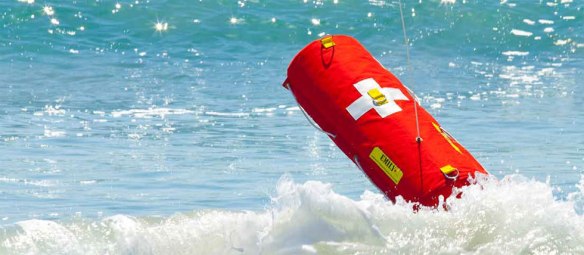
NavyRecognition is reporting, “The EMILY (Emergency Integrated Lifesaving Lanyard) robotic lifeguard will be showcased by the Office of Naval Research (ONR) during the Sea-Air-Space 2016 Exposition held May 16 to 18 at the Gaylord Convention Center in National Harbor, Maryland. The robot will also be displayed at the ONR’s booth (number 1004).”
“Outfitted in bright orange, red and yellow colors, each cylindrical EMILY buoy is 4-feet long and weighs 25 pounds. It’s powered by a jet engine system similar to a mini jet ski, shoots a water jet stream for propulsion and travels up to 22 mph. EMILY also has two-way communication radios, a video camera with a live feed to smartphones and lights for night rescues.
“‘EMILY is made of Kevlar and aircraft-grade composites and is virtually indestructible,’ said Mulligan, CEO of Hydronalix, a maritime robotics company. ‘The devices can be thrown off a helicopter or bridge and then driven via remote control to whoever needs to be rescued.'”
To me the description of its use and capabilities seems incomplete. For instance, could this be used to tow a rescue swimmer to a vessel in distress? and how was it “used to rescue nearly 300 Syrian migrants from drowning in the waters off the Greek Island of Lesbos”?
Looks like a piece of gear we should look into. If one of our readers gets a look at it, I would welcome first hand impressions.
Apparently it is already for sale to the general public.
Huntington Ingalls Industries (HII, builder of the Bertholf class cutters) is sponsoring a Coast Guard Essay contest with the US Naval Institute.
“Challenge: Advance new thinking about the U.S. Coast Guard’s critical role in the 21st Century. No issue is too big or too narrow as long as it makes the Coast Guard stronger. This does not mean authors canot be critical and take on conventional wisdom and current practices. In fact, we encourage you to push the ‘dare factor.'”
Cash prizes of $5000, $2500, and $1500.
I suspect there are several among the readership here that might have some ideas.
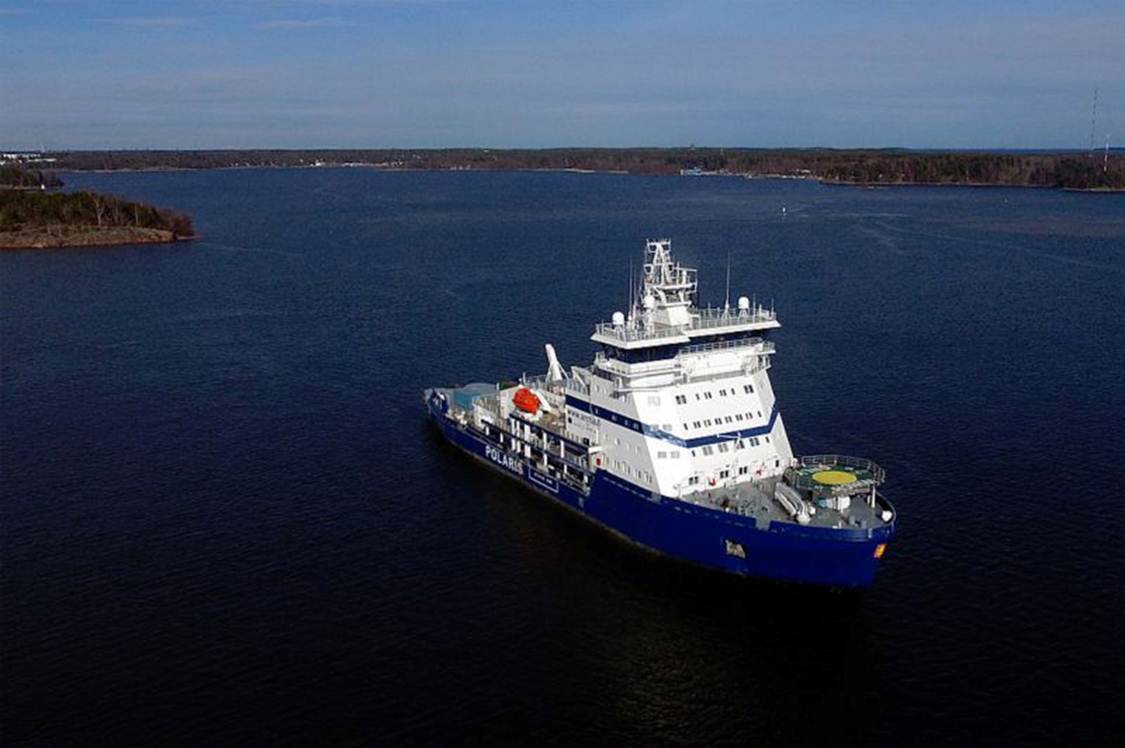
For more photos see http://gcaptain.com/photos-worlds-first-lng-powered-icebreaker-polaris/
ARCTECH has completed the World’s first LNG powered (dual fuel capable, low sulfur diesel or LNG) icebreaker, NB501 Polaris, for the Finnish Transport Agency, and it is currently in sea trials.
The vessel will be able to move continuously through about 1.6 meter thick level ice, to break a 25 meter wide channel in 1.2 meter thick ice at speed of 6 knots, as well as to reach 9…11 knots of average assistance speed in the demanding icebreaking conditions in the Baltic Sea. In open water the service speed will be 16 knots.
Reportedly “It will also be able to perform oil spill response operations, emergency towing and rescue operations.”
Its dimensions are 110x24x8 meters or 361x79x26 feet. Its propulsion comes from three azimuthing propulsors totaling 19kW or about 25,500 HP. Specs here (pdf).
Crew requirements are tiny at 16.
With a 30 day endurance, it does not have the range the Coast Guard needs for Polar Operations, but with 180% more horsepower than the Mackinaw, it would make a great Great Lakes icebreaker. The US certainly has a lot of LNG. Would be good for the environment too. (Of course it would have to be built in the US, but using a foreign design is not a problem for the Coast Guard.)
Thanks to Lee for bringing this to my attention.
 Chuck Hill's CG Blog