Document Alert: Coast Guard Cutter Procurement: Background and Issues for Congress

Samsung

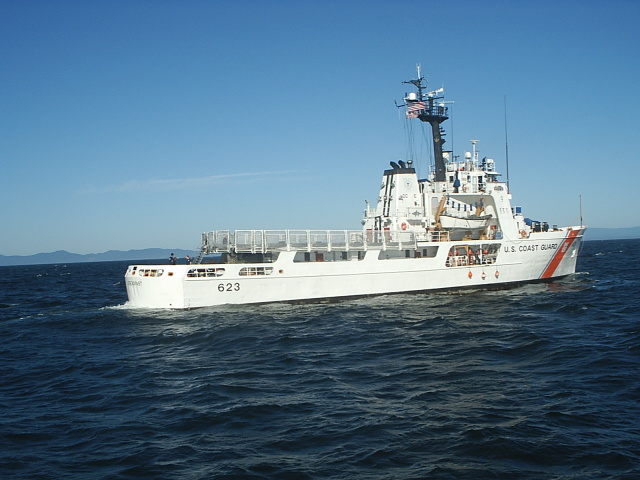
Photo: USCGC Steadfast, one of the newer 210 class, now about 48 years old. We don’t expect her replacement for at least another ten years.

The US Naval Institute has published the Congressional Research Services latest version of Coast Guard Cutter Procurement: Background and Issues for Congress, by their Naval Affairs Specialist, the ever prolific Ronald O’Rourke.

It is not quite up to date, because it does not reflect funding for a ninth National Security Cutter, but otherwise it nicely defines the issues the program has been faced with, most notably inadequate funding.

It also raises the question, should multi-year or block buy funding, with its potential for substantial savings, be pursued? We really should be doing this for the Webber class, which is a proven, mature design, approved for full rate production. In fact, we should have been doing this for a couple of years now.

The thing I found most disturbing was that the first Offshore Patrol Cutter (OPC) will not be funded until FY2018, although it looks like the detail design will be funded in FY2017. I am beginning to wonder if we will see the first OPC before 2022.

The FY2016 budget was a pleasant surprise with the addition of funds to build a ninth National Security Cutter. If this near $2B funding level is seen as a new norm (as I would hope) there will be room in the FY2017 budget for another major acquisition. It might be a tenth NSC. That would not be an altogether bad thing, but it would be outside the needs identified in the Fleet Mix Study. Unless another major project is injected into the FY2017 budget, we will loose the momentum for a larger AC&I budget.

If the FY2017 NSC, OPC, and FRC funding is as indicated in the document (see pdf page 14, marked at page 10), most of the shipbuilding funds will go for what looks like five or six more Webber class. There are smaller amounts for the OPC and NSC programs for a total of only $557M. There may, however, be the opportunity to fund a big part of the new polar icebreaker, as the Commandant has suggested, if the AC&I budget remains at least equal to the FY2016 level.

Early Icebreaker Specs

USCGC Polar Sea

USCGC Polar Sea

FedBizOpps.gov has published  a draft document that gives us a first look at possible specs for the proposed polar icebreaker,

Polar_Icebreaker_Replacement_Draft_Data_Package_13_J…(913.98 Kb)

This is different from what we saw on FedBizOpps only a few days ago.

There is a notional Polar Icebreaker Acquisition Schedule that anticipates contract award between Q4 FY 2018 and Q4 FY2019.

Some of the provisions/characteristics I found interesting were:

  • Sustained Speed, 15 knots.
  • Minimum range of 21,500 nautical miles at 12 kts
  • Capable of independently breaking though ice with a thickness ≥ 6 ft (threshold) / ≥ 8 ft (objective) at a continuous speed ≥ 3 kts.
  • Capable of independently breaking through ridged ice with a thickness of 21 ft.
  • Capable of breaking a single-pass channel to a width of at least 83 ft.
  • Three 9 ft x 35 ft buoys including associated buoy mooring equipment.
  • Six twenty foot equivalent units (TEU) with a maximum weight of 20 tons each.
  • Capable of underway replenishment.
  • Weapons limited to four .50 cal. and boarding party weapons.
  • Aviation facilities include hangaring two H-60s with blades folded.
  • Air-search radar.
  • Capacity to tow astern a vessel not exceeding an equivalent displacement to that of the PIB (Polar Icebreaker) (Not an overly ambitious spec,why don’t we just say 20,000 tons or specify bollard pull?–Chuck)

Again we have Bryant’s Maritime Consulting to thank for the link.

President Signs Illegal, Unreported and Unregulated (IUU) Fishing Enforcement Act.

Source NOAA: Albecore, Bluefin, Skipjack, Yellowfin, and Bigeye Tuna

Source NOAA: Albecore, Bluefin, Skipjack, Yellowfin, and Bigeye Tuna

BairdMaritime reports, that “US President Barack Obama has signed the Illegal, Unreported and Unregulated (IUU) Fishing Enforcement Act. The bi-partisan act promotes the sustainable management of eastern Pacific fisheries, tackles seafood fraud and prevents illegally harvested fish from entering the US.”

“In addition, the measure will allow the United States to ratify the Antigua Convention and fully participate in the work of the Inter-American Tropical Tuna Commission, which manages tunas and other highly migratory species in the eastern Pacific Ocean.”

Inflation and the OPC

CIMSEC has just republished a post which is specific to Canada’s shipbuilding program, but it addresses a problem that will effect the Offshore Patrol Cutter (OPC) as well, inflation.

Their point is one that is often missed.

Inflation in the shipbuilding industry is higher than inflation in general. 

The post states ” American warships have historically inflated at an annual rate of 9 to 11 percent based on a pay for view study by Rand Corporation, available here.” Figures I saw earlier suggest the shipbuilding inflation rate outpaces that for the economy in general by two to three percent annually

This difference in inflation rate means that even if well run, a shipbuilding program is almost always destined to go over budget and the longer it is stretched out, the worse it is going to get.

Inflation rates are recognized in the budgeting process, but only the overall rate, not the rate applicable to a particular industry.

Stretching the Offfshore Patrol Cutter program out over more than fourteen years will guarantee unfavorable comparisons between early estimates and actual performance.

This is the largest program in Coast Guard history and the largest in the Department of Homeland Security as well. Acquisition cost of the 25 ships are expected to be $10.523 billion, or an average of about $421 million per ship. The Coast Guard’s Request for Proposal (RFP) for the program, released on September 25, 2012, establishes an affordability requirement for the program of an average shipyard cost of $310M each for ships #4-9 in then year dollars. That does not include government furnished equipment (GFE).The longer the program stretches out, the less likely that becomes.

WAR IN THE SHALLOWS, VIETNAM, 1965–1968

WAVPmarkettime

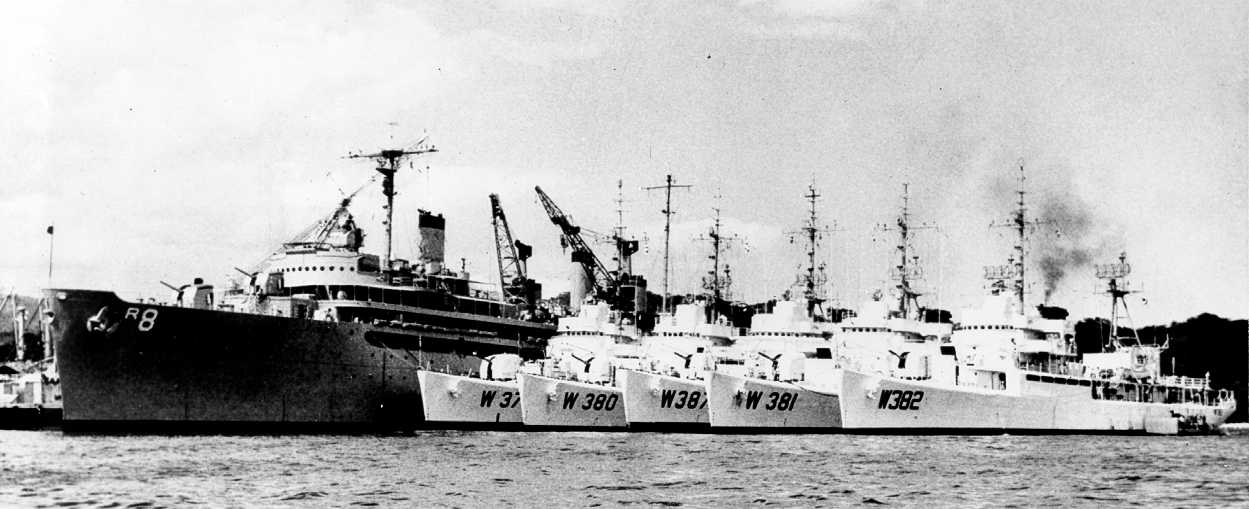
Photo: “COAST GUARD IN VIETNAM: Five white 311-foot cutters of the recently established Coast Guard Squadron Three assigned to “Market Time” coastal surveillance in South Vietnam are tied up alongside Navy repair ship USS JASON (AR-8) after arriving at Subic Bay, P.I.  From the left are the USCGC HALF MOON, USCGC YAKUTAT, USCGC GRESHAM, USCGC BARATARIA, and USCGC BERING STRAIT.” Coast Guard Photo Rel. No. 6201; 4 August 1967; photo by CDR Richard Morse, USCG, commanding officer of Barataria.”

There is a new book available that includes extensive coverage of the Coast Guard role in the Vietnam war. Best of all it is free and is available for download in pdf format. Just click on the link.

WAR IN THE SHALLOWS, U.S. NAVY COASTAL AND RIVERINE WARFARE IN
VIETNAM, 1965–1968

Yes, I know it says US Navy, but it does seem to give the Coast Guard its due, despite the title.

Thanks to Lee for bringing this to my attention.

GAO Report on Operational Test and Evaluation of the National Security Cutter

USCGC_Waesche_by_Yerba_Buena_Island

GAO has published a report on the National Security Cutters, GAO-16-148, contending, “Enhanced Oversight Needed to Ensure Problems Discovered during Testing and Operations Are Addressed.” Note, it goes beyond problems discovered during tests and evaluation, to include other problems encountered during operation.

Results are interesting. In many ways it sounds discouraging, with ten major deficiencies found during testing, but on the basis of my very limited experience with this sort of thing, I suspect it is at least no worse than average. After all, the cutter was rated as operationally effective and suitable. The Littoral Combat Ship program is very much a contemporary program, and it is also still undergoing testing.

During testing there were problems with the gantry on the stern, the single point davit, the gun, air search radar, and the Nulka decoy system. I did find it a bit troubling that essentially, all the weapon systems seemed to be having problems.

Probably more troubling are the problems encountered during operations, “…the NSC’s engines and generators have experienced persistent problems, the reasons for which are not yet known. As a result of these and other equipment casualties, the NSC has been operating in a degraded condition in some mission areas, even while having spent fewer days away from home port than planned.” Problems with the main engines include an inability to maintain full power while operating in warm water due to over heating and incidents of cracked cylinder heads at a higher than normal rate, page 31-35.  Generator bearings are overheating and failing at an unacceptable rate, page 35/36. The generator problems have resulted in ships operating with no functional back-up generator.

You can find a list of “Initial Operational Test and Evaluation Major Deficiencies and Coast Guard plans to resolve them” in Table 5, page 23/24.

Table 6, page 28 identifies “Retrofits and Design Changes for the National Security Cutter Class with Costs over $1 Million as of June 2015” totaling $202.1M. This is of course an incomplete list, in that additional changes are expected. Changes are also expected for the ammunition hoists, and the stern and side doors.

Replacement of the Gantry Crane (page 29): The crane, intended to move boats around the stern, was not designed for a salt water environment. I’m sorry, whose idea was this? How was this ever acceptable. If the shipyard picked the crane, I think they owe us at least the cost of replacement. A replacement has apparently been successfully prototyped.

Single Point Davit, page 30: The davit doesn’t work in high sea states, and it is not compatible with the Over the Horizon Boat IV so the ships end up with three different type boats. A replacement for this has also been prototyped.

Appendix II provides a “Summary of the Key Performance Parameters of the National Security Cutter,” page 42/43.

“As we found in 2015, during 2013 and 2014 the NSC fleet spent fewer days away from home port than the Coast Guard’s interim goal of 210 days. In addition, the NSCs operated in a degraded condition in one or more mission areas during a majority of their time spent in operations from 2010 to 2014 due to major equipment casualties.”

But the ships have a degree of redundancy and a depth of capability that allowed them to carry on.

“Although the NSC was often operating with major casualties during the period we examined, during the period from September 2013 through September 2015 the NSC was not mission capable as a result of maintenance needs only about 2 percent of the time, indicating that the casualties experienced during those years did not prevent the NSC from maintaining at least partial mission capability.”

Despite the lack of maturity of these assets, in terms of routing out systemic problems, that 2% figure is far better than the legacy fleet.

There was also a somewhat surprising note that the NSCs have space, weight, and power for a mine detection system.

We have Bryant’s Maritime Consulting to thank for the link to this document. 

Guided Projectile for 57mm Coming

NSCfires57mm

The US Naval Institute News Service recently published an article, “A Year Into Distributed Lethality, Navy Nears Fielding Improved Weapons, Deploying Surface Action Group.” As you might expect, it talked primarily about anti-ship cruise missiles, but there was a paragraph of particular interest to the Coast Guard.  It appears there may be guided 57 mm projectiles in the Coast Guard’s future.

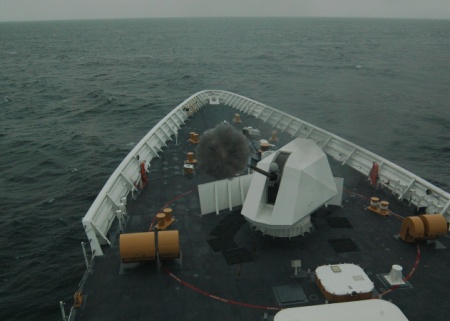
“The service is working on developing a guided 57mm round for its Mk 110 guns on the LCS and other Navy and Coast Guard ships, Surface Ship Weapons Office Program Manager Capt. Michael Ladner told USNI News last month. Fanta said at the SNA symposium that the project, which is funded and working its way through the development process now, was important because it would leverage research already being done for the guided Hypervelocity Projectile for the Electromagnetic Railgun.”

If that means we will be able to both target selected areas on a vessel and avoid the possibility of collateral damage, by shells gone astray, it will be good news.


Icebreaker Requirements Published

USCGC Polar Sea

USCGC Polar Sea

BreakingDefense.com has reported the Commandant has announced the release of  “a notional program schedule [and] notional Polar Icebreaker requirements” for two new heavy icebreakers today.

Details have been released to qualified contractors, but not the general public.

The reference to two icebreakers is a bit of a surprise. The source of the funding is not clear, but the Commandant suggest there is strong support in Congress and he sees some of it coming in 2017.

UPDATE: The additional details on the requirements from DefenseNews.

Specifically, the new ships need to be able to continuously push through up to six feet of ice — but preferably eight — going at least 3 knots.

In ice-free waters, it will need a sustained speed of 15 knots, or the speed at max horsepower.

The new icebreakers must also be able to:

  • Sail a range of 21,500 nautical miles at 12 knots.
  • Go 80 days underway without replenishment.
  • Run at least 3,300 operational hours a year.
  • Visually evaluate ice conditions for 12 nautical miles in each direction.
  • Land a range of military and federal helicopters.
  • Hangar two Coast Guard helicopters or future unmanned systems.


The Navy’s New Design for Maintaining Maritime Superiority–CNO

Download the pdf here.

Recently the new Chief of Naval Operations has issued a document , “A Design for Maintaining Maritime Superiority” that outlines how, hopefully, the US Navy can maintain a maritime superiority our foes will recognize and avoid confronting.

If you are looking for anything specifically regarding the Coast Guard here, you will not find it (other than the cutter in the formation on the cover). The Coast Guard is not mentioned even once, but it does talk about some things that are Coast Guard related. Perhaps we should not feel bad about this. It only mentions the Marine Corps once.

He talks about three forces that are changing the environment: 

  • The first global force is the traffic on the oceans, seas, and waterways, including the sea floor – the classic maritime system.
  • A second increasingly influential force is the rise of the global information system – the information that rides on the servers, undersea cables, satellites, and wireless networks that increasingly envelop and connect the globe.
  • The third interrelated force is the increasing rate of technological creation and adoption.”

Obviously the Coast Guard facilitates and regulates marine traffic and is tapped into the global information system. In wartime, these contacts will become essential. He also talks about new trade routes opening in the Arctic, that will only be reliable if we have new icebreakers. He also talks about illegal trafficing.

“This maritime traffic also includes mass and uncontrolled migration and illicit shipment of material and people.”

For once, finally, a document explicitly recognizes the competition,

“For the first time in 25 years, the United States is facing a return to great power competition. Russia and China both have advanced their military capabilities to act as global powers. Their goals are backed by a growing arsenal of high-end warfighting capabilities, many of which are focused specifically on our vulnerabilities and are increasingly designed from the ground up to leverage the maritime, technological and information systems. They continue to develop and field information-enabled weapons, both kinetic and non-kinetic, with increasing range, precision and destructive capacity. Both China and Russia are also engaging in coercion and competition below the traditional thresholds of high-end conflict, but nonetheless exploit the weakness of accepted norms in space, cyber and the electromagnetic spectrum. The Russian Navy is operating with a frequency and in areas not seen for almost two decades, and the Chinese PLA(N) is extending its reach around the world.

“…Coupled with a continued dedication to furthering its nuclear weapons and missile programs, North Korea’s provocative actions continue to threaten security in North Asia and beyond.

“…while the recent international agreement with Iran is intended to curb its nuclear ambitions, Tehran’s advanced missiles, proxy forces and other conventional capabilities continue to pose threats to which the Navy must remain prepared to respond.

“…international terrorist groups have proven their resilience and adaptability and now pose a long-term threat to stability and security around the world.”

He recognizes budgetary limitations.

“There is also a fourth ‘force’ that shapes our security environment. Barring an unforeseen change, even as we face new challenges and an increasing pace, the Defense and Navy budgets likely will continue to be under pressure. We will not be able to “buy” our way out of the challenges that we face. The budget environment will force tough choices but must also inspire new thinking.”

Throughout there is an emphasis on understanding history and the strategic concepts of the past. There is also a recognition of the need to work with partners.

“EXPAND AND STRENGTHEN OUR NETWORK OF PARTNERS: Deepen operational relationships with other services, agencies, industry, allies and partners – who operate with the Navy to support our shared interests.

Other than the Marine Corps, the US Navy has no closer partner than the USCG. The partnership has been a long and successful one, but I would like to see the Navy be a better partner to the Coast Guard.

What I want to see:

If we have “run out of money, now we have to think.” One thing we can do, is to try to get the maximum return from the relatively small investment needed to make the Coast Guard an effective naval reserve force.

  • We need explicit support from the Navy at every level, particularly within the Congress and Administration, for Coast Guard recapitalization.
  • We need an explicit statement from the Navy that they expect the Coast Guard to defend ports against unconventional threats, so that they can keep more forces forward deployed.
  • We need the Navy to supply the weapons we need to defend ports against unconventional attack with a probability approaching 100% ,including small missile systems like Hellfire or Griffin to stop small, fast, highly maneuverable threats and light weight anti-ship torpedoes that target propellers to stop larger threats, and we need those systems on at least all cutters of Webber class and larger.
  • We need to reactivate the Coast Guard’s ASW program and insure that all the new large cutters (NSC and OPC) have and ASW capability, if not installed on all of the cutters, at least planned, prototyped, tested, and practiced on a few ships (particularly in the Pacific).

(Note there is another post on this looking at the “design” from a Navy point of view.)