“Littoral combat ships in Mayport make the most of a year of restricted operations” –Defense News

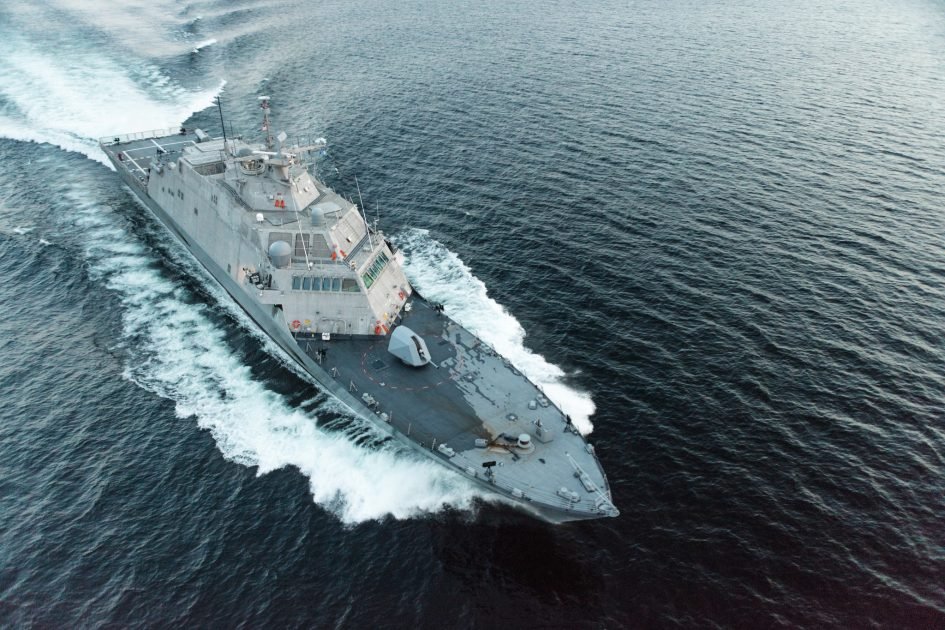
Littoral combat ship Little Rock (LCS 9) is underway during a high-speed run in Lake Michigan during acceptance trials. Lockheed Martin Photo

Defense News reports on the activities of the eight Freedom class Littoral Combat Ships based in Mayport during the year since recognition of their combining gear problem. (LCS-5, 7, 9, 11, 13, 15, 17, and 19. LCS-1 and 3 are in San Diego.)

All their deployments have been with Forth Fleet, primarily doing drug interdiction with a Coast Guard LEDET aboard.

“But, the squadron commodore said, the formation also has seen its greatest operational achievements during that same time, conducting seven successful deployments to U.S. 4th Fleet that took hundreds of millions of dollars’ worth of drugs off the market, interrupted trafficking networks across SOUTHCOM, supported partners throughout Central and South America and pushed back against excessive maritime claims.”

The report provides some insights in the nature of the class problems. The problems were not limited to when both turbines and diesels were operating together, to achieve maximum speed.

they are forbidden from operating in two modes to achieve top speeds — operating both the gas turbine and the diesel engine for full power, and using the diesel engine in “boost mode”

It appears the clutches for the diesel engines were not up to the torque those engines provided and this has meant that the ships are using turbines for cruise speeds that the diesels would have been expected to provide.

What we found out then later after that was, when Detroit had the failure, is that it was more than just that combined mode; it was actually the torque on that clutch when the diesel engine was operating under the higher loads, causing the same degradation and failure,”

This has impacted their already short range.

“…diesel engine is your most economical mode, so you just have to watch the operational employment of the ship more to make sure that you’re managing your fuel consumption” as the ships relied less on the diesel engine and more on the gas turbine.”

These ships continue to have reliability problems.

Defense News reported in June the LCS Strike Team, alongside the newly established LCS Task Force, had identified 32 reliability problems and were focused on five for the Freedom-variant ships. In addition to the combining gear, that list included issues related to the diesel generator rigid mount, fuel lines, water jets and boat davits.

That means they are being kept on a short leash. That is to some extent good news for 4th Fleet and the drug enforcement effort, since they are still not ready to be deployed to Bahrain.

On the other hand, that means PATFORSWA is to some extent covering missions that the LCSs should be doing.

I am not sure it’s true, but it seems the LCS are not as effective as cutters in drug enforcement. It would be interesting to do a study of that. To determine if it is true, and if so, why.

Another impression is that while we have deployed HITRON helicopters on foreign vessels engaged in drug enforcement, the LCSs use only Navy helicopters.

“Coast Guard’s Schultz gives ‘full-throated’ support for UN sea law treaty” –Breaking Defense

Vice Adm. Karl L. Schultz, commander, Coast Guard Atlantic Area, speaks at the Coast Guard Cutter Benjamin Dailey commissioning ceremony in Pascagoula, Miss. Coast Guard Photo

Breaking Defense reports the Commandant’s remarks regarding the United Nations Convention on the Law of the Sea (UNCLOS) at a Navy League event.

Also reported were vice chairman of the Joint Chiefs of Staff nominee, Adm. Christopher Grady’s expressions of support for ratification.

What’s Going on With the Coast Guard News Website?

Every day I try to look at all the sites included in my “Recommended Blogs” list. This includes three USCG sites:

MyCG, which seems directed at Coast Guard personnel, has been very active. CG-9’s site is, as you would expect, less active but still seems to be informative.

“Coast Guard News,” which seems to be directed at the national press, has covered Coast Guard ongoing operations, but seems to have dried up. For some time, it has seemed to have been neglected with few changes and little new material. Currently the top story is dated October 20. I know a lot has happened since then.

What’s going on?

If the site is not going to be maintained, we should say so and put some kind of notice on the site to say where to find Coast Guard news.

“Troubled CBP Gets $3.7 Billion Infrastructure Boost While Coast Guard Gets Peanuts” –Forbes

US Capital West Side, by Martin Falbisoner

Forbes makes a case that DHS is directing money to Customs and Border Protection because it’s broken, while minimally funding the Coast Guard because it works.

The Infrastructure Investment and Jobs Act, better known as the Bipartisan Infrastructure Bill, did a lot for the U.S. Coast Guard. The Coast Guard, the maritime component of the sprawling Department of Homeland Security, got a $434 billion windfall (that has to be million vice billion–Chuck) to fund operations and pay for physical improvements.

That’s better than a kick in the head. But the service got mere fraction of the $3.7 billion Congress meted out to the Department of Homeland Security’s continually-troubled Customs and Border Patrol.

Unfortunately, there seems to be a tendency in government to throw money at agencies that are not performing, in hopes of seeing an improvement, and providing no additional funds to agencies that are providing a good return on investment, inverting good investment strategy.

He also points out that for whatever reason, despite numerous demands from Congress, the Coast Guard is not providing the information Congress needs to make an informed decision about the true needs of the service.

At least this time the Coast Guard had provided an unfunded priority list. In many previous years there was none. The “program of record” for cutter procurement was formulated in 2004 and has not changed in 17 years. The only Fleet Mix study was done in 2011, a decade ago. There is no long-term capital asset or ship building plan.

“If you fail to plan, you plan to fail.”

Thanks to formerdirtdart for bringing this to my attention. 

“Iran Boosts IRCG Navy’s Swarm Attack Capabilities” –Naval News

110 speed boats entered service with the IRGC Navy (IRIB News picture)

Naval News reports,

According to the Iranian news outlet IRIB News, the Islamic Revolution Guards Corps (IRGC) Navy received 110 indigenously made combat speedboats on December 11 during a ceremony in Bandar Abbas….

“This is the seventh delivery of such vessels. Their speed has climbed from 55 knots to 75 and 90 knots, with the next stage reaching 110 knots. The boats are equipped with missiles and rockets and are capable of operating efficiently under the IRGC’s indigenous radar network.”

It’s not impossible the Iranians are employing deception tactics and may be redelivering boats seen in previous delivery media events, but there is little doubt, they do have a lot of fast attack craft, making the Coast Guard’s PATFORSWA operating area a rough neighborhood. (More here, here, here, here, and here.)

Considering if PATFORSWA is ever in a fight with the Islamic Revolutionary Guard Corp Navy, the cutters will probably be protecting tankers or Navy high value units. In that case, frankly I think most of the smaller craft are intended as a diversion, the primary threats are the missile and torpedo equipped boats that will screened by a cloud of smaller boats. Still machineguns and rockets mounted on small boats could damage the cutters.

If you want to consider if we can deal with the Iranian tactics, you might want to look at this earlier post, Guns vs the Swarm.

“New Royal Canadian Navy Offshore Patrol Vessel Visits Norfolk After Circumnavigating North America” –USNI

HMCS Harry DeWolf in ice (6-8 second exposure)

We have talked about the Canadian Navy’s Arctic Offshore Patrol Ship (AOPS) before (more here). It is, in many ways an Offshore Patrol Vessel, that would seem right at home in the US Coast Guard. In fact, in addition to the six being built for the Royal Canadian Navy, two are being built for the Canadian Coast Guard.

I would not be surprised if the US Coast Guard opts to build something similar. This US Naval Institute News Service story provides a bit more insight into its operations and how it is being used.

The AOPS, like the Offshore Patrol Cutter (OPC), is a VARD design. It is based on the Norwegian Coast Guard Cutter Svalbard, that was capable enough to reach the North Pole on 21 August 2019. Svalbard also completed a scientific mission for the US in the Beuford Sea in 2020, when CGC Healy had a fire in one of its main propulsion motors and was unable to recover data contained in buoys she had deployed earlier.

Most surprising for me were the comments the ship’s use of containers,

At the briefing to press in Norfolk, which was broadcast online, he noted that sea-shipping containers aboard Harry DeWolf, not usually carried on warships, can be used as laboratories for science and researchers studying changes in the Arctic.

Gleason added that at all times the ship will have two containers loaded for humanitarian assistance and disaster relief to respond to emergencies when called upon.

Gleason said early on there was a key training scenario of responding in a mass casualty scenario. In it Harry De Wolf  worked with the U.S. and Canadian coast guards and naval vessels in treating and evacuating the injured aboard and taking them ashore.

On this mission to the North, Gleason said the containers had a real-time military mission. They “were used as underwater listening devices” for submarines. “Fortunately, we didn’t find any.”

I suspect the “underwater listening devices” for submarines was the Towed Reelable Active Passive Sonar, TRAPS system, (more here).

Ukrainian Island Class Cutter Rearmed

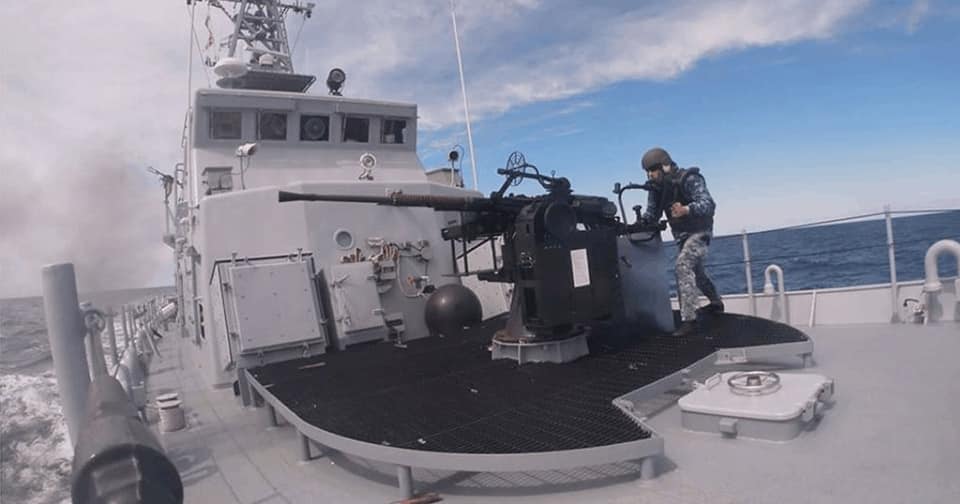
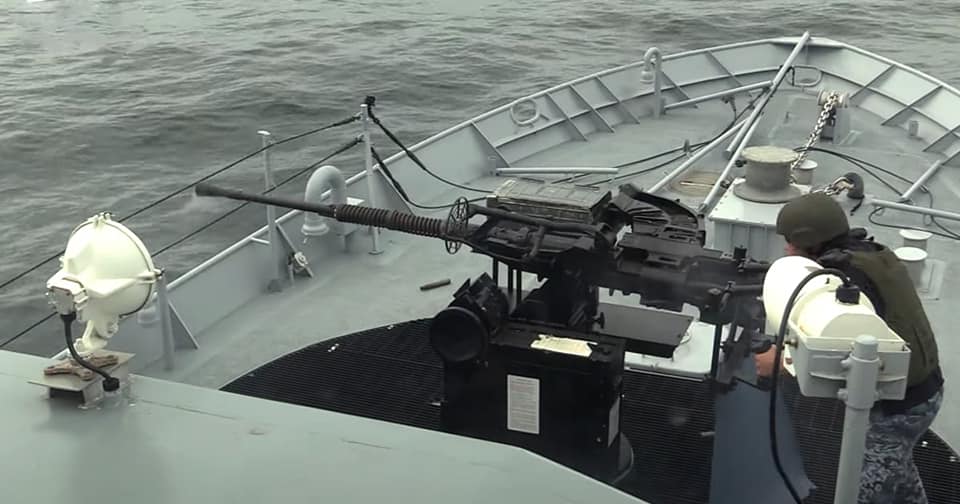
Via Facebook I obtained some photos, from a Ukranian friend, of how a couple of the five Ukranian 110 foot Island class cutters have been rearmed.

The intention was to rearm the ships with the MSI Seahawk 30mm, which reportedly will be the new USN Mk38 Mod4, but apparently it is not yet available, so instead, the ships have been armed with a Soviet era 25mm gun, the 110 PM. As can be seen, control is entirely manual and lacks stabilization, sensors, electro-optics, or any kind of firecontrol computer.

It’s not much, for a Navy facing off the Russian Black Sea Fleet, but at least it essentially restores the capability they had before the transfer. In some respects, it may be superior with a higher rate of fire and a heavier projectile.

“Coast Guard cutter undergoing repairs catches fire at Port Tampa Bay” –Tampa Bay Times

CGC BENJAMIN DAILEY, the first FRC stationed in Gulf of Mexico. Photo by Bigshipdriver

The Tampa Bay Times reports a fire on USCGC Benjamin Dailey, Friday night, December 10, while in dry dock. The cutter is based in Pascagoula, MS. It reportedly took 45 minutes to bring the fire under control.

Thanks to Long Boat John for bringing this to my attention. 

“Shultz: Two FRCs Soon to Depart for Basing in Persian Gulf” –Seapower

U.S. Coast Guard Cutter THETIS (WMEC-910) will be providing escort. US Navy photo ID:J3103SPT95001725 / DNST9800595

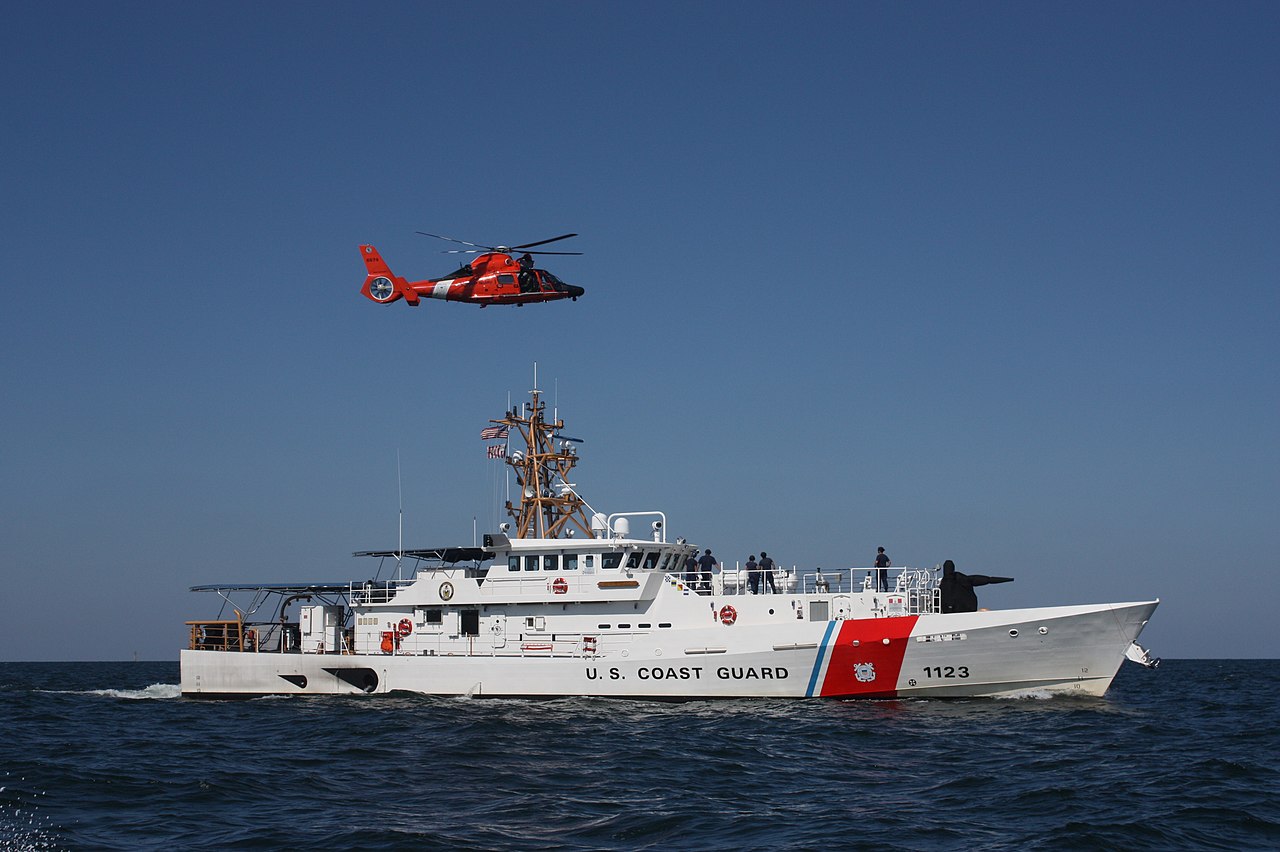
The Navy Leagues on-line magazine, Seapower, reports two two FRCs, USCGC Glenn Harris (WPC 1144) and USCGC Emlen Tunnell (WPC 1145), will soon be on their way to Bahrain to join PATFORSWA.

“Coast Guard Commandant Karl Schultz, speaking Dec. 8 at a Navy League Special Topic Breakfast, said the two 154-foot-long FRCs will be escorted across the ocean by the USCGC Thetis (WMEC 910), a Famous-class medium-endurance cutter that was topping off with fuel in Puerto Rico. Schultz said that after the escort mission the Thetis will be operating off Africa.”

I am a bit surprised the escort will be a medium endurance cutter instead of a Bertholf class National Security Cutter.

Also interesting is the report that Island-class patrol boats USCGC Adak (WPB 1333) and USCGC Aquidneck (WPB 1309), were transfered to Indonesia.

“Coast Guard Polar Security Cutter (Polar Icebreaker) Program: Background and Issues for Congress” –CRS, December 7, 2021


The Congressional Research Service has once again updated their look at the Polar Security Cutter (heavy icebreaker) program. (See the latest version here.) My last look at this evolving document was in regard to the October 19, 2021 revision.

The one-page summary, which has not changed, is reproduced below, but first I will point out what appears to have changed since the October 19 edition.


From page 13 re program delays (This is based on the report discussed here)

An October 19, 2021, press report stated

Delivery of the first new Coast Guard heavy polar icebreaker has slipped a year to 2025 due to the fact that it’s been 45 years since the last heavy icebreaker was built in the U.S. and impacts from the COVID-19 pandemic, Adm. Karl Schultz, the service’s commandant, said on Tuesday [October 19].

The first Polar Security Cutter (PSC) is expected to be delivered in the third quarter of fiscal year 2025, Schultz told a Senate Commerce Committee panel that oversees the Coast Guard. The PSC was originally expected to be delivered in March of 2024, which is in the second quarter of FY ’24. That timeline was later revised to May 2024, which is the third quarter….

Schultz said that COVID “complications” have hampered “international collaboration” on PSC ship construction, noting that the program is ambitious and “on a compressed timeline.”

A Coast Guard spokesman told Defense Daily in an email reply to questions that infection rates and travel restrictions due to COVID “significantly affected Halter Marine’s ship design efforts and subcontractor integration, resulting in unavoidable delays. COVID-19 was particularly impactful to HMI’s efforts to hire and maintain staffing levels across multiple occupation categories (labor, management, and engineering) and hindered collaboration with its ship design subcontractors, many of whom are based internationally and were significantly affected by early COVID-19 restrictions.”

The spokesman added that “The Coast Guard and Navy Integrated Program Office recently negotiated a consolidated contract action that definitizes COVID-19 delays and rebaselines the delivery schedule by 12 months.” Still, the program remains on track to begin operations in 2027 with Operation Deep Freeze, he said.

From pages 29 and 30, re a Great Lakes Icebreaker and a Forth PSC

Build Back Better Act (H.R. 5376)
House
Section 110023 of H.R. 5376 as passed by the House on November 19, 2021, states
SEC. 110023. GREAT LAKES ICEBREAKER ACQUISITION.

In addition to amounts otherwise available, there is appropriated for fiscal year 2022, out of funds in the Treasury not otherwise appropriated, $350,000,000, to remain available until September, 30, 2031, to the Coast Guard, for acquisition, design, and construction of a Great Lakes heavy icebreaker, as authorized under section 8107 of the William M. (Mac) Thornberry National Defense Authorization Act for Fiscal Year 2021 (P.L. 116-283).50 The Coast Guard shall return to the Treasury any funds appropriated under this section that have not been expended by September 30, 2031.

Section 10024 of H.R. 5376 as passed by the House states
SEC. 110024. POLAR SECURITY CUTTERS AND CLIMATE SCIENCE.

In addition to amounts otherwise available, there is appropriated for fiscal year 2022, out of any money in the Treasury not otherwise appropriated, $788,000,000, to remain available until September 30, 2031, to the Coast Guard, for the acquisition of the fourth heavy Polar Security Cutter, including scientific laboratory and berthing facilities, to expand access for scientists to the polar regions, to improve climate and weather research, for other polar missions, and for other purposes, as authorized under section 561 of title 14, United States Code.


Summary (Note no change from previous edition-Chuck)

The Coast Guard Polar Security Cutter (PSC) program is a program to acquire three new PSCs (i.e., heavy polar icebreakers), to be followed years from now by the acquisition of up to three new Arctic Security Cutters (ASCs) (i.e., medium polar icebreakers). The PSC program has received a total of $1,754.6 million (i.e., about $1.8 billion) in procurement funding through FY2021, including $300 million that was provided through the Navy’s shipbuilding account in FY2017 and FY2018. With the funding the program has received through FY2021, the first two PSCs are now fully funded.

The Coast Guard’s proposed FY2022 budget requests $170.0 million in procurement funding for the PSC program, which would be used for, among other things, procuring long leadtime materials (LLTM) for the third PSC.

The Navy and Coast Guard in 2020 estimated the total procurement costs of the PSCs in then year dollars as $1,038 million (i.e., about $1.0 billion) for the first ship, $794 million for the second ship, and $841 million for the third ship, for a combined estimated cost of $2,673 million (i.e., about $2.7 billion). Within those figures, the shipbuilder’s portion of the total procurement cost is $746 million for the first ship, $544 million for the second ship, and $535 million for the third ship, for a combined estimated shipbuilder’s cost of $1,825 million (i.e., about $1.8 billion).

On April 23, 2019, the Coast Guard-Navy Integrated Program Office for the PSC program awarded a $745.9 million fixed-price, incentive-firm contract for the detail design and construction (DD&C) of the first PSC to VT Halter Marine of Pascagoula, MS, a shipyard owned by Singapore Technologies (ST) Engineering. VT Halter was the leader of one of three industry teams that competed for the DD&C contract. The first PSC is scheduled to begin construction in 2021 and be delivered in 2024, though the DD&C contract includes financial incentives for earlier delivery.

The DD&C contract includes options for building the second and third PSCs. If these options are exercised, the total value of the contract would increase to $1,942.8 million (i.e., about $1.9 billion). The figures of $745.9 million and $1,942.8 million cover only the shipbuilder’s costs; they do not include the cost of government-furnished equipment (GFE), which is equipment for the ships that the government purchases and then provides to the shipbuilder for incorporation into the ship, post-delivery costs, costs for Navy-specific equipment, or government program-management costs.

The operational U.S. polar icebreaking fleet currently consists of one heavy polar icebreaker, Polar Star, and one medium polar icebreaker, Healy. In addition to Polar Star, the Coast Guard has a second heavy polar icebreaker, Polar Sea. Polar Sea, however, suffered an engine casualty in June 2010 and has been nonoperational since then. Polar Star and Polar Sea entered service in 1976 and 1978, respectively, and are now well beyond their originally intended 30-year service lives. The Coast Guard plans to extend the service life of Polar Star until the delivery of at least the second PSC. The Coast Guard is using Polar Sea as a source of spare parts for keeping Polar Star operational