US Coast Guard crew of cutter Spencer watched as a depth charge exploded near U-175, North Atlantic, 500 nautical miles WSW of Ireland, 17 Apr 1943. Photo by Jack January
The US Naval Institute’s April 2024 edition of Naval History magazine has an excellent article about USCGC Spencer’s destruction of U-175 on 17 April 1943, A Nautical Knife Fight, written by CPO William A. Bleyer, USCG. I have added the link to my heritage page.
I have read several accounts of this action, and this is the best and most detailed.
USCGC Spencer (WPG-36) in 1942 or 1943. Spencer sank U-175 with assistance of USCGC Duane, on April 17, 1943.
Spencer was the Coast Guard’s most successful ASW ship, sinking at least two U-boats (U-633 on March 1943 and U-175 17 April 1943) and possibly a third.
USCG Cmdr Harold S. Berdine of cutter Spencer talking with US Navy Capt Paul Heineman of the Escort Group A-3 after sinking German submarine U-175, North Atlantic, 500 nautical miles WSW of Ireland, 17 Apr 1943. US Coast Guard photo by Jack January
Spencer was one of seven 327 foot Secretary class cutters. As a class they were extremely successful. Unfortunately, one was lost 29 January 1942, after being torpedoed. Another of the class, USCGC Campbell, famously rammed and sank U-606 on 22 February 1943, after the U-boat was forced to the surface by the Polish destroyer Burza. I had the privilege of being XO on one of the class, USCGC Duane, which assisted Spencer in the sinking of U-175 and rescuing survivors.
040501-N-7586B-122, Gulf of Oman (May 1, 2004) – Members of the Vessel Board Search and Seizure (VBSS) team return to the guided missile cruiser USS Leyte Gulf (CG 55) in a Rigid Hull Inflatable Boat (RHIB) after searching several fishing dhows in the Gulf of Oman. U.S. Navy photo by Photographer’s Mate 1st Class Bart Bauer. (RELEASED)
News about Navy ships deployed to 4th Fleet has been sparse, but recently I noted the return of a destroyer, USS Farragut, from the 4th Fleet and remarked on how I was surprised they used a DDG rather than an LCS for this drug interdiction mission. Before they were all decommissioned, these missions were typically done by Perry class frigates. DDGs have been used in the past but lately the mission has been done almost exclusively by LCS. At one point in 2020, the administration made a big point of “surging” ships to the Drug interdiction zone, but in fact, that only happened because the carrier in a carrier strike group was unable to make its deployment and the escorts were suddenly at loose ends and available.
Cruisers are normally AAW coordinators for carrier strike groups. Deploying one independently to 4th Fleet is rare indeed.
Again, I suspect they may be there for reasons unrelated to drug interdiction. The DDG apparently stayed in the Caribbean rather than entering the Eastern Pacific, where we have a greater shortage of capable drug interdiction assets.
USS LEYTE GULF DEPLOYS FROM NORFOLK TO U.S. 4TH FLEET
By Lt.J.G. Jayden Hodgson, USS Leyte Gulf Public Affairs
28 January 2024, NORFOLK, Va. —
The Ticonderoga-class guided-missile cruiser USS Leyte Gulf (CG 55) departed Naval Station Norfolk on deployment, Jan. 28.
Leyte Gulf will independently deploy to the U.S. 4th Fleet area of operations.
Throughout the fall, the ship conducted extensive underway operations throughout the Western Atlantic in preparation for their tasking.
“Leyte Gulf and her crew are excited to work with our partner nations and services to maintain maritime security and interoperability in the Caribbean and South American areas of operation,” said Capt. Nate Diaz, commanding officer of Leyte Gulf.
The ship’s crew is comprised of more than 40 officers and nearly 350 enlisted Sailors.
“The crew continued to display a high level of proficiency and readiness during our sustainment phase,” said Leyte Gulf Command Master Chief Jason Kutsch. “We look forward to exercising the capabilities of our ship and crew while deployed.”
While deployed, Leyte Gulf will host Helicopter Maritime Strike Squadron (HSM) 50 and Coast Guard Law Enforcement Detachment 404 to provide robust expertise in keeping illegal drugs from reaching the shores of the U.S. and its regional partner nations. Leyte Gulf is scheduled to conduct passing exercises with other regional partners as well as several theater security cooperation port visits to strengthen maritime partnerships, enhance U.S. maritime posture and counter threats such as illicit drug trafficking.
Leyte Gulf was commissioned Sept. 26, 1987, and commemorates the largest naval battle in modern history fought in Oct. 1944. The Battle of Leyte Gulf was critical in turning the tide in the Pacific during World War II.
Two years ago, I did a post with a similar title from the same source. Somehow, I missed the 2023 edition. As I said in the earlier post, I don’t know Phoenix_jz, but the data appears to be credible, and it looks like readers are checking his figures.
It is very difficult to read the tonnages at the bottom of the graph unless you are using a computer and click on the graph to see it in a larger size.
The creator’s notes and some additional comments are below.
Hello all!
Well, 2024 is upon us, and as such so is the third edition of my top ten navy list. For those unfamiliar, here are links to 2022 and 2023, with a general explainer of the whole concept in the 2022 version.
The long and short of it is that this graph reflects a personal tracker I keep of almost every large and moderately sized navy, and calculates the aggregate displacement of these navies. It’s not a perfect way to display the size of navies – far from it in fact – but it is at least more representative than counting numbers of hulls alone, in my opinion.
To break down what each of these categories mean;
Surface Warships is an aggregate of all above-water warships and major aviation and amphibious assault platforms. This category includes CVNs, CVs, CVLs, LHDs, LHAs, LPDs, CGs, DDGs, FFGs, corvettes, OPVs, CPVs, lighter patrol craft, and MCM vessels.
Submarines is what it says on the tin – SSBNs, SSGNs, SSNs, SSKs, and for select nations where applicable (and where information is available), special purpose submarines. Please note dedicated training submarines are counted separately.
AORs includes all major fleet replenishment vessels (coastal vessels do not count, however).
Other Auxiliaries is a very wide net that essentially captures everything else. Special mission ships, support vessels, minor amphibious assault vessels (LSDs, LSTs, LCAC’s, LCM’s, LCU’s), training vessels, tugs, coastal support vessels, hydrography ships – all essential parts of navies, but generally often paid less attention to as they’re not as flashy as the warships proper.
Interesting trends in data that I thought I would share for various navies, and thoughts and observations otherwise;
The USN is, unsurprisingly, still top dog by a huge margin. In spite a net decommissioning of five ships this year, the USN has grown overall by about 32,000 tons – four ‘cruisers’, two SSNs, four LCS, and five patrol craft decommissioned against the introduction of three destroyers, an SSN, five LCS, and a replenishment ship. It is worth noting that 2023 is the first year since 2010 that the USN has commissioned three destroyers in a year, though a repeat performance in the next couple years is unlikely – these ships were launched in 2020 and 2021, and only one destroyer per year was launched in 2022 and 2023.
No one will be surprised to hear that the PLAN has grown for the nth consecutive year, adding the final Type 055 batch I and the remaining Type 054A Batch V, for almost 50,000 tons of new surface combatants. Much of the remaining increase in displacement for this year (which totaled nearly 90,000 tons) reflected a steady pace of modernization in mine warfare, landing forces, and logistical support/other auxiliaries. As with last year, the number of minor patrol craft continue to plummet as the PLAN continues to divest many of its obsolescent brown-water combatants, or relegates them to training duties.
Moving on to ongoing construction, progress on the new destroyer batches continues at pace. At least two Type 055 Batch II appear to be under construction, and the overall number of Type 052D Batch IV appears to be at least ten. The first ship actually launched at the very end of 2022 (at Jiangnan), and two further have been launched by the same yard as well as three at Dalian. Two more remain under construction at each yard. The first of these ships to be launched appears to be on trials and will likely commission this coming year. The Type 054A program of the navy appears to have finally wrapped up (construction of the hull for the China Coast Guard continues), and the Type 054B program has continued at pace if not scale – two ships were launched this year, but modules of further units have been scarce. Rounding things out for major surface vessels, a new Type 075 LHD was launched this past December. Conspicuously absent has been sightings of any modules for new carriers. Considering Fujian (Type 003) began construction at some point from 2015 to 2017, one has to wonder if we will see China launch another carrier before the end of the decade.
Perhaps most consequential of all, however, has been the completion of new production facilities at Bohai and a resumption of Type 093 SSN launches. The first of the new Type 093B launched in 2022, and has been followed up by two more launches this year (possibly up to three). A sustained pace of two submarines a year, or even just three submarines every two years, would quickly add up could see anywhere from nine to eleven new SSNs launched by the end of 2027, and in service by early 2030s. Only time will tell what the actual drumbeat of production will be.
Russia’s VMF woes in the Black Sea have continued unabated, except less at sea and largely fueled by the Franco-British SCALP cruise missile. The most dramatic loss by far was the destruction of the Project 636.3 ‘Improved’ Kilo Rostov-on-Don in drydock at Sevastopol, but similar attacks claimed the destruction or constructive loss of a Karakurt-class corvette (under construction, not in service) and two Ropucha-class LSTs. The infamous TB-2 made a brief return to destroy a Serna-class LCU, and two other LCU’s may have finally become the first victims of Kamikaze USVs this past November, for a total of 11,407 tonnes lost.
In regards to the more regular cycle of commissioning and decommissioning, one frigate, one MCM vessel, and three corvettes were brought into service, as well as a new SSGN, SSBN, and SSK each. Against this a corvette, SSGN, SSBN, and SSK were decommissioned. Overall, in spite of losses the VMF managed a net gain of 6,324 tonnes of surface warships and submarines. Anyone who checks against my figures from last year will note that the increase in the VMF’s overall tonnage this year is far more substantial, due to the auxiliary category. Though some of this was from new vessels, this was mostly down to a badly needed overhaul and reorganization of that part of my tracker, particularly for the tug fleet. Did you know the Russian navy tug fleet displaces more than either the Argentine or Canadian navies? Now you do! Seriously – it would be the 20th largest navy in the world by itself.
As a final note on the VMF – it is worth remembering that ships commissioned in the Russian navy are not always actually in service, as ships can often languish in near-terminal refits or simply be left inactive without a formal decommissioning. Almost half the remaining Projekt 877 Kilo’s, for example, appear to be inactive at this point (5 of 10).
(In comments the author noted the following, “Russian naval losses during the war have totalled 13 vessels for 29,870 tonnes. Quite a bit – but also only about 1.4% of their current overall tonnage.” –Chuck)
The British Royal Navy observes a second year of marginal reduction in overall tonnage (-2,640t, or -0.3%), losing another Type 23 frigate as well as the last Echo-class survey ship. Against this the RFA brought into service the first MROSS, Proteus. Proteus represents a considerable increase in subsurface capability, though the loss of a frigate with no replacement ship to replace it for another thee to four years is painful, especially given how many of the remaining eleven ships are deep in LIFEX/Post-LIFEX refits. With that said, their new frigate programs are moving on steadily. Steel was cut on two new frigates this year – the future HMS Birmingham (4th Type 26) and HMS Active (2nd Type 31), bringing the total construction volume to five frigates building and one fitting out.
The JMSDF continues to grow, albeit at a more moderate pace this year (+6,530t, or +0.9%), inducting a new Mogami-class frigate and Taigei-class attack submarine, while shifting another Oyashio-class from the active fleet to a training role. Two more FFM were launched this year, though surprisingly they have not started construction on the next pair. This past November, it was announced that the Mogami-class FFM would be curtailed at 12 units (of 22 planned), and followed on by an evolution of the design known as FMF-AAW. The FMF-AAW will feature greater air and surface warfare capabilities. Twelve such ships are planned.
The Indian Navy’s growth in 2023 was far less dramatic than in 2022, but still noteworthy (+9,200t, or +1.5%), as adding a new conventional attack submarine and destroyer to the fleet has finally pushed them over the 600,000-tonne line.
The Marine Nationale grew by almost 9,000 tonnes (2.1%) this year, largely down to the retirement and replacement of a patrol ship, nuclear attack submarine, and tugs with an equal number of replacements. Though it is worth noting that the new attack submarine is not fully operational yet – that will happen in 2024 – so technically the MN’s attack submarine fleet is really four boats at this point in time.
The saga of eight and ninth place swapping around continues, as the ROKN has managed to move back to the position of eighth largest navy in the world. In 2023 they added a net 15,374t (+4.3%), commissioning four Daegu-class frigates, a second KSS-III class attack submarine, an MCM vessel and a pair of LCACs, against the decommissioning of two corvettes and five PKM’s.
In contrast, the Marina Militare continues to feel the bite from the two FREMM sold to Egypt, as well as delays in brining the LHD Trieste into service – intended for 2023 but again pushed back, now to the spring of 2024. The first PPA ‘Light+’, Raimondo Montecuccoli, was brought into service in 2023 – an OPV on paper, but light frigate in practice. Against this one of the elderly Maestrale-class frigates, Zeffiro, was retired, as was one of the fleet’s AORs (Vesuvio) and a water tanker (Bormida), resulting in a real drop of 7,073 tonnes (-1.9%). The drop seen versus the chart versus last year is more dramatic (totals 16,632 tonnes), which reflects both cleaning up data on old auxiliary platforms for which information is scarce, and correcting some minor sheet errors, which totaled 9,559 tonnes.
The outlook should be looking up in the future – as previously mentioned, the LHD Trieste should enter service this year, as should the fourth and fifth PPA. The first of two replacement FREMM (GPe) was launched in late 2023 and a second will follow this spring, with both being slated to enter service in 2025 alongside the sixth PPA and second Vulcano-class replenishment ship – barring any delays.
Finally, the Indonesian Navy saw another year of growth, adding a net 9,930 tonnes (+3.1%), with another hospital ship commissioned, a new survey ship, corvette, and two new MCM vessels and FACs each, as well as several patrol boats. The TNIAL continues a steady program of domestic construction of patrol craft, and construction is ongoing on two Iver Huitfelt derivative frigates, with the keel of the first vessel laid down this past August. They have also cut steel on a new hydrography ship, which will launch in Indonesia and complete fitting out in Germany.
What comes next in terms of major platforms for the TNIAL is somewhat up in the air. As with the year prior, there has been no progress made on the procurement of six FREMM from Italy, despite a contract being signed two and a half years ago (June 2021). In spite of this, they have expressed interest in procuring two PPA to bolster their patrol fleet. In the interest of expediting procurement, they are looking at two ‘Light+’ configuration vessels currently fitting out at Muggiano – Marcantonio Colonna (due for delivery to the MMI in the latter half of 2024) and Ruggiero di Lauria (due for delivery to the MMI in mid-2025). According to the General Manager of Fincantieri’s Naval Vessels Division, Dario Deste, a contract for the two vessels could be signed in the first half of 2024.
(In answer to a question the author added this in the comments–Chuck)
No.11 to 20 are as follows for 1 January 2024;
11: Turkey – 297,298t
12: Taiwan – 268,958t
13 Egypt – 232,046t
14: Spain- 229,373t
15: Germany – 226,655t
16: Australia – 224,074t (decided to add the National Support Squadron, which added about 30kt)
Probably not surprising given all these nations are competing more or less with each other, but the rankings have basically remained the same except for Italy and South Korea trading places in 2023, then reverting to their 2022 places again this year. Nobody previous top 10 navy has left the club either.
However, do note that not all of the year-to-year tonnage differences are due to actual changes in fleet size/composition. As Phoenix mentioned in his post, the Russians in particular got a huge tonnage jump this year because he changed the way he counts auxiliaries, and given the discrepancy between his reported +32k figure for the USN and the numbers, there’s probably some math correction involved there too.
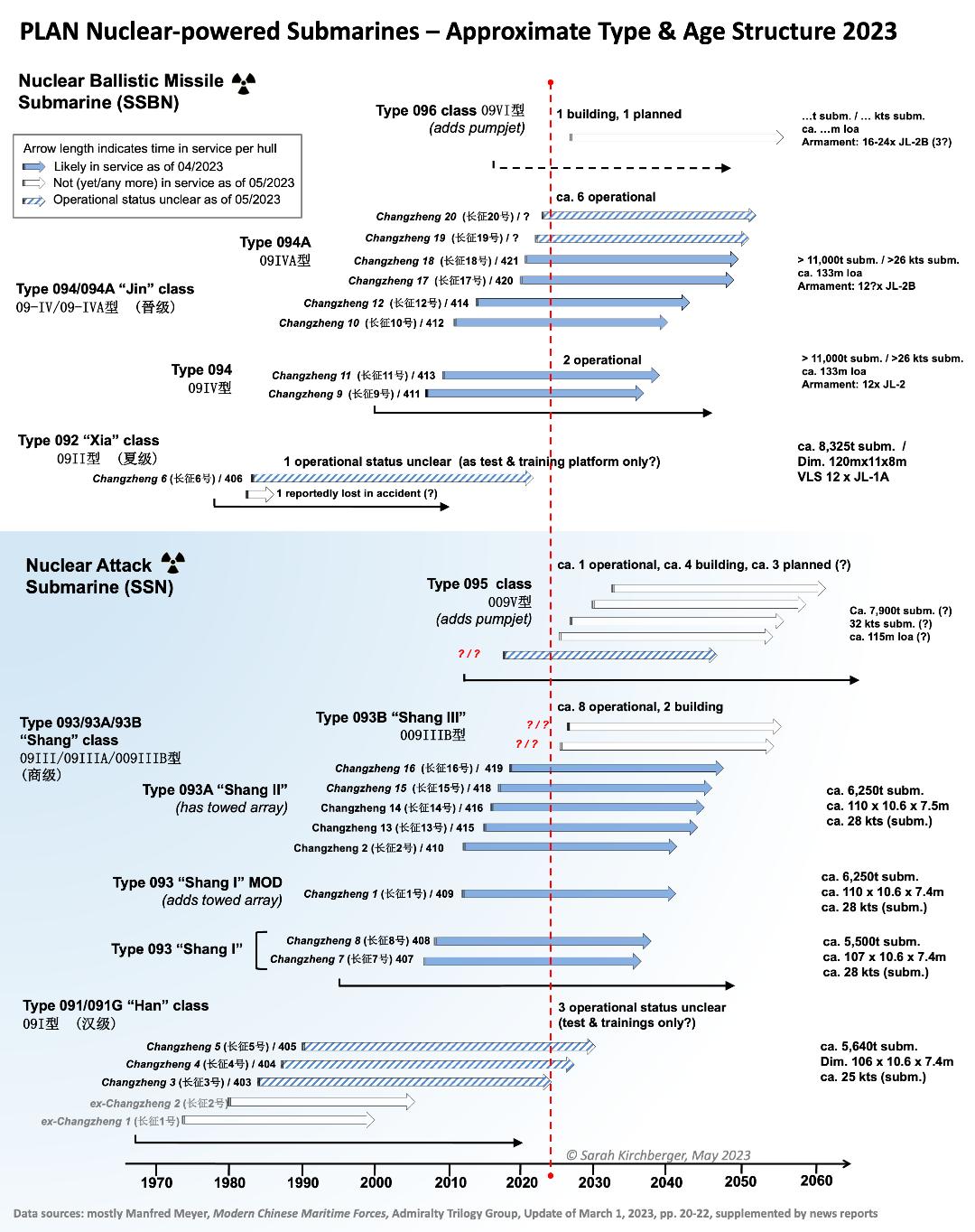
“China’s President Xi Jinping appointed a new Chief for the People’s Liberation Army Navy in a Monday ceremony in Beijing…Adm. Hu Zhongming…Hu was previously the PLAN Chief of Staff and is a submarine officer though details of his career are sparse, a Chinese media report in 2015 stated that Hu had a served in the PLA 92730 unit, which operates China’s nuclear submarine.”
I have not been able to confirm it, but as I recall the previous head of the PLAN was also a submariner.
It appears that the Chinese intend to match or exceed the US’s normal two nuclear submarine per year build rate, while continuing to build a substantial fleet of conventionally powered air-independent submarines.
It is becoming apparent, that in any future major conflict, submarines will be a threat, not just in distant waters, but in virtually any ocean right up to the US coast.
It is time for the Coast Guard and Navy to cooperate in redeveloping a Coast Guard role in ASW, whether it be permanently installed or containerized add-ons with Navy helicopter and personnel augmentation.
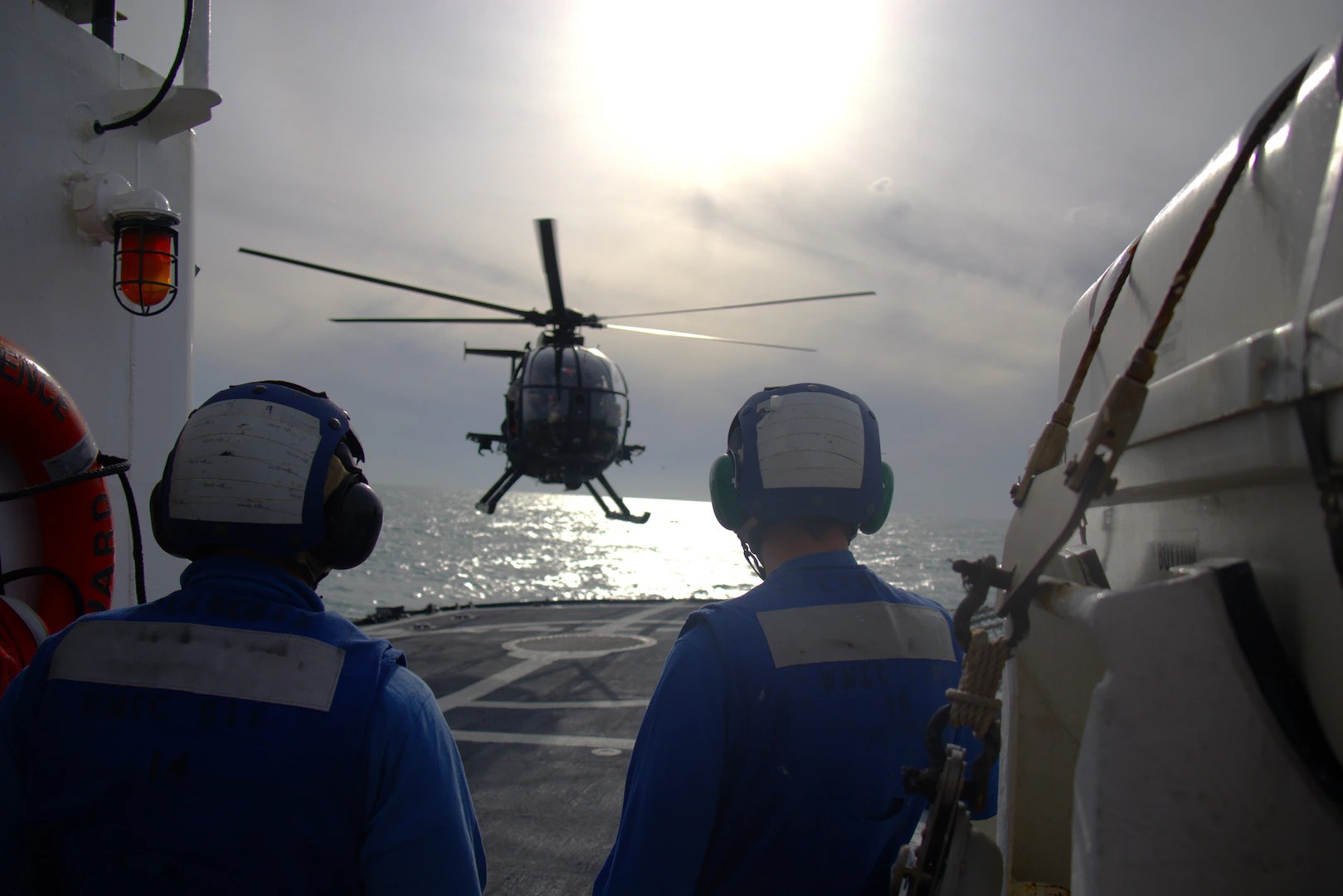
“Diligence also conducted a joint training exercise with the Army’s 160th Special Operations Aviation Regiment (SOAR). During the exercise, the Diligence crew and pilots from SOAR completed daytime and nighttime helicopter landing evolutions.”
Between 1987 and 1989 the U.S. Army’s 160th Special Operations Aviation Regiment, also known as “The Night Stalkers,” flew Little Bird helicopters from barges and Navy frigates in the Persian Gulf. Operation Prime Chance paired the U.S. Army helicopters with Navy SEALs, Marines, and Special Boat Units in an undeclared war against Iranian Revolutionary Guards units harassing civilian shipping. Six Little Birds, both MH-6 utility and AH-6 attack versions equipped with SEAL snipers, rockets, and machine guns, flew patrols as low as thirty feet.
This might be a reminder that Army and Marine helicopters could be operated from Coast Guard Cutters for limited periods for Special Operations, particularly in areas where there are few Navy assets such as the high North and 4th Fleet.
Thought I would share this video. Found it on a SeaWaves post, Patrolling Greenland on Denmark’s HDMS Triton. HMDS Triton a Thetis class patrol frigate. These ships do Coast Guard type work in or near the Arctic. It is a type of ship that you will not find in the Coast Guard fleet, but one that we may want to add in the future. It is ice strengthened. As a ship that operates in an area where icing is common. its ground tackle (anchor handling equipment) is below the foc’sle deck, and its boats and boat handling gear can be enclosed. The crew is relatively small (I think they are double crewed to get more underway time), but additional berthing is available, and weapons can be added using the Stanflex system.
Arctic (orthographic projection) with national borders and land highlighted. Credit Heraldry, Isochrone, via Wikipedia, 23 July 2023.
Below is the narrative that accompanied the YouTube video.
The Arctic region is the gateway to the North Atlantic. For NATO and its Allies, maintaining a strong presence here is vital to protect trade, transport and communication links between North America and Europe.
As climate change causes the polar ice caps to melt and the sea levels to rise, new sea routes are beginning to emerge, which could present a threat to Euro-Atlantic security. Greenland is considered by scientists to be ground zero for climate change. Along with the Faroe Islands, it forms part of the Kingdom of Denmark and is therefore under Danish military protection. That protection falls to the Joint Arctic Command, or JACO, a Danish-led operational command with a central headquarters in Nuuk, Greenland’s capital.
Join the Danish Armed Forces in Greenland, at sea, in the air and on land, to discover more about how security might be affected in this region and learn about the capabilities and experience NATO Ally Denmark has in the North Atlantic area.
Israel Shipyards Shaldag MK V. Israel Shipyards Ltd. picture
For some time, I have thought that the Webber class, “Fast Response Cutter” (FRC), program was misnamed. Webber class cutters don’t generally sit in port waiting for some alarm to call them to rush to the scene. Rather they are used more like small Medium Endurance Cutters. This has proven especially fortuitous in view of the delays in replacing the existing WMECs. It is only because of the versatility of the Webber class that the Coast Guard will be able to maintain its drug and alien migrant interdiction efforts in the 7th District and extend fisheries protection and counter IUU efforts into the Western Pacific while decommissioning WMECs before their replacements are completed.
Still, I do believe there is a need for true Fast Response Cutters for those rapidly developing missions that require more range and capability than a Response Boat, Medium, for protection of high value units, and to respond in the event of a maritime terrorist attack–units for which SAR and particularly Ports, Waterways, and Coastal Security are their primary missions.
The “Marine Protector” 87-foot patrol boats have had this job, but they are approaching the end of their service life (the oldest are now 25 years old). Four of them are particularly tasks with protecting Fleet Ballistic Missile submarines during surface transit from their bases to open sea. They have never been well prepared to deal with terrorist threats and aren’t really particularly fast.
We have discussed characteristics for a WPB replacement, a true Fast Response Cutter, before (here and here) and why nothing we have currently is suitable for the mission. The Shaldag Mk. V looks like a good candidate for the job, but first let’s look at where and why we might need vessels of this type.
The Webber class as Fast Response Cutters:
In some places, the Webber class might take on the functions of a “fast response cutter.” Where there are three or more based in a single location, it should be possible to have one on standby virtually at all times. Though better armed than the 87 footers, they are not particularly well prepared to deal with the terrorist threat, but it is possible to increase their armament to make them more effective in the role.
Even if the Webber class could be used in the FRC role, their basing, concentrated as it is to improve maintenance, would leave many ports with no similar protection.
Where Do We Need Fast Response Cutters:
In an earlier post, “A Reevaluation, Ruminating on Homeports While Playing the Red Cell,” Part 1 and Part 2, I identified 31 critical ports that required protection from unconventional attack.
I will assume that if the Coast Guard recognizes the need for a true Fast Response Cutter, a well-armed interceptor, and does build such a class, that they will also increase the armament of at least some of the Webber class, so that they could also be effective in this role at critical ports where they are based.
Webber class are based in 9 of the 31 critical ports: Moorehead City/Atlantic Beach, NC; Miami; San Juan; Pascagoula; Galveston; LA/Long Beach/San Pedro; Honolulu; and Guam.
That leaves 22 port complexes without resident Fast Response Cutters:
CCGD1:
Bath, Me–Major Naval shipbuilder
Kittery, ME/Portsmouth, NH –Naval Shipyard
Groton, CT–Submarine base
Hudson River complex, New York, NY/Elizabeth and Bayonne, NJ–a major cultural target, #3 US Port by tonnage, #3 Container port, #4 Cruise ship port (NYC) and #13 cruise ship port (Cape Liberty, NJ)
CCGD5:
Chesapeake Bay Complex, VA–Base for aircraft carriers and submarines, Major naval shipbuilder, Strategic Port, #9 port by tonnage, #5 container port; plus water route to Washington, DC (major cultural target) and Baltimore, MD–#14 port by tonnage, #13 container port, #12 cruise ship port
Jacksonville complex, FL (including Kings Bay, GA)–SSBNs, Navy Base Mayport, #14 cruise ship port, Strategic Seaport/ Mayport, FL
Port Canaveral, FL–#3 Cruise Ship port/ Cape Canaveral, FL:
Port Everglades/Fort Lauderdale, FL–#11 container port, #2 Cruise Ship port
Tampa, FL–#7 Cruise Ship port/
CCGD8
Mobile, AL–major naval shipbuilder, #11 port by tonnage
Gulfport, MS–Strategic Seaport
Mississippi River Complex, LA–New Orleans #6 port by tonnage, #14 container port, +#10 Cruise Ship port; South Louisiana #1 port by tonnage; Baton Rouge #8 port by tonnage; Port of Plaquemines #13 port by tonnage.
Lake Charles, LA–#12 port by tonnage
Sabine Pass complex (Beaumont/Port Author/Orange, TX)–#4 port by tonnage (Beaumont), Strategic Seaport (both Beaumont and Port Author), It also has an LNG exporting terminal.
Corpus Christi, TX–#7 port by tonnage, Strategic Seaport
CCGD11:
San Diego, CA–Base for aircraft carriers and submarines, major naval shipbuilder (NASSCO), Strategic Seaport
San Francisco Bay complex,, CA–A major cultural target, #6 container port (Oakland), Strategic Seaport (Oakland and Concord)/Alameda, CA
CCGD13:
Puget Sound Complex, Seattle/Tacoma, WA–Base for aircraft carriers (Bremerton), SSBNs (Bangor), and submarines, major naval bases, #8 container port (Seattle), #10 container port (Tacoma), #8 Cruise ship port (Seattle), Strategic Seaport (Indian Island and Tacoma, WA)
CCGD17:
Anchorage, AK–Strategic Seaport
Assuming we need two boats to maintain one on standby or underway at all times this suggests we need 44 Fast Response Cutters. Fewer than the 73 patrol boats of the Marine Protector class.
The Shaldag MkV as a Fast Response Cutter:
Navy Recognition reports delivery of a third batch of Israeli built Shaldag Mk. V fast attack craft to the Philippine Navy. In the Philippine Navy, these are referred to as Acero class coastal patrol interdiction craft (CPIC).
The Shaldag Mk. V seems to be a true Fast Response Cutter that checks many (but not all) of the boxes that could make it effective in this role. The Shaldag Mk V shows what can be done on even a modest sized vessel. They are:
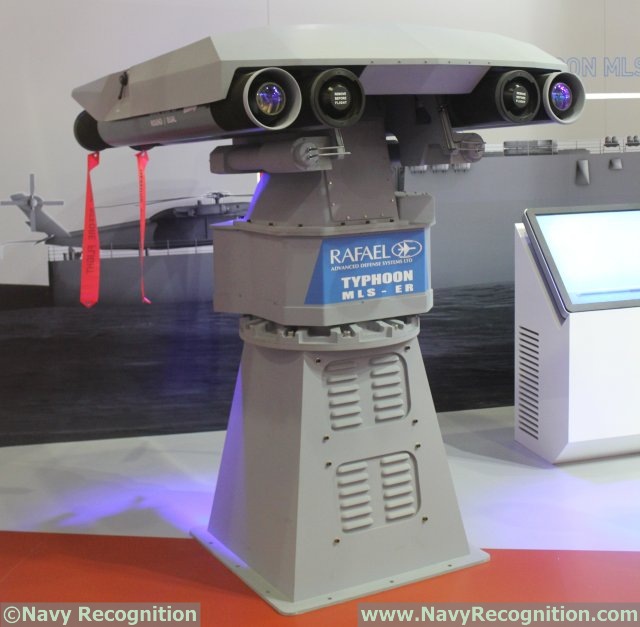
1 x Rafael Typhoon MLS-ER missile launcher for 4 x Spike ER surface-to-surface missiles, a weapon similar to Hellfire/JAGM (on at least four of the Acero class)
2 × M2HB Browning 12.7 mm/50-cal. heavy machine guns mounted on Rafael Mini Typhoon remote-controlled weapon stations
2 × M60 7.62 mm/30-cal. GP machine guns
What we might do differently:
The Shaldag Mk. V is certainly not the only possible solution for a true Fast Response Cutter, but its speed and equipment does represent some but not all the capabilities that should be incorporated in an FRC.
The Shaldag Mk. V has a capability against Unmanned Air Systems (UAS) and small, fast, highly maneuverable surface threats. As threat vessel increase in size their effectiveness diminishes substantially. They don’t need to sink large ships, but they do at least need to be able to immobilize them to keep terrorists from reaching their objective and to allow time for a DOD response.
The Shaldag’s boat handling facilities appear more difficult to use than those on the 87 foot cutters. We could do better, and it is likely we would need better boat handling equipment for day-to-day SAR missions.
The Missiles used on the Shaldag Mk. V are not used by the US Navy or Marine Corps, but comparable weapons–Hellfire, JAGM, or APKWS–could be used instead.
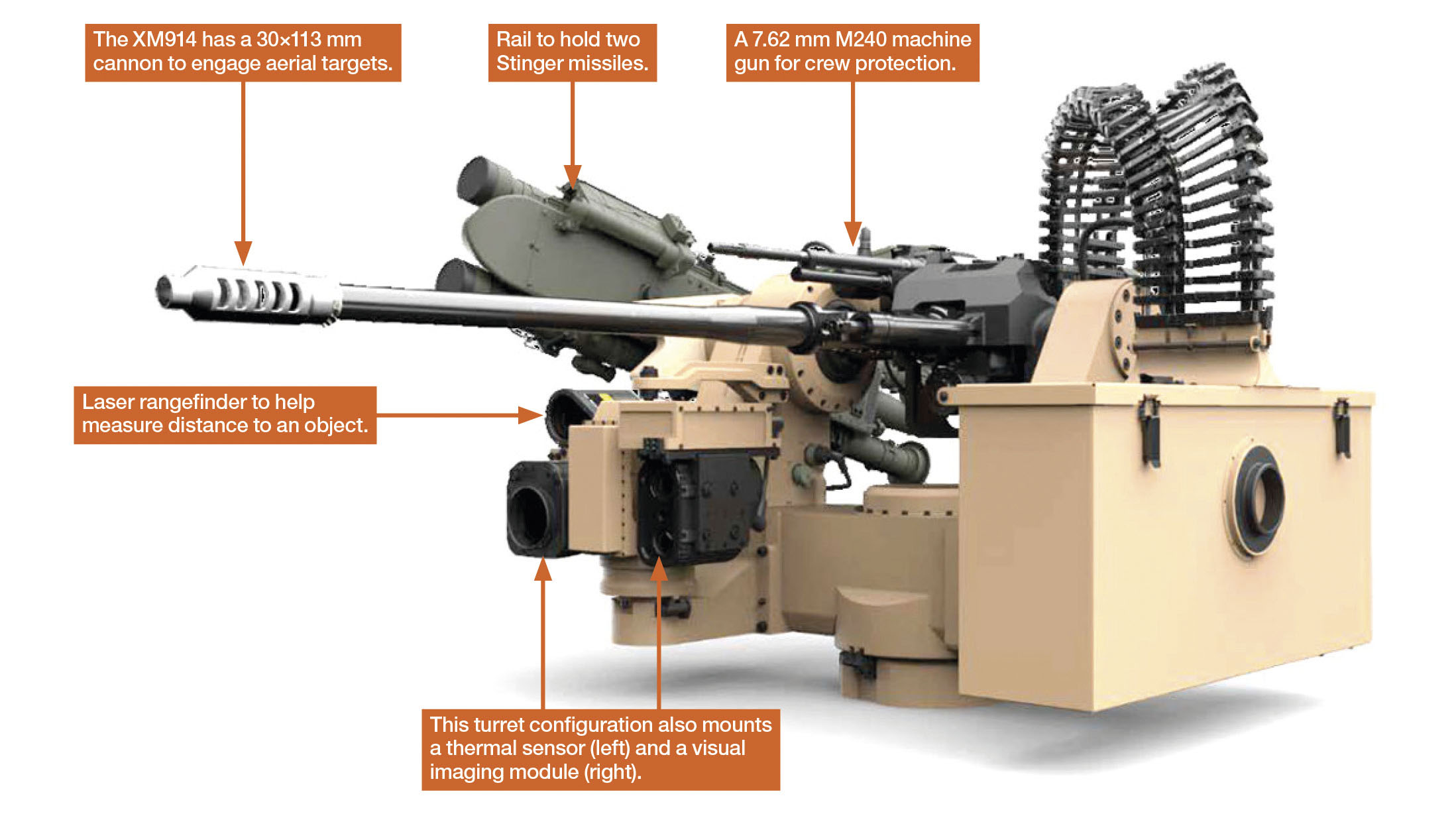
The 30mm Mk38 Mod4 would replace the Israeli 30mm Typhoon gun mount.
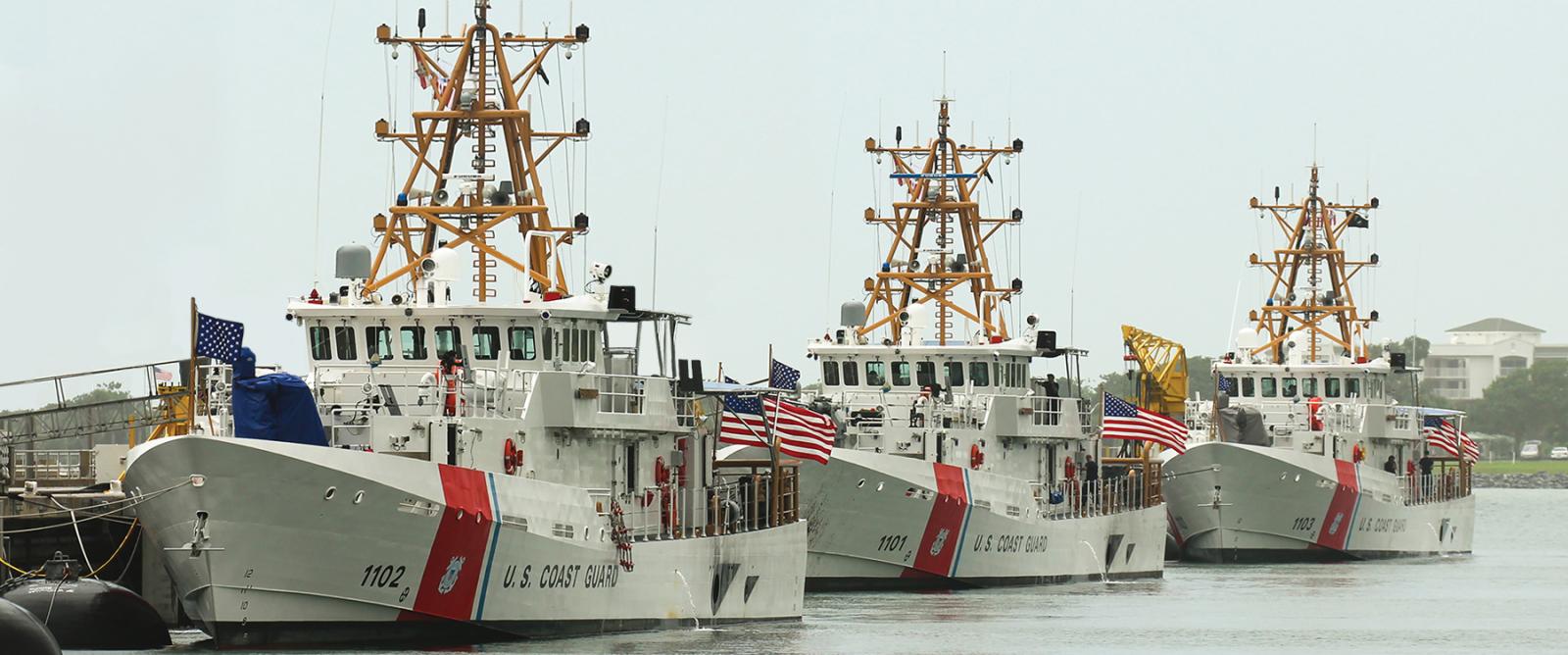
Sister ships. The first three fast response cutters—the USCGC Richard Etheridge (WPC-1102), Bernard C. Webber (WPC-1101), and William Flores (WPC-1103). U.S. COAST GUARD
Below is a news release from District 1. This is #54 with 11 more in the pipeline. The last will probably arrive in 2026 unless more are added.
Oct. 16, 2023
CORRECTED MEDIA AVAILABILITY: Fifth New England-based Fast Response Cutter to be commissioned in New Castle
Editors’ Note: This correction notes updated time for the ceremony and arrival, as well as ship information. Media interested in attending the ship’s commissioning ceremony are requested to RSVP with d1publicaffairs@uscg.mil no later than 4 p.m. Wednesday, October 18th. Media are requested to arrive by 8:30 a.m. to clear security and be escorted to the event, and must provide media credentials and government-issued photo ID.
WHO: Lt. Jacklyn Kokomoor, commanding officer of Coast Guard Cutter William Sparling (WPC-1154), Caroline S. Sparling, the cutter’s sponsor, along with additional Sparling family members
WHAT: Commissioning ceremony for the Coast Guard Cutter William Sparling
WHEN: Thursday, October 19th, at 9 a.m.
WHERE: 25 Wentworth Rd New Castle, NH 03854
BOSTON — The Coast Guard Cutter William Sparling (WPC-1154) is scheduled to be commissioned during a ceremony Thursday at 9 a.m.
The Coast Guard’s newest cutter was accepted by the Coast Guard on July 20, 2023 and will be the fifth of six Fast Response Cutters homeported in Boston.
The Sentinel-class fast response cutter (FRC) is designed for multiple missions, including drug and migrant interdiction; ports, waterways and coastal security; fishery patrols; search and rescue; and national defense. The Coast Guard has ordered a total of 65 FRCs to replace the 1980s-era Island-class 110-foot patrol boats. The FRCs feature advanced command, control, communications, computers, intelligence, surveillance and reconnaissance equipment; over-the-horizon cutter boat deployment to reach vessels of interest; and improved habitability and seakeeping.
William Sparling was one of the first Coast Guard enlisted members to be awarded the Silver Star Medal, one of the nation’s highest military awards for valor in combat. Sparling served as a landing craft coxswain during the Battle of Tulagi, a strategically important island in the Pacific theater, during World War II. The island was captured by enemy forces in May 1942, and Allied forces were concerned that the occupation of Tulagi would be used to threaten Allied units and supply routes in the region. Allied forces arrived at Tulagi on August 7, 1942, to reestablish control of the island.
The amphibious assault, supported by the landing craft piloted by Sparling and other coxswains, was the first U.S. offensive of World War II and was one of the first in a series of battles that defined the Guadalcanal campaign. During the invasion, Sparling and other coxswains landed the first wave of U.S. Marines from USS McKean on the beaches of Tulagi. Over the next three days of fighting, Sparling and others made repeated trips between the Navy destroyer and Tulagi to deliver equipment, ammunition and other supplies to Marines as they engaged a determined occupying force of 800 troops. On August 9, the remaining enemy forces surrendered, and the Allies successfully secured Tulagi.
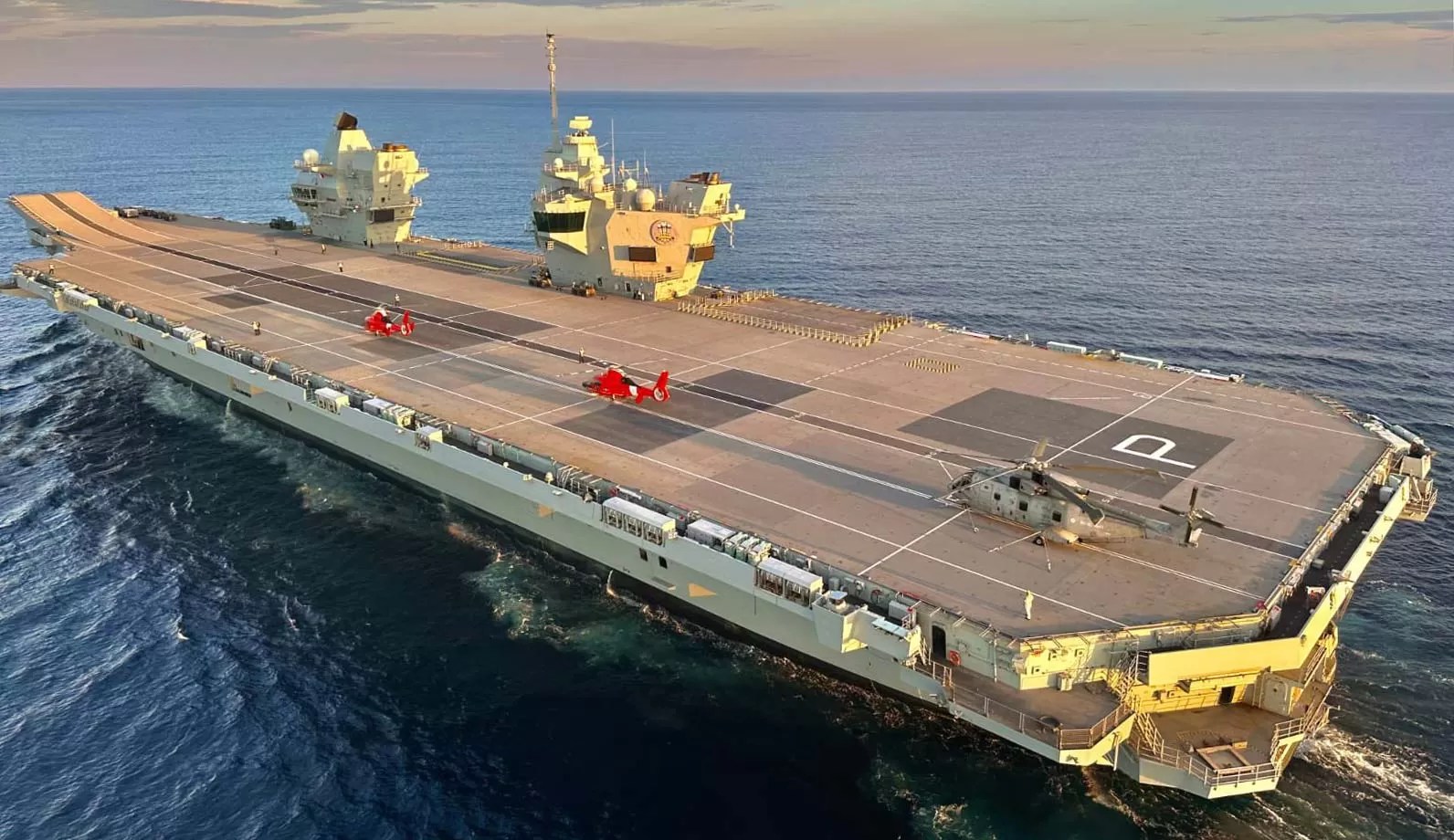
MH-65E Dolphin helicopter helicopters embarked on 25th September 2023 off the coast of Florida – the first time US Coast Guard aircraft had landed on HMS Prince of Wales. The group were led by Lt Cdr Fleming, RN on exchange with the USCG’s Helicopter Interdiction Squadron (HITRON) based in Miami which usually operate from USCG cutters, tracking and stopping go-fasts smuggling narcotics. Royal Navy photo.
The Dauphin (The USCG call them Dolphins) are the same type of aircraft used by FOST teams under contract with Bristow helicopters. Royal Navy Photo.
Three US Coast Guard Dolphins conduct night flying from the carrier. Royal Navy photo.
Thanks to David for bringing this to my attention.
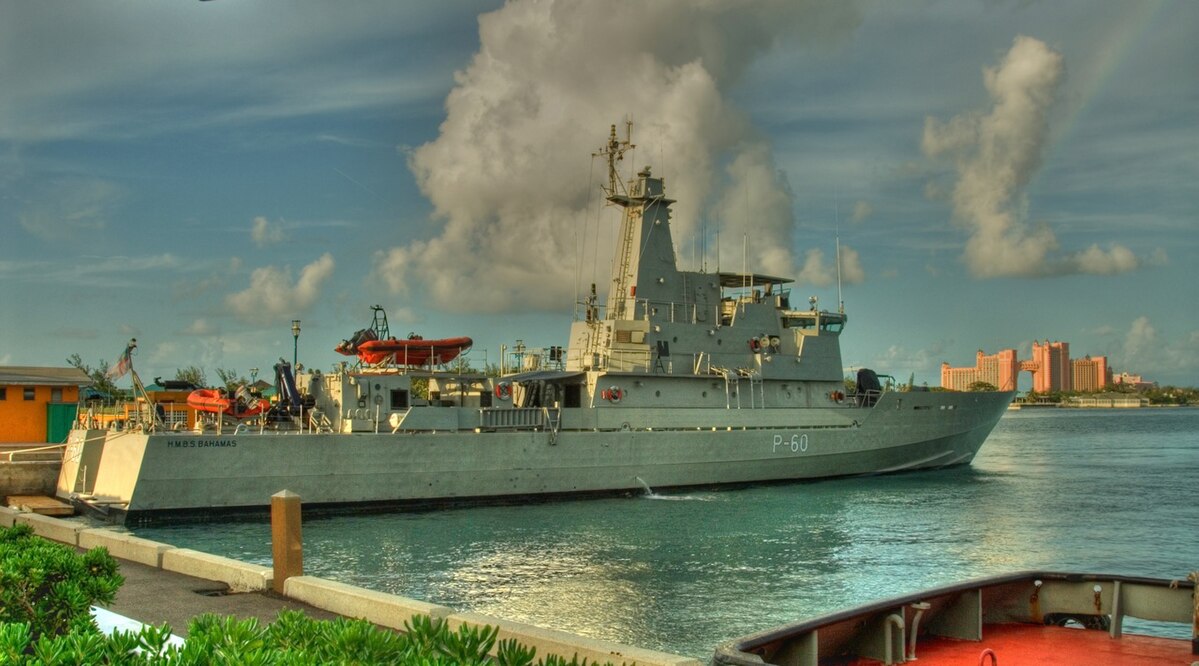
“The Royal Bahamas Defence Force (RBDF), operating jointly with the U.S. Coast Guard and Turks and Caicos Islands personnel, intercepted a ship with 145 Haitian migrants on August 13, 2023.”
What I found surprising here was this,
“The interdiction was the second since the Bahamas and the Turks and Caicos, a British Overseas Territory, signed a ship rider agreement in 2022. The pact allows law enforcement officials from one country to conduct operations on board the vessels of another for specific law enforcement purposes, according to an RBDF Facebook post.”
The Coast Guard, off course, has lots of these bilateral agreements, but this is the first I have heard about where the USCG was not one of the parties. Perhaps the model is spreading to other partnerships.







 Chuck Hill's CG Blog