China unveils vision for ‘Polar Silk Road’ across Arctic–Reuters

Chinese icebreaking research vessel Xue Long (Snow Dragon), Photo by Bahnfrend

Reuters has an interesting short article about China’s interest in the Arctic. Initially this will probably be primarily concerned with shipment of Russian LNG, but it appears we can expect other activities as well, including fishing. Certainly we should expect more traffic through the Bering Strait, bringing with it the possibility of SAR and Marine Environment Protection incidents.

“The white paper said China also eyes development of oil, gas, mineral resources and other non-fossil energies, fishing and tourism in the region. It said it would do so “jointly with Arctic States, while respecting traditions and cultures of the Arctic residents including the indigenous peoples and conserving natural environment”. “

Video–“Coast Guard Readiness: How Far Can We Stretch Our Nation’s Only Multi-Mission, Military Force?”

Above is the video of the Senate Subcommittee hearing for which I provided the Commandant’s prepared remarks earlier.

Participating Senators I noted were:

  • Dan Sullivan, Sub-Committee chair (R, Alaska)(Lt.Col., US Marine Corps Reserve)
  • Gary Peters, ranking member (D, Michigan)(LCdr. US Navy Reserve, Supply Corps)
  • Bill Nelson, ranking member of the Commerce Committee (D, Florida)(Capt. US Army Reserve)(NASA Scuttle payload specialist)
  • Roger Wicker, Chairman of the Seapower sub-committee (R, Mississippi)(Lt.Col. ret. USAF reserve)
  • Richard Blumenthal (D, Connecticut) (USMC Reserve 1970 to 1976 discharges as Sargent)
  • Brian Schatz (D, Hawaii)
  • Ed Markey (D, Mass.) (Spec4, US Army Reserve, 1968-73)
  • Jim Inhofe (R, Oklahoma) (Spec4, US Army, 1956-1958)
  • Maria Cantwell (D, Washington)

You can also check out the original post from the Senate Committee on Commerce, Science, and Transportation. (Same video is available there, but the meeting does not actually start on that version of the video until minute 36.) There you can also find the written statements of the other three witness who constituted the second panel. The Commandant was the sole witness on the first panel.

This was something of a love fest for the Coast Guard with repeated praise for the people and actions of the Coast Guard.

This hearing was reputedly about how the Coast Guard had been impacted by the unusually severe Hurricane season. There is not a lot new here but there were some interesting remarks.

Polar Icebreaker Contracts

The intention is to Contract for the first Icebreaker and then employ block buy for the next two (28m). To me this seems to negate most of the advantage of a block buy. I don’t believe we will or should buy one and then wait until we have tried it out before contracting for the next two. That would necessitate a delay of at least five years during which we would still have the nightmare scenario of our only heavy icebreaker having no rescue if it should break down in the ice–certainly not an impossibility even with a new ship. If we are going to contract for the remaining two before testing the first, we might as well block buy all three.

First of class is always the most expensive. If the shipyard gets a block buy they know that initial improvements in productivity can be amortized over the entire block buy quantity. In some cases, in order to win the whole project, the shipyard will cut the price of the first ship substantially knowing they will make a profit over the entire project.

If we buy one and then block buy the second and third, we have paid for improvements to the winning yard with the first contract and minimized the chances for a competitive bid for numbers two and three.

Legislation has capped DOD participation in icebreaker procurement, so the bulk of icebreaker procurement costs will come out of the Coast Guard budget.

Authorization

There was a lot of discussion about the need to have the Coast Guard Authorization Bill signed into law, still not approved. You can see it here.

Other topics

There was a discussion of the high cost of the Coast Guard response to the recent series of Hurricanes.

Representative Sullivan spent a lot of time, discussing and advocating for an eleven mile road from King Cove  (population estimate–989) to Cold Bay, Alaska (population estimate–122) which has an all-weather airport with two runways, one 10,180 feet and one 6285 feet in length. The Coast Guard connection is that the road would minimize or eliminate the necessity for the Coast Guard to Medivac emergencies from King Cove by helicopter, which is frequently hazardous. It is a Federal issue, because the road would run through a Federal reserve. The Commandant fully supported the desirability of completing the proposed single lane gravel road as a means of minimizing the requirement for helicopter medivac.

Video Breakdown

28m Domestic icebreakers–Design work on new domestic icebreakers is expected to start in 2030. That sounds a bit late to me. Mackinaw was commissioned in 2006 so if that is what he is really talking about, that makes sense, but the 140 foot icebreaking tugs are a different story. The first for of these will be 51 years old in 2030. More than  half of them have already completed in-service which was expected to add 15 years to their service life. Morro Bay, at least, is expected to reach the end of her service life in 2030, and considering how long it takes us to build a ship we really need to start the process not later than 2025.

45m Western Pacific Fisheries Protection–They have not seen much risk of Illegal, Unregulated, or Unreported fishing. 

51m Inland River Tenders

56m We may need to replace the 52 ft MLBs with something larger than the 47 foot MLB sometime in the future, but their end of life is not yet apparent

58m Coast Guard Museum in New London

60m Sexual Assault in the CG

1h02m Puerto Rico/Virgin Islands continuing commitment and its effects on drug seizures and alien migrant interdiction.

1h05m Vessel homeporting

1h08 CG center of expertise, particularly in regard to clean up spills in ice and fresh water

1h16m Army Corp of Engineers dredging backlog.

1h17m  Second Panel begins.

1h19m Medivac from King Cove

1h31m Mr Smithson regarding Deepwater Horizon experience, unified approach, investment in mitigation.


Drilling for Oil in Alaskan Arctic Resumes

© National Geographic Stock/ James P. Blair /WWF (Note, this may or may not be the facility in question–Chuck)

MarineLink reports that

“Italian oil producer Eni this week began drilling a new well in U.S. waters off the north coast of Alaska, becoming the first company to do so since 2015, federal regulators said on Wednesday.
“The oil and gas firm is working from an artificial island in the Beaufort Sea about three miles off Oliktok Point in the Arctic Ocean…The project could result in 20,000 barrels a day of oil production…”
 –
This should add urgency to research into dealing with oil spills in the ice covered water. Perhaps also more justification for revitalizing the icebreaker fleet.

Coast Guard Cutter Maple begins historic voyage through Northwest Passage

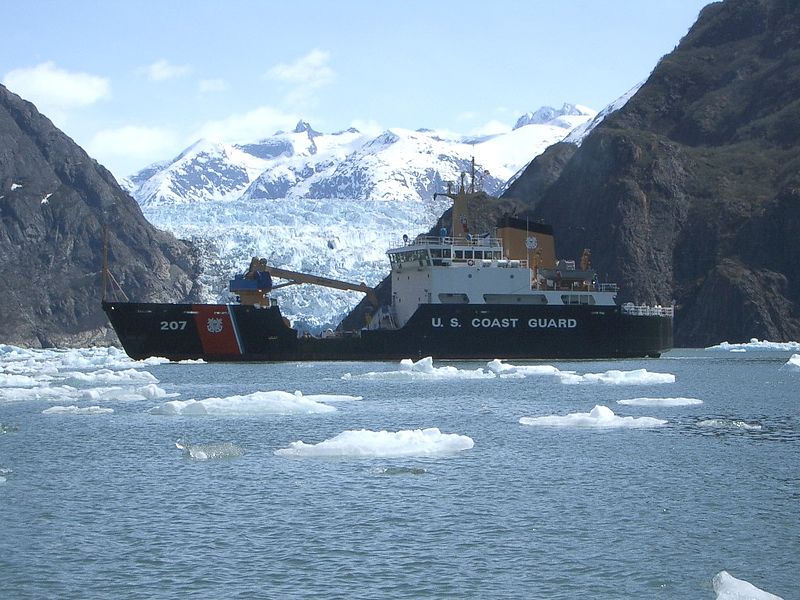
Photo: Maple in front of the LeConte Glacier

The following is a Coast Guard news release. USCGC Maple will be using the NorthWest Passage to transit to the Coast Guard Yard for its In Service Sustainment mid-life renovation, and will be doing some scientific research along the wah

ANCHORAGE, Alaska — The crew of the Coast Guard Cutter Maple, a 225-foot seagoing buoy tender homeported in Sitka, Alaska, departed Wednesday on a historic voyage through the Northwest Passage.

This summer marks the 60th anniversary of the three Coast Guard cutters and one Canadian ship that convoyed through the Northwest Passage. The crews of the U.S. Coast Guard Cutters Storis, SPAR and Bramble, along with the crew of the Canadian ice breaker HMCS Labrador, charted, recorded water depths and installed aids to navigation for future shipping lanes from May to September of 1957. All four crews became the first deep-draft ships to sail through the Northwest Passage, which are several passageways through the complex archipelago of the Canadian Arctic.

The crew of the cutter Maple will make a brief logistics stop in Nome, Alaska, to embark an ice navigator on its way to support marine science and scientific research near the Arctic Circle. The cutter will serve as a ship of opportunity to conduct scientific research in support of the Scripps Institution of Oceanography.

The Maple crew will deploy three sonographic buoys that are used to record acoustic sounds of marine mammals. A principal investigator with the University of San Diego embarked aboard the cutter will analyze the data retrieved from the buoys.

The Canadian Coast Guard Ship Sir Wilfrid Laurier will rendezvous with the Maple later this month to provide icebreaking services as the Maple makes it way toward Victoria Strait, Canada. The Maple has a reinforced hull that provides it with limited ice breaking capabilities similar to Coast Guard 225-foot cutters operating on the Great Lakes.

“We’re very excited to make this voyage through the Northwest Passage and to assist in the Scripps Institute research,” said Lt. Cmdr. Patrick Armstrong, commanding officer of the Maple. “In planning this, we have worked very closely with our Canadian counterparts and we look forward to continuing that cooperation in the Arctic.”

All scientific research, icebreaking and marine science activities that occur during the voyage will be conducted in accordance with the 1988 Canada-US Agreement on Arctic Cooperation.

The Maple crew is expected to conclude their historic voyage in Baltimore, Maryland, during late August. The cutter will undergo scheduled maintenance in dry dock at the Coast Guard Yard in Baltimore for repairs and upgrades. The crew will return to Sitka to take command of the 225-foot Coast Guard Cutter Kukui, which was previously homeported in Honolulu.

Building a 21st Century Infrastructure for America: Coast Guard Sea, Land, and Air Capabilities–House Subcommittee Hearing


The hearing recorded above was held 7 June. The original video was found here. That page also provides the chairman’s opening statement and links to the witnesses’ written statements that are also provided immediately below. The video does not actually start until time 4:30.

Below, you will find my outline of the highlights.

Witness List:

  • Vice Admiral Charles W. Ray, Deputy Commandant for Operations, United States Coast Guard | Written Testimony
  • Vice Admiral Sandra L. Stosz, Deputy Commandant for Mission Support, United States Coast Guard | Written Testimony Ms. Marie A. Mak, Director, Acquisition Sourcing & Management Team, Government Accountability Office | Written Testimony
  • Mr. John Acton, Chairman, Coast Guard Affairs Committee, Navy League of the United States | Written Testimony

The GAO’s written testimony is particularly comprehensive. They report that new assets (NSCs and FRCs) are not meeting planned availability. There have been an unexpected number of engine replacements. In the case of the National Security cutters it appears to me the down time was predictable, a normal part of introducing new ships and availability should return to planned levels as more ships join the fleet. The known defect, that when operating in waters 74 degrees or warmer, the NSCs cannot maintain maximum speed has apparently not been corrected. Max speed must be reduced two to four knots to allow adequate cooling.

Planning Documents:  The Congressional Representatives repeatedly complained that they were not getting an unsensored statement of the Coast Guard’s needs. It appears the Coast Guard is not being allowed provide this information. Rather it appears the GAO is telling the Coast Guard how much they will be getting and told to submit a budget that fits the predetermined amounts. Reportedly the Unfunded priorities list will be provided by the end of June. They also asked for the 5 year and 20 year plan (1h04:30). Coast Guard representatives were repeatedly told the Coast Guard does not say what they really need, that information provided by the Coast Guard is inadequate for the sub-committee to make decisions (1h48m).

It appears that the GAO continues to ask the Coast Guard to plan procurements based on historically low AC&I appropriations that were adequate for a time because of the sporadic character of Coast Guard ship building. They acknowledge that the current budget is not realistic. (43:45)

The Coast Guard is now consistent in requesting $2B in the AC&I annually and a 5% annual increase in its operating budget and that we need 5,000 additional active duty billets and 1,100 addtional reservists. There was a statement from one of the Representatives to the effect, We need you to fight for yourselves (1h50:30). The representatives were informed that the 5 year, 20 year plans and unfunded will be delivered together (1:56)

My opinion: we need a regularly revised Fleet Mix Study. That in turn should feed directly into a 30 year ship and aircraft procurement plan

Webber Class WPCs: The Coast Guard is reportedly pushing WPCs operations down as far as the coast of South America. (50:00) This confirms my earlier speculation that these ships would be operated in what had been WMEC roles. Six cutters for CENTCOM The representative confirmed that they had approved procurement of six Webber class requested by CENTCOM. Apparently their approval was in the form of the Coast Guard reauthorization bill which has still not been made law. Adm. Ray stated that these would be in addition to the 58 currently planned (9:30) and it is not clear how or when they would be funded. Adm Stosz indicated it was not certain six Webber class would be the Coast Guard’s choice in how to fill this requirement and the question required more study. (1h11)(1h41m).

Shore Facilities: Reportedly there is a $1.6B shore construction backlog. $700M shore facilities maintenance backlog. Some infrastructure improvements that directly support new operational platforms.are being accomplished under the platform programs (55:00) The representatives asked, why we have asked for only $10M if the total shore facilities backlog is $2.3B?(1h35)

Icebreakers: The possibility of leasing the commercial icebreaker Aiviq is still being considered. (1h27) The owners have offered a plan for Ice trials and the Coast Guard has said it would be interested in observing. (1h29:50)

Great Lakes Icebreaker: Rep. Lewis brought up icebreaker for Great Lakes.Adm Ray says for now we will address with the existing fleet. (1h00:30) Priority is still Polar Ice Breakers.

eLoran: There seems to be considerable interest in eLoran to deal with GPS vulnerabilities. (1:22) The Navy League representative supported the need. The Re-Authorization Bill directs Secretary of Transportation to initiate E-Loran testing. There was a clear anticipation that the Coast Guard would support implementation.

Coast Guard Health Care: Looks like the Coast Guard heath care records system which reverted to paper now may be able to piggy back on the VA’s conversion to the DOD system. (1h25)/(1h32:30) There is currently a major gap in funding for medical care of CG retirees

A Better Armed Coast Guard: Not that the Representatives were specific, but there was a statement, “We want to weaponize you.” (5:55) I think I heard essentially a second time as well. I’m not sure what that means.

Rising Sea Levels: There was concern expressed regarding rising sea level and how they might impact shore facilities (1h12:20)

WMEC Service Life Extension: The Coast Guard was given money several years ago to plan a service life extension program for 270. The Congress has not seen or heard any result and they questioned, why delay? (1:09) See fig. 4 on page 17 of the GAO’s written testimony

Operating Expenses: Replacement ships are costing more.(26:25)(50:55). This is becoming problematic without an increase in operating budget.

Changing the way we buy ships: Included in the Reauthorization Bill are changes in the way the Coast Guard can fund its shipbuilding, putting us on par with the Navy (5:50)

Cyber: Budget includes 70 additional billets. (19:45)  What are we doing for the ports? (1h13:45)

Inland Tender Fleet: Budget includes $!M to investigate alternatives. (52:30) (1h19)

It is remarkable that there seemed to be no sentiment that the Coast Guard budget should be cut, while there was considerable evidence the Representatives believe the Coast Guard is underfunded.

Marines (or Army) Sink Ship with Missiles from Coast Guard Ship–It Could Happen

PACOM wants the services to operate across domains. The Navy already operates aircraft over land, but he also wants the Army, Air Force, and Marine Corp to help control the sea areas. We noted earlier, that it appears the Army may be moving to form something like the old Coast Artillery.

Now the US Naval Institute reports the Army is set to sink a ship during the 2018 RIMPAC exercise, presumably from land. In addition,

“Headquarters Marine Corps and [Marine Corps Forces Pacific] are working to deploy HIMARS (M142 High Mobility Artillery Rocket System) rapidly aboard ships to shoot at other ships.”

Now the Marines will probably do this from a Navy amphibious assault ship, but wouldn’t it be cool if the Army did this from a Coast Guard Cutter. That would really demonstrate cross service cooperation.

It is also something we might want to do operationally from an Icebreaker in the Arctic some day.

Webber Class WPC Bailey Barco Tour

I recently had the opportunity to board the yet to be commissioned Webber Class cutter Bailey Barco (WPC-1122), during a stop, as she made her way from the Gulf coast to her new home port in Ketchikan, Alaska. The Captain, Frank Reed, generously took the time to show me around. She was transporting a lot of spares and other gear to her new homeport, so may appear a bit more cluttered than normal, but everything was securely stowed.

I took some photos. I’m providing the diagram below for reference. Click on it to enlarge.

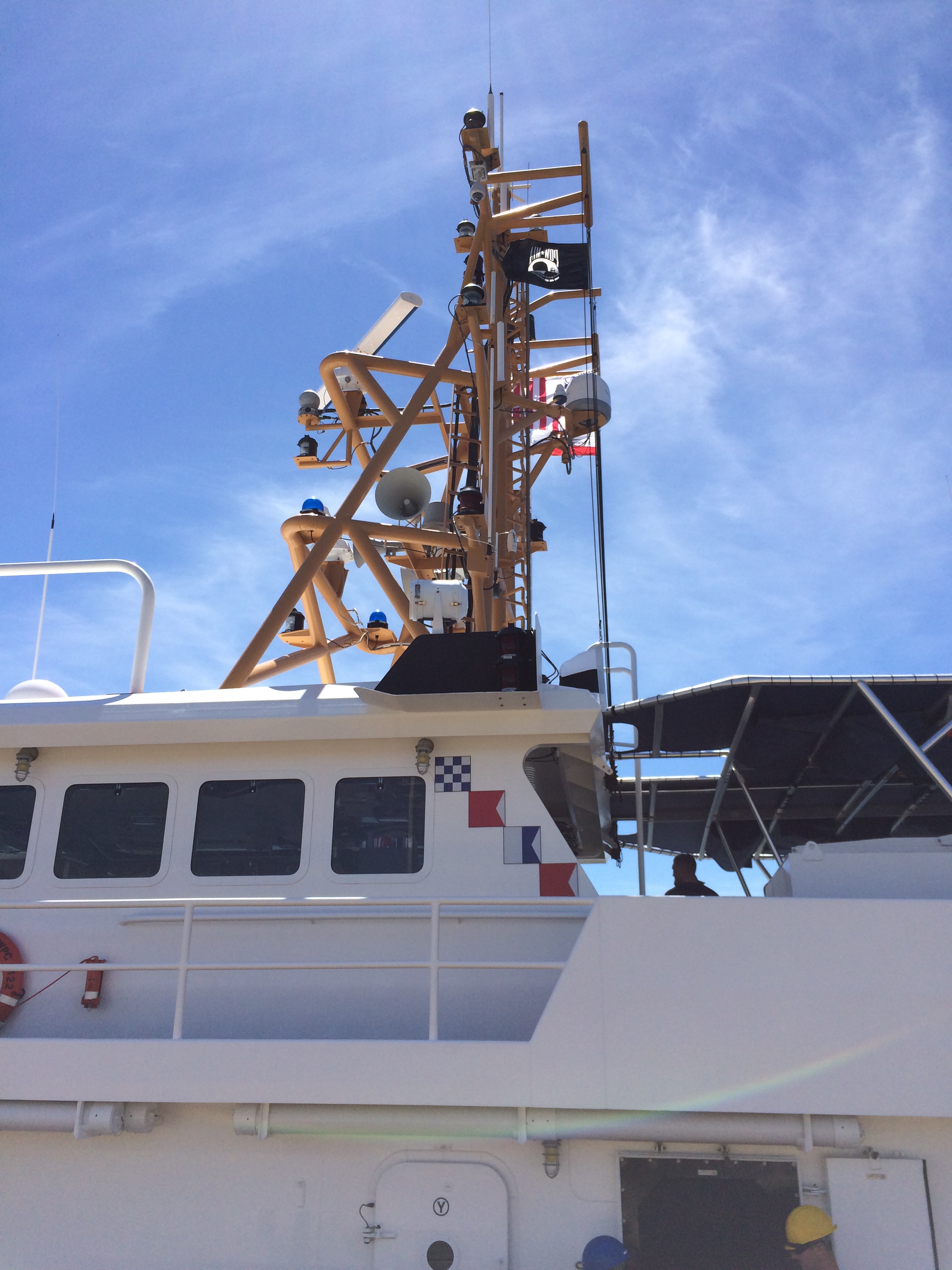
Mast and call sign

Bridge looking forward and a proud CO.

The bridge is large and spacious. Underway it becomes a secure space combining the functions of the CIC, Engineering Control Booth, Radio Room, and Firecontrol Shack in addition to the normal bridge functions. A secure space below passes information up to the bridge.  Normal underway manning is a three person watch.

Bridge displays and controls

Bridge looking aft.

Looking aft from the bridge, the watch can look back at the embarked over the horizon boat and observe as it is launched and recovered.

Ship’s boat.

Why a water tight door? As an XO who spent a lot of time making sure we could properly set Material Condition Zebra, these things are really important and can be a pain in the ass. The CO said earlier cutters of this class had had problems with their doors, but these were an improved version. The action was very positive and quick, requiring only a quarter turn instead of a three quarter turn for full actuation like the Quick Acting Water Tight Doors I was accustomed to.

Quick Acting Water Tight Door

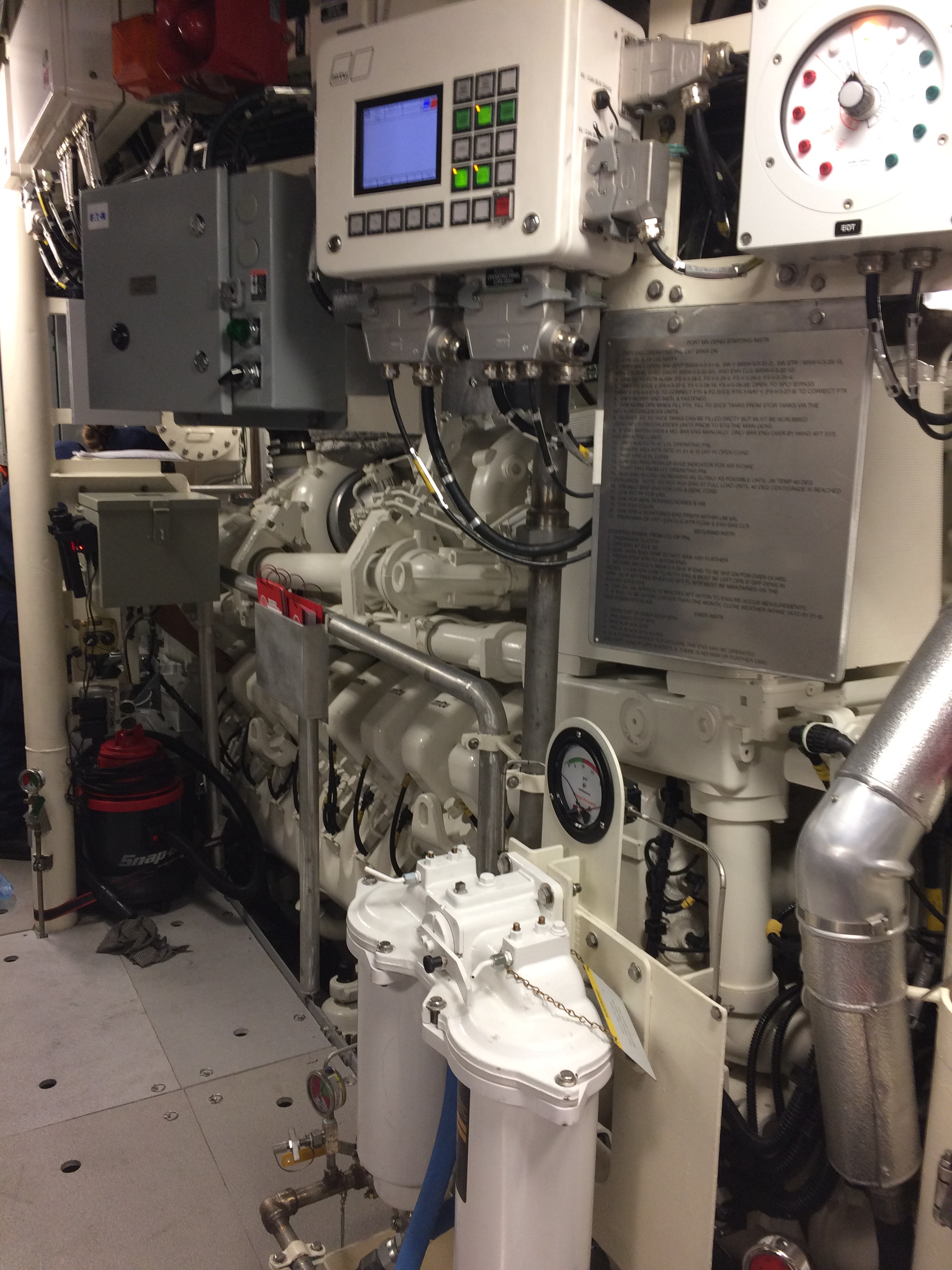
Engine Room amidships looking aft

Engineroom port side looking aft.

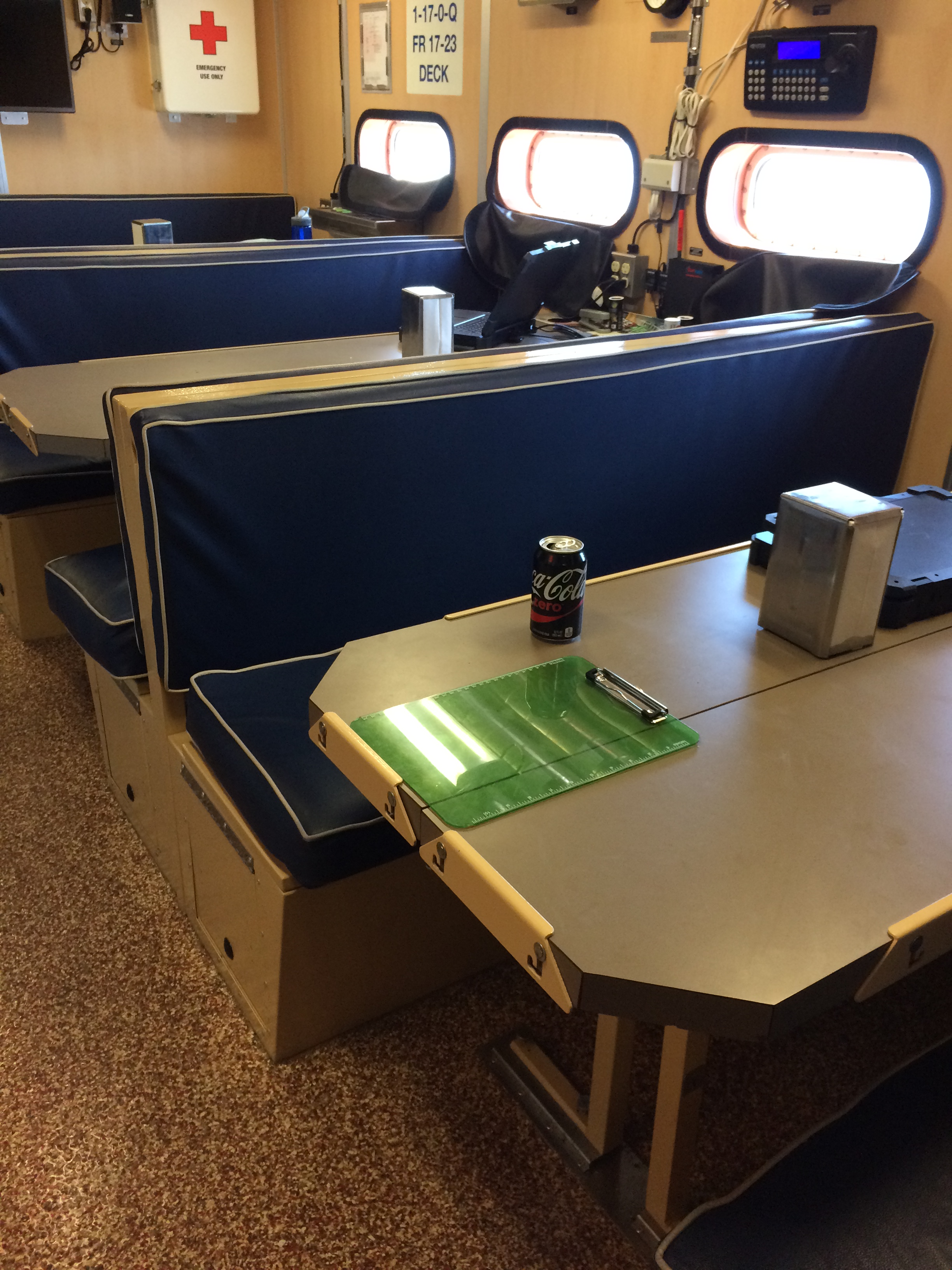
Mess deck

The mess deck (above) is on the main deck and benefitted from natural light. The panels they use to cover the ports are apparently leatherette mounted using velcro. The crew probably thinks of these a way to cut annoying glare, but I see it as a much improved way to darken ship, compared with the way it was done on 378s and 210s. 
I was told the anchor and ground tackle is an improvement over that used on the earlier cutters. It was beautifully chromed.

Weapons Testing: During my visit the gunners mate told me that Bailey Barco had been used as a test platform for a stabilized .50 caliber mount. A number of Navy and Marine in addition to Coast Guard Personnel observed test firing. Apparently it got a bit crowded. I did not confirm this while there, but I suspect this was a stabilized gun platform rather than a remotely controlled weapon. I did an earlier post on one of these. Good to see the Coast Guard doing some weapons testing. If we have to use weapons in a US port we really need a high degree of precision.

Stress Monitoring: The Captain pointed out a device that he said monitored hull stress and that it automatically submitted a report monthly. It is permanently installed. Made me wonder if perhaps some day this might be used real-time as a decision aid in determining how hard the ship can be pushed.

Alex Haley’s Last Sistership

ah2k5


LastStandOnZombieIsland reports USCGC Alex Haley’s last sister ship, the former
USS Beaufort (ATS-2), now the Republic of (South) Korea Navy Ship ROKS Peyongtaek (ATS-27), is to be decommissioned and scrapped.

The blog has a suggestion that might be worth pursuing.

“Maybe the South Koreans will let the USCG go over Peyongtaek for spare parts before they send her to the breakers.”

These ships were built in Britain by Broke Marine. That is very unusual for any US Navy ship. It probably also means finding spares may be more difficult that it would be for a US built ship.

Thanks to MSR for bringing this to my attention. 

United States-Canada Joint Arctic Leaders’ Statement

Below you will find a verbatim press release. The US and Canadian Coast Guards are mentioned prominantly, particularly in regard to the formation of Low impact shipping corridors. Certainly the Coast Guard will enforce the fisheries restrictions as well. 

THE WHITE HOUSE

Office of the Press Secretary

FOR IMMEDIATE RELEASE
December 20, 2016

In March, President Obama and Prime Minister Trudeau announced a new partnership to embrace opportunities and confront challenges in the changing Arctic, with Indigenous and Northern partnerships, and responsible, science-based leadership. Over the past year, both countries have engaged a range of partners and stakeholders, including Indigenous peoples and Northern communities, state, provincial and territorial governments, nongovernmental organizations and businesses. Those consulted have expressed a strong desire for real and long-term opportunities to build strong families, communities, and robust economies. Today, President Obama and Prime Minister Trudeau are proud to launch actions ensuring a strong, sustainable and viable Arctic economy and ecosystem, with low-impact shipping, science based management of marine resources, and free from the future risks of offshore oil and gas activity. Together, these actions set the stage for deeper partnerships with other Arctic nations, including through the Arctic Council.

Science-based approach to oil and gas:

In March, the United States and Canada committed that commercial activities will occur only if the highest safety and environmental standards are met, and if they are consistent with national and global climate and environmental goals. Today – due to the important, irreplaceable values of its Arctic waters for Indigenous, Alaska Native and local communities’ subsistence and cultures, wildlife and wildlife habitat, and scientific research; the vulnerability of these ecosystems to an oil spill; and the unique logistical, operational, safety, and scientific challenges and risks of oil extraction and spill response in Arctic waters – the United States is designating the vast majority of U.S. waters in the Chukchi and Beaufort Seas as indefinitely off limits to offshore oil and gas leasing, and Canada will designate all Arctic Canadian waters as indefinitely off limits to future offshore Arctic oil and gas licensing, to be reviewed every five years through a climate and marine science-based life-cycle assessment.[i]

Supporting strong Arctic communities:

In March, both countries committed to defining new approaches and exchanging best practices to strengthen the resilience of Arctic communities and continuing to support the well-being of Arctic residents, in particular respecting the rights and territory of Indigenous peoples.

Recently, in direct response to requests from Alaska Native communities, President Obama created the Northern Bering Sea Climate Resilience Area protecting the cultural and subsistence resources of over 80 tribes as well as one of the largest seasonal migrations of marine mammals in the world of bowhead and beluga whales, walrus, ice seals, and sea birds. The United States also launched an interagency Economic Development Assessment Team in the Nome region of Alaska to identify future investment opportunities, with other regions to follow. In addition, the Arctic Funders Collaborative (AFC), a group of 11 U.S., Canadian, and international philanthropic foundations, announced the coordination and mobilization of an estimated $27 million in resources for programs across the Arctic over the next three years.

Today, for its part, Canada is committing to co-develop a new Arctic Policy Framework, with Northerners, Territorial and Provincial governments, and First Nations, Inuit, and Métis People that will replace Canada’s Northern Strategy. The Framework will include priority areas identified by the Minister of Indigenous and Northern Affairs’ Special Representative, such as education, infrastructure, and economic development. The Framework will include an Inuit-specific component, created in partnership with Inuit, as Inuit Nunangat comprises over a third of Canada’s land mass and over half of Canada’s coast line, and as Inuit modern treaties govern this jurisdictional space. In parallel, Canada is reducing the reliance of Northern communities on diesel, by deploying energy efficiency and renewable power. Canada will also, with Indigenous and Northern partners, explore how to support and protect the future of the Arctic Ocean’s “last ice area” where summer ice remains each year.

Low impact shipping corridors:

In March, the United States and Canada committed to working together to establish consistent policies for ships operating in the region. Today, both countries are launching the first processes ever to identify sustainable shipping lanes throughout their connected Arctic waters, in collaboration with Northern and Indigenous partners. The U.S. Coast Guard is launching a Port Access Route Study (PARS) in the Beaufort and Chukchi Seas.[ii] Results from this analysis may be used to establish vessel routing measures including traffic separation schemes, recommended routes, Areas To Be Avoided, or other instruments such as fairways where no structures may be erected. The Canadian Coast Guard and Transport Canada is implementing Northern Marine Transportation Corridors, determining what infrastructure and navigational and emergency response services are needed.  Canada is also launching a new program to support training curriculum for Northerners, particularly Indigenous peoples, to join the marine field, as well as programming to support marine infrastructure and safety equipment for communities.

In addition, the U.S. Coast Guard, in consultation with industry, Indigenous communities, and the State of Alaska, has begun a strategy to phase down the use of Heavy Fuel Oil (HFO) in the Arctic. The Canadian Coast Guard is conducting similar outreach and consultations to develop proposals to phase down the use of HFO in 2017. The United States and Canada will each, or jointly, propose a plan for consideration at the International Maritime Organization’s spring 2017 meeting.

Science-based management of Arctic fisheries:

In March, the United States and Canada called for a binding international agreement to prevent the opening of unregulated fisheries in the Central Arctic Ocean and to build on a precautionary, science-based approach to commercial fishing that both countries have put in place in their Arctic waters. Today, the United States commits to supporting and strengthening existing commercial fishing closures in the Beaufort and Chukchi Seas, and to conducting scientific research to improve our understanding of the Arctic. Canada commits to working with Northern and Indigenous communities to build world-leading and abundant Arctic fisheries – based on science – that firstly benefit Northern communities. Together, the United States’ and Canada’s actions will create the largest contiguous area of well-regulated fisheries in the world.

Both countries reaffirm their commitment to a legally binding agreement to prevent unregulated commercial fisheries in the Arctic High Seas until an internationally recognized Regional Fishery Management Organization is in place to provide effective management. Both countries are working towards such an agreement in the coming months.

(Below are apparently footnotes–Chuck)

[i] Taking into account the respective obligations of the United States and Canada under international law to protect and preserve the marine environment, these steps also support the goals of various international frameworks and commitments concerning pollution, including those reflected in the 1990 International Convention on Oil Pollution Preparedness, Response, and Cooperation, the 2013 Agreement on Cooperation on Marine Oil Pollution Preparedness and Response in the Arctic, and the U.S.-Canada Joint Marine Pollution Contingency Plan.  Furthermore, with respect to areas of the Beaufort Sea where the U.S.-Canada maritime boundary has not yet been agreed, these practical arrangements are without prejudice to either side’s position and demonstrate self-restraint, taking into account the principle of making every effort not to jeopardize or hamper reaching a final maritime boundary agreement.

[ii] In conducting this study, and consistent with existing authorities, the Coast Guard will consider traditional knowledge from local communities, the effects of shipping and vessel pollution on the marine environment, marine mammal migratory pathways and other biologically important areas, subsistence whaling, hunting, and fishing, and the needs of maritime safety and commerce.

This came to my attention through the Bryant’s Maritime Consulting Blog.

White House Announces Actions to Protect Natural and Cultural Resources in Alaskan Arctic Ocean

The following from Bryant’s Maritime Consulting,

President Obama issued an Executive Order regarding Northern Bering Sea climate resilience. It provides that federal agencies regulating, overseeing, or conducting activities in the region coordinate those activities and do so with attention to the rights, needs, and knowledge of Alaska Native tribes, the delicate and unique ecosystem, the protection of marine mammals, fish, seabirds, and other wildlife, and with appropriate coordination with the State of Alaska. A Fact Sheet accompanies the Order. (12/9/16) [https://www.whitehouse.gov/the-press-office/2016/12/09/executive-order-northern-bering-sea-climate-resilience]. Note: Curiously, neither the US Coast Guard nor the Department of Homeland Security is named as members of the Bering Task Force even though shipping routing measures and reduction of pollution from vessels are mentioned as topics for consideration.

Mentioned or not. The Coast Guard certainly will have a role as we always have.