How much would it cost to weaponize a cutter?

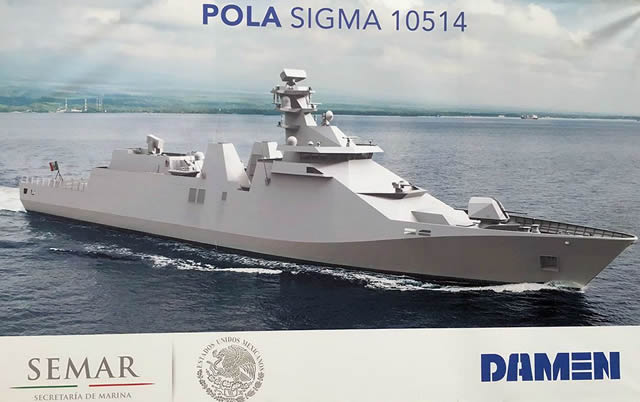
Photo: Sigma 10514 in Mexican Navy configuration, fitted with a BAE Systems Bofors 57Mk3 57mm main guna 12.7mm remote weapon system right behind it. The Mexican Navy opted for the Smart Mk2 radar by Thales. The Mexican “Long Range Patrol Vessel” will not be fitted with VLS cells but a Raytheon RAM launcher will be fitted on top of the helicopter hangar.

How much would it cost to turn one of our new construction cutters into a minimally capable frigate with at least some capability for anti-submarine, anti-surface, and self defense anti-air warfare?

I don’t have a definitive answer but we did get a good indication along with more information about Mexico’s new long range patrol vessel, a Damen 10514 design, that is close enough to our own Offshore Patrol Cutter requirements, that I thought it might have been an OPC contender.

Earlier we had an indication regarding the addition of VLS and  Evolved Sea Sparrow Missiles (ESSM) when Chile ordered $140.1M worth of equipment to arm three ships. Plus we had an earlier post based on a 2009 Congressional Budget Office study (apparently no longer available on line) that suggested costs to replace the Phalanx on NSCs with SeaRAM and to add 12 Mk56 VLS and associated equipment, which could have provided up to 24 ESSM ($68M/ship).

The Defense Security Cooperation Agency has issued a news release concerning the sale of weapons for the new Mexican patrol vessel, and the shopping list is a pretty extensive, including anti-surface, anti-air, and anti-submarine weapons.

Mexico –Harpoon Block II Missiles, RAM Missiles and MK 54 Torpedoes

Media/Public Contact: pm-cpa@state.gov
Transmittal No: 17-63

­­­WASHINGTON, Jan. 5, 2018 – The State Department has made a determination approving a possible Foreign Military Sale to Mexico of RGM-84L Harpoon Block II surface launched missiles, Block II Rolling Airframe Missile (RAM) tactical missiles and MK 54 Mod 0 lightweight torpedoes for an estimated cost of $98.4 million.  The Defense Security Cooperation Agency delivered the required certification notifying Congress of this possible sale today.

The Government of Mexico has requested to buy six (6) RGM-84L Harpoon Block II surface launched missiles, twenty-three (23) Block II Rolling Airframe Missile (RAM) tactical missiles and six (6) MK 54 Mod 0 lightweight torpedoes.  Also included are eight (8) MK 825 Mod 0 RAM Guided Missile Round Packs (GMRP) tri-pack shipping and storage containers; RAM Block 2 MK 44 Mod 4 Guided Missile Round Pack (GMRP); two (2) MK 32 Surface Vessel Torpedo Tubes (SVTT) triple tube launchers; two hundred and fifty (250) rounds of AA98 25 mm high explosive and semi-armor piercing ammunition; seven hundred and fifty (750) rounds A976 25mm target practice and tracer ammunition; four hundred and eighty (480) rounds of BA22 57mm high explosive programmable fuze ammunition; nine hundred and sixty (960) rounds of BA23 57mm practice ammunition; containers; spare and repair parts; support and test equipment; publications and technical documentation; personnel training and training equipment; U.S. Government and contractor representatives’ technical assistance; engineering and logistics support services; installation services; associated electronics and hardware to control the launch of torpedoes; and other related elements of logistics and program support.  The estimated cost is $98.4 million.

This proposed sale will support the foreign policy and national security of the United States by helping to improve the security of a strategic partner.  Mexico has been a strong partner in combating organized crime and drug trafficking organizations.  The sale of these ship-based systems to Mexico will significantly increase and strengthen its maritime capabilities.  Mexico intends to use these defense articles and services to modernize its armed forces and expand its existing naval and maritime support of national security requirements and in its efforts to combat criminal organizations.

Mexico intends to use the weapon systems on its Mexican Navy Sigma 10514 Class ship.  The systems will provide enhanced capabilities in effective defense of critical sea lanes.  The proposed sale of these systems and support will increase the Mexican Navy’s maritime partnership potential and align its capabilities with existing regional navies.  Mexico has not purchased these systems previously.  Mexico will have no difficulty absorbing this equipment into its armed forces.

The proposed sale of this equipment will not alter the basic military balance in the region.

The equipment will be provided from U.S. stocks.  There are no known offset agreements proposed in connection with this potential sale.

Implementation of this proposed sale will require annual trips to Mexico involving U.S. Government personnel and contractor representatives for technical reviews, support, and oversight for approximately two years.

There will be no adverse impact on U.S. defense readiness as a result of this proposed sale.

This notice of a potential sale is required by law and does not mean the sale has been concluded.

All questions regarding this proposed Foreign Military Sale should be directed to the State Department’s Bureau of Political Military Affairs, Office of Congressional and Public Affairs, pm-cpa@state.gov.

The big ticket items certainly made the head lines, but the ammunition for the 57mm is not cheap.

Fortunately for the Coast Guard, the Navy generally pays for our ammunition and weapon systems. The cost to the Coast Guard is installation and integration, plus primarily long term personnel and training costs.

Video–“Coast Guard Readiness: How Far Can We Stretch Our Nation’s Only Multi-Mission, Military Force?”

Above is the video of the Senate Subcommittee hearing for which I provided the Commandant’s prepared remarks earlier.

Participating Senators I noted were:

  • Dan Sullivan, Sub-Committee chair (R, Alaska)(Lt.Col., US Marine Corps Reserve)
  • Gary Peters, ranking member (D, Michigan)(LCdr. US Navy Reserve, Supply Corps)
  • Bill Nelson, ranking member of the Commerce Committee (D, Florida)(Capt. US Army Reserve)(NASA Scuttle payload specialist)
  • Roger Wicker, Chairman of the Seapower sub-committee (R, Mississippi)(Lt.Col. ret. USAF reserve)
  • Richard Blumenthal (D, Connecticut) (USMC Reserve 1970 to 1976 discharges as Sargent)
  • Brian Schatz (D, Hawaii)
  • Ed Markey (D, Mass.) (Spec4, US Army Reserve, 1968-73)
  • Jim Inhofe (R, Oklahoma) (Spec4, US Army, 1956-1958)
  • Maria Cantwell (D, Washington)

You can also check out the original post from the Senate Committee on Commerce, Science, and Transportation. (Same video is available there, but the meeting does not actually start on that version of the video until minute 36.) There you can also find the written statements of the other three witness who constituted the second panel. The Commandant was the sole witness on the first panel.

This was something of a love fest for the Coast Guard with repeated praise for the people and actions of the Coast Guard.

This hearing was reputedly about how the Coast Guard had been impacted by the unusually severe Hurricane season. There is not a lot new here but there were some interesting remarks.

Polar Icebreaker Contracts

The intention is to Contract for the first Icebreaker and then employ block buy for the next two (28m). To me this seems to negate most of the advantage of a block buy. I don’t believe we will or should buy one and then wait until we have tried it out before contracting for the next two. That would necessitate a delay of at least five years during which we would still have the nightmare scenario of our only heavy icebreaker having no rescue if it should break down in the ice–certainly not an impossibility even with a new ship. If we are going to contract for the remaining two before testing the first, we might as well block buy all three.

First of class is always the most expensive. If the shipyard gets a block buy they know that initial improvements in productivity can be amortized over the entire block buy quantity. In some cases, in order to win the whole project, the shipyard will cut the price of the first ship substantially knowing they will make a profit over the entire project.

If we buy one and then block buy the second and third, we have paid for improvements to the winning yard with the first contract and minimized the chances for a competitive bid for numbers two and three.

Legislation has capped DOD participation in icebreaker procurement, so the bulk of icebreaker procurement costs will come out of the Coast Guard budget.

Authorization

There was a lot of discussion about the need to have the Coast Guard Authorization Bill signed into law, still not approved. You can see it here.

Other topics

There was a discussion of the high cost of the Coast Guard response to the recent series of Hurricanes.

Representative Sullivan spent a lot of time, discussing and advocating for an eleven mile road from King Cove  (population estimate–989) to Cold Bay, Alaska (population estimate–122) which has an all-weather airport with two runways, one 10,180 feet and one 6285 feet in length. The Coast Guard connection is that the road would minimize or eliminate the necessity for the Coast Guard to Medivac emergencies from King Cove by helicopter, which is frequently hazardous. It is a Federal issue, because the road would run through a Federal reserve. The Commandant fully supported the desirability of completing the proposed single lane gravel road as a means of minimizing the requirement for helicopter medivac.

Video Breakdown

28m Domestic icebreakers–Design work on new domestic icebreakers is expected to start in 2030. That sounds a bit late to me. Mackinaw was commissioned in 2006 so if that is what he is really talking about, that makes sense, but the 140 foot icebreaking tugs are a different story. The first for of these will be 51 years old in 2030. More than  half of them have already completed in-service which was expected to add 15 years to their service life. Morro Bay, at least, is expected to reach the end of her service life in 2030, and considering how long it takes us to build a ship we really need to start the process not later than 2025.

45m Western Pacific Fisheries Protection–They have not seen much risk of Illegal, Unregulated, or Unreported fishing. 

51m Inland River Tenders

56m We may need to replace the 52 ft MLBs with something larger than the 47 foot MLB sometime in the future, but their end of life is not yet apparent

58m Coast Guard Museum in New London

60m Sexual Assault in the CG

1h02m Puerto Rico/Virgin Islands continuing commitment and its effects on drug seizures and alien migrant interdiction.

1h05m Vessel homeporting

1h08 CG center of expertise, particularly in regard to clean up spills in ice and fresh water

1h16m Army Corp of Engineers dredging backlog.

1h17m  Second Panel begins.

1h19m Medivac from King Cove

1h31m Mr Smithson regarding Deepwater Horizon experience, unified approach, investment in mitigation.


Coast Guard Cutter Procurement: Background and Issues for Congress–Nov. 30, 2017

OPC “Placemat”

The Congressional Research Service has issued an updated report on Coast Guard Cutter procurement by Specialist in Naval Affair, Ronald O’Rourke. It is available in pdf format here or you can read it on the US Naval Institute site here.

Quoting from the Report,

Summary

The Coast Guard’s acquisition program of record (POR) calls for procuring 8 National Security Cutters (NSCs), 25 Offshore Patrol Cutters (OPCs), and 58 Fast Response Cutters (FRCs) as replacements for 90 aging Coast Guard cutters and patrol craft. The Coast Guard’s proposed FY2018 budget requests a total of $794 million in acquisition funding for the NSC, OPC, and FRC programs.

NSCs are the Coast Guard’s largest and most capable general-purpose cutters. They have an estimated average procurement cost of about $695 million per ship. The first six are now in service (the sixth was commissioned into service on April 1, 2017). The seventh, eighth, and ninth are under construction; the seventh and eighth are scheduled for delivery in 2018 and 2019, respectively. As part of its action on the Coast Guard’s FY2017 budget, Congress provided $95 million for procurement of long lead time materials (LLTM) for a 10th NSC. The Coast Guard’s proposed FY2018 budget requests $54 million in acquisition funding for the NSC program; this request does not include additional funding for a 10th NSC.

OPCs are to be smaller, less expensive, and in some respects less capable than NSCs. They have an estimated average procurement cost of about $421 million per ship. The first OPC is to be funded in FY2018 and delivered in 2021. On September 15, 2016, the Coast Guard announced that it was awarding a contract with options for building up to nine ships in the class to Eastern Shipbuilding Group of Panama City, FL. The Coast Guard’s proposed FY2018 budget requests $500 million in acquisition funding for the OCP program for the construction of the first OPC, procurement of LLTM for the second OPC, and certain other program costs.

FRCs are considerably smaller and less expensive than OPCs. They have an estimated average procurement cost of about $65 million per boat. A total of 44 have been funded through FY2017. The 24 th was commissioned into service on October 31, 2017. The Coast Guard’s proposed FY2018 budget requests $240 million in acquisition funding for the procurement of four more FRCs.The NSC, OPC, and FRC programs pose several issues for Congress, including the following:

  • whether to fully or partially fund the acquisition of a 10th NSC in FY2018;

  • whether to fund the acquisition of four FRCs in FY2018, as requested, or some other number, such as six, which is the maximum number that has been acquired in some prior fiscal years;

  • whether to use annual or multiyear contracting for procuring FRCs;

  • whether to use annual or multiyear contracting for procuring OPCs;

  • the procurement rate for the OPC program;

  • planned procurement quantities for NSCs, OPCS, and FRCs;

  • the cost, design, and acquisition strategy for the OPC; and

  • initial testing of the NSC.

Congress’s decisions on these programs could substantially affect Coast Guard capabilities and funding requirements, and the U.S. shipbuilding industrial base.

“Coast Guard Readiness: How Far Can We Stretch Our Nation’s Only Multi-Mission, Military Force?”–Senate Testimony

Coast Guard Commandant Adm. Paul Zukunft at the Senate Committee on Commerce, Science, and Transportation. U.S. Coast Guard photo by Petty Officer 1st Class Patrick Kelley.

Below is the Commandant’s written testimony for the Senate Committee on Commerce, Science and Transportation, subcommittee on Oceans, Atmosphere, Fisheries, and Coast Guard hearing titled, “Coast Guard Readiness: How Far Can We Stretch Our Nation’s Only Multi-Mission, Military Force?”

Release Date:
November 16, 2017

253 Russell Senate Office Building

Good morning Mr. Chairman and distinguished members of the Committee. I appreciate the opportunity to testify today and thank you for your enduring support of the United States Coast Guard.

As the world’s premier, multi-mission, maritime service, the Coast Guard offers a unique and enduring value to the nation. The only branch of the U.S. Armed Forces within the Department of Homeland Security (DHS), a federal law enforcement agency, a regulatory body, a first responder, and a member of the U.S. Intelligence Community – the Coast Guard is uniquely positioned to help secure the maritime border, combat transnational criminal organizations (TCO), and safeguard commerce on America’s waterways.

The Coast Guard’s combination of broad authorities and complementary capabilities squarely align with the President’s national security and economic prosperity priorities and offer an agile toolset to address the Nation’s most pressing challenges. Appropriately positioned in DHS, the Coast Guard is a military service and a branch of the Armed Forces of the United States at all times.[1] We are also an important part of the modern Joint Force[2] and currently have forces assigned to each of the five Geographic Combatant Commanders as well as Cyber Command.

As demonstrated in the 2017 record hurricane activity, the Coast Guard is the nation’s “maritime first responder” and plays a leading role in executing the National Response Framework (NRF) for disaster situations. Our bias for action and ability to rapidly surge resources in response to emerging threats or contingencies distinguishes the Coast Guard and are critical to success across the spectrum of missions we prosecute.


1 14 U.S.C. § 1; 10 U.S.C. § 101
2 In addition to the Coast Guard’s status as an Armed Force (10 U.S.C. § 101), see also Memorandum of Agreement Between the Department of Defense and the Department of Homeland Security on the Use of Coast Guard Capabilities and Resources in Support of the National Military Strategy, 02 May 2008, as amended 18 May 2010.

Agile Force

The Coast Guard’s 88,000 active duty, reserve, civil service and auxiliary members offer a unique mix of authorities and extensive experience operating with both military and interagency response organizations. Beyond our statutory search and rescue requirements, which traditionally result in an average of 3,600 lives saved each year, the Coast Guard supports the Federal Emergency Management Agency (FEMA) and states during nationally declared disasters by:

  1. Saving lives in distress, and ensuring the survivability of our own forces and assets for immediate post-disaster response operations;
  2. Securing and reconstituting ports, waterways, and critical maritime infrastructure;
  3. Conducting environmental response operations (oil, chemical and hazardous material); and
  4. Supporting other agencies and the whole-of-government response effort.

Coast Guard personnel are well trained and experienced in response operations, which make them a sound choice to serve in visible positions in the NRF structure. This ability to operate concurrently in both military Joint Task Force and civilian NRF frameworks enhances unity of effort and dramatically improves effectiveness.

As an armed force, the Coast Guard can be a supported or supporting commander, and our forces are frequently integrated with Department of Defense (DoD) services in Joint Task Force organizations. We regularly provide forces in support of DoD exercises, Combatant Commander contingency plans, and theater security cooperation activities, all of which enable Coast Guard and DoD forces to integrate seamlessly during response operations.

Saving lives in distress is our first priority, and Coast Guard crews are typically the first federal responders on-scene. As a storm approaches, Coast Guard personnel make risk-based decisions to reposition assets and people to safe locations just outside of the storm’s path, ultimately facilitating rapid response as soon as it is safe to do so. Brave men and women on the front lines make it happen, invoking a deeply ingrained bias for action to repeatedly go into harm’s way and serve others.

In addition to conducting SAR operations, the Coast Guard surges forces and assets into the impacted regions to restore the $4.6 trillion maritime transportation system, respond to pollution, provide security and additional law enforcement capability, and protect offshore petrochemical platforms.

Critical Success Factors

The Coast Guard employs a decentralized command and control structure and distributed decision-making to provide operational commanders with the authority to move forces quickly to respond to large contingencies.

Our two Area Commanders, and their nine subordinate District Commanders, shift and reallocate forces from one region to another based on risk and the anticipated demand for operational capabilities. Well-reasoned and regularly exercised Continuity of Operations Plans preserve operational effectiveness while offering safe refuge for displaced operational commanders.

Coast Guard cutters, aircraft, and boats are built to respond to a variety of missions without the need for any reconfiguration or the addition of special equipment. During the recent hurricanes, cutters conducting counter-drug patrols in the Transit Zone quickly diverted to disaster areas to provide command and control, deliver rotary wing air capability from the sea, provide forward staging facilities, and deliver critical relief commodities – particularly in the U.S. Virgin Islands and Commonwealth of Puerto Rico.

Coast Guard aircraft that normally perform law enforcement surveillance to thwart transnational maritime criminal activities were dynamically repositioned and re-tasked to deliver disaster relief supplies, additional responders, and equipment to affected areas.

Additionally, Coast Guard forces were and are on station at key locations around the nation, most of them on short-notice recall, so they can respond quickly to emergent events. When a major catastrophe occurs, or is anticipated, we can reposition forces quickly to that area to optimize the response.

Over a five week period, Hurricanes HARVEY, IRMA, MARIA, and NATE impacted over 2,540 miles of shoreline[3], and Coast Guard women and men in helicopters, boats, cutters, vehicles and on foot rescued over 11,300 people and over 1,500 pets. Mere hours before Hurricane HARVEY made landfall, Coast Guard helicopter crews rescued mariners in peril[4] off the coast of Corpus Christi, Texas before repositioning to Alice, Texas.

The Coast Guard resolved over 1,269 aids to navigation discrepancies, handled 290 pollution cases, located and assessed more than 3,623 grounded vessels, with more than 1,585 removed to date. Within hours after each storm’s passage, Coast Guard Damage and Recovery Assessment Teams were on-scene determining the status of ports and waterways, leveraging electronic aids to navigation when feasible to facilitate the rapid reopening of the maritime transportation system and energy sectors vital to recovery, and assessing impacts to Coast Guard facilities and capabilities.


3 Using CRS method of Shoreline Measurement: Texas: 367 mi, Louisiana: 397 mi, Florida: 1,350 mi, Puerto Rico: 311 mi, USVI: 117 mi
4 Two MH-65’s from Sector/Air Station Corpus Christi saved 12 lives off a vessel taking on water in 45 knot sustained/60 knot gusting winds.

Enduring Challenges

Operational successes introduced real costs. Damage to Coast Guard facilities, IT, aids to navigation, and the cost of deferred maintenance are significant. Similar to any prolonged natural disaster or security event, responding to consecutive major hurricanes severely strained capacity and required us to assume additional risk in other geographic regions and mission areas. Across the recent disaster response operations, more than 3,000 Coast Guard women and men, and 200 assets or platforms deployed from places as far away as Alaska, Hawaii and Maine.

As a result, the rest of the Coast Guard assumed additional risk, and units were significantly challenged to sustain maintenance and training standards while diminishing future readiness. The Medium Endurance Cutter MOHAWK, already aged and well beyond its designed service life, deferred major maintenance in order to get underway and avoid Irma. Cutter FORWARD diverted from a counter-drug patrol to provide supplies and critical command and control services after all three major hurricanes.

Given the heavy demand for aviation services following each storm, training at Aviation Training Center Mobile was suspended, creating a backlog in the pilot training pipeline at a time when we are facing a critical aviator shortage. Maintaining a full-time SAR response posture at our air stations requires at least three aircraft, yet many of our units that contributed assets to hurricane operations were forced to get by with just one. Forces available for counter-drug, fisheries enforcement, and migrant interdiction operations in the Eastern Pacific Ocean, Caribbean Sea, and Florida Straits were significantly reduced as well. In total, risk-based choices to maximize hurricane response operations stretched our existing resources to their limits.

The size of the Service also limits our capacity to respond to prolonged and sequential events. While the Coast Guard is well-positioned for immediate and effective first response, our “bench strength” makes it impossible to sustain these operations for an extended period of time. In addition, many of our heroic first responders suffered life-changing personal loss as well. Approximately 700 Coast Guard families’ homes were damaged to the point where they will need to be relocated.

Conclusion

The Coast Guard’s unique blend of authorities, capabilities, capacities, and partnerships position us well for success during maritime SAR events and natural disasters. Flexible, multi-mission forces and agile command and control systems provide the solid foundation from which we base these critical response operations.

When the Coast Guard has the opportunity to recapitalize our facilities, we need to make them more storm-resilient and survivable. In fact, several of our shore facilities that were rebuilt following Hurricane IKE suffered minimal damage along the paths of HARVEY and IRMA, a testament to modern building codes and standards.

Modern assets bring exceptional capability, but our greatest strength will always be our people. Coast Guard operations require a capable, proficient, and resilient workforce that draws upon the broad range of skills, talents, and experiences found in the American population. Together, modern platforms and a strong, resilient workforce will maximize the Coast Guard’s capacity to meet future challenges.

History has proven that a responsive, capable, and agile Coast Guard is an indispensable instrument of national security. With the continued support of the Administration and Congress, the Coast Guard will continue to live up to our motto. We will be Semper Paratus – Always Ready. Thank you for the opportunity to testify before you today and for all you do for the men and women of the Coast Guard. I look forward to your questions.

USCGC Polar SeaThe US Naval Institute reports the Coast Guard has issued a draft Request for Proposals for a new Heavy Icebreaker with options for two more.

Certainly good news to see the process moving along, but it is also important to remember what it is not.

It is only a draft. “Responses to the draft RFP are due Dec. 11, and the Coast Guard and Navy will release a final RFP early next year, to support a Fiscal Year 2019 contract award.”

Like all of our contracts so far, there is no apparent consideration of a block buy that would lock Congress into funding the entire program–three ships in this case. Perhaps an astute shipbuilder will include that in their ultimate response, in case the Congress wants to commit for all three.

Unfortunately I can’t comment on the draft because of its limited distribution. Hopefully because,

“…Polar icebreakers enable the U.S. to maintain defense readiness in the Arctic and Antarctic regions; enforce treaties and other laws needed to safeguard both industry and the environment; provide ports, waterways and coastal security; and provide logistical support – including vessel escort – to facilitate the movement of goods and personnel necessary to support scientific research, commerce, national security activities and maritime safety.”

They will be provided with the means to be upgraded to allow them to exercise both self-defense and a modicum of offensive capability.


U.S. Coast Guard: Priorities for the Future–CSIS/USNI

The video above records an recent event, a “Maritime Security dialogue” presented by the Center for Strategic and International Studies (CSIS) and the United States Naval Institute (USNI) featuring Admiral Paul F. Zukunft, Commandant of the U.S. Coast Guard, for a discussion on the “U.S. Coast Guard’s future priorities.”

Despite the title, don’t expect a recitation of Coast Guard priorities. Most of the material is familiar, but there were a few interesting comments, including some that might be surprising. A number of things the Commandant said here made news.

  • That the NSCs could be made into frigates.
  • That the Polar Icebreaker would cost less than $1B
  • His support of transgender CG personnel.

I’ll give a quick outline of what was talked about. At the end I will rant a bit about some of my pet peeves.

The Commandant’s prepared statement is relatively short beginning at time 2m45s and ending about 11m.

6m00 In our listing of missions, the Commandant said Defense Operations should be listed first. He noted that there are 20 ships chopped to Combatant Commanders including eleven  ships operating under SOUTHCOM.

Q&A begins at 11:00.

16m20s The Commandant noted there is a Chinese ship rider on a USCG cutter off Japan and that Coast Guard aircraft are flying out of Japan.

17m30s Boarder protection/drug interdiction

20m Called the OPCs “light frigates”

22m As for priorities the Commandant noted a need to invest in ISR and Cyber

23m Cyber threat.

24m Expect return to sea duty because of length of training.

26m30s “Demise of the cutterman”/Human Capital Plan–fewer moves–removed the stigma of geographic stability

29m25s Highest percentage of retention of all services–40% of enlisted and 50% of officers will still be in the service after 20 years

30m Law of the Sea. Extended continental shelf in the Arctic.

32m30s Need for presence in the Arctic.

36m ISR, 38m15s Firescout. An interesting side note was that the Commandant seemed to quash any possibility of using the MQ-8 Firescout. He noted when they deployed on a cutter 20 people came with the system.  He called it unoccupied but not unmanned.

40m Icebreakers

43m30s Comments on transgender members

45m15s Icebreakers–will drive the price down below $1B.

47m NSC as frigate–no conversations with the Navy about this. Performance of Hamilton.

49m50s Count the NSCs toward the 355 ship Navy.

50m30s Illegal migration and virulent infectious disease

53m35s CG training teams in the Philippines and Vietnam to provide competency to operate platforms to be provided by Japan. Two patrol boats going to Costa Rica. Other efforts to build capacity.

56m DHS is the right place for the CG.

The Commandant touched on a couple of my pet peeves, specifically

  • He called the OPCs “Light Frigates,” so why aren’t they designated that way? WMSM and WMSL are just wrong in too many ways.  Give our ships a designation our partners and politicians can understand. A WLB is a cutter and also a buoy tender. The OPC can be both a cutter and a light frigate. I have suggested WPF. Maybe WFF for the Bertholfs and WFL for the Offshore Patrol Cutters. If we want to be thought of as a military service, we need to start using designations that will be seen and understood as military.
  • He mentioned the possibility of including the Bertholfs in the 355 ship fleet total. Coast Guard combatants should be included when the country counts its fleet. No, the cutters are not aircraft carriers or destroyers, but the current fleet of about 275 ships includes about 70 ships that have no weapons larger than a .50 cal. These include eleven MCM ships and about 60 ships manned by civilian crews such as tugs, high speed transports, salvage ships, underway replenishment ships, and surveillance ships. Counting the Cutters as part of the National Fleet would raise  our profile as a military service. The Navy might not like it, but it does give a better idea of our actually available assets for wartime, which is the point of such a listing.


Coast Guard Sea, Land, and Air Capabilities, Part II, 25 July, 2017

The House Subcommittee on Coast Guard and Maritime Transportation hearing recorded above is a follow-on to one already discussed. The video does not actually begin until minute 10:40. It is basically done in two parts as indicated below.

Panel I

Panel II

  • Rear Admiral Michael J. Haycock, Assistant Commandant for Acquisition and Chief Acquisition Officer, United States Coast Guard | Written Testimony
  • Ms. Marie A. Mak, Director of Acquisition and Sourcing Management, Government Accountability Office | Written Testimony
  • Rear Admiral Richard D. West (Navy Ret.), Chair, Committee on Polar Icebreaker Assessment, National Academy of Sciences | Written Testimony
  • Mr. Ronald O’Rourke, Specialist in Naval Affairs, Congressional Research Service | Written Testimony

Elsewhere the Coast Guard reported on the Commandant’s testimony, but what we really need to listen to is what the Congressional Sub-Committee members are telling us. They seem to love and respect the Coast Guard (you may have noticed Congress keeps giving us more than we ask for), but they are not pleased with the planning documents they are getting from the Coast Guard. I would particularly recommend you watch the opening comments of Representatives Hunter (10:40 to 13:30), Garamendi (to 17:00), and DeFazio (to 21:20). It will probably make you mad. You should be mad. We have to identify the problem and fix it.

If you want only a taste, here is a short version: 

So what is discussed?:

  • 27:00 Great Lakes icebreakers, line item for design of a Great Lakes Icebreaker is being budgeted but no plan for buying one.
  • 29:30 Five Year plan “reflects Fiscal guidance.” That is, we are being told, we have to fit our budget request into predetermined ceilings, so it is less than we really need.
  • 35:00 We are asking DOD to fund six FRCs CENTCOM has requested to replace the 110s currently assigned.
  • 37:00 Graph comparing AC&I funding as requested, authorized, and funded.
  • 39:00 Twenty year plan which was due to Congress at the end of June has not been submitted to Department.
  • 44:00 DOD does not see icebreakers as a National Defense resource. Navy will not pay for the first icebreakers.
  • 54:00 Strong support for icebreakers among the representatives.
  • 57:30 Question on icebreaker lease. Ice trials issue still on the table.
  • 1h02:00 Discussion of Cyber.
  • 1h09 Why not a block buy on the first ship?
  • 1h18m Commandant’s testimony ended
  • 1h34m.Particularly watch Ronald O’Rourke’s testimony, he suggests accelerating the OPC program may be an alternative to WMEC life extension program.
  • 1h43m Sub-Committee liked getting the fleet mix study, but that was several years ago.
  • Block Buy Report due in Dec.
  • Expected cost of heavy icebreaker has dropped about $200M.
  • 2h07m again, “no military requirement for an icebreaker.” Representatives feel that question should be studied.
  • 2h15m if we wait a number of years between the first and second WAGB contract results in loss of expertise and additional cost.

The discussion was dominated by three topics,

  • Coast Guard long term planning,
  • block buys for the OPC and Icebreakers,
  • whether we should build three or four heavy icebreakers.

Three or four heavy icebreakers: The proposal to build four heavy icebreakers rather than three came from a study by the National Academies of Sciences, Engineering, and Medicine. It is largely based on the reasonable assumption that heavy icebreaker #4 will cost less than medium icebreaker #1, as a result of the learning curve savings on heavy icebreakers and first of class costs for the medium icebreakers. I have not read the study but they don’t seem to have addressed the question, of the need for a total of six icebreakers found in the high altitude study. Assuming we build four of a single class of icebreakers, should we then start on a new class of two medium icebreakers with its attendant start-up costs or should we go ahead and build six heavies?

Block Buys for OPC and Icebreakers: The Congress has authorized the Coast Guard to use “Block Buy” funding for its shipbuilding programs. The Coast Guard seems hesitant to even ask to do this. In the case of the OPC, it might save us more than $1B. We could have (and I believe should have) asked to use multi-year procurement for the second phase of the Webber class WPC buy, but we did not.

The National Academy of Sciences study recommends we use block buy procurement for four icebreakers. The current contract for the OPCs is a contract for the first with options for eight more to be funded through FY2023. Until the options are executed we have the option of seeking a block buy contract for future construction.

Block buys commit Congress to fully fund all vessels included in a program to the extent of the contract. If they back out there are penalties incurred. From the Coast Guard’s point of view it would seem a commitment from Congress would be a good thing.

Because of that commitment, shipyards are likely more willing to invest in productivity improvements, resulting in lower costs.

The Commandant’s remarks on the Icebreaker seem to indicate we will wait until we finish and evaluate operations of the first new Polar Icebreaker before seeking funding for a second. If that happens not only will we miss the potential savings of the a block buy, we will also lose the experience the shipyard gained building the first. Long delays between the first few NSCs was largely why we did not see a significant price drop after the first ship.

Coast Guard long term planning: Our current program of record is a continuation of the “Deep Water” program which originated in 2002 and updated in 2005 following 9/11. A fleet mix study (apparently completed in 2009) confirmed that the Program of Record, if executed, would be an improvement of the fleet as it existed in 2007, but it also showed that it fell well short of meeting all the Coast Guard’s statutory requirements with many missions at risk. Additionally the fleet mix study assumed 230 days away from homeport for both the NSCs and the OPC using the “Crew Rotation Concept.”

We still have a very long way to go before we can achieve the Program of Record. There has been no meaningful test of the “Crew Rotation Concept” in spite of the fact that virtually every test of rotating multiple crews among multiple ships has proven problematic and has failed to realize the claimed benefits. Aircraft are also not achieving utilization hours planned. The OPCs, if constructed as currently planned, will not be completed until 2034.

In short our planning is out of date and the current planning seems to be limited to answering the question, “What will fit in the predetermined, but inadequate budget?”

If five-year plan is subject to “fiscal guidance” then why would the 20 year plan not also be subject to “fiscal guidance.” If we are to provide a true picture of what we need we need to change what we are doing.

What do we need to do?:

  • We need to know what we need.
  • We need to know the consequences of not getting what we need.
  • We need to be able to communicate both what we need and the consequences of inadequate funding to the Congress and Administration.

As noted in the introduction to the executive summary of the Offshore and Aviation Fleet Mix Analysis.

To support its role as Systems Integrator (SI), the Coast Guard (CG) needs to establish and continually update a strategic plan for the acquisition, operation, and sustainment of capabilities necessary in achieving organizational goals. Key to this strategic plan is a repeatable, comprehensive process that identifies alternative capabilities and Fleet mix solutions that will meet future mission requirements in an efficient, effective, and affordable manner.

This should not be a one time thing. We need to do this regularly as a repetitive process that is improved over time. We also really need to look at alternatives, not just already chosen solutions.

Once we know where we want to go we can come up with a 20 year (or better yet a 30 year) plan, beginning with what are we going to lose.

It might be best if the long-term plan did not include cost figures. Then we don’t have to comply with preconceptions of cost limits. Identify generic platform types with the capabilities we need.

———

Copies of Acquisition and Operation of Polar Icebreakers: Fulfilling the Nation’s Needs are available from the National Academies Press on the Internet at www.nap.edu

2018 Budget Request

The FY 2018 budget request has been published.

There is:

The overview includes “2016 Performance Highlights.” Also included is a page that says what the Coast Guard does on an average day.

On page 12 of the Overview, you can see a comparison of the FY 2018 President’s Budget request compared to the FY 2016 revised enacted and FY 2017 annualized budgets. The FY 2018 request is approximately $440M less than the FY 2017 annualized.  On the other hand this request is $339M more than the FY 2017 Presidential request. I think we can expect some changes before it becomes law.

Building a 21st Century Infrastructure for America: Coast Guard Sea, Land, and Air Capabilities–House Subcommittee Hearing


The hearing recorded above was held 7 June. The original video was found here. That page also provides the chairman’s opening statement and links to the witnesses’ written statements that are also provided immediately below. The video does not actually start until time 4:30.

Below, you will find my outline of the highlights.

Witness List:

  • Vice Admiral Charles W. Ray, Deputy Commandant for Operations, United States Coast Guard | Written Testimony
  • Vice Admiral Sandra L. Stosz, Deputy Commandant for Mission Support, United States Coast Guard | Written Testimony Ms. Marie A. Mak, Director, Acquisition Sourcing & Management Team, Government Accountability Office | Written Testimony
  • Mr. John Acton, Chairman, Coast Guard Affairs Committee, Navy League of the United States | Written Testimony

The GAO’s written testimony is particularly comprehensive. They report that new assets (NSCs and FRCs) are not meeting planned availability. There have been an unexpected number of engine replacements. In the case of the National Security cutters it appears to me the down time was predictable, a normal part of introducing new ships and availability should return to planned levels as more ships join the fleet. The known defect, that when operating in waters 74 degrees or warmer, the NSCs cannot maintain maximum speed has apparently not been corrected. Max speed must be reduced two to four knots to allow adequate cooling.

Planning Documents:  The Congressional Representatives repeatedly complained that they were not getting an unsensored statement of the Coast Guard’s needs. It appears the Coast Guard is not being allowed provide this information. Rather it appears the GAO is telling the Coast Guard how much they will be getting and told to submit a budget that fits the predetermined amounts. Reportedly the Unfunded priorities list will be provided by the end of June. They also asked for the 5 year and 20 year plan (1h04:30). Coast Guard representatives were repeatedly told the Coast Guard does not say what they really need, that information provided by the Coast Guard is inadequate for the sub-committee to make decisions (1h48m).

It appears that the GAO continues to ask the Coast Guard to plan procurements based on historically low AC&I appropriations that were adequate for a time because of the sporadic character of Coast Guard ship building. They acknowledge that the current budget is not realistic. (43:45)

The Coast Guard is now consistent in requesting $2B in the AC&I annually and a 5% annual increase in its operating budget and that we need 5,000 additional active duty billets and 1,100 addtional reservists. There was a statement from one of the Representatives to the effect, We need you to fight for yourselves (1h50:30). The representatives were informed that the 5 year, 20 year plans and unfunded will be delivered together (1:56)

My opinion: we need a regularly revised Fleet Mix Study. That in turn should feed directly into a 30 year ship and aircraft procurement plan

Webber Class WPCs: The Coast Guard is reportedly pushing WPCs operations down as far as the coast of South America. (50:00) This confirms my earlier speculation that these ships would be operated in what had been WMEC roles. Six cutters for CENTCOM The representative confirmed that they had approved procurement of six Webber class requested by CENTCOM. Apparently their approval was in the form of the Coast Guard reauthorization bill which has still not been made law. Adm. Ray stated that these would be in addition to the 58 currently planned (9:30) and it is not clear how or when they would be funded. Adm Stosz indicated it was not certain six Webber class would be the Coast Guard’s choice in how to fill this requirement and the question required more study. (1h11)(1h41m).

Shore Facilities: Reportedly there is a $1.6B shore construction backlog. $700M shore facilities maintenance backlog. Some infrastructure improvements that directly support new operational platforms.are being accomplished under the platform programs (55:00) The representatives asked, why we have asked for only $10M if the total shore facilities backlog is $2.3B?(1h35)

Icebreakers: The possibility of leasing the commercial icebreaker Aiviq is still being considered. (1h27) The owners have offered a plan for Ice trials and the Coast Guard has said it would be interested in observing. (1h29:50)

Great Lakes Icebreaker: Rep. Lewis brought up icebreaker for Great Lakes.Adm Ray says for now we will address with the existing fleet. (1h00:30) Priority is still Polar Ice Breakers.

eLoran: There seems to be considerable interest in eLoran to deal with GPS vulnerabilities. (1:22) The Navy League representative supported the need. The Re-Authorization Bill directs Secretary of Transportation to initiate E-Loran testing. There was a clear anticipation that the Coast Guard would support implementation.

Coast Guard Health Care: Looks like the Coast Guard heath care records system which reverted to paper now may be able to piggy back on the VA’s conversion to the DOD system. (1h25)/(1h32:30) There is currently a major gap in funding for medical care of CG retirees

A Better Armed Coast Guard: Not that the Representatives were specific, but there was a statement, “We want to weaponize you.” (5:55) I think I heard essentially a second time as well. I’m not sure what that means.

Rising Sea Levels: There was concern expressed regarding rising sea level and how they might impact shore facilities (1h12:20)

WMEC Service Life Extension: The Coast Guard was given money several years ago to plan a service life extension program for 270. The Congress has not seen or heard any result and they questioned, why delay? (1:09) See fig. 4 on page 17 of the GAO’s written testimony

Operating Expenses: Replacement ships are costing more.(26:25)(50:55). This is becoming problematic without an increase in operating budget.

Changing the way we buy ships: Included in the Reauthorization Bill are changes in the way the Coast Guard can fund its shipbuilding, putting us on par with the Navy (5:50)

Cyber: Budget includes 70 additional billets. (19:45)  What are we doing for the ports? (1h13:45)

Inland Tender Fleet: Budget includes $!M to investigate alternatives. (52:30) (1h19)

It is remarkable that there seemed to be no sentiment that the Coast Guard budget should be cut, while there was considerable evidence the Representatives believe the Coast Guard is underfunded.