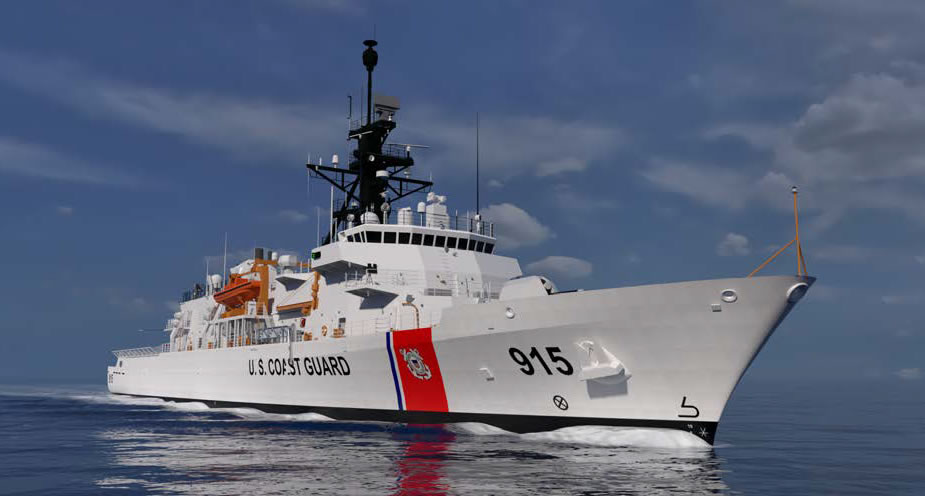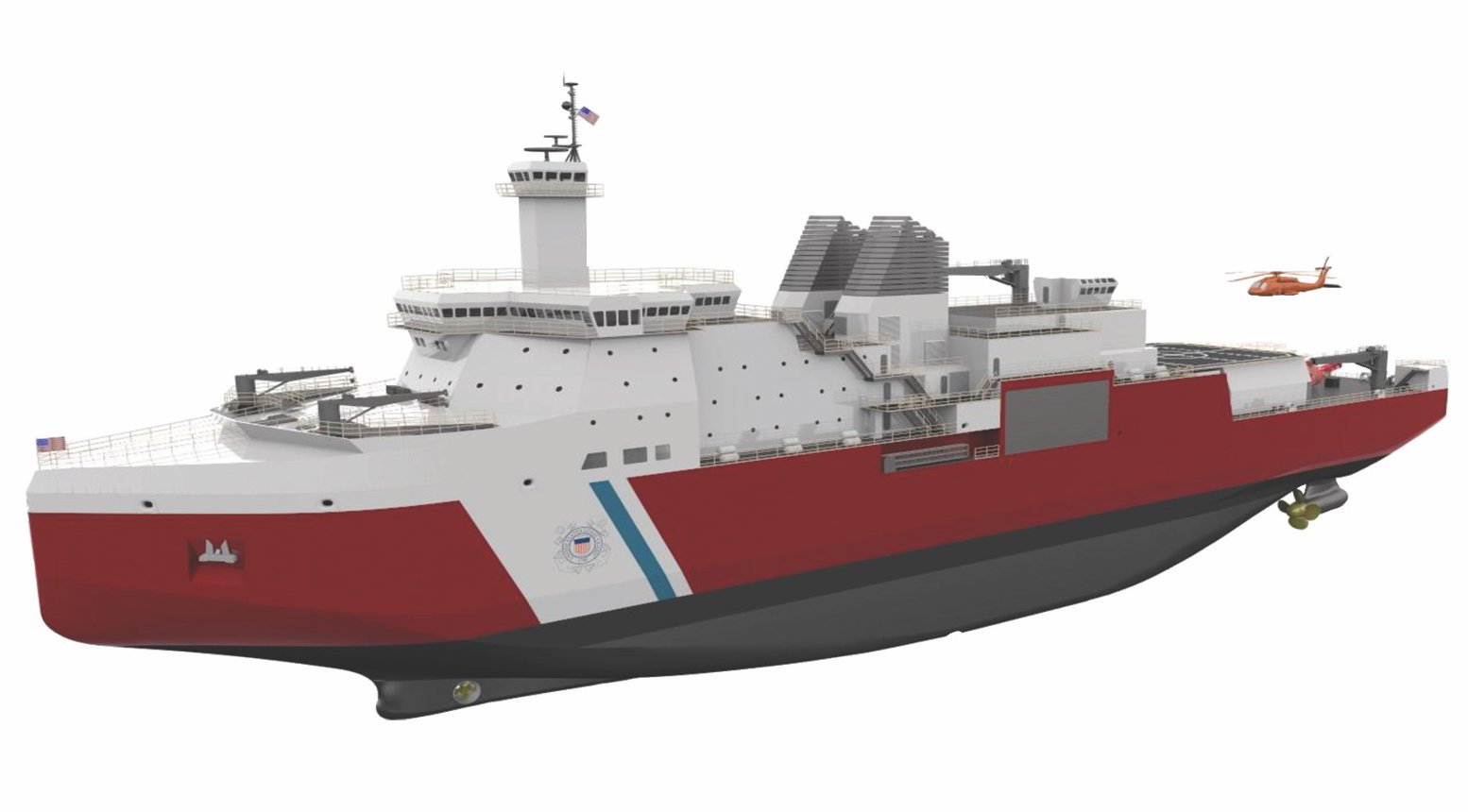
CRS, “Coast Guard Polar Security Cutter (Polar Icebreaker) Program: Background and Issues for Congress Updated November 11, 2020”

Since our last look at this report, there have been four updates. (See the latest version here.)

We now have the Senate Appropriations Committee’s (SAC) views on this part of the FY2021 DHS Appropriations Act. The Senate committee, like its counterpart in the House, has recommended approval of the Administration request for $555M that would fund the second Polar Security Cutter.

I have reproduced the section on Senate Activity (page 25/26) below. Note there is also mention of renovation of the Polar Star and acquisition of a future Great Lakes icebreaker as well:


Senate

The Senate Appropriations Committee, in the explanatory statement for S. XXXX that the committee released on November 10, 2020, recommended the funding level shown in the SAC column of Table 2.

The explanatory statement states (emphasis added):

Full-Funding Policy.—The Committee again directs an exception to the administration’s current acquisition policy that requires the Coast Guard to attain the total acquisition cost for a vessel, including long lead time materials [LLTM], production costs, and postproduction costs, before a production contract can be awarded. This policy has the potential to make shipbuilding less efficient, to force delayed obligation of production funds, and to require post-production funds far in advance of when they will be used. The Department should position itself to acquire vessels in the most efficient manner within the guidelines of strict governance measures. The Committee expects the administration to adopt a similar policy for the acquisition of the Offshore Patrol Cutter [OPC] and heavy polar icebreaker.

Domestic Content.—To the maximum extent practicable, the Coast Guard is directed to
utilize components that are manufactured in the United States when contracting for new
vessels. Such components include: auxiliary equipment, such as pumps for shipboard
services; propulsion equipment, including engines, reduction gears, and propellers;
shipboard cranes; and spreaders for shipboard cranes. (Pages 71-72)

The explanatory statement also states:

Great Lakes Icebreaking Capacity.—The recommendation includes $4,000,000 for preacquisition activities for the Great Lakes Icebreaker Program for a new Great Lakes
icebreaker that is as capable as USCGC MACKINAW. The Coast Guard shall seek
opportunities to accelerate the acquisition and request legislative remedies, if necessary. Further, any requirements analysis conducted by the Coast Guard regarding overall Great Lakes icebreaking requirements shall not assume any greater assistance rendered by Canadian icebreakers than was rendered during the past two ice seasons and shall include meeting the demands of United States commerce in all U.S. waters of the Great Lakes and their harbors and connecting channels. (Page 72)

The explanatory statement also states:

Polar Ice Breaking Vessel.—The Committee recognizes the value of heavy polar icebreakers in promoting the national security and economic interests of the United States in the Arctic and Antarctic regions and recommends $555,000,000, which is the requested amount. The total recommended for this program fully supports the Polar Security Cutter program of record and provides the resources that are required to continue this critical acquisition.
Polar Star.—The recommendation includes $15,000,000 to carry out a service life extension program for the POLAR STAR to extend its service life as the Coast Guard continues to modernize its icebreaking fleet. (Page 73)

CRS’s “Coast Guard Cutter Procurement: Background and Issues for Congress” –an Update

US Capital West Side, by Martin Falbisoner

It has been seven months since we last looked at this Congressional Research Service document. (Clicking on this link will always take you to the latest version of the report). Since then, there have been six revisions, with the latest Oct. 14, 2020.

Notable changes include report of the issuance of a draft RFP for the follow-on Offshore Patrol Cutter competition (page 12)

There is no report of any action by the Senate, but the House has been working on two bills that could effect Cutter procurement, the FY2021 DHS Appropriations Act (H.R. 7669) (page 23) and the FY2021 National Defense Authorization Act (H.R. 6395) (pages 23-26)

H.R. 7669, if made into law, would add four Fast Response Cutters to the FY2021 budget, bumping the FRC line item from $20M to $260M and would not include the proposed rescission of $70,000,000 of the $100,500,000 provided in fiscal year 2020 for the acquisition of long lead time materials for the construction of a twelfth National Security Cutter, leaving the door open for NSC#12.

Division H of H.R. 6395 is the Elijah E. Cummings Coast Guard Authorization Act of 2020:

  • Section 8004 (page 23) would authorize NSC #12,
  • Section 8012 (page 24) would authorize four Webber class Fast Response Cutters (page 24)
  • SEC. 9211 (page 24) addresses modification of acquisition process and procedures, specifically the “Extraordinary relief” granted Eastern.
  • SEC. 9422 (page 25) requires a report on the combination of Fast Response Cutters, Offshore Patrol Cutters, and National Security Cutters necessary to carry out Coast Guard missions not later than 90 days after the date of the enactment of this Act. Sounds like a revisit to at least parts of the “Fleet Mix Study.”
  • SEC. 11301. Directs that the Coast Guard better align its mission priorities  to direct more effort to the Arctic and develop capabilities to meet the growing array of challenges in the region; including providing a greater show of Coast Guard forces capable of providing a persistent presence. Additionally it directs that the Coast Guard must avoid overextending operational assets for remote international missions at the cost of dedicated focus on this domestic area of responsibility (meaning the Arctic).

“Stuck in the middle with you: Resourcing the Coast Guard for global competition” –Brookings

Brookings contends that the Coast Guard, not the Navy, is the proper instrument to counter Chinese maritime “gray zone” operations. But it needs more money, something in the range of $200-500M more per year, a 1.7-4.2% budget increase.

Simply put, for a relatively meager influx of operations and maintenance funds, at least in DoD terms (where the unit cost of a single Fordclass aircraft carrier is more than the Coast Guard’s entire annual budget), the Coast Guard could provide substantially more services in the Pacific. Enhanced funding in the range of $200-$500 million would translate to improved readiness and availability of its National Security Cutter (NSC) fleet and other Coast Guard assets capable of operating deep into the Pacific theater. Importantly, this funding might actually save money for DoD. Using the Coast Guard to conduct joint military exercises and patrols, capacity building, and international training is far cheaper than using a higher-end Navy ship to perform the same missions. (emphasis applied–Chuck)

It goes on to suggest that the PATFORSWA model be replicated in the Western Pacific and suggests,

As a corollary, as the Coast Guard plans for its Offshore Patrol Cutter acquisition, it should consider whether it could optimize a sub-class of these vessels for these types of defense-flavored operations in the Pacific.

There is also a suggestion of overseas basing,

Finally, it may also be time for the Coast Guard to consider independent foreign basing options for the first time in recent memory, perhaps with America’s close ally and “Five Eyes” partner, Australia. A Coast Guard detachment in Australia would not only provide for an additional Pacific-centric staging area, besides existing Coast Guard locations in Hawaii and Guam, but would also assist with Coast Guard strategic icebreaking operations directed towards Antarctica, which is itself becoming more and more relevant in the era of great power competition.

Once we have our fleet of icebreakers, we might want to base one in Australia or New Zealand, but Guam still looks like a good place for our patrol ships, even if we might include OPCs in addition to the three Webber class FRCs currently planned. Patrolling our Western Pacific EEZ and that of friendly Micronesian states, we might want to replenish at Manus Island, Papua New Guinea, where Australia is developing a joint use base. At least for short term deployments, our ships and aircraft might also exploit the newly improved base at Wake Island 1,501 miles (2,416 kilometers) east of Guam, 2,298 miles (3,698 kilometers) west of Honolulu.

“Coast Guard exercises contract option for FRCs 57-60” –CG-9

Below I have reproduce an announcement from the Acquisitions Directorate, CG-9. Names for FRCs #55-64 were announced earlier along with a brief summary of the namesake’s accomplishments. Wikipedia lists the names for all 64 and reported homeports for the first 47.  The last four FRCs, #61-64 have not been funded, and no request for funding was in the Administration’s FY2021 budget request. Hopefully Congress will see fit to add them. 

I would not be surprised to see Congress decide we need to replicate PATFORSWA in the Western Pacific. That would require additional FRCs, #65-70 if all are in addition, #65-67 if it incorporated the three already planned for Guam. If they are going to do that, they need to fund 61-64 in FY2021 to keep the hot production line going. 


Coast Guard exercises contract option for FRCs 57-60

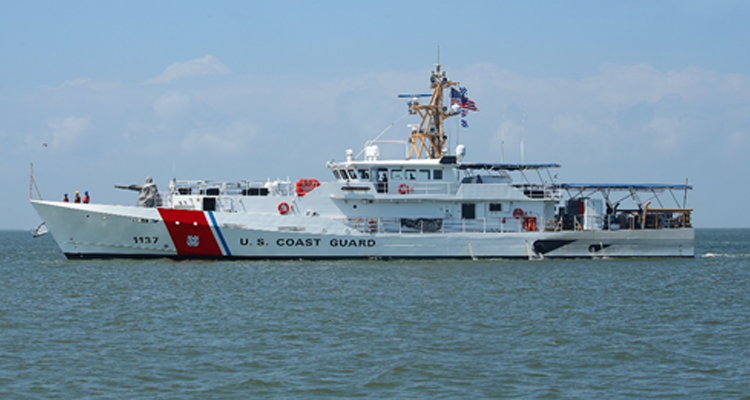
Coast Guard fast response cutter (FRC) Edgar Culbertson, commissioned June 11, 2020, is the 37th FRC delivered to the Coast Guard. The service awarded a contract option Sept. 22, 2020, for production of four more Sentinel-class FRCs and associated deliverables. U.S. Coast Guard photo.


The Coast Guard today exercised a contract option for production of four more Sentinel-class fast response cutters (FRCs) and associated deliverables worth just over $222 million with Bollinger Shipyards of Lockport, Louisiana.

This option brings the total number of FRCs under contract with Bollinger to 60 and the total value of the contract to approximately $1.48 billion. The FRCs built under this option will be delivered beginning late-2023 into mid-2024. The FRC contract was recently modified to increase the maximum number of cutters to 64 FRCs and total potential value to $1.74 billion if all options are exercised. This change was needed to maintain the domestic program of record of 58 FRCs while also providing for the replacement of six 110-foot patrol boats assigned to Patrol Forces Southwest Asia.

To date, there are 38 FRCs in operational service.

FRCs have a maximum speed of over 28 knots, a range of 2,500 nautical miles and an endurance of five days. The ships are designed for multiple missions, including drug and migrant interdiction; ports, waterways and coastal security; fishery patrols; search and rescue; and national defense. They feature advanced command, control, communications, computers, intelligence, surveillance and reconnaissance equipment; over-the-horizon cutter boat deployment to reach vessels of interest; and improved habitability and seakeeping.

For more information: Fast Response Cutter program page

“New Missions Push Old Coast Guard Assets To The Brink” –Forbes

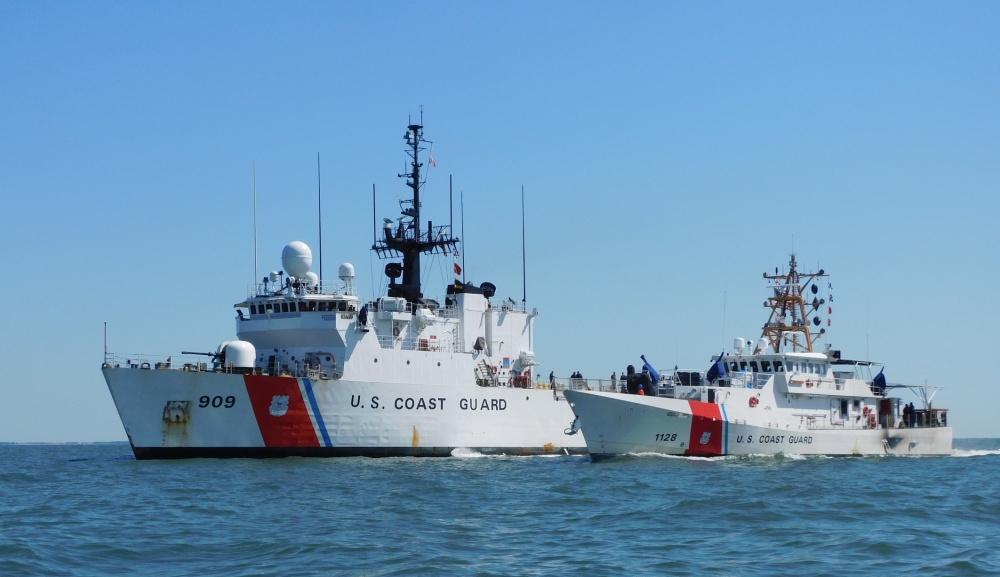
The crew of the Coast Guard Cutter Bruckenthal participates in a fueling exercise with the Coast Guard Cutter Campbell on the Chesapeake Bay, April 11, 2020. The Coast Guard acquired the first Sentinel Class cutter in 2012, with the namesake of each cutter being one of the service’s many enlisted heroes. (U.S. Coast Guard photo by Petty Officer 3rd Class Isaac Cross)

Forbes evaluates the Coast Guard’s performance and the dangers inherent in its aging fleet.

“With all the new interest, America’s Coast Guard is transitioning from an overlooked national security afterthought into a more significant geopolitical player, befitting what is, after all, the world’s 12th largest naval force.”

But,

“It all looks pretty good so far. America’s Coast Guard can be proud of its current operational record and new strategic potential. But as the geopolitical importance of Coast Guard missions ramp up, so too will the ramifications of mission failure. The Coast Guard has a lot of fragile ships that can break at any time. The stress may already be showing…”

There is a lot of criticism of the 270 foot WMECs here. I have never been a great fan. When they were being built, the Chief Engineer made keeping the cost down a number one priority. He saw cost closely related to length. Contrary to stories that they were supposed to have been longer, in fact the original design was three feet shorter. I heard at the time, that Naval engineers went “down on bended knees” to get an additional three feet of shear on the bow.

USCGC Citrus, 1984, after conversion from buoy tender to WMEC. US Coast Guard photo.

When the 270 program began, the Coast Guard still had 18 World War II vintage WHECs and WMECs

  • Six larger, slightly faster, and much loved 327 foot cutters.
  • USCGC Storis, 230′, but actually a little larger in displacement
  • Three 213′ former Navy rescue and salvage  vessels, Escape, Acushnet, and Yacona
  • Five 205′ former Navy fleet tugs, Chilula, Cherokee, Tamaroa, Ute, and Lipan
  • three converted 180′ buoy tenders, Clover, Evergreen, and Citrus

Twelve of those, including all the 327s, were decommissioned 1980 to 1991. Tamaroa and Citrus were decommissioned in 1994, Escape in 1995, Yacona in 1996, Storis in 2007, and Acushnet hung on until 2011.

210s Courageous and Durable were decommissioned September 2001.

Until the first National Security Cutter, Bertholf, was commissioned Aug. 4, 2008, the only addition to the fleet, after the completion of the 270s, was 283′ Alex Haley, transferred from the Navy in 1999.

So at the end of 1991, the year the last 270 was delivered, we had 47 WHECs and WMECs (12 x 378s, 13 x 270s, 16 x 210s and 6 WWII vintage ships). By the time the first NSC came out, we were down to 41 (12 x 378s, 1 x283, 13 x 270s, 14 x 210s and 1 WWII vintage ship). We are currently at 37 (8 x NSCs, 1 x 378s, 1 x283, 13 x 270s, 14 x 210s) and working toward 36 (11 NSCs and 25 OPCs). I suspect we will the the number drop below that before the OPC program is complete.

USCGC Tahoma (WMEC-908)

While I always felt we would have been better off evolving an improved 327, the 270 was a net improvement. Unlike the ships they replaced, they had a helicopter deck and hangar. Even the 378s did not have a hangar at that point. The 270s introduced the digital Mk92 fire control, 76mm Mk75 gun, SLQ-32 ESM, and Mk36 SRBOC. They were a half knot slower than the 327s, but were substantially faster than the other ships they replaced, none of which were capable of more than 16 knots.

It was perhaps a lost opportunity to build something better, for only a little more money, but they were an improvement. We should have built at least six more to replace the WWII built ships, and maybe another 16 to replace the 210s beginning in 1994 (perhaps a block 2 with a bit more bow). We should have awarded contracts to start replacing the 270s more than a decade ago.

Now that we do have bipartisan support in Congress, we need to translate that into consistently larger Procurement, Construction, and Improvement funding and an accelerated build rate for the OPCs. After all, we currently have only one WMEC less than 30 years old, that just barely. We really should not wait 17 or 18 years to replace them all.


“Coast Guard Polar Security Cutter (Polar Icebreaker) Program: Background and Issues for Congress” Updated 10 June, 2020, CRS

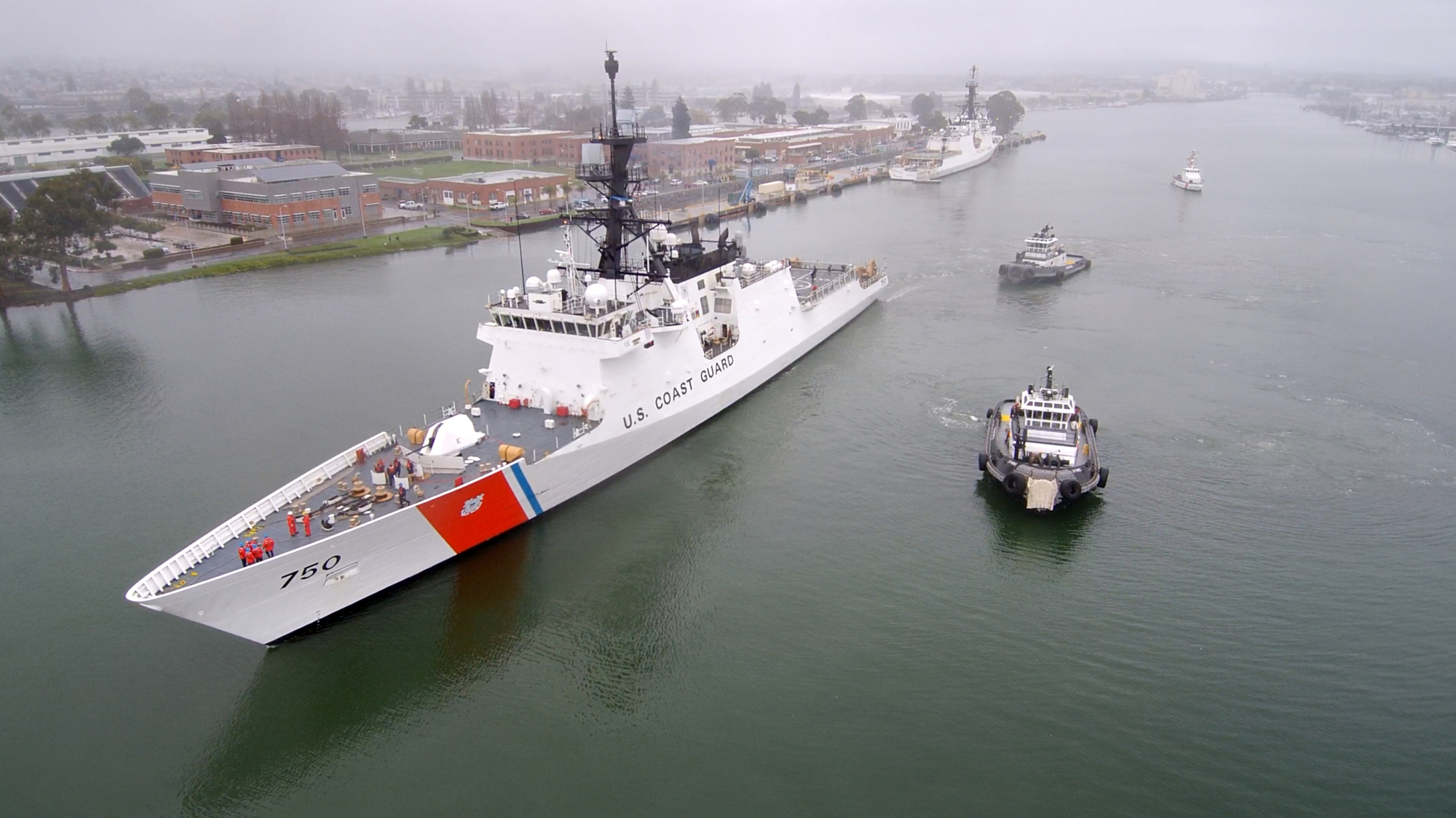
The Congressional Research Service has once again updated their report on the Polar Security Cutter. You can see the whole report here. I have reproduced the one page summary below. The entire report is a 66 page pdf. 

Summary

The Coast Guard Polar Security Cutter (PSC) program is a program to acquire three new PSCs (i.e., heavy polar icebreakers), to be followed years from now by the acquisition of up to three new medium polar icebreakers. The PSC program has received a total of $1,169.6 million (i.e., about $1.2 billion) in procurement funding through FY2020, including $135 million in FY2020, which was $100 million more than the $35 million that the Coast Guard had requested for FY2020. With the funding it has received through FY2020, the first PSC is now fully funded and the second PSC has received initial funding.

The Coast Guard’s proposed FY2021 budget requests $555 million in procurement funding for the PSC program. It also proposes a rescission of $70 million in FY2020 funding that Congress had provided for the procurement of long lead time materials (LLTM) for a 12th National Security Cutter (NSC), with the intent of reprogramming that funding to the PSC program. The Coast Guard states that its proposed FY2021 budget, if approved by Congress, would fully fund the second PSC.

The Coast Guard estimates the total procurement costs of the three PSCs as $1,039 million (i.e., about $1.0 billion) for the first ship, $792 million for the second ship, and $788 million for the third ship, for a combined estimated cost of $2,619 million (i.e., about $2.6 billion). Within those figures, the shipbuilder’s portion of the total procurement cost is $746 million for the first ship, $544 million for the second ship, and $535 million for the third ship, for a combined estimated shipbuilder’s cost of $1,825 million (i.e., about $1.8 billion).

On April 23, 2019, the Coast Guard-Navy Integrated Program Office for the PSC program awarded a $745.9 million fixed-price, incentive-firm contract for the detail design and construction (DD&C) of the first PSC to VT Halter Marine of Pascagoula, MS, a shipyard owned by Singapore Technologies (ST) Engineering. VT Halter was the leader of one of three industry teams that competed for the DD&C contract. The first PSC is scheduled to begin construction in 2021 and be delivered in 2024, though the DD&C contract includes financial incentives for earlier delivery.

The DD&C contract includes options for building the second and third PSCs. If these options are exercised, the total value of the contract would increase to $1,942.8 million (i.e., about $1.9 billion). The figures of $745.9 million and $1,942.8 million cover only the shipbuilder’s costs; they do not include the cost of government-furnished equipment (GFE), which is equipment for the ships that the government purchases and then provides to the shipbuilder for incorporation into the ship, or government program-management costs. When GFE and government program management costs are included, the total estimated procurement cost of the first PSC is between $925 million and $940 million, and the total estimated procurement cost of the three-ship PSC program is about $2.95 billion.

The operational U.S. polar icebreaking fleet currently consists of one heavy polar icebreaker, Polar Star, and one medium polar icebreaker, Healy. In addition to Polar Star, the Coast Guard has a second heavy polar icebreaker, Polar Sea. Polar Sea, however, suffered an engine casualty in June 2010 and has been nonoperational since then. Polar Star and Polar Sea entered service in 1976 and 1978, respectively, and are now well beyond their originally intended 30-year service lives. The Coast Guard plans to extend the service life of Polar Star until the delivery of at least the second PSC. The Coast Guard is using Polar Sea as a source of spare parts for keeping Polar Star operational.

“Growing Missions, Shrinking Fleet” –USNI

The US Naval Institute has an argument in favor of funding National Security Cutter #12

The author talks about the shortage of ships both because of the failure of the crew rotation concept and because of the shortfall revealed in the Fleet Mix Study. This has been discussed in the Congressional Research Service report on Cutter Acquisition.

What I found new, was information about SOUTHCOM interceptions,

In congressional testimony last year, Admiral Craig Faller, Commander, U.S. Southern Command, noted: “The Coast Guard’s presence any given day is six to eight cutters. . . . But, keep in mind, we’re talking about covering areas the size of the United States—with from six to 10 ships. And so, the interdiction percentage with the current assets we have is about 6 percent of the detections. So, we need more ships.”

that is a lower interception rate than previously reported, and impact on jobs,

The NSC is an indispensable national asset. The economic impact of the NSC production line touches nearly 500 suppliers across 39 states. An additional ship order would help jumpstart the U.S. economy and have an immediate and profound effect on a host of U.S. suppliers, who stand ready to deliver. Moving forward with a 12th NSC is low risk.

If we had been further along with the Offshore Patrol Cutter (OPC), I would say, just build another OPC instead of a twelth NSC, but we were way behind in starting the OPC program and the difficulties at Eastern put us even further behind.

The OPC program is so far behind, that the Bertholf is likely to be 30 years old before the 25th OPC is ready for its first operational mission. Plus we really do need more than 36 large patrol cutters, but the fact we have not done a new Fleet Mix Study in almost ten years does not help our case.


“Coast Guard Pursuing Ambitious ‘Tech Revolution’” –NationalDefenseMagazine

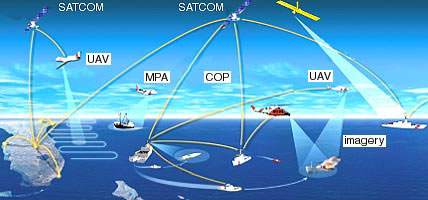
National Defense Magazine is reporting the Coast Guard is planning major upgrades to its connectivity.

Improvements are planned for both routine reporting and staff work and for Command and Control,

“The Coast Guard was slated to transition to Microsoft Office 365 this spring to increase email reliability. Plans also include making internet speeds 50 times faster this year and improving ship connectivity over the next three years, Schultz noted.”

Plus there will be additional Cyber expertise.

“President Donald Trump’s fiscal year 2021 budget request calls for adding 179 cyber personnel to the Coast Guard’s existing force, Schultz noted. The service currently has about 360 cyber personnel, and about 50 or 60 are coming on board this year.”


However, the Coast Guard isn’t just looking to play defense, he noted. It wants to conduct its own cyber attacks against adversaries.

Presumably all this will include better connectivity in the polar regions. The Healey was reportedly out of contact for long periods during her last trip to the Arctic.

Recently sections of the Rescue 21 system were down for prolonged periods in Alaska. We don’t want that to happen.

“Coast Guard Cutter Procurement: Background and Issues for Congress, Updated April 15, 2020” –CRS

The Congressional Research Service (CRS) has again updated their “Coast Guard Cutter Procurement: Background and Issues for Congress.” The last updated edition of this analysis, that I reported on here, was dated 28 Jan. 2020. The FY2021 PC&I request includes funding for OPC#3 and long lead time material for #4, plus small amounts for the NSC and FRC program. Not addressed here is the second Polar Security Cutter for which funding is also requested, addressed in a separate CRS report. There is a good breakdown of the entire request for vessels here.

As noted earlier, eight Marine Protector class, 87 foot WPBs are to be decommissioned without replacement. 

Congress has routinely added Webber class Fast Response Cutters to previous budgets. I have to believe the Congress will fund four additional FRCs, if not in FY2021 then in 2022, so that we can ccomplete the program of record and replace all six Island class WPBs of PATFORSWA. A 12th NSC seems much less likely, but not impossible. The summary for the 15 April edition is quoted below. 

Summary

The Coast Guard’s program of record (POR) calls for procuring 8 National Security Cutters (NSCs), 25 Offshore Patrol Cutters (OPCs), and 58 Fast Response Cutters (FRCs) as replacements for 90 aging Coast Guard high-endurance cutters, medium-endurance cutters, and patrol craft. The Coast Guard’s proposed FY2021 budget requests a total of $597 million in procurement funding for the NSC, OPC, and FRC programs. It also proposes a rescission of $70 million in FY2020 procurement funding that Congress provided for the NSC program.

NSCs are the Coast Guard’s largest and most capable general-purpose cutters; they are replacing the Coast Guard’s 12 Hamilton-class high-endurance cutters. NSCs have an estimated average procurement cost of about $670 million per ship. Although the Coast Guard’s POR calls for procuring 8 NSCs to replace the 12 Hamilton-class cutters, Congress through FY2020 has fully funded 11 NSCs, including the 10th and 11th in FY2018. In FY2020, Congress provided $100.5 million for procurement of long lead time materials (LLTM) for a 12th NSC, so as to preserve the option of procuring a 12th NSC while the Coast Guard evaluates its future needs. The funding can be used for procuring LLTM for a 12th NSC if the Coast Guard determines it is needed. The Coast Guard’s proposed FY2021 budget requests $31 million in procurement funding for activities within the NSC program; this request does not include further funding for a 12th NSC. The Coast Guard’s proposed FY2021 budget also proposes a rescission of $70 million of the $100.5 million that Congress provided for a 12th NSC, with the intent of reprogramming that funding to the Coast Guard’s Polar Security Cutter (PSC) program. Eight NSCs have entered service; the seventh and eighth were commissioned into service on August 24, 2019. The 9th through 11th are under construction; the 9th is scheduled for delivery in 2020.

OPCs are to be less expensive and in some respects less capable than NSCs; they are intended to replace the Coast Guard’s 29 aged medium-endurance cutters. Coast Guard officials describe the OPC and PSC programs as the service’s highest acquisition priorities. OPCs have an estimated average procurement cost of about $411 million per ship. The first OPC was funded in FY2018. The Coast Guard’s proposed FY2021 budget requests $546 million in procurement funding for the third OPC, LLTM for the fourth, and other program costs. On October 11, 2019, the Department of Homeland Security (DHS), of which the Coast Guard is a part, announced that DHS had granted extraordinary contractual relief to Eastern Shipbuilding Group (ESG) of Panama City, FL, the builder of the first four OPCs, under P.L. 85-804 as amended (50 U.S.C. 1431-1435), a law that authorizes certain federal agencies to provide certain types of extraordinary relief to contractors who are encountering difficulties in the performance of federal contracts or subcontracts relating to national defense. ESG reportedly submitted a request for extraordinary relief on June 30, 2019, after ESG’s shipbuilding facilities were damaged by Hurricane Michael, which passed through the Florida panhandle on October 10, 2018. The Coast Guard intends to hold a competition for a contract to build OPCs 5 through 15.

FRCs are considerably smaller and less expensive than OPCs; they are intended to replace the Coast Guard’s 49 aging Island-class patrol boats. FRCs have an estimated average procurement cost of about $65 million per boat. A total of 60 have been funded through FY2020, including four in FY2020. Four of the 60 are to be used by the Coast Guard in the Persian Gulf and are not counted against the Coast Guard’s 58-ship POR for the program, which relates to domestic operations. Excluding these four FRCs, 56 FRCs for domestic operations have been funded through FY2020. The 36th FRC was commissioned into service on January 10, 2020. The Coast Guard’s proposed FY2021 budget requests $20 million in procurement funding for the FRC program; this request does not include funding for any additional FRCs.

“Coast Guard Modifies Contract to Construct Second Offshore Patrol Cutter, Acquire Long Lead-Time Material for Third Offshore Patrol Cutter” –CG-9

Above: Artists rendering from Eastern Shipbuilding Group

Contract for the Second Offshore Patrol Cutter, the future USCGC Chase, and long lead time items for the third. Presumably this is a contract modification, rather than the  exercise of a contract option, because the price is higher than the original option. Still this does not look a great deal higher than the previous contract ($317.5M), for the first OPC and long lead time items for the second. Following from the Acquisitions Directorate, CG-9:

The U.S. Coast Guard modified its contract with Eastern Shipbuilding Group (ESG) April 2 to begin construction of the second Offshore Patrol Cutter (OPC) and to acquire long lead-time material (LLTM) for the third OPC. Contract delivery of the second OPC, to be named Chase, is scheduled to occur in 2023.

The total value of the construction and LLTM orders is $343 million. In addition to ordering construction of the second OPC, this contracting action also covers the initial order of components and materials necessary to support the future construction of the third OPC by acquiring propeller and steering components, marine diesel engines, the ship integrated control system, switchboards, and generators.

The lead OPC is currently in production at ESG’s shipyard in Panama City, Florida.  Production of the lead cutter, Argus, commenced January 7, 2019. Delivery of Argus is scheduled for 2022.

The OPC meets the Service’s long-term need for cutters capable of deploying independently or as part of task groups and is essential to stopping smugglers at sea, interdicting undocumented migrants, rescuing mariners, enforcing fisheries laws, responding to disasters and protecting our ports. The acquisition of 25 OPCs will complement the capabilities of the Service’s National Security Cutters, Fast Response Cutters and Polar Security Cutters as an essential element of the Department of Homeland Security’s layered security strategy.

For more information: OPC program page