“Report to Congress on Coast Guard Cutter Procurement” –CRS, Updated October 19, 2021″ –CRS

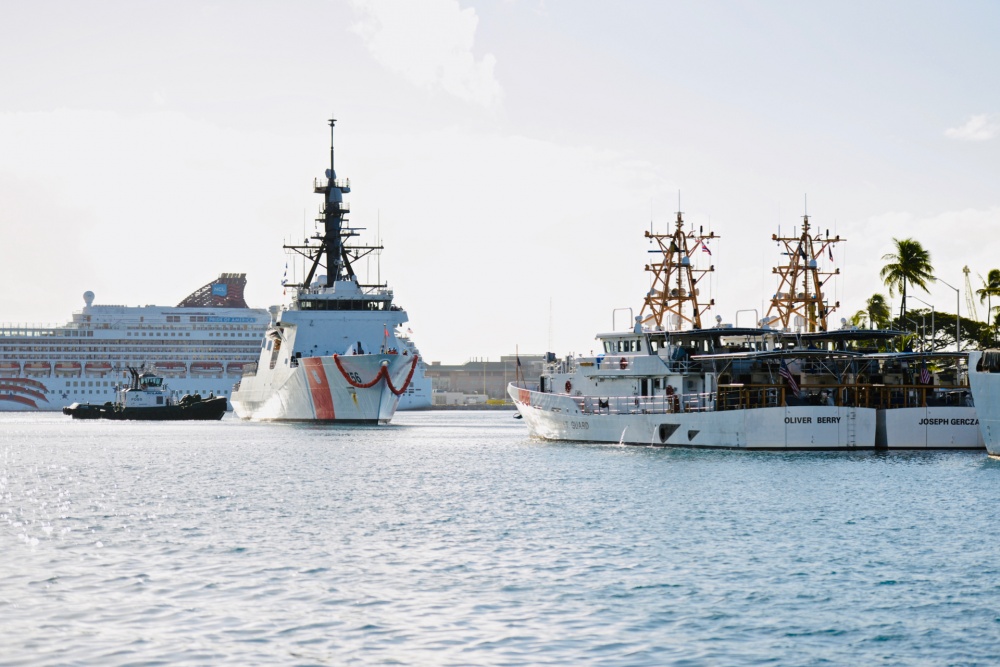
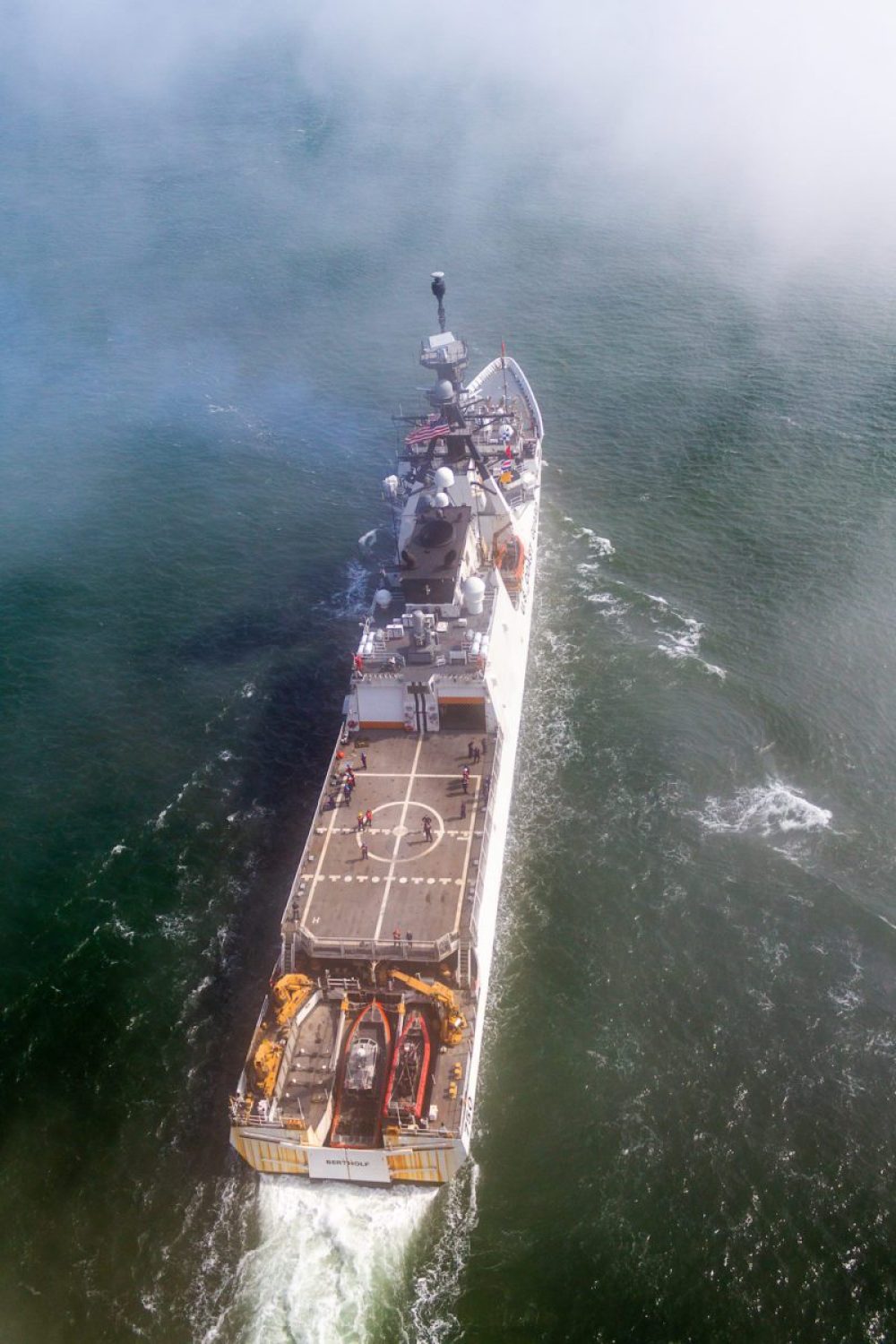
The Coast Guard Cutter Bertholf enters the San Francisco Bay en route to their Alameda, California homeport following a three-month multi-mission patrol, Oct. 3, 2020. Bertholf is one of four Legend-class national security cutters homeported in Alameda. (Photo by Pablo Fernicola)

The Congressional Research Service has again updated their “Report to Congress on Coast Guard Cutter Procurement”. (This link will always take you to the most recent edition of the report.) My last post on this evolving document was in reference to a 15 September, 2021 update. The questions raised in that report remain largely unanswered. I have reproduced the one page summary in full below. The summary does not appear to have changed, except to reflect the commissioning of the 45th FRC. But first I will highlight what I believe to be the changes since the last update. The significant changes reflect the Senate’s actions reported on pages 27 and 28.

Senate

The Senate Appropriations Committee, in the explanatory statement it released on October 18, 2021, for the FY2022 DHS Appropriations Act (S. XXXX), recommends the funding levels shown in the SAC column of Table 2. (PDF page 144 of 160) The explanatory statement states:

Offshore Patrol Cutter [OPC].—The Committee provides the requested amount of $597,000,000 for the construction of the fourth OPC and LLTM for the fifth OPC. While the Committee supports OPC procurements, the Committee remains concerned about costs for the program and continues the requirement for the Coast Guard to brief the Committee within one week prior to taking any procurement actions impacting estimated costs for the OPC program.

Fast Response Cutter [FRC] Program.—In accordance with the Coast Guard’s recapitalization plan, the Committee has completed funding for the replacement of legacy 110-foot Island Class patrol boats with FRCs that will operate similarly in the coastal zone. The Coast Guard is encouraged to notify the Committee if additional FRCs are necessary to support the Department of Defense in Patrol Forces Southwest Asia. (PDF page 69 of 160)

The explanatory statement also states:

Fleet Mix Analysis.—The Committee recognizes ongoing acquisition programs for various cutter classes that are responsible for many of, but not all, Coast Guard missions. While programs have correctly been prioritized around recapitalizing the oldest vessels in the fleet, several cutter classes are rapidly approaching the end of their service lives, while others have long surpassed their service lives. In order to best understand future capital investment needs, the Coast Guard shall provide to the Committee within 180 days of the date of enactment of this act, a comprehensive analysis that provides a fleet mix sufficient to carry out the assigned missions of the Coast Guard and other emerging mission requirements. The Coast Guard shall brief the Committee within 60 days of the date of enactment of this act on its plans to carry out this requirement.

Full-Funding Policy.—The Committee again directs an exception to the administration’s current acquisition policy that requires the Coast Guard to attain the total acquisition cost for a vessel, including long lead time materials [LLTM], production costs, and postproduction costs, before a production contract can be awarded. This policy has the potential to make shipbuilding less efficient, to force delayed obligation of production funds, and to require post-production funds far in advance of when they will be used. The Department should position itself to acquire vessels in the most efficient manner within the guidelines of strict governance measures.

Domestic Content.—To the maximum extent practicable, the Coast Guard shall utilize components that are manufactured in the United States when contracting for new vessels. Such components include: auxiliary equipment, such as pumps for shipboard services; propulsion equipment, including engines, reduction gears, and propellers; shipboard cranes; and spreaders for shipboard cranes. (PDF page 68 of 160)


Summary

The Coast Guard’s program of record (POR), which dates to 2004, calls for procuring 8 National Security Cutters (NSCs), 25 Offshore Patrol Cutters (OPCs), and 58 Fast Response Cutters (FRCs) as replacements for 90 aging Coast Guard high-endurance cutters, medium-endurance cutters, and patrol craft. The Coast Guard’s proposed FY2022 budget requests a total of $695.0 million in procurement funding for the NSC, OPC, and FRC programs, including $597 million for the OPC program.

NSCs are the Coast Guard’s largest and most capable general-purpose cutters; they are replacing the Coast Guard’s 12 Hamilton-class high-endurance cutters. NSCs have an estimated average procurement cost of about $670 million per ship. Although the Coast Guard’s POR calls for procuring 8 NSCs to replace the 12 Hamilton-class cutters, Congress through FY2021 has fully funded 11 NSCs, including the 10th and 11th in FY2018. In FY2020, Congress provided $100.5 million for procurement of long lead time materials (LLTM) for a 12th NSC, so as to preserve the option of procuring a 12th NSC while the Coast Guard evaluates its future needs. The Coast Guard’s proposed FY2022 budget requests $78.0million in procurement funding for activities within the NSC program; this request does not include further funding for a 12th NSC. The Coast
Guard’s proposed FY2022 budget also proposes rescinding $65.0 million of the $100.5 million in FY2020 funding for LLTM for a 12th NSC, “allowing the Coast Guard to focus investments on building, homeporting, and crewing Polar Security Cutters and Offshore Patrol Cutters.” The remaining $35.5 million appropriated in FY2020 for LLTM would be used to pay NSC program costs other than procuring LLTM for a 12th NSC. Nine NSCs have entered service; the ninth was commissioned into service on March 19, 2021.

OPCs are to be less expensive and in some respects less capable than NSCs; they are intended to replace the Coast Guard’s 29 aged medium-endurance cutters. Coast Guard officials describe the OPC and PSC programs as the service’s highest acquisition priorities. OPCs have an estimated average procurement cost of about $411 million per ship. The first OPC was funded in FY2018. The Coast Guard’s proposed FY2022 budget requests $597.0 million in procurement funding for the fourth OPC, LLTM for the fifth, and other program costs. On October 11, 2019, the Department of Homeland Security (DHS), of which the Coast Guard is a part, announced that DHS had granted extraordinary contractual relief to Eastern Shipbuilding Group (ESG) of
Panama City, FL, the builder of the first four OPCs, under P.L. 85-804 as amended (50 U.S.C. 1431-1435), a law that authorizes certain federal agencies to provide certain types of extraordinary relief to contractors who are encountering difficulties in the performance of federal contracts or subcontracts relating to national defense. The Coast Guard is holding a full and open competition for a new contract to build OPCs 5 through 15. On January 29, 2021, the Coast Guard released a Request for Proposals (RFP) for this Stage 2 contract, as it is called. Responses to the RFP were due by May 28, 2021. The Coast Guard plans to award the Stage 2 contract in the second quarter of FY2022.

FRCs are considerably smaller and less expensive than OPCs; they are intended to replace the Coast Guard’s 49 aging Island-class patrol boats. FRCs have an estimated average procurement cost of about $65 million per boat. A total of 64 have been funded through FY2021, including four in FY2021. Six of the 64 are to be used by the Coast Guard in the Persian Gulf and are not counted against the 58-ship POR quantity for the program, which relates to domestic operations. As of October 19, 2021, 45 of the 64 have been commissioned into service. The Coast Guard’s proposed FY2022 budget requests $20.0 million in procurement funding for the FRC program; this request does not include funding for any additional FRCs

“L3 Harris will continue to support MK 20 electro-optical sensor systems for US Navy ships” and Coast Guard Cutters

L3 Harris Mk20 mod1 Electro Optic Sensor System. (Picture source Navy Recognition)

A quick nod to an often overlooked system on the NSC and I think the OPC.

Navy Recognition reports a contract award to L3Harris.

The MK20 Mod 1 has three primary functions – EOSS/GWS integration, automatic target detection and tracking, and day/night video surveillance. These functions effectively support multiple mission requirements for full-spectrum surface detection, identification, surveillance, and target assessment. The MK20 Mod 1 supports operations including anti-surface and anti-air warfare, spotting and damage assessment, target detection and identification, naval gun fire support, safety check-sight, location/track of man overboard, and channel position and navigation.

“Report to Congress on Coast Guard Cutter Procurement” –CRS, Updated September 15, 2021″ –CRS

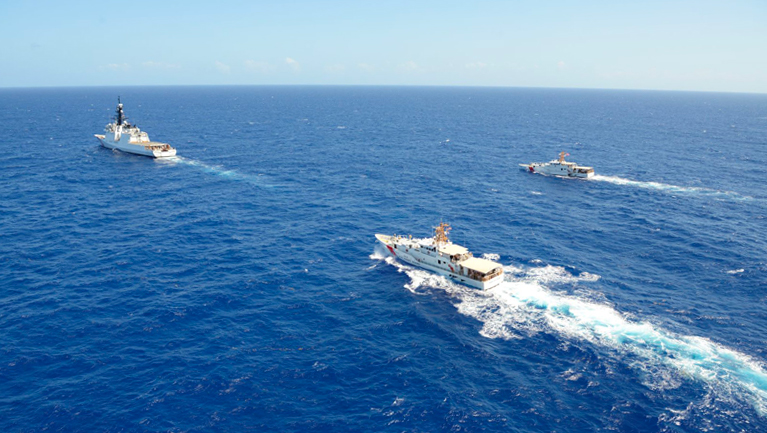
“Coast Guard Cutter Hamilton leads the way for cutters Robert Goldman and Charles Moulthrope as they depart Puerto Rico April 1. National security cutter Hamilton is escorting the two fast response cutters (FRCs) across the Atlantic to Rota, Spain. From there, the FRCs will continue to their homeport of Manama, Bahrain.” U.S. Coast Guard photo by Petty Officer 3rd Class Sydney Phoenix.

The Congressional Research Service has again updated their “Report to Congress on Coast Guard Cutter Procurement”. (This link will always take you to the most recent edition of the report.) My last post on this evolving document was in reference to a 17 August, 2021 update. I have reproduced the one page summary in full below. But first,

I missed this addition in my last look at the report. From page 22/23:

August 2021 House Committee Request for GAO Review

In a letter dated August 16, 2021, the House Transportation and Infrastructure Committee requested GAO to review the management of the OPC program and the Coast Guard’s efforts for managing its existing medium endurance cutters. The letter stated:

Initially projected to cost about $12 billion over its 30-year life cycle, the [OPC] program recently experienced significant cost and schedule delays….

In addition to construction of the OPC, the Committee continues to remain concerned about the operational gap between the end of service life for the aging Medium Endurance Cutters and the delayed delivery of the OPCs….

Given the significant budgetary commitment that the Congress, DHS, and Coast Guard have made for the OPC program to date, continued oversight is necessary to ensure the OPC program does not continue to experience cost growth or additional schedule delays. As such, the Committee requests that the Government Accountability Office (GAO) review the management of the OPC and Medium Endurance Cutters acquisition programs including, but not limited to:

  • The status of the Phase 1 (the first four hulls) and Phase 2 (hulls 5 through 25) OPC acquisition programs, including what steps are being taken to manage the program within the revised cost and schedule commitments; and
  • The status of the Medium Endurance Cutters and level of maintenance needed to keep the fleet operating to minimize the operational gap until the OPCs are incrementally delivered.

This is new. From page 27:

FY2022 National Defense Authorization Act (H.R. 4350) House
The House Armed Services Committee’s report (H.Rept. 117-118 of September 10, 2021) on H.R. 4350 states:

Sentinel-class Fast Response Cutter

The committee looks forward to reviewing the Navy’s updated force structure assessment and shipbuilding plan. The committee understands the Navy intends to change the fleet architecture reflected in the 355-ship force-level goal to reflect a more distributed fleet mix with a smaller proportion of larger ships and a larger proportion of smaller manned ships as well as unmanned vessels. The committee supports incorporating a mix of smaller manned ships into the fleet and encourages the Navy to consider the capabilities the U.S. Coast Guard’s Sentinel-class Fast Response Cutter could provide to the fleet and the concept of operations and associated requirements that would support acquisition of these vessels.

Further, the committee is aware the U.S. Coast Guard has contract options for 12 additional Sentinel-class Fast Response Cutters with firm fixed pricing in place until May of 2023. Exercising these contract options in advance of their expiration would lock in favorable pricing on Sentinel-class Fast Response Cutters should the Navy determine that they add value to the fleet.

Given the successes of the U.S. Coast Guard’s Sentinel-class Fast Response Cutter in support of the Navy’s Fifth Fleet as a part of Patrol Forces Southwest Asia, the committee believes there are similar roles for Sentinel-class Fast Response Cutters in other areas of responsibility. Therefore, the committee directs the Secretary of the Navy to submit a report to the congressional defense committees not later than February 1, 2022, that details the current mission sets and operating requirements for the Sentinel-class Fast Response Cutter and expands on how successes in the U.S. Central Command area of responsibility would translate to other regions, including the U.S. Indo-Pacific Command. Further, the committee directs the Secretary of the Navy to assess the requisite upgrades to the Sentinel class Fast Response Cutter required to meet Navy standards and evaluate the concept of operations for employing these vessels in Southeast Asia. This report should be unclassified but may include a classified annex. (Page 21)

The Summary page is reproduced below:


Summary

The Coast Guard’s program of record (POR), which dates to 2004, calls for procuring 8 National Security Cutters (NSCs), 25 Offshore Patrol Cutters (OPCs), and 58 Fast Response Cutters (FRCs) as replacements for 90 aging Coast Guard high-endurance cutters, medium-endurance cutters, and patrol craft. The Coast Guard’s proposed FY2022 budget requests a total of $695.0 million in procurement funding for the NSC, OPC, and FRC programs, including $597 million for the OPC program.

NSCs are the Coast Guard’s largest and most capable general-purpose cutters; they are replacing the Coast Guard’s 12 Hamilton-class high-endurance cutters. NSCs have an estimated average procurement cost of about $670 million per ship. Although the Coast Guard’s POR calls for procuring 8 NSCs to replace the 12 Hamilton-class cutters, Congress through FY2021 has fully funded 11 NSCs, including the 10th and 11th in FY2018. In FY2020, Congress provided $100.5 million for procurement of long lead time materials (LLTM) for a 12th NSC, so as to preserve the option of procuring a 12th NSC while the Coast Guard evaluates its future needs. The Coast Guard’s proposed FY2022 budget requests $78.0million in procurement funding for activities within the NSC program; this request does not include further funding for a 12th NSC. The Coast
Guard’s proposed FY2022 budget also proposes rescinding $65.0 million of the $100.5 million in FY2020 funding for LLTM for a 12th NSC, “allowing the Coast Guard to focus investments on building, homeporting, and crewing Polar Security Cutters and Offshore Patrol Cutters.” The remaining $35.5 million appropriated in FY2020 for LLTM would be used to pay NSC program costs other than procuring LLTM for a 12th NSC. Nine NSCs have entered service; the ninth was commissioned into service on March 19, 2021.

OPCs are to be less expensive and in some respects less capable than NSCs; they are intended to replace the Coast Guard’s 29 aged medium-endurance cutters. Coast Guard officials describe the OPC and PSC programs as the service’s highest acquisition priorities. OPCs have an estimated average procurement cost of about $411 million per ship. The first OPC was funded in FY2018. The Coast Guard’s proposed FY2022 budget requests $597.0 million in procurement funding for the fourth OPC, LLTM for the fifth, and other program costs. On October 11, 2019, the Department of Homeland Security (DHS), of which the Coast Guard is a part, announced that DHS had granted extraordinary contractual relief to Eastern Shipbuilding Group (ESG) of
Panama City, FL, the builder of the first four OPCs, under P.L. 85-804 as amended (50 U.S.C. 1431-1435), a law that authorizes certain federal agencies to provide certain types of extraordinary relief to contractors who are encountering difficulties in the performance of federal contracts or subcontracts relating to national defense. The Coast Guard is holding a full and open competition for a new contract to build OPCs 5 through 15. On January 29, 2021, the Coast Guard released a Request for Proposals (RFP) for this Stage 2 contract, as it is called. Responses to the RFP were due by May 28, 2021. The Coast Guard plans to award the Stage 2 contract in the second quarter of FY2022.

FRCs are considerably smaller and less expensive than OPCs; they are intended to replace the Coast Guard’s 49 aging Island-class patrol boats. FRCs have an estimated average procurement cost of about $65 million per boat. A total of 64 have been funded through FY2021, including four in FY2021. Six of the 64 are to be used by the Coast Guard in the Persian Gulf and are not counted against the 58-ship POR quantity for the program, which relates to domestic operations. Forty-four of the 64 have been commissioned into service. The Coast Guard’s proposed FY2022 budget requests $20.0 million in procurement funding for the FRC program; this request does not include funding for any additional FRCs
“Report to Congress on Coast Guard Cutter Procurement” –CRS, Updated August 17, 2021

The crew of USCGC Kimball (WMSL 756) arrive in Honolulu for the first time Dec. 22, 2018. Known as the Legend-class, NSCs are designed to be the flagships of the Coast Guard’s fleet, capable of executing the most challenging national security missions, including support to U.S. combatant commanders. (U.S. Coast Guard photo by Chief Petty Officer Sara Muir/Released)

The Congressional Research Service has again updated their “Report to Congress on Coast Guard Cutter Procurement”. (This link will always take you to the most recent edition of the report.) My last post on this evolving document was in reference to an 8 June 2021 update. I have reproduced the one page summary in full below. But first,

Comments:

It appears this report is little changed from the previous edition. The significant change is a reflection of the actions of the House Appropriations Committee and this change is relatively small. The Administration’s FY2022 Procurement Funding Request was:

  • NSC (Bertholf Class) program   $78.0M
  • OPC (Argus Class) program    $597.0M
  • FRC (Webber Class) program   $20.0M
  • TOTAL                                      $695.0M

The House Appropriations Committee mark up increased the total to $716M adding $21M to the NSC program.

An explanation included in House Report 117-87 of July 15, 2021 states

“National Security Cutter (NSC).—The Committee provides $99,000,000, which is $21,000,000 above the request, for the NSC program. This funding will support Post Delivery Activities to missionize and operationalize NSCs 10 and 11. The shortfall for these activities is currently over $200,000,000. The $21,000,000 is funded in the bill as a rescission and re-appropriation of prior-year funds to extend their availability.” (Page 57)

So while construction of the eleven National Security Cutters have be funded, we can expect to see future funding requests totaling over $100M to make #10 and #11 fully operational.

The rescission referred to is from funds earmarked for long lead time items for a possible future NSC#12. This seems to put an end to any possibility of a NSC.

The House Appropriations Committee action leaves in place the Administration’s plan to fund OPC#4 and procure long lead time items for OPC#5, but adds no additional NSCs or FRCs.

Summary (Below is the one page summary contained in the report–Chuck)

The Coast Guard’s program of record (POR), which dates to 2004, calls for procuring 8 National Security Cutters (NSCs), 25 Offshore Patrol Cutters (OPCs), and 58 Fast Response Cutters (FRCs) as replacements for 90 aging Coast Guard high-endurance cutters, medium-endurance cutters, and patrol craft. The Coast Guard’s proposed FY2022 budget requests a total of $695.0 million in procurement funding for the NSC, OPC, and FRC programs, including $597 million for the OPC program.

NSCs are the Coast Guard’s largest and most capable general-purpose cutters; they are replacing the Coast Guard’s 12 Hamilton-class high-endurance cutters. NSCs have an estimated average procurement cost of about $670 million per ship. Although the Coast Guard’s POR calls for procuring 8 NSCs to replace the 12 Hamilton-class cutters, Congress through FY2021 has fully funded 11 NSCs, including the 10th and 11th in FY2018. In FY2020, Congress provided $100.5 million for procurement of long lead time materials (LLTM) for a 12th NSC, so as to preserve the option of procuring a 12th NSC while the Coast Guard evaluates its future needs. The Coast Guard’s proposed FY2022 budget requests $78.0million in procurement funding for activities within the NSC program; this request does not include further funding for a 12th NSC. The Coast
Guard’s proposed FY2022 budget also proposes rescinding $65.0 million of the $100.5 million in FY2020 funding for LLTM for a 12th NSC, “allowing the Coast Guard to focus investments on building, homeporting, and crewing Polar Security Cutters and Offshore Patrol Cutters.” The remaining $35.5 million appropriated in FY2020 for LLTM would be used to pay NSC program costs other than procuring LLTM for a 12th NSC. Nine NSCs have entered service; the ninth was commissioned into service on March 19, 2021.

OPCs are to be less expensive and in some respects less capable than NSCs; they are intended to replace the Coast Guard’s 29 aged medium-endurance cutters. Coast Guard officials describe the OPC and PSC programs as the service’s highest acquisition priorities. OPCs have an estimated average procurement cost of about $411 million per ship. The first OPC was funded in FY2018. The Coast Guard’s proposed FY2022 budget requests $597.0 million in procurement funding for the fourth OPC, LLTM for the fifth, and other program costs. On October 11, 2019, the Department of Homeland Security (DHS), of which the Coast Guard is a part, announced that DHS had granted extraordinary contractual relief to Eastern Shipbuilding Group (ESG) of Panama City, FL, the builder of the first four OPCs, under P.L. 85-804 as amended (50 U.S.C. 1431-1435), a law that authorizes certain federal agencies to provide certain types of extraordinary relief to contractors who are encountering difficulties in the performance of federal contracts or subcontracts relating to national defense. The Coast Guard is holding a full and open competition for a new contract to build OPCs 5 through 15. On January 29, 2021, the Coast Guard released a Request for Proposals (RFP) for this Stage 2 contract, as it is called. Responses to the RFP were due by May 28, 2021. The Coast Guard plans to award the Stage 2 contract in the second quarter of FY2022.

FRCs are considerably smaller and less expensive than OPCs; they are intended to replace the Coast Guard’s 49 aging Island-class patrol boats. FRCs have an estimated average procurement cost of about $65 million per boat. A total of 64 have been funded through FY2021, including four in FY2021. Six of the 64 are to be used by the Coast Guard in the Persian Gulf and are not counted against the 58-ship POR quantity for the program, which relates to domestic operations. Forty-four of the 64 have been commissioned into service. The Coast Guard’s proposed FY2022 budget requests $20.0 million in procurement funding for the FRC program; this request does not include funding for any additional FRCs.

“SEA CONTROL 219 – USCG COMMANDANT ADMIRAL KARL SCHULTZ” –CIMSEC

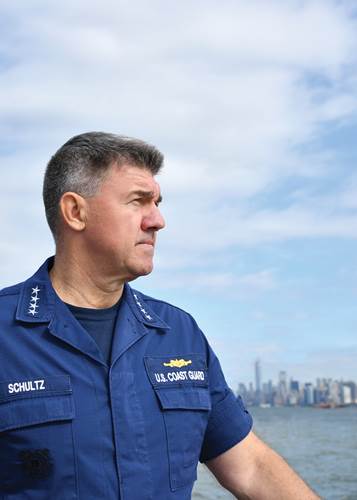
Coast Guard Commandant Adm. Karl Schultz visits with Coast Guard crews stationed in New York City. U.S. Coast Guard photo illustration by Petty Officer 1st Class Jetta Disco.

(I meant to cover this earlier, but perhaps still worth a listen)

CIMSEC’s Podcast “SEA Control,” had an interview with the Commandant, Dec. 27, 2020. You can find it here.

At first I thought I had heard it all before, but toward the end, there were some surprises.

He talked about  Arctic, Antarctic, and IUU. He talked about the Arctic Strategic Outlook and the IUU Strategic Outlook.

Illegal, Unreported, Unregulated fishing got a lot of attention. He related that it was gaining visibility and had become a national security issue since overfishing has created food security issues for many countries. He pointed to Coast Guard Cooperation with Ecuador in monitoring a fishing fleet off the Galapagos Islands. Internationally he sees a coordination role for the USCG.

Relative to the Arctic he mentioned the possibility of basing icebreakers in the Atlantic and the need for better communications.

He talked about the Tri-Service Strategy and the Coast Guards roles in it, particularly in less than lethal competition.

More novel topics started about minute 38 beginning with Unmanned systems. He talked about the recent CG experiments with unmanned systems and went on to note that the CG will also regulated Unmanned commercial vessel systems.

About minute 41 he talked about the Coast Guard’s role in countering UAS in the Arabian Gulf. He added that we have a lead role in DHS in counter UAS. “We are in the thick of that”

GA-ASI Concludes Successful Series of MQ-9 Demonstrations in Greece

He said the service was looking at MQ-9 maritime “Guardian” (minute 45)

When ask about reintroducing an ASW capability he said that while the Coast Guard was looking at it, the service would have to be cautious about biting off too much. (My suggestion of how the CG could have an ASW mission with minimal impact on its peacetime structure.)

He talked about balancing local and distant missions and concluded that the CG could do both (47), and that the Coast Guard was becoming truly globally deployable (48).

He noted that the first two FRCs for PATFORSWA would transit to Bahrain in Spring, followed by two more in the Fall, and two more in 2022. (49)

He noted technology is making SAR more efficient. “Hopefully we will put ourselves out of the Search and Rescue business.” 50

He talked about the benefits of “white hull diplomacy.” (52)

Asked about our funding for new missions he said it was sometime necessary to demonstrate the value of the mission first, then seek funding. (55)

He also talked about raising the bar on maintenance.

“Coast Guard releases request for proposal for offshore patrol cutter follow-on detail design and production” –CG-9

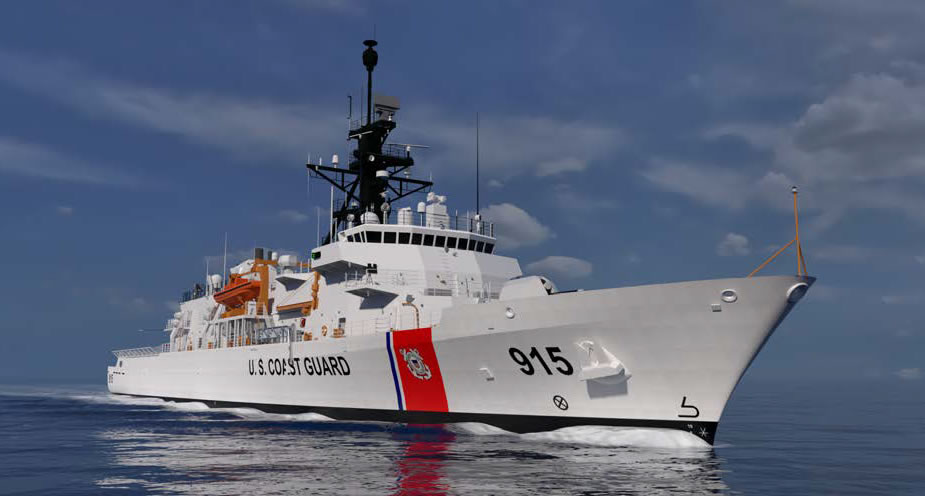
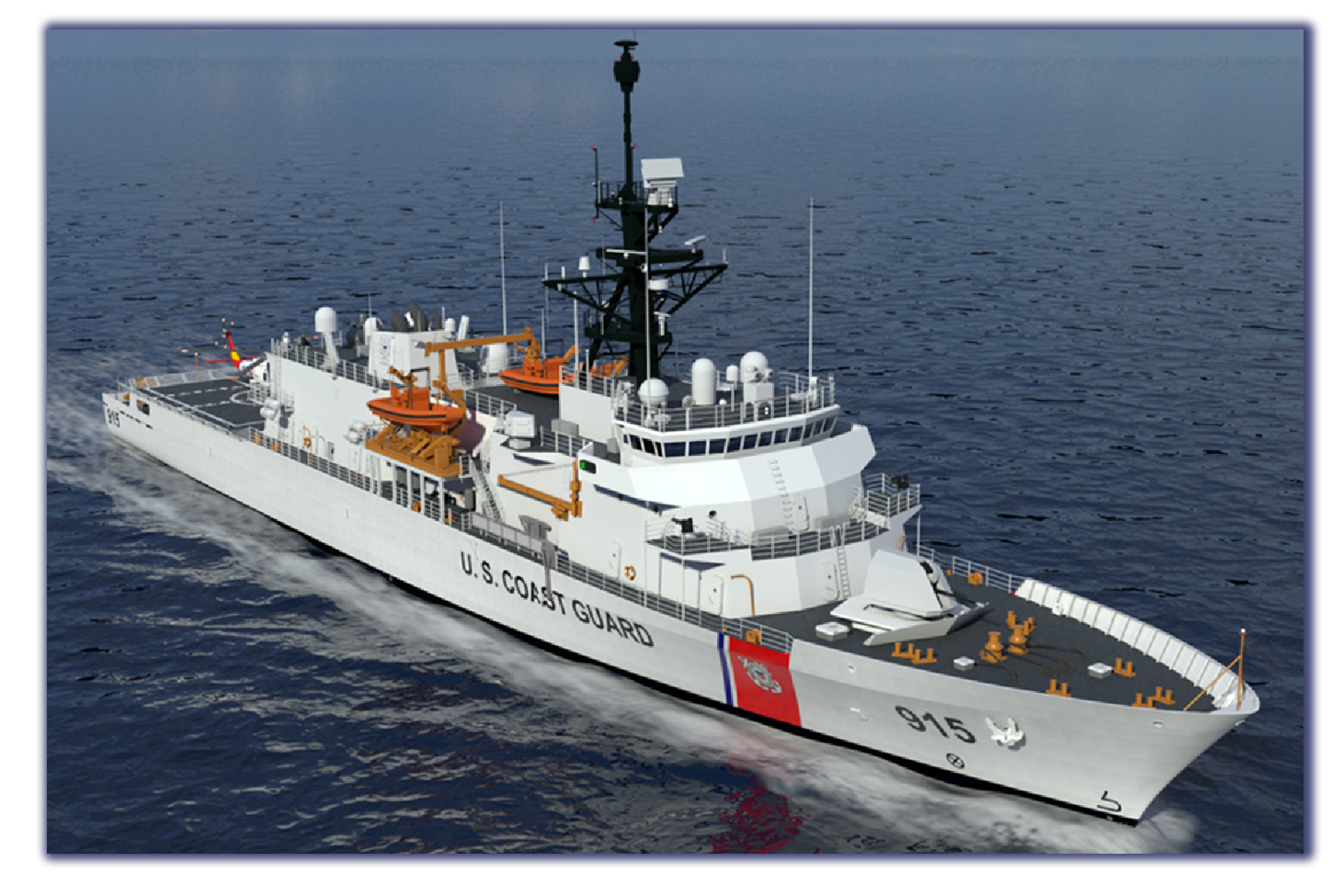
Artists rendering of the future USCGC Argus, from Eastern Shipbuilding Group

The following is reproduced from the Acquisitions Directorate announcement: Interesting to look though some of the linked documents. Shows how complex contracting has become. 


The Coast Guard released a request for proposal (RFP) Jan. 29 for detail design and production of up to 11 offshore patrol cutters (OPCs). The RFP is available here. The competition is open to all interested offerors.

Establishing a new, full and open competitive environment for the OPC program is a key component of the Coast Guard’s strategy to recapitalize its offshore surface capabilities. The RFP was informed by extensive industry engagement, including contracted industry studies with eight U.S. shipyards, an invitation to review and respond to a draft RFP and the establishment of an OPC technical library. The OPC technical library provides updated design information that reflects the current state of OPC acquisition activities to potential offerors.

The deadline to submit responses to the RFP is May 28, 2021. Contract award is scheduled to occur in the second quarter of fiscal year 2022.

The OPC acquisition program meets the service’s long-term need for cutters capable of deploying independently or as part of task groups, and is essential to stopping smugglers at sea, interdicting undocumented migrants, rescuing mariners, enforcing fisheries laws, responding to disasters and protecting ports and waterways. The acquisition of up to 25 OPCs will complement the capabilities of the service’s national security cutters, fast response cutters, and polar security cutters as an essential element of the Department of Homeland Security’s layered maritime security strategy.

For more information: Offshore Patrol Cutter program page

Coast Guard Cutter + Navy Reserve + Mission Module = ASW

The US is seriously short of Anti-Submarine Warfare escort vessels, but a little forethought and some cooperation between the Navy Reserve and the Coast Guard could seriously reduce the deficit, without a huge impact on either the Navy or the Coast Guard’s peacetime budget, operations, and manning.

It is a simple concept, a payload/platform solution. The Navy provides the payload. The Coast Guard provides the platform and drives “the truck.” It would allow the Coast Guard to have an important wartime role without significantly increasing its manning or training requirements. The costs to the Navy would be minimal and it would allow them to exploit their reserve pool of trained ASW personnel long before additional ships could be built.

In peacetime, the Coast Guard has been placing detachments on Navy ships. In wartime, Navy detachments could be placed on Coast Guard ships.

The essential elements are:

  • 36 Coast Guard Cutters, 11 National Security Cutters and 25 Offshore Patrol Cutters built, building, or planned.
  • Navy Reserve Helicopter Maritime Strike (HSM) aircraft and crews
  • An ASW mission module for each cutter
  • Navy personnel (active or reserve, officer and enlisted) trained and experienced in operating the ASW mission module equipment and ASW operations

The Threat:

If we have a non-nuclear war with a near peer, e.g. China or Russia, it is almost certain we will need more Anti-Submarine Warfare escort vessels than we currently have. The Chinese have almost 80 submarines  (60 conventional and about 19 nuclear) and they are doubling their capacity for building nuclear submarines. Russia has about 63 submarines, mostly nuclear.

US Navy ASW escorts, we are short:

The Navy’s force level goal is 156 surface combatants, out of the projected fleet of 355. These would include 104 large surface combatants (LSC, cruisers and destroyers) and 52 small surface combatants (SSC, LCS and frigates), but so far, there is no clear path to that goal. The Navy’s fleet will vary over time, but for the foreseeable future it will include less than 120 surface combatants. These include fewer than 90 cruisers and destroyers. A total of 35 LCS are built or funded, but it appears four of those may be decommissioned. Only ten LCS will be equipped as ASW escorts. The FFG(X), now FFG-62 program, is expected to produce 20 FFGs, but that program, is unlikely to produce its first ten ships before 2029.

The “Battle Force 2045” plan, which was never approved by DOD, projects a need for 60 to 70 Small Surface Combatants.

In any case we are going to short of escorts. A little over two years ago, the Military Sealift Command was told that ‘You’re on your own’: US sealift can’t count on Navy escorts in the next big war.

That is really not a good plan. We already have a minimal number of logistics support vessels and only a small pool of American mariners to sail them. Maritime Patrol Aircraft might be able to provide some degree of protection for transiting logistics vessels but one thing they cannot do, is rescue mariners from ships that are inevitably sunk. Coast Guard ships might be able to rescue mariners, but without ASW equipment, they themselves would be vulnerable.

The Mission: 

I would not expect the cutters to be on the forward edge of battle, but by providing escort service from the Continental US to forward logistics bases, they would free more capable assets for areas where the threat level, particularly the air threat, is higher.


The Cutters: 

The Coast Guard has or is building two classes of cutters that might be useful as ASW escorts, the Bertholf class National Security Cutters (NSC) and the Argus class Offshore Patrol Cutters (OPC).

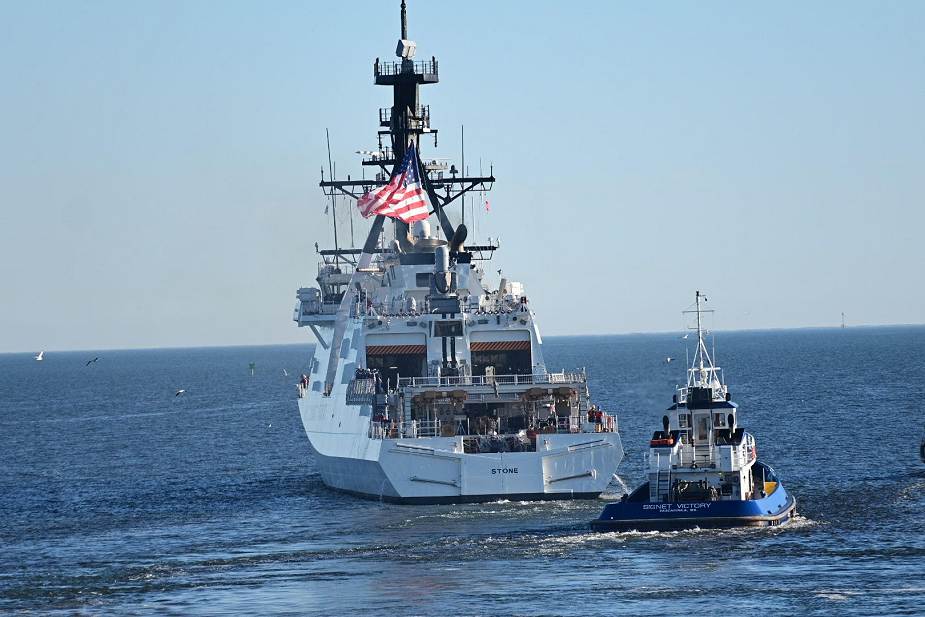
USCGC Stone, the ninth National Security Cutter. Dual helicopter hangars clearly visible.  (Huntington Ingalls photo)

Nine NSCs have already been completed. Two more are building or on order. Though they lack any current ASW capabilities, the Bertholf class National Security Cutters are in many ways already equipped to serve as frigates. A modified version of the design was apparently a contender for the FFG(X) program. They are a bit faster than the new FFGs and have a longer range and greater endurance. They have a flight deck and hangars capable of handling two MH-60s or one MH-60 and UAS. Like the new frigate and the LCSs, they have a 57mm Mk110 gun, but with a better fire control system than found on the LCSs, that includes a SPQ-9B Fire Control Radar. They also have a Phalanx CIWS and a sensitive compartmented intelligence facility (SCIF). They were designed with provision to accept twelve Mk56 VLS and Evolved Sea Sparrow Missiles. Their equipment includes:

  • EADS 3D TRS-16 AN/SPS-75 Air Search Radar
  • SPQ-9B Fire Control Radar
  • AN/SPS-79 Surface Search Radar
  • AN/SLQ-32B(V)2
  • 2 × SRBOC/ 2 × NULKA countermeasures chaff/rapid decoy launchers
  • AN/UPX-29A IFF
  • AN/URN-25 TACAN
  • MK 46 Mod 1 Optical Sighting System (WMSL 750 – 753)
  • MK 20 Mod 0 Electro-Optical Sighting System (WMSL 754 – 760)
  • Furuno X and S-band radars
  • Sea Commander Aegis derived combat system
  • Link-11 and Link-16 tactical data links

The Offshore Patrol Cutters are only slightly less capable than the National Security Cutters. They are about the same size at 4,500 tons full load. Speed is lower at 22+ knots sustained. They also have a 60 day endurance and an over 10,000 mile range. They are designed to support and hangar both a helicopter and a UAS, but while they clearly could hangar a MH-60R, it is not clear if it could also support an MQ-8. It is currently unclear if they will have a SCIF as built, but they have space for one. Their equipment includes:

  • Saab Sea Giraffe AN/SPS-77 AMB multi-mode naval radar
  • AN/UPX-46 IFF
  • AN/URN-32 TACAN
  • MK 20 Mod 1 EOSS
  • Link 22 Tactical Data Link
  • AN/SLQ-32C(V)6 Electronic Warfare System
  • 2 x MK 53 Mod 10 NULKA Decoy Launching Systems

Navy Reserve Helicopter Maritime Strike (HSM) squadron(s):

HSM squadrons fly both the MH-60R and MQ-8 Fire Scout UASWikipedia reports there are currently 18 HSM squadrons. They are now the only provider of shipboard airborne ASW capability. Only one of those is a Reserve squadron. Reportedly the Navy currently has 34 excess MH-60R which could equip virtually all the large cutter currently planned.

The ASW Mission Module:

The Navy apparently intends to equip ten LCS with ASW mission modules. But the new FFG-62 class will share the same ASW equipment including the TB-37U MFTA (Multi-Function Towed Array) which takes the form of a three inch cable towed behind the ship. The LCS ASW module also includes a variable depth sonar, the AN/SQS-62. This may or may not be required for the cutters’ open ocean escort mission. Even 36 complete ASW modules at the current cost of 19.8M would cost less than a single new FFG.

AN/SQS-62 Variable Depth Sonar intended for Littoral Combat ships. Photo Raytheon.

Manning the ASW Modules:

There are at least two possible sources of crews to man the ASW modules:

  • Active duty personnel assigned to rotational crews of LCS and FFGs
  • Navy Reservists

All LCS are now expected to be manned by rotating Blue and Gold crews. A similar scheme is being considered for the FFGs. Upon mobilization it is likely crew rotations will stop. That may mean experienced ASW officers and crew will be available to serve on similarly equipped ASW capable cutters.

As of Sept 30, 2019, the Navy’s Ready Reserve Force included over 100,000 members, 59,658 Selected Reservists (SELRES) and 44,020 Individual Ready Reservists (IRR). Currently I doubt there are organized reserve units prepared to operate ASW mission modules, but that might be a future option that would allow them to operate with cutters during training and exercises, while maintaining their training using simulators. There will certainly be recently separated IRR members, trained in the operation of the relevant systems who could be recalled to active duty.

Conclusion: 

This is a simple low cost way to add about 30% more ASW capable surface combatants to the fleet, putting it much closer to its projected requirements. They may not be ideal ASW escorts, but they may be good enough to make a difference.

“Schultz: Upcoming Coast Guard Budget Has ‘Dollars For People’ Focus” –USNI

The US Naval Institute’s news service has an excellent article about the Commandant’s recent remarks on the budget.

It is wide ranging. I will not try to outline it, but there was one particularly interesting discussion on the coming icebreaker fleet that suggest we may ultimately see more than six icebreakers. 

“There’s been conversation” in the administration and with Congress about expanding upon his plan for to have six icebreakers in the fleet to meet missions in the polar regions.”

Take a look, its well worth the read.

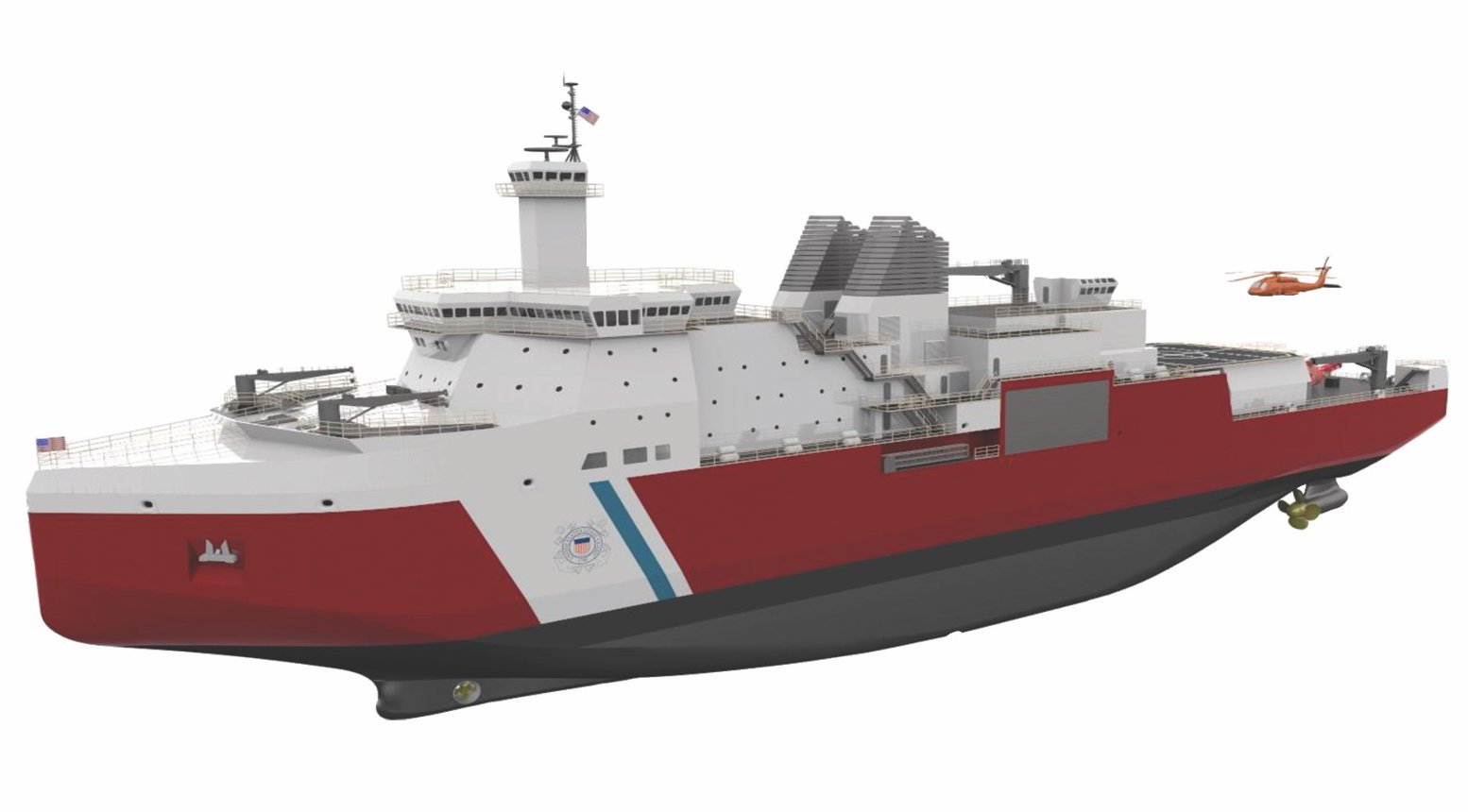
Polar Security Cutters and Coast Guard ASW

The US Naval Institute Proceedings web page has a couple of Coast Guard related articles that did not appear in the print version of Proceedings,

I have reproduced my comments on these topics below.


In regard to arming the Polar Security Cutters (the author seemed fixated on cruise missiles. We did discuss this topic earlier here)

There are limits to what we want to put on ships bound for Antarctica, since they have to be open for inspection. On the other hand if we ever do have a near peer conflict involving the Arctic or Antarctic, these will become rare and essential naval auxiliaries. As such they will probably operate with other vessels, including more powerful warships if appropriate, but that does not mean they should not be able to defend themselves against the possibility of leakers. We need to make provision for last ditch defense with systems like SeaRAM.

Meanwhile the fact that they are law enforcement vessels means they should be able to forcibly stop any private or merchant vessel regardless of size. So far it seems they will have at most, 25mm Mk38 Mod3 guns.

The follow on Medium Icebreakers or Arctic Security Cutters, which are unlikely to go to Antarctica, are more likely to be more heavily armed from the start.


Coast Guard ASW (comments were generally surprisingly adverse):

It is a fact that in WWII most U-boats were sunk by aircraft, but about a third (about 230) were sunk by surface vessels, primarily those of our allies Britain and Canada.

Even when surface vessels did not sink U-boats, they often performed valuable service in blocking access to convoys and in rescuing mariners from sunken ships.

US Naval vessels only sank about 38 U-boats. Coast Guard cutters and Coast Guard manned Navy ships were involved in sinking a disproportionate number of those (ten) for various reasons. Most of the US Navy effort went into the Pacific and most of the USN effort in the Atlantic at least through mid-1943, was in escorting high speed troop convoys than largely avoided contact with U-boats.

Circumstances we will face in any near peer conflict may be very different.

The advantages provided by code breaking in WWII are unlikely.

The advantages provided by radar equipped aircraft detecting U-boats charging their batteries or transiting the Bay of Biscay on the surface during the night no longer exists.

The Chinese surface and air threat would divert the most capable USN assets from ASW tasks.

Unlike the Japanese during the Pacific campaign, the Chinese are likely to make a concerted effort to disrupt our logistics train.

We simply do not have enough ASW assets.

Augmenting Coast Guard cutters to allow them to provide ASW escort and rescue services for ships that are sunk by hostile subs, in lower threat areas, is a low cost mobilization option that can substantially increase the number of escorts at low cost.

This could be facilitated by augmenting cutter with USN Reserves. Navy reserve ASW helicopter squadrons could be assigned to fly from cutters.
LCS ASW modules could be placed on cutters and manned by reactivated Navy reservists with LCS ASW module experience.

Our few US merchant ships need to be protected and when inevitably, some are sunk, we need someone to rescue those mariners, because they have become a rare and precious commodity.

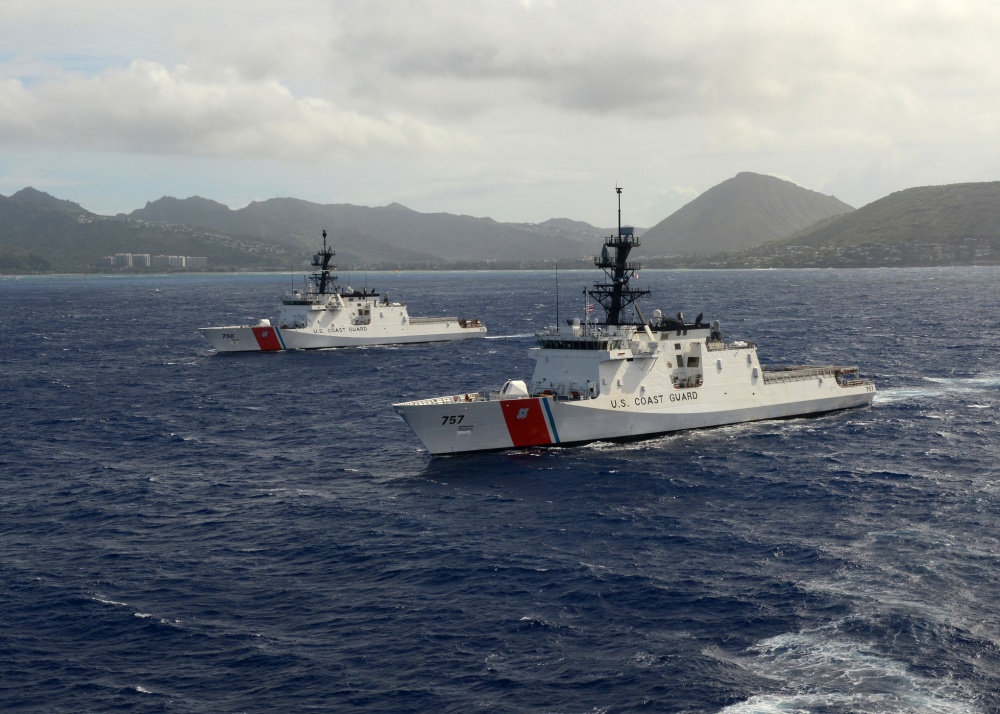
The crews of the Coast Guard Cutters Midgett (WMSL 757) and Kimball (WMSL 756) transit past Koko Head on Oahu, Hawaii, Aug. 16, 2019. The Kimball and Midgett are both homeported in Honolulu and two of the newest Coast Guard cutters to join the fleet. (U.S. Coast Guard photo by Petty Officer 3rd Class Matthew West/Released)


In answer to this comment from James M

Add : For (millions)

ASIST : 6.263
Mk 32 SVTT : 3.237
SLQ-25 Nixie: 1.727
AN/SRQ-4 LAMPS III: 4.625
VDS/MFTA combo: 14.802
ASW Combat Suite: 33.684
64.338 total. I am sure something could be arrived at for less. I look at this as what it takes to fit out an NSC the whole way. For one, OPC will never fit that VDS/MFTA on its stern. At best it would be a Nixie, maybe a container towed sonar we don’t yet use, and the mods for MH-60R. It would be good to know the plan for MUSV as it might help the equation. After all, the 64.338 would buy 2 MUSVs without payload. It could also buy an additional FRC.

So, we could equip ASW equip all eleven projected Bertholf class National Security Cutters (NSC) for less than the cost of a single frigate.

Why do you believe the VDS/MFTA would not fit on the Offshore Patrol Cutter? It is fully as large as the NSCs and does not have the boat launch ramp cut into the stern. They are also substantially larger than the LCSs.

OPC “Placemat”