Breaking Defense Interviews the Commandant

Coast Guard Commandant Adm. Paul Zukunft (right) meets with then-Southern Command chief Gen. John Kelly, now Trump’s nominee for Secretary of Homeland Security.

Coast Guard Commandant Adm. Paul Zukunft (right) meets with then-Southern Command chief Gen. John Kelly, now Trump’s nominee for Secretary of Homeland Security.

Breaking Defense’s Robbin Laird has an Interview with the Commandant and speculates on the prospects for the Coast Guard under the new administration and DHS selectee General John Kelly.

Trump, Kelly, & The Coast Guard: Exclusive Interview With Adm. Zukunft

Its a good one, and even the comments are worth reading. There is much of the same we have heard before. The Commandant has a clear and consistant message and agenda, but there is more detail about a possible role in the far Western Pacific.

“I have discussed with the CNO (Chief of Naval Operations Adm. John Richardson, the senior officer in the Navy) the concept that we would create a permanent USCG presence in the South China Sea and related areas,” Zukunft said. “This would allow us to expand our working relationship with Vietnam, the Philippines, and Japan. We can spearhead work with allies on freedom of navigation exercises as well.”

This is the first time I have seen the phrase “permanent USCG presence in the South China Sea and related areas.” Does that mean we will have a CG patrol squadron working out of Sinagpore or Okinawa (or Cam Ranh Bay), like the one in Bahrain? Or are we just looking at the Webber class WPCs we already know are going to Guam? (Must be more to it than that.) I do think we should put some OPCs in Guam, if only to patrol the EEZ in the Western Pacific.

Until recently we might have considered the possibility of basing in the Philippines, but that no longer looks like a possibility.

What ever you may think of the incoming administration, for the Coast Guard at least, it looks promising.

Thanks to Luke for bringing this to my attention. 

Fallout from the Philippines vs China SCS Case on US EEZ

Pacifci Marine Reserve
Photo Credit: Marine Conservatory Institute, Click to enlarge.

gCaptain reports,

“Largely overlooked in the tribunal’s July 12 decision was a strict interpretation of which dry land is entitled to a 200-nautical-mile exclusive economic zone—the surrounding ocean where a nation has sole rights to fish, drill for oil, and search for minerals.”

“The United Nations Convention on the Law of the Sea doesn’t allow nations to declare exclusive economic zones around “rocks which cannot sustain human habitation or economic life of their own.” What that’s meant has never been clear. Many countries, including the U.S. and Japan, have claimed exclusive economic zones around tiny atolls and outcroppings of rock.”

“The tribunal concluded that having people live on an island doesn’t prove habitability if food and water comes from elsewhere.”

The result could mean large stocks of fish in the Pacific including at least parts of the newly expanded Pacific Remote Islands Marine National Monument could loose the protection of US regulation  This could have long term implications for the US fossil fuel industry as well as the future of Offshore Thermal Energy Conversion.

New S. Korean Cutter

SKoreaLargestCutter

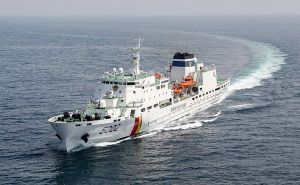
Jane’s 360 is reporting that the S. Korean Coast Guard has commissioned their largest and most heavily armed cutter.

Lee Chung-ho has a length of 150.5 m, a beam of 16.5 m, a loaded displacement of 6500 tonnes and a complement of 104 persons, although 140 persons can be embarked.

The hybrid propulsion system has four MTU 20V1163M94 diesels (each rated at 9,900 bhp) and two 750KW electric motors that are connected to the propellers.

How big is it?

The cutter, at 6,500 tons, is 44% larger than the Bertholf class. While its length and beam are almost identical to Japan Coast Guard’s two largest cutters, the displacement is reportedly far less. I have seen no info on the draft, so that is at least possible. In any case, it is definitely much smaller than the huge cutters the Chinese have built.

The post compares the new cutter to the slightly smaller Sambong-ho (pennant 5001), which entered service in 2002 and was previously the largest cutter in the S. Korean Coast Guard, stating it is three knots faster. That would indicate a top speed of 24 knots. The new cutter has a four diesel power plant compared to its predecessor’s two engine plant. In addition, the two 750 HP electric motors mounted on the shafts which should allow the cutter to slow cruise while the main diesels are cold iron.

Weapons: 

According to Wikipedia, S. Korean has 34 cutters over 1000 tons. All are armed with one or more 20 mm Vulcan Gatling Guns and .50 caliber machine guns. Fourteen have Bofors 40 mm guns, and one other also has a 76 mm. The 20 mm and 40 mm mounts are locally produced in S. Korea.

Looking at the armament, it may be an upgrade compared to the typical S. Korean cutter, but only slightly better armed than what appears to be, becoming a world wide standard for offshore patrol vessels–a medium caliber gun, 57 or 76 mm, and a pair of 20 to 30mm machineguns in remotely controlled weapon stations. It is really no better armed than the 1,150 ton PC-1005, the Hankang, smallest of S. Korea’s 34 cutters major cutters, commissioned in 1985.

All the weapons appear to have been recycled from previous installations. In the photo, an older model OTO Melara 76 mm, like those used on the FRAMed Hamilton class WHECs and Bear class WMECs is clearly visible on the bow. There is also a Vulcan 20 mm mount on the O-3 deck superfiring over the 76 mm mount forward of the bridge. It also appears to have a locally built twin Bofors 40 mm compact mount using an earlier version of the Bofors than the 70 caliber weapon currently offered, which appears to be atop the superstructure aft. She has no CIWS, missiles, or ASW capability.

What is it with these very large cutters?:

Japan, China, and S. Korea, have now each built two very large cutters. Why to they exist?

It is their size, not their weapons, that make them exceptional. The Russian Coast Guard has smaller, but much more heavily armed ships (Krivak III frigates and Grisha II class corvettes).

There has been a general trend for ships of all types to grow in size. Their crews are not exceptionally large, so the operating cost may not be that much more.

Still these are significantly bigger than other cutters built by the same coast guards, at the same time, apparently for the same missions.

None of these three nations has a patrol area as distant and demanding as Alaska.

Japan did have a reason for building the first of these. Shikishimacommissioned in 1992, was intended to escort plutonium transport ships between Europe and Japan, but I have seen no explanation for the ships that followed.

Is it prestige, just “keeping up with the Jones?”

Are they intended for a future shoving match? If so, they are giving up agility for presence.

Are they perhaps intended as flag ships for long term operations?

I would love to hear the reasoning from someone in the know.


China Coast Guard Cutter Built on Frigate Hull

Type054cutter

China Defense Blog is reporting the Chinese Coast Guard is getting at least one cutter based on the same hull used for the Type 054 frigate. I have to believe there will be several more.

The Type 054 is a large and apparently successful class of frigate. The ships are only slightly smaller than the Bertholf class, displacement 4,053 tons full load, length 134.1 m (440 ft), beam 16 m (52 ft), 30,400 HP, 27 knots, compared to the Bertholf’s 4,500 tons, 127.4 m (418 ft), 16.46 m (54 ft), 49,875 HP, and 28 knots.

My first reaction is that they should make very good cutters. They have a four diesel power plant that should be economical to operate and very flexible. The frigates reportedly have a range of over 8,000 miles. They also have reasonably good aviation facilities.

Type054A800px-Aft-deck_of_the_PLAN_frigate_Yi_Yang_(FF_548)

US Navy photo:  120917-N-YF306-107 GULF OF ADEN (Sept. 17, 2012) Sailors from the guided-missile destroyer USS Winston S. Churchill (DDG 81) board the Chinese People’s Liberation Army (Navy) frigate Yi Yang (FF 548) to meet prior to conducting a bilateral counter-piracy exercise.

The Chinese Coast Guard has been experiencing explosive growth. China has built some huge cutters, they have gotten some hand-me-down frigates from their navy, and there have been reports that the China Coast Guard will be getting ships based on the Type 056 Corvette, but until recently, new construction Chinese cutters were not warships. They looked more like research vessels. Most have been armed with nothing heavier than 14.5 mm machine guns. This ship may mark a change.

Building based on a Navy design assures that should the need arise, these ships can be upgraded to a more combat ready configuration. How they are equipped when commissioned will give us an indication of the future direction of the Chinese Coast Guard. Will it remain essentially civilian, or will it become an increasingly capable naval auxiliary?

Which systems will be retained from the frigate configuration, and which systems are deleted? My guess is, that they will emerge with a medium caliber gun (either the 76 mm being currently fitted to the Navy’s Type 054As or the older 100 mm that was fitted on the original Type 054s) and two 30 mm gatling guns (these may be older model AK-630s rather than the newer CIWS fitted on current Navy Type 054As). I don’t expect to see the Vertical Launch Systems that support AAW and ASW systems, Anti-Ship Cruise missiles, torpedo tubes, or the sonars which are being fitted to the Navy versions, but if any of these are fitted, it will mark a drastic change in the character of the Chinese Coast Guard.

Thanks to Lee for bringing this to my attention.

Document Alert: The Trans-Pacific Partnerships: Strategic Implications–CRS

There is a new and interesting product from the Congressional Research Service, “The Trans-Pacific Partnership: Strategic Implications.” 

Growth in trade naturally grows the Coast Guard’s responsibilities. This, unlike NAFTA would impact primarily the marine transportation system.

Congress still has to approve implementing legislation. Would be interesting to know how the presidential candidates feel about this agreement.

Good News–and Bad, from the Western Pacific

A great New York Times article , “Palau vs the Poachers,” looking at Palau’s attempts to police their waters as a microcosm of the problems created by poaching and overfishing.

I’ll repeat my oft stated contention that we do not spend nearly enough time in the Western Pacific where the US has a huge chunk of Exclusive Economic Zone (EEZ). There is a new Marine Reserve to protect. Plus we have an obligation to help former US territories that are now independent island nations struggling to effectively protect their own fisheries.

The work of “SkyTruth” and Google in crowd sourcing fisheries intelligence recounted here is encouraging, but there is simply to little enforcement. There were a couple of paragraphs that particularly stood out to me.

The oceans belong to everyone and no one, and the general perception is that they are too big to need protection. We also tend to think of fish as an ever-regenerating crop, there forever for our taking. But roughly 90 percent of the world’s ocean stocks are depleted or overexploited; one study predicts that by 2050, the sea could contain more plastic waste than fish. Though most governments have neither the inclination nor the resources to patrol the oceans, Palau is trying a different approach, and whether it succeeds or fails may have consequences for the entire planet.

In the span of one human lifetime, humankind has become brutally adept at plundering the seas. In the late 1940s, the annual global catch was roughly 16.5 million tons; now, after decades of innovation, this number is about 94 million tons. ‘‘That’s equivalent in weight of the entire human population at the turn of the 20th century, removed from the sea each and every year,’’ Paul Greenberg, an author of books about fish and seafood, told me.

Chilean Icebreaker/Supply Vessel, plus Other News From Chile

ChileanIcebreaker

Photo: New Chilean Icebreaker/Antarctic Supply Vessel.  

I recently had an exchange of emails with Andrés Tavolari, a lawyer and Chilean Marine Reserve Officer, who wrote one of our most popular posts, Three Nations Share German OPV Design.

He tells me Chile is building an icebreaker/supply ship. In terms of horsepower, it will be more powerful than the old Wind class icebreakers and only slightly less powerful than the Glacier. Our resident icebreaker expert, Tups, talked about this ship in a comment on an earlier post.

VARD is designing an icebreaker for the Chilean Navy:

http://www.marinelink.com/news/icebreaker-antarctic404371.aspx

One thing that puzzles me is the performance. 14.5 MW for 2 knots in 1 m ice? I mean, the bigger South African research vessel S. A. Agulhas II can do 5 knots with just 9 MW propulsion power (12 MW installed power).

My initial comment was that “Some times they just call out the minimum contract specs. Does not mean they might not be capable of more.” While that might be the case, there is an alternate possibility, perhaps the hull will not be strong enough to break heavier ice or to break one meter of ice at a faster rate. If you look at where Chile has their Antarctic stations, they are all about as far from the Pole as you can get and still be in Antarctica. Perhaps they do not need great icebreaking performance to accomplish their mission. Shaping very thick steel plate is undoubtably difficult and one of the more demanding aspects of building an icebreaker. Perhaps lighter plate is seen as a reasonable compromise.

512px-Antarctica_CIA_svg

Antarctic claims. This chart from Wikipedia Commons. 

Chile’s current icebreaker is the former Canadian Icebreaker CCGS Norman McLeod Rogers, which entered service originally in 1969.

Also of interest, the Chilean Navy magazine has published a special edition with some nice pictures regarding several naval and maritime activities. The text is written in Spanish, but it is mostly pictures and graphics. So the language doesn’t preclude understanding much of it.

Andres pointed out, on pages 36 and 37, there is a graphic with the ships and aircraft of the Navy. Among others there are 3 OPVs, 18 Protector class boats, 4 Grumete / Dabur class boats, 26 Archangel boats and 15 Defender boats, and 3 C-295 Persuader MPA and 8 HH-65 Dolphin helicopters. All in all, there are 22.000 men and women in the navy, including some 2.800 marines. The icebreaker is illustrated on page 44.

On page 45 there is some information regarding the OPVs project called “Danubio”. This is a continuation of the OPV project Andres posted about earlier.

Andres also sent along some information about their Navy’s Shipyard, in the form of a power point presentation including some pictures of the damage suffered by the 2010 tsunami, and its reconstruction (slides 19 – 26). Slide 39 covers the icebreaker.

We also talked a little about the organization of Chile’s Coast Guard counterpart, DIRECTEMAR. It is a part of the Navy organization. While heads of DIRECTEMAR have gone on to head the Navy, these officers have not come up through the ranks in DIRECTEMAR, they have been regular Navy officers.

DIRECTEMAR’s counterpart to our WPBs are the 16 Danubio Class, delivered 1999-2004.

  • 125 tons fl
  • 25 knots
  • 33.1×6.6×1.9 meters or 109x22x6.2 feet
  • one 12.7mm
  • 2 MTU 16V2000 M90 diesels 3,200HP
  • 2 off, 8 enlisted
Many of DIRECTEMAR’s small boats will look familiar. They have a number of USCG type boats procured through Foreign Military Sales, which have proven effective in countering illegal fishing activities.

Document Alert: World Wide Threat Assessment of the US Intelligence Community, 2/9/16

We have a statement for the record (pdf) from James R. Clapper, Director of National Intelligence, dated February 9, 2016. Perhaps it is the nature of the beast, but there is no good news, and much that is bad.

Smuggling of every type appears to be on the rise including drugs and people. We can expect an increase in illegal immigration as a result of violence, poverty, and disorder in Latin America and particularly Cuba and Central America.

It is a relatively compact document. There are sections on Terrorism (pp 4-6), transnational organized crime (pp 11-12), Arctic (p 13), Environmental Risks and Climate Change (pp 13-14), health (including potential pandemics) (pp 14-15), and Global Displacement, “These 60 million consist of approximately 20 million refugees, 38 million internally displaced persons (IDPs), and approximately 2 million stateless persons, also according to UNHCR statistics.” (p.15)

There are also regional assessments including one on Latin America and the Caribbean (pp 28-29).

There is no regional assessment for the US. In terms of direct terrorist threats to the US, while there is a recognition of an aspiration on the part of various groups to attack the US, but the emphasis seems to be on “homegrown violent extremists” (HVEs) and there is nothing about the possibility of a maritime attack on the US. Is that because none exist?

President Signs Illegal, Unreported and Unregulated (IUU) Fishing Enforcement Act.

Source NOAA: Albecore, Bluefin, Skipjack, Yellowfin, and Bigeye Tuna

Source NOAA: Albecore, Bluefin, Skipjack, Yellowfin, and Bigeye Tuna

BairdMaritime reports, that “US President Barack Obama has signed the Illegal, Unreported and Unregulated (IUU) Fishing Enforcement Act. The bi-partisan act promotes the sustainable management of eastern Pacific fisheries, tackles seafood fraud and prevents illegally harvested fish from entering the US.”

“In addition, the measure will allow the United States to ratify the Antigua Convention and fully participate in the work of the Inter-American Tropical Tuna Commission, which manages tunas and other highly migratory species in the eastern Pacific Ocean.”

Russian Navy Primer–USNI

If you are interested in being up to speed on the Russian Navy, the US Naval Institute has provided access to an Office of Naval Intelligence (ONI) briefing book on the Russian Navy.

“Cdr Salamander” provides an intro to the publication on the US Naval Institute Blog. 

Unfortunately I did not see anything about the Russian Coast Guard in my initial scan of the document. It is a not insignificant force.

On page 5, where you see the 1000 mile rings that the document suggest the Russians have a special interest in, you might notice that one includes most of Alaska.

It is a nice, readable update.