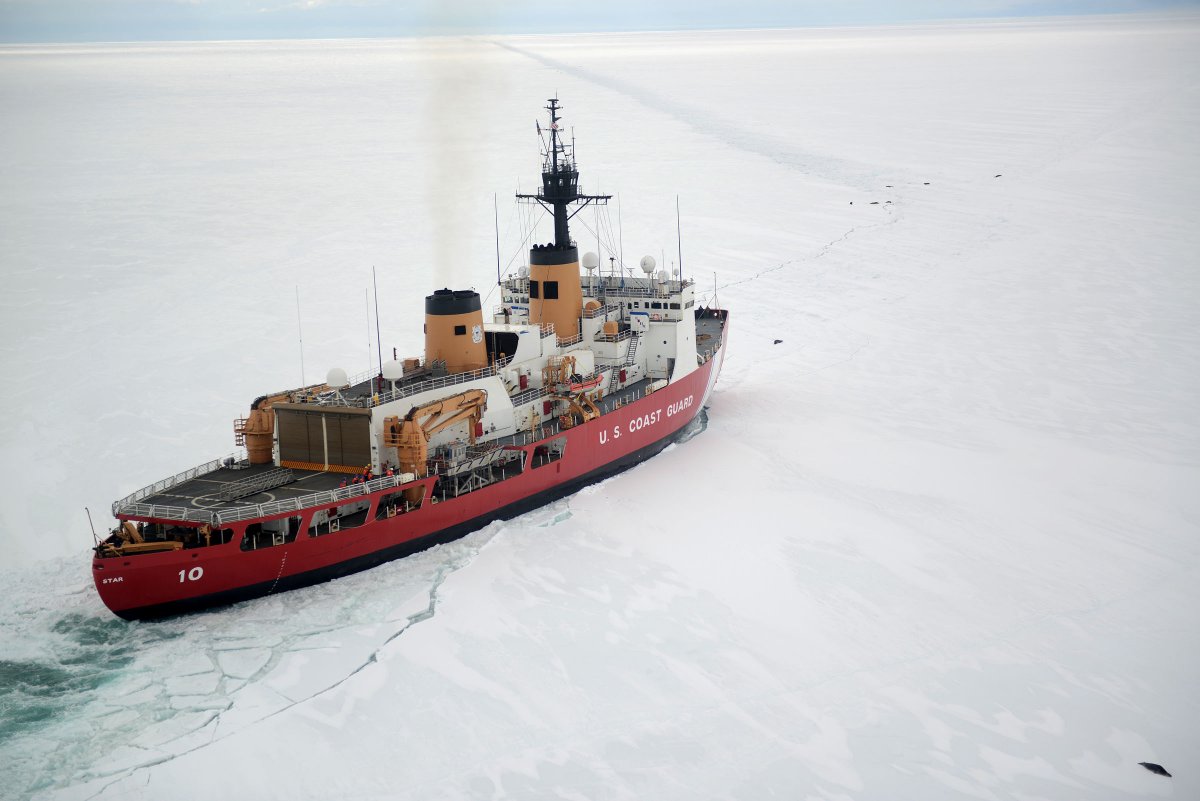
“U.S. Coast Guard Cutter Polar Star completes Operation Deep Freeze 2024 mission, departs Antarctica” –News Release

Below is a Pacific Area news release. I followed the link in the editor’s note and there are some great photos and interesting stories, including the fact that while in McMurdo Sound, divers went under the ice to repair a leaking shaft seal.  

ANTARCTICA, 02.03.2024,Photo by Petty Officer 2nd Class Ryan Graves
U.S. Coast Guard Lt. Cmdr. Don Rudnickas, the Coast Guard Cutter Polar Star (WAGB 10) operations officer, salutes Cmdr. Jayna McCarron, Polar Star’s executive officer, prior to a medal ceremony for Polar Star’s crew on the Ross Ice Shelf, Antarctica, Feb. 3, 2024. The U.S. military’s support of U.S. Antarctic research began in 1955. U.S. Indo-Pacific Command continues to lead the Joint Task Force-Support Forces Antarctica team in providing logistic support for the United States Antarctic Program. (U.S. Coast Guard photo by Petty Officer 2nd Class Ryan Graves)

Feb. 23, 2024

U.S. Coast Guard Cutter Polar Star completes Operation Deep Freeze 2024 mission, departs Antarctica

Editor’s Note: For more imagery of Operation Deep Freeze, click here. 

SOUTHERN OCEAN — The U.S. Coast Guard Cutter Polar Star (WAGB 10) and crew departed McMurdo Station, Antarctica, Feb. 12, after operating for 51 days below the Antarctic Circle in support of Operation Deep Freeze 2024.

The Polar Star and crew broke a 38-mile channel through fast ice to create a navigable route for vessels to reach McMurdo Station and escorted a cargo vessel and oil tanker through the ice to and from the station.

“This year, the fast ice in McMurdo Sound was exceptionally thick due to the winds and temperature at the end of last season” said Lt. Cmdr. Don Rudnickas, operations officer. “It challenged our ship and our crew in almost every way, but we met those challenges to achieve our ultimate concern – the resupply of McMurdo Station by sea.”

Before departing the Antarctic Region, the cutter also visited the Bay of Whales, where members from all three of the Coast Guard Regional Dive Lockers dove 90 miles south of the previously documented record for southernmost scuba dive. The crew also went ashore adjacent to the Ross Ice Shelf in the Bay of Whales where they conducted their Antarctica Service Medal ceremony and were able to walk up to the ice shelf.

“Operation Deep Freeze demands more than just breaking ice; it requires navigating the complexities of keeping a 48-year-old cutter operational while subjecting her to the most extreme conditions possible,” said Capt. Keith Ropella, commanding officer. “We rely on the crew’s technical expertise, teamwork, and their commitment to overcoming the relentless obstacles posed by time and nature. It’s also the collaboration of a Joint Task Force, comprised of servicemembers from the U.S. Air Force, Army, and Navy, that play a crucial role in mission success.”

Operation Deep Freeze is the annual logistical support mission provided by the Department of Defense to the National Science Foundation (NSF) managed by the U.S. Antarctic Program (USAP). This includes coordination of strategic inter-theater airlift, tactical intra-theater airlift and airdrop, aeromedical evacuation support, search and rescue response, sealift, seaport access, bulk fuel supply, port cargo handling, and transportation requirements supporting the NSF. This is a unique mission demonstrating U.S. commitment to the Antarctic Treaty and to research programs conducted for the betterment of all humanity. The Polar Star and crew contribute to this yearly effort through icebreaking to clear the channel for supply vessels.

The Polar Star is the United States’ only asset capable of providing access to both Polar Regions. It is a 399-foot heavy polar icebreaker commissioned in 1976, weighing 13,500 tons and is 84-feet wide with a 34-foot draft. The six diesel and three gas turbine engines produce up to 75,000 horsepower.
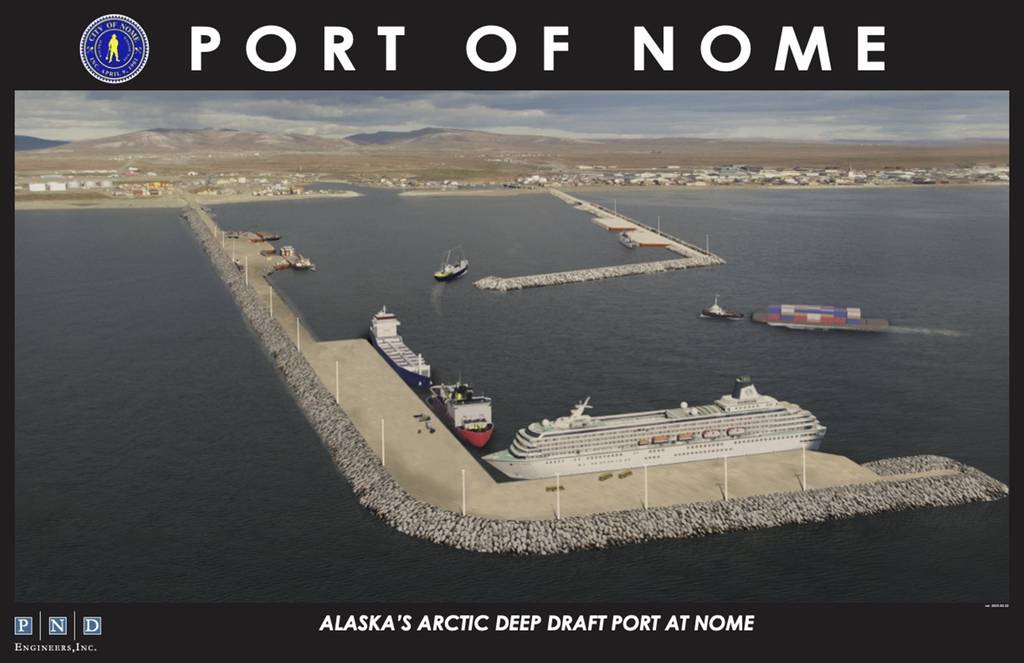
“First US deep water port for the Arctic to host military, cruise ships” –Navy Times

This rendering provided by the City of Nome shows how the Port of Nome, Alaska, will appear following an expansion project that will cost more than $600 million. Shipping lanes that were once clogged with ice for much of the year along Alaska’s western and northern coasts have relented thanks to global warming, and the nation’s first deep water Arctic port should be operational in Nome by the end of the decade. (PND Engineers Inc./City of Nome via AP)

Navy Times reports,

Workers will dredge a new basin 40 feet (12.2 meters) deep, allowing large cruises ships, cargo vessels, and every U.S. military ship except aircraft carriers to dock, Port Director Joy Baker said.

Nome in red. Adapted from Wikipedia’s AK borough maps by en:User:Seth Ilys.

We have been talking about a deepwater port in the area for some time,

Alaska and the Bering Strait

Nome isn’t actually in the Arctic, despite the fact that the US government defines the Arctic to include the Bering Sea. The Arctic Circle runs just a little North of Nome, essentially at the Bering Strait. The Bering Strait connects the Pacific with the Arctic Ocean and is about 44 nautical miles (82 kilometers) wide at its narrowest point. Whoever controls the Bering Strait can regulate traffic between the Pacific and the Arctic Oceans. Having a nearby deepwater port would certainly help, if it were desirable to regulate that traffic. Nome is within 160 nautical miles of the Russian side of the Strait.

Traffic through the Strait has increased and the possibility of a cruise ship disaster in the Arctic is probably a District 17 nightmare, but I think the probability is low that large numbers of CG units will be based at Nome. As noted earlier, I don’t think we will see either large patrol cutters (unless it is the Alex Haley) or FRCs based there but moving one of the Juniper class seagoing buoy tenders there, with its light icebreaking capability might make sense. A medium icebreaker might be a possibility, but that is a very long shot.

As I have noted before, the US Navy’s Pacific Fleet surface ships have not really shown much interest in operating in the Arctic. Their “Arctic” exercises have been in the Gulf of Alaska or little, if at all, North of the Aleutians.

We might see Air Force and Marines in the area in time of War. Airpower and/or shore based anti-ship missiles could control surface traffic through the Strait. Those forces would have to be supplied, which would mean logistics shipping to what we now know will be the deepwater port at Nome. The shipping would presumably require naval protection, air and/or surface.


“Naval shipyard Tandanor to build new icebreaker for Argentina” –Navy Recognition

Artist rendering of the future icebreaker for Argentinian Navy (Picture source: Argentinian MoD)

Navy Recognition reports, state owned “Tandanor Naval Shipyard will proceed to the construction of a polar ship for the Argentinian Navy.”

“The new polar ship will have a length of 131,5 m, a beam of 23,6 m, and could reach a top speed of 16 knots.”

That is 431’4″ long and 77’5″ of beam.

Argentina is moving to strengthen their claim on territory in Antarctica.

In 2015 they completed repairs on their only icebreaker which had suffered a serious fire in 2007.

In 2019 Argentina contracted for four Offshore Patrol Vessels, three of which were to be ice-strengthened. Two of the ice-strengthened OPVs have already been delivered and the third should be delivered this year.

Argentina’s claim on Antarctica overlaps those of the UK and Chile.


“Coast Guard Icebreaker Polar Star Bound for the Arctic in December” –USNI

The Coast Guard Cutter Polar Star cuts through Antarctic ice in the Ross Sea near a large group of seals as the ship’s crew creates a navigation channel for supply ships, January 16, 2017. The resupply channel is an essential part of the yearly delivery of essential supplies to the National Science Foundation’s McMurdo Station.US Coast Guard photo by Chief Petty Officer David Mosley

US Naval Institute News Service reports Polar Star will deploy to the Arctic in December. We knew this was coming, but we have been short of details of when and for how long. This at least indicates it will begin in December. (I will speculate, she will be gone about three months, returning in March to provide a little inport time before going into the yard.)

There seem to be a couple of errors in the story.

“For the first time in almost five decades, the Coast Guard’s heavy icebreaker won’t be supporting Antarctic scientific missions in coming months…”

Coast Guard heavy icebreaker support has not been continuous over that period, at least once, and I believe more than once, the McMurdo break-in was done by non-Coast Guard icebreakers, either contracted foreign icebreakers or the National Science Foundation’s own smaller icebreaker.

“This would be the first Coast Guard operation in the Arctic Ocean since August 1994 when a now-deactivated heavy icebreaker with a Canadian Coast Guard heavy icebreaker reached the North Pole.”

This seems to be missing a qualifier. The Coast Guard has certainly operated in the Arctic since August 1994. There is better information on Polar class operations in the Arctic here, in a Military.com report.

“It will be the first deployment of a U.S. Polar-class icebreaker to the Arctic on a non-science mission (emphasis applied–Chuck) since August 1994, when the heavy icebreaker Polar Sea, now inactive, became one of the first two American surface ships to reach the North Pole.

“In 1998, Polar Star spent three months in the region on a science mission. And in 2009, the Polar Sea conducted a three-month Arctic deployment, also dedicated solely to science.”

Canada’s New Icebreaker, John G. Diefenbaker

Canadian Polar Icebreaker John G. Diefenbaker

Some information from Canadian ship design agency VARD, on the planned Canadian polar icebreaker John G. Diefenbaker. The project is long delayed and construction has not yet begun.

There is much more detail in the VARD brochure and Wikipedia entry linked above, but a few significant data points.

  • Displacement, full load: 23,500 tons
  • Length overall: 150.1 m 492’-6”
  • Length waterline: 137.6 m 451’-5”
  • Breadth moulded 28.0 m 91’-10”
  • Design draft: 10.5 m 34’-6”
  • Generators: 39,600 kW 53,100 hp
  • Propulsion: two 11 MW (14,751 hp) wing shafts and a 12 MW (16,092 hp) azimuth thruster. total 34 MW (45,595 hp),
  • Speed: 18 knots ice free, 3.0 kn, 2.5m ice 
  • Range:  26,000 NM @ 12 kn ice free 
  • 1,800 NM @ 3.0 kn 2.2 m of ice
  • 60 core crew + 40 program personnel
  • Endurance  270 days

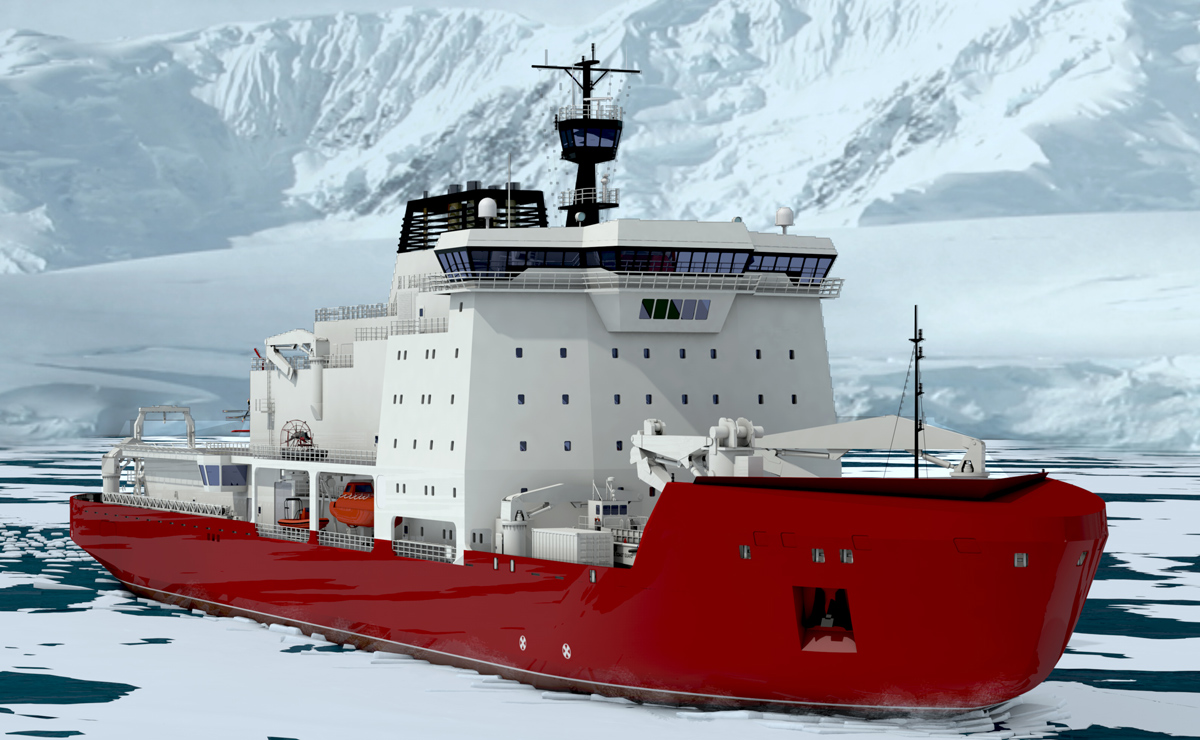
For comparison these are figures for the planned Polar Security Cutter. Projected delivery dates, 2024, 2025, 2027.

  • Displacement, Full Load: 22,900 tons
  • Length: 460 ft (140 meters)
  • Beam: 88 ft (26.8 meters)
  • HP: 45,200
  • Accommodations: 186
  • Endurance: 90 days

In many ways the designs are remarkably close. Looks like the Canadian breaker will be slightly larger than the PSC, but will have a much smaller crew.

Presumably there will be no provision for armament since the Canadian Coast Guard does not arm its vessels.

The Diefenbaker’s very long endurance is a bit of a surprise, in view of Canada’s lack of a requirement to go to Antarctica, a feature that has driven the design of the PSC.

Propulsion power is almost identical, a bit over 45,000 HP, and both designs include three propellers, but the way it is done is different. While the PSC has a conventional shaft on the centerline and rotatable drive units to port and starboard, the Canadian design has a single rotating drive unit on the centerline and conventional shaft driven props port and starboard. This may provide the PSC with a redundancy advantage in that it might allow steerage even if one unit is damaged. On the other hand the single Canadian unit may be less likely to be damaged because of its position.

A Conversation with Admiral Karl Schultz, Commandant of the U.S. Coast Guard–CSIS

CSIS and the United States Naval Institute (USNI) conduct an interview with Admiral Karl L. Schultz, the 26th Commandant of the United States Coast Guard, conducted 1 August, 2018.

Below I will attempt to outline the conversation, noting the topics and in some cases providing a comment.

The first question is about immigration. Coast Guard is the “away game.” minimizing the factors that push immigration to the US.

The Commandant does not expect a substantial increase in help from the Navy, because they are already heavily tasked, but would welcome any additional help.

06:30 Talk about Inland fleet. Congressional support is evident. $25M provided so far.

9:20 House Appropriations Committee decision to divert $750M from the icebreaker program to fund “the Wall” in their markup of the FY2019 budget bill. The Commandant is “guardedly optimistic”

11:30 Human capital readiness? Operating account has been flat and effectively we have lost 10% in purchasing power. Want to increase leadership training.

16:30 Support for combatant commanders.

18:00 Capacity building and partnering. Detachments working on host nation platforms.

21:00 Defense Force planning–Not going back to the MARDEZ model.

22:30 Situation in Venezuela/Preparation for dealing with mass migration.

24:30 Arctic forums–Need to project our sovereignty

29:00 UNCLOS

30:00 Maritime Domain Awareness (MDA)

32:30 Tracking cargo as an element of MDA

34:00 Cyber

36:15 High Latitude engagement/partnerships.

39:30 Perhaps the icebreaker should be the “Polar Security Cutter?”

40:00 International ice patrol, still an important mission.

41:00 CG role in response to Chinese aggressiveness in the South China Sea. In discussion with Indo-Pacific Command. Will see more CG presence there.

44:00 Offshore Patrol Cutter (OPC)–on track

46:30 Border issue — passed on that

48:00 Small satellites–we are looking at them

49:00 African Capacity building/cooperation. May send an MEC.

51:30 Tech modernization. Looking at it more holistically.

Other Coverage:

This interview prompted a couple of notable posts.

SeaPower’s coverage of the discussion is here. They focused on the growth of demands on the Coast Guard.

Military.com reported on the possibility of a greater Coast Guard role in South East Asia and capacity building in Africa. It probably should be noted that the title, “Coast Guard Could Send Ship to Pacific to ‘Temper Chinese Influence’,”is a bit deceptive in that the Commandant’s remark about tempering Chinese Influence was in regard to Oceania, the islands of the Central and Western Pacific. The Commandant was quoted in the Seapower post, “In the Oceania region, there are places where helping them protect their interests, tempering that Chinese influence, is absolutely essential.”