Maybe Another Reason to Look at APKWS

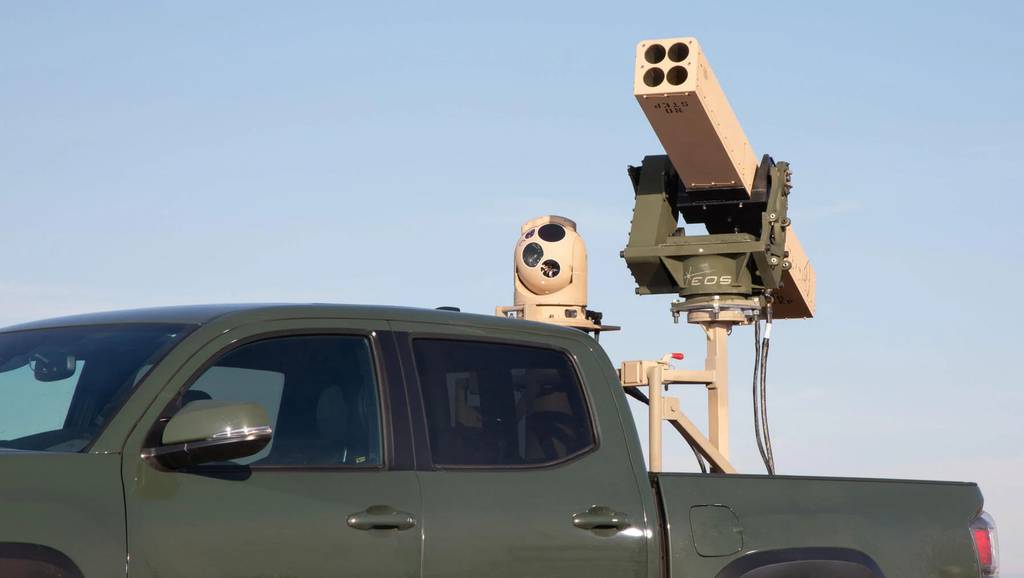
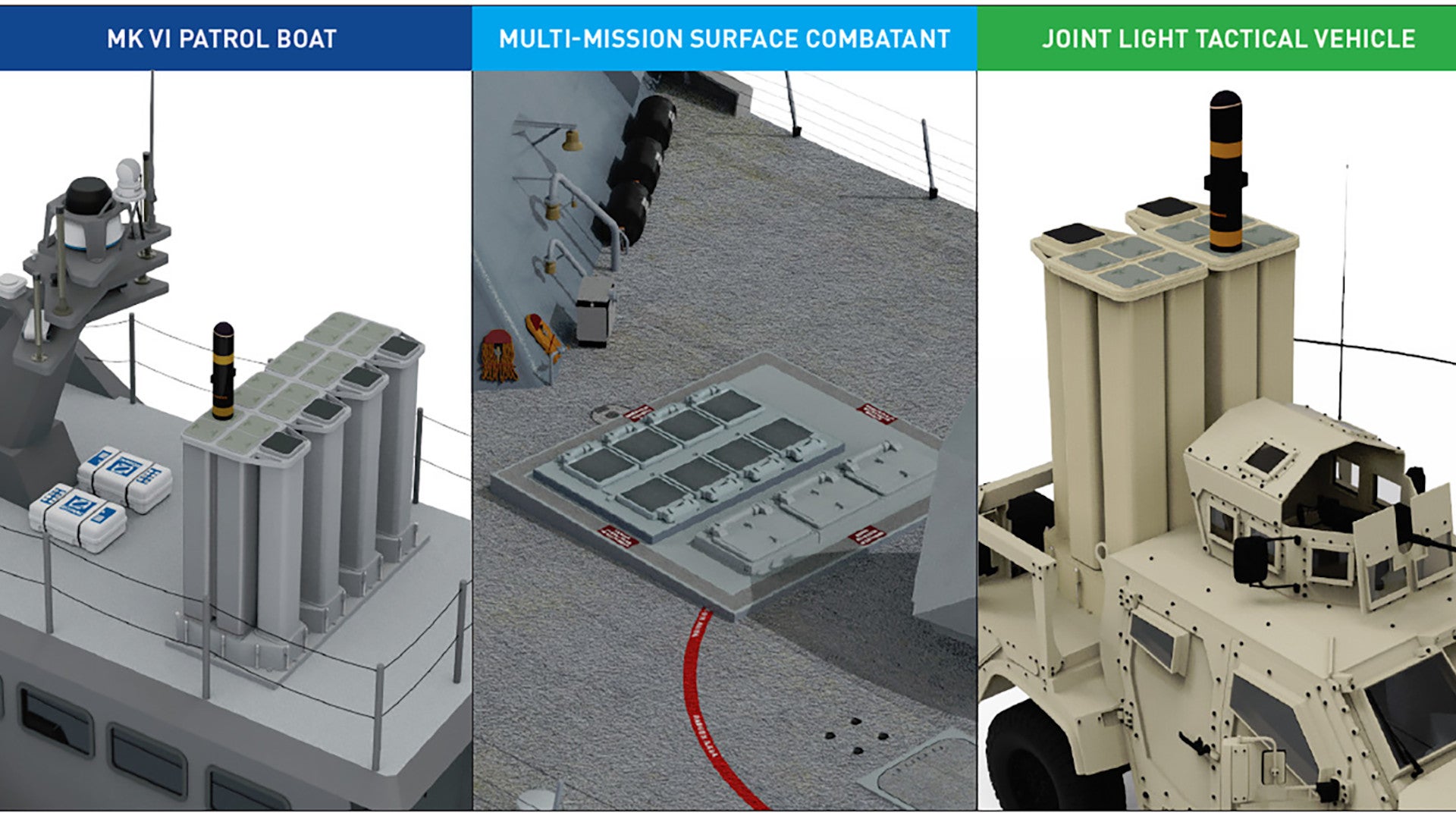
The VAMPIRE system can fit in almost any pickup or vehicle with a cargo bed. (Courtesy of L3Harris)

The Navy League’s on-line magazine, Seapower, reports,

BAE Systems completed additional ground-to-air test firings to prove the effectiveness of 70mm rockets guided by APKWS guidance kits against Class-2 unmanned aerial systems (UAS) that weigh roughly 25-50 pounds and can travel at speeds exceeding 100 miles per hour, the company said in a Nov. 29 release…During the demonstration in Southern Arizona, five APKWS-guided counter-UAS rockets were fired from a containerized weapon system and destroyed all targets, including fast-moving drones.

APKWS  info.

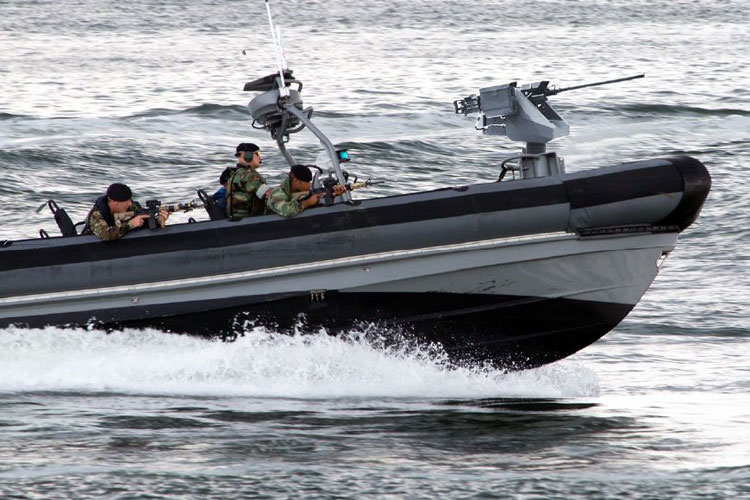
Another Gun/Missile Remote Weapon Station Suitable for Patrol Boats

Navy Recognition reports,

At Euronaval 2022, a naval defense exhibition that was held in Paris, French Company Nexter unveils the latest generation of its NARWHAL 20mm remote-controlled turret which is now armed with one 20mm automatic cannon and the MBDA’s AKERON guided missile launch pod.

I am not a fan of this particular system. I would like to see at least a 30mm gun, but it is more evidence of the practicality and desirability of combining small missiles with a gun mounted on a remote weapon station.

Would really like to see the Coast Guard push for an upgrade of their Mk38 gun mounts to incorportate either APKWS or Hellfire / JAGM.

“Laser-Guided Rockets Are Getting New Highly-Versatile Anti-Armor Warhead” –The Drive

The Drive reports on a test of a new warhead for the “Advanced Precision Kill Weapon System” (APKWS)

The Advanced Precision Kill Weapon System, or APKWS, laser guidance kit designed by BAE Systems has been tested in a surface-to-surface role with a new highly versatile, multi-purpose warhead that is capable of taking on armor and other targets. The new warhead is provided by General Dynamics Ordnance and Tactical Systems. The test demonstrated added flexibility for not only the APKWS itself, which is most often employed in air-to-ground applications against more lightly armored targets, but also for all platforms that are capable of firing APKWS rockets.

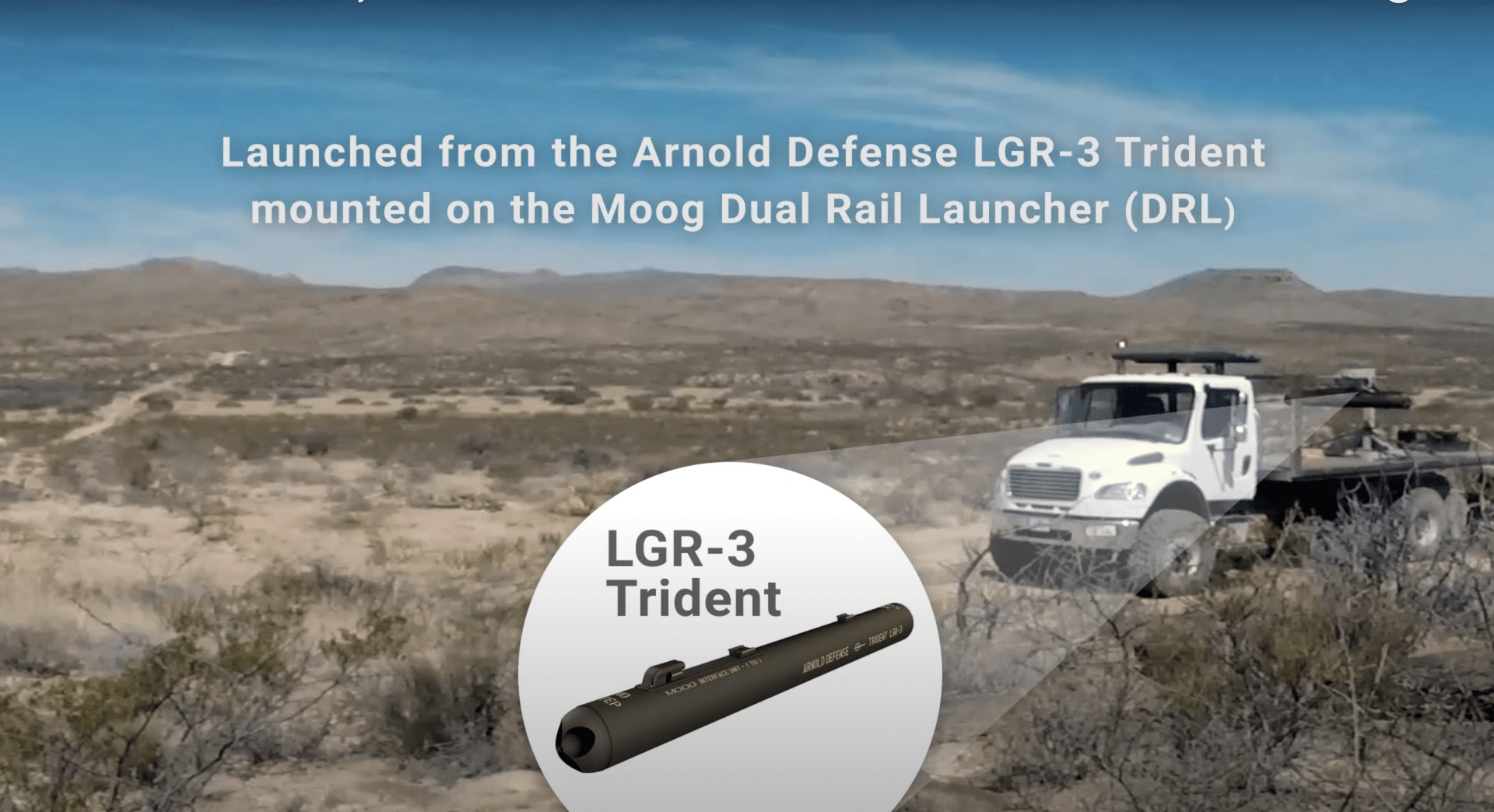
A screenshot from the General Dynamics video showing the launcher configuration used during the test. Credit: General Dynamics

The test also demonstrated a new launcher.

The report was quite complete, providing background and an update on the entire program.

If you have been reading this blog regularly, you know I think APKWS would be a good fit for the Coast Guard as a precision weapon that would be highly effective against small, fast, highly manueverable threats while minimizing the possibility of collateral damage. Its relatively new proximity fuse also makes it effective against Unmanned Air Vehicles which appear to be an emerging threat. APKWS might even be effective against small ships if used in quantity.

For larger threats Hellfire or its replacement, JAGM, would be a better choice, but because this is so much cheaper and available in larger quatities, it appears much more likely. APKWS would probably be a better choice for PATFORSWA where the threat includes large numbers of small craft and UAVs.

We may have seen the video below, but it does suggest that the system is suitable for the 85 foot Navy MkVI patrol boat, so its certainly suitable for cutters of similar size and larger.

“Loitering Munition Strikes Ukrainian Gunboat, A First In Naval Warfare” –Naval News

Naval News reports a Ukrainian Gyruza-M-class patrol boat

Gyurza-M-class gunboat. Photo: Ministry of Defense of Ukraine

has been hit by a Russian Lancet Loitering Munition.

ZALA Lancet, side view, Photo by Nickel nitride

The Ukrainian gunboat seems to have been pretty well armed.

We have talked about Loitering Munitions before:

These could be the answer to the Coast Guard’s need to be able to defeat small, highly manueverable, high speed surface threats.

They also extend the range at which non-state actors might be able to engage Coast Guard units.

“SHARK SMART WEAPON STATION FOR LIGHT BOATS” –Joint Forces / Counter UAS

Joint-Forces reports,

General Robotics of Israel, an advanced systems developer, has unveiled the SHARK Naval RCWS smart weapon station for light boats.

Not only is it light (85 kg without weapon and ammunition), but it also has a unique fire control system,

When the operator presses the trigger, the AI-driven fire control runs a target prediction algorithm to align the projectile’s path and the target’s expected location and points the weapon in that direction. Only then is a burst fired. This technique has demonstrated hit accuracy of about 70 percent. This unique capability enables SHARK to be used as a naval Counter-UAS weapon.

Looks like something the Coast Guard might be interested in.

A pair of these mounted on opposite corners of the PATFORSWA Webber class, replacing two of the crew served .50 cal., might come in handy.

Boom Defense, Everything Old is New Again

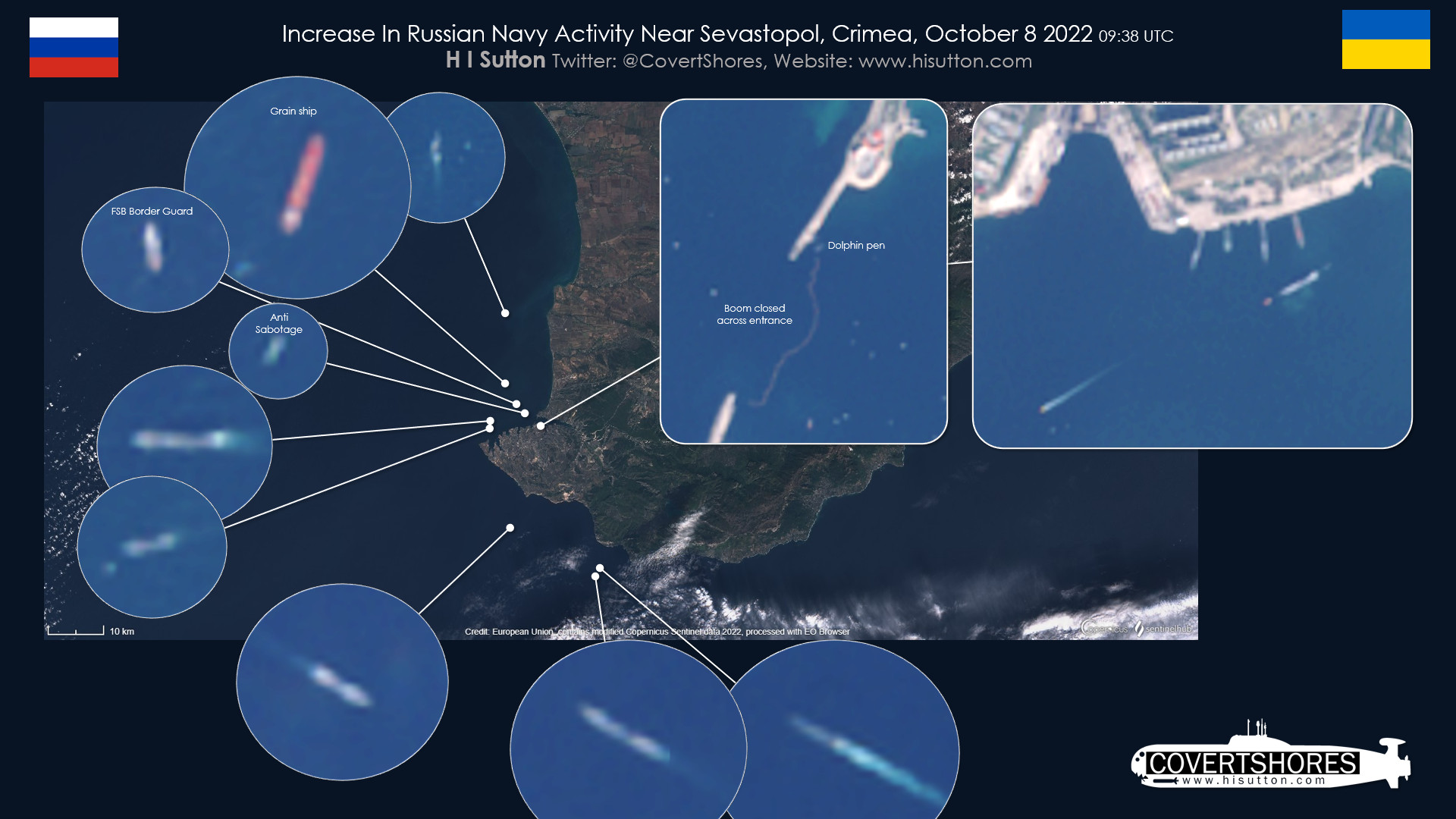
A little footnote on the War in Ukraine. This is from Covert Shores “Attack On Kerch Bridge: Initial Geolocation Of Damage.” A section at the bottom of the post is a look at increased Russian activity after the attack on the bridge.

Take a look at the detail picture of the harbor, above, top, near the center, second from the right. The thin wavy line is a boom or net accross the entrence to Sevastopol harbor.

Steel floats for anti-submarine nets, 1953

Anti-submarine nets were common during WWII, and booms go back to at least the American Revolution if not to antiquity. This may be in response to Ukraine’s apparent use of unmanned surface vessels. I have seen some barriers deployed around aircraft carriers moored at North Island in San Diego.

What does this have to do with the Coast Guard? Buoy tenders were commonly used as Net Tenders during WWII, opening and closing the anti-submarine nets.

Armed unmanned surface and subsurface vehicles are providing a new reason to deploy nets and barriers. We may see a return of these systems.

“Hellfire Missile With Roughly Three Times More Range Tested…” –The Drive

New Lockheed Hellfire/JASM launcher discussed earlier

The Drive reports an exercise that claimed to employ an enhanced version of Hellfire with a range about three times as great as that of the previous versions. Hellfire’s replacement, JASM, perhaps more accurately an upgraded Hellfire, has now been approved for full rate production and there have been reports that a longer range version was in the works.

Beyond the air-launched advantages, this missile would be hugely beneficial for sea-launched applications, such as the LCS. Beyond that, it could be extremely beneficial in servicing Hellfire’s growing surface-to-air role, as well.

Since the typically reported surface to surface range of the Hellfire is 8 km, three times that would be 24 km or over 26,000 yards (equal to the longest ranged battleship hit in WWII). In most cases, that means it can reach anything within the visual horizon. It would also mean, it would out range our 57 and 76mm guns. If this longer ranged Hellfire/JASM is mounted on the new 30 mm Mk38 Mod4, it could mean even Polar Security Cutters will have a potentially more potent weapon than the 57mm Mk110, with a much smaller footprint and lower maintenance requirements.

The weapon would certainly be a welcomed addition to the Webber class patrol craft of PATFORSWA because it would give them greatly enhanced capability against swarming small inshore attack craft, helicopters, and UAS, threats common in their operating area.

As I noted earlier, JASM could provide Coast Guard vessels as small as patrol boats, with a much more accurate, more powerful, and longer ranged response to the need to be able to forcibly stop vessels both small and large, while also providing counter UAS, a degree of anti-aircraft protection, and should it ever be required, a naval fire support ashore capability.

“AGM-179 JAGM: REPLACING THE LEGENDARY HELLFIRE MISSILE” –Sandboxx

U.S. Marines with Marine Aerial Refueler Transport Squadron (VMGR) 252 equip a KC-130J Hercules with AGM-114 Hellfire missiles (U.S. Marine Corps photo by Lance Cpl. Christian Cortez)

Sandbox has a good overview of the Hellfire missile’s replacement, the AGM-179 JAGM (Joint Air Ground Missile–Despite the acronym, this missile will be used surface to surface and even surface to air, as well as air to surface.)

I have for a long time pointed to the Hellfire as a missile that could provide much needed firepower if any of our vessels, down to and including patrol boats, encounter a situation where they need to forcibly stop a vessel, regardless of size, with a near 100% prospect of success against small, fast highly maneuverable targets and at least some chance of success against large ships. All with minimal chance of collateral damage.

The post notes that the AGM-114L Longbow Hellfire, the version used in vertical launchers as part of the anti-surface module on Littoral Combat Ships has been out of production since 2005, but the new missile will include the capabilities of the Longbow Hellfire as well as Semi-Active Laser Homing.

The Missile:

JAGM shares many components with the Hellfire. It has the same dimensions:

  • Length: 70″ (1,800mm)
  • Diameter: 7″ (180mm)
  • Weight: 180 pounds (49 kg)
  • Warhead: 20 pounds
  • Range: 8 km (almost 9,000 yards)

Launchers: 

There are a number of ways the missile could be integrated into the various cutter classes.

There are stand alone single round launchers.

Launch tubes could be attached to existing Mk38 gun mounts.

We could use small vertical launch systems.

Textron Systems’ CUSV with Surface Warfare payload including a Hellfire vertical launch system, the box in the center, at SAS 2019

These weapons will be made in huge numbers, thousands per year, and in the meantime, there are thousands of Hellfires in inventory that could meet our needs. This is a weapon based on the Hellfire’s history of success and with a promising long term future. It has a small foot print, and requires minimal maintenance and training while providing the punch of a 6″ naval gun. Range is expected to be extended to 16 km.

This is doable, at modest cost, and the Navy should pay for most of it.


“‘Vampire’ to transform Ukraine pickups into deadly missile launchers” –Defense News

The VAMPIRE system can fit in almost any pickup or vehicle with a cargo bed. (Courtesy of L3Harris)

Defense News reports,

The U.S. is sending Ukraine “Vampire” kits that transform pickup trucks and other non-tactical vehicles into highly portable missile launchers...The L3Harris-made weapon ― a small, four-barreled rocket launcher and sensor ball ― can be mounted in two hours and operated by a single person, the company said. It can be equipped with missiles to hit ground or air targets including unmanned aircraft systems.

Gee, that sounds like something the Coast Guard could use, first and foremost on the Webber class FRCs of PATFORSWA, but really on virtually all cutters. It could be almost a ubiquous as the .50 caliber machine gun. Good for use against drones and swarming small craft, even small ships, and a bigger single round punch than any weapon in the current Coast Guard inventory.

The weapons expected to be used by the VAMPIRE (Vehicle-Agnostic Modular Palletized ISR Rocket Equipment) system are the AGR-20 APKWS II (Advanced Precision Kill Weapon System), 70mm (2.75″) rockets with a semi-active laser homing guidance kit added.

This is not an expensive, exotic, limited production weapon. It is used in the thousands by the Army, Air Force, Navy, and Marines. It is combat proven. As we noted earlier, in “More on Surface Launch Application of APKWS,

“… the U.S. military has a lot of 70mm rockets and buys thousands more every year. The Army alone plans to buy 60,000 unguided rockets in fiscal 2023 alone. BAE Systems, which builds the APKWS II seeker kit, is tooled to build 25,000 of them per year and is expanding production, according to its website. It has already delivered 37,000 units in six years of production.”

As I have contended,

This is a weapon the Coast Guard could add, relatively painlessly, that could deal with a range of threats including:

  • Drones/Unmanned Air Systems
  • Small, fast, highly maneuverable surface threats
  • Small ships

With the right choice of ammunition type, it might provide a degree of effectiveness against larger ships, all while doing so with great precision and minimal chance of collateral  damage.

It is an easy fix, at least for the lower end of target set. If we can’t mount APKWS launchers on the 25mm Mk38, on the Webber class, we could mount it on the deck immediately above and behind the gun.

That the VAMPIRE system includes a laser designator also means that it can be used to identify targets for supporting units, particularly attack aircraft, something else I think we need.

30mm as Replacement for the 25mm?

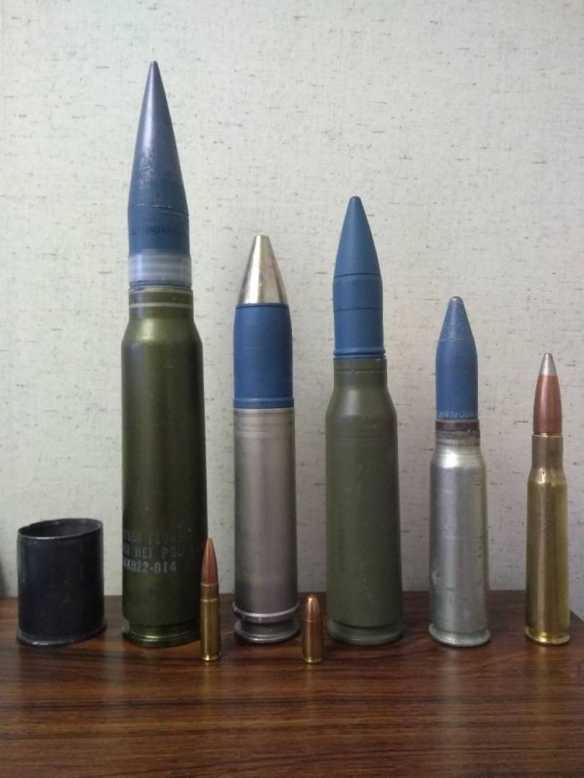
From Back Left: 40mm grenade casing, 30x173mm (A-10/M44), 30x113mm (M230), 25x137mm (M242/Mk38 gun mount), 20x103mm (Phalanx), 50 BMG
foreground: 300Blackout (typical rifle round), 9mmx19 (typical pistol round)

We have known for a long time, the 30mm was much more effective than the 25mm even against relatively small vessels. We really did not need the test to show that, physics is very much on the side of the larger round, but the revalation was how ineffective the 25mm using HEI rounds, really was.

More recently, two options that are not available for the 25mm, have made the case for the 30mm even more compelling, an airburst round that can be used against UAVs and a swimmer round that is much more likely to penetrate the hull if if it hits the water short of the target, subjecting the target to flooding.

Then we saw reports that the Navy was procuring a new, very different Mk38, the 30mm mod4.

Recently, one of our readers, Secundius, in an in comments discussion of the status of the ALaMO guided 57mm projectile program, pointed to a document that reports the funding of Navy Department ammunition purchases. (Incidentally the ALaMO round is in service now. MAD-FIRES is in a 27 month, third stage of development, that should end, January 2023.)

Using the document, I took a look at “other ship gun ammunition,” specifically looking at 25 and 30mm ammunition, in hopes of seeing evidence of fielding of the 30mm Mk38 Mod4.

If I am reading Vol. 1-127 correctly, the Navy bought only target practice rounds for the 25mm in FY2020 and 2021, and no 25 mm rounds in FY2022. On the other hand, in regard to 30mm ammunition, in addition to 120,010 training rounds purchased FY2020-2022, they bought 14,177 Armor Piercing Fin Stabilized Discarding Sabot Tracer (APFSDS-T) rounds in FY2021 and 8,245 in FY2022. 3,000 Counter UAS rounds were purchased in FY2021.

We know the Polar Security Cutter will get the Mk38 Mod4 and that, reportedly, existing installations of the Mk38 Mod2/3 are not expected to be replaced by the new mount.

I feel strongly that if the US ever experiences a terrorist attack, using a medium to large ship, the key asset, that will oppose them, will be a Webber class WPC.

Other US armed forces are not prepared to respond to this threat. There are no Navy ships near most of our ports. Our larger cutter will be either on distant patrol or unable to get underway in time. The Webber class will likely be the most heavily armed cutter available.

To be able to avoid being disabled by improvised armaments such a threat might bring along, e.g. ATGM, heavy machine guns, or anti-tank and anti-aircraft guns, we need to be able to engage from at least 4,000 yards.

Reportedly the 30mm MK258 MOD 1 APFSDS-T Swimmer round, “provides a short time of flight, high impact energy and maximum penetration capability out to more than 4 000 m,” so it should meet the range requirement. The effective range of the 25mm is only 2,700 yards (2,457 m) using HEI projectiles. It is probably over 3,200 yards using the APDS projectile.

The Coast Guard can make a strong case, that ships armed with nothing larger than the 25mm Mk38, specifically the Webber class, should either, be given the more capable 30mm Mk38 Mod4, or have short range missiles like APKWS or Hellfire mounted on the existing mounts (which might be the simplest and best solution). Similar missiles have already been mounted on the Israeli mount that is the Mk38 Mod2/3 and on the MSI mount that is the Mk38 Mod4. (My thoughts on countering such a terrorist threat and what we can do with what we have now are here.

To validate the capability of the 30mm with the APFSDS-T round, we really ought to do a SINKEX, using only this weapon from a range of 4000 yards or more. While a larger target might be more appropriate, the Coast Guard could offer up one or two of its decommissioned Island class 110 foot WPBs as targets for the 2024 RIMPAC. The 30mm used for the SINKEX might not be on a Coast Guard vessel, but perhaps if the first OPCs emerge with the 30mm Mk38 Mod4, they could have the honors. Using an OPC in a Coast Guard SINKEX would be a great debut for the new class, and if the 30mm proves ineffective, after expending the equivilent of an FRC’s ammo allowance, the OPC could then use the 57mm Mk110, perhaps with ALaMO ammunition.

We need to see how effective our weapons and their ammunition really are.

We have already had sort of a SINKEX using the 25mm, and it did not turn out well.