“USCG Report: Small Cutters Prove They Can Patrol a Big Ocean” –Marine Link

Cutters Joseph Gerczak and Juniper refuel in Papeete, Tahiti, while underway during Operation Aiga, February 6, 2022. The two cutters were in the region combating illegal, unreported, and unregulated fishing and other maritime threats on the high seas throughout the Pacific. (U.S. Coast Guard photo courtesy of the USCGC Juniper)(cropped)

Marine Link has an interesting article that recounts the methods that allow the 154 foot Webber “Sentinel” class WPCs “Fast Response Cutters, FRCs”with a nominal endurance of only five days and a range of 2500 nautical miles at 14 knots to deploy well beyond that distance.

Issues that must be dealt with other than limited storage and fuel include lack of an independent duty corpsman and carbon build-up in the engines due to operating at lower than design RPM.

When we go to Tahiti or American Samoa, there’s nothing in between. We’ll usually travel with a ‘black hull’ buoy tender in case we need to take on fuel at sea. But we have to be very careful with our fuel, and how we run our engines, and balance the need to have enough provisions for the trip and arrive safety with at least 20 percent fuel on board with the need to get down there so we can get to work.”

Sea State can also make it difficult to do a Replenishment at Sea (RAS).

The article does not reflect the current number of FRCs planned–77 rather than the 64 indicated in the article. It appears likely that the number of FRCs in Guam will increase from three to six and that additional FRCs (probably three) will be based in American Samoa.)

The article talks about future OPCs allowing National Security Cutters to spend more time in the Western Pacific but makes no mention of USCGC Harriet Lane, currently based in Oahu, or other WMECs that might be based in the Pacific in the Future.

“…in the absence of the perfect asset, the FRCs are the right asset for the job right now. “We’re making it work.”

“Coast Guard to send 3 more cutters to Guam, has no plans to escort Philippine ships” –Stars and Stripes

A U.S. Coast Guard boat crew and boarding team from U.S. Coast Guard Cutter Oliver Berry (WPC 1124) approaches a foreign fishing vessel to conduct a joint boarding inspection with members of the Western and Central Pacific Fisheries Commission on the high seas in Oceania, Sept. 22, 2024. U.S. Coast Guard Cutter Oliver Berry’s crew recently completed a 45-day patrol in Oceania in support of Operation Blue Pacific, promoting security, safety, sovereignty, and economic prosperity in the region.

Stars and Stripes reports,

The Coast Guard will double its Guam fleet to six cutters but doesn’t plan to accompany the Philippine coast guard as it struggles to maintain territorial claims in the South China Sea, the service’s Pacific-area commander said Friday.

This is based on a video news conference by Pacific Area Commander Vice Adm. Andrew Tiongson speaking from Japan.

“The Coast Guard will not escort Philippine resupply missions to the BRP Sierra Madre, a grounded warship garrisoned by Filipino troops at the Second Thomas Shoal in the South China Sea, according to Tiongson.”

The Philippines has not asked for escorts, Tiongson said. “We do advise, and we do assist,” he said. “We provide what we would do in this situation.”

He also said, “It’s possible we may get another Indo-Pacific support cutter,” using the description applied to USCGC Harriet Lane, recently arrived in the Pacific Area to support operations in the Western Pacific.

There is more in the article.

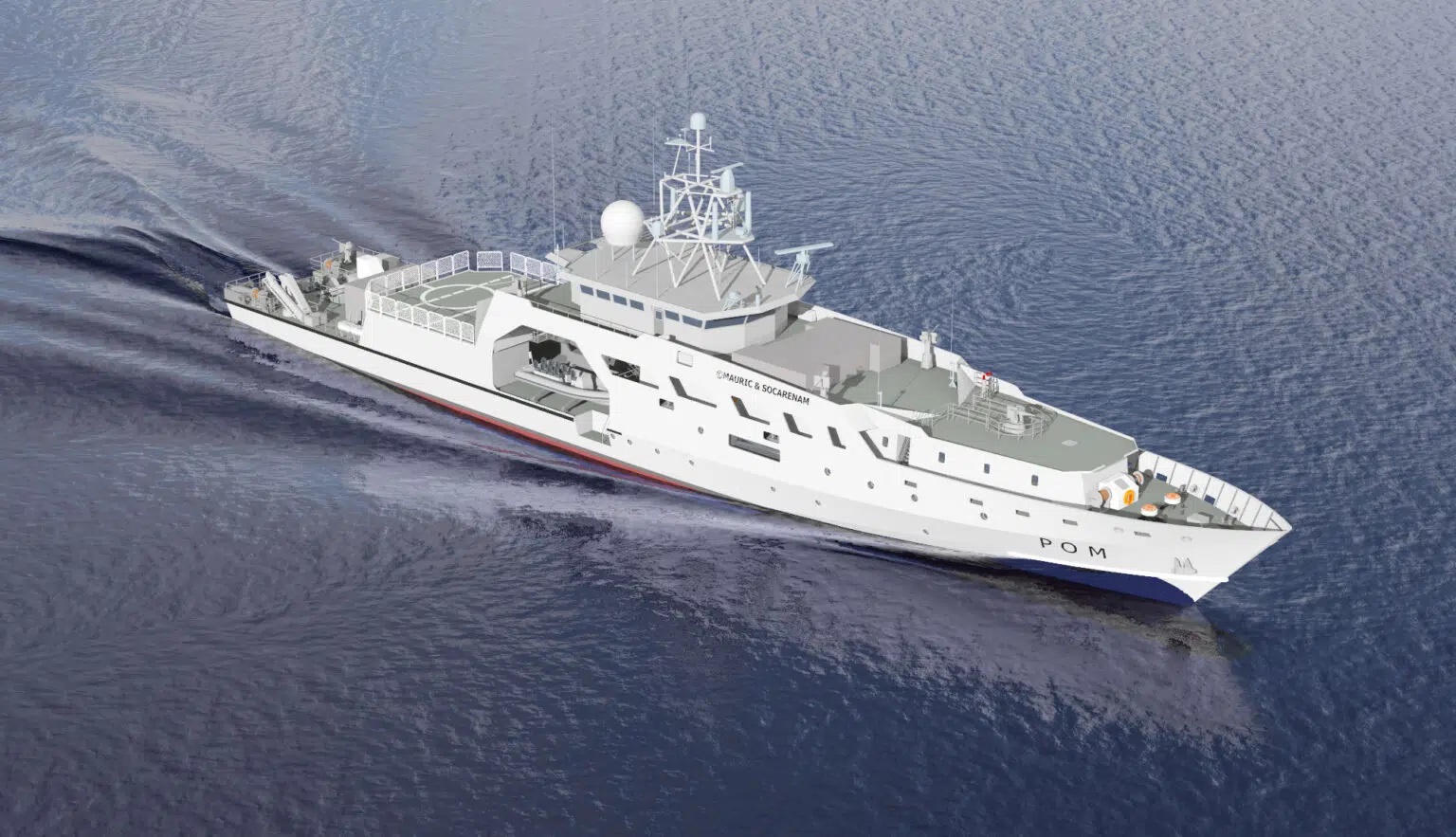
The Félix Éboué class, a Modern, Minimalist, Medium Endurance Cutter

An artist’s rendering, Félix Éboué class or Patrouilleurs Outre-mer (POM)

The Offshore Patrol Cutter (OPC) is described as, “…a capability bridge between the national security cutter, which patrols the open ocean in the most demanding maritime environments, and the fast response cutter, which serves closer to shore.”

That may have been the intention, but that is not what we got.

While the National Security Cutter is better than the WHECs they replaced in almost every way, the OPCs are not only better than the WMECs they will replace, but they are also, in every way except maximum speed, better than the WHECs as well. Instead of a high/low mix of cutters, they all turned out high end. We should not be surprised the OPCs construction and operating costs approach those of the NSCs.

Construction costs are typically proportional to displacement. The OPCs’ displacement is 98% that of the NSC and 1232.8% (more than 12 times) that of the Fast Response Cutters.

This would not be a bad thing, if we had enough NSCs and OPCs to meet our large patrol cutter needs, but I don’t think we will ever get there.

We are expected to ultimately end up with only 36 large patrol cutters, fewer than we have had in decades and fewer than other Coast Guards with far smaller EEZs.

A new fleet mix study has been completed, but the results have not been made public (Why not? This is not transparency). I suspect it shows a need for substantially more than 36 large patrol cutters.

If we look at the previous “Fleet Mix Study,” now over a dozen years old, which minimized requirements because it did not consider “High Latitude regions of the ice shelf and Deployable Operations Group (DOG),” and assumed that NSCs would use the “Crew Rotation Concept” that was expected to allow them to operate 230 days per year, to meet all statutory requirements, the study indicated the Coast Guard needed 66 large cutters, 30 more than currently planned, and 91 FRCs.

If we want significantly more large patrol cutters than currently planned, perhaps we need a smaller, cheaper alternative to the OPCs that requires a smaller crew and are more economical to operate. In previous posts, I have referred to this alternative as (Cutter X).

Thinking Ahead: 

Getting funding for more than two OPCs per year is probably unrealistic. The last OPC is not expected to be commissioned until 2038, 14 years from now. If we continue to build only two large patrol cutter a year, will not be able to grow the fleet until after 2038 and then it will grow slowly because the National Security Cutters will start aging out.

We might not be able to continue to build OPC sized patrol cutter after 2038. The Coast Guard will want to build Arctic Security Cutters (or perhaps Arctic Patrol Cutters). Both the Juniper class WLBs and Keeper class WLMs will need to be replaced.

(Where is our long-range shipbuilding plan?)

If we started in the next year of two, we could be producing true medium endurance cutters in significant numbers before the planned completion of the OPC program. On a 3 for 1 or even 2 for 1 exchange for the last few OPCs, if we tried, we could start to grow the fleet perhaps as early as 2032.

That is why the Félix Éboué class is worth a look. It is, what I believe may be, the absolute minimum fully capable Offshore Patrol Vessel. It covers all the bases. It is good enough for most operating areas. That is not to say, there are no good reasons for some add–ons, but I think it is a kind of benchmark. It is also a good representation of Cutter X. There are reasons we might want to go bigger, but before you increase the quality of the individual cutters, first we need to have enough.


The French Experience

France, like the US has a huge Exclusive Economic Zone (EEZ), the largest in the world, 11,691,000 km2 (4,514,000 sq mi). The US EEZ is 11,351,000 km2.

Unlike the US, the French don’t have a coast guard that operates ocean going ships to enforce laws and protect sovereignty. The French Navy does this, and uses a fleet of Offshore Patrol Vessels, some of which are referred to as frigates.

The Félix Éboué class is their newest class of OPVs. They are intended specifically to patrol the waters of French overseas territories in the Pacific and Indian Oceans. They will be based, two each, at NouméaTahiti and La Réunion. They replace the P400 class, which are slightly larger than the Webber class WPC, which were found to be inadequate.

I have found some very good photos of the second ship of the class being fitted out, that show details I had not seen before, and would like to share them. I will also bring forward some of my earlier commentary with updates, so as to consolidate information on this interesting class.

Comparison with Webber class WPC (FRC):

Below is a comparison between the FRC and the Félix Éboué class (POM) that was included in an earlier post, updated with information about the propulsion system on the French ships.

French overseas patrol vessel (POMs) Auguste Bénébig. Photo: http://www.meretmarine.com

Like an FRC:

I always thought these looked like oversized Webber class, the proportions are similar, and the much larger POM is not much more complicated than the Webber class. The crew of the POM is 30, only six more than that of the FRC. Both have a bridge with a 360-degree view positioned well aft, minimizing vertical acceleration. Both have an 8 meter boat in a stern ramp. The armament is similar with four .50 cal. machine guns and a single medium caliber gun in the bow, a 20mm on the POM and a 25mm on the FRC. The POM uses slightly less powerful diesel engines, 2x ABC 16V DZC medium speed diesels 3.7MW each @ 1,000rpm, for a total of about 9924 HP compared to 11,600 for the FRC. (I am told the POM’s engines are also more economical and simpler to maintain.) But the French ships still manage to make 24 knots, a couple of knots more than claimed for the OPC. With similar crew and systems, they should not cost much more than the FRCs to operate.

Unlike an FRC:
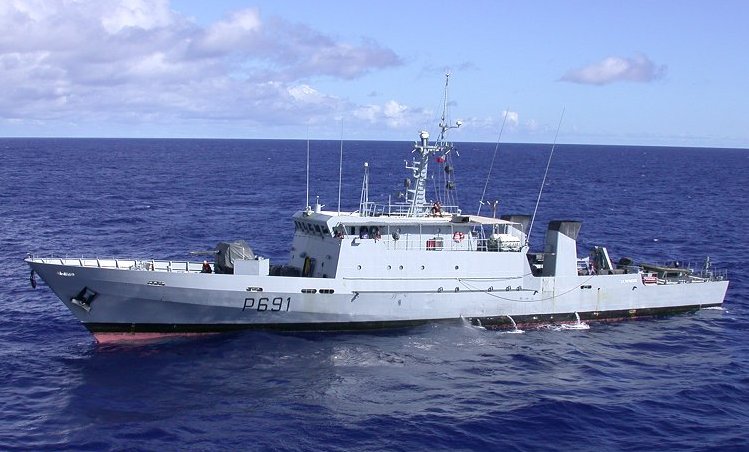
P400 patrol ship Tapageuse at sea near Tahiti (18 June 2003). Photographer: Jean-Michel Roche

While they would have been thinking of their existing 373 ton P400 class pictured above, it might appear to us that they wanted a ship to do the same sorts of missions the Webber class Fast Response cutters (FRC) are doing out of Guam, but they recognized that these ships would be far from any major naval base and that they would need to travel great distances and would be exposed to extreme weather conditions, so they needed to be larger (1300 tons vs 353 tons for the FRC) and have greater range (5500 miles vs 2500) and endurance (30 days vs 5 days).

Having chosen a larger hull, they took advantage of the greater volume and deck space to add a second RHIB, a multimode radar, space for 29 passengers (roughly a platoon of Marines), a sickbay, a dive locker, space for a 20 foot containerized mission module, a flight deck and hangar for a 700-kilogram-class rotor-blade drone (not yet deployed), and a holding area for up to six prisoners.

Some sources also indicate the French ships also have electric motors that would allow them to cruise on the ship’s service generators and secure the main propulsion engines, but I have seen no specifics.

The Photographs: 

The second of the French Navy’s six new overseas patrol vessels (POM), the Teriieroo a Teriierooiterai, which will be based in French Polynesia and has been named in tribute to a Companion of the Liberation native of this Pacific territory, Photo: http://www.meretmarine.com

The Teriieroo at Teriierooiterai fitting out at the end of July, 2023 in Boulogne. Photo: http://www.meretmarine.com

Stern ramp for 8 meter RHIB. French Navy overseas patrol vessel (POM), Teriieroo a Teriierooiterai, fitting out 2023. Photo: http://www.meretmarine.com

Second 8 meter RHIB and davit (only) on starboard side. French Navy overseas patrol vessel (POM), Teriieroo a Teriierooiterai, fitting out 2023. Photo: http://www.meretmarine.com

Aliaca aerial drone on its launch catapult. French Navy overseas patrol vessel (POM), Teriieroo a Teriierooiterai, fitting out 2023. Photo: http://www.meretmarine.com

Recovery System for Unmanned Air System, French Navy overseas patrol vessel (POM), Teriieroo a Teriierooiterai, fitting out 2023. Photo: http://www.meretmarine.com

“Coasties, Marines and Sailors Awarded for Seizing Millions of Pounds of Explosive Materials in Middle East” –Military.com

220822-A-KS490-1182 STRAIT OF HORMUZ (Aug. 22, 2022) From the left, U.S. Coast Guard fast response cutters USCGC Glen Harris (WPC 1144), USCGC John Scheuerman (WPC 1146), USCGC Emlen Tunnell (WPC 1145) and USCGC Clarence Sutphin Jr. (WPC 1147) transit the Strait of Hormuz, Aug. 22. The cutters are forward-deployed to U.S. 5th Fleet to help ensure maritime security and stability across the Middle East. (U.S. Army photo by Spc. Noah Martin)

Military.com reports,

“Hundreds of service members earned an award for seizing two million pounds of “explosive precursor material” in the Gulf of Oman last year, according to a citation obtained by Military.com. It is one of the U.S. military’s largest publicly revealed hauls as it works to stifle arms smuggling in the region.”

The award was made to “192 Marines and sailors with the 26th MEU, 342 sailors assigned to the USS Carter Hall” and unreported numbers of additional personnel “aboard the USS Stethem and Coast Guard Cutters Emlen Tunnell, Glen Harris and John Scheuerman…”

This is not the first time PATFORSWA cutters have stopped shipments of explosives.

I had never heard of the Meritorious Team Commendation (MTC). It is a Coast Guard unit award created in 1993 for groups or teams that are not identifiable by OPFAC as a United States Coast Guard unit.

“USCGC Myrtle Hazard (WPC 1139) enters first drydock maintenance in Honolulu” –Forces Micronesia/Sector Guam

The USCGC Myrtle Hazard (WPC 1139) crew departs Guam for Honolulu on May 13, 2024, marking a significant milestone as the crew prepare for the first drydock maintenance period of approximately four and a half months. Commissioned in 2021, the Myrtle Hazard is the first of three Guam-based Fast Response Cutters to make the transit to Hawaii from Guam, traveling 3,743 miles to undergo this crucial maintenance phase. (U.S. Coast Guard photo by Chief Warrant Officer Sara Muir)

Below is a U.S. Coast Guard Forces Micronesia/Sector Guam news release (more photos there) that clarifies how Guam based Fast Response Cutters will be maintained. Just to provide a hint of how arduous this was, the distance from their base to Hawaii, 3743 nautical miles, would take 12 days at a 14 knot cruise speed, while the nominal range and endurance of ships of this class is 5 days and 2500 miles. Actually, she departed Guam on May 13 and arrived in Hawaii, May 28, 15 days later, presumably having stopped at least once to refuel and resupply. 

USCGC Myrtle Hazard arrived in Guam in September of 2020. This is her very first drydocking. Just getting to Hawaii required a transit equal to 16.3% of the miles she transited during the previous 42 months.

June 4, 2024

USCGC Myrtle Hazard (WPC 1139) enters first drydock maintenance in Honolulu

SANTA RITA, Guam — The USCGC Myrtle Hazard (WPC 1139) crew arrived in Honolulu on May 28, 2024, marking a significant milestone as it enters its first drydock maintenance period of approximately four and a half months. 

Commissioned in 2021, the Myrtle Hazard is the first of three Guam-based Fast Response Cutters (FRCs) to transit to Hawaii from Guam, traveling 3,743 miles to undergo this crucial maintenance phase.

In just the past two years, the Myrtle Hazard crew patrolled a vast 1.9 million square nautical mile area traveling as far south as Australia, accruing over 23,000 nautical miles steamed. The cutter crew enhanced regional maritime security and strengthened international cooperation by participating as the deputy commodore’s platform during a search and rescue exercise phase of Pacific Partnership 2022, the largest multinational humanitarian exercise in the Indo-Pacific. They also operationalized newly signed agreements by conducting historic bilateral boardings with Papua New Guinea, rescued mariners in dangerous sea conditions in the Northern Mariana Islands, and participated in critical operations escorting Department of Defense assets. The drydock maintenance is crucial for maintaining these high standards and ensuring the cutter’s continued ability to perform such missions.

“Throughout the transit east, as we leapfrogged through the Federated States of Micronesia and the Republic of the Marshall Islands to reach Hawaii, this crew demonstrated extraordinary resilience and skill. Despite several engineering challenges that tested our capabilities, their steadfast commitment and proficient handling of all casualties ensured our safe and timely arrival for drydock maintenance. I am immensely proud of their dedication and professionalism, which continue to ensure our readiness and effectiveness in fulfilling our missions,” said Lt. Emma Saunders, commanding officer of the USCGC Myrtle Hazard, on her first transit since assuming command.

Why Drydock is Essential

Drydock maintenance is vital for operational readiness, extending the cutter’s service life, and ensuring the safety of its crew. It involves a series of comprehensive inspections and repairs the crew cannot perform while the vessel is waterborne. These include hull preservation, mechanical overhauls, and technological upgrades, all of which are crucial for maintaining the cutter’s peak performance and safety standards.

Logistical Excellence and Risk Management

The logistical operation to transfer the cutter from Guam to Honolulu highlights the strategic planning and risk management necessary for this evolution. By proactively addressing maintenance needs, the team can meet operational commitments without compromising the safety or effectiveness of the fleet.

“Regular maintenance isn’t just about keeping our ships in shape; it’s about ensuring we’re always ready to meet the challenges we face at sea. Working closely with Coast Guard District 14 and our logistics teams, we schedule these critical maintenance periods to keep our missions running smoothly without missing a beat. This careful planning ensures we’re always there where we’re needed most, from safeguarding our shores to ensuring maritime safety and security across the Pacific. It’s a team effort, and every member of Team Guam plays a part in keeping our commitment strong and our presence steady in the waters we protect and the communities we serve.” said Capt. Robert Kistner, emphasizing the critical role of regular maintenance.

Next Steps for Guam-Based FRCs

Following the Myrtle Hazard, the other two Guam-based FRCs, USCGC Oliver Henry (WPC 1140) and USCGC Frederick Hatch (WPC 1143), will undergo their respective drydock periods. This systematic approach ensures that all vessels maintain their operational capabilities and readiness.

“We are committed to continuous improvement in maintenance practices, which is crucial for fulfilling our mission to protect and secure maritime interests in the Pacific,” said Kistner. “We look forward to Myrtle Hazard’s return this Fall.”

Future Outlook

As Base Guam continues to come online under the command of Cmdr. Dana Hiatt and operators employ the recently established Operational Logistics Command Expeditionary Team (LOG-X) more frequently; the U.S. Coast Guard is exploring enhancements in local maintenance capabilities and infrastructure in the Pacific. This includes potential investments in existing and new purpose-built facilities for Team Guam, which are crucial for minimizing downtime and ensuring a ready fleet capable of meeting future challenges.

Myrtle Hazard, the 39th 154-foot Sentinel-class FRC, is named in honor of the first enlisted woman in the U.S. Coast Guard who served as an electrician and radio operator. As part of the Guam-based cutters, it is a cornerstone for the U.S. Coast Guard’s ongoing commitment to the people of Oceania, focusing on maritime safety, security, and stewardship.

-USCG-

About U.S. Coast Guard Team Guam
Comprising over 350 members, this team is focused on maritime safety, security, and stewardship in Oceania. U.S. Coast Guard Forces Micronesia/Sector Guam, U.S. Coast Guard Base Guam, and their sub-units are staffed by dedicated active-duty, reserve, and civilian personnel. With a significant presence in Guam, Saipan, and the Micronesia sub-region, this integrated team focuses on operations and logistics to support maritime safety, security, and stewardship in Oceania and maintains close ties with local communities.

Changing of the Guard, WPC for WMEC

USCGC ALERT departing Astoria

Passing this along from the “Coast Guard Sea Duty Veterans” Facebook page. The post was by Bill James.


On Friday, 10 May, Cutter ALERT sailed beneath the Astoria-Megler bridge, crossed the Columbia River Bar, and proceeded south enroute to her new homeport of Cape Canaveral, Florida.
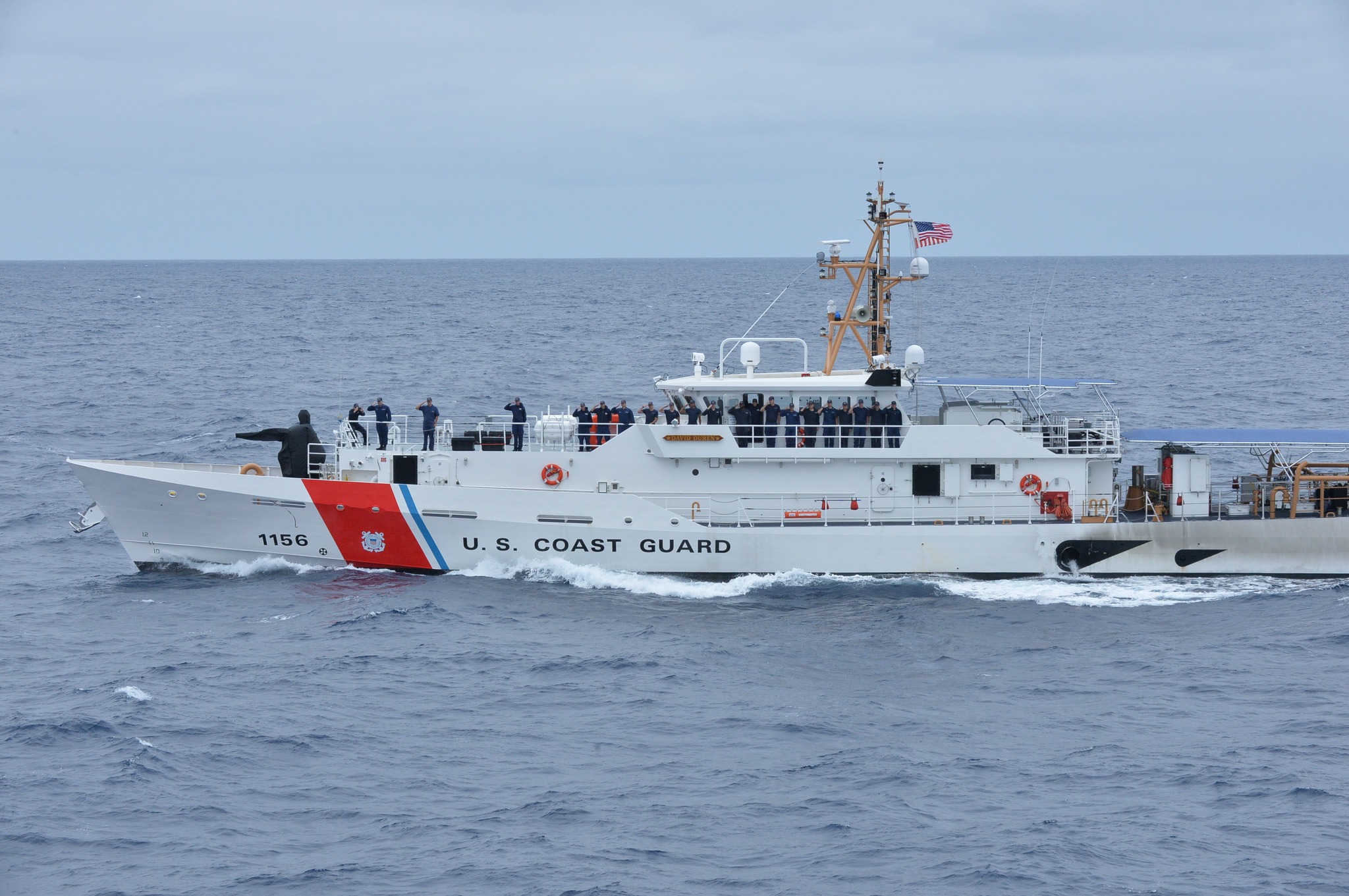
Simultaneously, the newly built CGC DAVID DUREN, one of the two 154’ USCG Sentinel Class cutters proceeded northward on its journey from Key West to its new homeport of Astoria, OR.
This Thursday, 16 May, the two cutters passed close abroad in the Eastern Pacific Ocean. DAVID DUREN rendered passing honors and ALERT returned the salute, thereby properly relieving ALERT’s 30-year watch to the first of two Sentinel Class Cutters to be stationed in Astoria.

USCGC DAVID DUREN (WPC-1156) Renders Passing Honors

“Canadian-Led CTF 150 Seize Nearly 2,000kg of Narcotics in Two Interdictions in a Single Day” –Combined Maritime Forces

Apr 14, 2024
ARABIAN SEA – 240410-N-NO146-1005 ARABIAN SEA (April 10, 2024) Bags of illegal narcotics seized from a vessel are stacked on the deck of the U.S. Coast Guard Sentinel-class fast-response cutter USCGC Clarence Sutphin Jr. (WPC 1147) in the Arabian Sea, April 10. Clarence Sutphin Jr. was operating under Combined Task Force 150, one of five task forces under Combined Maritime Forces, the largest multinational naval partnership in the world. CTF 150 focuses on maritime security operations outside the Arabian Gulf. Crimson Barracuda counters terrorist and criminal organizations’ use of the high seas to smuggle narcotics, weapons, and other illicit substances in the Indian Ocean, Arabian Sea and Gulf of Oman.

Below is a news release from Combined Maritime Forces Public Affairs.

I would note two things about this particular incident. The use of “Canadian space-based intelligence” to cue the cutter’s interdiction, and second, that you can see Long Range Acoustic Devices mounted on the cutter in the photo above. Below is a close-up.

Long Range Acoustic Device.


MANAMA, Bahrain —The Canadian-led Combined Task Force (CTF) 150 carried out two drug interdictions at sea in a single day as part of Focused Operation Crimson Barracuda in the Arabian Sea, April 10. The two interdictions resulted in the seizure of a combined total of nearly 2,000 kg of drugs.

The Royal Navy’s HMS Lancaster, a Duke-class Type 23 frigate, seized over 800 kg of hashish, 390 kg of methamphetamines and 110 kg of heroine from a stateless dhow in the Arabian Sea. This was the crew’s first day of deployment after completing a crew swap a few weeks before.

“I am exceptionally proud of the entire team in Lancaster executing this interdiction on the first day of our deployment,” said Royal Navy Cmdr. Chris Sharp, HMS Lancaster’s commanding officer. “Complex interdictions in such a challenging environment require true teamwork across the entire ship’s company. This success is shared with our partners in CTF 150 who provided essential support to the operation.”

Then, using Canadian space-based intelligence, the Sentinel-class fast-response cutter USCGC Clarence Sutphin Jr. (WPC 1147) seized 257 kg of methamphetamines, 92 kg of heroine, 17 kg of amphetamines, 296 kg of hashish, and 15 kg of marijuana from another dhow in the Arabian Sea. After weighing and documenting the hauls, the crew disposed of the narcotics.

Clarence Sutphin Jr is forward deployed to Bahrain as part of a contingent of U.S. Coast Guard ships under Patrol Forces Southwest Asia (PATFORSWA). PATFORSWA deploys Coast Guard personnel and ships alongside U.S. and regional naval forces throughout the Middle East.

“These two interdictions have made a significant dent in criminal and terrorist organizations’ ability to use drugs to fund their activities,” said Royal Canadian Navy Capt. Colin Matthews, Commander Combined Task Force 150. “The collaboration of our assets and personnel allowed us to become a precise and highly effective team that not only undermined the efforts of these organizations, but also nearly 2,000 kg of drugs from hitting the streets.”

Crimson Barracuda counters terrorist and criminal organizations’ use of the high seas to smuggle narcotics, weapons, and other illicit substances in the Indian Ocean, Arabian Sea and Gulf of Oman.

CTF 150 is one of five task forces under Combined Maritime Forces, the world’s largest international naval partnership. CTF 150’s mission is to deter and disrupt the ability of non-state actors to move weapons, drugs and other illicit substances in the Indian Ocean, the Arabian Sea and the Gulf of Oman.

Combined Maritime Forces is a 42-nation naval partnership upholding the international rules-based order by promoting security and stability across 3.2 million square miles of water encompassing some of the world’s most important shipping lanes.

“Coast Guard to commission new ship in New London, Connecticut”

USCGC MELVIN BELL (WPC-1155) Photo by: Petty Officer 2nd Class Briana Carter VIRIN: 240131-G-HT254-1095.JPG

Below is a Coast Guard news release. This may be the first time many cadets will get an opportunity to see a Webber class WPC. Note the approximately four and a half months between delivery and commissioning. The next two FRCs will go to Astoria, Oregon.


March 25, 2024

MEDIA AVAILABILITY: Coast Guard to commission new ship in New London, Connecticut

WHO: Rear Adm. John W. Mauger, the First Coast Guard District commander, Lt. Patrick Kelly, the Coast Guard Cutter Melvin Bell (WPC-1155) commanding officer, Rita Mayer, the cutter’s sponsor, along with additional Bell family members.
WHAT: Commissioning Ceremony for Coast Guard Cutter Melvin Bell
WHEN: Thursday, March 28, at 10:00 a.m.
WHERE: Coast Guard Academy at 31 Mohegan Ave Pkwy, New London, CT 06320.

Editor’s Note: Media interested in attending must RSVP to D1PublicAffairs@uscg.mil by 8 a.m. Wednesday to gain access to the ceremony.

New London, CT. — The Coast Guard Cutter Melvin Bell (WPC-1155) is scheduled to be commissioned during a ceremony Thursday at 10 a.m. at the Coast Guard Academy in New London.

The Coast Guard’s newest cutter was accepted by the Coast Guard on November 16, 2023, and will be the sixth and final fast response cutter homeported in Boston.

The Sentinel-class fast response cutter (FRC) is designed for multiple missions, including drug and migrant interdiction; ports, waterways and coastal security; fishery patrols; search and rescue; and national defense. The Coast Guard has ordered a total of 65 FRCs to replace the 1980s-era Island-class 110-foot patrol boats. The FRCs feature advanced command, control, communications, computers, intelligence, surveillance and reconnaissance equipment; over-the-horizon cutter boat deployment to reach vessels of interest; and improved habitability and seakeeping.

All Coast Guard fast response cutters are named after an enlisted Coast Guard hero who distinguished themselves in the line of duty. Melvin Kealoha Bell was a master chief electronics technician and served in the Coast Guard from November 1938 to December 1958. ETCM Melvin Bell distinguished himself during World War II by transmitting the first warning messages to military installations in Pearl Harbor on the morning of December 7, 1941, when the Japanese attacked. He continued to prove instrumental throughout the war as he helped break enemy codes leading to numerous victories, including the Battle of Midway and in an operation to break up a Nazi espionage network in New York City. ETCM Bell became the first Pacific Islander to achieve the rank of chief petty officer, the first master chief electronics technician and the first master chief petty officer of color.

“Coast Guard Cutter Procurement: Background and Issues for Congress, Updated March 25, 2024” –CRS

USCGC David Duren is the first of three FRCs to be homeported in Astoria, OR

The Congressional Research Service (CRS) has again updated their “Report to Congress on Coast Guard Cutter Procurement”. (This link will always take you to the most recent edition of the report.) My last post on this evolving document was in reference to the October 19,2023 update. I have reproduced the one-page summary in full below. It gives a good picture of where we are. (The CRS report on icebreakers has also been updated.)

There have been other updates in the interim, but I have been looking forward to this one because it reports the 2024 budget as enacted into law, and (surprise, surprise) it includes two Fast Response Cutters that were not in the 2024 budget request. From page 35,

“Enacted The explanatory statement for Division C of H.R. 2882/P.L. 118-47 of March 23, 2024, provides the funding levels shown in the “Enacted” column of Table 1. The explanatory statement states that the increase of $200.0 million for the FRC program is for “no less than two Fast Response Cutters and the economic price adjustment for Fast Response Cutters funded in prior years”.”

There was a request for four additional FRCs in the Unfunded Priorities List. The House Appropriations Committee had wanted to fund four ($355M) while the Senate Appropriations Committee approved none. Apparently, they compromised. (Nice to see bipartisan support.)

Two Additional FRCs ($216M) are also in the 2025 budget request. (The appropriation amounts include addition funds for FRC program support over and above shipyard construction costs.)

If you do the math, you will see that there has been a departure from the original “Program of Record” (8 NSCs, 25 OPCs, and 58 FRCs for 91 total). The current program will provide 11 NSCs, 25 OPCs, and 67 FRCs (one of which severely damaged in a fire) for a total of 102 operations ships, 104 if we get the two additional FRCs in the FY2025 budget.

While this may look like a large gain, the number of large patrol cutters (36 over 1000 tons) is well below historical norms (=>41), while demands on the cutter fleet have grown substantially, no OPCs have been actually delivered, and the entire WMEC fleet is already well overage.


Summary
The Coast Guard’s program of record (POR), which dates to 2004, calls for procuring 8 National Security Cutters (NSCs), 25 Offshore Patrol Cutters (OPCs), and up to 71 Fast Response Cutters (FRCs) as replacements for 90 aging Coast Guard high-endurance cutters, medium-endurance cutters, and patrol craft.

National Security Cutters are the Coast Guard’s largest and most capable general-purpose cutters; they are replacing the Coast Guard’s 12 Hamilton-class high-endurance cutters. NSCs have an estimated average procurement cost of about $670 million per ship. Congress has fully funded the procurement of 11 NSCs—three more than the 8 in the Coast Guard’s POR. The Coast Guard’s proposed FY2024 budget requested $17.1 million in procurement funding for the NSC program. The Coast Guard’s proposed FY2025 budget requests $7.0 in procurement funding for the NSC program, and the Coast Guard’s FY2025 Unfunded Priorities List (UPL) includes an item for an additional $50.0 million in procurement funding for activities relating to the 11th NSC. Nine NSCs have entered service; the Coast Guard accepted delivery of the 10th on October 13, 2023, and plans to commission it into service in 2024. The 11th is under construction.

Offshore Patrol Cutters are intended to replace the Coast Guard’s 29 aged medium-endurance cutters. Coast Guard officials describe the OPC program and the Polar Security Cutter (PSC) program (which is covered in another CRS report) as the service’s highest acquisition priorities. The first four OPCs are being built by Eastern Shipbuilding Group (ESG) of Panama City, FL. The Coast Guard held a full and open competition for a new contract to build the next 11 OPCs (numbers 5 through 15). On June 30, 2022, the Coast Guard announced that it had awarded a fixed-price incentive (firm target) contract to Austal USA of Mobile, AL, to produce up to 11 offshore patrol cutters (OPCs). The Coast Guard’s proposed FY2024 budget requested $579.0 million in procurement funding for the construction of the sixth OPC and other OPC program costs. The Coast Guard’s proposed FY2025 budget requests $530.0 million in procurement funding for the construction of (once again) the sixth OPC and other OPC program costs, and states that the requested FY2024 procurement funding would now be for the construction of the fifth OPC rather than the sixth.

A June 2023 Government Accountability Office (GAO) report on the OPC program states “The OPC’s total acquisition cost estimate increased from $12.5 billion to $17.6 billion between 2012 and 2022…. In addition, the program incurred a 1.5-year delay in the delivery of the first four OPCs…. GAO also found indicators that the shipbuilder’s significant level of complex, uncompleted work may lead to further delays.”

Fast Response Cutters are considerably smaller and less expensive than OPCs; they are replacing the Coast Guard’s 49 aging Island-class patrol boats. The Coast Guard’s FY2020 budget submission estimated the total acquisition cost of the 58 cutters intended for domestic use at $3.748 billion, or an average of about $65 million each. A total of 65 FRCs have been procured through FY2023. As of March 25, 2024, 54 FRCs have been commissioned into service. The Coast Guard’s proposed FY2024 budget requested $20.0 million in procurement funding for the FRC program, and the Coast Guard’s FY2024 UPL included an item for $400.0 million in procurement funding for procuring four more FRCs at an average cost of $100 million each, to provide increased Coast Guard presence and engagement with allied and partner countries in the Indo-Pacific region. The Coast Guard’s proposed FY2025 budget requests $216.0 million in procurement funding for the FRC program for the procurement of two more FRCs for operations in the Indo-Pacific region, plus additional FRC program costs.

“BOLLINGER SHIPYARDS DELIVERS US COAST GUARD CUTTER DAVID DUREN (FRC 1156) TO U.S. COAST GUARD” –Bollinger News Release

USCGC David Duren is the first of three FRCs to be homeported in Astoria, OR

Below is a Bollinger news release.

This delivery is a little more than 16 weeks after the delivery of USCGC Melvin Bell (WPC-1155) on November 16, 2023. There are still nine more on order, and the FY 2025 budget request asks for two more. The Coast Guard has said all 65 on order will be delivered by 2025, but that seems unrealistic. Delivery rates have generally been five per year or less, and it appears there will be only three in 2024. Looks like deliveries will extend into at least 2026.

The next Fast Response Cutter, the future USCGC Florence Finch (WPC-1157) will also go to Astoria and is expected to be delivered June 13, 2024. Sector Columbia River will have to wait a bit for their third FRC since WPC-1158 is expected to go to Kodiak with delivery expected October 24, 2024.

As noted below, deliveries are made at Key West. Typically, it has been about three months from delivery to commissioning of units this class.


LOCKPORT, La., — (March 18, 2024) – Bollinger Shipyards (“Bollinger”) recently delivered the USCGC David Duren to the U.S. Coast Guard in Key West, Florida. This is the 182nd vessel Bollinger has delivered to the U.S. Coast Guard over a 35-year period and the 56th Fast Response Cutter (“FRC”) delivered under the current program.

“We’re incredibly proud to deliver the USCGC David Duren, the first of three Fast Response Cutters to be homeported in Astoria, Oregon,” said Bollinger President & CEO Ben Bordelon. “We’re confident that pound for pound, the quality and capabilities of the FRC platform are unmatched and that this vessel will outperform its mission requirements and expectations in the challenging conditions where it will operate in the Pacific Northwest. Our unique experience building for the Coast Guard is unparalleled and has shown time and time again that we successfully deliver the highest quality vessels on a reliable, aggressive production schedule. We look forward to continuing our historic partnership with the U.S. Coast Guard.”

The USCGC David Duren will be the first of three FRCs to be homeported in Sector Columbia River, which is known as “The Protectors of the Pacific Northwest.” The sector is responsible for coastal safety, security, and environmental protection, as well as protecting and securing vital infrastructure, rescuing mariners in peril at sea, enforcing federal law, maintaining navigable waterways, and responding to all hazards impacting the maritime transportation system along the Oregon coast.

As the U.S. Congress continues to debate Fiscal Year 2024 government funding, the future of the Fast Response Cutter Program remains uncertain. While the House Homeland Security Appropriations Bill included funding for four new FRCs, the Senate bill did not include funding for any new vessels. The prospect for a year-long Continuing Resolution (CR) at last year’s funding level introduces a critical level of uncertainty, as funding levels continue to lag behind the meteoric rise in raw material and input costs. The Coast Guard’s Fiscal Year 2025 Budget to Congress includes procuring two more FRCs to provide increased Coast Guard presence and engagement with allied and partner countries in the Indo-Pacific region. Last year, Adm. Linda Fagan, the Commandant of the U.S. Coast Guard, said, “The Indo-Pacific is clearly a consequential region for America’s future. The United States Indo-Pacific Strategy identifies an expanded role for the U.S. Coast Guard as a top Administration priority as we seek to ensure a region that is free and open. The U.S. Coast Guard will continue its long history of operational presence in the region with additional cutter patrols and deployable specialized forces.”

Each FRC is named for an enlisted Coast Guard hero who distinguished themselves in the line of duty. Boatswain’s Mate Master Chief David N. Duren was one of the most iconic figures in the history of Coast Guard surfmen. Considered perhaps the finest boat driver in the history of the modern Coast Guard, he is remembered by his shipmates and mentees not only for his expertise in seamanship, but also for his leadership and character. Between 1979 and 1983, Duren deployed on search and rescue cases more frequently than any other officer-in-charge and, in one year, executed over 250 cases. During this tour, Duren received two Coast Guard Medals for exceptional heroism, and the Douglas A. Munro Inspirational Leadership Award. Perhaps more remarkable was the fact that the personnel under his watch at Depoe Bay earned a total of 24 medals and awards.

ABOUT THE FAST RESPONSE CUTTER PLATFORM

The FRC is an operational “game changer,” according to senior Coast Guard officials. FRCs are consistently being deployed in support of the full range of missions within the United States Coast Guard and other branches of our Armed Services due to its exceptional performance, expanded operational reach and capabilities, and ability to transform and adapt to the mission. FRCs have conducted operations as far as the Marshall Islands—a 4,400 nautical mile trip from their homeport. Measuring in at 154 feet, FRCs have a flank speed of 28 knots, state of the art C4ISR suite (Command, Control, Communications, Computers, Intelligence, Surveillance, and Reconnaissance), and stern launch and recovery ramp for a 26-foot, over-the-horizon interceptor cutter boat.

ABOUT BOLLINGER SHIPYARDS

Bollinger Shipyards (www.bollingershipyards.com) has a 78-year as a leading designer and builder of high-performance military patrol boats and salvage vessels, research vessels, ocean-going double hull barges, offshore oil field support vessels, tugboats, rigs, lift boats, inland waterways push boats, barges, and other steel and aluminum products from its new construction shipyards as part of the U. S. industrial base. Bollinger has 13 shipyards, all strategically located throughout Louisiana and Mississippi with direct access to the Gulf of Mexico, the Mississippi River and the Intracoastal Waterway. Bollinger is the largest vessel repair company in the Gulf of Mexico region.