When is a Flight Deck Not a Flight Deck?

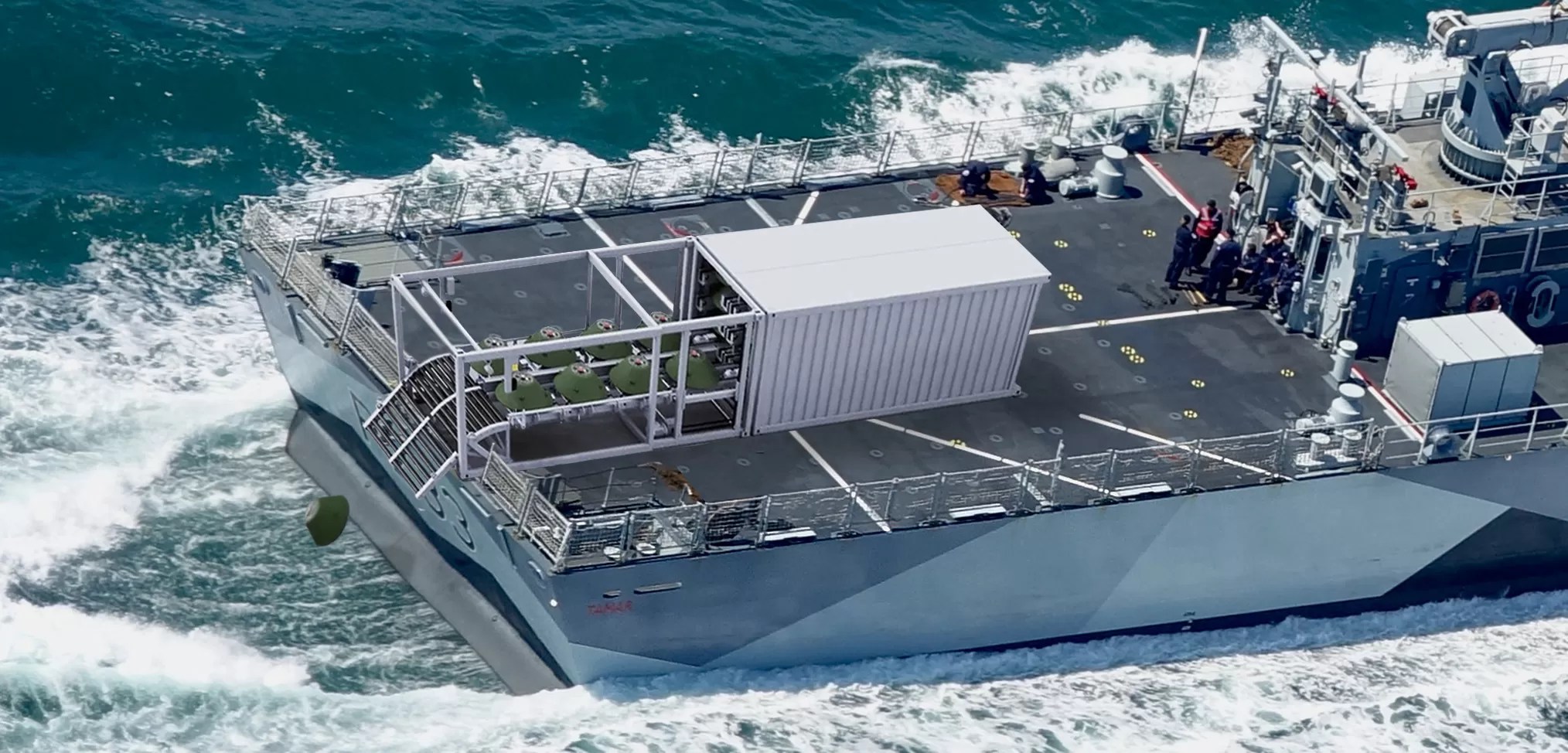
Containerized minelaying system on a River Batch 2 Offshore Patrol Vessel

It has been said that aircraft carriers are the ultimate modular warships because their primary weapons (aircraft) are interchangeable.

A flight deck on an Offshore Patrol Vessel (OPV) certainly offers a degree of aviation options. General purpose, cargo, ASW, and ASuW helicopters and a range of Unmanned Air Systems, but it appears our allies, the UK and particularly Australia may be looking at other ways to use this large open space.

Royal Navy:

Navy Lookout had a post that talked about restoring a naval mining capability in the Royal Navy. There was no specific reference to using flight decks or to Offshore Patrol Vessels.

The RN does not need dedicated minelaying vessels. The SSNs have a theoretical minelaying capability but XLUUVs are a much lower risk and stealthier solution for covert and sensitive missions. Where stealth is less important, containerised minelaying solutions are being developed that can be secured to the deck and dispense mines over the stern. (emphasis applied–Chuck)

But the photo, above, definitely got my attention. There we see an SH Defence “CUBE” containerized mine laying system developed by RWM Italia S.p,A. (Rheinmetall). on the flight deck of a River Batch 2 Offshore Patrol Vessel (HMS TAMAR).

Australian Navy:

Australia is planning to produce up to 14 flight deck equipped Arafura class OPVs including two intended specifically for Mine Counter Measures (MCM). These ships were always intended to accept containerized mission loads. It appears they are now planning what these ships will do in wartime.

Missile Launcher:

We already saw “Australia Considering Modular C-Dome For Arafura OPVs” –Naval News
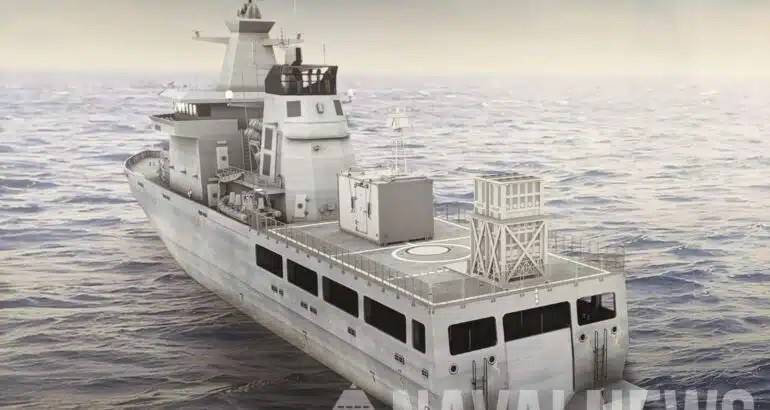
Australia Considering Modular C-Dome For Arafura OPVs
Illustration of Arafura-class OPV fitted with C-DOME

Mine Layer:

As noted in the Navy Lookout, Australia is planning to buy and produce large numbers of mines. Naval News reports,

“Australia is set to accelerate the procurement of sea mines as part of Project SEA 2000…The decision to rapidly procure the capability, reportedly from a European supplier, will deliver a ‘significant’ deterrent effect according to Defence…it’s understood that the government has budgeted approximately $500 million to 1 billion Australian dollars for the acquisition…the weapons being brought are smart mines, able to disseminate between civilian vessels and a variety of military targets, allowing a strategic anchorage to be denied to hostile forces, all the while preserving access for aligned vessels(emphasis applied–Chuck)

This all points to large numbers of mines being used in defensive fields. Such minefields will almost certainly be laid by surface vessels. Australia does have some civilian crewed support ships that might be used for mine laying, but as the Arafura class comes online, they will be the most likely surface minelayers.

SURTASS-E:
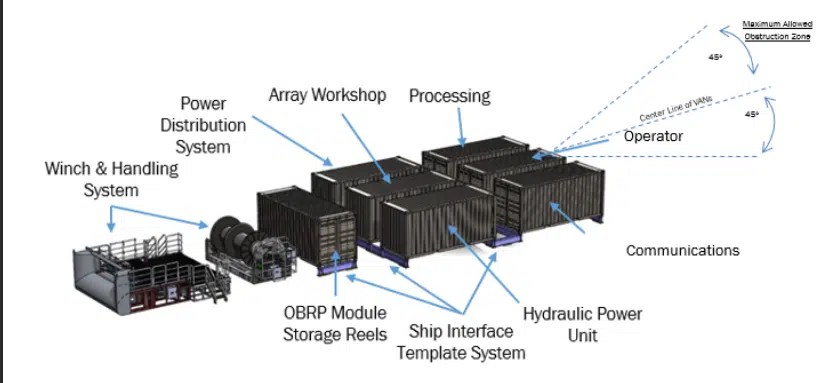
SURTASS-E. (U.S Department of Defense)

Then there is these reports from Naval News and The Drive that Australia is getting SURTASS-E systems.

SURTASS-E is expected to provide long range detection and cuing for tactical weapons, against both diesel- and nuclear-powered submarines. Again, the Arafura class seems a likely host, because the system is intended for military crew manning and, unlike the civilian manned National Support Squadron ships, these ships are armed and have communication systems that include tactical data link.

Now About the Coast Guard:

Using a flight deck for non-aviation purposes is not a foreign idea to the Coast Guard. They do it all the time to provide a holding area for migrants. 
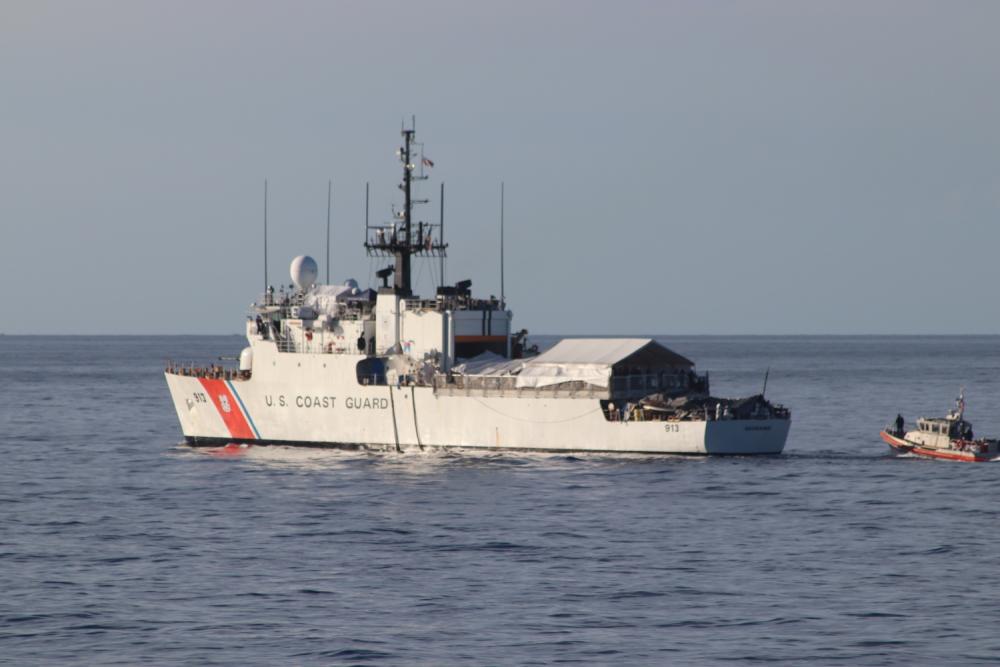
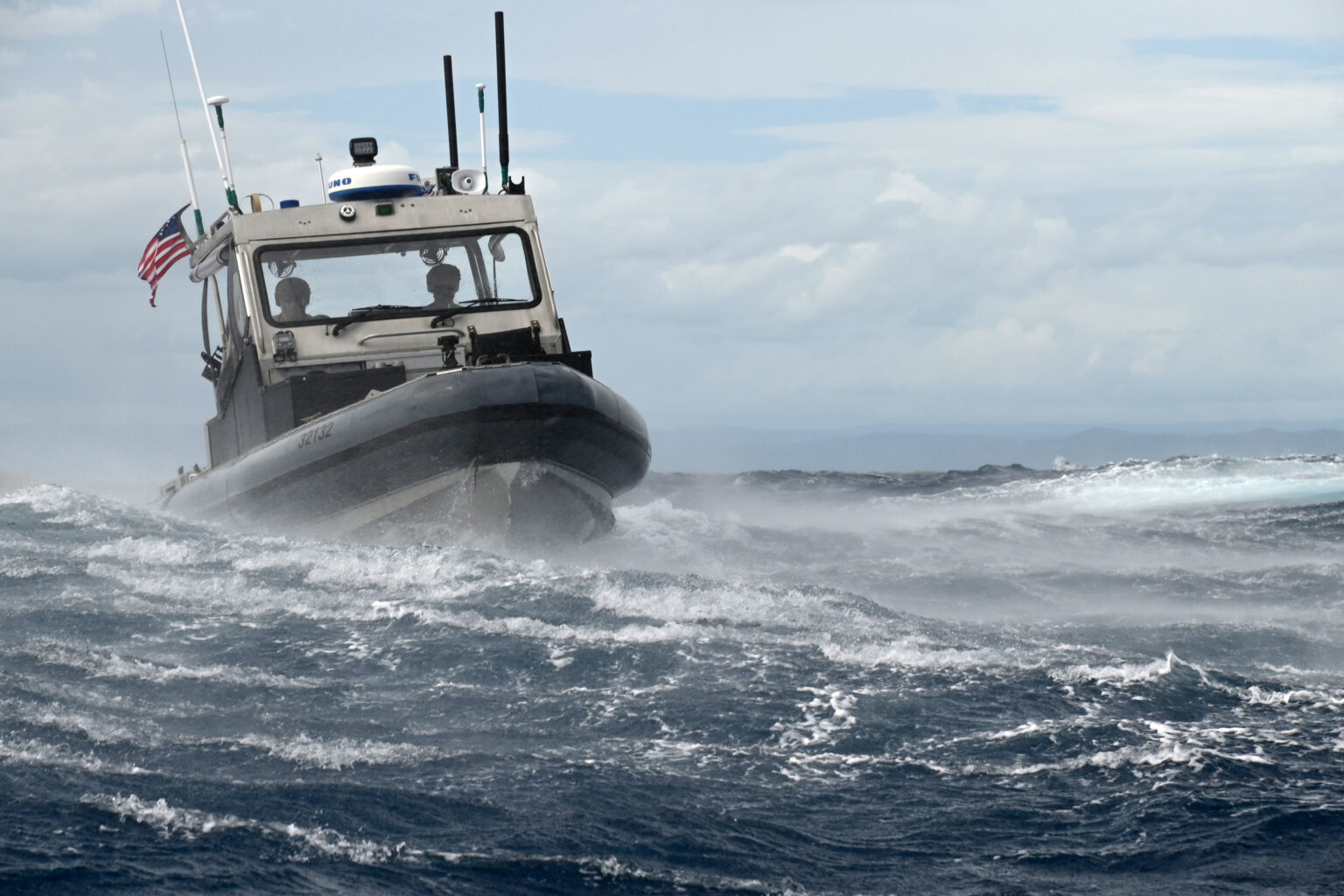
USCGC Mohawk’s (WMEC 913) crew patrols the South Florida Straits during Operation Vigilant Sentry, Jan. 5, 2023. Mohawk’s crew patrolled the Florida Straits and Caribbean Sea in support of Homeland Security Task Force—Southeast and Operation Vigilant Sentry in the Coast Guard Seventh District’s area of operations for a 46-day patrol. (U.S. Coast Guard photo by USCGC Legare (WMEC 912)

“ASEAN Coast Guard Forum strengthens cooperation to combat maritime threats” –Indo-Pacific Defense Forum

Coast guard leaders and personnel from member states of the Association of Southeast Asian Nations participate in the June 2023 ASEAN Coast Guard Forum in Jakarta, Indonesia. IMAGE CREDIT: Indonesian Maritime Security Agency

Indo-Pacific Defense Forum reports on the second annual ASEAN Coast Guard Forum.

“Representatives of the coast guards of Brunei, Indonesia, Malaysia, the Philippines, Singapore and Thailand attended the meeting…The inaugural ACF was held in Bali, Indonesia, in November 2022. The next ACF will be held in the Philippines in 2024, with Thailand serving as host in 2025.”

Good to see growing regional international cooperation between coast guard agencies. Similar organizations include the North Pacific Coast Guard Agencies Forum initiated by the Japan Coast Guard in 2000 and the Arctic Coast Guard Forum established in 2015.

Coast Guard in Oceania in the News

The USCGC Oliver Henry (WPC 1140) crew arrives in Manus, Papua New Guinea, on Aug. 14, 2022, from Guam as part of a patrol headed south to assist partner nations in upholding and asserting their sovereignty while protecting U.S. national interests. The U.S. Coast Guard is participating with partners to support the Pacific Islands Forum Fisheries Agency-led Operation Island Chief and the larger Operation Blue Pacific through patrols in the Western Pacific in August and September 2022. (U.S. Coast Guard photo by SW3 Victor Villanueva, NMCB-FOUR)

A couple of recent articles about the US relations with Palau and Papua New Guinea.

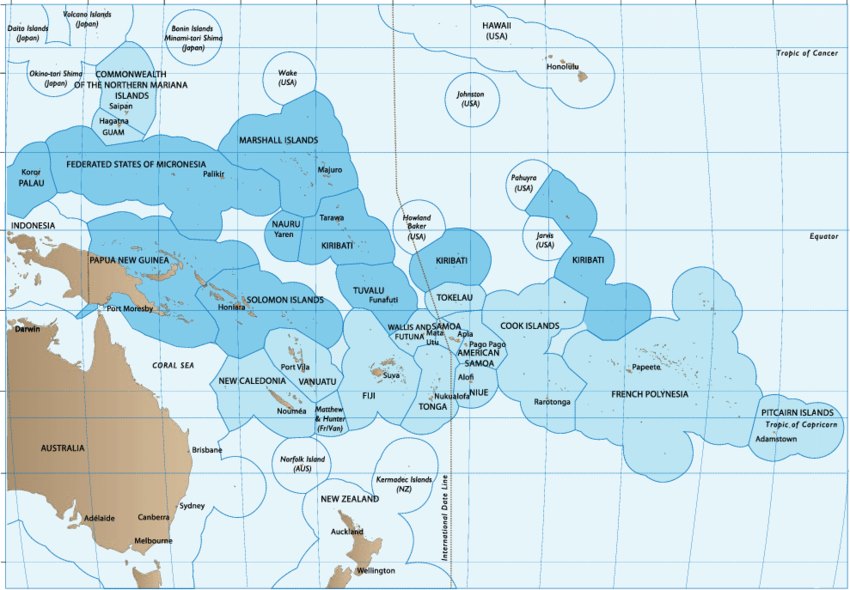
Map of the exclusive economic zones in the Pacific.

There has long been interest in a US base on Manus, Papua New Guinea, but this is politically sensitive. Basing cutters there that protect an important economic resource and occasionally rescue the locals when they get in trouble, would probably be most welcome.

On the map above, Manus and Guam do not look that far apart, but Manus is 1,737.88 km (938 nautical miles) SSE of Guam. That is about the distance from Miami to New York City. 

Cutters based in Manus would be closer to parts Freely Associated States (FAS) of Palau and Federated States of Micronesia than cutters based in Guam and much closer to most non-FAS Micronesian nations. It might also be a good place to site a fixed wing forward operating base (CGAS Honolulu DET).

I am beginning to think we will see two new bases in the Western Pacific, one in American Samoa and one in Manus.

If we do end up with additional Webber class based outside Hawaii and Guam, we might need a squadron support organization similar to, and perhaps even larger than, PATFORSWA, to support all FRCs based in the Pacific South and West of Hawaii, e.g. a PATFORSWPAC.

“New Naval Vessels For Denmark” –Naval News

OMT MPV-80 technical specifications

Naval News reportthat the Danes are embarking on a naval program. The details of what kind of ships and how many are not clear but,

Naval News understands that some of the future vessels will be OMT’s MPV-80. These will feature a great deal of modularity via “The Cube” system by local company SH Defence.

The MPV-80 looks a lot like an Offshore Patrol Vessel, but with a difference.

The Danes have a long and apparently successful history of incorporating modularity in their ship designs. They invented the StanFlex system almost 40 years ago. (Not to mention, they have been making LEGOs since 1949.) It appears this design will go much further, “Container capacity: 30 –23 of which are ‘Cube’ ready.” The post explains “The Cube” system by local company SH Defence but more here.

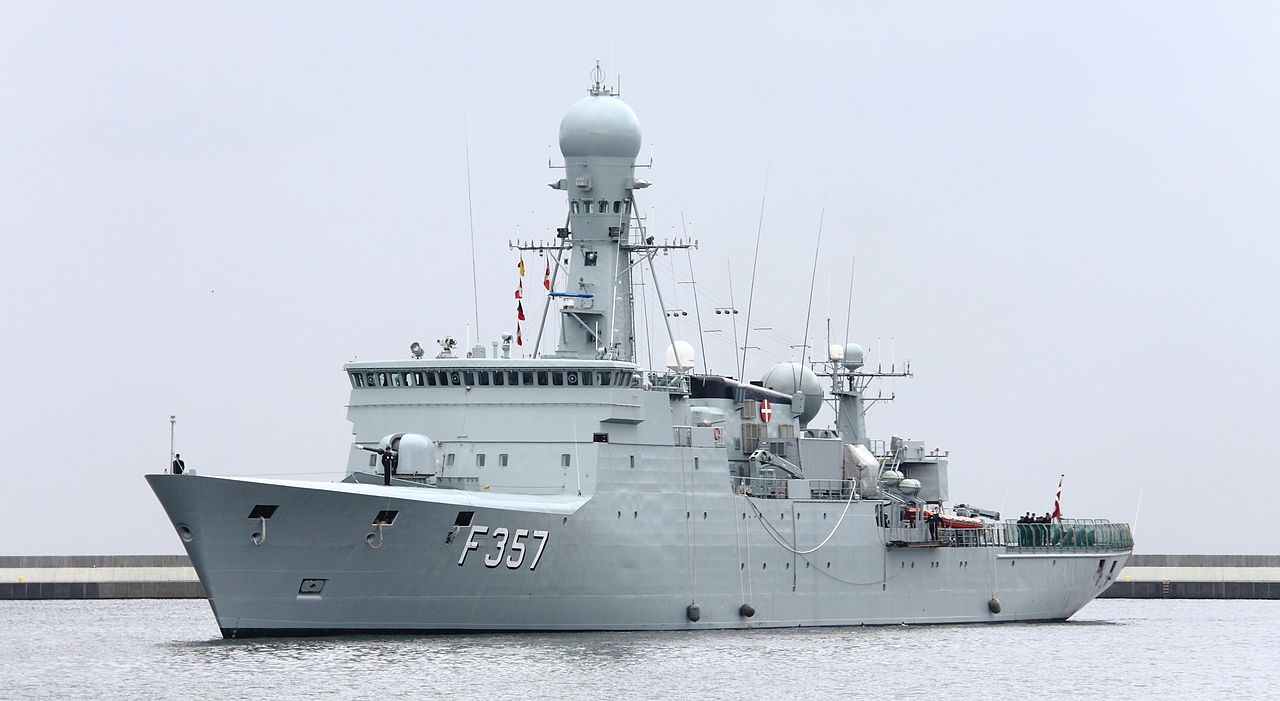
It does appear the four ice-strengthened Thetis class patrol frigates, already over 30 old, are in need of replacement.

Thetis-class ocean patrol vessel belonging to the Royal Danish Navy. Source: konflikty.pl, Author: Łukasz Golowanow

“Icebreakers, Pay Raise, New Cutters: House Adds $430M to Coast Guard Budget” –Military.com

FOUR WEBBER CLASS PATROL CRAFT. 220822-A-KS490-1182 STRAIT OF HORMUZ (Aug. 22, 2022) From the left, U.S. Coast Guard fast response cutters USCGC Glen Harris (WPC 1144), USCGC John Scheuerman (WPC 1146), USCGC Emlen Tunnell (WPC 1145) and USCGC Clarence Sutphin Jr. (WPC 1147) transit the Strait of Hormuz, Aug. 22. The cutters are forward-deployed to U.S. 5th Fleet to help ensure maritime security and stability across the Middle East. (U.S. Army photo by Spc. Noah Martin)

Military.com reports,

The House Appropriations Committee on Wednesday approved an increase to the Coast Guard’s fiscal 2024 budget, forwarding a bill to the full chamber that funds a 5.2% pay raise for members, a commercial icebreaker, four additional fast response cutters, and an extra HC-130J Super Hercules aircraft.

In addition to the projects in the original budget request, the committe has obviously, they have been looking at the Coast Guard’s FY2024 Unfunded Priority List.

The Unfunded Priority List included requests for an additional $1.6B.

The House Appropriations Committee recommendation would fund about $430M, including two big ticket items, four additional Webber class patrol craft and an additional C-130J. The unfunded priority list had listed the total price for the cutters and aircraft as $538.5M, so the markup may not include all the support costs for the cutters and missionization costs for the aircraft included in the Unfunded Priority list.

This still has a way to go before becoming law, but the Coast Guard has been receiving substantial bipartisan support and for the last few years Procurement, Construction, and Improvements budgets have been increased substantially over the requested amounts. There seems to be wide support for additional Webber class cutters to serve in the Western Pacific. As I noted in March,

We shouldn’t expect everything on the list to be approved, but I think we will definitely see the additional C-130 and at least three additional FRCs. Some of the other items will probably be approved as well. Those items not funded in FY2024 will likely be included in the FY2025 budget.

Missing Anti-Ship Cruise Missiles

Long Range Anti-Ship Missile (LRASM)

Myself and others have suggested that it might be a good idea to equip US Coast Guard cutters with anti-ship cruise missiles (ASCMs).

While I think cutters should be fitted for launchers of at least eight ASCMs, so that in wartime they might swamp the defenses of an enemy combatant with a relatively robust air defense, they don’t need to carry that many all the time. (The new FFGs will carry up to 16 ASCMs.) For defense against a possible terrorist attack using a medium to large ship, two LRASM, AGM-158C Long Range Anti-Ship Missile, with their large warhead and target selectivity, would probably suffice. For sensitive international peacetime missions, they might need or want to carry none at all.

Certainly not everyone agrees, “U.S. Coast Guard’s VADM Linda Fagan (Pacific Command) answers why the Large Coast Guard Cutters Do Not Up-Arm” by Peter Ong, but there may be another reason the idea has not been accepted.

A Defense News report has a revealing quote,

“We need about 1,000 to 1,200 [long-range anti-ship missiles] if you believe the unclassified wargames,” Gallagher adding, noting the U.S. currently has less than 250 in its inventory.

That may only refer to the Long Range Anti-Ship Missile, but there may be a shortage of anti-ship missiles. That could explain a lot, including why no ASCMs on cutters; why no ASCM armed surface combatants; why so slow to arm LCS with cruise missiles, why many Destroyers apparently have no ASCMs. DOD is going to fill their highest priority needs first.

The US Navy has about 110 surface combatants (cruisers, destroyers, and LCS). If each were armed with 8 ASCMs that would require 880. Submarines may carry a relatively small number of ASCMS, but ships are not the primary users of ASCMs. Aircraft have that role.

Each Air Force B-1Bs can carry up to 24 LRASMs. LRASM and NSM are also to be carried by Navy F/A-18s and Air Force, Navy, and Marine F-35, and by P-8 Maritime Patrol Aircraft. A fully loaded Aircraft Carrier might require well over a hundred missiles.

Until recently, ASCM procurement rates have been modest. Apparently, more missiles are coming.

The rapid consumption of high-tech munitions in Ukraine has apparently convinced many we need deeper magazines.

The Pentagon’s $170 billion procurement budget request ― touted as the largest ever ― would use a new “large lot procurement pilot” strategy to maximize production capacity for several munitions used across the services: Lockheed Martin’s Joint Air-to-Surface Standoff Missile Extended Range (JASSM-ER) and Long-Range Anti-Ship Missile (LRASM) ― and the Raytheon Technologies-made RIM-174 Standard Missile (SM-6), AIM-120 Advanced Medium Range Air-to-Air Missile (AAMRAM).

Though not in the pilot program, the Pentagon is also using multiyear contracting to buy roughly 103 Naval Strike Missiles at $250 million. The Marine Corps’ new, low-signature Marine Littoral Regiments and their Navy/Marine Corps Expeditionary Ship Interdiction System are slated for 90 of the ground-based missiles, which Raytheon manufactures.

Procuring 103 missiles over five years still looks like a pretty slow pace to me, considering China is apparently threatening to attack Taiwan in 2027 and we have a capacity for producing hundreds of missiles per year. If Taiwan is attacked in 2027, it will be a target rich environment and those missiles in the out years will be too late.

In 2021 Defense News reported, there is no production bottleneck delaying the rapid deployment of large numbers of Naval Strike Missiles (NSM).

“Demand is not an issue. If they suddenly come out and they say we need 200 a year, 300 a year, 500 a year, we can do that,” Schreiber added.

Lockheed is doubling their production capacity.

Perhaps when magazines are filled, the question of missiles for cutters will be reconsidered.

“Coast Guard completes mission at Naval Base Guantanamo Bay” –MyCG

Coast Guardsmen from Port Security Unit 307 conduct seaward security for Department of Defense assets and personnel at Naval Station Guantanamo Bay, Cuba, April 25, 2022. During the nine-month deployment, unit operations focused on maritime defense, providing more than 30,000 hours of around-the-clock waterside and shore side anti-terrorism and force protection. U.S. Coast Guard by photo by Lt. Cmdr. Glenn Sanchez.

Just passing this along from MyCG.


June 16, 2023

Coast Guard completes mission at Naval Base Guantanamo Bay

By Lt. Cmdr. Jeannie Shaye, Coast Guard Public Affairs Officer

NAVAL BASE GUANTANAMO BAY, Cuba — U.S. Coast Guard Port Security Unit (PSU) 305 members conducted a casing of the colors ceremony at Naval Base Guantanamo Bay Tuesday, marking the end of the Coast Guard’s 21-year mission supporting Joint Task Force Guantanamo (JTF-GTMO).

Coast Guard Commandant Adm. Linda Fagan presided over the historical ceremony and presented a Coast Guard Unit Commendation award to the men and women of PSU 305.

Port Security Units are part of the Coast Guard’s deployable specialized forces and have served JTF-GTMO as the Maritime Security Detachment (MARSECDET) in support of Operation Enduring Freedom for over 21 years. The Virginia-based PSU 305 was the first PSU deployed to Guantanamo Bay in 2002 in support of Operation Enduring Freedom, and this tour completes their fifth unit deployment.

“Thanks to the quiet resolve and careful watch of our Port Security Units for the past 21 years, the work our Nation has conducted here has been done safely and securely,” said Fagan during the ceremony.

Coast Guard PSUs and Maritime Safety and Security Teams have provided maritime anti-terrorism force protection for JTF-GTMO since 2002 as a part of the Global War on Terror.

There have been 39 unit rotations to Guantanamo Bay since the Coast Guard began supporting the mission. The men and women assigned to the MARSECDET collectively provided over 200,000 underway hours conducting around-the-clock waterside patrols and over 50,000 hours of shoreside anti-terrorism and force protection defense security to Department of Defense assets and personnel at Naval Station Guantanamo Bay.

Upon the conclusion of the JTF-GTMO mission, PSUs will continue to remain an agile expeditionary force provider that play a critical role in protecting strategic maritime operations in an environment of increasing global competition. In addition, PSUs will participate in national-level joint and combined exercises to increase readiness and proficiency for the full spectrum of PSU capabilities.

“This is an exciting time for the PSU community,” said Capt. Matthew Michaelis, Pacific Area Deputy Chief of Operations. “As the focus shifts from a long-standing enduring mission, we look forward to supporting future missions that align with their diverse set of capabilities. Our PSUs recently completed three joint DoD exercises and are preparing for additional exercises overseas with DoD and some of our trusted partners.  The increased focus on interoperability will better prepare our PSUs to deploy in a joint or multi-lateral environment as they were designed, while also creating opportunities to evolve and uncover new and novel ways for their employment.”

PSUs are Coast Guard Reserve-staffed units that support our nation with well-equipped, trained, and organized expeditionary forces that can rapidly deploy worldwide for anti-terrorism and force protection operations or in defense of high-value assets. Eight PSUs are strategically positioned throughout the country and assigned to the Coast Guard Pacific Area commander in Alameda, Calif.

JTF-GTMO is a U.S. Southern Command task force responsible for the safe, humane, legal care and custody of law of armed conflict detainees; collection and dissemination of intelligence; and supporting military commissions, periodic review boards, and habeas review.

The MARSECDET responsibilities were turned over in May to servicemembers assigned to the Naval Station Guantanamo Bay’s Navy Harbor Patrol Unit and Marine Corps Security Forces.

Following the ceremony, PSU 305 members will return home to Joint Base Langley-Eustis, Va.

“The Compacts of Free Association and the Role of the U.S. Coast Guard” –CSIS

Estimated exclusive economic zones (EEZs) of Pacific Island countries and territories (PICTs). The EEZs of countries that are the Parties to the Nauru Agreement are shown in darker blue. Note that not all EEZs of PICTs have been officially delineated under the United Nations Convention on the Law of the Sea. Source: Patrick Lehodey

(Before we start, CSIS also has a great overview of what has been going on in the Western Pacific/Oceania, “STRATEGIC UPGRADES IN THE PACIFIC,” that includes an interactive map. You might want to take a look at it if you want an update on what has been happening in the Western Pacific.)

The Center for Strategic and International Studies has a study proposing,

“One way for the U.S. to show value to the relationship is by aiding the FAS (Freely Associated States–Chuck) in combating illegal maritime activities, building maritime law enforcement capacity, and working with local government and civilian partners to conduct a range of maritime domain training using the USCG as the interlocutor.”

This seems to be encouragement to do more of what the Coast Guard is already doing as part of the aid package negotiations. But to do more, the Coast Guard needs more. US EEZ South and West of Hawaii is equal to 181% the size of the entire Atlantic Area (AA) EEZ, where more than half of all Coast Guard assets are assigned.

If we add the Freely Associated States:

Without considering the other eleven additional island states with EEZs totaling 7.3 times that of the entire Atlantic Area EEZ, the US and Freely Associated States alone have a combined EEZ 4.85 times that of the entire Atlantic Area, e.g., East Coast, Gulf Coast, Puerto Rico, and the Virgin Islands. Permanently based in this huge area we have exactly three patrol craft and a buoy tender, and not a single Coast Guard aircraft.

Will the Coast Guard get the four additional Webber Class Fast Response Cutters on their Unfunded Priorities List? Will there be at least a fixed wing aviation support detachment?

A US Coast Guard base in one of the Freely Associated States could be a win-win.

Thanks to Paul for bringing this to my attention.

Canada’s Multi-Purpose Vessels

Canadian CG MPV. Credit Aker Arctic.

Canada has a project to replace a large part of the Canadian Coast Guard fleet with up to 16 Multi-purpose Ships at an estimated cost of $14.2 billion (Canadian), with the first ship to be delivered in 2029.

There has not been a lot of reporting about this class, but frequent contributor Walter pointed me to two sources, Seaspan Shipyards and designer Aker Arctic. It appears they have very concrete ideas about what the class will look like.

Canadian CG MPV. Credit Aker Arctic.

MISSIONS:

According to Aker Arctic,

The MPVs will also perform cargo missions, bringing supplies to northern communities, carry out search & rescue and patrol missions, in addition to icebreaking. Most of their time will be spent on the St Lawrence River, the Great Lakes, and along the Canadian East Coast. Additionally, they will have a summer Arctic mission leaving from Victoria in British Columbia and travelling north around Alaska to the Canadian Arctic.

Due to the wide variety of tasks, the long-distance mission to the western Arctic, and the fact that some of the waterways have a limited depth, the vessel needed to be compact with a shallow draught, narrow beam, high endurance, and with a large cargo capacity.

CHARACTERISTICS:

  • Displacement: about 8,500 tons
  • Length, overall: 99.9 meters (328′)
  • Beam: 20.3 meters (66.7′)
  • Draft: 6.2 meters (20’4″)
  • Propulsion: diesel-electric; two azimuthing propulsion units

As is the case with all Canadian Coast Guard cutters, they have no fixed armament. It does look like it could host a medium sized helicopter and containerized systems, including perhaps below the hangar deck.

RANGE:

To me the most surprising characteristic of the ship is its range, 12,000 nautical miles. This was apparently driven by a summer Arctic mission from Victoria in British Columbia, north around Alaska to the Canadian Arctic.

ICE CLASS: 

These ships will be Canadian Ice Class 4, meaning they will have the capability to maintain a speed of 3 knots through ice 4 feet thick. The Canadian Coast Guard will consider these heavy icebreakers. We don’t have any figures on horsepower, but they probably will have less than 20,000 HP which, in the USCG system, would classify them as light icebreakers.

Compared to the US Coast Guard’s “heavy” Great Lakes icebreaker, Mackinaw (3,500 tons and 73m), these will be more powerful and more than twice as large. These might be a good design for the planned second USCG Great Lakes icebreaker.

IMPLICATIONS FOR THE USCG:

Aside from possible use of the design for Great Lakes icebreaker, these might be pretty close to what the USCG needs for their planned medium icebreakers. Certainly, consultation with Canadian counterparts will sharpen the focus of the US design effort. We might also have reasons to limit beam and draft.

U.S. Coast Guard participates in Exercise Argus 2023

The USCGC Sycamore (WLB 209) crew participates in a navigation exercise with HDMS Knud Rasmussen (P570), a Royal Danish Navy Knud Rasmussen-class patrol vessel and the FNS Fulmar (P740), a French Navy patrol vessel, off the coast of Southern Greenland, June 13, 2023. Deployed forces demonstrated U.S. Coast Guard capabilities to build partner capacity and expertise in search and rescue, navigation, and damage control. These efforts solidify key strategic relationships while achieving mutual Danish, Greenlandic, and U.S. goals in the North American Atlantic Arctic and Northwest Atlantic Ocean. (U.S. Coast Guard photo by Lt. Cmdr. Katherine Blue)

Just passing along this very nice photo and caption from the Defense Visual Information Distribution Service (DVIDS). I have added links to describe the vessels involved.