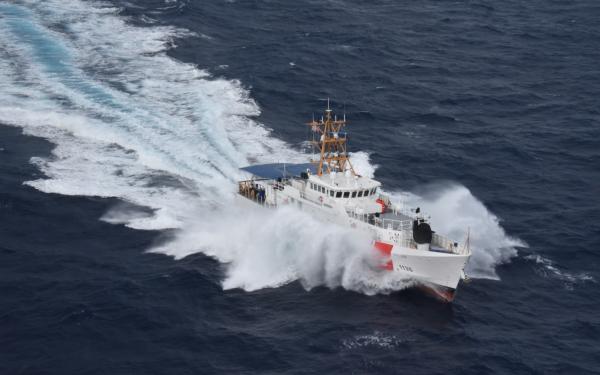
“Fast Response Cutter Faces Procurement Pause” –National Defense

Coast Guard Cutter Angela McShan
Photo by Petty Officer 3rd Class Brandon Murray

National Defense reports, 

Despite receiving no new procurement funding in the fiscal year 2021 budget request, the Coast Guard commandant said the Sentinel-class fast response cutter program is on track.

56 of the 64 units planned have been funded and 39 have been delivered. About 5 per year are being delivered so we can expected continued deliveries through at least 2023. It is possible a one year lapse in funding would not disrupt the orderly construction of these ships, but nevertheless the Commandant is hoping the Congress will once again, as they have frequently, add additional cutters.

Schultz said the service needed to free up dollars for other priorities such as polar security cutters, offshore patrol cutters and aviation. But he hopes procurement funding for fast response cutters will be added back in during the budget process.

SAAB’s Light Weight Torpedo

Dmitry Shulgin reports the successful testing of a new light weight torpedo from SAAB that offers some unique feature un-available on US Navy light weight torpedoes.

While American light weight torpedoes are explicitly anti-submarine weapons that at least, in the case of the Mk46 mod5, might have an incidental anti-surface capability, these are expressly identified as being for both anti-submarine and anti-surface use. Unlike USN light weight torpedoes, it has the option of wire guidance. It is designed specifically for operation in  difficult littoral environments while also being usable in deeper water.

This new torpedo is designated the Torped 47, it replaces an earlier type with similar characteristics, the Torped 45. Compared to the US Navy’s Mk54, they are longer (2.85 m (9.35′) vs (2.72m (8.91′), heavier (340 kg (750 lb) vs 276 kg (608 lb)), and of greater diameter (400mm (15.75″) vs 324mm (12.75″)).

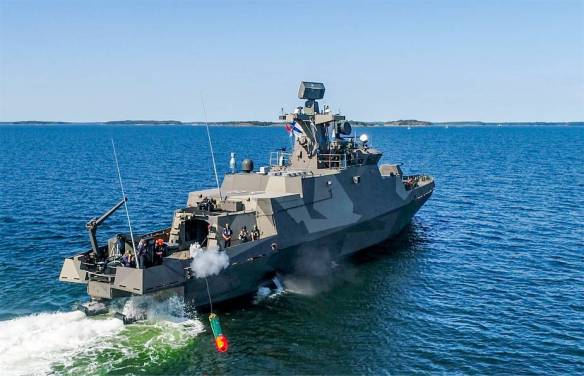
Finnish_Navy_conducts_first_torpedo_firing_from_Hamina-class_fast-attack_craft

Finnish Navy conducted its first torpedo firing from FNS Tornio Hamina-class fast-attack craft in the Archipelago Sea with a TP45 torpedo. (Picture source Finnish Navy)

They use a LiFPO4 battery which is rechargeable, so it is likely practice torpedoes can be used numerous times and quickly returned to service. Believe this is more difficult with the Otto fueled USN torpedoes.


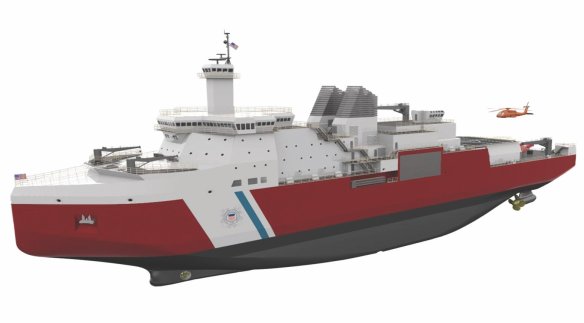
Memorandum on Safeguarding U.S. National Interests in the Arctic and Antarctic Regions

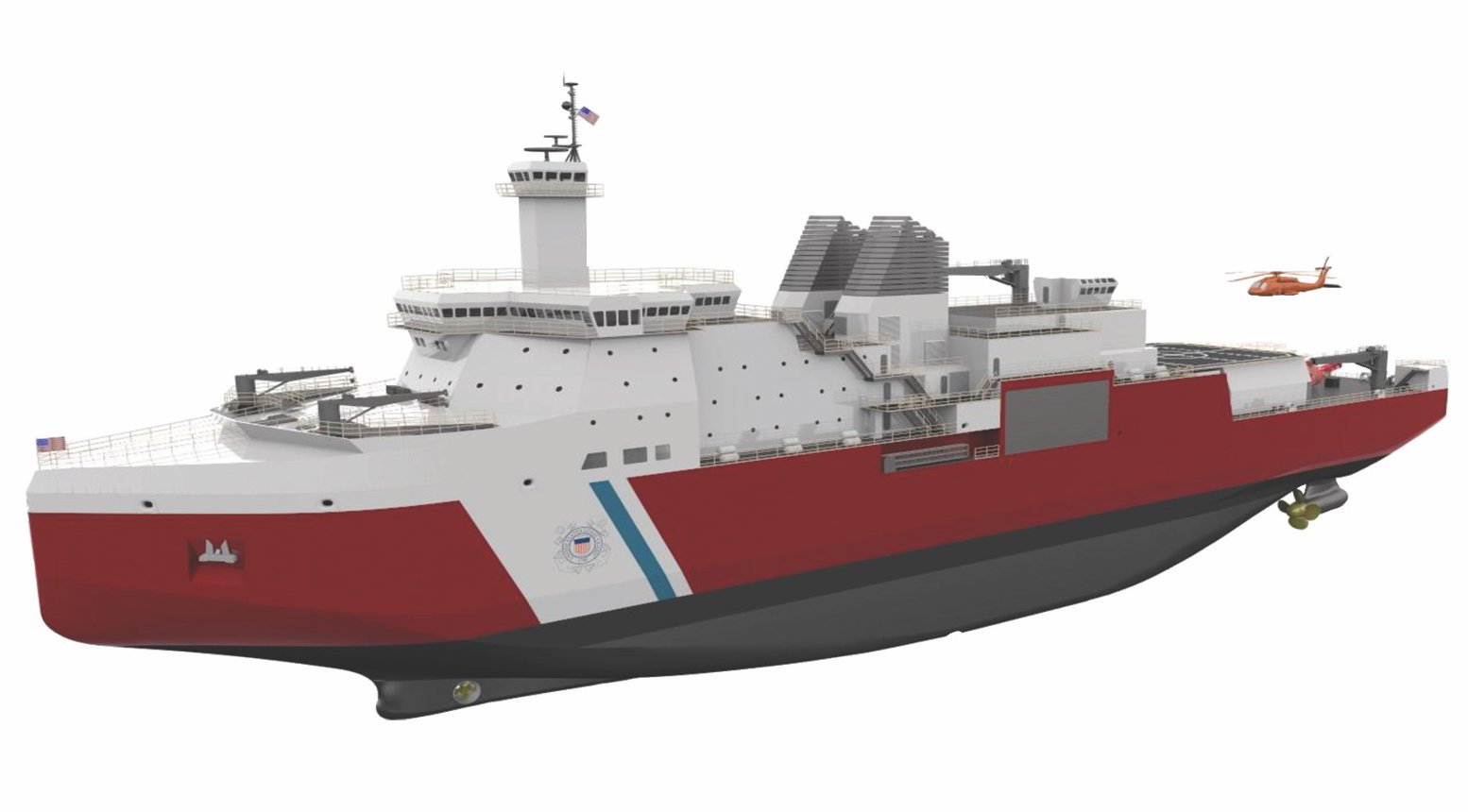
The President has issued a memorandum, dated 9 June, 2020, regarding the Coast Guard’s Polar Security Cutter Program. The Memorandum is relative short and is duplicated below. I have added emphasis to what I see as some of the more important points by making some of the text bold. Below that, I will provide my comments.

MEMORANDUM FOR THE SECRETARY OF STATE
THE SECRETARY OF DEFENSE
THE SECRETARY OF COMMERCE
THE SECRETARY OF ENERGY
THE SECRETARY OF HOMELAND SECURITY
THE DIRECTOR OF THE OFFICE OF MANAGEMENT AND
BUDGET
THE ASSISTANT TO THE PRESIDENT FOR NATIONAL
SECURITY AFFAIRS
SUBJECT:    Safeguarding U.S. National Interests in the
Arctic and Antarctic RegionsTo help protect our national interests in the Arctic and Antarctic regions, and to retain a strong Arctic security presence alongside our allies and partners, the United States requires a ready, capable, and available fleet of polar security icebreakers that is operationally tested and fully deployable by Fiscal Year 2029.  Accordingly, by the authority vested in me as President by the Constitution and the laws of the United States of America, I hereby direct the following:Section 1.  Fleet Acquisition Program.  The United States will develop and execute a polar security icebreaking fleet acquisition program that supports our national interests in the Arctic and Antarctic regions.

(a)  The Secretary of Homeland Security, in coordination with the Secretary of State, the Secretary of Defense, the Secretary of Commerce, and the Director of the Office of Management and Budget (OMB), shall lead a review of requirements for a polar security icebreaking fleet acquisition program to acquire and employ a suitable fleet of polar security icebreakers, and associated assets and resources, capable of ensuring a persistent United States presence in the Arctic and Antarctic regions in support of national interests and in furtherance of the National Security Strategy and the National Defense Strategy, as appropriate.  Separately, the review shall include the ability to provide a persistent United States presence in the Antarctic region, as appropriate, in accordance with the Antarctic Treaty System.  The Secretary of Homeland Security and the Director of OMB, in executing this direction, shall ensure that the United States Coast Guard’s (USCG) Offshore Patrol Cutter acquisition program is not adversely impacted.

(b)  The Secretary of Homeland Security, acting through the Commandant of the Coast Guard, in coordination with the Secretary of Defense, acting through the Secretary of the Navy, and the Secretary of Energy, as appropriate, shall conduct a study of the comparative operational and fiscal benefits and risks of a polar security icebreaking fleet mix that consists of at least three heavy polar-class security cutters (PSC) that are appropriately outfitted to meet the objectives of this memorandum.  This study shall be submitted to the President, through the Director of OMB and the Assistant to the President for National Security Affairs, within 60 days from the date of this memorandum and at a minimum shall include:

(i)    Use cases in the Arctic that span the full range of national and economic security missions (including the facilitation of resource exploration and exploitation and undersea cable laying and maintenance) that may be executed by a class of medium PSCs, as well as analysis of how these use cases differ with respect to the anticipated use of heavy PSCs for these same activities.  These use cases shall identify the optimal number and type of polar security icebreakers for ensuring a persistent presence in both the Arctic and, as appropriate, the Antarctic regions;

(ii)   An assessment of expanded operational capabilities, with estimated associated costs, for both heavy and medium PSCs not yet contracted for, specifically including the maximum use of any such PSC with respect to its ability to support national security objectives through the use of the following:  unmanned aviation, surface, and undersea systems; space systems; sensors and other systems to achieve and maintain maritime domain awareness; command and control systems; secure communications and data transfer systems; and intelligence-collection systems.  This assessment shall also evaluate defensive armament adequate to defend against threats by near-peer competitors and the potential for nuclear-powered propulsion;

(iii)  Based on the determined fleet size and composition, an identification and assessment of at least two optimal United States basing locations and at least two international basing locations.  The basing location assessment shall include the costs, benefits, risks, and challenges related to infrastructure, crewing, and logistics and maintenance support for PSCs at these locations.  In addition, this assessment shall account for potential burden-sharing opportunities for basing with the Department of Defense and allies and partners, as appropriate; and

(iv)   In anticipation of the USCGC POLAR STAR’s operational degradation from Fiscal Years 2022-2029, an analysis to identify executable options, with associated costs, to bridge the gap of available vessels as early as Fiscal Year 2022 until the new PSCs required to meet the objectives of this memorandum are operational, including identifying executable, priced leasing options, both foreign and domestic.  This analysis shall specifically include operational risk associated with using a leased vessel as compared to a purchased vessel to conduct specified missions set forth in this memorandum.

(c)  In the interest of securing a fully capable polar security icebreaking fleet that is capable of providing a persistent presence in the Arctic and Antarctic regions at the lowest possible cost, the Secretary of State shall coordinate with the Secretary of Homeland Security in identifying viable polar security icebreaker leasing options, provided by partner nations, as a near- to mid-term (Fiscal Years 2022-2029) bridging strategy to mitigate future operational degradation of the USCGC POLAR STAR.  Leasing options shall contemplate capabilities that allow for access to the Arctic and Antarctic regions to, as appropriate, conduct national and economic security missions, in addition to marine scientific research in the Arctic, and conduct research in Antarctica in accordance with the Antarctic Treaty System.  Further, and in advance of any bid solicitation for future polar security icebreaker acquisitions, the Secretary of State shall coordinate with the Secretary of Homeland Security to identify partner nations with proven foreign shipbuilding capability and expertise in icebreaker construction.

(d)  The Secretary of Defense shall coordinate with the Secretary of State and the Secretary of Homeland Security to continue to provide technical and programmatic support to the USCG integrated program office for the acquisition, outfitting, and operations of all classes of PSCs.

Sec2.  General Provisions.  (a)  Nothing in this memorandum shall be construed to impair or otherwise affect:

(i)   the authority granted by law to an executive department or agency, or the head thereof; or

(ii)  the functions of the Director of OMB relating to budgetary, administrative, or legislative proposals.

(b)  This memorandum shall be implemented consistent with applicable law and subject to the availability of appropriations.

(c)  This memorandum is not intended to, and does not, create any right or benefit, substantive or procedural, enforceable at law or in equity by any party against the United States, its departments, agencies, or entities, its officers, employees, or agents, or any other person.

DONALD J. TRUMP
Commentary:
Notably this is in reference to both Arctic and Antarctic. There are a number of issues raised here:
  • Optimal number and type of polar security icebreakers
  • What does “persistent United States presence” mean?
  • How the Medium icebreakers will be used differently from the Heavy icebreakers?
  • Expanded operational capabilities
  • Defensive armament
  • Nuclear power
  • Basing: “two optimal United States basing locations and at least two international basing locations”
  • “Leasing options, both foreign and domestic”
  • “Identify partner nations with proven foreign shipbuilding capability and expertise in icebreaker construction.”
In most cases these topics are not new. With few exceptions, the Coast Guard has certainly considered these topics and should have well thought out positions.

Basing “two optimal United States basing locations and at least two international basing locations”

The Basing question seem the most original and may suggest the US may want to have icebreakers based in the Atlantic. First it is not clear what is meant by bases. Does it mean homeports, permanent US Navy/Coast Guard overseas bases, or just a place to replenish?
We already know the Coast Guard plans to base the first Polar Security Cutters (PSC) in Seattle.
When bound for Antarctica, icebreakers operate out of Christchurch, on New Zealand’s South Island. At one time there was consideration of basing icebreakers there, but it seems unlikely New Zealand would actually welcome a year round Navy or Coast Guard base, and there seems to be little reason to seek one. Perhaps this could qualify as a base if we are only talking a regular replenishment station.
The US unlike the rest of the world includes the Aleutians and Bering Sea as part of the Arctic, although they are below the Arctic Circle. There has been a lot of discussion about an “Arctic (really near Arctic) Base” for the Navy and Coast Guard. Likely candidates are Adak, Port Clarence, or Nome. We talked about it here, here, and here.
Seattle, Christchurch, and the Alaskan Arctic base might account for three of the four bases referred to, two domestic and one “international,” all on the Pacific side of the World. What about the fourth base? I don’t see need for another base in the South Pacific. Could he actually be thinking about having icebreakers based on the Atlantic side? There might be reason to base some icebreaking capability with easier access to the Atlantic side. We discussed that here. If that is the case, he is really talking two homeports, one on the Pacific and one on the Atlantic or perhaps Great Lakes, plus two supporting locations, one in the South Pacific and one closer to the Arctic on the Atlantic side. (We don’t need an “international” base to access the Pacific side of the Arctic.) An Atlantic support base could mean Canada, Greenland, Iceland, or least likely, Norway. If we wanted to count the proposed Alaskan near Arctic base that would mean two homeports and three support locations.

Optimal number and type of polar security icebreakers:

The High Latitude Study, now at least eight years old, has been what the Coast Guard has hung its hat on for an establish requirement, specifically three heavy and three medium icebreakers.  Based on the rule of thumb, that you need three ships to keep one fully operational (one in maintenance, one in training, work-up, or standby, and one operational), that would mean we could have one heavy and one icebreaker underway essentially year round. Problem is that we need heavy icebreakers for both the Arctic winter and the Antarctic summer which occur at the same time. We might even need heavy icebreakers to operate in the Arctic Spring and Fall, and we would really like to have two heavies go south to provide a rescue capability.

This suggest that since the price of the Heavy PSC has come down to close to what we had anticipated for the Medium PSC, perhaps we should simply continue building the more capable ship.

Six Heavy PSC would still not provide any icebreaking capability on the Atlantic side and would preclude the possibility of ever using the ships in the Great Lakes. Maybe there is a place for medium icebreakers there?

What does “persistent United States presence” mean?

Do we really need an icebreaker in Antarctic waters year round? We do have a presence in the form of people who winter over in Antarctica.

In reference to the Arctic, presence might be in the form of a continuous Icebreaker presence, but it also might be in the form of surveillance with an icebreaker on call somewhere below the Bering Strait which the US considers the Arctic, where it might be useful for SAR and fisheries enforcement.

Does Presence include an Atlantic side presence? We need some better definitions here.

How the Medium icebreakers will be used differently from the Heavy icebreakers?

This might be a back door way to ask if we really need two different classes? One of my impressions was that the while Heavy icebreakers might go North or South, the medium breakers would operate exclusively in the Arctic. The lack of treaty obligations gives us more flexibility in how to equip ships that would not be subject to inspection, so medium breakers might have heavier weapons, ESM, classified sensors, or intelligence spaces. None of this however precludes equipping Heavies this way, if they will not be going South.

Expanded operational capabilities:

The memorandum specifically mentions unmanned aviation, surface, and undersea systems; space systems; sensors and other systems to achieve and maintain maritime domain awareness; command and control systems; secure communications and data transfer systems; and intelligence-collection systems.

The heavies are large vessels with lots of space, plus organic weight handling equipment. They should be readily adaptable for operation of unmanned systems. Maritime Domain Awareness in the Arctic is challenging, but unmanned air systems should expand the ship’s horizons. There should be space for command and control systems; secure communications and data transfer systems; and intelligence-collection systems but what they actually carry and the choice of installed or containerized system would depend on anticipated employment.

Defensive armament:

It may be significant that it specifies defensive armament. The Commandant has referenced the Russian’s building of Project 23550 armed icebreakers illustrated with containerized cruise missile systems on their stern. Adm. Zukunft suggested that given the unpredictability of the situation in the Arctic the Coast Guard might need to add Anti-Ship Cruise Missiles (ASCM) and consequently the PSCs were being built with reserves as a hedge against such future additions.
So far the only armament seen on illustrations of the PSCs appear to be 25mm Mk38 Mod2/3 mounts like those being fitted to the Webber class WPCs. That is probably adequate for law enforcement.
Given the Navy’s desire to have distributed lethality, it might make sense to put ASCMs on icebreakers that do not go South to Antarctica.
All icebreakers should have the option of adding defensive systems. If we ever have a conflict in ice covered area, the icebreakers will be critically important, perhaps irreplaceable. There should be provision for providing adequate defense including perhaps two SeaRAM, Electronic Warfare systems, decoys, and torpedo warning system and countermeasures,
Nuclear power:
The Coast Guard did consider this, quite a while a go (back when I was a cadet). The Navy at that time had, not only nuclear powered carriers and submarines, but also a number of nuclear powered surface combatants. Since then, the Navy has backed away from nuclear power except for subs and carriers. After serious consideration, the Coast Guard decided they could not maintain a cadre of nuclear trained engineers.
Nuclear power is very expensive, especially if you take into account the cost of disposing of the waste at the end of the vessels life.
There is also the consideration that nuclear powered ships are not welcome at all ports.
We have apparently succeeded in providing sufficient endurance for the Polar Class icebreakers that they could winter over in Antarctica if necessary, so it does not appear there is a strong case for nuclear powered icebreakers.
“Leasing options, both foreign and domestic”:
The question of leasing has come up repeatedly in Congressional hearings. The options are limited and none can do what the Polar Star can do when its operational. The Coast Guard has decided to invest in keeping the Polar Star operational until the second PSC is fully operational.
Should the Polar Star have a catastrophic failure that leaves her stuck in the ice the Coast Guard have to hustle to find a way to get her out, but the same would apply to any leased icebreaker.
There might be an opportunity to lease vessels to fulfill the Medium PSC role, but so far the Coast Guard has not moved in that direction.
“Identify partner nations with proven foreign shipbuilding capability and expertise in icebreaker construction.”
I think the Coast Guard has done that. Building Coast Guard icebreakers in a foreign yard is against established policy and would probably be a non-starter politically–too many jobs at stake. In developing the PSC the Coast Guard cooperated with Canada and it appears sought advice around the world.
Conclusion: 
The Coast Guard is probably ready to answer this memorandum. Most of these questions were addressed in preparation for the PSC contract. I don’t think there is anything here that will require a contract modification to the existing PSC program.
Still, I am a bit mystified by the basing question.

Thanks to the readers alerted me to this topic and particularly Tups who found the original memorandum.

“Future Force Structure Requirements for the United States Navy” and the Possibilities of a Dual Service (Navy/Coast Guard) Ship

Note the hearing does not actually begin until time 57:45.

The video above is of a U.S. House Armed Services Committee hearing on “Future Force Structure Requirements for the United States Navy.” 

While most of it is not closely related to the Coast Guard, there were considerations that may be significant for the Coast Guard. There is also discussion of a new class of combatant smaller than the recently selected 7,000 ton FFG(X) that might be shared in common with the Coast Guard.

Witnesses were:

  • Admiral Gary Roughead, USN (Ret.), Former Chief of Naval Operations
  • Bryan Clark, Senior Fellow, Hudson Institute
  • Ronald O’Rourke, Naval Expert, Congressional Research Service

Links are provided to prepared statements by Bryan Clark and Ronald O’Rourke that are more comprehensive than their initial oral statements.

There were questions or comments about increased coordination and interoperability with the Coast Guard at time 1:09:15, 3:07:45 and 3:14:00.

There was mention of operating in the Arctic at time 3:03:00, but most of that was about submarines.

There was much discussion about the Navy’s failure to provide a 30 year ship building program (time 1:33:00 and throughout the hearing). The Coast Guard has never provided a long term shipbuilding program despite a Congressional mandate to provide a 20 year shipbuilding projection.

Perhaps the most interesting development was an apparent general agreement that there was a need for a class of combatants, smaller than the new frigates. At time 1:15:50 Admiral Roughhead, talked about the need for a high-low mix of surface ships. Time 1:23:00 Mr Clark, said there was a need a more diversified fleet including more smaller ships. 2:59 Corvettes were discussed by Mr. Clark. 

The written statement by Mr. Clark reflected a Hudson Institute study that suggested a need for 91 corvettes. I think we could make a good case that at least some of them should be painted white with racing stripes.

Mr. O’Rourke’s written statement suggested the possibility of “Coordination with Coast Guard Shipbuilding,”

As can be seen from the above list of options, there is currently some potential, at least in theory, for coordinating procurement of smaller Navy surface combatants with procurement of Coast Guard cutters—something that might increase production economies of scale and help optimize the nation’s shipbuilding effort at the national level (rather than sub-optimize it at the individual service level).

Such coordination could be viewed as consistent with Navy-Coast Guard policy statements: On at least three occasions in recent years—in 2002, 2006, and 2013—Navy and Coast Guard leaders signed joint National Fleet Policy Statements to provide (as stated in the 2013 edition) “direction and guidance for our Services to achieve commonality and interoperability for 21st century maritime and naval operations.” The document states that “This Policy is particularly important in light of: significantly constrained fiscal resources; the growing costs of acquiring, training, and maintaining technologically advanced forces; and the complexity and lethality of national security threats and challenges confronting the Nation in and from the maritime domain.” It states further that “This Policy enables Navy and Coast Guard forces to effectively and efficiently support each other while identifying specific methods and measurements, avoid redundancies and achieve economies of scale to maximize our Nation’s investment of increasingly scarce resources.” The 2013 National Fleet Policy Statement was followed in 2015 by a joint Navy-Coast Guard National Fleet Plan for implementing the National Fleet Policy Statement.

These smaller combatants might be based on the National Security Cutter or the Offshore Patrol Cutter, or might be a new design that would give birth to a new class of cutters that could make a more meaningful contribution to the National Defense. Personally I could see a modification of the current OPC design to provide greater speed by say providing a gas turbine or a second set of diesels, with the Navy variant  armed much I suggested earlier and the Coast Guard variant a bit more lightly armed but readied for rapid upgrade. These ships could presumably achieve 27 to 28 knots and could be built in second line shipyards.

If the Navy and Coast Guard start talking soon, we could probably see this new class replace the last six or eight OPCs in the program of record, replace the NSCs as they age out, and grow the large cutter fleet.


“New Normal” in the Eastern Pacific?

A Pacific Area news release (reproduced at the end of the post) concerning a change of command aboard USCGC Waesche while at sea, along with the captions of the accompanying photos, show how drug interdiction operations are changing to deal with COVID-19. If you don’t have it on your ship, the best way to avoid it, is to stay underway.

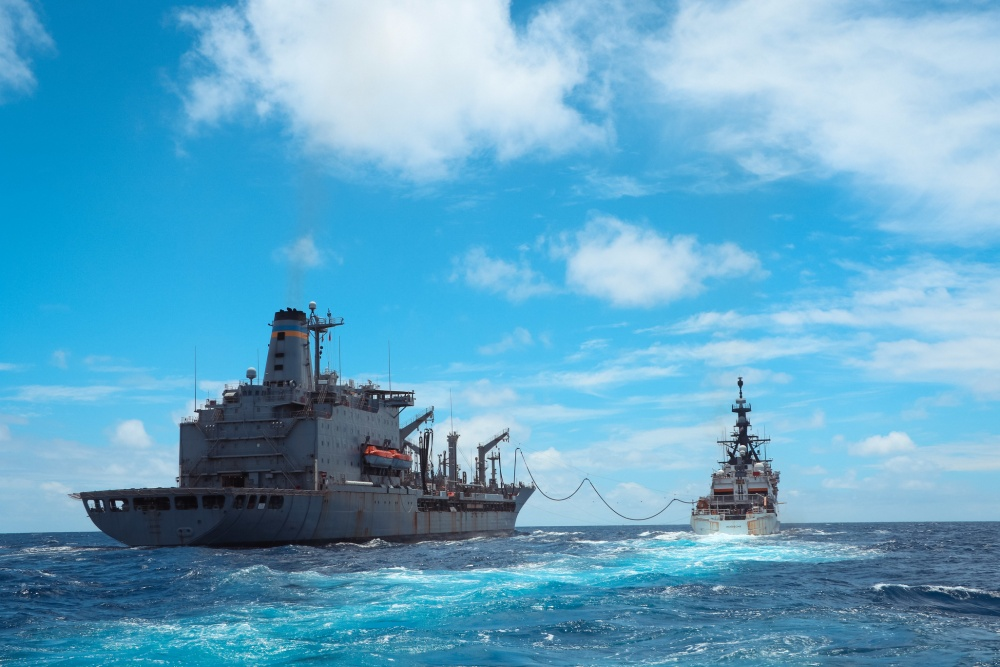
The U.S. Coast Guard Cutter Waesche (WMSL 751) conducts a replenishment-at-sea with the fleet replenishment oiler USNS Laramie (T-AO 203) while patrolling the Eastern Pacific Ocean, April 20, 2020. Waesche is deployed to the U.S. Southern Command area of responsibility to support Joint Interagency Task Force South’s mission, which includes counter illicit drug trafficking in the Caribbean and Eastern Pacific. U.S. Coast Guard photo by Chief Petty Officer Dave Horning.

Waesche was underway for 90 days, apparently without a port call, replenishing underway. In the photos there is an indication of at least two underway replenishments from USNS Laramie (T-AO-203) an MSC oiler, on April 20 and on May 23. There is a good chance there may have been more.

This probably would not have been possible prior to the Navy’s surge of additional assets to the Forth Fleet for law enforcement.

The U.S. Coast Guard Cutter Waesche (WMSL 751) conducts a replenishment-at-sea with the fleet replenishment oiler USNS Laramie (T-AO 203) while patrolling the Eastern Pacific Ocean, May 23, 2020. Waesche is deployed to the U.S. Southern Command area of responsibility to support Joint Interagency Task Force South’s mission, which includes counter illicit drug trafficking in the Caribbean and Eastern Pacific. U.S. Coast Guard photo by Petty Officer 3rd Class Vincent Gordon.

Waesche in turn, replenished the Webber Class USCGC Terrell Horne (WPC-1131) on several occasions over an unspecified period. This is more evidence of the wide ranging operation of Webber class cutters, particularly in the Pacific Area.

The U.S. Coast Guard Cutter Waesche (WMSL 751) conducts an astern fueling at sea (AFAS) with the Coast Guard Cutter Terrell Horne (WPC 1131) while patrolling the Eastern Pacific Ocean during surface action group (SAG) operations, May 11, 2020. The cutters conducted multiple astern fueling at sea (AFAS) evolutions and one underway replenishment (UNREP) for food stores, which extended operations beyond normal patrol leg lengths for the Terrell Horne without foreign port calls by providing supply and logistics needs at sea, and protecting the crew from coronavirus and ensuring sustained Coast Guard operations. U.S. Coast Guard photo.


Alameda Coast Guard cutter conducts change-of-command ceremony during transit home from counterdrug deployment

News Release

June 4, 2020
U.S. Coast Guard Pacific Area
Contact: Coast Guard Pacific Area Public Affairs
D11-DG-M-PACAREA-PA@uscg.mil
Pacific Area online newsroom

Alameda Coast Guard cutter conducts change-of-command ceremony during transit home from counterdrug deployment

The Coast Guard Cutter Waesche conducts a change-of-command ceremony during their transit home following a 90-day counterdrug patrol
The Coast Guard Cutter Waesche conducts a change-of-command ceremony during their transit home following a 90-day counterdrug patrol The Coast Guard Cutter Waesche conducts a change-of-command ceremony during their transit home following a 90-day counterdrug patrol The Coast Guard Cutter Waesche conducts a change-of-command ceremony during their transit home following a 90-day counterdrug patrol The Coast Guard Cutter Waesche conducts a change-of-command ceremony during their transit home following a 90-day counterdrug patrol
Coast Guard Cutter Waesche conducts counterdrug operations in the Eastern Pacific Ocean The Coast Guard Cutter Waesche conducts a change-of-command ceremony during their transit home following a 90-day counterdrug patrol Coast Guard Cutter Waesche conducts counterdrug operations in the Eastern Pacific Ocean Coast Guard Cutter Waesche conducts counterdrug operations in the Eastern Pacific Ocean
Coast Guard Cutter Waesche conducts counterdrug operations in the Eastern Pacific Ocean Coast Guard Cutter Waesche conducts counterdrug operations in the Eastern Pacific Ocean Coast Guard Cutter Waesche conducts counterdrug operations in the Eastern Pacific Ocean Coast Guard Cutter Waesche conducts counterdrug operations in the Eastern Pacific Ocean

Editors’ Note: Click on images to download high resolution version.

ALAMEDA, Calif. — The crew of the Coast Guard Cutter Waesche (WMSL 751) held a modified change-of-command ceremony Thursday while anchored in the San Francisco Bay.

Capt. Jason H. Ryan relieved Capt. Patrick J. Dougan as commanding officer during the ceremony.
 
The change-of-command ceremony is a historic military tradition representing the formal transfer of authority and responsibility for a unit from one commanding officer to another. The event reinforces the continuity of command and provides an opportunity to celebrate the crew’s accomplishments.

The crew conducted the ceremony following a 90-day counterdrug patrol, stemming the flow of illicit narcotics trafficked across international waters of the Eastern Pacific Ocean amid the coronavirus pandemic.
 
Waesche coordinated efforts with the Coast Guard Cutter Terrell Horne and used their unmanned aerial system to disrupt criminal networks’ vital smuggling routes.
 
The crew self-quarantined for 14 days off the coast of California prior to the start of their patrol to ensure their health and safety. Instead of making international port calls, the crew took on fuel, food and supplies during replenishments at sea with the U.S. Navy.
 
Ryan reported to Waesche from the 7th Coast Guard District, headquartered in Miami, where he served as the Enforcement Branch chief. Ryan oversaw the Coast Guard’s enforcement of U.S. laws, from the protection of marine resources to drug and migrant interdiction efforts in the Southeast U.S and the Caribbean basin. 
 
Following the change of command, Dougan reported to the Coast Guard’s Pacific Area Command in Alameda, where he will serve as Pacific Area’s chief of operations. 
 
“Waesche has been successful because Captain Dougan provided the vision and leadership that allowed the crew to flourish.” said Vice Adm. Linda Fagan, commander, Pacific Area, who presided over the ceremony.

Dougan served as Waesche’s commanding officer from June 2018 to June 2020 and supported Coast Guard operations throughout the Eastern Pacific by conducting two counterdrug patrols. The crew seized more than 6,000 pounds of narcotics under Dougan’s command worth an estimated wholesale value over $200 million.
 
Dougan also oversaw an eight-month in-port maintenance period for the installation of a small unmanned aircraft system and reinstallation of fabricated parts to the main reduction gear worth a total of $15 million.
 
“This crew has faced extraordinary challenges over the last two years, and faced every one head on with vigor and a can-do spirit,” said Dougan. “Leading change is hard. Changing momentum is hard. It takes focused effort, perseverance and involved leadership at all levels. Fortunately, the Waesche crew has all three and then some.”

A Cutter X for Malta, the P71

Another cutter design fitting about half way between the Offshore Patrol Cutter and the Fast Response Cutter. An unusual feature of this one, is its hybrid propulsion system. Also found it interesting that it used the ABS classification system. Before COVID-19 this vessel was expected to be delivered this year.

The characteristics of the vessel are as follows:
Length Overall – 74.8m (245.3′)
Moulded breadth – 13m (42.6′)
Speed – More than 20 Knots
Displacement – 1800 tons full load
Draught – 3.8m (12.5′)
Classification Society – ABS
Propulsion – 2 x 5440 kW Hybrid with PTI (14,590 HP)
Propellers – 2 x CPP

Given that it will have twice the horsepower of a WMEC270 and is nearly the same displacement, its maximum speed is likely to be about 23 knots.

The hybrid propulsion includes electric motors capable of propelling the ship at up to 12 knots.

It is expected to have a crew of 48 and additional accommodations for 20.

It is expected to operate two 9.1 meter RHIBs, one from a stern ramp and one from a davit, starboard side. It is also expected to operate an AW139, an approximately seven ton gross weight helicopter. No hangar is fitted.

The construction contract, signed 10 Oct. 2018, is for EUR48.6 million (USD56.2 million) funded 75% by the European Union Security Fund.

Thanks to Lee for bringing this to my attention. 

Sources:

D-Day Anniversary

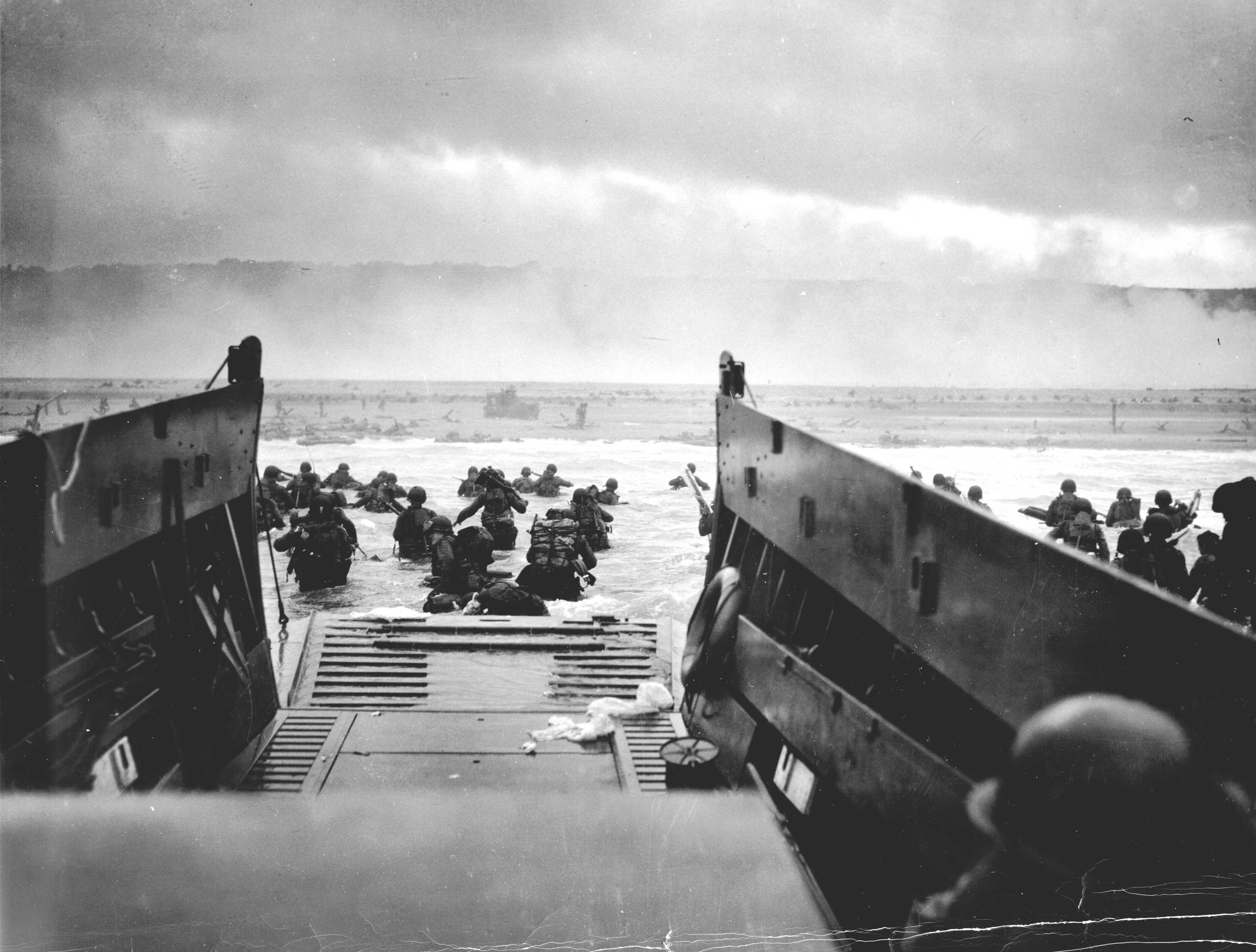
A LCVP (Landing Craft, Vehicle, Personnel) from the U.S. Coast Guard-manned USS Samuel Chase disembarks troops of Company E, 16th Infantry, 1st Infantry Division (the Big Red One) wading onto the Fox Green section of Omaha Beach (Calvados, Basse-Normandie, France) on the morning of June 6, 1944. American soldiers encountered the newly formed German 352nd Division when landing. During the initial landing two-thirds of Company E became casualties.

It is the anniversary of the D-Day landings on the beaches of Normandy.

The Coast Guard Compass has a story of one of the men rescued that day by the 83 foot cutters that provided rescue service.

We have remembered the day before.

To provide some measure of the part played by the Coast Guard, below are some of the citations accompanying awards for action in support of the operation. You will note it was a particularly rough day for Coast Guard manned Landing Craft, Infantry (LCI). We lost four.

FRITZCHE, Edward H. CAPT, USCG, WWII, Legion of Merit, For exceptionally meritorious conduct, both in the preparation and execution of the amphibious assault on the coast of France June 6, 1944. Captain Fritzche was in command of a main group of the Assault Force, composed of a mixed fleet of American and British transports and American landing craft. He brought these ships and craft to their predetermined stations in the transport area, successfully effected their prompt and efficient unloading and expedited the assault troops and equipment to the designated beaches.—Gold Star in lieu of a second Legion of Merit, For meritorious conduct as commanding officer of a Coast Guard transport prior to and during the amphibious invasion of Southern France August 15, 1944. He efficiently organized and trained his ship and boat group to execute the assigned mission of loading transporting to the assault area and landing the embarked Army assault units on the invasion beaches. His able conduct contributed materially to the effective establishment of the beachhead and to the over all success of the invasion.

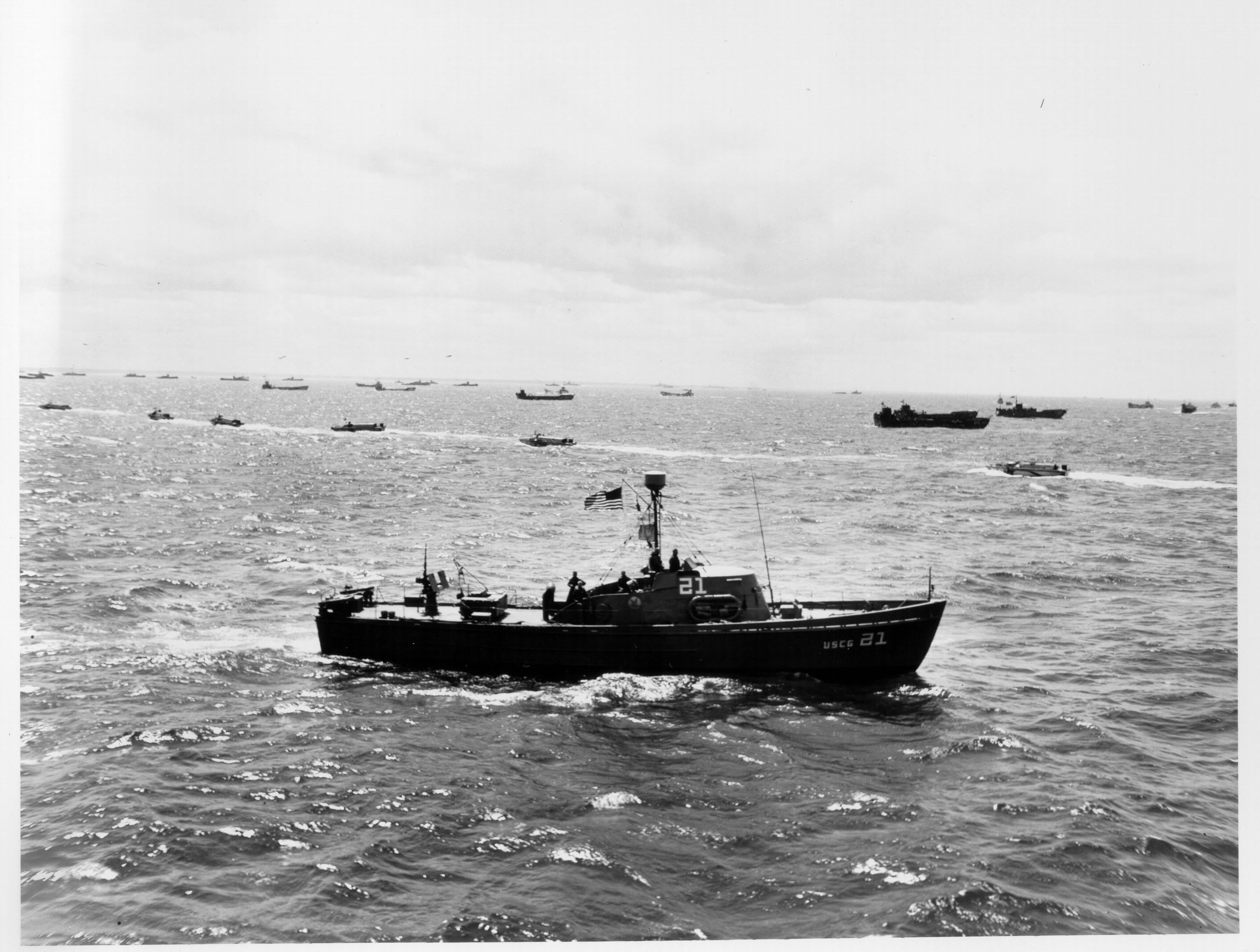
A convoy of Landing Craft Infantry (Large) sails across the English Channel toward the Normandy Invasion beaches on D-Day, 6 June 1944. Each of these landing craft is towing a barrage balloon for protection against low-flying German aircraft. Among the LCI(L)s present are: LCI(L)-56, at far left; LCI(L)-325; and LCI(L)-4. Photograph from the U.S. Coast Guard Collection in the U.S. National Archives. Photo #: 26-G-2333

GISLASON, Gene R., LT, USCGR, WWII, Silver Star, For outstanding heroism as Commanding Officer of the USS LCI (L) 94, while landing assault troops in Normandy June 6, 1944. He successfully directed his ship through numerous beach obstacles to the proper beach, discharged his troops and retracted while his ship was seriously damaged from heavy enemy fire. Ship’s communications, engine telegraph and electric steering were disabled by direct hits on the pilothouse which killed three crewman and one screw and shaft were rendered inoperative by beach obstacles. By his coolness under fire and excellent seamanship, Lt Gislason overcame these difficulties and brought his ship off the beach on hand steering and one screw. He later supervised repairs and in four hours enable the LCI (L) to remain operative in the assault area for three weeks.

HENLEY, Coit T., LTJG, USCGR, WWII, Normandy invasion, Silver Star, For heroism as Commanding Officer of the USS LCI(L) 85 while landing assault troops in Normandy, France, June 6, 1944. Lt Hendley successfully landed his troops despite the mining of his vessel, fire in three compartment and concentration of enemy fire while unloading. His courage and seamanship in directing repairs and retracting from the beach resulted in saving the lives many wounded aboard.

IMLAY, Miles Hopkins, CAPT, USCG, WWII, Invasion of Sicily and Normandy, Legion of Merit, For exceptionally meritorious conduct as Commander of the Reserve Attack Group during the Sicilian invasion campaign. With outstanding skill and expert seamanship, Captain Imlay brought the group under his command to the scene of action and with speed and precision dispatched them to the designated beaches, as they were required. Following the initial assault, he assisted in the support of the Army at Licata, and later was temporarily Commander of the Advance Base at Porto Empedocles, participating in the opening of that port while under enemy gunfire.—Gold Star in lieu of Second Legion of Merit, For exceptionally meritorious conduct as Commander of the LST convoy of a Major Task Force during the assault upon Italy in September 1943. Charged with the difficult assignment of brining the vessels under his command safely through the hazardous course between Bizerte, Tunisia , and the Gulf of Salerno, Italy, Captain Imlay (the Commander) performed his essential duties with outstanding skill, successfully reaching the designated assault beaches at the assigned time despite extremely adverse weather conditions and fierce enemy aerial opposition.—Silver Star, For conspicuous gallantry as Deputy Commander of an Assault Group participating in the initial invasion on the coast of France , June 6, 1944. Undaunted by heavy enemy fire, Captain Imlay courageously took station close to the shore on the early morning of D-Day and throughout the most bitter period of the fighting, coolly and promptly made spot decision on the reorganization, grouping and dispatching of craft to the beach, subsequently relieving the Task Group Commander of his duties when he withdrew his transport from the assault area, immediately thereafter, he was placed in charge of operations afloat as assistant to the naval Officer in Charge of one of the beaches and discharging the duties of this responsibility with distinctive professional ability, contributed essentially to the rapid clearing of the backlog of ships.

OXLEY, Gene E., Sea. 1c [ Seaman, First Class], WWII, USCGR, Silver Star, For gallantry while on the USS LCI(L) 85 during the assault on the coast of France June 6, 1944 and for extraordinary courage in volunteering and twice taking a line ashore, in the face of heavy machine gun and shell fire in order to assist troops unloading from the ship to the bench through chest deep water.

SALMON, Robert M., LT, USCGR, WWII, Normandy invasion, Silver Star, For gallantry as commanding officer of a U.S. LCI (L) while landing assault troops in Normandy, France June 6 1944. He pressed the landing of troops despite the mining of his vessel a serious fire forward and heavy enemy gunfire. He supervised the unloading of troops, directed the fire fighting despite the loss of proper equipment and exhibiting courage of high degree remained with the ship until it was impossible to control the progress of the fire and it was necessary to abandon ship over the stern. After abandoning he directed a party searching for fire fighting equipment and subsequently fought the fire on another LCI (L) and assisted her commanding officer until she was abandoned.

USCG 83 ft patrol boat, probably June 1944. Photographer unknown.

VERNON, Albert, LTJG, USCGR, Bronze Star, For meritorious service as Commanding Officer of a Coast Guard Cutter in rescuing survivors of the invasion off the coast of France June 6, 1944. During D-Day, his cutter rescued 97 men. Each rescue was effected in the face of constant enemy fire from the beach which was in no way allowed to deter the splendid rescue operations.

VYN, Arend, Jr., LTJG, USCGR, Silver Star, For gallantry in action as commanding officer of USS LCI 91 in the assault on the cost of France June 6, 1944. LTJG Vyn beached his ship and discharged the Army elements therein the face of murderous fire and a labyrinth of obstacles and mines. In spite of the fact that his ship was mined and repeatedly struck by artillery fire and small arm fire, he continued to land the army load in the face of certain loss of his ship. his determination to put the Army ashore was in keeping with the highest traditions of the offensive spirit of the U.S. Naval Service.

CLARK, George C., LTJG, USCGR, British Distinguished Service Cross, During the landing of Commandos at Quistreham by LCI (S) on 6 June 1944 Lt. Clark’s cutter was detailed to act as escort to LCI (S). HM LCI(S) 524 on clearing the beach after landing troops received a direct hit and blew up in a sheet of flames leaving a mass of blazing Octane petrol on the water. Although his cutter burned Octane petrol, he did not hesitate to steer his craft into the flames and rescue the commanding officer and some of his men.

The 83-foot Coast Guard cutter USCG 1 off Omaha Beach on the morning of D-Day, tied up to an LCT and the Samuel Chase

“Taiwan’s Coast Guard Launches and Christens its Largest Vessel to Date” —

Photo: CSBC Corporation

Like many Asian nations, Taiwan is rapidly expanding their Coast Guard Administration (CGA). Naval News reports that Taiwan has launched it’s largest Coast Guard vessel ever, “Chiayi” (CG-5001). This is only part of a general major expansion.

“CGA has a programme to build 141 coast guard ships from 2018 to 2027. The programme includes four 4000-ton class patrol vessels, six 1000-ton class patrol vessels, twelve 600-ton class patrol vessels, seventeen 100-ton class patrol boats, fifty-two 35-ton class patrol boats and fifty littoral utility boats. Taiwanese media also  reported that the CGA is considering to establish aviation units, and have sent a report on this issue to the parliament in April.”

Nominally these are 4,000 ton ships, but given the Asian tendency to use light displacement, its full load approach 5,000 tons. This may be reflected in the ship’s hull number, 5001, since, while most of their larger ships have three digit hull numbers, some of their smaller vessels have five digit hull numbers, where the first two or three digits that reflect their nominal displacement.

We talked briefly about these ships earlier. Interestingly the Taiwanese refer to these ships as frigates. The description says the “frigate is equipped with rockets and machine guns.”

After much searching, I finally found some more detailed information about these ships.

The Chiayi, which will be deployed at the CGA’s central base, is 125 meters (410 feet) long, 16.5 meters (54.1 feet) wide and can travel up to 10,000 nautical miles at a maximum speed of 24 knots, the CGA said.

In terms of its weapons system, it will be equipped with a 2.75-inch rocket launcher, two 20 millimeter cannons, and several water cannons with a range of 120 meters, the CGA said.

The Chiayi is one of four 4,000-ton CGA patrol ships commissioned to CSBC at a total cost of NT$ 11.74 billion (US$392 million), according to Hsieh Ching-chin (謝慶欽), head of the CGA Fleet Branch.

It appears they are at least as large as the Offshore Patrol Cutters and National Security Cutters, perhaps a little larger.

What is the 2.75 inch rocket launcher referred to above? I found reference to a “multi-barrel Zhenhai rocket system” in a post about their new 600 ton cutter with a wave piercing catamaran hull, that included the artist’s presentation, seen above, of the vessel with what appears to be multiple rocket launcher on the bow. These might be a Taiwanese equivalent of the APKWS guided rocket system. If the rockets were not guided, they would be relatively useless for Coast Guard applications.

There is a discussion of the history and missions of the Taiwan Coast Guard Authority from 2017 here..

The Taiwanese Coast Guard is about 1/3 the size of the US Coast Guard, even though its EEZ is only about 1/136th that of the US. It has at least 14 ships of over 1000 tons.

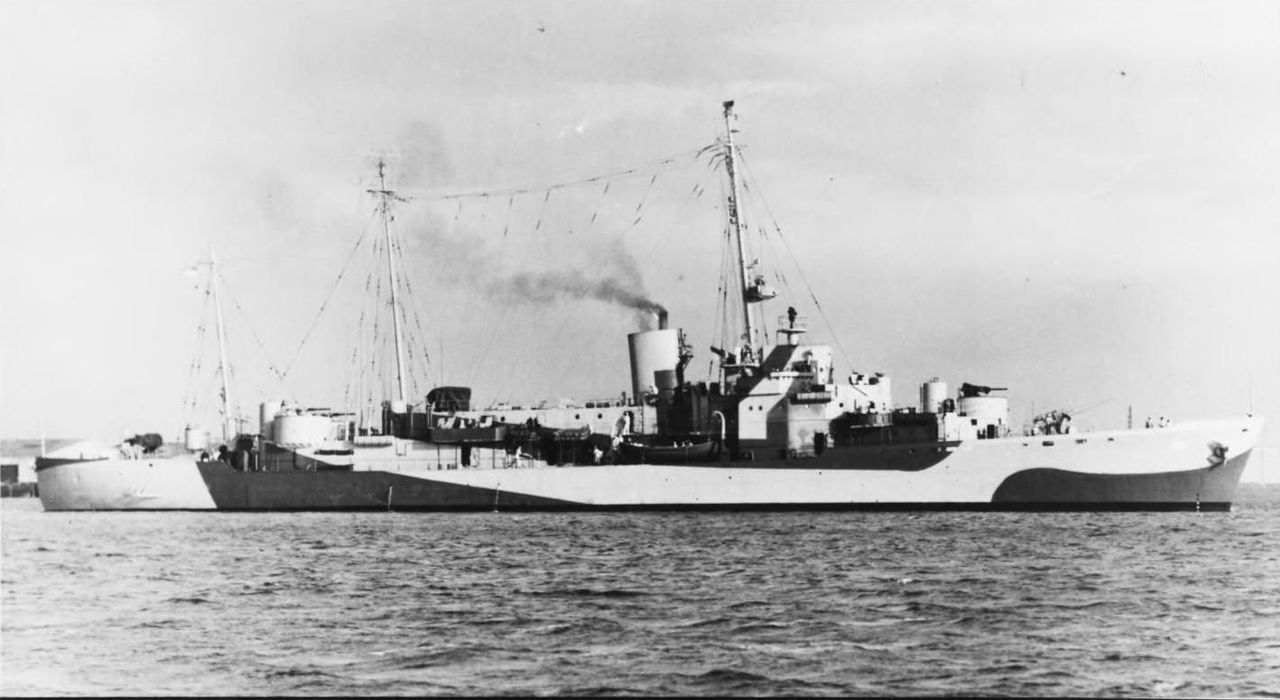
USCGC Ingham (WPG/WAGC/WHEC-35), Bit of Coast Guard History

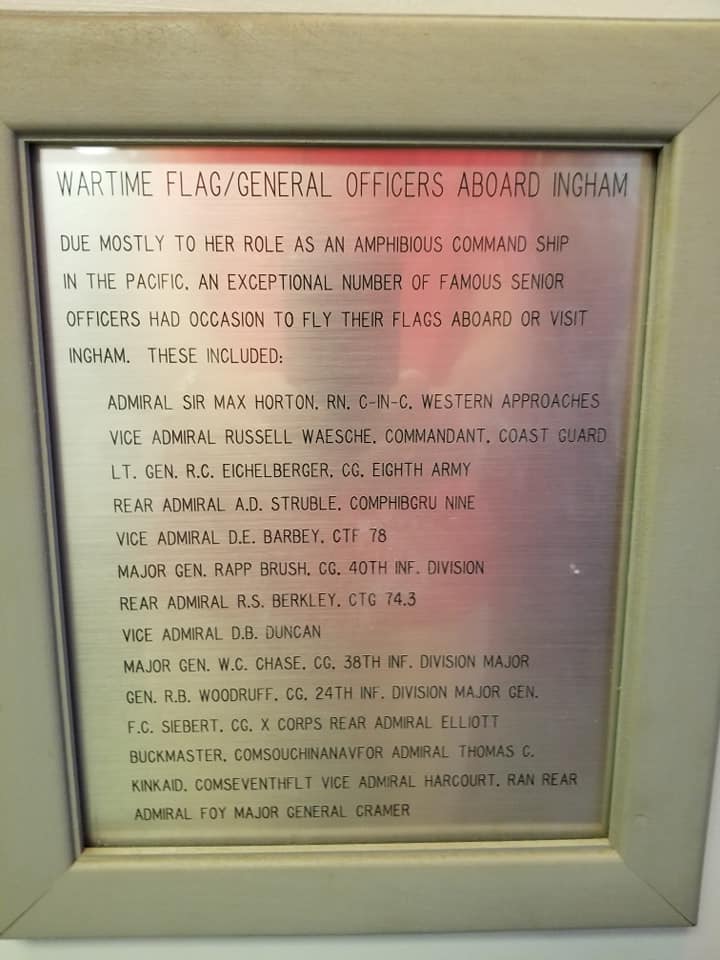
Ran across the photo above at the “327 Sailors” Facebook page, part of a 65 photo tour of museum ship the former USCGC Ingham now in Key West, posted by Douglas Meier.

Two “Fletcher” class destroyers (left) and a “Cleveland” class light cruiser (right) standing off Corregidor Island as it is bombarded by ships and aircraft, prior to landings there, 16 February 1945. Other ship present (2nd from right) is force flagship USCGC INGHAM (WAGC-35). National Archives #80-G-273318

USCGC INGHAM (WAGC-35)